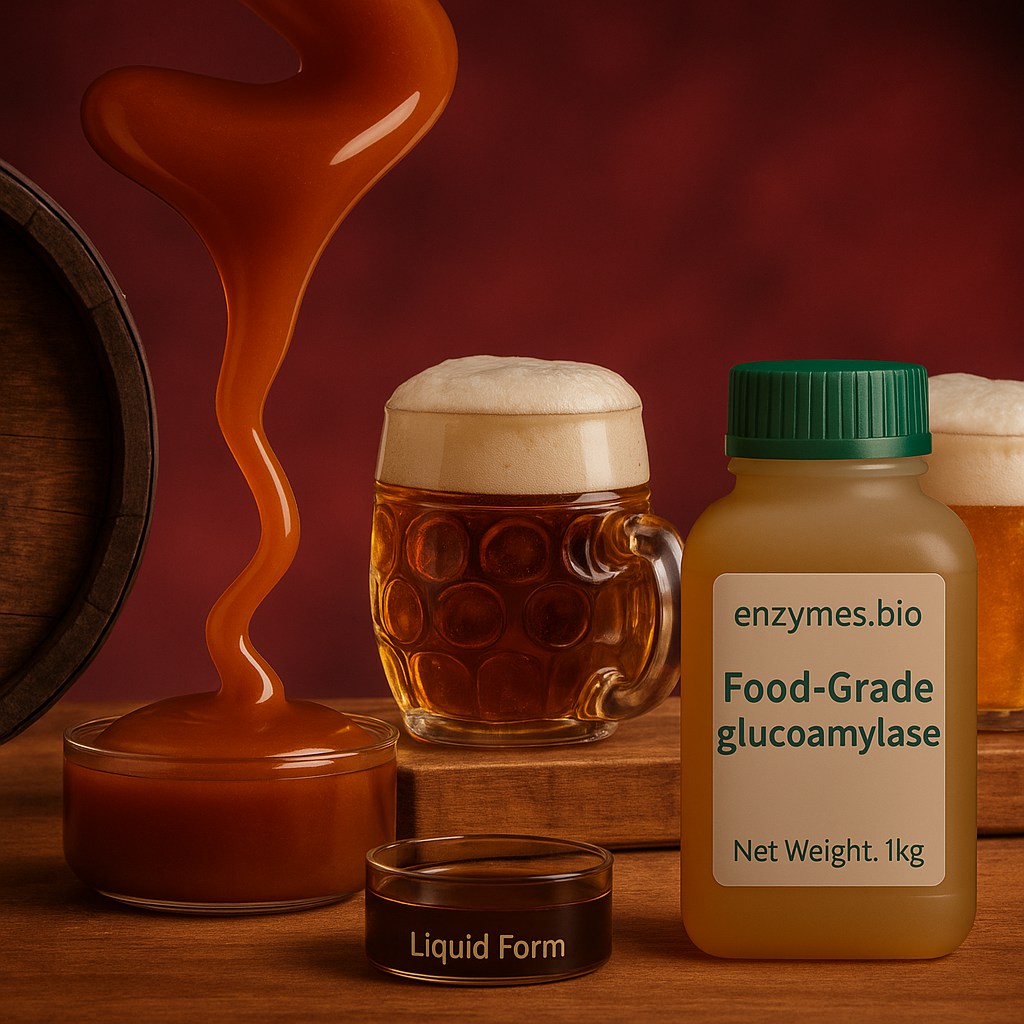
Food-Grade Glucoamylase | High-Activity Liquid Enzyme for Brewing & Food Processing
Gambaran Keseluruhan Produk
This food-grade Glucoamylase is a high-activity liquid enzyme designed for efficient hydrolysis of starch-based substrates.This food-grade glucoamylase is produced through submerged liquid fermentation and ultrafiltration using Aspergillus niger. It utilizes starch as its substrate and, under appropriate processing conditions, catalyzes the stepwise hydrolysis of both non-gelatinized and gelatinized starch. It breaks α-1,4 glycosidic bonds to produce glucose and gradually hydrolyzes α-1,6 glycosidic bonds to generate linear oligosaccharides.
The enzyme demonstrates excellent stability under a broad temperature and pH range, making it highly compatible with industrial-scale operations. Its liquid form allows for precise dosing,
rapid dispersion, and consistent performance in continuous and batch systems.
Key Features & Benefits
- High Starch Conversion Efficiency: Rapidly converts starch into glucose, improving substrate utilization and enhancing fermentation yield.
- Improved Fermentation Performance: In brewing and alcohol production, Glucoamylase increases fermentable sugar levels, enabling better attenuation and achieving
cleaner fermentation profiles. - Broad Compatibility: Effective between 30–65°C and pH 3.5–6.0, suitable for various food and beverage processing environments.
- Easy Liquid Application: Liquid format ensures uniform mixing, easy dosing, and reliable process control.
- Versatile Applications: Ideal for brewing, sweetener production, caramel and flavor syrups, fermented foods, and other starch-based food processes.
- Enzyme activity:260,000 U/mL
Recommended Applications
Industri Pembuatan Bir
Glucoamylase is widely used in beer production to increase fermentable sugar content, optimize wort composition, and improve overall fermentation efficiency. It supports brewing styles
requiring high attenuation or low residual sugar, and helps achieve stable, clean flavor profiles in finished beer.
Pemprosesan Makanan
In food manufacturing, the enzyme hydrolyzes starch-containing ingredients used in syrups, caramel preparations, confectionery bases, and liquid sweeteners. It enhances sweetness, improves texture, and supports consistency in formulated foods such as sauces, beverages, and fermented products.
Usage Guidelines
The recommended dosage is typically 0.4–1.0 kg per ton of raw material, depending on substrate properties and desired sugar conversion levels. Optimal operating conditions are:
- Julat suhu: 30–65°C
- julat pH: 3.5–6.0
- Enzyme deactivation: Heat to 95°C for 30 minutes or longer
Dosage should be fine-tuned through pilot trials, as raw material composition and processing objectives may vary across applications.
Product Specifications
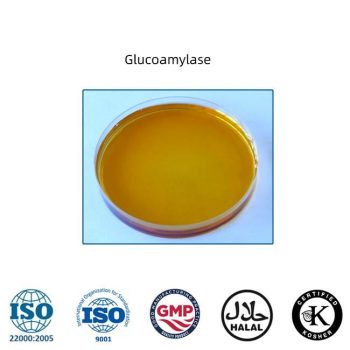
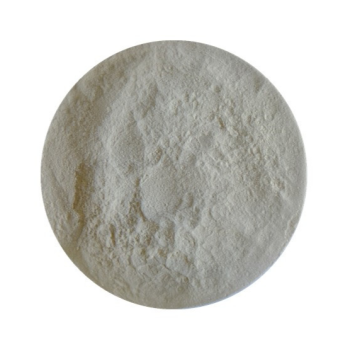
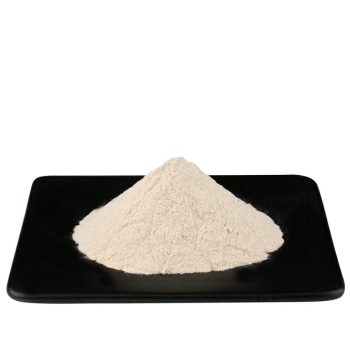
- Penampilan: Dark brown liquid
- Ketumpatan: 1.10–1.20 g/mL
- pH (25°C): 3.0–5.0
- Lead (Pb): ≤ 5.0 mg/kg
- Arsenic (As): ≤ 3.0 mg/kg
- Total Plate Count: ≤ 50,000 CFU/mL
- Coliforms: ≤ 30 CFU/mL
- Pathogenic microorganisms: Not detected
Packaging & Storage
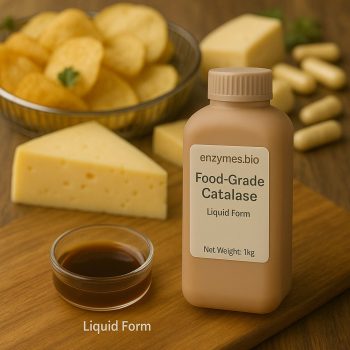
1 kg bottle (supplied in an industrial-grade plain bottle). Please note that the product image is for illustration purposes. Actual packaging may differ. suitable for global food industry use. Store in a cool, dry environment away from direct sunlight. Keep sealed when not in use to preserve enzyme activity. Under proper storage conditions, the enzyme maintains its activity for up to 12 months.