
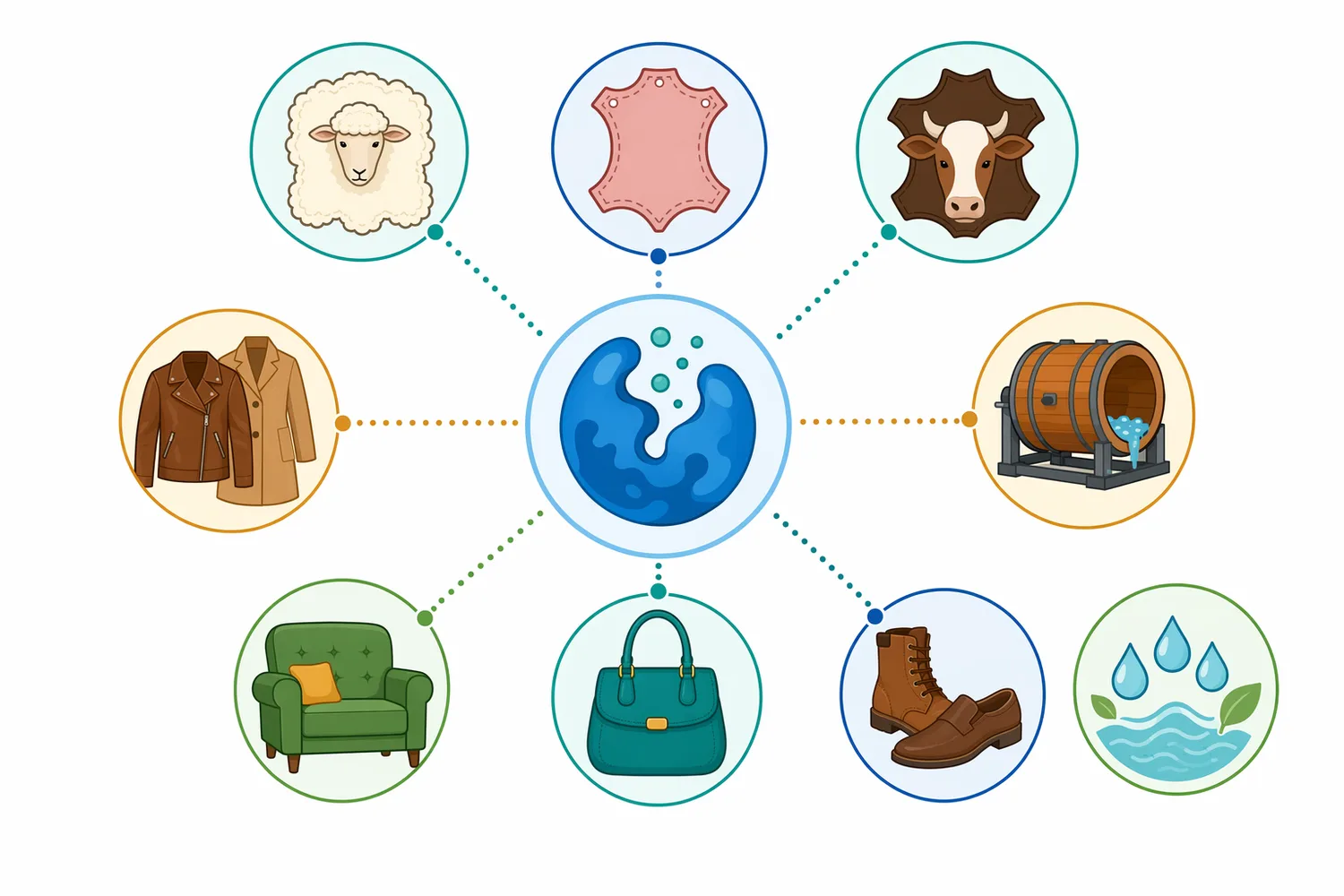
Acid Lipase for Leather Degreasing Process is used to hydrolyze natural fats in hides, skins, wet-blue leather, acid leather, and fur under acidic processing conditions. It works by cutting triglyceride fats into smaller, more dispersible lipid fragments, so grease trapped on the surface and within the fiber structure can be removed more effectively during washing and mechanical processing. Enzymes.bio supplies this product directly online by the 1 kg unit; buyers place and pay for the order online, and the order is processed and shipped with a Certificate of Analysis and Safety Data Sheet.
Natural fats are not just a cosmetic issue in leather production. In fatty hides and skins, lipids can sit on the grain surface, in the flesh-side tissue, and within the fiber network. If these fats remain in place, later wet-end operations can become less uniform because retanning agents, dyes, and finishing chemicals encounter patches of hydrophobic material rather than a consistently wetted collagen matrix. Reviews of enzyme use in leather processing identify degreasing as one of the established operations where enzymes can support cleaner and more controlled processing, alongside soaking, unhairing, bating, and waste treatment applications [1].
The practical problem is that fats behave differently from proteins, salts, and soluble dirt. Water alone cannot reliably remove hydrophobic triglycerides, and surfactants or solvents may remove accessible surface grease more easily than grease held deeper in the skin structure. Lipases address this by acting chemically on the lipid molecule itself: they hydrolyze ester bonds in triglycerides, producing smaller, more polar or more easily emulsified products that can be dispersed and washed out. A 2024 review of lipase-catalyzed hydrolysis of vegetable oils describes this core reaction as the enzymatic cleavage of oils into fatty-acid-rich products, with reaction efficiency influenced by mixing, mass transfer, and the oil–water interface [2].
Acid lipase is especially relevant where the leather material is already in an acidic state, such as acid leather, wet-blue leather, or certain fur-processing operations. In these cases, shifting the process into a strongly alkaline environment only to remove grease may add process complexity and can affect material behavior. Acid-lipase product literature for leather degreasing describes the enzyme for use in acidic leather-processing conditions, including acid leather, wet blue, and fur, where the objective is to break down fats and improve degreasing without relying only on conventional chemical removal.
The main substrate for lipase in degreasing is natural lipid, especially triglyceride. A triglyceride molecule has a glycerol backbone with three fatty-acid chains attached by ester bonds. These long fatty-acid chains make the molecule strongly hydrophobic, so it resists water-based removal. Lipase acts at the oil–water boundary and cuts ester bonds, gradually converting large triglycerides into partial glycerides, free fatty acids, and glycerol-type fragments that behave differently in the bath and are easier for surfactants, emulsifiers, washing, and drum action to remove [2].
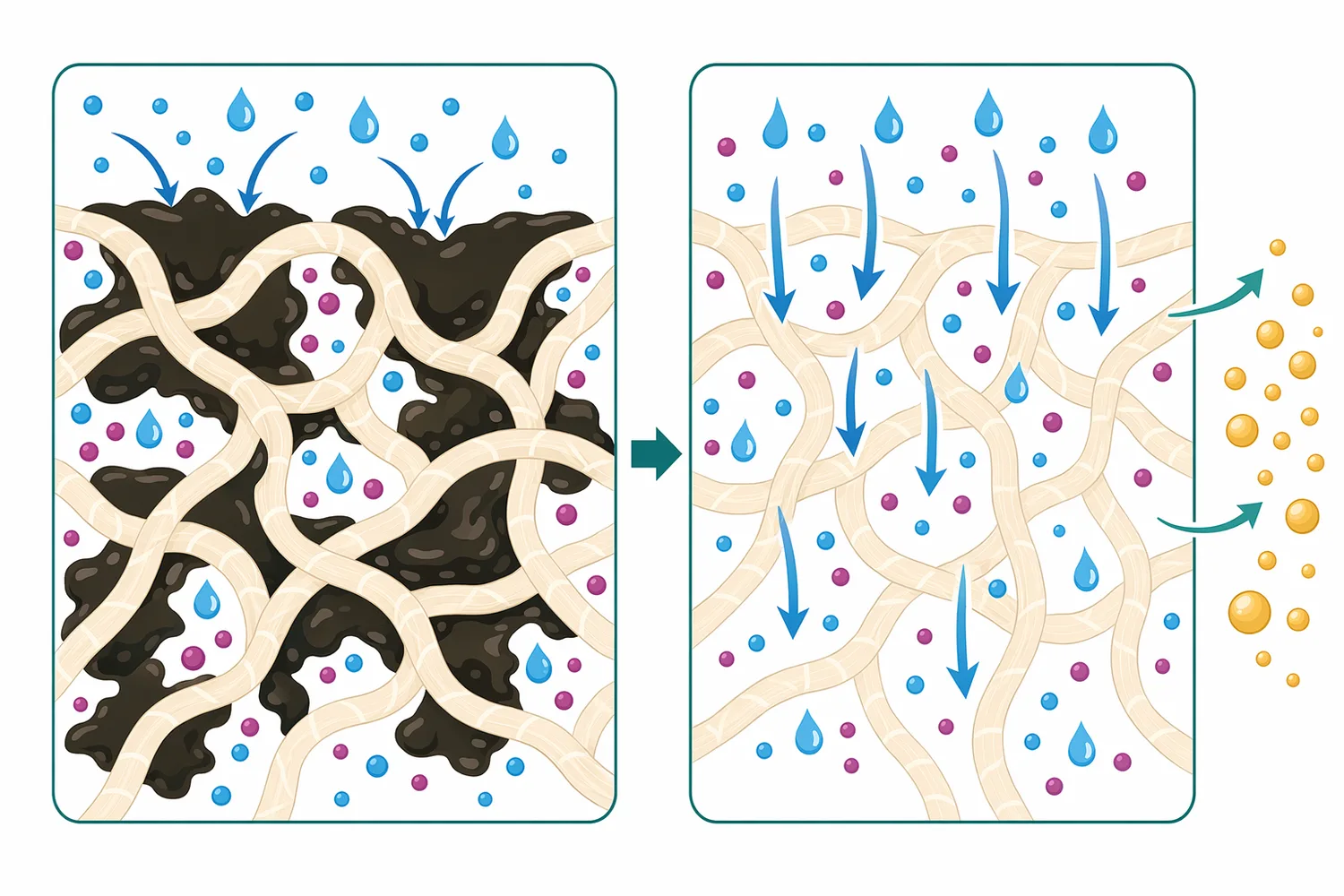
In leather, this biochemical change matters because fat is distributed in a fibrous, porous substrate rather than in a simple oil layer. Some fat is accessible at the surface, but some is held in interfibrillar spaces or associated with residual tissue. Once lipase begins hydrolyzing accessible triglycerides, the fat phase becomes less continuous and easier to break into smaller droplets or dispersed material. Studies on enzymatic hydrolysis of animal fats show that lipase treatment can intentionally change fats at the molecular level, altering the mixture of lipid species and the physical properties of the modified fat [3].
The enzyme does not “dissolve leather.” Its target is lipid, not the collagen framework that gives leather its structure. This distinction is the main reason lipases are used for degreasing rather than for bating or unhairing, where proteolytic enzymes are more relevant. Technical reviews of leather biotechnology describe different enzyme classes according to the material they act on: proteases act on proteins, while lipases act on fats and oils, making lipase the appropriate enzyme class when the processing goal is grease removal rather than fiber-opening through protein breakdown [1].
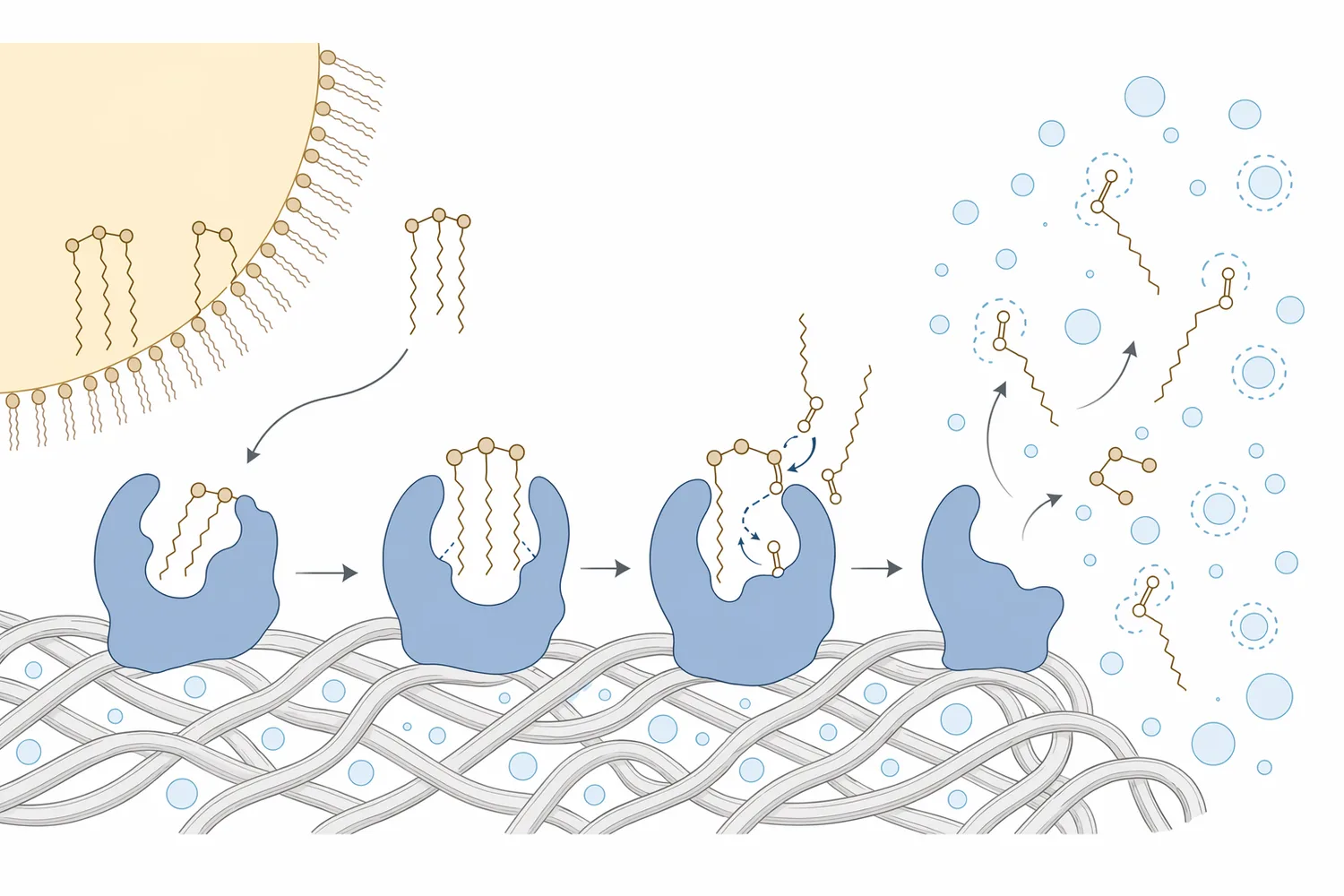
Acid lipase also fits the chemistry of wet-blue and acid-stage processing because collagen-based material can be sensitive to abrupt pH changes. In an acidic workflow, the enzyme can support fat hydrolysis while the bath remains aligned with the existing process condition. This does not mean acid lipase alone performs every part of degreasing; mechanical action, washing, and compatible auxiliaries still help remove the hydrolysis products. But the enzyme changes the fat chemically first, so the physical removal step is not relying only on detergency and agitation.
Leather degreasing can be approached in several ways. Conventional degreasing often depends on surfactants, emulsifiers, and sometimes solvents to lift and disperse grease. Enzymatic degreasing adds a catalytic step: instead of only trying to detach intact fat, it partially hydrolyzes the fat into materials that are easier to mobilize. Peer-reviewed work on sheepskin degreasing with Yarrowia lipolytica LIP2 lipase supports the leather-industry relevance of lipase as a cleaner degreasing tool, showing that lipase-based processing can be evaluated as an alternative to more chemical-intensive degreasing routes [4].
| Degreasing approach | Main action on natural fat | Where it can help | Practical limitation |
|---|---|---|---|
| Surfactant-only degreasing | Emulsifies and disperses accessible grease without necessarily breaking the triglyceride molecule | Surface and loosely held fats; general washing support | Less effective where intact grease is trapped deeper in the fiber structure |
| Solvent-assisted degreasing | Solubilizes or extracts hydrophobic lipids | Heavy grease loads and difficult fatty materials | Environmental, handling, odor, and wastewater considerations can be significant |
| Alkaline enzymatic degreasing | Uses lipase activity in alkaline conditions, often in earlier or specially adjusted operations | Processes already operating in alkaline ranges | May not match acid leather or wet-blue conditions without process adjustment |
| Acid lipase degreasing | Hydrolyzes triglycerides under acidic leather-processing conditions | Acid leather, wet-blue leather, fur, and acidic degreasing systems | Performance still depends on contact, time, bath movement, fat distribution, and overall washing design |
The comparison is conceptual rather than a claim that one method always replaces another. In practice, enzyme-assisted degreasing is often best understood as a targeted biochemical improvement inside a complete process. A broader review of mechanical intensification and additives in lipase-catalyzed oil hydrolysis emphasizes that lipase reactions depend heavily on interfacial contact between enzyme, oil, and water, which explains why mixing, dispersion, and contact time remain important even when the enzyme is well matched to the substrate [2].
The strongest direct application evidence comes from leather-focused lipase work. The 2021 study on cleaner degreasing of sheepskins using Yarrowia lipolytica LIP2 lipase is particularly relevant because it examines lipase as a degreasing agent for an actual fatty leather substrate, not only for model oils. The study frames lipase-based degreasing as a chemical-free alternative in the leather industry, supporting the practical principle that lipase can remove or reduce natural grease in skins through enzymatic hydrolysis [4].
That study is not the same as saying every acid lipase will behave identically in every acidic tannery process. Lipases differ by source, structure, and operating window, and sheepskin degreasing results cannot automatically be transferred to all hides, wet-blue processes, and fur systems. However, the study is important because it demonstrates the key application logic: lipase can be used directly on a leather substrate to improve degreasing outcomes, rather than being relevant only to food oil or biodiesel chemistry [4].
The broader leather-enzyme literature also supports the application. Reviews of enzymes as ecological alternatives in the leather industry describe enzymes as tools for reducing the severity of chemical treatments and improving selectivity in several wet-processing stages. Degreasing is one of those stages because the target material—fat—is chemically distinct from collagen, making it possible to use a fat-specific biocatalyst rather than a broad chemical attack on the entire substrate [1].
Additional support comes from industrial enzyme literature outside leather, where lipases are repeatedly shown to hydrolyze oils, fats, and ester-containing hydrophobic materials. For example, microbial lipase studies in detergent-related applications report lipase relevance for fat removal and biodegradation of ester compounds, which is consistent with the same ester-bond hydrolysis mechanism used in leather degreasing [5]. While detergent and leather processes differ, the underlying reaction—enzymatic cleavage of lipid ester bonds—is the same.
Acid lipase is positioned for leather materials that are already acidic or are handled in an acid degreasing step. Wet-blue leather is a common example: chrome-tanned material normally remains in an acidic condition, and processors may want to remove residual natural grease before retanning, dyeing, fatliquoring, or finishing. Acid-lipase documentation specifically identifies acid leather, wet blue, and fur as application areas for leather degreasing in acid conditions.
This is commercially meaningful because the pH history of leather affects swelling, fixation, shade development, handle, and compatibility with auxiliaries. A degreasing step that works in an acidic bath can reduce the need for large pH excursions when the material is already in an acid state. The enzyme’s role is not to replace all process control, but to provide lipid hydrolysis in a part of the workflow where acid conditions are already expected.
Fur and wool-on skins add another layer of sensitivity because the processor is not only protecting the leather fiber network but also maintaining the appearance and handle of hair or wool. In these applications, overly harsh degreasing can affect fiber feel or appearance, while insufficient degreasing can leave odor, greasiness, or uneven wetting. Enzymatic fat hydrolysis provides a targeted way to weaken and mobilize grease without treating the entire substrate as if it were a simple oil-contaminated surface [1].
Fatty skins such as sheepskin are particularly relevant because their natural lipid content can be high and unevenly distributed. The sheepskin lipase-degreasing study is therefore a useful practical reference: it addresses a substrate where ordinary washing can struggle and where internal or persistent grease affects the quality of later processing [4]. Acid lipase is applied with the same overall objective—make natural fat easier to remove—while matching acid-stage processing needs.
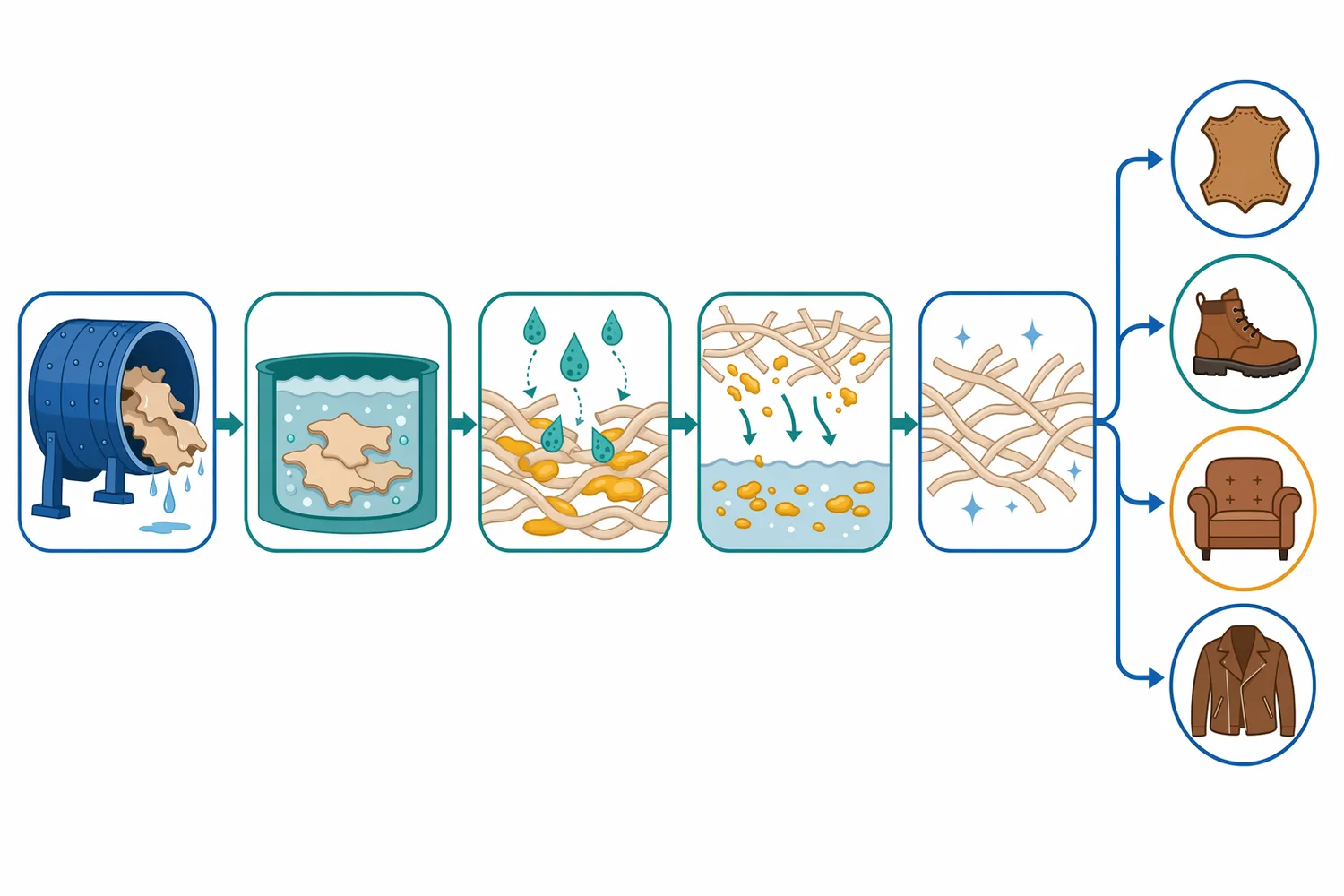
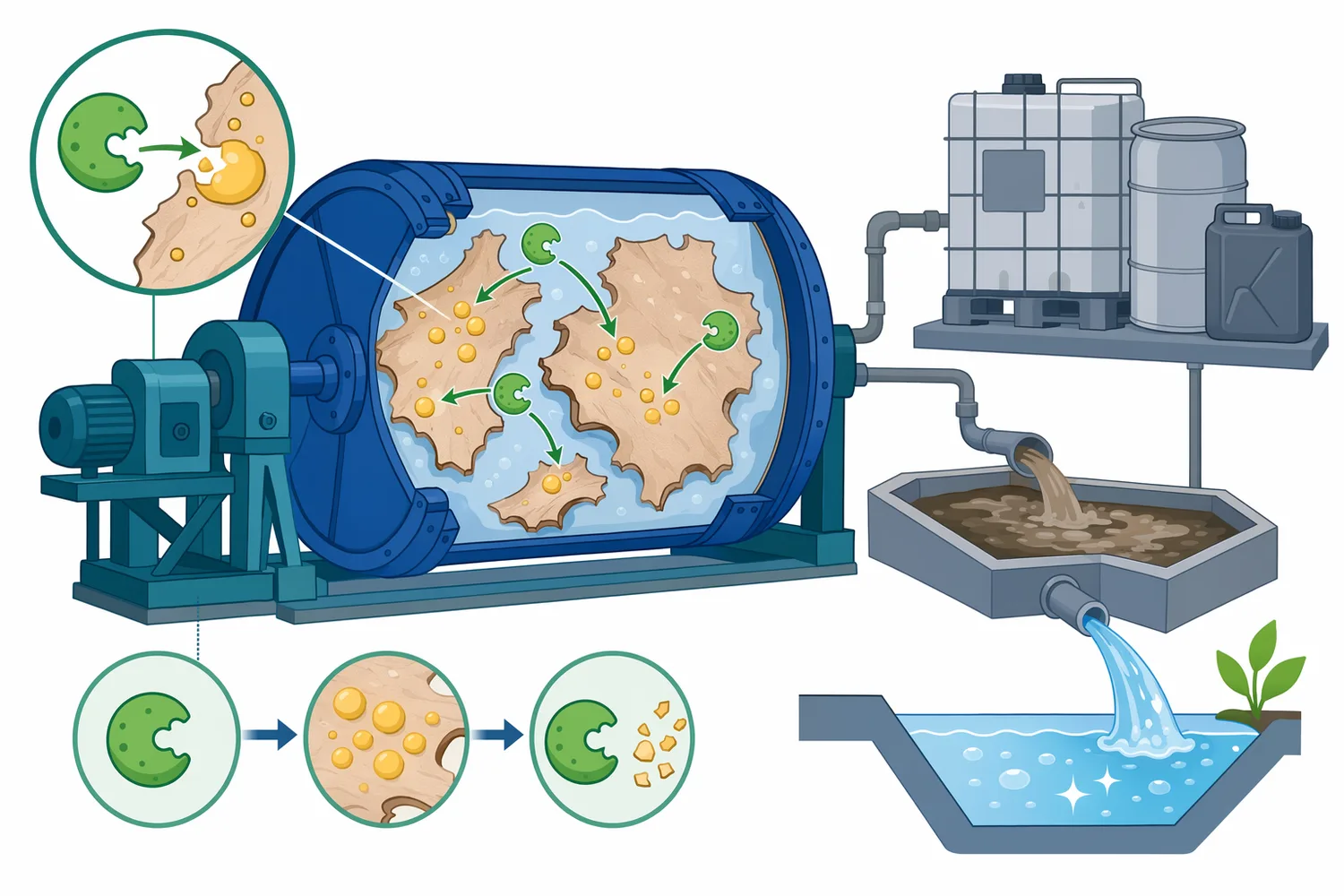
Lipase is a catalyst, but it still needs access to the lipid. In a leather drum, fat hydrolysis occurs at interfaces: the enzyme is in the aqueous phase, while much of the substrate is hydrophobic lipid held within the skin. Mechanical action helps expose fresh surfaces, move bath liquor through the structure, and disperse hydrolysis products once they form. Reviews of lipase oil hydrolysis emphasize that interfacial area and process intensification strongly influence reaction performance because lipase must reach the oil–water boundary to act efficiently [2].
This explains why acid lipase is not simply a “drop-in detergent.” The enzyme changes the chemistry of the grease, but drum movement, float circulation, temperature control, and washing steps determine how well the changed material leaves the leather. If hydrolyzed fatty products remain in the bath or redeposit onto the substrate, the final degreasing effect can be limited. Good removal therefore comes from combining enzymatic cleavage with physical transport out of the fiber network [2].
Research on lipase hydrolysis of goat cream under ultrasound-assisted conditions illustrates the same principle from another substrate: when physical energy changes dispersion and contact between enzyme and lipid, the hydrolysis reaction can change because the enzyme, substrate, and interface are all affected. Although cream is not leather, the study is mechanistically useful because leather degreasing also depends on the relationship between enzyme accessibility and the lipid phase [6].
In leather terms, the practical takeaway is straightforward: acid lipase helps break fat molecules, while the process bath must carry the resulting materials away. The enzyme acts on the substrate; washing removes the products. That two-part logic is why enzyme-assisted degreasing is often used with wet-processing auxiliaries rather than treated as an isolated reaction in water alone.
Residual natural fat can interfere with downstream uniformity. Hydrophobic patches can restrict wetting, reduce penetration of retanning agents, and cause uneven dye uptake. After degreasing, the leather surface and internal fiber structure are more consistently accessible to water-based chemistry. Reviews of leather enzyme applications connect enzymatic processing with improvements in process selectivity and product quality because enzymes remove specific unwanted components rather than broadly attacking the hide or skin [1].
The mechanism is not mysterious: dyes and retanning agents are transported through water, and water does not penetrate greasy regions evenly. When lipase hydrolyzes triglycerides, the grease phase becomes less intact and easier to emulsify. As fat is removed, more fiber surface becomes available to interact with subsequent chemicals. The result can be better leveling, fewer greasy defects, and more predictable finishing behavior, depending on the material and the complete process design [1].
This is also why degreasing is often evaluated by its effect on later stages, not only by whether the bath looks oily. A hide can appear cleaner at the surface while still containing internal fat that later causes shade variation or finishing defects. Lipase is valuable because it can act on lipid in locations that are reached by the processing liquor, including grease held within the structure rather than only loose surface oil [4].
The outcome remains material-dependent. High-fat sheepskins, pigskins, wet-blue splits, fur skins, and other substrates differ in fat content, fiber structure, prior liming or tanning history, and accessibility. Acid lipase provides a specific catalytic function—fat hydrolysis under acidic conditions—but the visible leather result depends on how much fat is present, where it is located, and how effectively the process removes the hydrolysis products.
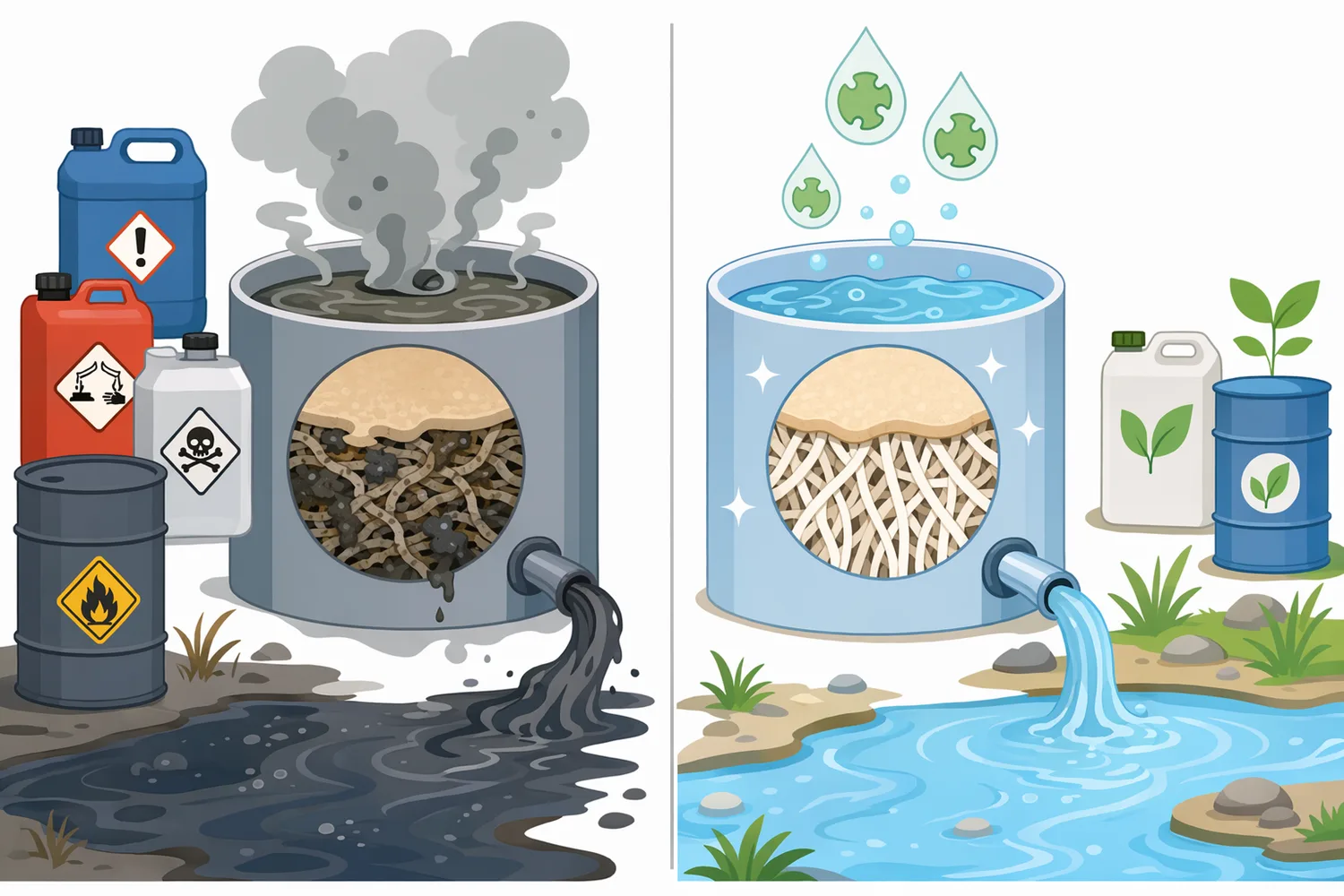
Leather processing is associated with wastewater and solid-waste challenges because multiple wet operations use salts, surfactants, tanning agents, dyes, fatliquors, and other auxiliaries. A review of photocatalytic processes for leather wastewater describes the sector’s wastewater as complex and highlights the need for treatment approaches that address organic load and persistent contaminants [7]. Enzyme-assisted degreasing does not eliminate wastewater treatment requirements, but it can support cleaner processing by making one operation more selective.
The environmental value of lipase is its specificity. Instead of using only broad chemical extraction to remove grease, the enzyme catalyzes a defined reaction on fats. This can reduce the severity of degreasing chemistry in some processes, although the total environmental outcome depends on the full formulation, washing sequence, and waste stream. Reviews of enzyme use in leather processing frame enzymes as ecological alternatives because they can lower chemical intensity and improve selectivity in targeted operations [1].
Leather solid waste is another part of the same sustainability picture. Research on discarded leather-industry solid wastes highlights the scale and diversity of leather waste streams and the importance of finding better management and reuse routes [8]. While acid lipase for degreasing is not a solid-waste treatment product, it belongs to the broader shift toward more controlled biochemical processing in the leather sector.
Enzymatic hydrolysis is also studied for chrome-tanned leather waste processing, where the objective is different—protein hydrolysis rather than fat removal—but the broader point is that enzyme-based routes are being investigated for process efficiency and waste valorization. A technological-economic optimization study of enzymatic hydrolysis for chrome-tanned leather waste shows that enzyme-assisted processing is part of current research into more resource-efficient leather-sector operations [9].
Acid lipase is best understood as a degreasing aid for acidic leather-processing stages. It is relevant when the target problem is natural grease in acid leather, wet-blue leather, skins, or fur. Its value is highest where fat is difficult to remove uniformly, where moving to a different pH regime is undesirable, or where a more selective fat-hydrolysis mechanism is wanted inside a broader wet-processing system.
The enzyme can support degreasing before later wet-end operations such as retanning, dyeing, fatliquoring, and finishing. By reducing intact natural lipid, it can help create a cleaner substrate for those later steps. The mechanism is direct: hydrolyzed fat is less persistent than intact triglyceride, and once the grease phase is disrupted, washing and emulsification can remove more of it from the fiber matrix [2].
Acid lipase should not be described as a universal replacement for all surfactants, solvents, or degreasing auxiliaries. The evidence supports lipase as a powerful and selective tool, but leather is variable, and degreasing is a combined chemical, enzymatic, and mechanical operation. Even in lipase-focused studies, the reaction depends on access to the lipid and on conditions that allow the enzyme and substrate to interact effectively [4].
The most responsible expectation is therefore process support rather than a guaranteed one-step cure. Acid lipase can improve fat breakdown in acidic conditions, help make residual grease easier to remove, and support more uniform downstream processing. It should be used as part of a controlled wet-processing sequence where washing, bath movement, and auxiliary chemistry are aligned with the degreasing objective.
The evidence base has different levels. At the broadest level, enzyme use in leather processing is well established in the literature, and lipases are recognized as the enzyme class for fats and oils. At the application level, peer-reviewed work on sheepskin degreasing with Yarrowia lipolytica LIP2 provides direct support that lipases can be used for cleaner leather degreasing [4].
At the acid-condition level, the most specific support comes from acid-lipase leather-degreasing product documentation that identifies acid leather, wet blue, and fur as intended application areas. That information is useful for understanding commercial positioning and application fit, but it should be read together with the broader peer-reviewed evidence for lipase hydrolysis and leather enzyme processing.
There is also strong mechanistic support outside leather. Lipase hydrolysis of oils and animal fats is widely studied, and the reaction pathway—cleavage of triglyceride ester bonds—does not change simply because the fat is inside a hide rather than in a separate oil phase. What changes is accessibility: leather introduces diffusion limits, fiber structure, and the need to wash products out of a porous substrate [3].
This distinction is important for buyers because it prevents overclaiming. Acid lipase is not a finishing agent, tanning agent, or general leather-quality improver by itself. Its job is narrower and clearer: catalyze fat hydrolysis in acidic degreasing conditions so natural grease can be removed more effectively as part of the process.
Enzymes.bio supplies Acid Lipase for Leather Degreasing Process directly online by the 1 kg unit. The product is ordered and paid for through the website, after which the order is processed and shipped. A Certificate of Analysis and Safety Data Sheet are included with the order for documentation and safe handling support.
Enzymes.bio is a supplier, not a manufacturer or testing laboratory. This article is intended to explain the application logic, mechanism, and evidence base for acid lipase in leather degreasing so buyers can understand what the enzyme is designed to do before purchasing online.
Acid lipase helps leather processors address one of the most persistent wet-processing problems: natural grease that is difficult to remove uniformly from hides, skins, wet-blue leather, acid leather, and fur. It works by hydrolyzing triglyceride fats into smaller lipid products that are easier to disperse and wash away, especially when combined with drum action, washing, and appropriate degreasing auxiliaries [2].
The strongest application evidence supports lipases as effective leather-degreasing enzymes, including peer-reviewed work on sheepskin degreasing with Yarrowia lipolytica LIP2 lipase [4]. Acid lipase adds the important application fit of working in acidic leather-processing contexts such as wet blue, acid leather, and fur, where maintaining an acid workflow can be valuable.
Used responsibly, Acid Lipase for Leather Degreasing Process should be viewed as a targeted biochemical degreasing aid. It does not replace the need for sound wet-processing practice, but it can make natural fats easier to remove, support cleaner and more uniform substrates, and reduce reliance on purely chemical fat-removal mechanisms in suitable acidic leather processes.
Sold by the 1 kg unit, in stock and ready to ship. Order directly on our store — pay online and we process your order. A Certificate of Analysis and Safety Data Sheet are included with every order.
Buy Acid Lipase For Leather Degreasing Process →Numbered in order of first citation. Open-access sources, each verified reachable at publication; citation numbers in the text link here.