
Alkaline cellulase for laundry detergents is a fabric-care enzyme used to act on exposed cellulose microfibers on cotton and cotton-rich fabrics during alkaline washing. Its main contribution is not broad stain digestion; it helps smooth roughened cotton surfaces, release soil trapped in raised fibrils, reduce fuzz-related dullness, and support a cleaner, brighter fabric appearance over repeated laundering. Research on detergent-compatible cellulases, including alkaline cellulase systems from Bacillus strains, supports their role in laundry and textile applications where enzyme activity must remain useful in alkaline, surfactant-containing wash environments [1].
Enzymes.bio supplies Alkaline Cellulase For Laundry Detergents as a direct online product sold by the 1 kg unit. Buyers can place the order and pay online; the order is then processed and shipped, with a Certificate of Analysis and Safety Data Sheet included with the order.
Cellulase is the general name for enzymes that hydrolyze cellulose, the glucose-based structural polysaccharide that makes up cotton, linen, viscose-derived fibers, and many plant-based textile materials. In a laundry detergent, cellulase is not used to dissolve the garment. It is used in a controlled fabric-care role: the enzyme acts preferentially on accessible, damaged, or protruding cellulose at the fabric surface, where washing, wearing, abrasion, and drying have loosened tiny fibrils from yarns [2].
The word alkaline is important because many detergent systems operate above neutral pH. Alkaline wash conditions help detergents remove fatty soil, particulate soil, and many everyday residues, but they can also deactivate enzymes that are not adapted to high-pH environments. Alkaline cellulase is relevant because it is intended for cellulase activity under those detergent-like alkaline conditions rather than under acidic textile-finishing conditions or near-neutral laboratory conditions [3].
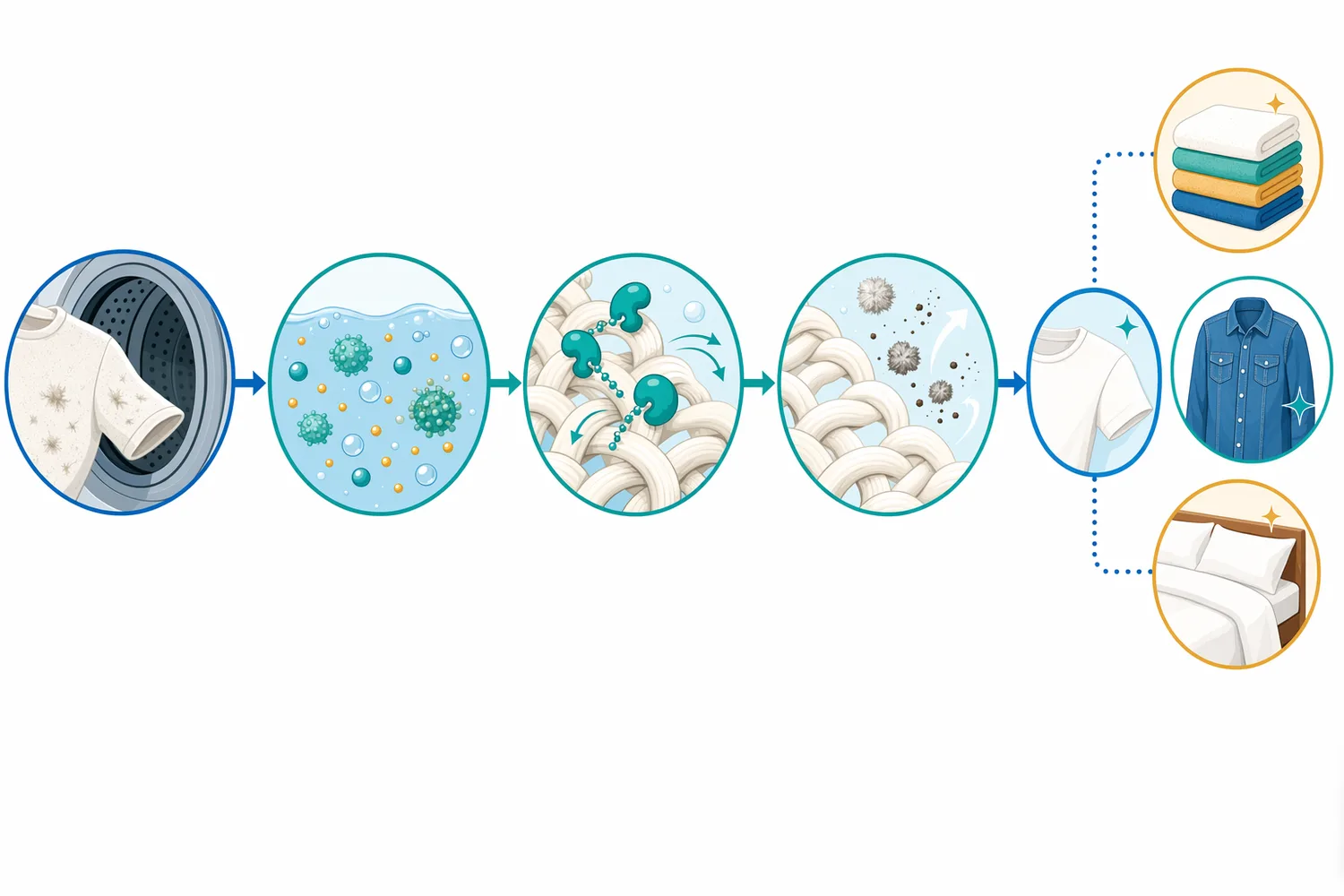
For cotton laundry, the useful substrate is the fabric surface. Cotton yarns contain bundles of cellulose-rich fibers; as the fabric ages, the surface becomes rougher and more fibrillated. These microfibrils scatter light, make colors appear less vivid, hold onto clay and particulate soil, and contribute to a harsh or worn hand feel. A detergent cellulase helps by cutting accessible β-1,4-glycosidic bonds in exposed cellulose chains, weakening or shortening the raised fibrils so they can be removed by the combined action of water, surfactants, builders, and mechanical agitation [1].
This mechanism explains why alkaline cellulase is typically described as a fabric-care enzyme rather than a single-stain enzyme. Protease is aimed at protein soils, amylase at starch residues, and lipase at fats and oils; cellulase targets the textile surface itself where cellulose is exposed. The practical result is a cleaner-looking cotton surface, improved release of soil held in roughened fibers, and reduced fuzz-related dullness over repeated wash cycles [4].
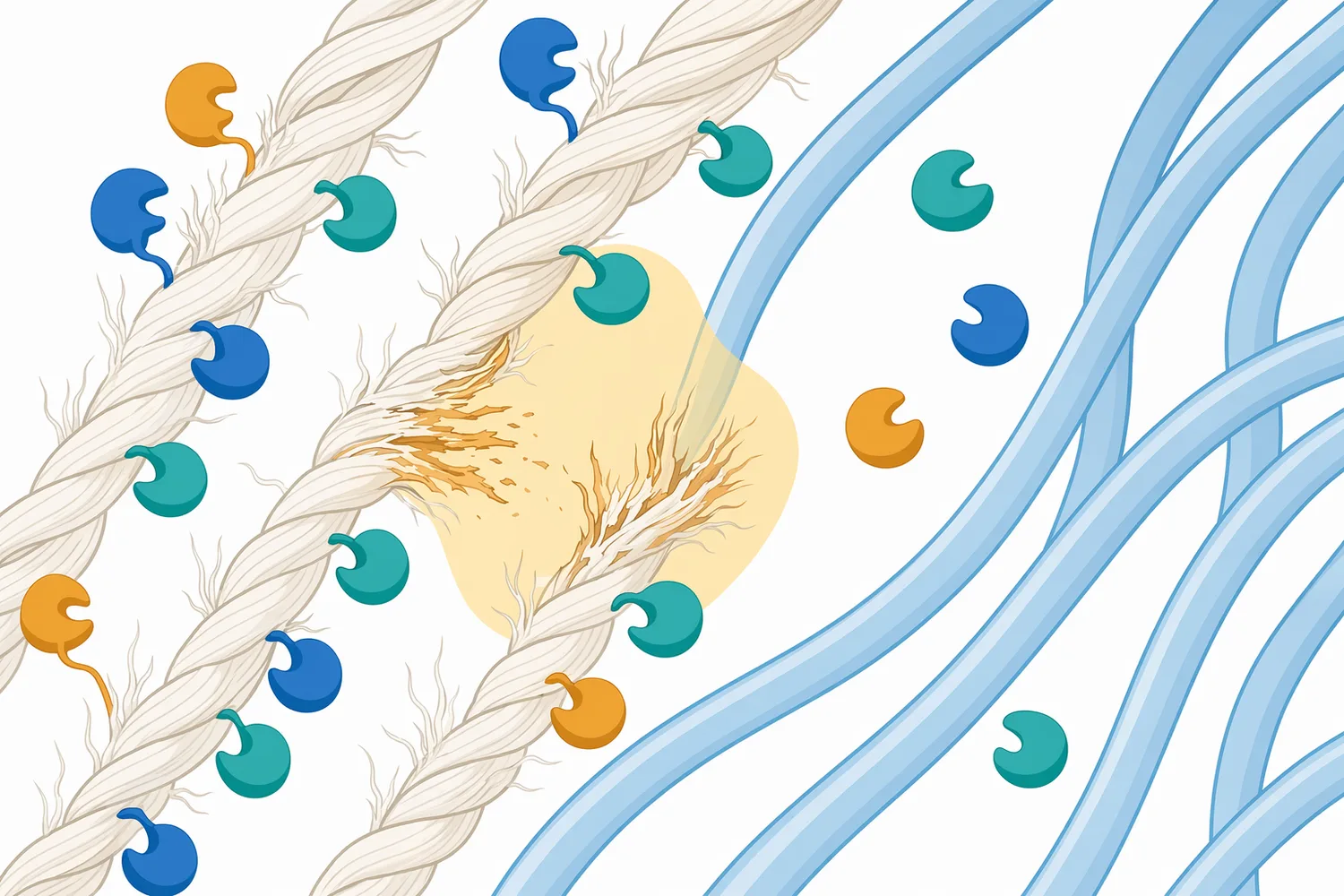
Cellulose is a long-chain polymer made from glucose units connected mainly through β-1,4 linkages. In cotton, these cellulose chains are packed into microfibrils with both ordered and less ordered regions. Highly crystalline cellulose is relatively resistant, while damaged, amorphous, swollen, or mechanically abraded surface regions are more accessible to enzyme attack [2].
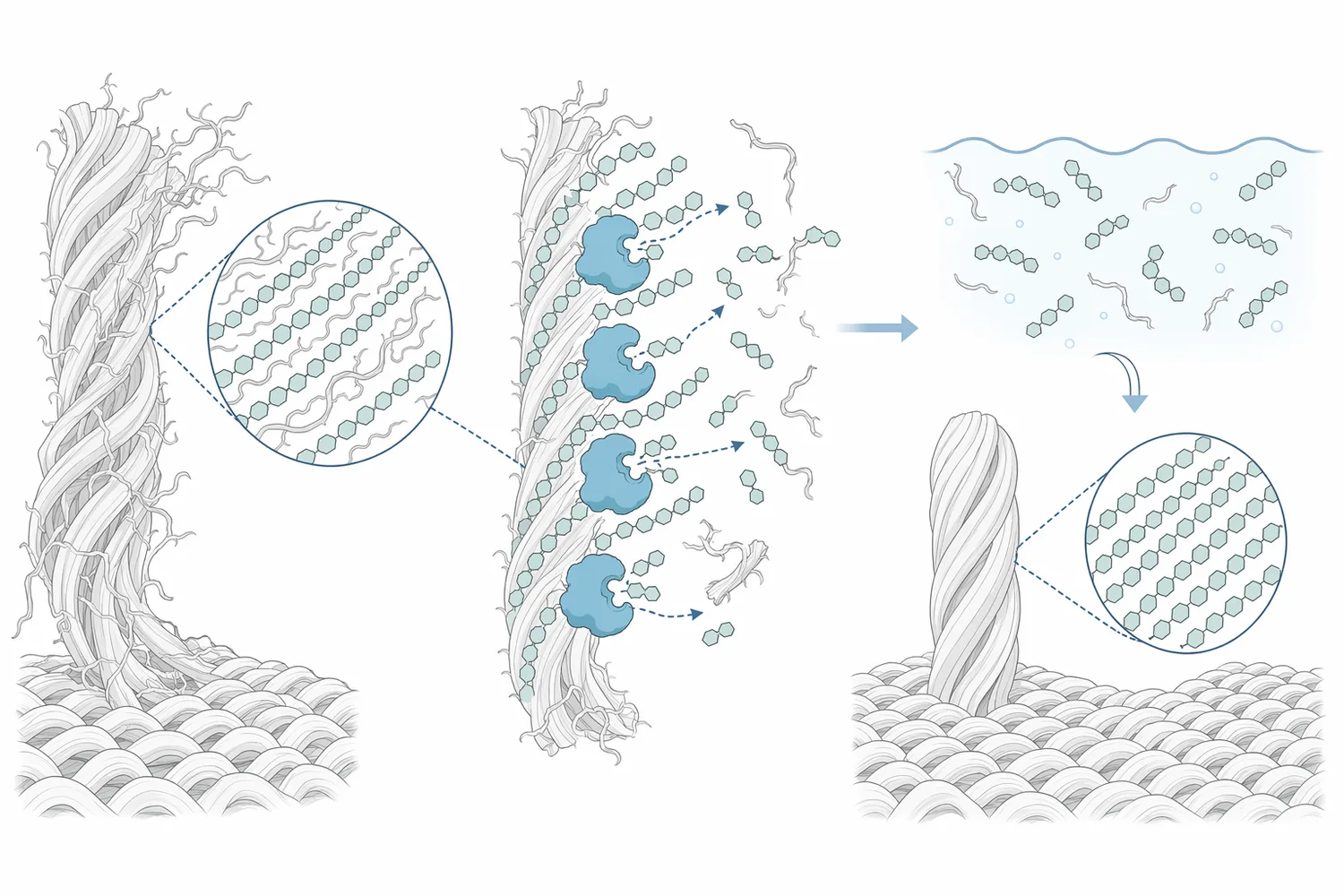
In laundry use, that accessibility difference is valuable. A detergent cellulase does not need to penetrate and hydrolyze the bulk fiber to provide benefit; it only needs to act at the outer surface where fibrils are exposed. When the enzyme cleaves accessible cellulose chains on raised fuzz, those fibrils lose strength and detach more easily during agitation and rinsing. This makes the surface optically smoother because fewer loose fibers remain to scatter light and hold grey particulate material [1].
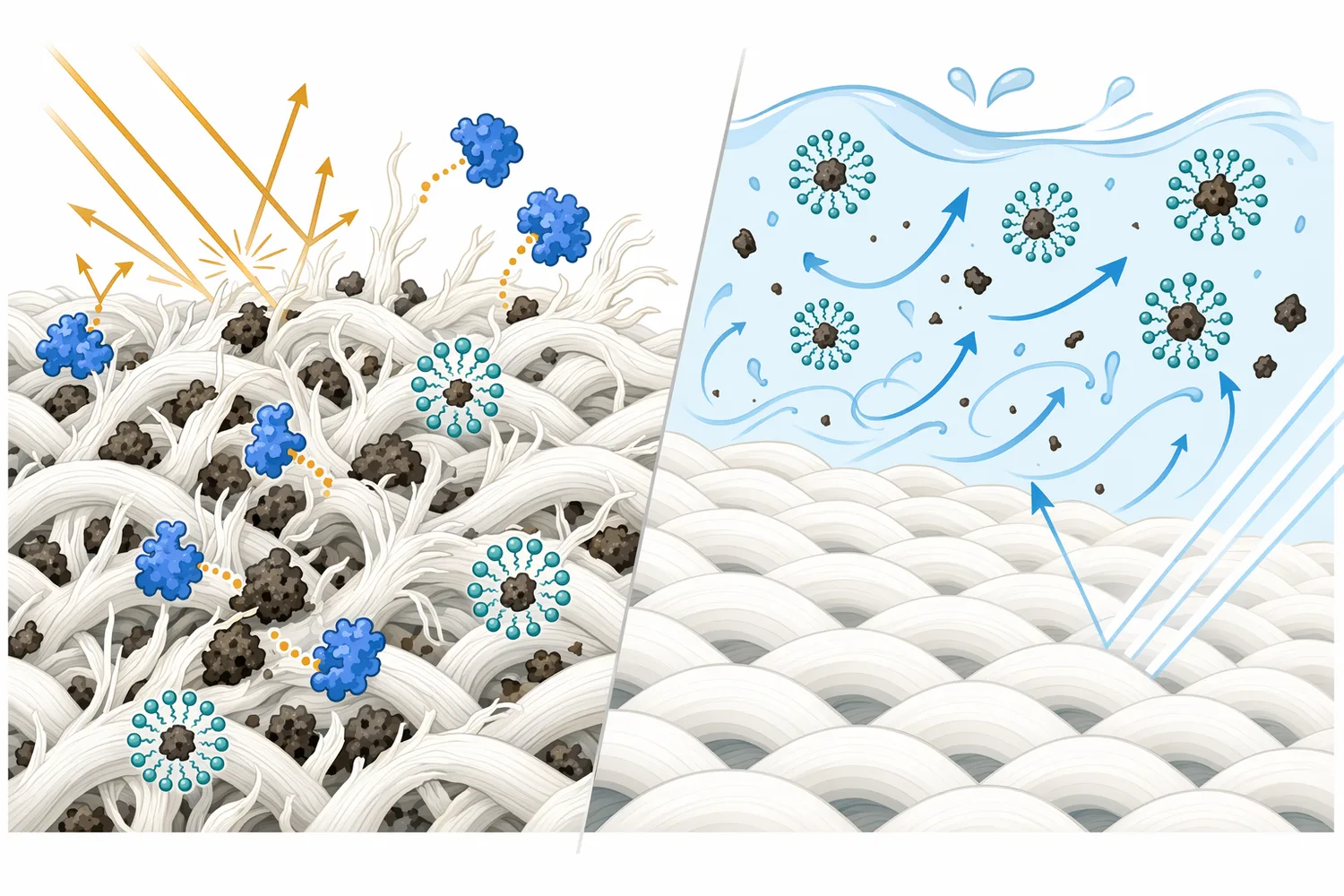
The same surface action can improve soil release. Clay, soot, dust, and other fine particles can become lodged among cotton fibrils and damaged fiber ends. Surfactants can wet and disperse soils, but if particles are physically trapped inside a rough cellulose network, removal is harder. By trimming that network, alkaline cellulase can make the fabric surface less retentive, helping the detergent system remove soils that are mechanically shielded within the cotton surface [1].
This is why cellulase can improve apparent detergency even though cellulose is not the stain. The enzyme modifies the fabric architecture around the soil, while the rest of the detergent system removes the loosened residues. The effect is especially relevant for cotton and cotton-rich fabrics, where repeated laundering can create microscopic surface damage that gradually leads to greying, pilling, and loss of brightness [5].
Laundry detergent is a chemically demanding environment. A detergent enzyme must operate in water containing surfactants, builders, chelating agents, salts, fragrances, soil residues, and often other enzymes. Alkaline cellulase is designed for the part of this environment that ordinary cellulases may find most difficult: useful activity and stability above neutral pH [4].
Alkaline adaptation is not only a formulation label; it reflects enzyme structure and behavior. Alkaline cellulases from alkaliphilic or alkali-tolerant microorganisms are studied because their catalytic proteins can maintain function under conditions that would reduce the activity of many neutral enzymes. Research on alkaline cellulase from extremophilic Bacillus pumilus VLC7, isolated from Lake Van, describes biotechnological relevance linked to alkaline cellulase properties in demanding industrial settings [3].
The detergent relevance of alkaline cellulase is also supported by research specifically focused on cotton cleaning. Hoshino and co-workers reported improvement of cotton cloth soil removal when alkaline cellulase from Bacillus sp. KSM-635 was included in detergents, connecting alkaline cellulase activity directly with laundry performance rather than only with biomass hydrolysis or general cellulose breakdown [1].
| Cellulase category | Typical pH context | Main relevance to textiles or washing | Why it matters for laundry detergents |
|---|---|---|---|
| Acid cellulase | Below neutral | Often associated with acidic textile biopolishing and controlled fabric finishing | Less aligned with alkaline detergent systems unless the wash chemistry is adjusted |
| Neutral cellulase | Near neutral | Can act on cellulose under milder pH conditions | Useful in some textile and cleaning contexts, but may be less robust in alkaline detergent liquor |
| Alkaline cellulase | Above neutral | Designed for cellulose modification under alkaline conditions | Best aligned with many laundry detergents where pH, builders, and surfactants create an alkaline wash environment |
This table is conceptual rather than a product specification. The key point is that cellulase performance is shaped by the chemical environment, and alkaline cellulase is the form most relevant when cellulose-surface activity is needed in an alkaline detergent wash [3].
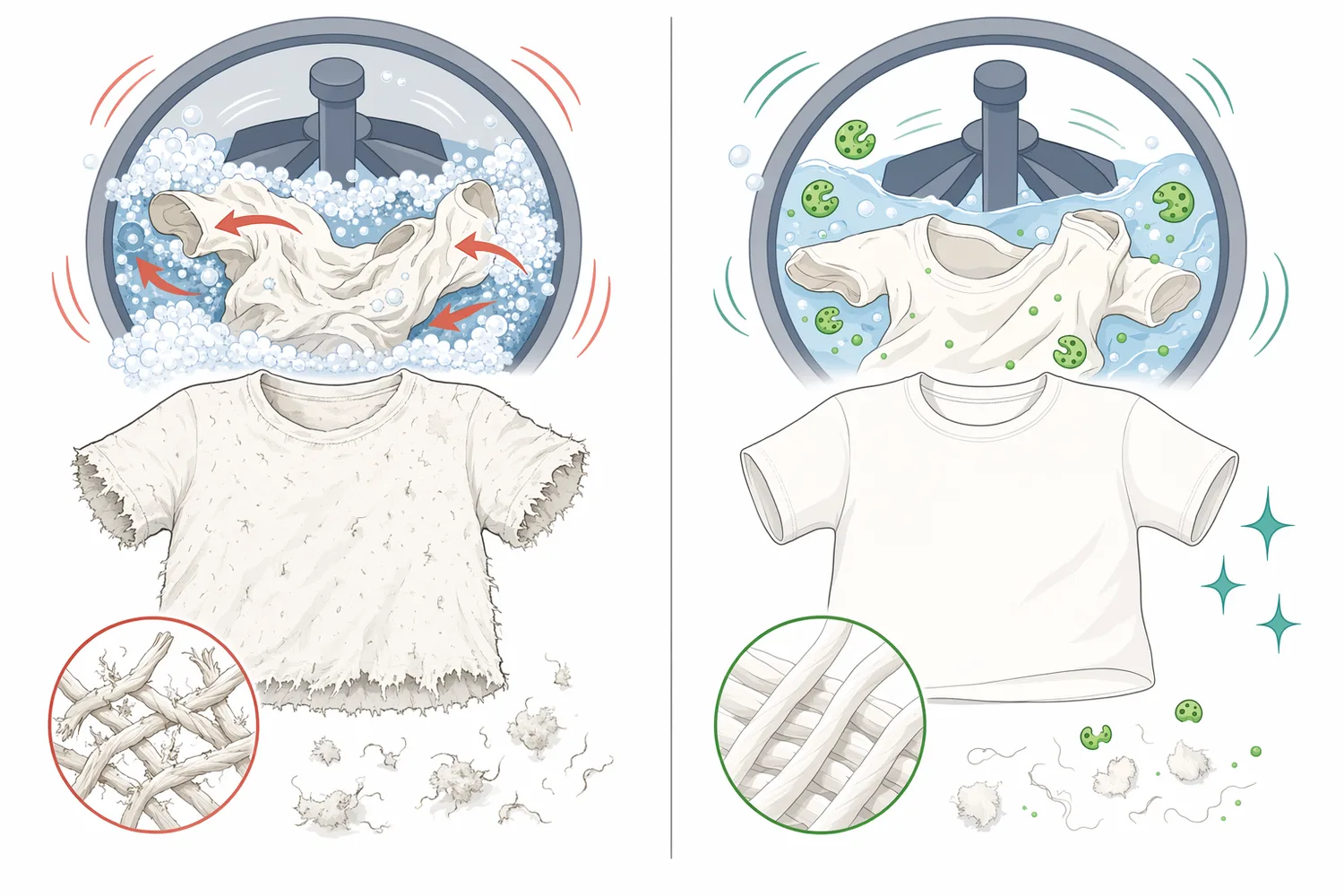
Cotton becomes dull because the fabric surface becomes optically uneven. Raised fibers, fibrils, and small pills scatter light instead of allowing the dyed or white surface to reflect evenly. Alkaline cellulase helps reduce this roughness by weakening exposed cellulose fibrils, which are then more readily removed during the wash. The result is a cleaner visual surface rather than a chemical whitening reaction [1].
This distinction matters in formulation thinking. Bleaches and optical brighteners affect color perception through oxidation or fluorescence, while cellulase changes the physical surface that light interacts with. When fewer microfibrils remain on the surface, dark fabrics may look less faded and white cotton may look less grey because less particulate soil is trapped in the raised fiber layer [5].
Alkaline cellulase can support cleaning by addressing a physical soil-retention problem. Fine particulate soils lodge in fuzzed cotton, especially after repeated wear and washing. The enzyme hydrolyzes accessible cellulose in the raised fibrils, reducing the number of physical anchor points that hold those particles. Surfactants, water flow, and agitation then remove more of the loosened material [1].
The effect is strongest for soils associated with the fabric surface rather than for stains chemically bound to non-cellulosic residues. For example, cellulase is not a substitute for protease on blood or egg protein, amylase on starch paste, or lipase on oily food stains. Its role is to make the cellulose surface cleaner and less soil-retentive, which is why it fits naturally into multi-enzyme detergent systems [4].
Fibrils and small pills are not only visual defects; they also make a garment feel rougher. By acting on protruding cellulose at the fabric surface, cellulase can contribute to a smoother hand feel. This is closely related to textile biopolishing, where cellulases are used to improve cotton smoothness and reduce surface fuzz under controlled textile-processing conditions [6].
Laundry use is milder and repeated rather than a single finishing step. In household-style washing, the enzyme’s contribution accumulates through repeated exposure at moderate intensity. That pattern is consistent with the idea that cellulase benefits are often seen as maintenance of appearance and feel over repeated laundering rather than as a one-wash dramatic transformation [5].
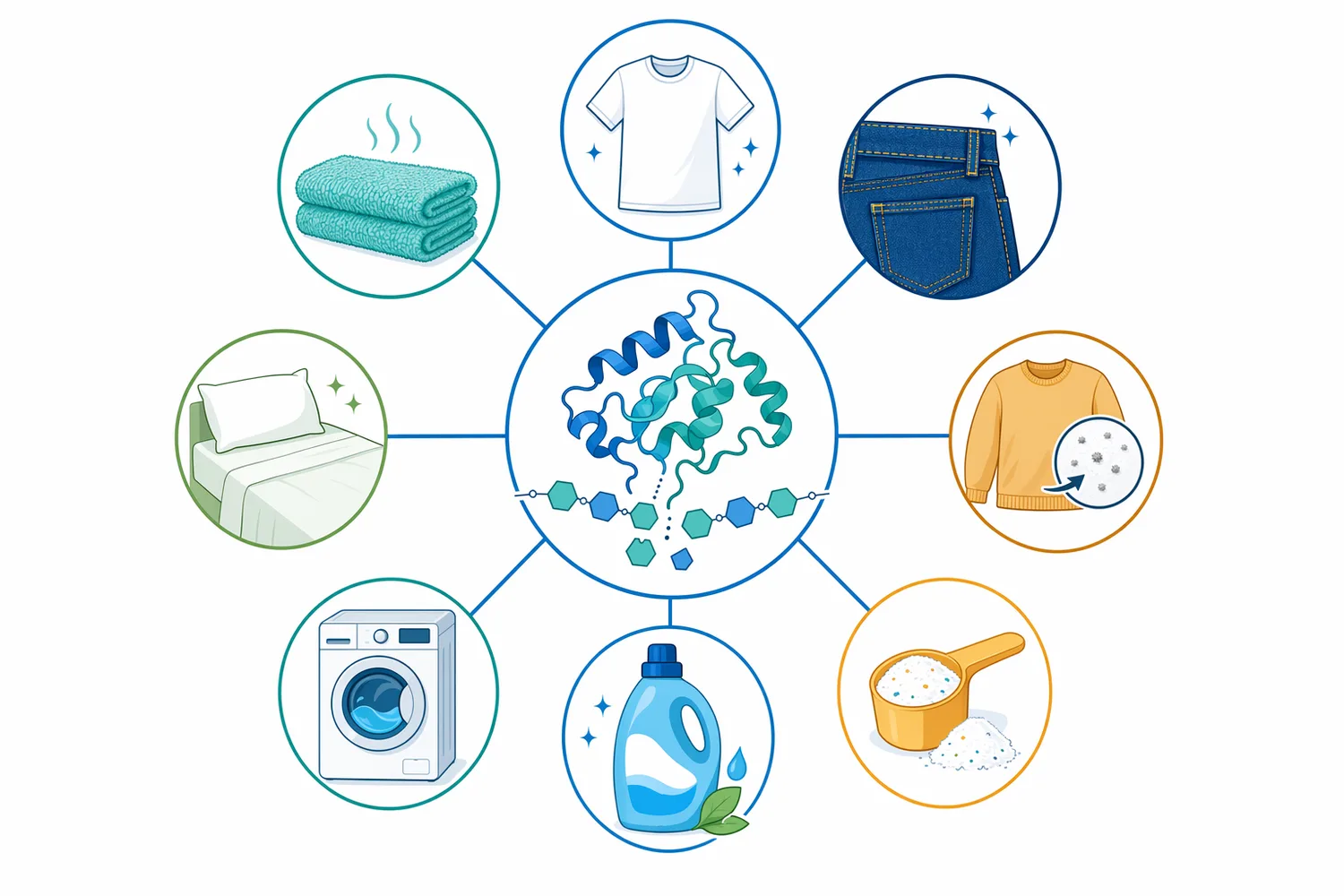
Cellulase is especially relevant to cotton, cotton blends, and other cellulose-containing textiles. On synthetic fibers such as polyester, cellulase has no cellulose substrate to hydrolyze, although it may still help when the fabric is a blend that includes cotton. This substrate specificity is one of the reasons enzymes are attractive in detergents: each enzyme class performs a targeted task rather than relying only on broad chemical action [2].
For cotton-rich garments, alkaline cellulase contributes to the fabric-care side of detergent performance. It can be part of products positioned around everyday cleaning, color maintenance, anti-greyness, soft feel, or refreshed appearance. Its value comes from changing the cotton surface in a way that supports detergency and fabric aesthetics at the same time [1].
The most directly relevant evidence comes from detergent-focused cellulase studies. Hoshino’s work on alkaline cellulase from Bacillus sp. KSM-635 showed that adding alkaline cellulase to detergents improved cotton cloth soil removal, which is precisely the performance area expected for a cotton-surface enzyme. The study is important because it links alkaline cellulase to a laundry substrate and a detergent context rather than only to general cellulose degradation [1].
Research on detergent-compatible enzyme-producing bacteria also supports the feasibility of using cellulase in detergent environments. Bektaş and co-workers isolated and characterized bacteria producing detergent-compatible amylase, protease, lipase, and cellulase, reflecting the modern detergent trend toward enzyme systems that address different soil and substrate classes within the same wash [4].
Development work on cellulases for liquid detergents further shows that fabric-care cellulases are an active engineering target, not only a legacy enzyme category. Krouwer and colleagues reported engineering an improved cellulase for fabric care in liquid detergents, demonstrating that cellulase performance in real detergent formats depends on protein properties, liquid formulation compatibility, and the desired fabric-care outcome [7].
Textile-processing research provides additional mechanistic support because it examines cellulase action on cotton fabric under controlled conditions. Hebeish and co-workers studied cellulase biotreatment as part of cotton multifunctionalization involving reactive dyeing and easy-care finishing, illustrating how cellulase can alter cotton surface behavior and fabric properties when applied to cellulose-rich textiles [6].
Broader reviews of enzymes in sustainable textile wet processing also place cellulase among the enzymes used to reduce harsh processing conditions and modify textile surfaces. While textile finishing is not identical to laundry detergent use, both rely on controlled enzyme-substrate interaction at the fiber surface rather than indiscriminate fiber destruction [5].
Modern laundry detergents often combine several enzyme classes because household soils are chemically diverse. Proteases address proteinaceous stains such as dairy, blood, and grass residues. Amylases hydrolyze starch-based soils from foods and thickeners. Lipases act on triglyceride-based fats and oils. Cellulases, by contrast, act on the fabric’s cellulose surface and help remove the roughness that traps particulate soil [4].
This division of labor explains why cellulase is usually complementary rather than competing with other enzymes. A detergent can use protease to digest protein soil and cellulase to improve cotton surface cleanliness in the same wash, provided the formulation is designed so the enzymes remain functionally compatible. Detergent enzyme literature consistently treats compatibility with surfactants and other formulation ingredients as a central requirement for practical performance [8].
Protease research also reinforces the importance of alkaline stability in detergents. Reviews of extracellular bacterial serine proteases describe alkaline detergent bioadditives as environmentally relevant tools for detergent performance, showing that high-pH operation is a common design challenge across enzyme classes, not only cellulase [9].
For formulators, the practical value of alkaline cellulase is therefore specific: it fills the cellulose-surface role within a multi-enzyme detergent. It should not be expected to replace enzymes aimed at food, body, or oil stains; instead, it helps the wash system deliver a cleaner and better-maintained textile surface [7].
Alkaline cellulase can be used in detergent concepts where cotton surface care matters, including powder and liquid formats. The science behind its use is the same in both cases: the enzyme must survive the product environment well enough to deliver cellulose-surface activity in the wash. Liquid detergent research is particularly important because enzymes can face long-term exposure to surfactants and water before use [7].
Powder detergents present a different environment, where water activity, granulation, dust control, and compatibility with alkaline builders are relevant to overall enzyme handling and performance. The customer-facing takeaway is that alkaline cellulase is an established detergent enzyme category, but the final effect depends on how the whole detergent system is built and used [4].
In either format, alkaline cellulase contributes after dilution into the wash liquor. Once hydrated and dispersed, the enzyme must contact accessible cellulose on the fabric surface. Agitation helps by bringing enzyme, detergent solution, and textile surfaces into repeated contact, while rinsing removes loosened fibrils and soils. The enzyme’s contribution is therefore coupled with normal wash mechanics, not separate from them [1].
Textile biopolishing is an industrial process in which cellulase is used to remove protruding fibers from cotton fabrics, improving smoothness, reducing pilling tendency, and enhancing fabric appearance. Laundry cellulase operates on the same substrate principle, although under consumer-style washing conditions rather than controlled mill finishing. The shared mechanism is the selective hydrolysis of accessible cellulose at the surface [6].
Sustainable textile wet-processing literature describes enzymes as tools that can replace or reduce harsher chemical treatments in selected operations. Cellulases are part of that enzyme set because they can modify cotton surfaces under aqueous conditions. This supports the broader credibility of cellulase for fabric care, even though detergent use requires compatibility with a more complex wash formulation [5].
The distinction between textile finishing and laundry is important. In finishing, treatment time, fabric load, liquor chemistry, and mechanical action are controlled for a defined fabric outcome. In laundry, the enzyme must be robust enough for variable soils, water quality, fabric blends, and wash habits. Alkaline cellulase is valuable because it brings cellulase surface action into the alkaline detergent space where those everyday variables occur [3].
Alkaline cellulase acts on cellulose, so its primary fabric-care effect is expected on cotton and cellulose-rich textiles. It does not hydrolyze polyester, nylon, acrylic, or elastane in the same way because those fibers do not contain cellulose. On cotton-polyester blends, the enzyme’s action is limited to the cotton component and to accessible cellulose surfaces [2].
The enzyme also acts where cellulose is accessible. New, tightly spun, low-fuzz cotton may show less immediate visible change than a worn, fibrillated cotton fabric with more exposed microfibers. Conversely, very delicate, heavily damaged, or highly abraded cellulose fabrics require appropriate detergent use because any cellulase works by hydrolyzing cellulose bonds at accessible sites [5].
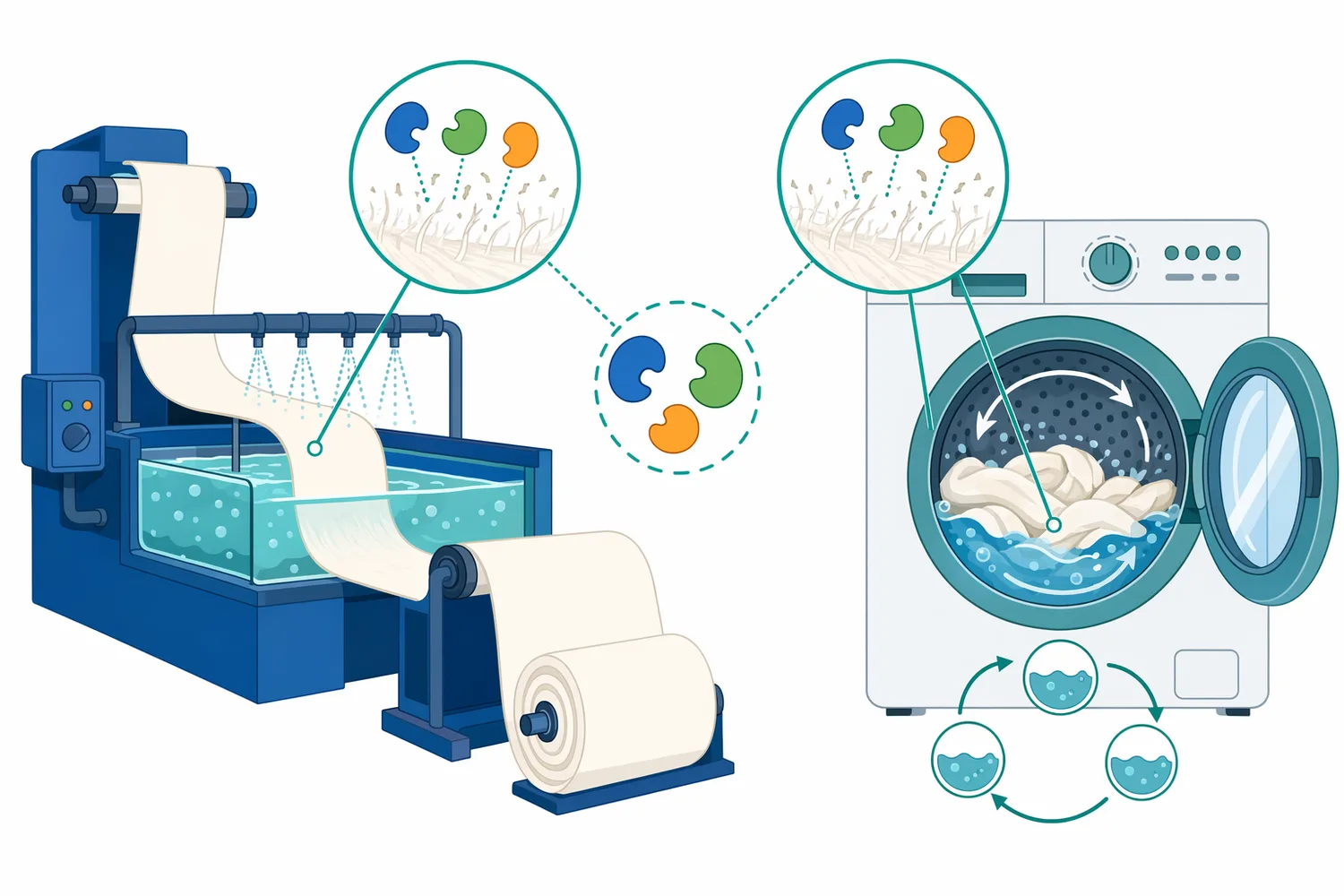
Performance should therefore be understood as formulation- and use-dependent. Wash pH, surfactant system, fabric type, soil load, temperature, mechanical action, and exposure time all influence how much enzyme reaches the accessible cotton surface and how much loosened material is removed. That does not weaken the scientific case for alkaline cellulase; it reflects the reality that laundry detergency is a combined chemical, enzymatic, and mechanical process [7].
Enzymes are widely used in detergent and textile applications because they provide catalytic, substrate-specific action in water-based systems. A small amount of enzyme protein can repeatedly catalyze bond cleavage on its target substrate, which can help detergents perform targeted tasks without relying entirely on stronger alkalinity, more aggressive chemistry, or higher wash temperatures. Cellulase contributes specifically by addressing cellulose-surface roughness and soil retention [9].
In textile wet processing, enzyme technologies are discussed as part of more sustainable processing because they can reduce the severity of conventional treatments in selected operations. For laundry, the sustainability argument should be framed carefully: alkaline cellulase does not make a detergent sustainable by itself, but it can support milder fabric-care performance by using targeted biocatalysis on cotton surfaces [5].
The best environmental and performance value comes from the whole detergent system: surfactants, builders, enzymes, washing conditions, packaging, and consumer use all matter. Within that system, alkaline cellulase is a focused ingredient for cotton surface renewal and particulate soil release, complementing other detergent functions rather than replacing them [4].
Like other detergent enzymes, cellulase is a protein and should be handled with attention to dust, aerosols, and skin or respiratory exposure. Occupational-health literature on detergent enzymes has documented asthma and allergy risks associated with enzyme exposure in industrial settings, which is why enzyme-containing products are handled according to appropriate safety information and good workplace hygiene practices [10].
For buyers ordering from Enzymes.bio, the product ships with a Safety Data Sheet that provides handling information for the supplied product. In practical terms, enzyme powders should be used in a way that avoids unnecessary airborne dust, minimizes direct contact, and follows the safety guidance supplied with the order [10].
Enzymes.bio supplies Alkaline Cellulase For Laundry Detergents as a direct online product sold by the 1 kg unit. The purchase process is straightforward: the buyer places the order online, pays online, and the order is then processed and shipped. A Certificate of Analysis and Safety Data Sheet are included with the order.
This product page is intended to explain the enzyme category, its detergent role, and the scientific basis for using alkaline cellulase in cotton-focused laundry applications. It should be read as educational support for understanding how the enzyme works in detergent and fabric-care systems, while the supplied product documentation provides the order-specific information accompanying the shipment.
Alkaline cellulase is a detergent-relevant cellulase designed for activity on cellulose under alkaline wash conditions. In laundry, its practical target is the roughened cotton surface: exposed fibrils, fuzz, and accessible cellulose that trap particulate soil and reduce fabric brightness. By hydrolyzing accessible cellulose bonds at those sites, alkaline cellulase helps the detergent system remove loosened fibrils and associated soil [1].
Its strongest value is in cotton and cotton-rich fabric care, where it can support brightness maintenance, anti-greyness, smoother hand feel, and improved surface cleanliness over repeated laundering. It is not a universal stain enzyme; it complements protease, amylase, lipase, surfactants, builders, and mechanical washing by performing a specific cellulose-surface function [4].
The scientific literature supports alkaline cellulase as a credible laundry enzyme class through detergent-focused cotton soil-removal research, engineered cellulases for liquid detergent fabric care, detergent-compatible microbial enzyme studies, and textile biopolishing work on cotton surfaces [7]. For buyers who need this enzyme category in a practical online format, Enzymes.bio offers Alkaline Cellulase For Laundry Detergents by the 1 kg unit with order processing and shipment after online payment.
Sold by the 1 kg unit, in stock and ready to ship. Order directly on our store — pay online and we process your order. A Certificate of Analysis and Safety Data Sheet are included with every order.
Buy Alkaline Cellulase For Laundry Detergents →Numbered in order of first citation. Open-access sources, each verified reachable at publication; citation numbers in the text link here.