
Alkaline endo-proteases for the leather industry are enzymes used in alkaline wet-processing steps to cut internal peptide bonds in unwanted hide and skin proteins. In leather processing, that controlled protein hydrolysis can support soaking, enzymatic unhairing, bating, fibre opening, wet-blue modification, and protein-rich waste handling, while helping reduce reliance on harsher chemical action in selected operations [1].
Enzymes.bio supplies Alkaline Endo-Proteases for Leather Industry as an online-order product sold directly by the 1 kg unit. Buyers place and pay for the order online; the order is then processed and shipped, with a Certificate of Analysis and Safety Data Sheet supplied with the order.
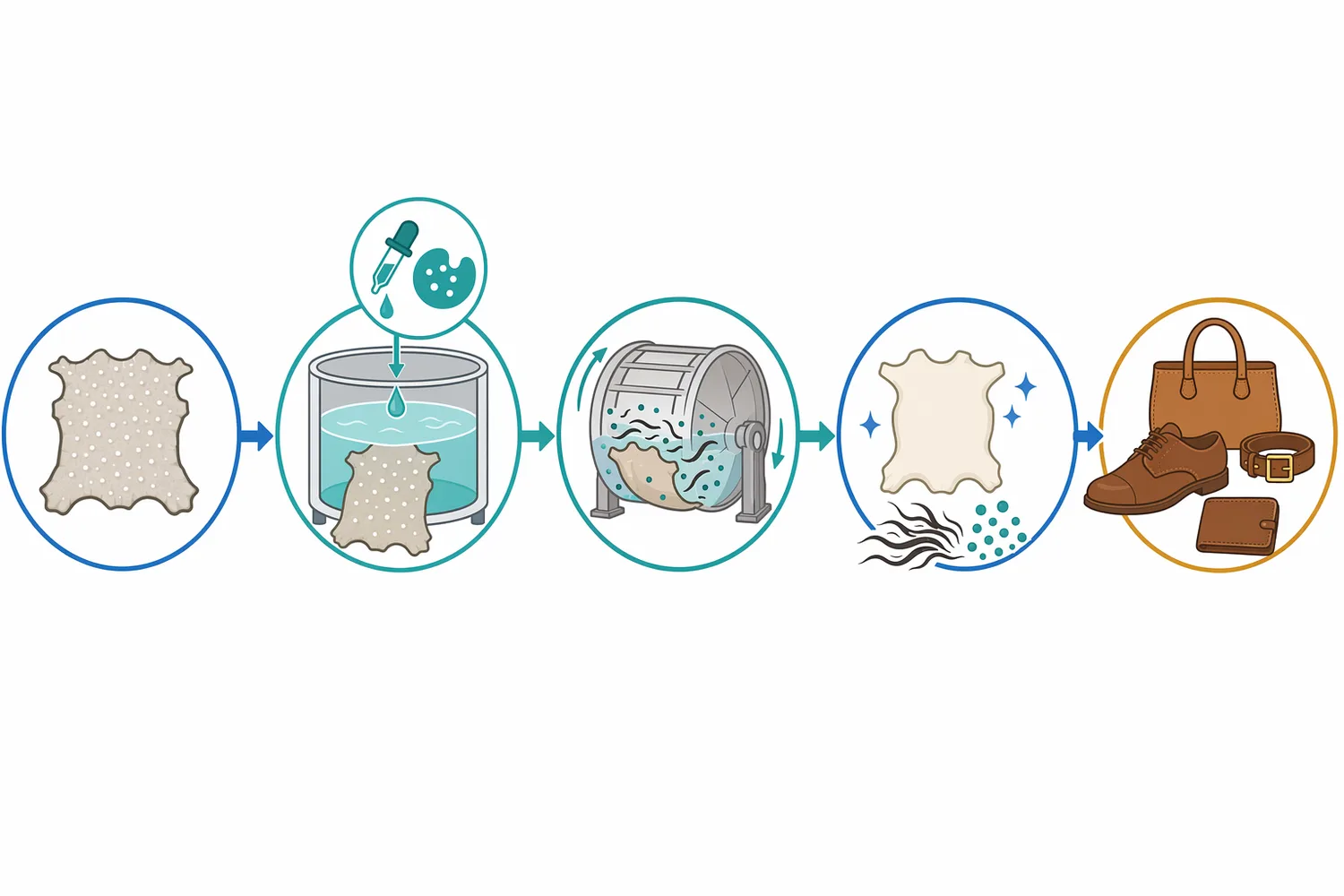
Leather manufacture is built around a controlled transformation: a biological skin or hide is cleaned, opened, stabilised by tanning, and then adjusted through post-tanning and finishing to deliver the required strength, handle, fullness, grain, and appearance. Modern reviews of leather tanning describe this as a sequence of chemical and physical changes in which collagen is preserved and stabilised, while non-leather-forming materials must be removed or modified before and after tanning [2].
Alkaline endo-proteases belong mainly to the beamhouse and wet-processing part of this sequence. They are not tanning agents and they do not “make leather” by themselves. Their role is to act on proteins that interfere with cleaning, hair release, fibre separation, softness, uniform chemical penetration, or waste management. In practical terms, they help convert large, insoluble, matrix-bound protein materials into smaller peptides that can move out of the hide structure into the float.
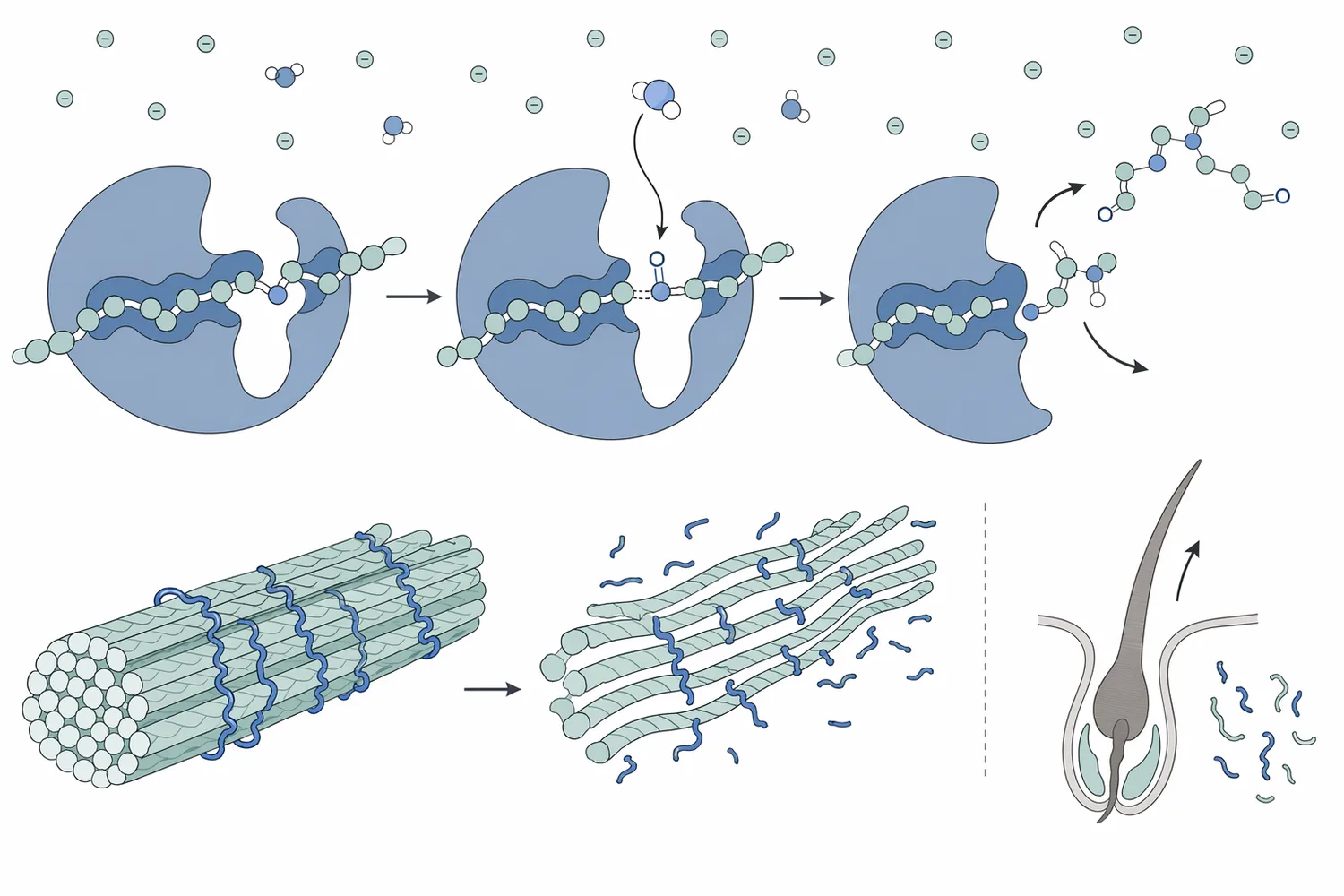
The term endo-protease is important. An exo-acting enzyme removes amino acids or small units from protein chain ends, while an endo-protease cleaves peptide bonds inside the protein chain. Inside a hide, that means the enzyme can break long protein networks at multiple internal points, reducing their ability to bind water, hold fibres together, anchor hair, or remain trapped between collagen bundles. The effect is not simply “protein removal”; it is a structural change in the non-collagenous matrix surrounding the collagen fibre network.
Alkaline proteases are especially relevant because several leather operations occur under neutral-to-alkaline or strongly alkaline conditions. Liming and unhairing traditionally rely on alkaline chemistry, and bating commonly follows alkaline beamhouse operations after deliming adjustment. Reviews of modern tanning and post-tanning trends consistently place enzymes among the tools being developed to reduce pollution load and improve process control in leather manufacture [3].
A raw hide is not pure collagen. Collagen is the main structural protein, but it is embedded with albumins, globulins, blood proteins, epidermal proteins, hair-root-associated proteins, elastin, proteoglycan-associated protein structures, residual fats, salts, dirt, and other biological materials. The process challenge is to remove or modify the unwanted materials while preserving enough collagen architecture to produce strong leather.
Alkaline endo-proteases work by hydrolysing accessible peptide bonds in proteins that are more exposed, less crystalline, or less structurally protected than intact collagen fibre bundles. When these peptide bonds are cut, large protein molecules lose continuity: a long chain becomes shorter fragments, a gel-like residue becomes more dispersible, and a fibre-binding “cement” becomes easier to wash out. This is why protease action can translate into better water uptake, cleaner grain, easier hair release, softer handle, and more open fibre structure when the process is controlled.
The mechanism is particularly clear in enzymatic dehairing. Hair itself contains keratin, a tough, sulfur-rich protein, but hair release does not always require complete digestion of the hair shaft. Proteolytic unhairing can target the softer protein structures around the hair follicle, epidermis, basal cells, and root sheath region. A mechanism study on bacterial alkaline protease dehairing described enzymatic action around the hair-supporting region of skin, explaining how hair can be loosened without simply dissolving the full hair mass into the liquor [4].
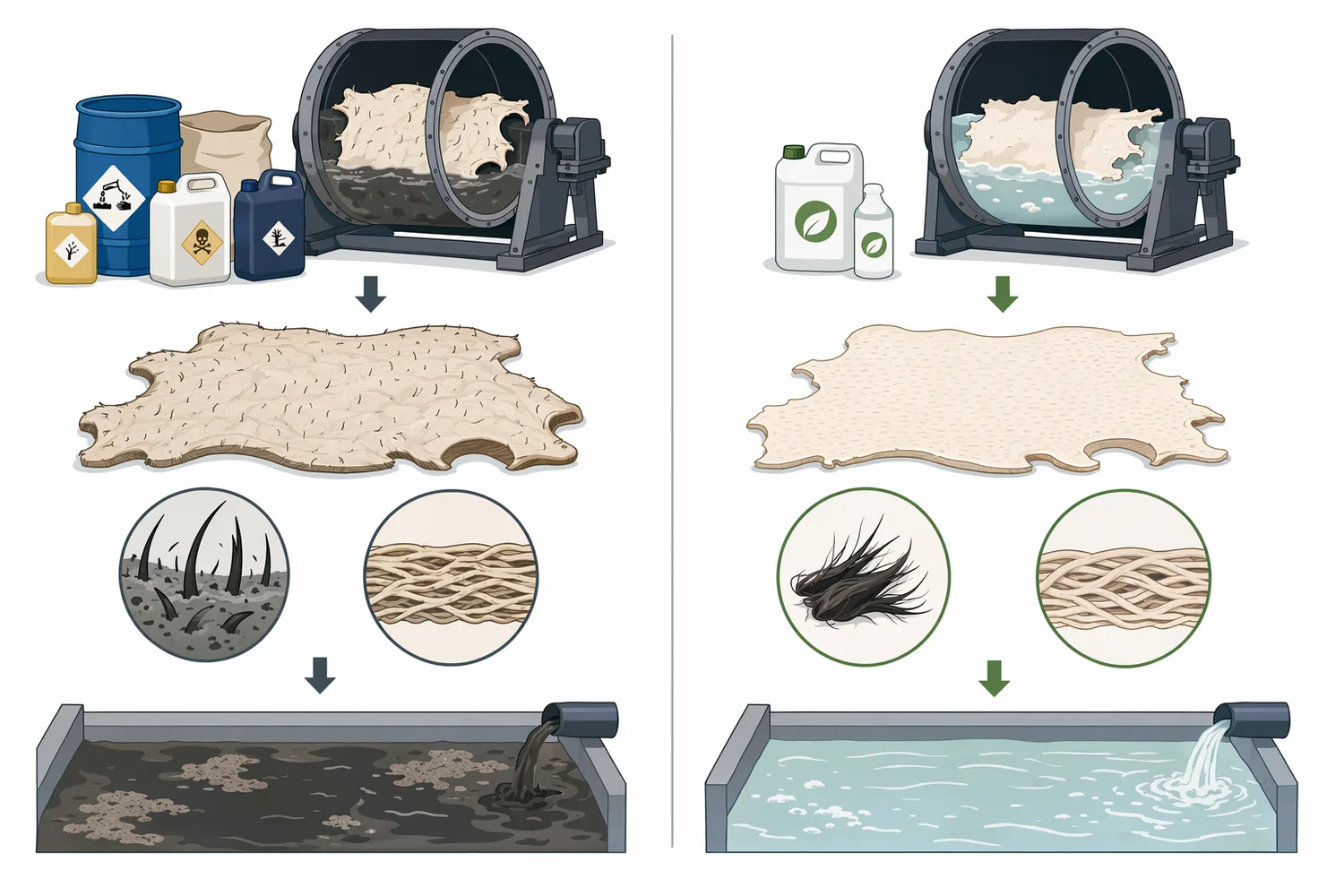
This is different from conventional hair-destruction systems, where sulfide-lime chemistry can break down hair more aggressively and increase the organic and sulfide-related burden in the effluent. Enzymatic unhairing is valuable because it can shift part of the work from harsh chemical dissolution toward biological weakening of the anchoring proteins. In practice, this can make hair removal cleaner and can support recovery of more intact hair solids when the wider process is designed for that outcome.
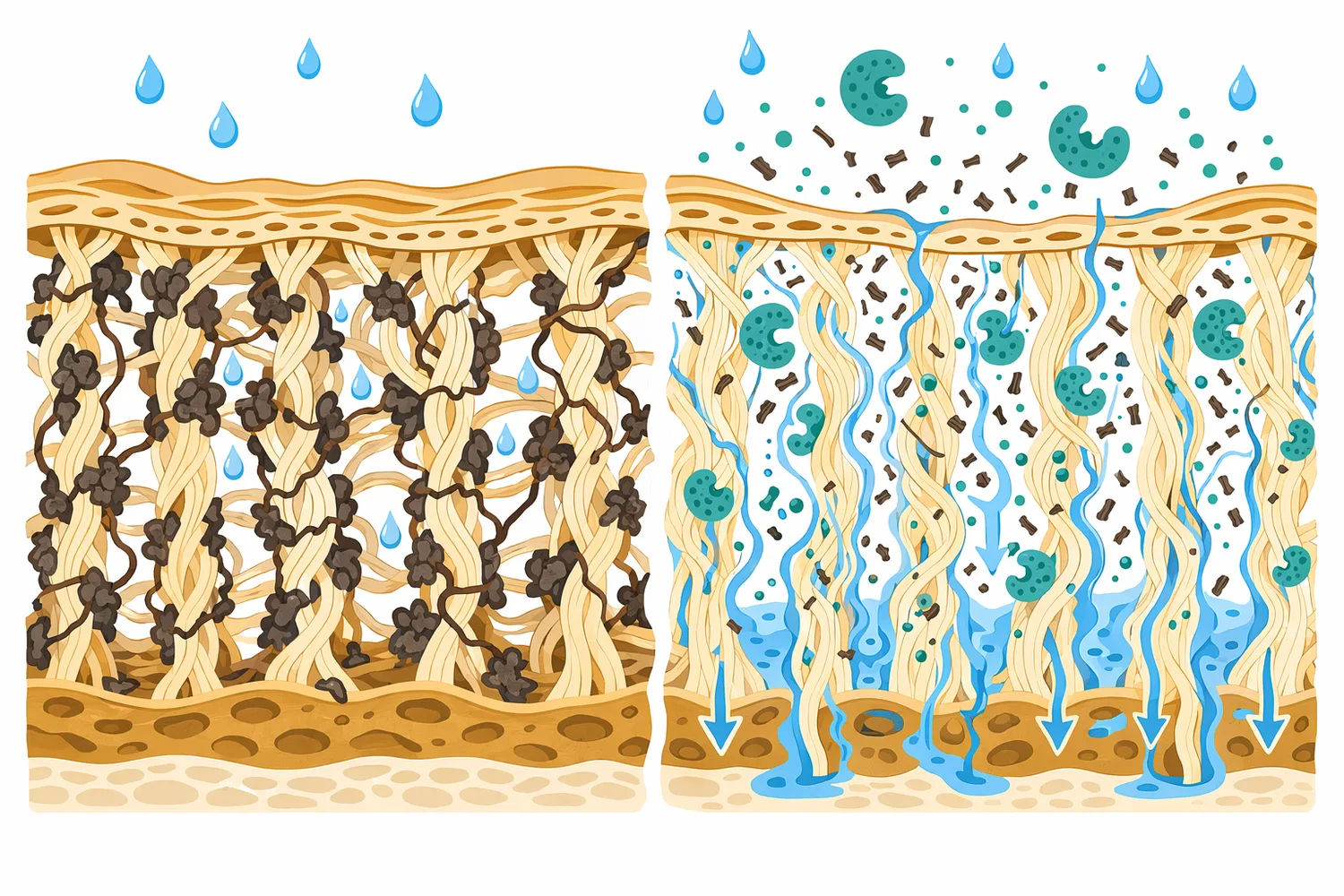
The same logic applies in bating. Residual interfibrillary proteins can behave like glue between collagen fibre bundles. When an alkaline endo-protease cuts these proteins, fibre bundles can separate more easily under drum action and water movement. The pelt becomes less tight, less harsh, and more receptive to later tanning and retanning materials, because diffusion paths through the structure are less blocked.
Different proteases are defined partly by the pH range in which they work best. For leather processing, the pH environment matters because the hide structure, swelling state, chemical compatibility, and enzyme behaviour all change with pH. Alkaline endo-proteases are generally associated with beamhouse-style operations where alkaline conditions are already part of the process environment.
| Protease type | Conceptual pH environment | Main leather-processing relevance | Practical distinction |
|---|---|---|---|
| Acid proteases | Acidic systems | More relevant to acidic protein hydrolysis or specialised low-pH treatments than to conventional alkaline beamhouse work | Less naturally aligned with liming, unhairing, and alkaline bating environments |
| Neutral proteases | Near-neutral systems | Can be useful where mild protein modification is required without strong alkalinity | Often considered where lower swelling or gentler treatment is desired |
| Alkaline endo-proteases | Alkaline systems | Soaking support, unhairing/dehairing, bating, fibre opening, and proteinaceous waste hydrolysis | Best aligned with alkaline wet-processing conditions and cleaner beamhouse enzyme concepts |
This table is conceptual rather than a product specification. Leather research describes enzyme-based processing as part of broader sustainable tanning and post-tanning development, but the practical effect always depends on the hide type, process sequence, float chemistry, time, temperature, mechanical action, and how the enzyme is integrated into the operation [3].
Soaking is the first opportunity to make the hide more uniform. Salted hides and skins must reabsorb water, release salt, loosen dirt and blood residues, and begin removing soluble proteins. If this stage is incomplete, later operations are less even: liming may be patchy, unhairing may vary across the pelt, and tanning chemicals may penetrate inconsistently.
Alkaline endo-proteases support soaking by cutting soluble and weakly bound proteins that obstruct water movement. Blood proteins, serum proteins, and other non-structural proteins can form films or residues in the matrix. Once hydrolysed, they become smaller and more mobile, so drum action and washing can remove them more effectively. Research on sustainable leather treatment using crude protease enzyme links protease application with enhanced leather properties and pollution reduction, reflecting the wider interest in using proteolysis to make early processing cleaner and more effective [1].
Mechanistically, the benefit is water access. A hide is a dense fibre network; water must pass between fibre bundles and into capillary spaces. Protein residues in those spaces behave like plugs or gels. Endo-protease cleavage reduces the molecular size and binding strength of those residues, helping the structure rehydrate more evenly. This can make later chemical processing less dependent on excessive alkalinity or aggressive opening.
Soaking protease action should still be understood as controlled cleaning, not digestion of the hide. The goal is to remove soluble and non-structural materials while maintaining the collagen framework. That distinction is central to all enzyme-assisted leather processing: useful proteolysis improves preparation; excessive or poorly controlled proteolysis can damage physical quality.
Unhairing is one of the most studied applications for alkaline proteases in leather. Conventional unhairing with lime and sulfide is effective but environmentally demanding, because it can dissolve hair into the processing liquor and contribute to high organic load, odour, and sulfide-related treatment issues. Enzymatic unhairing aims to release hair by attacking the protein structures that anchor the hair in the follicle and epidermal region.
Several studies support the feasibility of microbial alkaline proteases for dehairing. Work on proteases from Bacillus species has described effective industrial application for ecofriendly dehairing of leather hide, positioning bacterial proteases as a route toward more sustainable pre-tanning operations [5]. Other studies have focused on alkaline protease from Bacillus sp. SB12 for goat skin dehairing and alkaline protease from Bacillus cereus TD5B as a sheep-skin dehairing agent, showing that the research base includes multiple animal substrates and microbial enzyme sources [6].
The concrete mechanism is localised weakening. Hair is held in place by follicular structures, root sheaths, epidermal proteins, and cell-to-cell proteinaceous materials. When an endo-protease cuts those proteins, the “socket” around the hair loses integrity. The hair can then be removed by mechanical action and float movement rather than being chemically destroyed throughout its length.
This distinction matters for effluent quality. If hair is dissolved, its protein load enters the wastewater. If hair is loosened and removed more intact, more of that organic matter can be separated as a solid. A study on enzymatic sheep-skin dehairing also examined recovery and characterisation of commercially important wool hydrolysate and fats, illustrating that enzyme-assisted dehairing can be connected with resource recovery as well as cleaner processing [7].
Keratinase research is closely related but not identical to ordinary alkaline endo-protease use. Keratinases are proteases with particular ability to degrade keratin-rich materials such as feathers, wool, or hair. A study on Bacillus subtilis ES5 keratinase highlighted its potential application in leather dehairing as part of a clean leather tanning process, while feather-waste bioremediation research also identifies keratinase production as relevant to tannery dehairing applications [8].
For buyers, the key point is that enzymatic unhairing is not a single universal reaction. Some proteases mainly weaken follicular proteins; keratinases may act more directly on keratin-rich material; encapsulated or formulated approaches can change delivery and contact. A 2025 study on protease-encapsulated liposomes described twin benefits of green unhairing and soft leather production, showing that researchers continue to explore delivery systems that improve how protease reaches the skin structures involved in unhairing [9].
Bating is the classic protease application in leather. After liming and related beamhouse steps, the pelt can remain swollen, harsh, and loaded with residual non-collagenous proteins. Bating uses proteolysis to make the structure cleaner and more flexible before tanning.
At the fibre level, the enzyme acts between collagen bundles. Non-collagenous proteins and degraded epidermal residues can remain in the interfibrillary spaces. When alkaline endo-proteases cut these materials, the bundles separate more readily. Drum movement then helps open the structure physically. The result is not just a cleaner pelt; it is a pelt with more accessible internal surface area for tanning agents and post-tanning chemicals.
This is why bating affects handle. A tightly bound fibre network feels firm and boardy. A more evenly opened network bends more easily and can produce softer, more elastic leather. Research on enzymatic plasticising of structured semi-finished leather describes enzyme use as a way to improve suppleness, reinforcing the practical link between controlled proteolysis and leather handle [10].
Protease-assisted fibre opening also supports chemical uniformity. Tanning agents, dyes, fatliquors, retanning agents, and finishing auxiliaries all depend on penetration and distribution through the collagen matrix. If residual proteins block internal pathways, penetration can be uneven. By reducing those barriers, bating can contribute to more uniform uptake and a more consistent finished article.
The important boundary is collagen preservation. Collagen is also a protein, so any protease application must avoid excessive attack on structural fibre. Useful bating preferentially removes non-structural and accessible proteins; damaging bating goes too far and can cause looseness, grain weakness, or reduced physical performance. This is why enzyme-assisted leather processing is best viewed as controlled modification rather than aggressive digestion.
Although alkaline endo-proteases are most strongly associated with beamhouse processes, enzyme treatment can also be relevant in semi-finished leather modification. Wet blue is chrome-tanned leather that has already undergone tanning but may still require retanning, dyeing, fatliquoring, and finishing to achieve the desired final properties. Enzymatic treatment at this stage is more about fine adjustment than raw hide cleaning.
A study on wet-blue enzymatic treatment evaluated its effect on leather properties and post-tanning processes, indicating that enzyme action can influence how semi-finished leather behaves in later processing [11]. The mechanism is again structural: limited protein modification can change the accessibility, softness, or response of the fibre network, which may affect subsequent uptake and distribution of post-tanning materials.
This does not mean wet-blue treatment is identical to soaking, unhairing, or bating. Tanned collagen is more stabilised than raw pelt, and the performance targets are different. In beamhouse operations, the goal may be cleaning or hair release. In wet-blue or semi-finished modification, the goal is more likely controlled property adjustment, such as suppleness, fullness balance, or improved response to post-tanning operations.
Enzymes in post-tanning also include non-protease systems. For example, transglutaminase has been studied for eco-friendly retanning applications and pollution-load reduction, showing that enzyme use in leather extends beyond proteolysis alone [12]. Alkaline endo-proteases therefore sit within a broader enzyme toolkit, but their distinguishing feature remains internal cleavage of protein chains.
Leather production generates proteinaceous by-products and waste streams: fleshings, trimmings, hair, wool, sludge fractions, and other residues. These materials can be difficult to handle because collagen, keratin, and associated proteins are large, insoluble, and resistant to ordinary breakdown. Alkaline proteases can help convert some of these materials into smaller peptide-rich hydrolysates.
The mechanism is straightforward: hydrolysis reduces molecular size and changes solubility. A large protein fibre or residue becomes a mixture of shorter peptides and amino-containing fragments. That can make the material easier to pump, separate, further process, or biologically treat, depending on the waste-management system. Research on microbial bioremediation of feather waste for keratinase production connects keratin-degrading enzymes with leather dehairing and broader protein-waste valorisation concepts [13].
Sheep-skin enzymatic dehairing research also points to recovery of wool hydrolysate and fats, showing that dehairing can be considered not only as a cleaning step but also as a source of recoverable proteinaceous material [7]. While the exact downstream value depends on the process and local regulations, enzyme hydrolysis creates possibilities that are harder to achieve when hair and protein residues are fully degraded in mixed chemical effluent.
Protein-waste treatment should not be oversold as a stand-alone solution. Proteases do not remove salts, metals, dyes, or every organic contaminant. They act on proteins. Their value is strongest where the processing challenge is specifically protein structure, protein solubility, or keratin/collagen breakdown within a broader environmental-management system.
The leather sector is under ongoing pressure to reduce pollution load, improve resource efficiency, and lower dependence on hazardous chemicals while preserving leather performance. Reviews of tannins, tanning chemistry, and environmental impacts emphasise that the environmental profile of leather depends on the full sequence of beamhouse, tanning, post-tanning, and effluent-treatment operations [14].
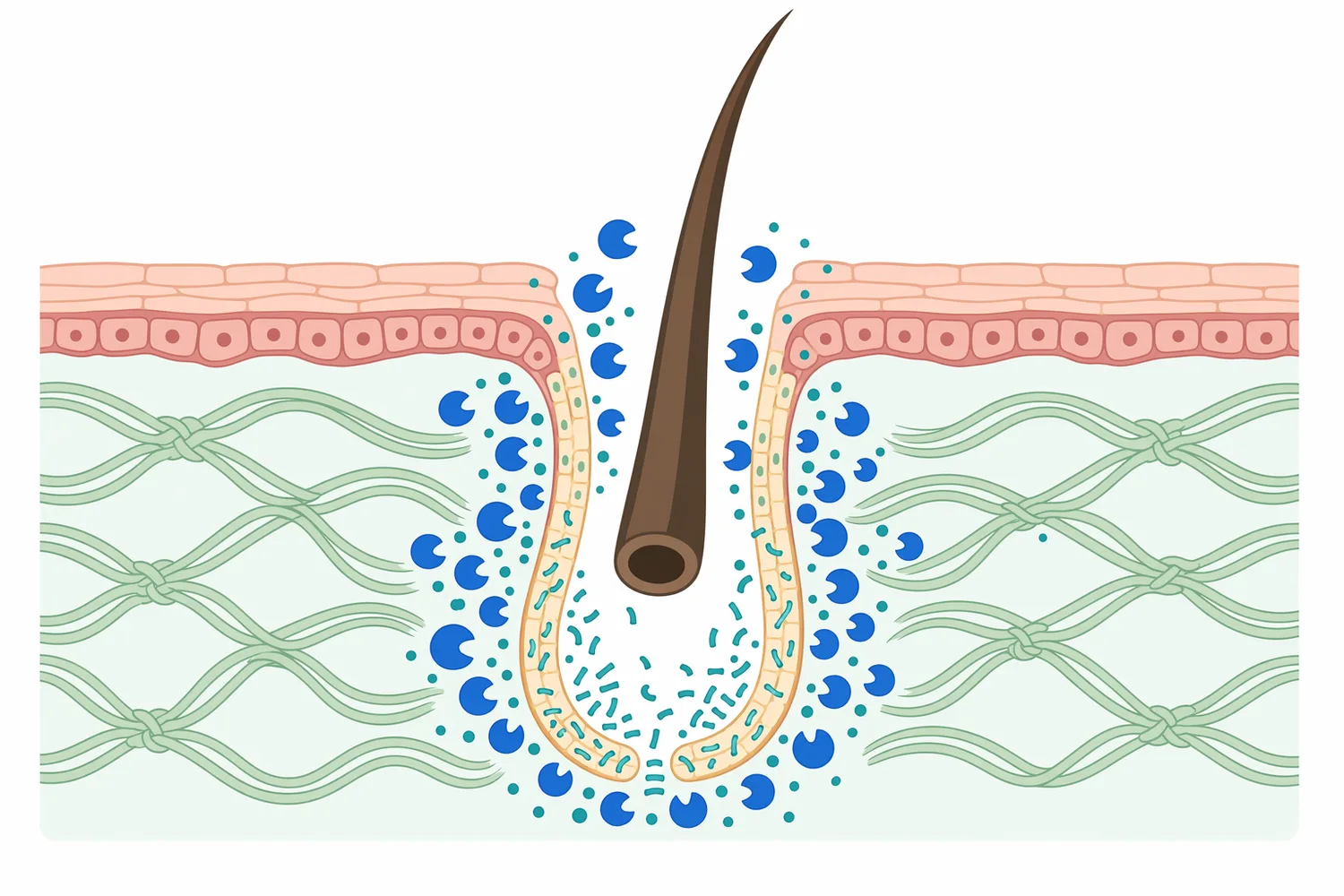
Alkaline endo-proteases contribute to this sustainability direction by making selected protein-removal steps more biological and less chemically severe. In soaking, they help remove protein residues that interfere with rehydration. In unhairing, they can reduce the need for hair-destroying chemistry. In bating, they improve softness and fibre opening through targeted hydrolysis. In waste treatment, they can help break down protein-rich residues.
Recent work on sustainable leather tanning using crude protease enzyme treatment reported enhanced properties and pollution reduction, supporting the idea that protease treatment can improve both processing outcomes and environmental indicators under the conditions studied [1]. Cleaner leather research also increasingly combines enzymatic, biodegradable, and multifunctional approaches rather than relying on one change alone; examples include biodegradable tanning agents, mineral alternatives, and post-tanning innovations [15].
The realistic claim is therefore balanced: alkaline endo-proteases can help make leather processing cleaner and more controlled, but they do not eliminate the need for process design, wastewater treatment, or responsible chemical management. They are practical biochemical tools within a larger leather-production system.
The evidence for alkaline proteases in leather is broadest in unhairing, dehairing, bating, and cleaner pre-tanning applications. Studies have examined bacterial alkaline proteases, Bacillus-derived proteases, keratinases, and formulated delivery approaches across hides, goat skins, sheep skins, and related keratin-rich substrates [5].
Mechanistic evidence is important because it explains why enzymatic dehairing can work without simply digesting the whole hide. The bacterial alkaline protease mechanism study linked dehairing to enzymatic action at hair-associated skin structures, which supports the idea that controlled proteolysis can release hair while preserving the collagen matrix when the process is properly managed [4].
Application evidence includes goat-skin dehairing with alkaline protease from Bacillus sp. SB12, sheep-skin dehairing using alkaline protease from Bacillus cereus TD5B, and keratinase from Bacillus subtilis ES5 proposed for clean leather dehairing [6]. These studies do not prove that every alkaline protease will perform identically in every tannery, but they do establish that the category is technically credible and repeatedly investigated.
There is also evidence for enzyme effects beyond raw dehairing. Wet-blue enzymatic treatment has been studied for its effect on leather properties and post-tanning processes, while enzymatic plasticising research has addressed improvements in supple leather manufacture [11]. Together, these papers support the broader point that controlled protein modification can influence both process efficiency and finished leather characteristics.
For a leather-processing buyer, the practical expectation should be controlled assistance in protein removal and fibre modification. Alkaline endo-proteases are most relevant where the process needs cleaner rehydration, easier hair release, improved bating, better fibre opening, softer handle, or hydrolysis of proteinaceous residues. Their action is biochemical, but the visible effect is physical: cleaner pelts, loosened hair, more open fibre structure, and modified leather handle.
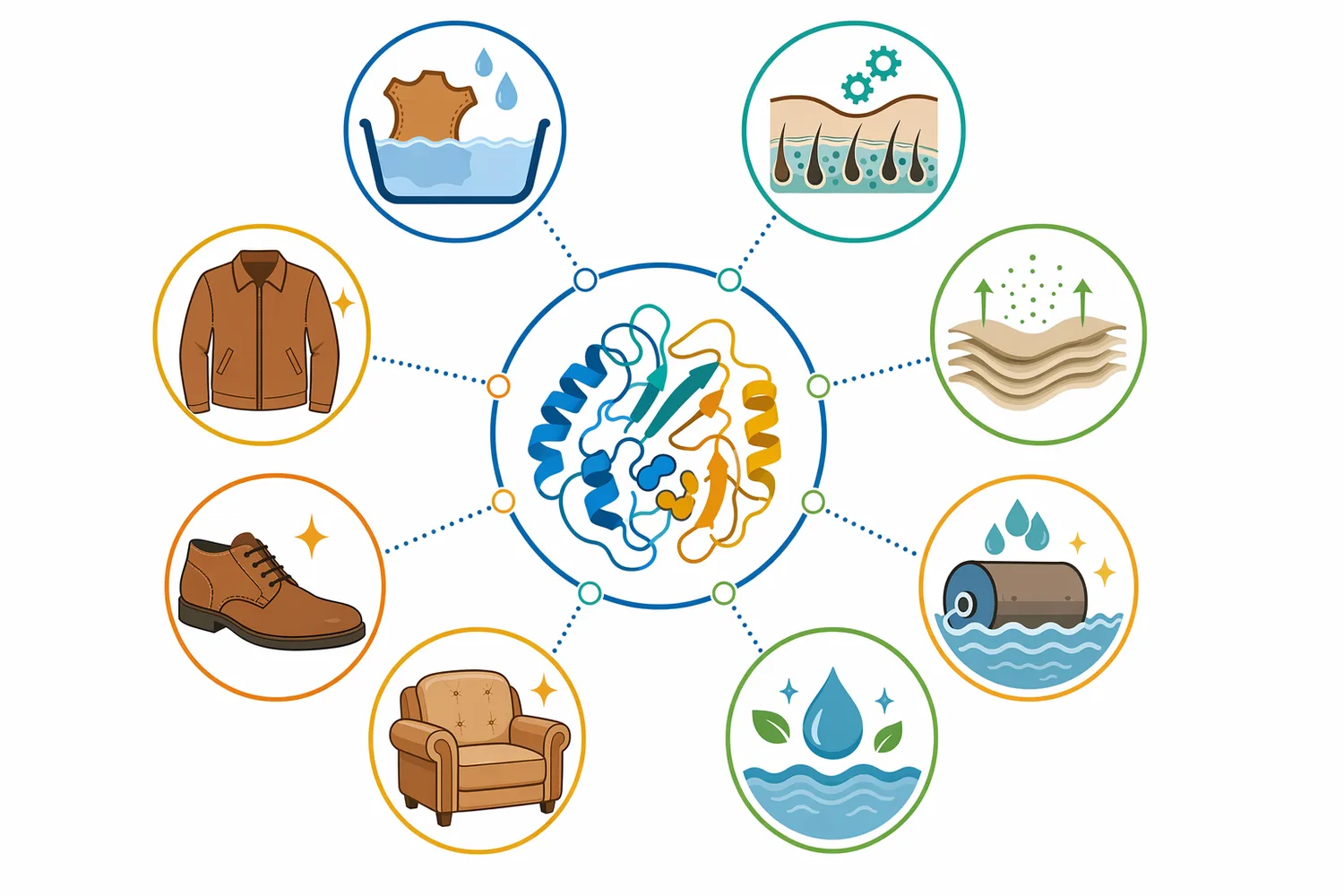
The result depends on the real processing environment. Hide or skin origin, preservation method, liming history, mechanical action, float composition, exposure time, temperature, and pH all influence how much protein is hydrolysed and where the enzyme can penetrate. This is not a limitation unique to Enzymes.bio; it is a feature of enzyme-assisted leather processing generally, because enzymes act on biological substrates whose structure varies from lot to lot.
The most important operating idea is balance. Insufficient proteolysis may produce little improvement. Excessive proteolysis can weaken the grain or loosen the structure. Productive use sits between those outcomes: enough hydrolysis to remove unwanted proteins and open the structure, not so much that the collagen network loses performance.
Enzymes.bio supplies Alkaline Endo-Proteases for Leather Industry for customers who need an enzyme product for leather wet-processing applications. The product is sold directly online by the 1 kg unit. After online payment, the order is processed and shipped, and the order includes a Certificate of Analysis and Safety Data Sheet.
This page is intended to explain the enzyme category, its mechanism, and the research-supported leather applications behind it. Alkaline endo-proteases are best understood as controlled protein-hydrolysis aids for leather processing: they cut internal peptide bonds in unwanted or accessible proteins so that hides, skins, semi-finished leather, or protein-rich residues become cleaner, more open, softer, or easier to manage.
Alkaline endo-proteases are credible, well-studied enzymes for leather applications because they act directly on the protein materials that make beamhouse and wet-processing difficult. They can support soaking, enzymatic unhairing, dehairing, bating, fibre opening, wet-blue modification, and protein-rich waste hydrolysis by converting large protein structures into smaller, more removable fragments.
Their value is practical rather than theoretical: targeted proteolysis can reduce harshness in selected operations, improve fibre opening, support softer leather, and contribute to cleaner processing when used within a controlled leather-production sequence. Research on sustainable protease treatment, Bacillus protease dehairing, keratinase-based clean dehairing, wet-blue enzymatic treatment, and enzymatic plasticising all supports alkaline proteases as an important enzyme class for modern leather processing [1].
Sold by the 1 kg unit, in stock and ready to ship. Order directly on our store — pay online and we process your order. A Certificate of Analysis and Safety Data Sheet are included with every order.
Buy Alkaline Endo-Proteases For Leather Industry →Numbered in order of first citation. Open-access sources, each verified reachable at publication; citation numbers in the text link here.