
Beta-Glucanase Brewing Enzyme Liquid supplied by Enzymes.bio is a brewing process aid used to break down cereal beta-glucans that can make mash, wort, and beer difficult to separate or filter. Its main value is physical: it reduces the chain length of viscosity-forming beta-glucans from barley, oats, rye, wheat, unmalted cereals, and under-modified malt, helping wort run off and filter more predictably when beta-glucans are the limiting factor.
Enzymes.bio supplies this product directly online by the 1 kg unit: the buyer pays online, and the order is processed and shipped. A Certificate of Analysis and Safety Data Sheet come with the order; Enzymes.bio is the product supplier, not a manufacturer or laboratory developer of the enzyme .
Beta-glucanase is the name used for enzymes that hydrolyze beta-glucans, a family of glucose-based polysaccharides found in plants, microbes, and fungi. In brewing, the most important beta-glucans are cereal cell-wall polymers, especially the mixed-linkage beta-glucans in barley endosperm cell walls, because these long hydrated chains can increase wort viscosity and interfere with solid-liquid separation [1].
The enzyme is not used primarily to create fermentable sugar. In a mash, amylases act on starch; beta-glucanase acts on cell-wall beta-glucan. That distinction matters because a mash can have adequate starch conversion and still lauter poorly if beta-glucan-rich material remains intact in the liquid phase or in the mash bed [2].
For brewers, the practical effect is easier movement of liquid through grain solids and filters. When beta-glucanase cuts long beta-glucan chains into shorter fragments, the fragments bind and structure water less effectively, reducing the “gummy” character associated with high-molecular-weight cereal gums. That change can support smoother mash mixing, faster wort run-off, lower filter loading, and fewer beta-glucan-related filtration disruptions in beer production [3].
Cereal beta-glucans are structural carbohydrates, not starch granules. In barley, oats, rye, and wheat, they help form the cell-wall matrix surrounding starch and protein reserves. During malting and mashing, that wall material must be loosened enough for water and enzymes to reach the starch, and any soluble high-molecular-weight beta-glucan that remains can pass into wort [1].
Long beta-glucan chains are process-active because they increase viscosity at relatively low concentrations compared with small sugars. A long polymer chain occupies a large hydrated volume, tangles with other chains, and slows liquid flow. In the lauter tun, that can mean a less permeable mash bed; in beer filtration, it can mean faster formation of a resistant gel layer on filter media or more rapid pressure rise during clarification [4].
Malt quality and grist composition are major reasons the problem appears inconsistently. Well-modified malt has already undergone cell-wall breakdown during germination, but under-modified malt, highly kilned malt with reduced native enzyme survival, and grists rich in unmalted or flaked cereals can leave more beta-glucan available to hydrate during mashing. A study profiling 94 commercially produced malt batches specifically examined malt enzymes in relation to fermentability, lautering, and beer filtration performance, underscoring that malt-to-malt variation is a real process variable rather than a theoretical concern [5].
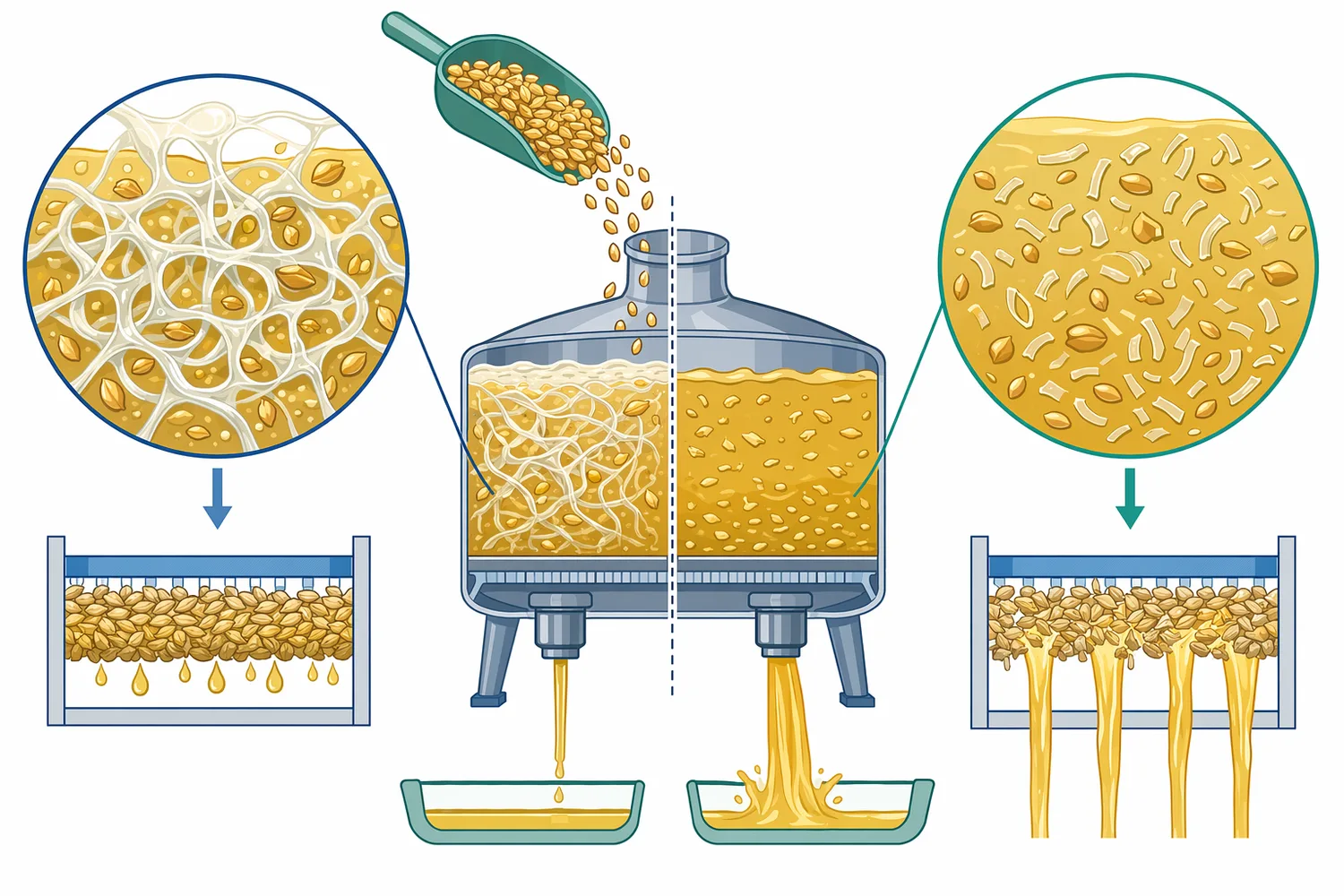
Oats and rye are especially familiar to brewers for their positive sensory contributions and their processing difficulty. They can support body, mouthfeel, haze stability, or flavor differentiation, but they also bring non-starch polysaccharides that can increase wort viscosity. Beta-glucanase targets one of the main contributors to that viscosity without replacing the normal starch-converting enzyme system in the mash [2].
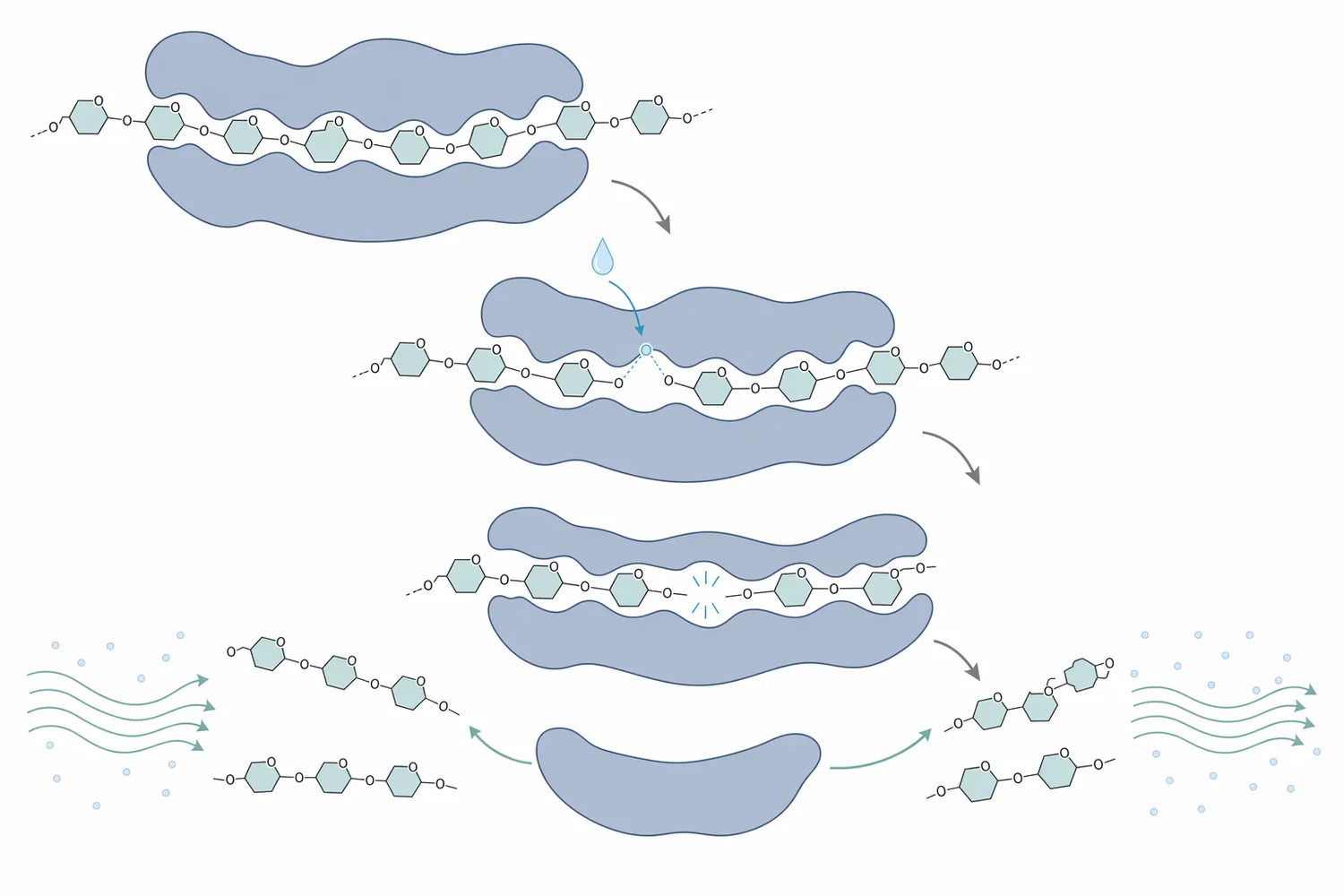
The relevant cereal substrate is often described as mixed-linkage beta-glucan: glucose units connected mainly by beta-1,4 linkages interrupted by beta-1,3 linkages. This pattern creates a flexible but extended polymer that hydrates strongly. The chain does not behave like starch, because starch uses alpha-linkages and folds into structures that amylases recognize; beta-glucanase recognizes beta-linked glucan architecture instead [6].
Endo-type beta-glucanases cut internal bonds within the polymer rather than trimming only from the ends. That is why a relatively small number of cuts can have a large viscosity effect: breaking one long chain into several shorter chains sharply reduces molecular size, chain entanglement, and water-structuring behavior. The mash does not need every beta-glucan fragment to be converted into glucose for lautering to improve; reducing polymer length is often enough to change flow behavior [6].
Classic work on barley beta-glucanase hydrolysis of barley beta-D-glucan identified defined products formed during enzymatic cleavage, showing that the enzyme action is specific to the structure of the glucan rather than a nonspecific “gum destruction” effect. For brewing, this specificity is beneficial because the enzyme acts on the cell-wall gum problem while leaving starch conversion to amylases and protein modification to proteases [6].
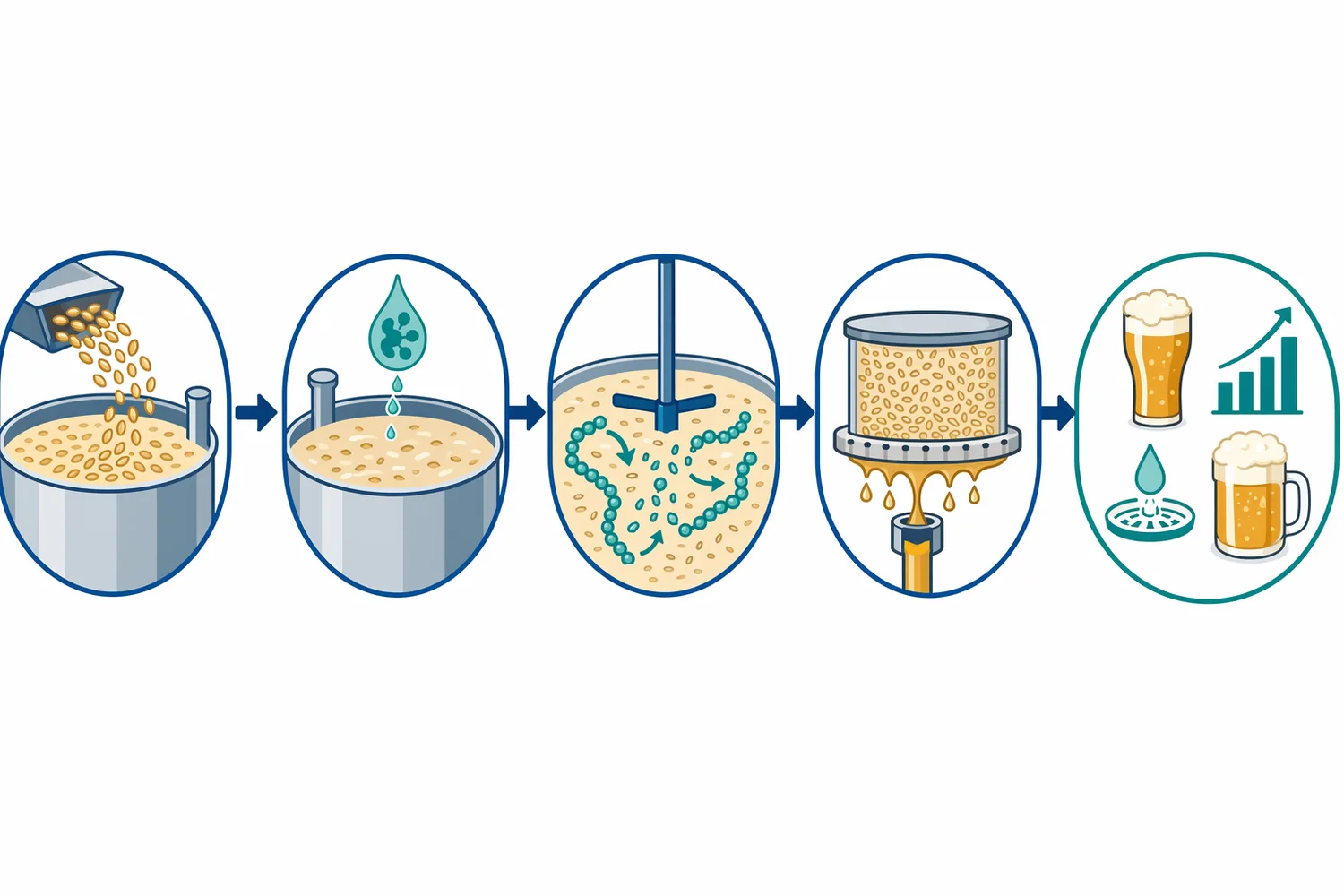
The physical sequence in the brewhouse is straightforward. First, hydrated beta-glucan is solubilized from the grain matrix during mashing. Second, beta-glucanase cleaves the long mixed-linkage chains into smaller fragments. Third, the liquid phase becomes less viscous and the mash bed less prone to gummy compaction, allowing wort to pass through grain solids and filtration media with less resistance [3].
Brewing enzymes are often discussed together, but they solve different substrate problems. The comparison below is useful because beta-glucanase is sometimes mistaken for an extract-yield enzyme or a sugar-generation enzyme when its main contribution is usually viscosity and separation control.
| Enzyme type | Main brewing substrate | What the enzyme changes | Practical process effect | What it does not replace |
|---|---|---|---|---|
| Beta-glucanase | Cereal beta-glucans in cell walls, especially mixed-linkage barley and adjunct beta-glucans | Cuts long viscosity-forming glucan chains into shorter fragments | Supports mash flow, lautering, wort run-off, and beer filtration when beta-glucans are problematic | Does not replace amylase for starch conversion |
| Alpha- and beta-amylase | Starch polymers and dextrins | Breaks alpha-linked starch into fermentable and dextrinous carbohydrates | Drives extract formation, attenuation potential, and wort sugar profile | Does not directly remove beta-glucan gum |
| Protease / peptidase activity | Malt and adjunct proteins | Breaks proteins into peptides and amino nitrogen fractions | Influences FAN, haze precursors, foam-active proteins, and modification | Does not directly solve beta-glucan viscosity |
| Xylanase | Arabinoxylans and related hemicelluloses | Reduces certain non-starch polysaccharides distinct from beta-glucans | Can support processing in cereal systems where arabinoxylans are important | Does not specifically target mixed-linkage beta-glucan |
This substrate specificity is central to successful use. If the bottleneck is incomplete starch conversion, beta-glucanase is not the primary solution. If the bottleneck is beta-glucan-driven viscosity, slow lautering, or filtration drag, beta-glucanase addresses the actual material causing resistance [2].
Barley produces cell-wall-degrading enzymes during germination, and malt modification depends partly on that enzymatic breakdown. However, native beta-glucanase is vulnerable to heat, and the conditions that preserve beta-glucanase are not always the same as those used in modern kilning and mashing. This is one reason brewers may encounter beta-glucan issues even when the malt has otherwise acceptable extract and conversion behavior [3].
A traditional beta-glucanase rest is associated with the lower-temperature part of the mash schedule, often described around 95–113°F, with a relatively acidic mash environment. Brewing education sources present this rest as most relevant for grists containing rye, wheat, oats, unmalted barley, or under-modified malt, rather than as a standard requirement for every well-modified all-malt mash [2].
Supplemental brewing beta-glucanase provides an additional source of beta-glucan-hydrolyzing activity at the point where the substrate is hydrated and accessible. In practice, this means the enzyme is normally most meaningful during mash-in, a low-temperature rest, cereal pre-treatment, or other early process stage where beta-glucans can be cut before wort separation begins [3].
Microbial beta-glucanases are also studied because enzyme source affects temperature tolerance, pH behavior, and substrate preference. Reviews of beta-glucanase protein engineering describe efforts to improve catalytic activity, thermostability, and acid/base stability, which reflects the industrial importance of matching enzyme robustness to processing environments such as brewing mashes [7].
Adjunct brewing is one of the clearest use cases. Oats and rye can improve body and flavor but may produce thick mashes; wheat can add foam and haze attributes while contributing non-starch polysaccharides; unmalted barley can bring beta-glucan without the same level of malt-developed cell-wall degradation. In these grists, beta-glucanase helps reduce the specific polymer fraction most associated with gummy flow behavior [2].
The enzyme does not remove the sensory identity of these grains. Instead, it changes the process behavior of their soluble cell-wall fraction. A hazy oat beer, rye beer, wheat beer, or adjunct lager may still retain its intended composition and mouthfeel, but the mash and wort can become easier to separate when excessive beta-glucan chain length is reduced before lautering [1].
When malt modification is uneven, cell walls may not be broken down sufficiently before mashing. The brewer may see signs such as slow run-off, compacted mash bed behavior, or wort that appears unusually viscous for the grist. Because malt enzyme profiles differ across commercial malt batches, beta-glucan-related performance variation can appear even without a deliberate process change [5].
Beta-glucanase is useful here because it addresses a specific missing or insufficient function: breakdown of beta-glucan cell-wall gums. It should be understood as a targeted processing aid, not as a way to compensate for every malt issue. If crush, mash thickness, false-bottom loading, water chemistry, or filtration hardware is the true bottleneck, beta-glucanase alone will not correct those mechanical or process causes [4].
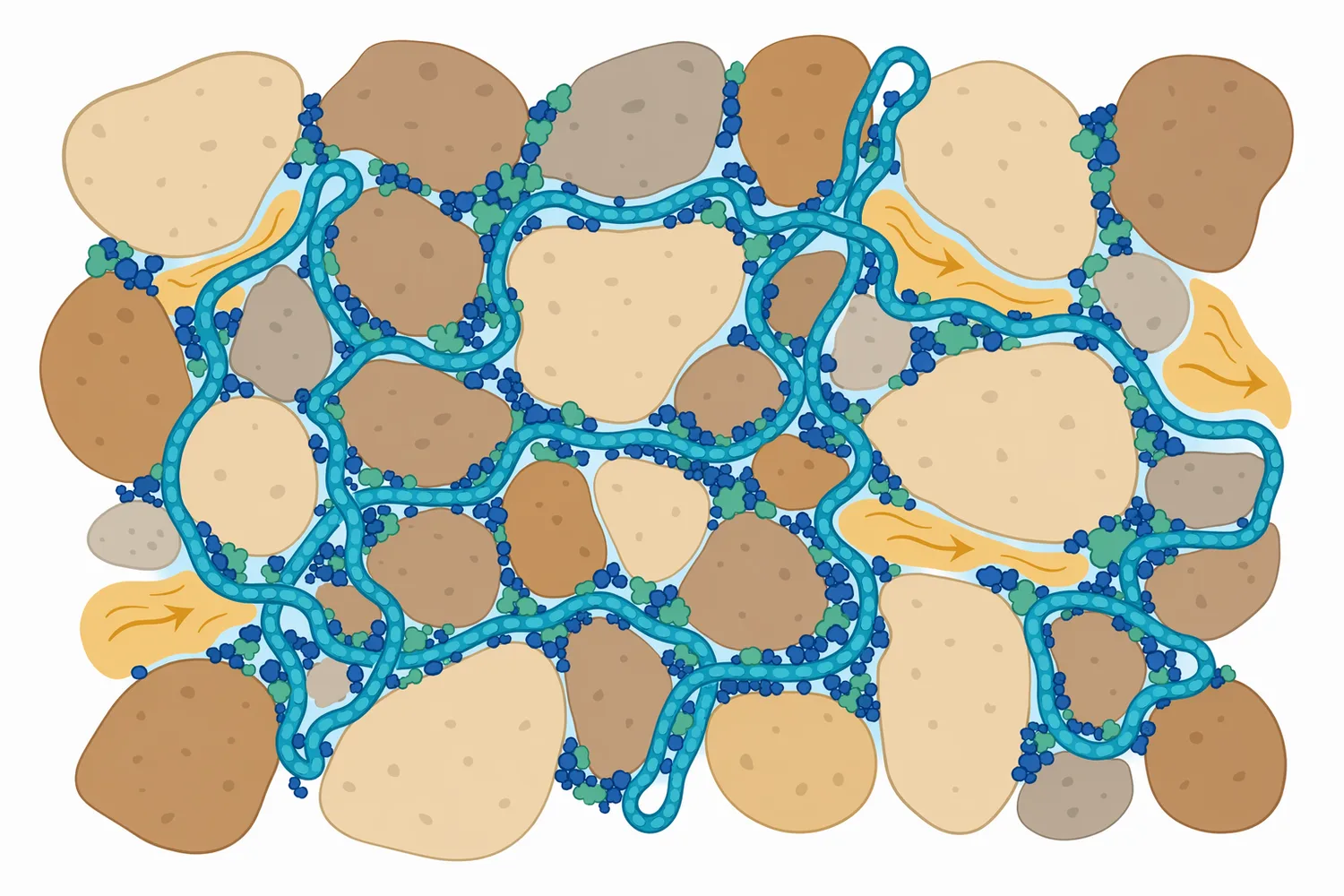
In lautering, the mash bed is both a filter and a porous medium. High beta-glucan increases liquid viscosity and can reduce permeability by making fine particles and soluble gums behave as a denser, more resistant layer. Cutting beta-glucan chains lowers the resistance of the liquid phase and can reduce the tendency of the bed to blind or compact under differential pressure [3].
The benefit is typically seen as more predictable run-off rather than as a dramatic change in extract chemistry. The wort may flow more readily through the grain bed, recirculation can stabilize sooner, and sparging may proceed with less risk of slow collection when beta-glucan was a major contributor to the problem [2].
Beta-glucans that survive into wort and beer can affect filtration after fermentation. In beer filtration, the issue is no longer access to starch inside the grain; it is the behavior of soluble high-molecular-weight material on filter surfaces. These polymers can contribute to pressure rise, reduced filtration throughput, and inconsistent clarification performance [4].
Historical brewing literature includes the use of filtration enzyme preparations with dominant beta-glucanase activity in beer brewing, showing that the connection between beta-glucan hydrolysis and filtration performance has long been recognized in applied brewing practice [8]. Modern use follows the same principle: reduce the polymeric gum load before it becomes a filtration constraint.
Beta-glucanase can also be relevant outside conventional beer lautering. Malt extracts, cereal-based beverages, low- or no-alcohol malt drinks, and specialty wort streams can all contain hydrated cereal beta-glucans. Where viscosity control is important for pumping, separation, clarification, or downstream blending, beta-glucanase can be used as a targeted enzyme for the beta-glucan fraction [1].
In these applications, the enzyme’s value is still based on the same chemical event: cleavage of beta-linked glucan chains. The process format may differ from a brewhouse mash, but the physical result—lower polymer chain length and reduced viscosity contribution—remains the core reason beta-glucanase is used [6].
The mechanistic basis is well established: beta-glucanases hydrolyze beta-glucan polymers, and barley beta-glucanase research has characterized the products formed when barley beta-D-glucan is enzymatically cleaved. This supports the brewing interpretation that beta-glucanase works by changing beta-glucan molecular size and structure, not by altering starch or fermentable sugar production directly [6].
Brewing-specific work has also connected beta-glucanase-dominant enzyme preparations with filtration applications. The 1987 brewing publications on filtration enzymes with dominant beta-glucanase activity are important historically because they place the enzyme in the same applied context used today: managing beer and wort filtration problems associated with beta-glucan-rich material [8].
Malt research further supports the importance of enzyme variation. The 2021 study of 94 commercially produced malt batches profiled enzymes related to malt fermentability, lautering, and beer filtration, demonstrating that lautering and filtration performance are connected to measurable malt enzyme and composition differences across real commercial malt lots [5].
Filtration research in beer production also reinforces the practical importance of reducing materials that load or blind filtration systems. Centrifugation and filtration technologies can affect beer quality and process performance, but upstream reduction of troublesome soluble polymers remains a logical way to reduce stress on downstream separation steps [4].
The broader enzyme engineering literature shows why commercial beta-glucanases are not all identical. Work reviewing protein engineering strategies for beta-glucanase focuses on catalytic activity, thermostability, and acid/base stability, which are exactly the properties that influence how well an enzyme survives and acts in warm, mildly acidic cereal-processing environments [7].
Beta-glucanase needs access to hydrated beta-glucan. That is why timing matters. If the enzyme is added after the mash has already reached temperatures that inactivate the relevant activity, or after the beta-glucan problem has already carried into filtration, its opportunity to change lautering behavior is reduced. Early mash contact is generally more meaningful than late correction because the enzyme can act before the mash bed is asked to perform as a filter [2].
Temperature and pH affect all brewing enzymes. Traditional brewing guidance places beta-glucanase activity in a lower-temperature rest range, while modern microbial enzyme preparations may be designed for broader processing conditions. The important brewing principle is that enzyme performance follows the environment: useful activity exists only where the enzyme remains folded, soluble, and able to bind its substrate [7].
Mash composition also matters. A thin mash can allow easier enzyme diffusion, while a very thick or highly adjunct-loaded mash can slow mixing and hydration. Fine milling may increase extract access but can also increase bed resistance if beta-glucan and fine particles combine into a compact layer. Beta-glucanase addresses the soluble gum component, but it does not override physical constraints created by milling, vessel geometry, or overloaded filtration area [4].
Because beta-glucanase acts on a non-starch polysaccharide, its use should be coordinated with the broader mash program rather than treated as a replacement for it. Starch gelatinization, saccharification, protein modification, wort pH, and mash separation still need to be managed in the normal way. Beta-glucanase adds a cell-wall hydrolysis function aimed at improving the flow behavior of beta-glucan-rich mash and wort [2].
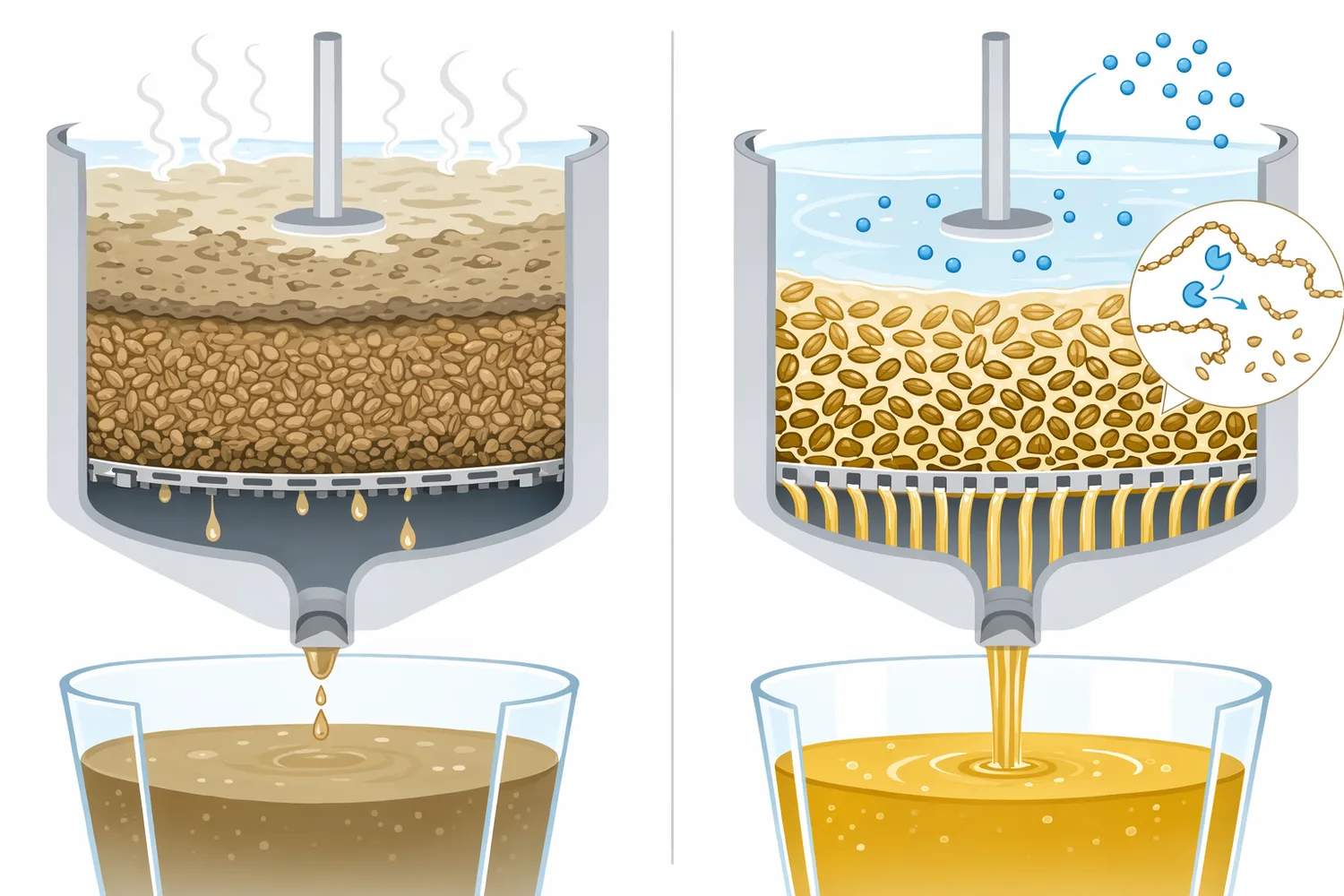
The most direct expected benefit is reduced viscosity when beta-glucans are present at levels that affect flow. This can make mash transfer, recirculation, lautering, and wort collection easier. The effect is strongest when beta-glucan is truly one of the limiting causes of poor separation; it may be small or unnoticeable in well-modified, low-beta-glucan grists that already run cleanly [3].
A second benefit is more predictable lautering. By shortening beta-glucan chains before they form a resistant gum network in the mash bed, beta-glucanase can help reduce slow run-off events associated with oats, rye, wheat, unmalted barley, or under-modified malt. This is especially useful where a recipe is intentionally designed with grains known to increase viscosity [2].
A third benefit is reduced stress on downstream clarification and filtration. If less high-molecular-weight beta-glucan survives into wort and beer, filtration media may face a lower gum load. Filtration performance depends on many factors, including yeast, protein-polyphenol complexes, particles, filter type, and beer temperature, but beta-glucanase addresses one well-known contributor to filtration resistance [4].
A fourth benefit is consistency. Commercial malt batches vary, adjunct raw materials vary, and recipe changes can shift the beta-glucan burden. Using a targeted beta-glucanase can help smooth some of that raw-material variation by reducing the process impact of cereal beta-glucan chain length before separation begins [5].
Beta-glucanase is not a universal cure for stuck mashes. If the root cause is over-milling, excessive fine particles, poor false-bottom design, inadequate mixing, very high bed depth, incorrect mash thickness, or aggressive pump suction, the enzyme may help only partly or not at all. It reduces beta-glucan viscosity; it does not redesign the lauter tun or remove all suspended solids [4].
It also does not replace amylases. A mash still needs sufficient starch conversion to produce the intended wort composition. Beta-glucanase can improve physical access and flow by degrading cell-wall gums, but fermentability and attenuation depend mainly on starch-degrading enzymes and mash schedule [2].
The enzyme’s effect depends on substrate presence. In a highly modified all-malt grist with low beta-glucan load and no run-off or filtration issue, there may be little visible improvement because there is little beta-glucan-related resistance to remove. This is why beta-glucanase is best understood as a targeted tool for beta-glucan-rich or beta-glucan-sensitive processes [3].
Finally, “beta-glucanase” is a functional category, not a guarantee that every enzyme preparation behaves identically. Different beta-glucanases can prefer different beta-linkages, tolerate different processing environments, and generate different oligosaccharide profiles. The brewing-relevant function is hydrolysis of cereal beta-glucans under the conditions in which the enzyme is used [7].
Beta-Glucanase Brewing Enzyme Liquid supplied by Enzymes.bio is offered as a brewing enzyme product for beta-glucan management. It is sold directly online by the 1 kg unit, with online payment, order processing, and shipment through the Enzymes.bio product page .
The product is best viewed as a process aid for brewers working with beta-glucan-related viscosity, lautering, run-off, or filtration constraints. It is not positioned as a substitute for good brewing practice, recipe design, malt handling, mash control, or filtration management; it is a targeted enzyme for reducing the process impact of cereal beta-glucans [2].
A Certificate of Analysis and Safety Data Sheet come with the order. Those documents support normal receiving and safe-use handling for the purchased product, while this article provides educational context on why beta-glucanase is used in brewing and how it acts on cereal beta-glucan substrates .
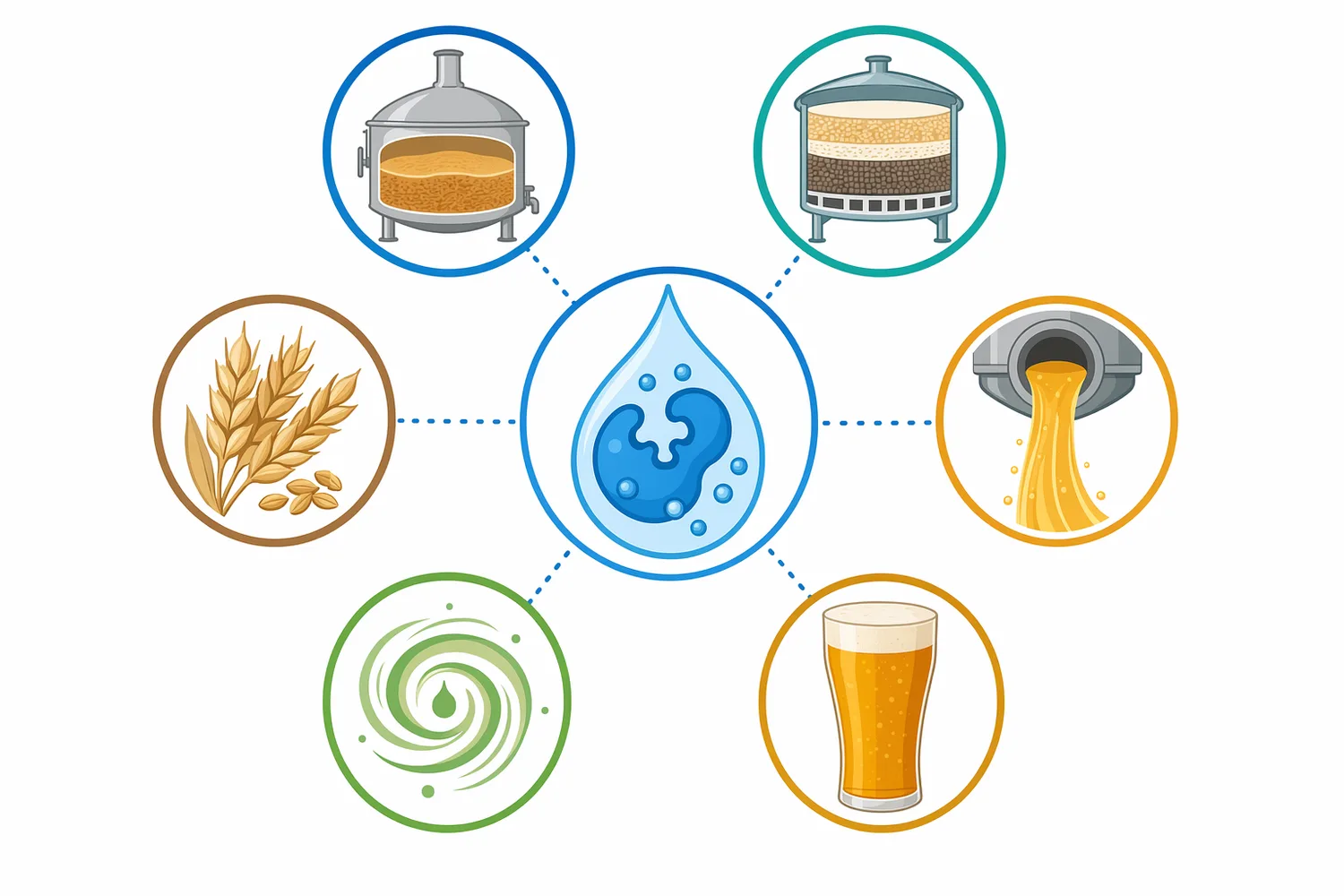
Beta-Glucanase Brewing Enzyme Liquid is most useful when the brewing process is limited by beta-glucan-rich raw materials or by malt variation that leaves too much soluble cell-wall gum in the mash or wort. Its mechanism is concrete: it cleaves long mixed-linkage beta-glucan chains into shorter fragments, lowering their viscosity contribution and reducing the tendency of mash and beer filtration systems to encounter gum-related resistance [6].
For grists containing oats, rye, wheat, unmalted barley, flaked cereals, or under-modified malt, beta-glucanase can support smoother lautering, more predictable wort run-off, and reduced downstream filtration stress. For well-modified all-malt grists already running cleanly, the benefit may be limited because beta-glucan is not the main process constraint [2].
Enzymes.bio supplies the product online in 1 kg units for buyers who want a straightforward way to purchase a brewing beta-glucanase process aid. The order is placed and paid for online, then processed and shipped with the accompanying Certificate of Analysis and Safety Data Sheet .
Sold by the 1 kg unit, in stock and ready to ship. Order directly on our store — pay online and we process your order. A Certificate of Analysis and Safety Data Sheet are included with every order.
Buy Beta-Glucanase Brewing Enzyme 13,000 U/G Liquid →Numbered in order of first citation. Open-access sources, each verified reachable at publication; citation numbers in the text link here.