
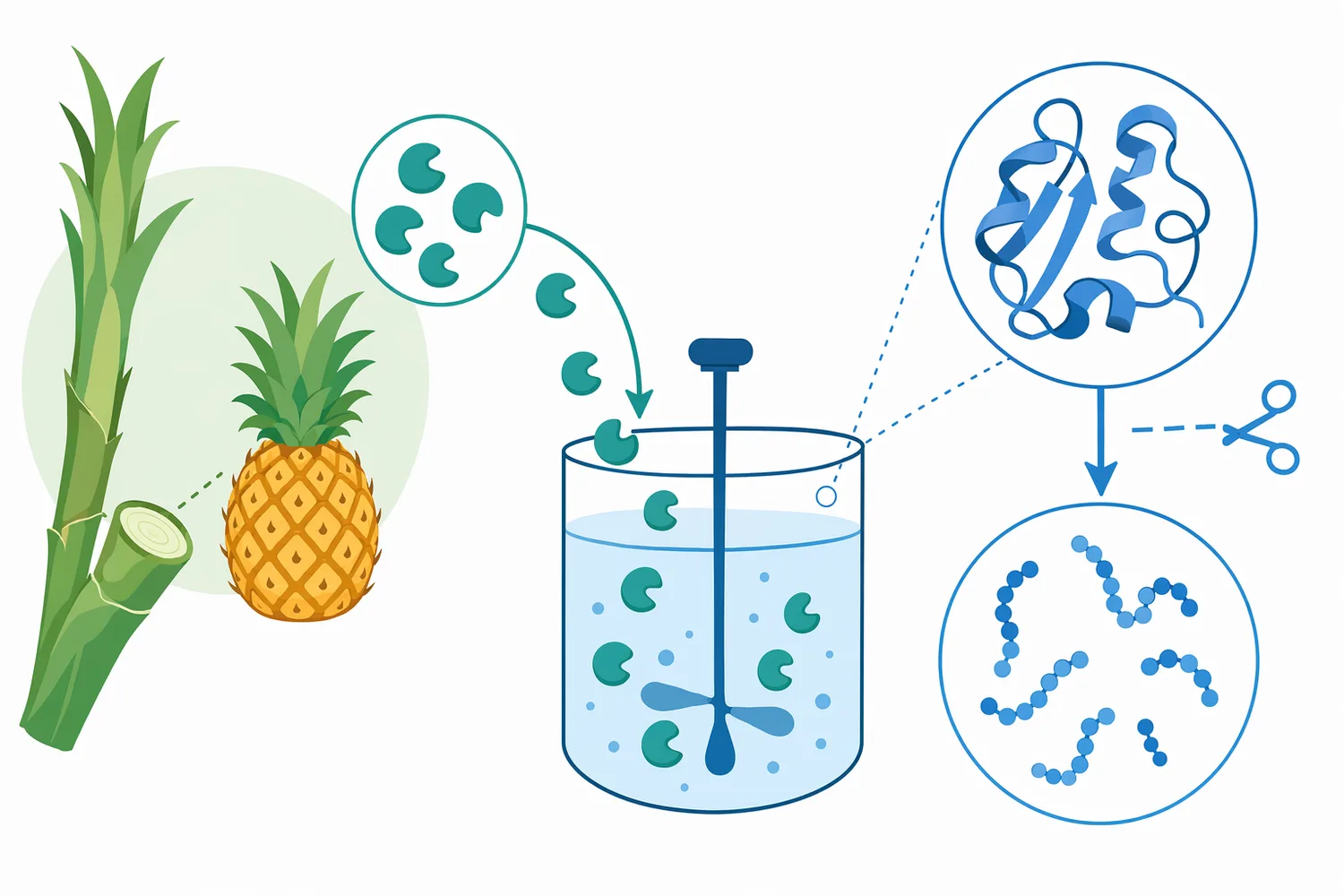
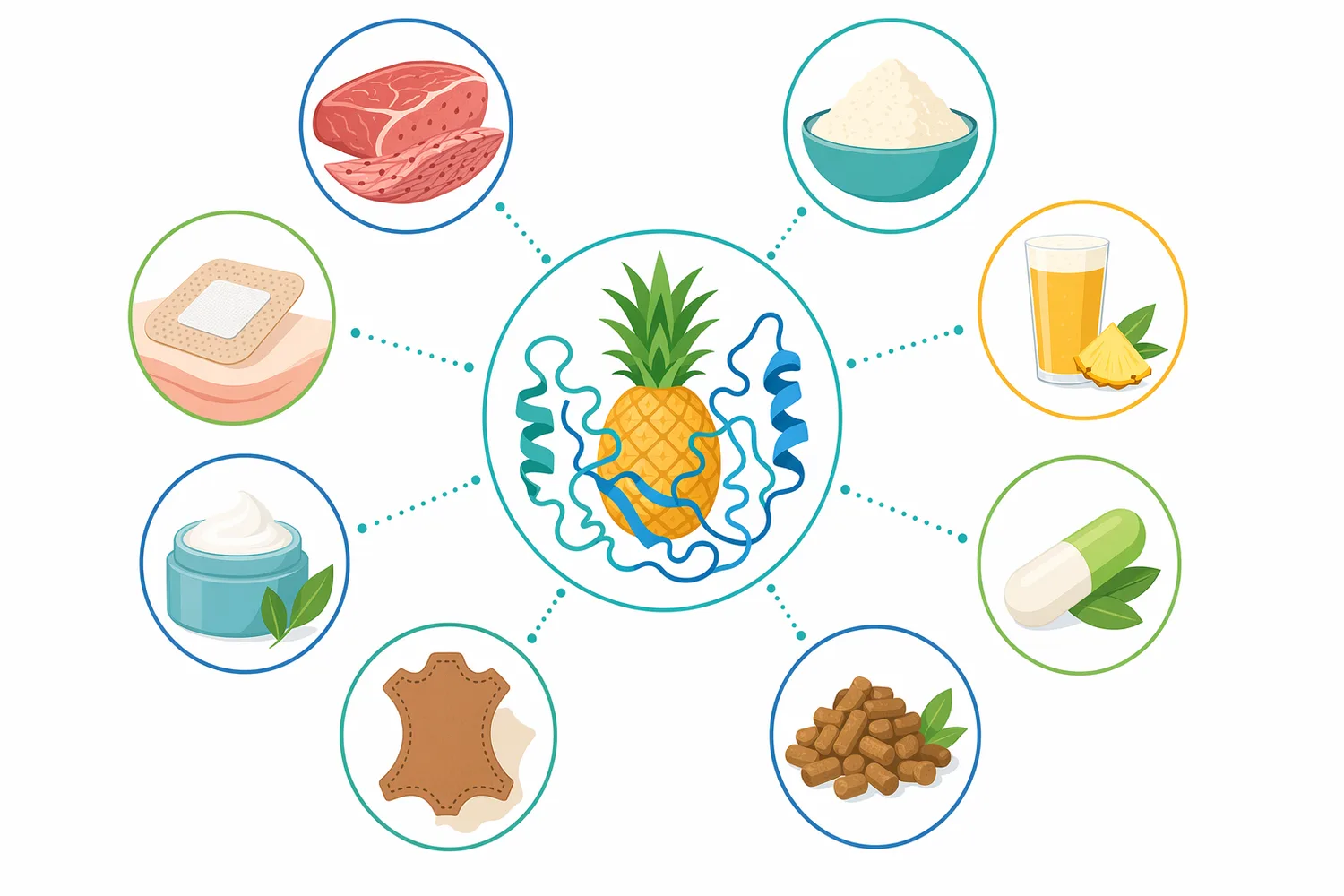
Bromelain is a pineapple-derived protease complex used to hydrolyze proteins into smaller peptides and soluble fragments. In practical processing terms, it helps weaken protein structures, soften protein-rich materials, and change how proteins bind water, oil, and other ingredients.
Enzymes.bio supplies Bromelain Pineapple Enzyme Protein Hydrolysis Biological Enzyme Preparation directly online by the 1 kg unit. After online payment, the order is processed and shipped, and the product is supplied with a Certificate of Analysis and Safety Data Sheet.
Bromelain is not best understood as one single enzyme molecule. In commercial and scientific use, it is generally described as a group of proteolytic enzymes associated with pineapple, especially the stem and fruit of Ananas comosus; authoritative health and scientific summaries describe bromelain as enzymes that break down proteins [1].
The central application is protein hydrolysis. A protein is a chain of amino acids held together by peptide bonds, folded into a structure that may be tough, insoluble, viscous, elastic, or resistant to processing. Bromelain cleaves peptide bonds in accessible regions of the protein, turning large protein molecules into shorter peptides and fragments; those fragments often behave differently in water, oil, gels, emulsions, and tissue matrices [2].
That makes bromelain useful where a buyer wants a plant-derived protease for controlled protein breakdown rather than purely chemical hydrolysis. Reviews describe bromelain as a pineapple proteolytic complex with relevance across food, biomedical, pharmaceutical, cosmetic, and related technical uses, although the strongest general-purpose claim remains its ability to degrade proteins [3].
For Enzymes.bio customers, the product is most appropriately viewed as an enzyme ingredient for protein hydrolysis, food-processing trials, formulation work, and other non-diagnostic technical applications. Enzymes.bio is a supplier; the product is available for direct online purchase in 1 kg units, with order documentation supplied after purchase and shipment .
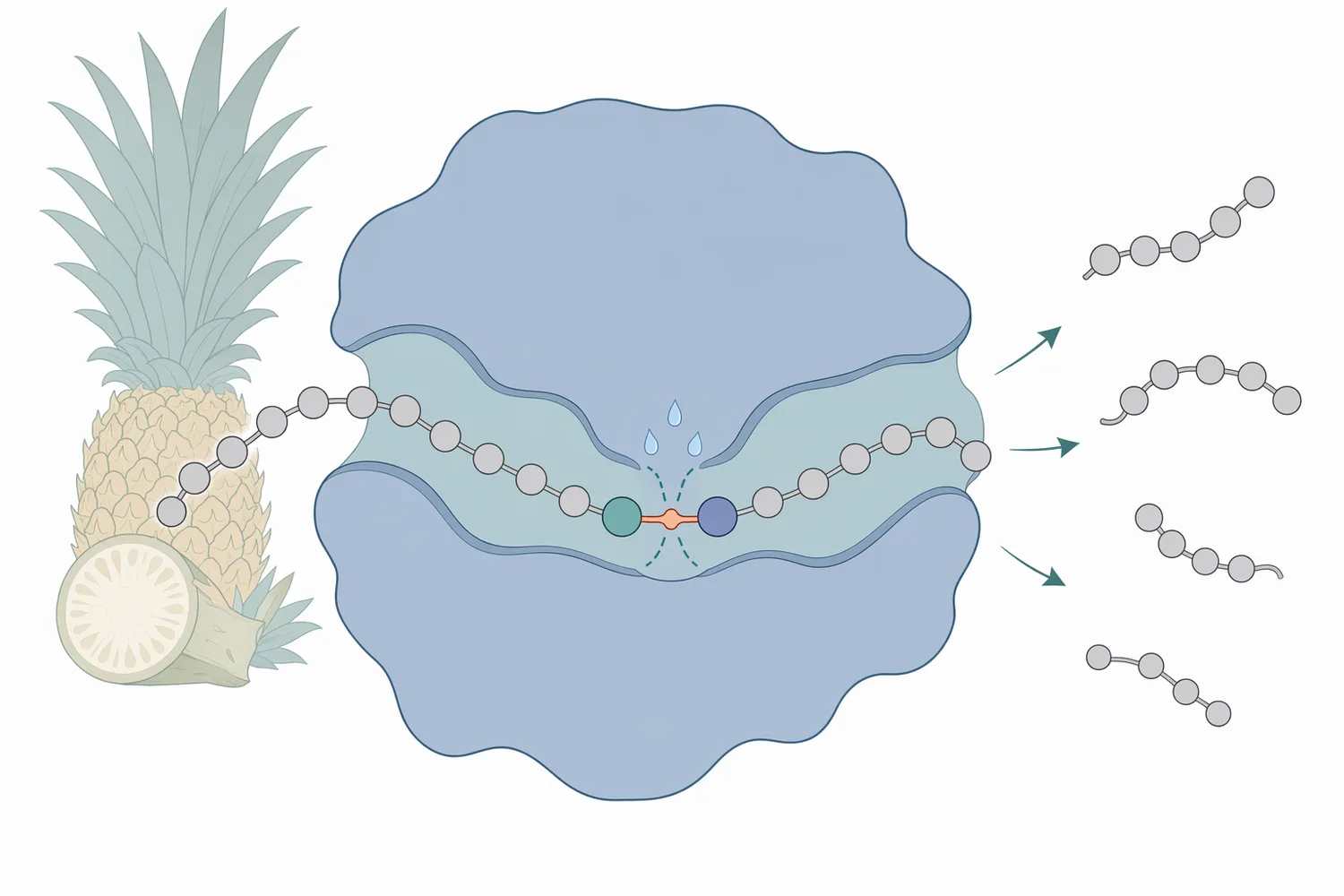
Bromelain belongs to the broader class of proteases: enzymes that catalyze the cleavage of peptide bonds. In a protein matrix, this means the enzyme contacts exposed regions of a folded or partially unfolded protein, catalyzes bond cleavage, and progressively reduces the average molecular size of the protein material [4].
Mechanistically, bromelain is commonly discussed with plant cysteine proteases. These enzymes use an active-site sulfur-containing group to attack the carbonyl carbon of a peptide bond, forming a short-lived enzyme–substrate intermediate; water then participates in releasing the cleaved peptide products. The practical outcome is not “dissolving” protein in a vague sense, but cutting long chains into shorter segments that can hydrate, disperse, or soften differently [4].
The extent of hydrolysis matters. Light hydrolysis may loosen a structure while preserving some body or bite, whereas deeper hydrolysis can produce softer texture, lower viscosity, greater solubility, and more free peptides. Excessive hydrolysis can also cause mushy texture in foods or generate bitter peptide notes, because short hydrophobic peptides are a known contributor to bitterness in protein hydrolysates [5].
Protein accessibility is equally important. Compact, crosslinked, highly crystalline, or structurally protected proteins are harder for a protease to attack than swollen, hydrated, denatured, or finely dispersed proteins. This is why processing conditions such as moisture, mixing, particle size, thermal history, and contact time influence the observed effect even when the same enzyme is used [3].
Bromelain should therefore be understood as a controlled biological cutting tool. It does not convert every protein substrate in the same way, and it does not replace specialized enzymes for every resistant material. Its strength is broad proteolytic action on suitable protein matrices, especially where a pineapple-derived enzyme is desired [6].
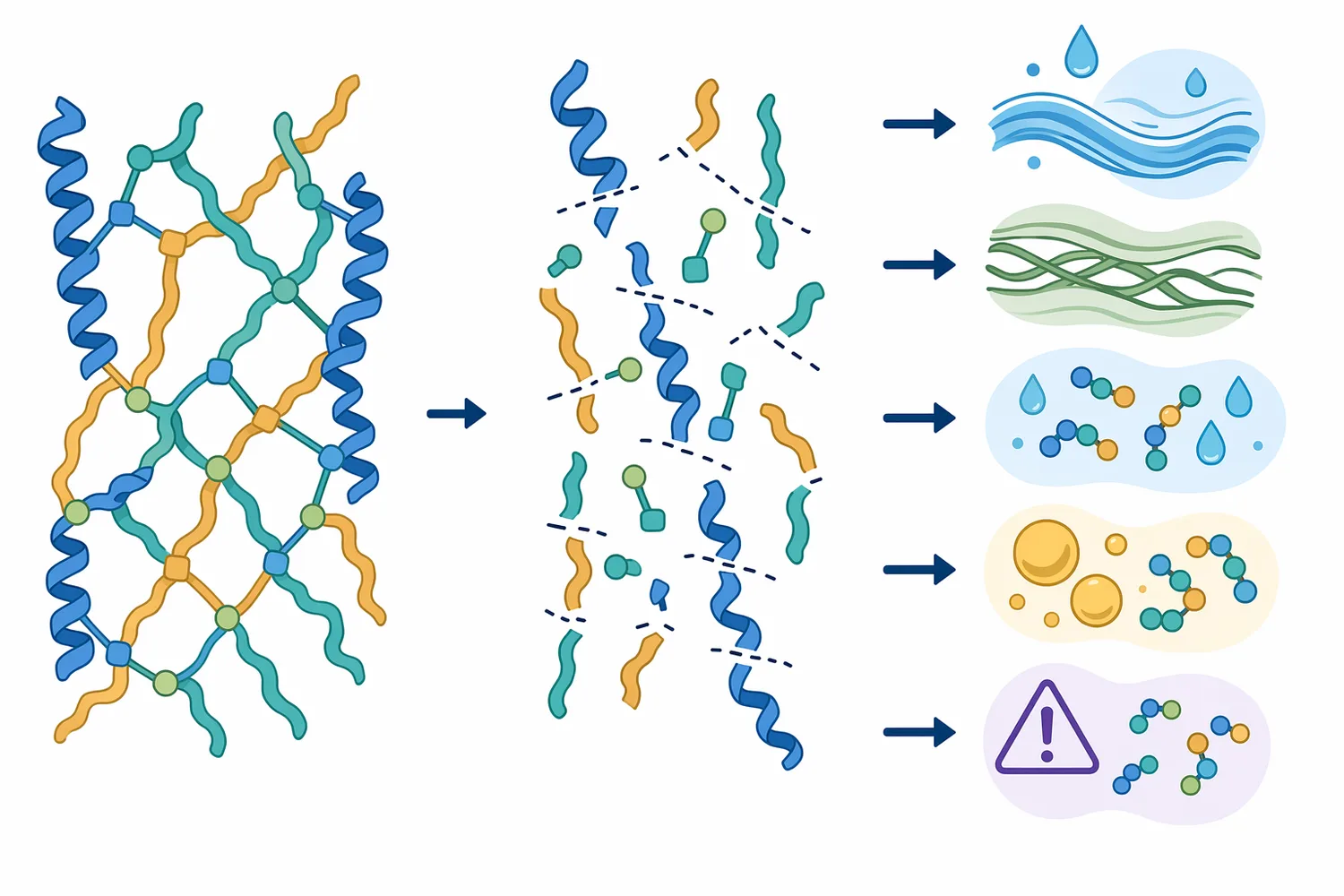
When bromelain acts on a protein ingredient, the first measurable change is molecular size reduction. Large protein chains and aggregates are partially cleaved, increasing the proportion of shorter peptides and soluble fragments. These smaller fragments have more chain ends, altered charge exposure, and different surface properties than the original intact protein [2].
Those molecular changes can translate into processing changes. A protein slurry may become less viscous because large networks are cut into shorter chains. A meat or collagen-containing matrix may become softer because structural proteins are weakened. A plant-protein dispersion may hydrate differently because buried polar or hydrophobic regions are exposed after cleavage [5].
Hydrolysis also changes water interaction. Intact proteins can trap water in a gel-like structure or exclude water if they are poorly soluble; partial hydrolysis can expose additional polar groups, increase dispersibility, and modify swelling behavior. At the same time, too much hydrolysis can reduce the ability to form strong gels because the long chains needed for a network have been shortened [3].
Oil interaction can change for the same reason. Cutting a protein can expose hydrophobic amino-acid regions that were previously buried inside the folded structure, which may improve interaction with fat phases in certain emulsified or filled systems. But if peptides become too small, they may no longer stabilize interfaces as effectively as larger amphiphilic protein fragments [5].
Flavor can also change. Hydrolysates often have a more complex taste profile than the starting protein because peptides and amino-acid fragments contribute their own sensory properties. Reviews of protein hydrolysates repeatedly note bitterness as a practical limitation, especially when hydrophobic peptide fragments accumulate [5].
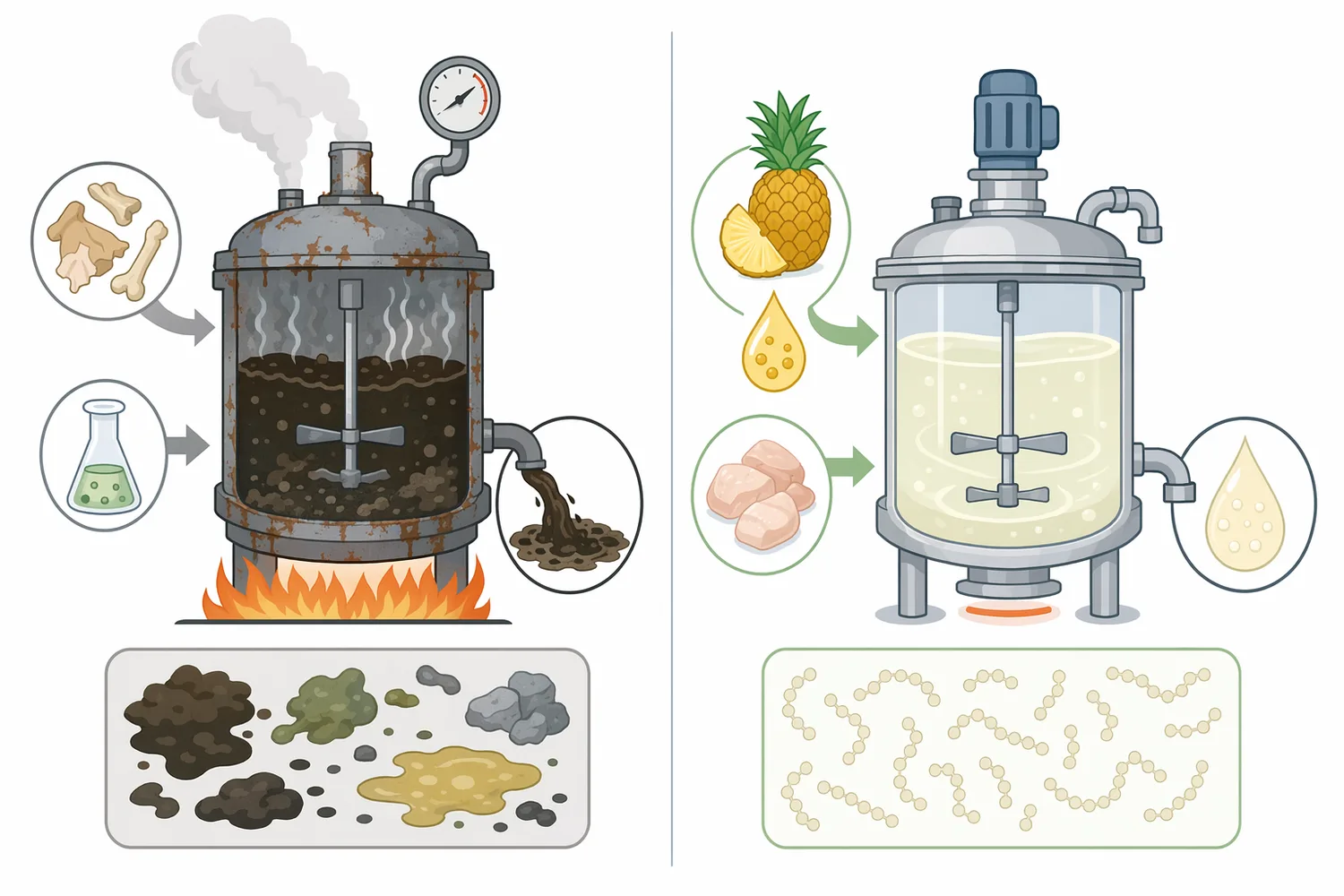
The table below is not a selection checklist; it is a process-level comparison showing how bromelain differs conceptually from other common ways to break down proteins.
| Protein-breakdown route | How it acts on the substrate | Typical processing character | What changes in the protein material | Main practical limitation |
|---|---|---|---|---|
| Bromelain enzymatic hydrolysis | Protease-catalyzed cleavage of accessible peptide bonds | Biological, comparatively selective, plant-derived | Shorter peptides, softer protein structures, altered solubility and water/oil interaction | Performance depends on protein accessibility and process control |
| Other protease hydrolysis | Enzyme-specific cleavage based on the protease type | Biological and selective, but with different substrate preferences | Peptide profiles vary by enzyme, substrate, and conditions | One protease rarely performs best on every protein |
| Acid hydrolysis | Chemical cleavage under acidic conditions | Less enzyme-specific, typically harsher than enzymatic treatment | Broad breakdown of protein chains and side-chain changes may occur | Can damage sensitive amino acids and alter flavor or color |
| Alkaline hydrolysis | Chemical cleavage under alkaline conditions | Strong chemical treatment, useful for some resistant matrices | Protein chains are broken and chemically modified | Can create unwanted chemical changes if not tightly controlled |
| Heat-only treatment | Denaturation rather than targeted peptide-bond cleavage | Physical unfolding and aggregation | Proteins unfold, aggregate, gel, or precipitate | Does not reliably generate controlled peptide hydrolysates |
Enzymatic hydrolysis is valuable because it can target peptide bonds under milder processing conditions than many chemical methods. Reviews of bromelain processing emphasize its proteolytic role and its use in contexts where controlled biological protein modification is useful [3].
Bromelain is widely associated with meat tenderization because meat toughness depends heavily on protein structure. Muscle contains myofibrillar proteins that create contraction and bite, connective-tissue proteins such as collagen that contribute chewiness, and a hydrated protein matrix that changes during aging, heating, marination, and processing [6].
When bromelain is applied to a suitable meat system, it cleaves accessible muscle and connective-tissue proteins. This weakens the structural continuity of the tissue: fibers separate more easily, collagen-containing regions lose some resistance, and the bite can become softer. The value is not simply “adding pineapple enzyme,” but using proteolysis to reduce the mechanical strength of tough protein networks [2].
The same mechanism can become a risk if uncontrolled. Too much enzyme action can move the product from tender to overly soft, pasty, or surface-degraded, especially if the enzyme remains active for too long before cooking or stabilization. Reviews of bromelain in food and animal-product contexts identify meat tenderization as a major use while also recognizing that protease behavior depends on the matrix and treatment conditions [6].
Collagen is a structural protein with a tough, fibrous architecture. Bromelain’s ability to disrupt collagen-containing systems is relevant not only to food texture but also to broader biological-material processing. A study on fish-collagen disintegration in a mucoadhesive patch context used bromelain specifically because of its proteolytic capacity against collagen-based material [7].
The practical change in collagen-rich systems is matrix weakening. Rather than dissolving the entire structure instantly, proteolysis progressively cuts accessible protein regions, increases fragmentation, and reduces the cohesive strength of the matrix. In applications where collagen toughness is a barrier, bromelain can therefore contribute to softening, partial solubilization, or controlled breakdown [7].
Medical debridement literature provides another mechanistic example, although it should not be read as a claim for this industrial product. Reviews describe bromelain-based enzymatic debridement as acting on denatured proteins and damaged tissue matrices in wound environments, illustrating the enzyme complex’s capacity to digest protein-rich biological material under appropriate professional-use conditions [8].
Plant proteins can be difficult to formulate because they often have compact globular structures, limited solubility, beany or bitter notes, and variable hydration behavior. Partial proteolysis can open those structures and generate fragments with different dispersibility, surface activity, and water interaction than the intact protein [5].
For plant-protein systems, bromelain can be used to create hydrolysates or to adjust functional properties in a formulation-development setting. The mechanism is direct: peptide-bond cleavage reduces molecular size, exposes internal amino-acid regions, and changes how the protein interacts with water, fat, minerals, starches, gums, and other formulation components [3].
This is especially relevant for plant-based foods, nutrition powders, fillings, sauces, bakery systems, and blended protein products where the original protein may be too gritty, viscous, poorly hydrated, or texturally rigid. The process must still be controlled, because the same hydrolysis that improves dispersibility may reduce gel strength or create bitter peptides if allowed to proceed too far [5].
Bromelain can also be relevant in soluble protein systems such as dairy proteins, whey-derived materials, and mixed protein beverages. In these systems, the enzyme acts on proteins that are already dispersed or partially soluble, which can make hydrolysis more uniform than in dense tissue matrices [3].
The practical goal is often to reduce molecular size, modify viscosity, generate peptide-rich material, or change how the protein behaves during heating and formulation. Because dairy proteins differ structurally from meat or legume proteins, the peptide profile and functional outcome will not be identical even under similar processing concepts [5].
In soluble systems, hydrolysis can be easier to overshoot because the enzyme can contact the substrate more evenly. Controlled contact time and downstream stabilization are therefore important process concepts, even though the exact treatment design depends on the product and the intended use [3].
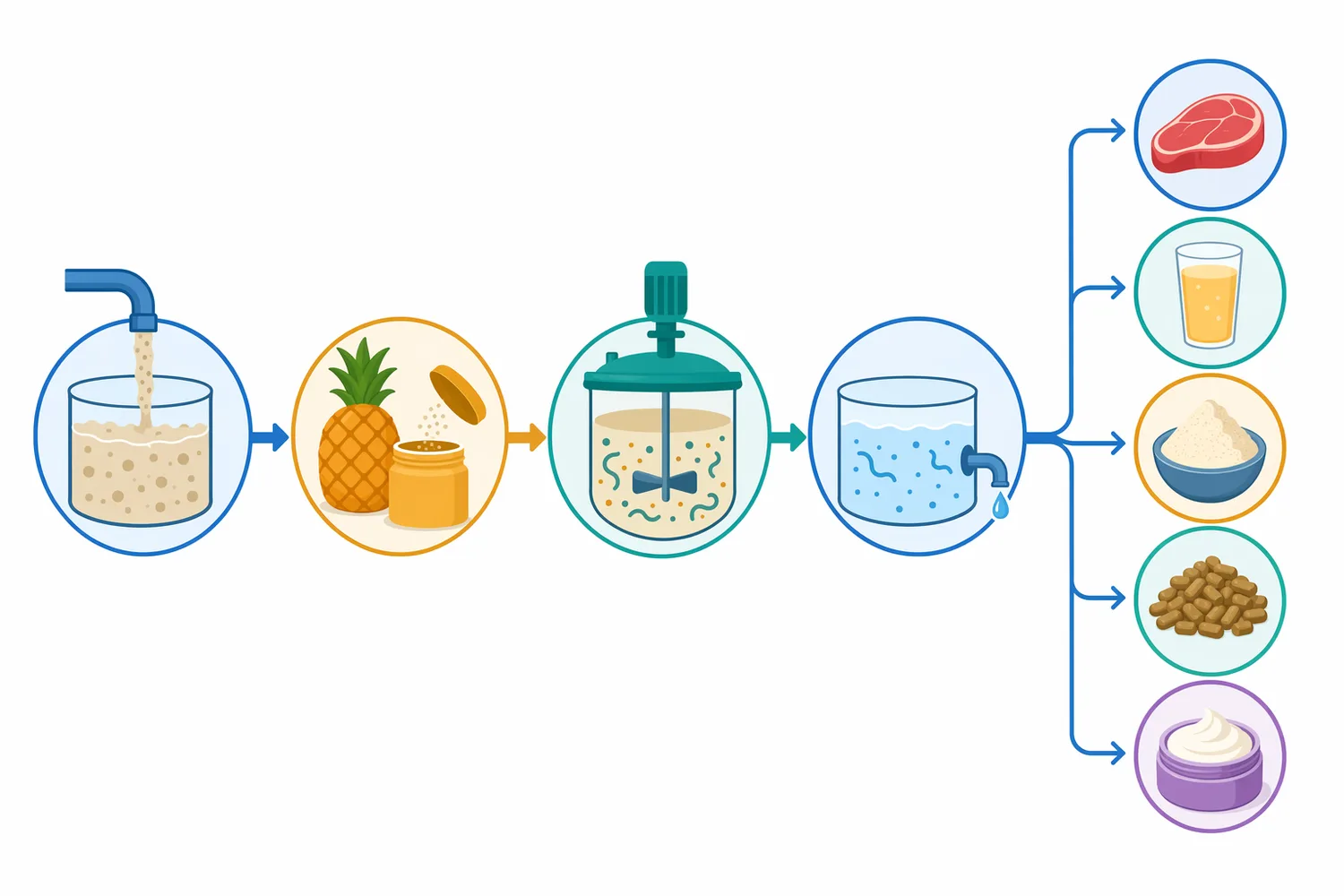
Bromelain works only when it can physically contact its protein substrate in an environment compatible with enzyme action. A dry powder blend with little available water will not hydrolyze in the same way as a hydrated slurry, marinade, or aqueous protein dispersion. Water allows proteins to swell and allows the enzyme and substrate to diffuse into contact [3].
Temperature affects both reaction speed and enzyme stability. As with most enzymes, warmer conditions generally accelerate molecular motion and can increase hydrolysis rate up to the point where the enzyme structure begins to lose activity. Excessive heat can denature the enzyme, while low temperatures slow the reaction [4].
pH affects protein charge, protein unfolding, and enzyme conformation. A substrate may become more or less soluble depending on the pH environment, and the enzyme’s active-site chemistry also depends on its ionization state. For bromelain, the important processing idea is not a single universal pH number, but the interaction between enzyme activity, protein solubility, and the target product structure [3].
Contact time determines the degree of hydrolysis. Short treatment may loosen a protein network or create a lightly modified ingredient; long treatment can generate smaller peptides, reduce viscosity further, and increase the risk of bitter taste or excessive softening. Time is therefore a functional control point, not just an operational detail [5].
Mixing and substrate preparation influence uniformity. In meat, surface application can produce stronger effects near the surface than in the interior unless the process is designed for penetration. In plant-protein slurries, dispersion quality affects how evenly the enzyme reaches protein particles. In collagen-containing materials, particle size and hydration influence how much surface area is available for cleavage [6].
Stopping or limiting the reaction is also part of controlled use. Many processes rely on downstream heating, drying, formulation change, or other process steps that reduce enzyme mobility or activity. Without a limiting step, hydrolysis may continue longer than intended, especially in moist systems [3].
In meat processing, bromelain is used for the concrete purpose of weakening tough protein structures. It can help soften tougher cuts, improve bite, and support more consistent tenderness when applied under controlled conditions. Reviews of bromelain’s beneficial properties and food uses repeatedly identify meat tenderization as one of its best-known applications [6].
The mechanism is structural protein cleavage. Muscle fibers, connective tissue, and protein junctions contribute to toughness; bromelain cuts accessible peptide bonds in those materials, reducing mechanical resistance. The resulting texture change can be useful in marinated meats, further-processed meat products, and protein preparations where tenderness or softening is desired [2].
Protein hydrolysates are produced when proteins are intentionally broken into peptide-rich mixtures. These hydrolysates may disperse differently, digest differently in formulation contexts, or provide different texture and mouthfeel than intact proteins. Bromelain’s role is to generate those peptides through enzymatic cleavage [5].
This application is relevant to protein beverages, powders, savory systems, sauces, and functional-food development. However, hydrolysate design is not only about maximizing breakdown. A usable hydrolysate needs the right balance of solubility, viscosity, taste, color, and compatibility with the rest of the formulation [3].
Plant-based meat analogues, hybrid meat-plant blends, and high-protein foods often depend on carefully managed water binding and texture. If a plant protein hydrates poorly or forms an overly rigid structure, partial hydrolysis can help alter its behavior. Bromelain can contribute by cutting protein chains and changing the surface characteristics of the resulting fragments [5].
The result can be improved dispersion or a different balance between firmness and juiciness, depending on how the hydrolysate is incorporated. The same reaction can also reduce structure if overused, so bromelain is best considered a texture-modifying tool rather than a universal plant-protein fix [3].
Protein-related haze, sediment, or instability can occur in beverages when proteins aggregate, interact with polyphenols, or lose solubility during storage. Proteolytic enzymes can reduce the size of haze-forming proteins or alter their aggregation behavior. Bromelain has been discussed in broader food and beverage application reviews because of this protein-modifying capability [6].
In such systems, the intended result is usually not deep hydrolysis but targeted reduction of problematic protein behavior. The balance is important: too little hydrolysis may not address the issue, while too much can affect flavor, body, foam, or nutritional positioning [5].
Outside food, bromelain is discussed in cosmetics, topical systems, textile-related processing, and leather-related applications because many of these materials contain proteins or protein-like residues that can be modified enzymatically. Reviews of bromelain chemistry and applications describe its relevance across food, pharmaceutical, cosmetic, and technical sectors [5].
The common mechanism remains proteolysis. In a cosmetic or topical exfoliating concept, protease action may help loosen proteinaceous material at a surface. In textile or leather-related contexts, proteolysis can help modify or remove protein components. The regulatory and formulation requirements differ by sector, but the underlying enzyme action is the same [4].
The strongest evidence for bromelain is its identity as a pineapple-derived proteolytic enzyme complex and its ability to break down proteins. That claim is consistent across scientific reviews, health-information summaries, and application-focused bromelain literature [1].
There is also a strong practical basis for bromelain in protein hydrolysis and food-processing contexts. Reviews describe bromelain’s use in meat tenderization, food processing, and protein modification, and the mechanism directly explains why it changes texture and hydrolysate properties [6].
Evidence becomes more application-specific when claims move from “breaks down proteins” to “produces a particular sensory, nutritional, or performance outcome.” The final result depends on substrate, process design, and formulation. Two protein materials can respond differently because their structures, accessibility, aggregation state, and competing ingredients differ [3].
Health-related claims require particular caution. Bromelain is widely discussed in therapeutic literature, including inflammation, wound care, and other biomedical contexts, but authoritative summaries note that evidence is limited or mixed for many oral uses and that specific medical applications should not be generalized to ordinary enzyme-ingredient use [1].
For a product page or customer-facing formulation document, the most supportable position is therefore clear: bromelain is a plant-derived protease for protein hydrolysis and protein-structure modification. Claims about disease treatment, clinical outcomes, or regulated medical use should not be inferred from the enzyme’s general proteolytic function [9].
Bromelain Pineapple Enzyme Protein Hydrolysis Biological Enzyme Preparation is useful when the processing goal is to modify a protein substrate biologically. The key value is controlled peptide-bond cleavage: reducing protein size, weakening tough matrices, altering hydration behavior, and creating peptide-rich hydrolysates [2].
Compared with harsh chemical treatment, bromelain offers a biological route to protein modification. It can operate in moist formulation environments and can be integrated into processing steps where the enzyme is later limited or inactivated by the broader process. This makes it attractive for food, ingredient, cosmetic, and technical applications where plant-derived proteolysis is preferred [5].
The product is sold directly online by Enzymes.bio in 1 kg units. The buyer places the order and pays online; the order is then processed and shipped, with a Certificate of Analysis and Safety Data Sheet supplied with the order .
In use, the most important expectation is realism. Bromelain is powerful because it cuts proteins, but that same action must be matched to the desired texture and hydrolysis level. A tough meat substrate, a hydrated plant-protein slurry, a collagen-containing matrix, and a soluble dairy protein system will not respond identically [6].
The best-supported applications are protein hydrolysis, meat tenderization, collagen-rich matrix softening, peptide-rich hydrolysate production, and functional modification of protein ingredients. Used as a controlled protease rather than a generic additive, bromelain can help turn difficult protein substrates into materials with more useful texture, solubility, dispersibility, and processing behavior [3].
Sold by the 1 kg unit, in stock and ready to ship. Order directly on our store — pay online and we process your order. A Certificate of Analysis and Safety Data Sheet are included with every order.
Buy Bromelain 600000 U/G Pineapple Enzyme Protein Hydrolysis Biological Enzyme Preparation →Numbered in order of first citation. Open-access sources, each verified reachable at publication; citation numbers in the text link here.