
Cellulase Enzyme for Bioethanol Production CAS 9012-54-8 is used to convert cellulose in plant biomass into fermentable sugars, mainly glucose and cellobiose, during the saccharification stage of lignocellulosic ethanol production. It is most useful after biomass pretreatment, when cellulose fibers are more accessible and can be hydrolyzed enzymatically before fermentation. Enzymes.bio supplies this cellulase product directly online by the 1 kg unit; buyers place and pay for the order online, and the order is processed and shipped with a Certificate of Analysis and Safety Data Sheet.
Cellulase is an enzyme preparation used to hydrolyze cellulose, the main structural carbohydrate in many agricultural residues, grasses, straws, bagasse streams, wood-derived materials, and food-processing byproducts. In bioethanol production, cellulase does not ferment sugar into ethanol; instead, it prepares the sugar by cutting insoluble cellulose into soluble carbohydrates that yeast or other ethanol-producing microorganisms can use in the fermentation stage. Reviews of second-generation bioethanol consistently identify enzymatic hydrolysis as one of the central conversion steps between pretreatment and fermentation because raw lignocellulosic biomass is naturally resistant to biological breakdown [1].
The CAS number 9012-54-8 refers to cellulase as an enzyme category rather than to a single small molecule. In practical use, “cellulase” usually means a cellulolytic enzyme system with complementary activities that act on different parts of the cellulose structure. Microbial cellulases are widely discussed in industrial biotechnology because fungi and bacteria can produce enzyme systems capable of attacking plant cell-wall polysaccharides under aqueous processing conditions [2].
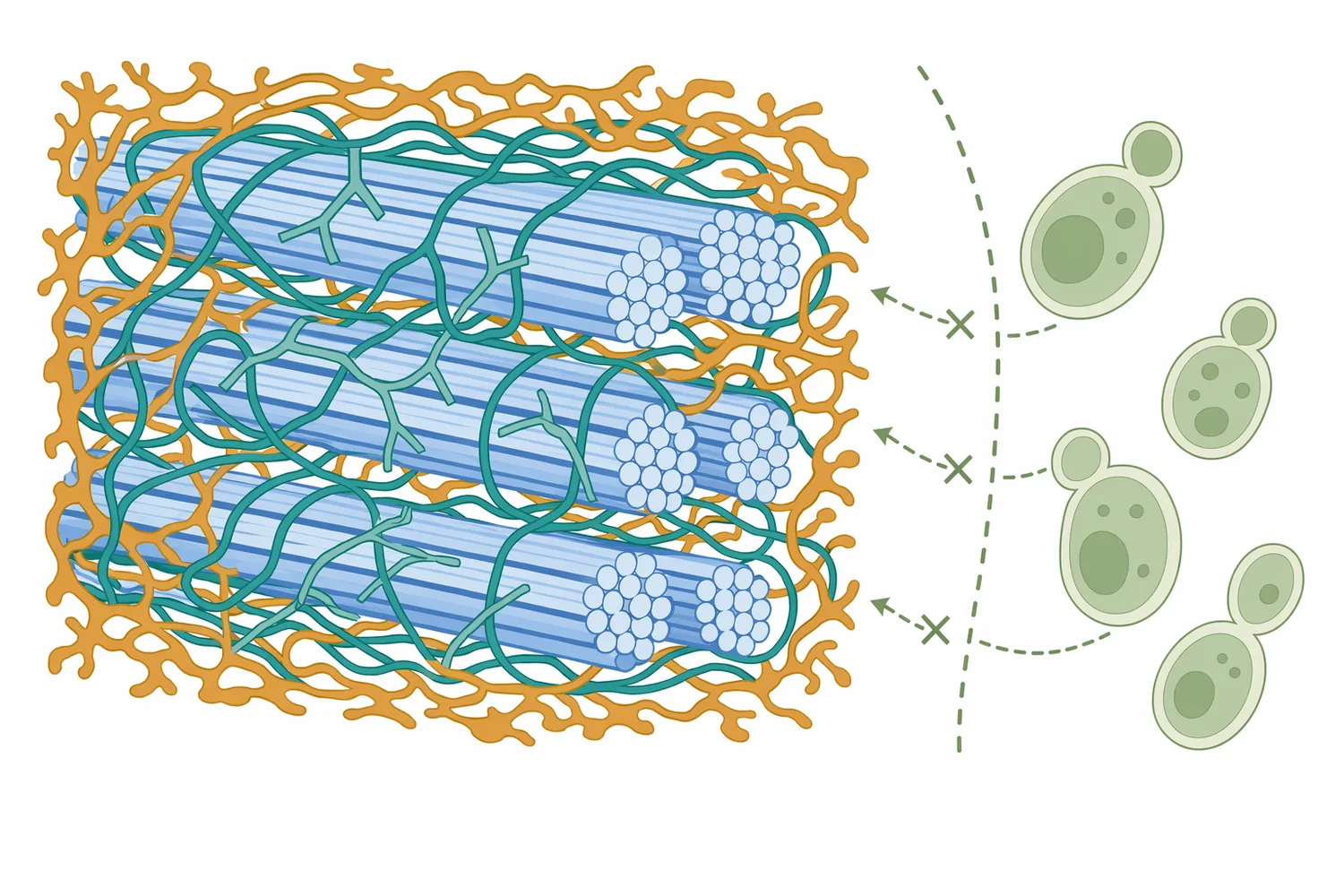
For a bioethanol workflow, cellulase is best understood as a saccharification aid. The enzyme helps release fermentable sugars from cellulose-rich solids after the plant material has been opened up by milling, heat treatment, liquid hot water processing, steam-based treatment, organosolv treatment, dilute-acid treatment, alkaline treatment, biological preparation, or another pretreatment strategy. Pretreatment reviews emphasize that this upstream step is important because cellulose is embedded inside a matrix of hemicellulose and lignin, which limits enzyme access unless the structure is disrupted first [3].
Cellulose is abundant, renewable, and attractive as a carbon source for bioethanol, but it is not directly fermentable by conventional ethanol-producing yeast. The reason is structural: cellulose is a long-chain polymer of glucose units joined by β-1,4-glycosidic bonds. The glucose is present, but it is locked into an insoluble fiber rather than available as free sugar in the liquid phase. Cellulase solves this conversion problem by catalyzing hydrolysis of those β-1,4 linkages, releasing shorter soluble sugars and ultimately glucose [4].
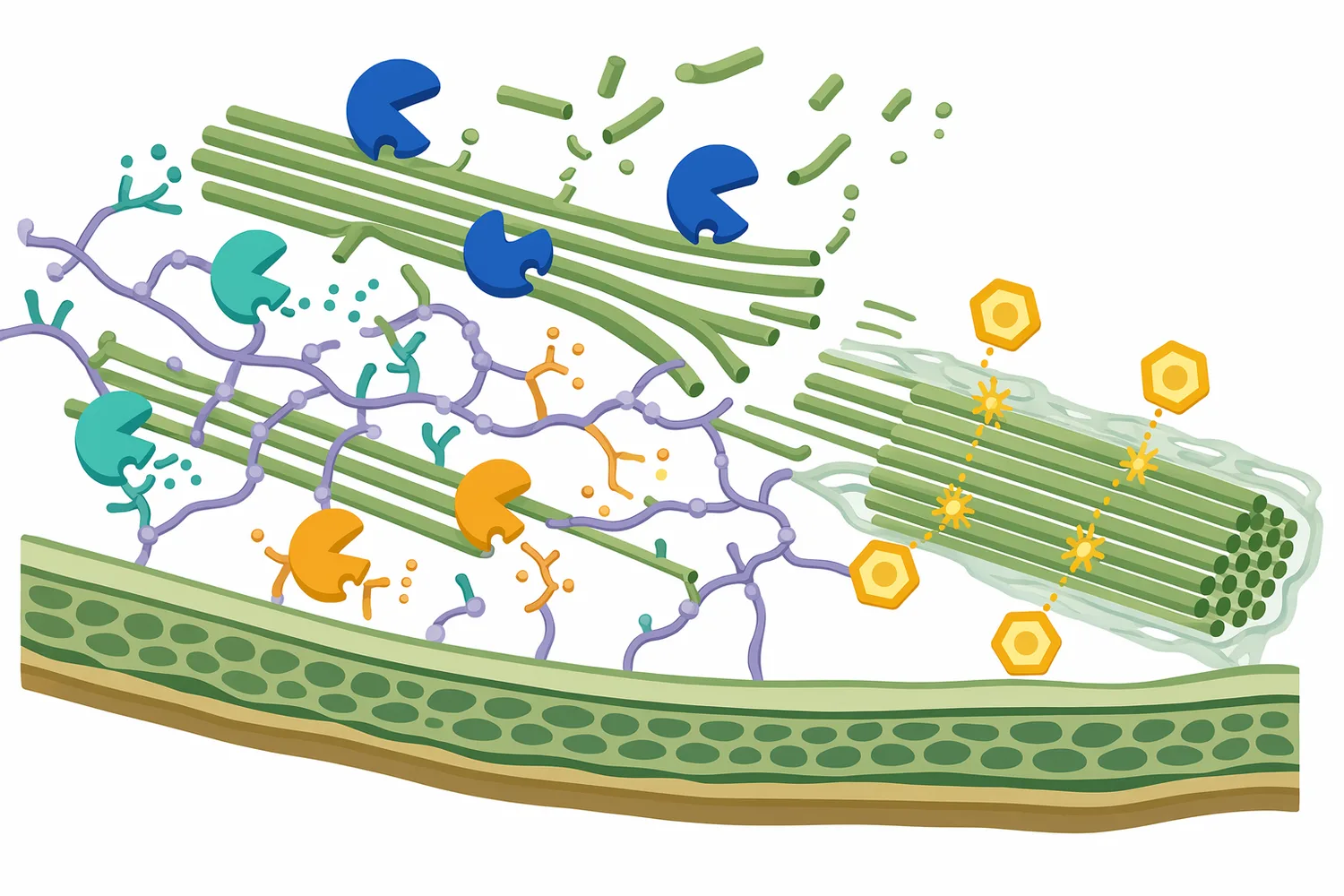
The resistance of cellulose is not only chemical; it is physical. Cellulose chains align into tightly packed microfibrils with crystalline regions, and those microfibrils are surrounded by hemicellulose and lignin in the plant cell wall. Lignin gives rigidity and hydrophobic protection, while hemicellulose cross-links the structure and fills space around cellulose. Reviews of lignocellulosic ethanol describe this cellulose–hemicellulose–lignin architecture as a key reason that residual biomass requires pretreatment and enzymatic hydrolysis rather than simple fermentation [5].
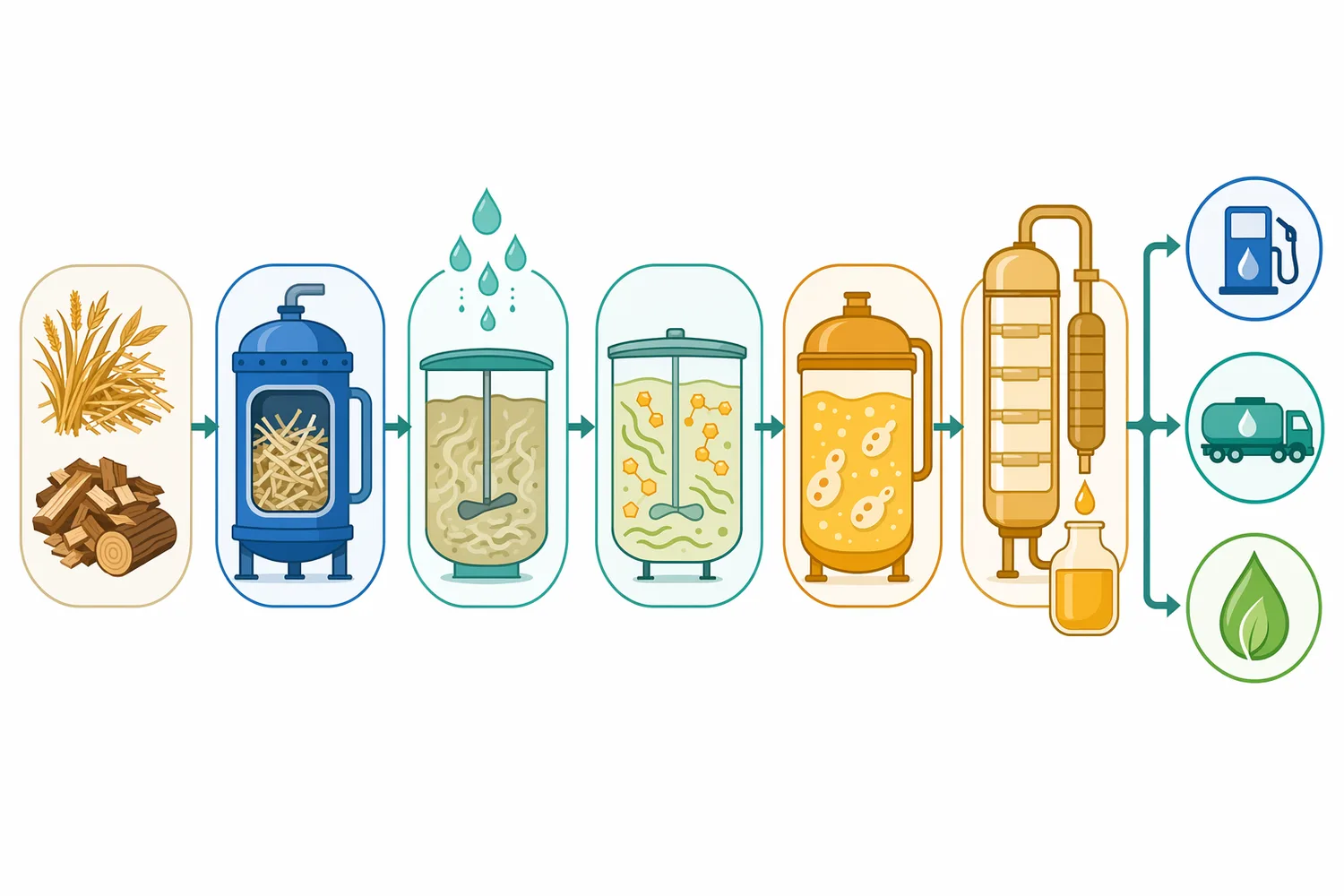
This is why cellulase performs a very specific role in biomass conversion. It does not “digest biomass” in a generic way. It attacks accessible cellulose surfaces, creates breaks in cellulose chains, releases cellobiose and soluble oligosaccharides, and supports further conversion to glucose. If pretreatment has exposed more cellulose surface area and reduced structural shielding, cellulase has more points of contact and saccharification can proceed more effectively [6].
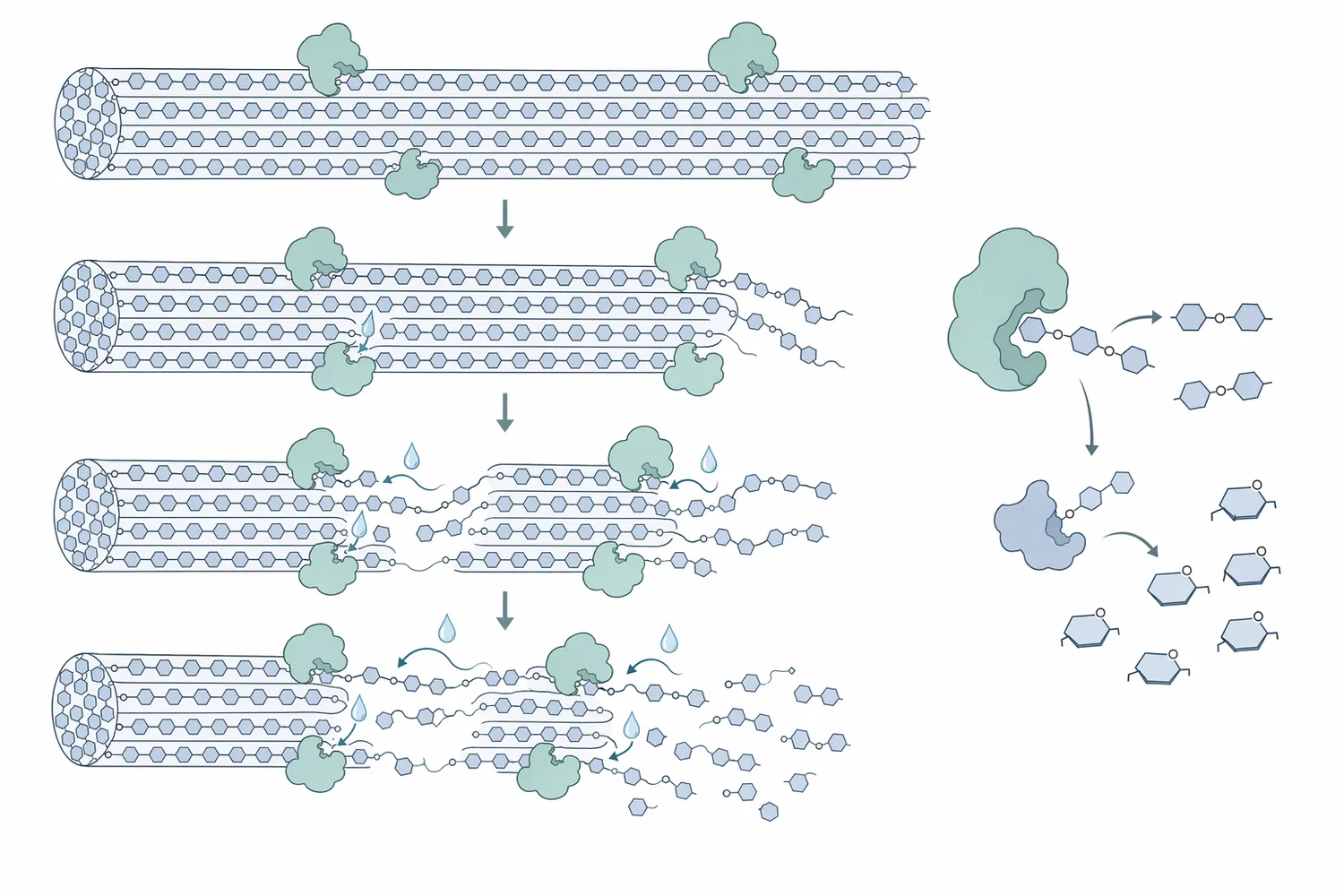
A cellulase system typically works through three coordinated enzyme functions: endoglucanase, cellobiohydrolase, and β-glucosidase. Endoglucanases cut internal bonds within cellulose chains, especially in more accessible amorphous regions. These internal cuts create new chain ends. Cellobiohydrolases then act from the chain ends and progressively release cellobiose, a two-glucose sugar. β-Glucosidases complete the sequence by hydrolyzing cellobiose and short soluble sugars into glucose, reducing cellobiose accumulation and increasing the pool of fermentable sugar [7].
The three functions matter because cellulose is not hydrolyzed efficiently by a single cut. A useful analogy is a rope made of many tightly aligned strands: internal cutting opens the rope, end-wise cutting shortens the strands, and final trimming converts the short pieces into individual glucose units. At the substrate level, the visible process is a change from insoluble fibrous solids toward soluble sugars in the liquid phase. At the molecular level, β-1,4-glycosidic bonds are cleaved by water with enzyme catalysis, lowering the activation barrier and making hydrolysis feasible under mild aqueous conditions [8].
This coordinated action is also why cellulase is often described as an enzyme complex or enzyme cocktail in lignocellulosic bioethanol literature. Real biomass contains crystalline cellulose, amorphous cellulose, hemicellulose, lignin, extractives, ash, and soluble compounds. The cellulase portion mainly targets cellulose, while accessory enzymes may improve exposure or conversion of surrounding polysaccharides. Reviews on cellulase and oxidative enzymes note that improved cellulose degradation for bioethanol depends on how effectively the enzyme system overcomes the structural barriers of lignocellulosic material [9].
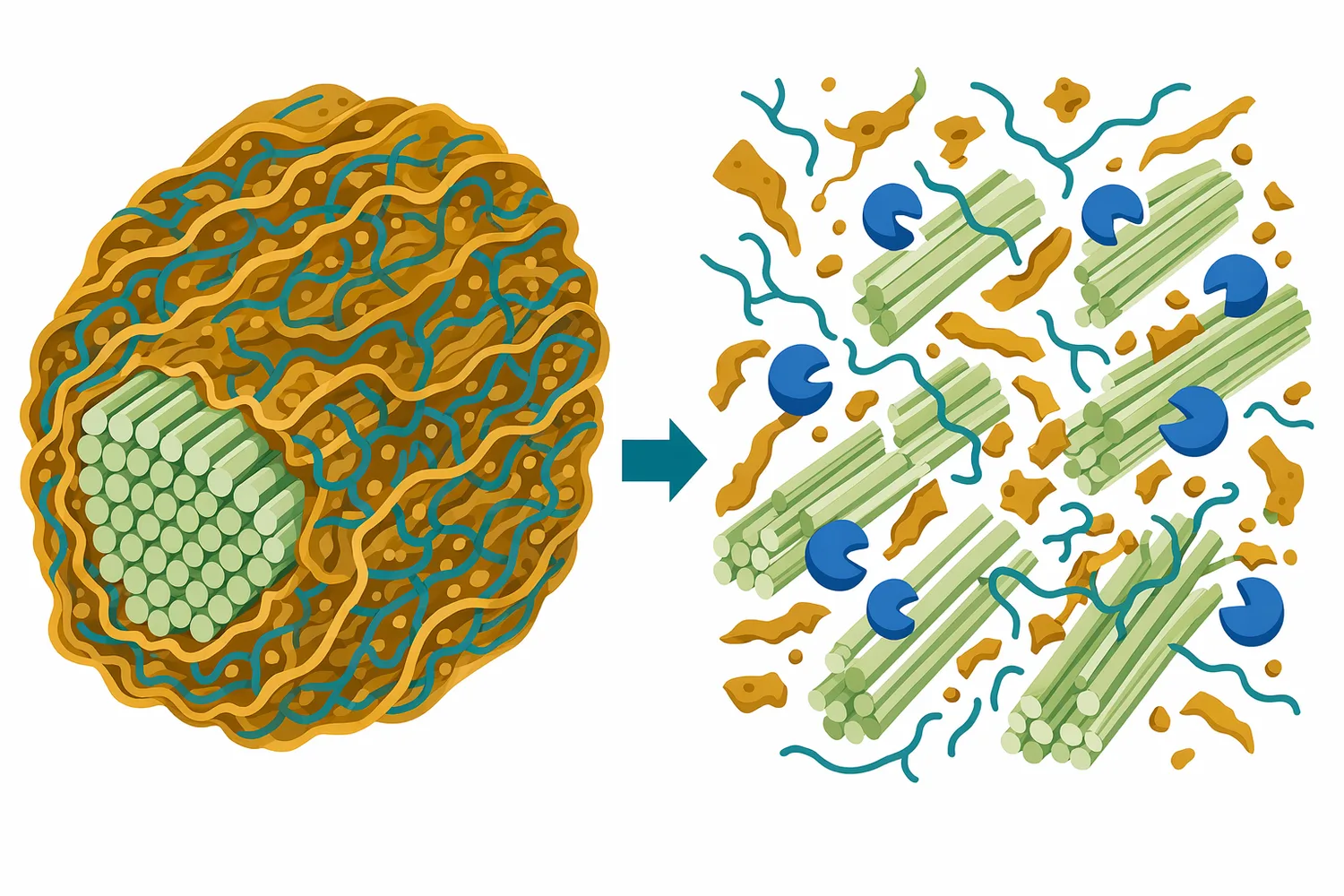
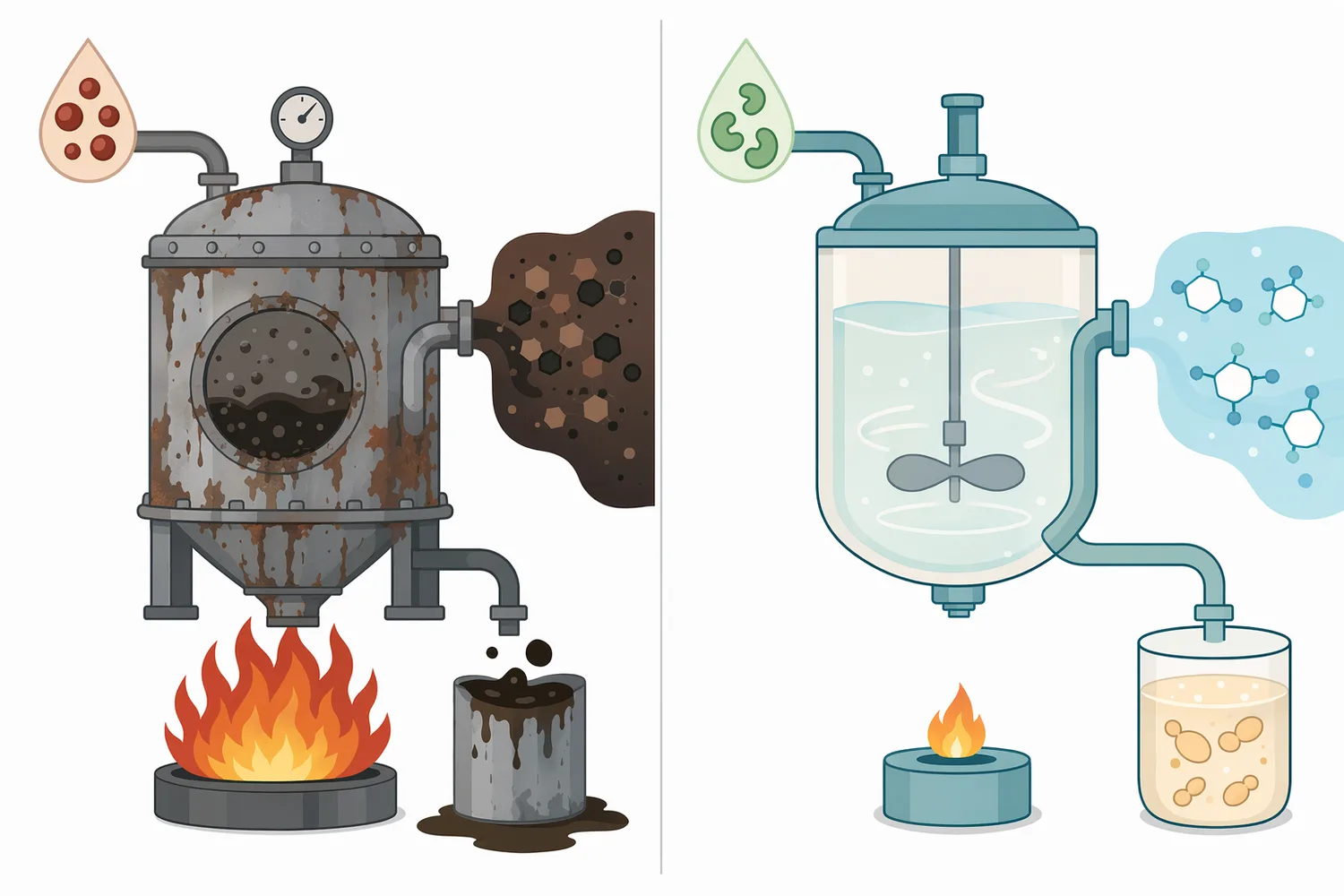
Pretreatment is not a replacement for cellulase; it prepares the substrate so cellulase can work. Mechanical size reduction can increase surface area. Hydrothermal methods can alter hemicellulose and open the cell-wall matrix. Alkaline approaches can reduce lignin barriers. Organosolv treatment can solubilize lignin and hemicellulose fractions, leaving cellulose more accessible. The shared purpose is to make cellulose less protected and more available to enzymatic hydrolysis [3].
Liquid hot water pretreatment is one example of a method designed to improve access to lignocellulosic carbohydrates while also generating potentially valuable co-products. In this type of process, hot compressed water alters the biomass structure, can solubilize part of the hemicellulose, and changes the way enzymes contact cellulose surfaces. Reviews describe liquid hot water as a pretreatment route studied for bioethanol production because it can increase enzymatic digestibility of biomass without relying on large additions of chemical catalysts [10].
Organosolv pretreatment illustrates another mechanism. Organic solvent systems can remove or redistribute lignin, reduce physical shielding, and improve enzymatic accessibility of cellulose. Reviews of organosolv processing emphasize that delignification is central to its value: when lignin is removed from around cellulose fibers, cellulase has fewer blocked surfaces and less non-productive contact with lignin, improving the probability that enzyme binding leads to actual cellulose hydrolysis [11].
Organic solvent pretreatment more broadly has been reviewed for biofuels and biochemicals because it can fractionate lignocellulosic biomass into cellulose-rich, hemicellulose-derived, and lignin-rich streams. For cellulase use, the important point is that fractionation changes the substrate architecture. A cellulose-rich fraction with reduced lignin shielding is generally more suitable for enzymatic saccharification than untreated biomass, although the actual result remains dependent on feedstock and processing history [12].
| Pretreatment route | Main structural change relevant to cellulase | Typical effect on saccharification logic | Important process consideration |
|---|---|---|---|
| Mechanical preparation | Reduces particle size and increases exposed surface | Gives cellulase more external surface to contact | Does not by itself remove lignin or hemicellulose barriers |
| Liquid hot water | Alters biomass structure and can solubilize hemicellulose | Opens the matrix and improves enzyme access to cellulose | Conditions influence sugar degradation and inhibitor formation |
| Organosolv | Removes or redistributes lignin and separates biomass fractions | Reduces physical shielding and can improve cellulose-rich fraction digestibility | Solvent recovery and downstream compatibility matter |
| Alkaline treatment | Targets lignin and ester linkages in the cell wall | Can reduce lignin-related obstruction to cellulase | Feedstock response differs by biomass type |
| Biological pretreatment | Uses microorganisms or enzymes to modify lignocellulose | Can soften the matrix under mild conditions | Usually slower than physicochemical methods |
Pretreatment reviews make the same practical point across different technologies: cellulase works best when cellulose is made accessible, but pretreatment severity must be balanced against sugar loss, inhibitor formation, cost, and downstream fermentation needs [13].
A typical lignocellulosic bioethanol process has four broad stages: feedstock preparation, pretreatment, enzymatic hydrolysis, and fermentation. Cellulase is mainly added in the enzymatic hydrolysis stage, where pretreated biomass is held in water under controlled process conditions so enzymes can release fermentable sugars. Those sugars are then fermented into ethanol and later recovered by separation steps [6].
Two common process configurations are separate hydrolysis and fermentation, and simultaneous saccharification and fermentation. In separate hydrolysis and fermentation, cellulase first generates sugars in a dedicated hydrolysis step, and fermentation follows afterward. In simultaneous saccharification and fermentation, enzyme hydrolysis and microbial fermentation occur in the same vessel or overlapping process stage, so sugars released by cellulase may be consumed as they form. Reviews of lignocellulosic ethanol describe both approaches as established process concepts with different operational trade-offs [5].
The cellulase function is the same in both configurations: hydrolyze cellulose into fermentable sugars. The process design changes what happens to those sugars after release. In separate hydrolysis, sugars may accumulate before fermentation. In simultaneous processes, yeast or another fermenting organism can consume glucose as it appears, which may reduce product inhibition of some hydrolysis steps but requires greater compatibility between enzyme performance and microbial fermentation conditions [1].
Many bioethanol feedstocks are not pure cellulose. Straw, bagasse, grasses, crop residues, and fruit-processing residues contain hemicellulose as well as cellulose. Hemicellulose is a mixed group of polysaccharides, often including xylan-rich fractions in agricultural residues. Xylanases hydrolyze xylan and can help open the hemicellulose network surrounding cellulose, which can make cellulase attack more effective on complex plant materials [14].
This enzyme synergy is important because cellulose exposure is partly controlled by non-cellulose components. If xylan or other hemicellulose polymers remain wrapped around cellulose microfibrils, cellulase may have fewer productive binding sites. When hemicellulases or xylanases reduce that surrounding network, cellulase can reach more cellulose surfaces. The result is not just “more enzyme activity” in a general sense; the substrate itself becomes more penetrable because one layer of the plant-wall matrix has been loosened [14].
Accessory oxidative enzymes are also discussed in modern cellulose-degradation research. These enzymes can act on highly ordered cellulose surfaces and support breakdown of recalcitrant regions that conventional hydrolytic enzymes attack more slowly. Reviews on cellulase and oxidative enzyme systems describe them as part of newer approaches to improving cellulose degradation for bioethanol, especially where crystalline cellulose and lignin-associated barriers limit hydrolysis [9].
Agricultural residues are a major focus for cellulase-based bioethanol because they are widely available and contain significant structural carbohydrates. Paddy straw, wheat straw, corn residues, grasses, and similar materials are often discussed as second-generation ethanol feedstocks because they can provide fermentable carbon without relying only on sugar crops or starch crops. Reviews on residual biomass emphasize that the main technical challenge is converting lignocellulosic carbohydrates into sugars efficiently enough for fermentation [1].
Paddy straw is a useful example of the challenge. It contains cellulose that can be converted into glucose, but the cellulose is embedded in a lignocellulosic matrix and may also be associated with silica and other biomass-specific components. A review focused on paddy straw-based ethanol describes enzymatic hydrolysis as a sustainable route after appropriate pretreatment, reinforcing the role of cellulase in converting this residue into fermentable sugars [15].
Grass biomass follows the same principle. Grasses can be abundant and renewable, but they require pretreatment and hydrolysis to overcome cell-wall resistance. A review on grass biomass for bioethanol highlights pretreatment, fermentation, and molecular techniques as routes to improve ethanol output, with enzymatic conversion serving as a key link between structural biomass and microbial ethanol production [16].
Wheat straw has also been studied in enzyme-based bioethanol contexts. Research using co-cultures of Trichoderma reesei and Monascus purpureus examined wheat straw hydrolysis toward improved biodegradation of lignocellulosic biomass in a bioethanol biorefinery setting. The relevance for cellulase users is that wheat straw conversion depends on coordinated degradation of the lignocellulosic structure rather than on cellulose chemistry alone [17].
Rice straw is another representative lignocellulosic substrate. Work on cellulase production and its efficacy in bioethanol production from rice straw by simultaneous saccharification and fermentation connects cellulase-mediated hydrolysis directly with an integrated ethanol process. The study also illustrates the broader pattern seen across biomass research: cellulase is valuable because it converts a resistant agricultural residue into fermentable carbohydrate within a fermentation-oriented workflow [18].
Non-crop and waste biomass can also be relevant. Bioethanol production through separate hydrolysis and fermentation of Parthenium hysterophorus biomass shows that invasive or low-value plant materials may be explored as lignocellulosic feedstocks when their cellulose fraction can be hydrolyzed and fermented. In such cases, cellulase helps turn an otherwise difficult fibrous material into a sugar stream suitable for ethanol production [19].
Fruit and vegetable processing residues are also being studied. Recent work integrating enzymatic hydrolysis and nanoparticle catalysis for bioethanol production from pumpkin and dragon fruit pomace demonstrates continuing interest in using food-processing residues as fermentation feedstocks. For these substrates, cellulase may act alongside other hydrolytic activities because pomace can contain cellulose, hemicellulose, pectin, soluble sugars, and other plant-derived components [20].
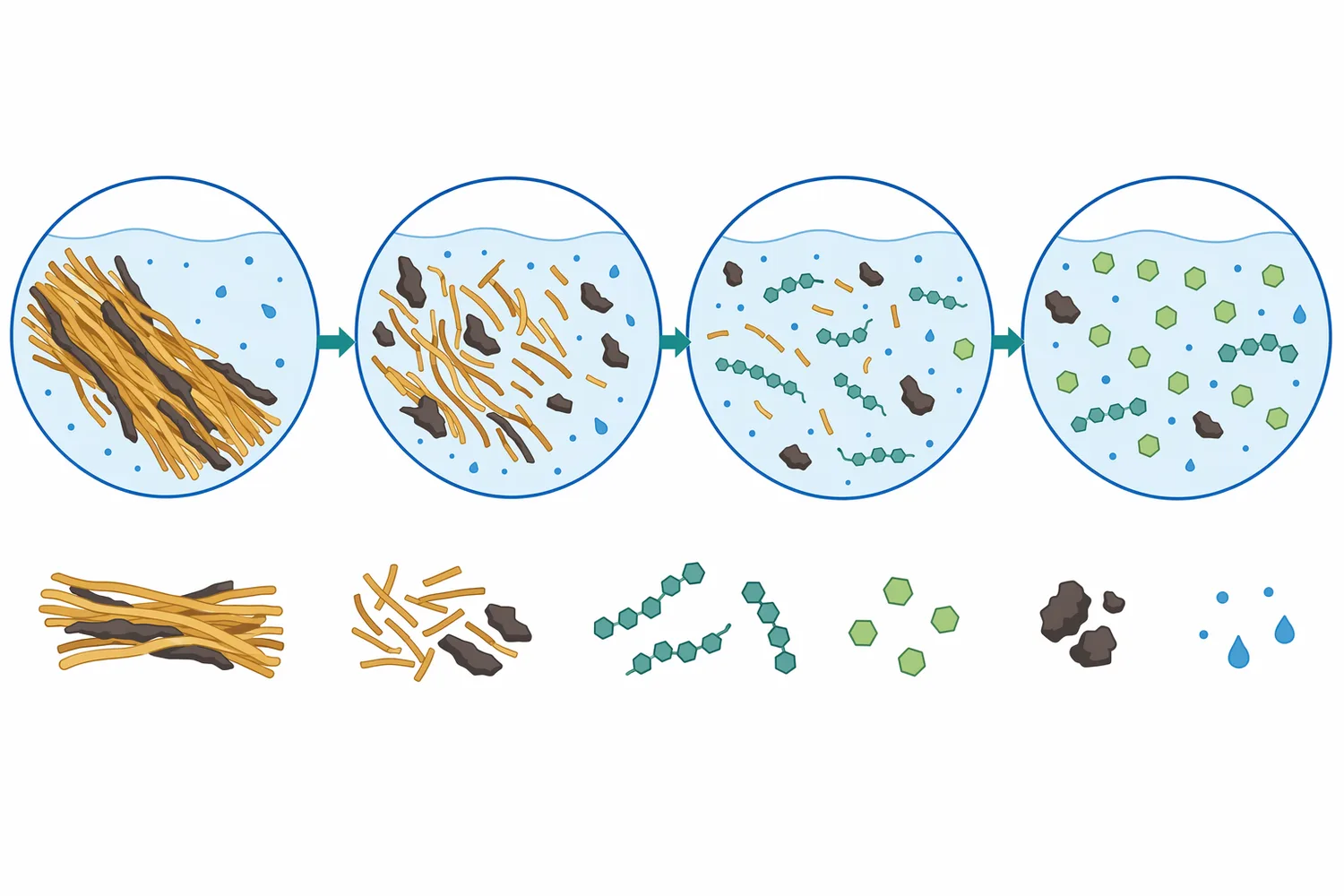
During cellulase treatment, the most important practical change is the movement of carbohydrate from the solid phase into the liquid phase. Untreated or poorly treated biomass holds much of its glucose potential inside insoluble cellulose fibers. As cellulase acts, the polymer chains are cleaved into soluble oligosaccharides, cellobiose, and glucose. This changes the process stream from a suspension of largely unfermentable fibers into a hydrolysate containing sugars that can be metabolized during fermentation [4].
The solid residue also changes. As cellulose is hydrolyzed, fibers can lose integrity, become more porous, and release fines or partially degraded fragments. If hemicellulose-targeting enzymes are present, the surrounding matrix can be further loosened. If lignin remains, it may persist as an enzyme-resistant fraction and may continue to influence viscosity, mixing, adsorption, and downstream separation. Reviews of microbial cellulases describe this hydrolysis of plant cell-wall cellulose as the biochemical basis for applications in biofuel and other industries [2].
Sugar composition also changes over time. Early hydrolysis may release soluble cellodextrins and cellobiose as cellulose chains are shortened. β-Glucosidase activity then shifts that mixture toward glucose, which is generally more directly fermentable by standard ethanol-producing organisms. If β-glucosidase is insufficient relative to upstream cellulose cleavage, cellobiose can accumulate and slow further hydrolysis, which is why complete cellulase systems are valued in bioethanol saccharification [7].
Lignin is one of the main reasons cellulase performance varies from one biomass stream to another. It can block cellulose physically, limiting enzyme access to the carbohydrate surface. It can also bind enzymes non-productively, meaning the enzyme attaches to lignin rather than cellulose and therefore cannot catalyze useful hydrolysis. Reviews of lignocellulosic conversion repeatedly identify lignin-related recalcitrance as a major barrier to efficient enzymatic saccharification [5].
This limitation does not reduce the importance of cellulase; it explains why pretreatment quality matters. A process that exposes cellulose while limiting enzyme loss to lignin will generally give cellulase a better opportunity to convert structural carbohydrate into fermentable sugar. In contrast, a substrate with high residual lignin shielding or strong non-productive adsorption can require more process effort for the same sugar release, even when the cellulose content is high [3].
Lignin also helps explain why the same cellulase may behave differently on different feedstocks. Wheat straw, rice straw, grasses, fruit pomace, bagasse, and woody residues differ in lignin structure, hemicellulose content, ash, extractives, and physical density. Cellulase chemistry is consistent, but the number of productive enzyme–cellulose contacts depends on how the biomass presents its cellulose surface after pretreatment [13].
The primary benefit of cellulase is improved sugar availability. Cellulose is one of the largest carbohydrate fractions in lignocellulosic biomass, but without hydrolysis it remains locked in an insoluble polymer. Cellulase converts that polymer into soluble sugars, making the carbohydrate fraction available for microbial ethanol production [8].
A second benefit is better use of low-value residues. Agricultural byproducts and processing wastes can become feedstocks rather than disposal burdens when their carbohydrate content is recovered. Reviews of second-generation ethanol production describe residual biomass as a promising resource because it can support renewable fuel production while reducing reliance on conventional sugar or starch inputs [1].
A third benefit is compatibility with milder conversion strategies compared with severe chemical hydrolysis. Enzymatic hydrolysis is typically discussed as a more selective biological conversion step, especially when paired with pretreatment that avoids excessive sugar degradation. Reviews of enzyme-based hydrolysis for lignocellulosic ethanol emphasize that cellulases offer an important route for converting biomass carbohydrates under controlled aqueous conditions [6].
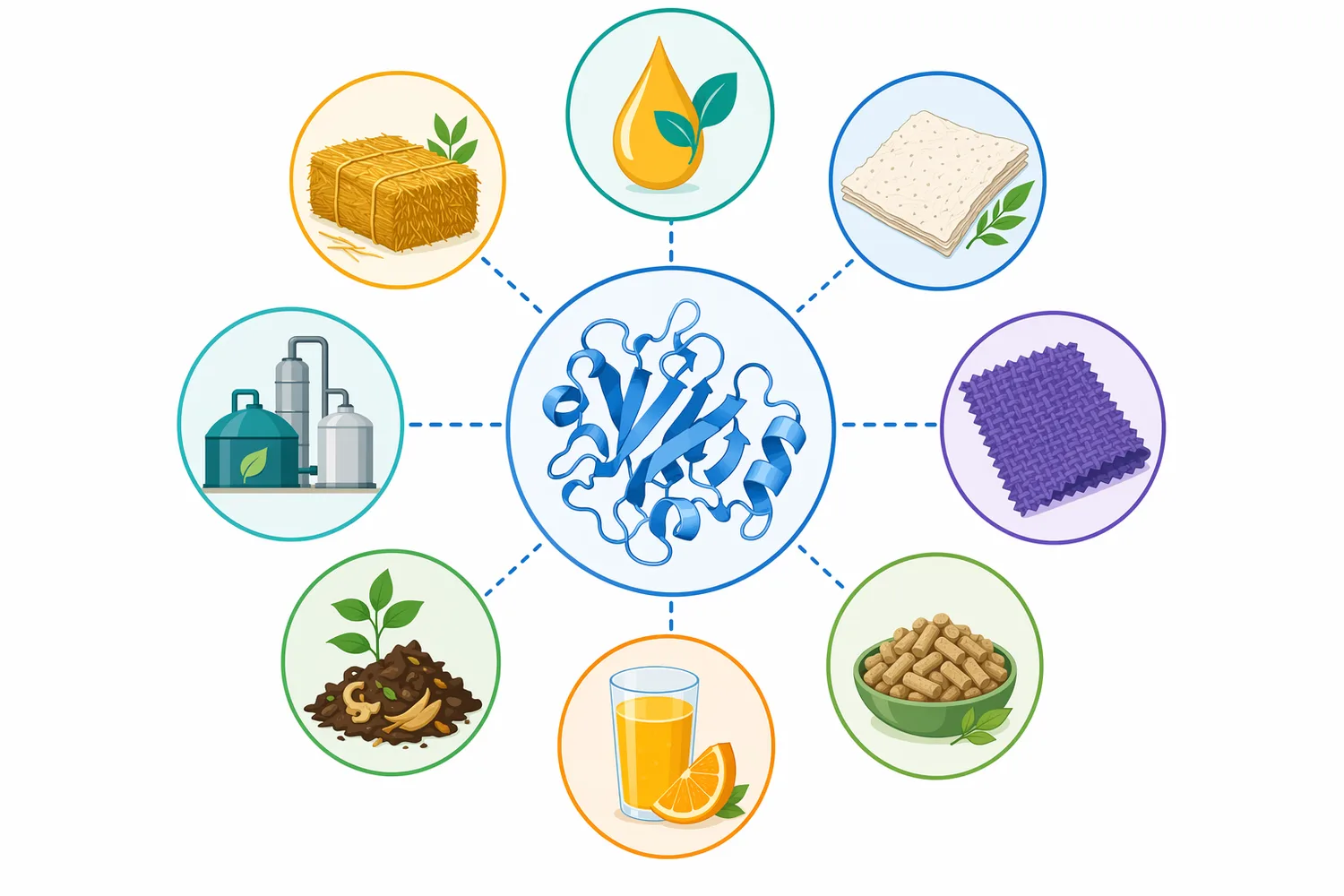
A fourth benefit is process flexibility. Cellulase can be used in workflows that are designed around separate hydrolysis, simultaneous saccharification and fermentation, or broader biorefinery concepts. It can also function alongside hemicellulases, xylanases, β-glucosidases, and oxidative enzymes when the feedstock contains a complex plant-wall matrix. Research reviews continue to explore enzyme combinations because biomass conversion is rarely limited by cellulose chemistry alone [9].
Cellulase is essential for cellulose saccharification, but its performance is not universal across all biomass streams. The same enzyme category can produce different hydrolysis outcomes depending on feedstock type, pretreatment method, lignin content, particle structure, solids level, mixing, hydrolysis time, and fermentation configuration. Reviews of current lignocellulosic ethanol technology emphasize that process performance depends on integration of pretreatment, hydrolysis, and fermentation rather than on any single step in isolation [5].
This process dependence is especially important for customers using real industrial residues. Unlike purified cellulose, practical feedstocks may contain dirt, ash, waxes, phenolics, soluble sugars, acids, residual process chemicals, or variable moisture. Some of these factors influence enzyme contact with cellulose; others affect the downstream fermenting organism. Cellulase supplies the biochemical capability to cleave cellulose, but the process environment determines how much of that capability becomes useful sugar release [16].
The strongest evidence supports the broad role of cellulase in releasing fermentable sugars from cellulose-rich biomass after appropriate pretreatment. Evidence is also strong that enzyme synergy can improve conversion of complex lignocellulosic substrates, especially where hemicellulose and lignin limit cellulase access. What remains process-specific is the final ethanol yield, because fermentation organism performance, inhibitor levels, hydrolysate composition, and ethanol tolerance all affect the conversion of released sugars into finished ethanol [21].
Enzymes.bio supplies Cellulase Enzyme for Bioethanol Production CAS 9012-54-8 for buyers who need a cellulase input for biomass saccharification and bioethanol-related processing. The product is sold directly online by the 1 kg unit: the buyer places the order, pays online, and the order is then processed and shipped. A Certificate of Analysis and Safety Data Sheet are supplied with the order for documentation and responsible handling support.
Enzymes.bio is a supplier, not a manufacturer or laboratory developer. This article is intended to explain the role of cellulase in bioethanol production and the science behind cellulose saccharification. It does not replace site-specific validation, plant safety review, or process development work for a particular biomass stream.
Cellulase Enzyme for Bioethanol Production CAS 9012-54-8 supports the saccharification step in lignocellulosic ethanol production by hydrolyzing cellulose into soluble sugars. Its practical value comes from converting a resistant, insoluble plant-wall polymer into glucose-rich hydrolysate that can be fermented into ethanol. The enzyme is most effective when biomass has been pretreated so that cellulose surfaces are accessible and lignin-related barriers are reduced [6].
The scientific literature strongly supports cellulase as a central enzyme class in second-generation bioethanol. Reviews and biomass studies show that pretreatment, cellulase hydrolysis, accessory enzymes, and fermentation must work together because real biomass is a complex cellulose–hemicellulose–lignin material rather than a pure cellulose substrate. For buyers, the key takeaway is straightforward: cellulase provides the biochemical step that unlocks cellulose-derived sugar, while the surrounding process determines how efficiently that sugar becomes ethanol [1].
Enzymes.bio makes Cellulase Enzyme for Bioethanol Production CAS 9012-54-8 available as a directly orderable 1 kg online product. Orders are placed and paid for online, then processed and shipped with the accompanying Certificate of Analysis and Safety Data Sheet.
Sold by the 1 kg unit, in stock and ready to ship. Order directly on our store — pay online and we process your order. A Certificate of Analysis and Safety Data Sheet are included with every order.
Buy Cellulase Enzyme For Bioethanol Production Cas 9012-54-8 →Numbered in order of first citation. Open-access sources, each verified reachable at publication; citation numbers in the text link here.