
Chill-Haze Prevention in Brewing – Protease Enzyme CAS 232-642-4 is a brewing protease supplied by Enzymes.bio for reducing the protein side of beer chill haze: the cold cloudiness formed when haze-active proteins and polyphenols associate into light-scattering particles. By hydrolyzing susceptible beer proteins into smaller peptide fragments, the enzyme lowers the ability of those proteins to cross-link with polyphenols during chilled storage. Enzymes.bio supplies this product directly online by the 1 kg unit, with the order processed and shipped after online purchase and documentation supplied with the order .
Chill haze is a colloidal stability problem: beer can appear bright at ambient temperature, then become visibly cloudy when cooled. The cloudiness is not simply “dirt” or suspended solids; it is usually caused by small soluble beer components forming larger aggregates that scatter light. Brewing research has identified haze-active beer constituents using analytical methods such as HPLC and mass spectrometry, confirming that haze is associated with specific molecular fractions rather than a single generic “protein” problem [1].
The central interaction in classic chill haze is between haze-active proteins and polyphenols. Barley-derived proteins, especially proline-rich hordein fragments, provide binding surfaces that can associate with malt- and hop-derived polyphenols. Polyphenols contain multiple phenolic groups, so one polyphenol molecule can bind more than one protein region; likewise, one protein can offer multiple binding points. This creates a network effect: small soluble molecules become larger complexes, and those complexes become visible when they reach a size that scatters light [2].
Temperature matters because solubility and molecular association change as beer cools. A beer that is bright at room temperature may develop a reversible chill haze at refrigeration temperature because protein–polyphenol complexes become less soluble and aggregate. With time, oxidation and further molecular rearrangement can make the haze more persistent, moving from a temporary cold haze to a more permanent colloidal defect. For bright lagers, pilsners, export beers, and other styles where clarity is expected, this can reduce perceived freshness even when flavor remains acceptable [1].
Chill haze should also be separated from other causes of turbidity. Yeast carryover, starch residues, microbial contamination, hop particles, beta-glucan-related filtration issues, or mineral precipitation can all create cloudiness, but a protease mainly addresses the protein component. The value of a chill-haze protease is therefore most direct when the beer’s instability is driven by haze-active proteins that are available to bind polyphenols [2].
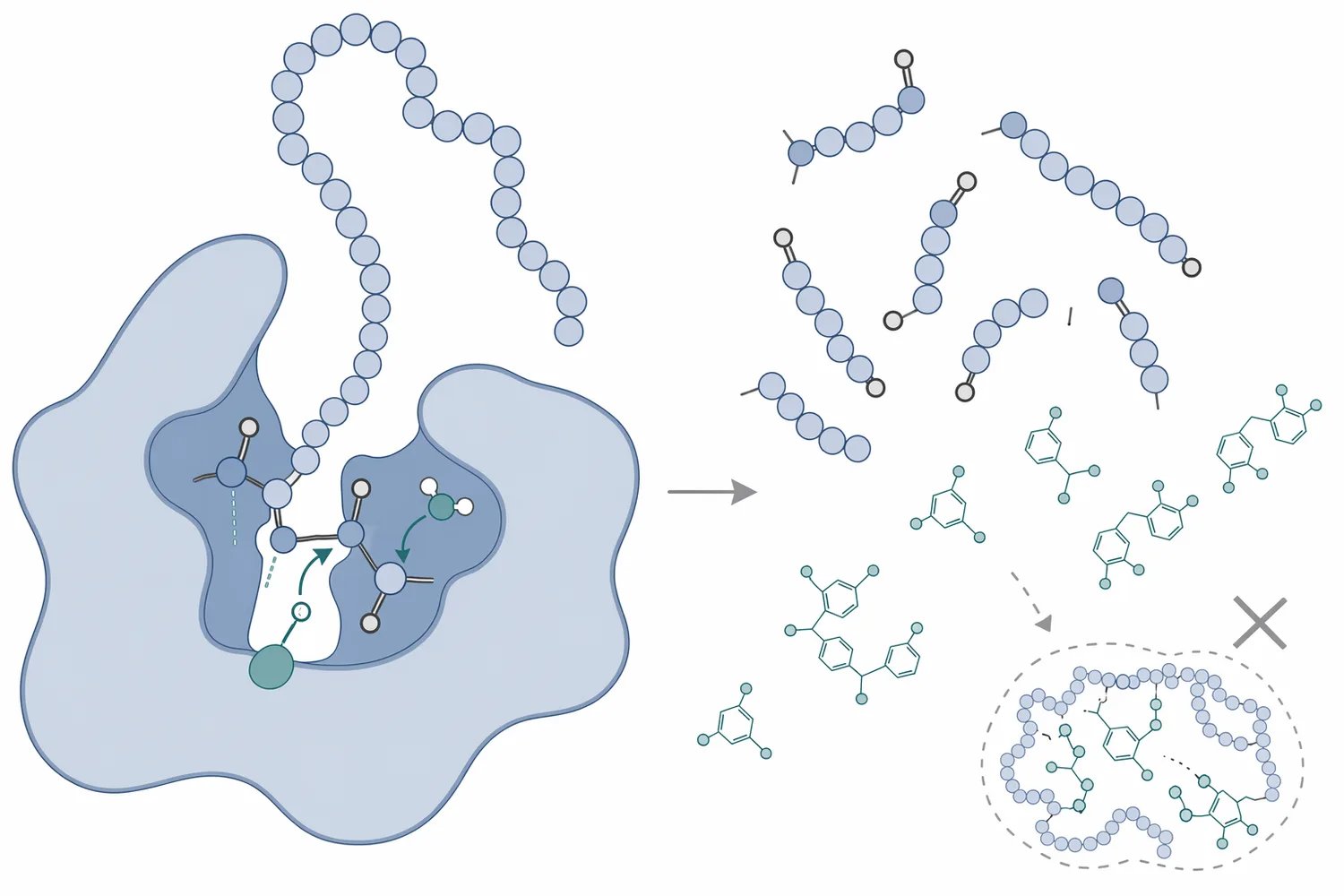
Proteases hydrolyze proteins by cleaving peptide bonds. In brewing, that means large or haze-active protein molecules can be cut into shorter peptides. The important practical change is not merely that “protein is reduced”; the protein’s structure and binding behavior are changed. A long haze-active protein can present multiple polyphenol-binding regions along the same chain, allowing it to participate in cross-linked aggregates. After proteolysis, the resulting fragments are shorter, less multivalent, and less able to bridge polyphenols into visible haze particles [3].
For chill-haze prevention, this is a targeted process outcome: reduce the haze-forming behavior of susceptible proteins while preserving desirable beer attributes as much as possible. Beer foam, body, and mouthfeel also depend partly on protein and peptide fractions, so the goal is controlled protein modification rather than indiscriminate degradation. Historical brewing work comparing papain, chymotrypsin, and related proteins specifically evaluated their beer chill-proofing abilities and characteristics, showing that protease type matters in how haze reduction is achieved [3].
Enzymes.bio lists Chill-Haze Prevention In Brewing – Protease Enzyme CAS 232-642-4 as a brewing enzyme product for this purpose. It is sold online by the 1 kg unit, so a buyer can purchase directly through the product page rather than initiating a custom project. A Certificate of Analysis and Safety Data Sheet are provided with the order, supporting routine receipt and handling of the product in a professional brewing environment .
A useful way to understand chill haze is to think in terms of “bridging.” Haze-active proteins are not all beer proteins equally; the proteins most associated with haze tend to have sequences and structures that interact readily with polyphenols. Proline-rich regions are especially important because proline disrupts regular protein folding and can leave accessible binding surfaces. Polyphenols can attach through hydrogen bonding and hydrophobic interactions, linking protein regions into larger assemblies [2].
When a protease cuts a haze-active protein, several things change at once. First, the average chain length decreases. Second, the number of binding sites on a single connected molecule is reduced. Third, some fragments become too small or too soluble to form large visible complexes. Finally, fragments formed earlier in the process may be removed more easily with trub, yeast sediment, filtration, or other clarification steps. The result is not that all protein disappears, but that fewer protein molecules remain in the right form to build cold-sensitive haze [4].
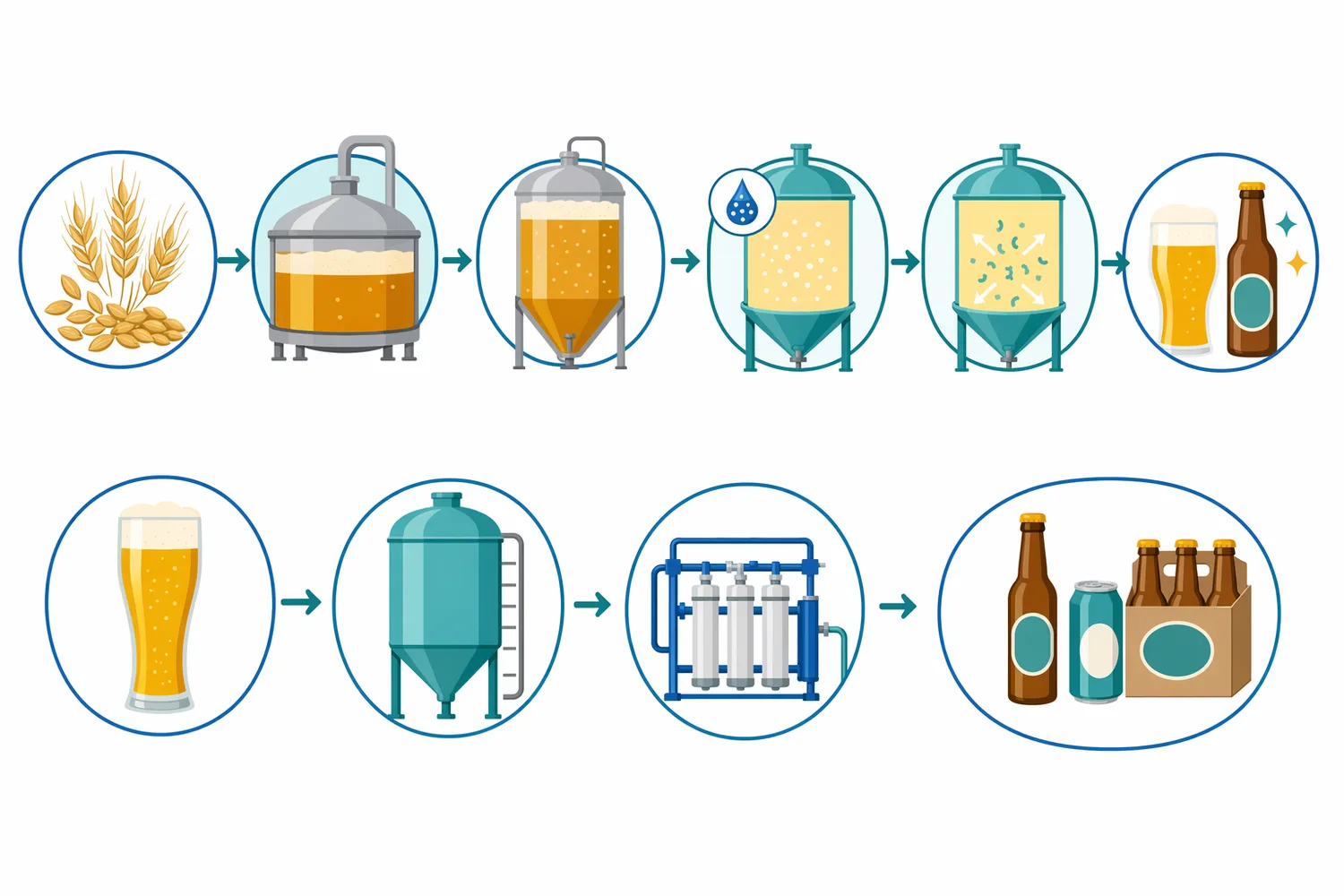
This explains why protease can help prevent haze rather than only remove haze after it appears. A clarifier or filtration step can remove particles that already exist, but enzymatic treatment changes the precursor pool. If fewer haze-active protein structures survive into finished beer, there is less material available to bind polyphenols during package storage and cold distribution. That is the technical reason protease is considered a process aid for colloidal stability rather than simply a fining agent [4].
The same mechanism also explains why protease is not a universal turbidity fix. If haze is driven mainly by yeast, starch, hop-derived particulates, microbial growth, or excessive polyphenol load, protein hydrolysis alone may not fully correct the appearance. Protease is most effective when the limiting problem is the protein side of the haze reaction: enough haze-active protein remains in beer to interact with polyphenols under cold conditions [1].
Protease-based chill-proofing is not new in brewing science. A comparative study of papain, chymotrypsin, and related proteins evaluated their ability to chill-proof beer and examined differences among proteolytic enzymes. That work is important because it shows the principle clearly: enzymes that cleave beer proteins can reduce the formation of chill haze, but different proteases do not behave identically in beer [3].
A separate brewing study focused on adding proteases to the fermenter to control chill-haze formation. Fermenter addition is notable because it places the enzyme in contact with beer proteins after wort production, while yeast activity, alcohol formation, pH development, and beer maturation are underway. The existence of this approach shows that protease treatment has been studied not only as a mash-stage concept but also as a practical brewing intervention for finished-beer stability [4].
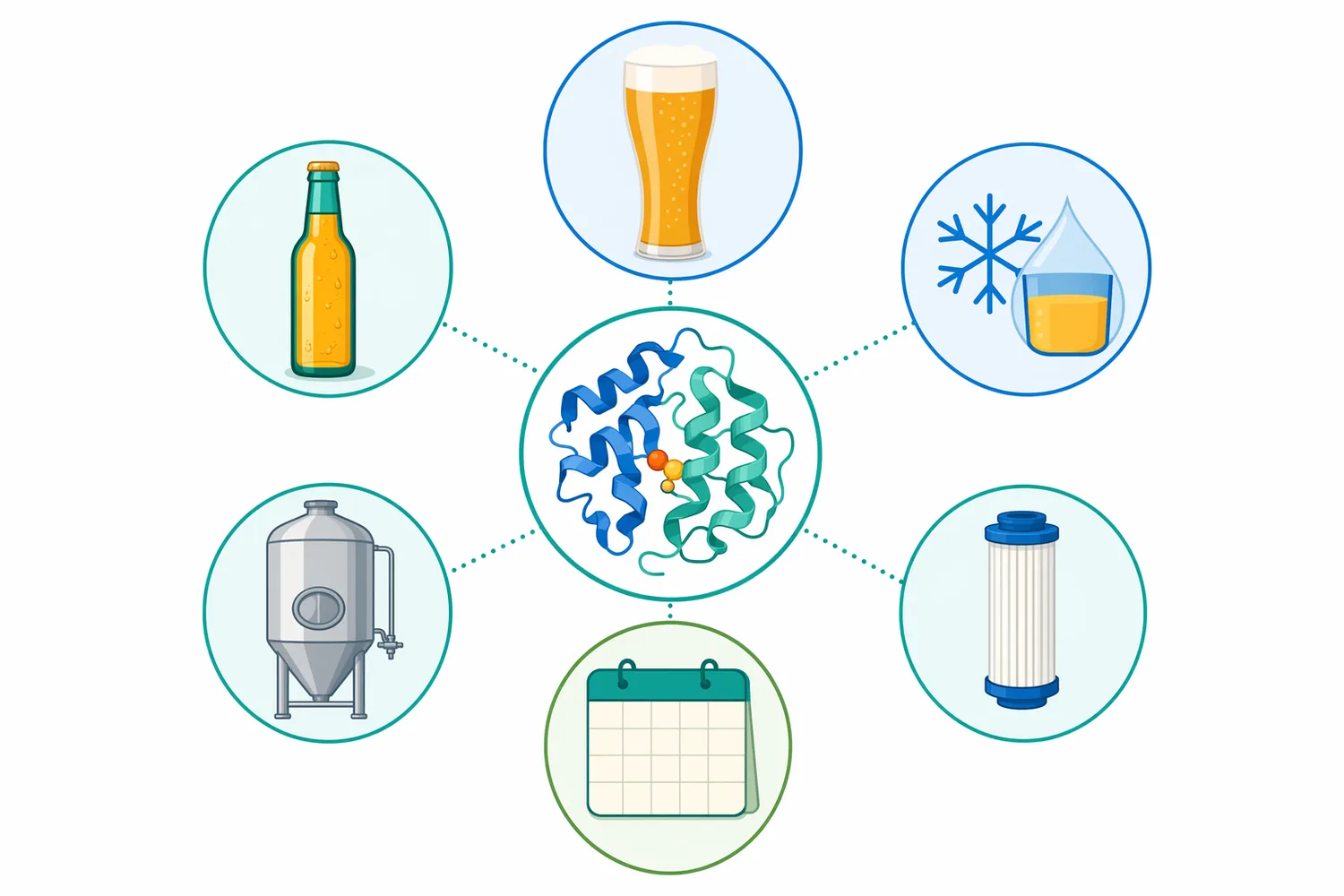
More recent enzyme research has also focused on proline-specific endoproteases. These enzymes are particularly relevant because barley hordeins and haze-active protein regions are often rich in proline, and proline-rich peptide bonds can be less accessible to many general proteases. Work on immobilizing proline-specific endoprotease on amino-functionalized nonporous silica nanoparticles reflects continuing technical interest in enzymes that act on proline-containing substrates [5].
The strongest practical conclusion from this body of work is balanced: protease treatment is a proven route for reducing protein-driven chill haze, but the outcome depends on the enzyme’s specificity and how the beer matrix responds. A broad protease, papain-like enzyme, chymotrypsin-like enzyme, or proline-specific endoprotease may all hydrolyze proteins, but they can differ in which peptide bonds they cut and how much they affect foam-positive or body-contributing proteins [3].
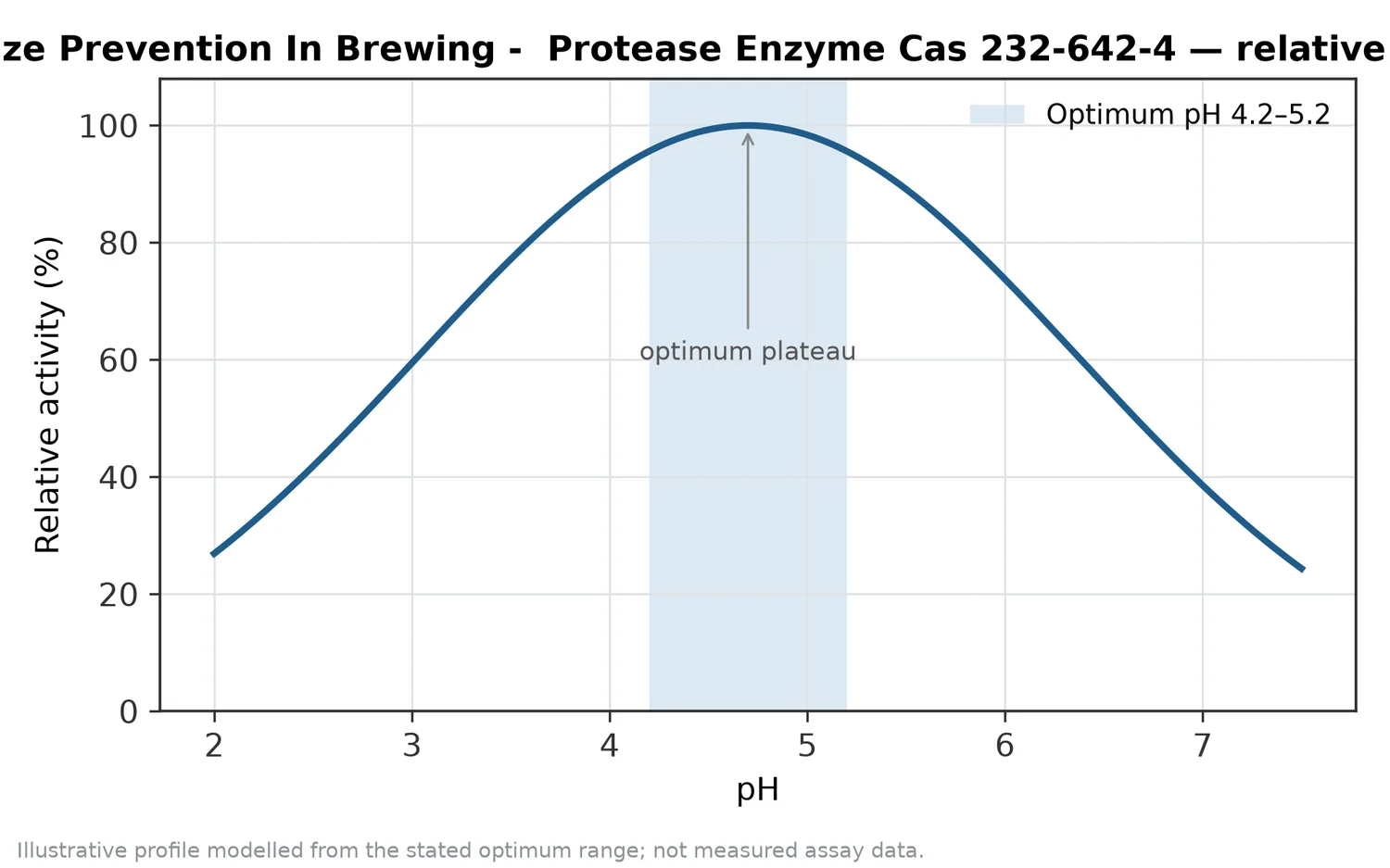
Different proteases are often discussed by their pH preference and catalytic behavior. In beer haze control, the key distinction is not just “acid” or “neutral” as a label, but where the enzyme can remain active in the brewing process and which protein bonds it is likely to cleave. The table below is conceptual; it is intended to explain how protease categories differ, not to define a product specification.
| Protease category | Conceptual fit in brewing | Main action on haze precursors | Practical caution |
|---|---|---|---|
| Acid protease | More compatible with acidic beer or late-process environments | Hydrolyzes susceptible proteins under lower-pH conditions, potentially reducing protein–polyphenol complex formation | Needs controlled use because beer proteins also contribute to foam and mouthfeel |
| Neutral protease | Often discussed around mash or wort protein modification | Breaks down barley and adjunct proteins into shorter peptides, which can reduce haze-active protein load and support nitrogen release | Excessive protein hydrolysis can reduce desirable protein functionality |
| Alkaline protease | Generally less aligned with normal beer pH conditions | Can be highly effective on proteins in non-brewing food or industrial settings | Beer is not an alkaline process, so this category is less typical for direct chill-haze stabilization |
The reason enzyme category matters is specificity. A protease that cuts broadly may reduce haze but can also attack proteins that support foam stability. A more targeted protease may reduce haze-active substrates while leaving more foam-positive fractions intact, depending on the beer and process. Brewing studies comparing different proteases for chill-proofing make this distinction clear: the enzyme’s substrate preference affects the quality result, not only the clarity result [3].
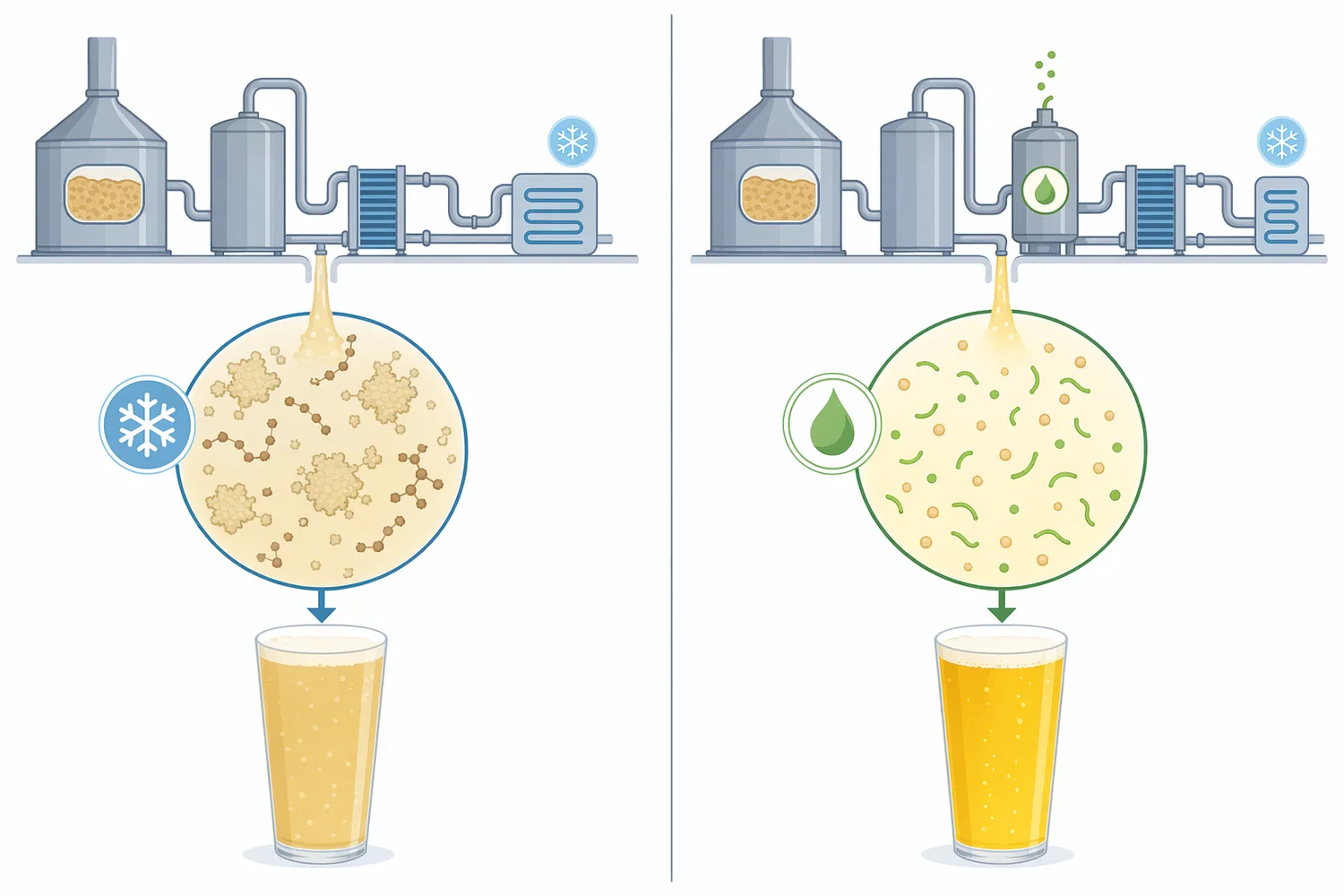
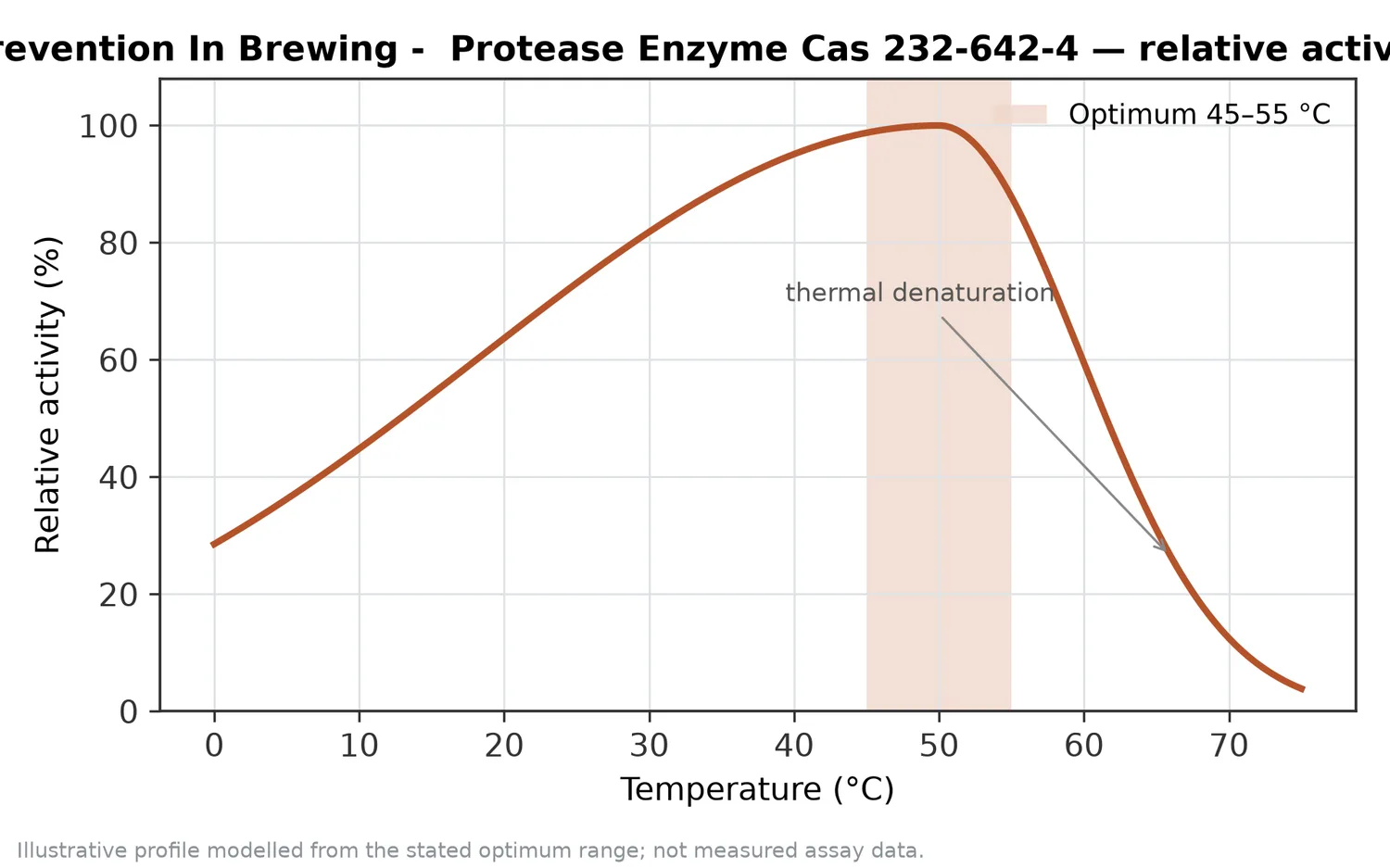
Protease use in brewing can intersect with two broad stages: wort production and fermentation or maturation. During mashing, malt proteins are already being modified by endogenous malt enzymes, and an added protease can increase the conversion of larger proteins into peptides and amino nitrogen. Research on protease selection during mashing has specifically examined increased solubilization of protein-derived thiols while limiting excessive release of free amino acids, showing that protease choice can change wort chemistry in measurable ways [6].
In a chill-haze context, mash-stage protein modification can reduce the load of large haze-active proteins entering the kettle and fermenter. When longer proteins are hydrolyzed earlier, subsequent wort boiling, trub formation, fermentation, and clarification can remove or transform some of the fragments. This can reduce the amount of haze-active material that survives into packaged beer. However, the mash is also where foam-relevant and nutrition-relevant protein fractions are shaped, so controlled modification is important [6].
Fermenter-stage protease use works differently. Instead of modifying the raw wort protein pool before boiling, the enzyme acts on proteins that have survived into fermenting beer. A study specifically on adding proteases to the fermenter for chill-haze control shows that this stage has been investigated as a direct way to lower haze formation in beer. The practical rationale is that haze precursors present after wort production can still be altered before final clarification and packaging [4].
Neither stage should be understood as automatically superior in every beer. Mash treatment influences wort composition early; fermenter treatment targets proteins after kettle coagulation and fermentation changes have occurred. The shared mechanism is protein hydrolysis, but the surrounding matrix is different: mash contains grist solids and wort enzymes, while fermenting beer contains yeast, ethanol, lower pH, and evolving colloidal structure [4].
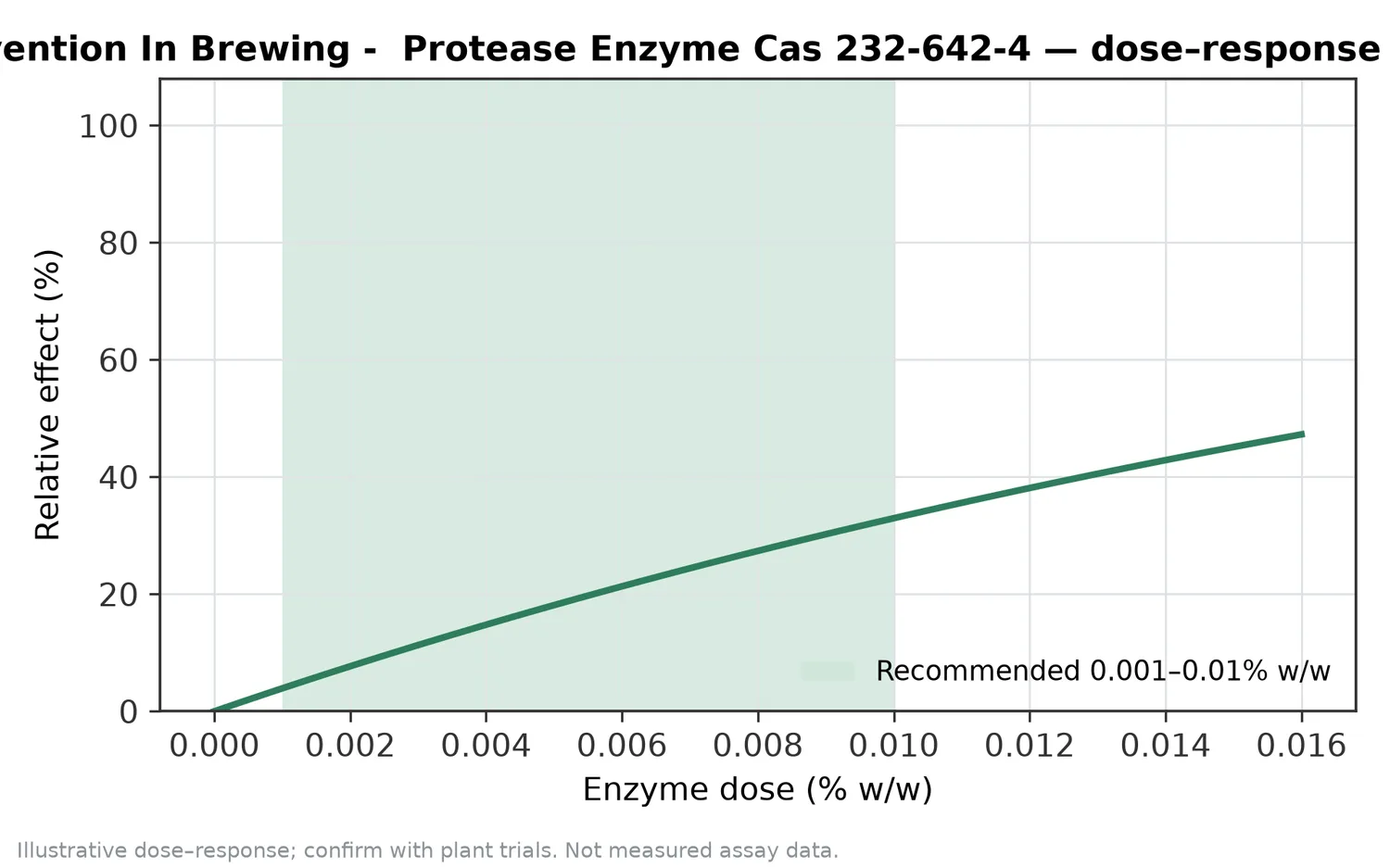
The main technical concern with any brewing protease is over-proteolysis. Beer needs some proteins and polypeptides. Foam formation depends on surface-active molecules that migrate to bubble interfaces and form elastic films. Body and palate fullness are also influenced by the balance of dextrins, proteins, peptides, and other colloids. If a protease cuts too aggressively or acts on the wrong fractions, beer may become clearer but lose foam persistence or mouthfeel [2].
This is why chill-haze prevention is best understood as controlled reduction of haze-active proteins, not total protein removal. The most desirable outcome is a shift in protein size distribution and binding behavior: enough susceptible haze-active chains are cleaved to reduce cold aggregation, while enough foam-positive and body-supporting material remains. Historical comparison of papain, chymotrypsin, and related proteases is relevant here because chill-proofing ability and beer quality characteristics must be considered together [3].
Protein chemistry also interacts with polyphenol chemistry. A highly hopped beer or a beer with a large polyphenol load may still show instability if enough phenolic material remains to bind residual proteins. Conversely, a beer with moderate polyphenol content but high haze-active protein may benefit strongly from protein-side stabilization. Protease addresses one side of the interaction; it changes the protein’s ability to participate in haze, but it does not remove every possible haze-forming component [1].
The clearest application is bright beer intended to remain visually stable under chilled storage. Lagers, pilsners, many blonde ales, export beers, and filtered packaged beers are judged heavily on brilliance. In these beers, even a moderate cold haze can be perceived as a quality defect. Protease treatment reduces the pool of protein structures that would otherwise become visible when the beer is cooled [4].
High-adjunct brewing can also benefit from deliberate protein management. Adjuncts change the balance of starch, protein, husk-derived polyphenols, and malt enzyme contribution. If the protein profile is less predictable than in a well-modified all-malt grist, enzymatic protein modification can help bring the wort or beer closer to a stable colloidal balance. Enzymes.bio’s brewing enzyme category covers enzymes used for clarification, processing efficiency, and beer stability applications .
Breweries producing beer for longer distribution chains may also use chill-haze protease as part of a stability program. Temperature fluctuations during storage and transport can repeatedly encourage haze precursors to associate and dissociate. Over time, some reversible haze can become more persistent. Reducing haze-active protein before packaging lowers the number of molecular partners available for those cold-triggered aggregation cycles [1].
Protease can also complement physical clarification. Filtration and centrifugation remove suspended material, but they do not necessarily eliminate soluble haze precursors. If soluble proteins remain capable of binding polyphenols, haze can develop after packaging. Enzymatic protein hydrolysis changes those soluble precursors before they become visible, making it a useful partner to mechanical clarification rather than a replacement for good separation practice [2].
Proline-specific endoproteases receive attention in brewing because many haze-active barley proteins contain proline-rich regions. Proline’s cyclic structure makes peptide bonds near it more resistant or structurally distinctive, so enzymes that can attack these regions may be especially useful for modifying hordein-derived haze precursors. Research on immobilized proline-specific endoprotease demonstrates the technical interest in making this enzyme class more usable and controllable in food and beverage processing contexts [5].
General proteases can also contribute to chill-haze reduction, especially when they reduce larger proteins into smaller fragments. However, they may not attack proline-rich regions with the same preference as a proline-specific enzyme. This is why the brewing literature does not treat all proteases as interchangeable. The 1981 comparative work on papain, chymotrypsin, and related proteins is a useful reminder that enzymes with the same broad label can differ in chill-proofing performance and beer-quality effects [3].
For the Enzymes.bio product, the practical customer-facing point is straightforward: it is a protease product positioned for chill-haze prevention in brewing. Its value lies in the established brewing mechanism of proteolytic haze-precursor reduction. Buyers should view it as a protein-side stabilization aid for beers where protein–polyphenol chill haze is relevant, rather than as a universal correction for every turbidity cause .
Good chill-haze control starts before enzyme addition. Malt quality, wort boiling, trub separation, fermentation performance, yeast removal, filtration, oxygen control, and cold storage all influence final clarity. Protease adds a biochemical control point: it modifies the protein structures that are capable of becoming haze-active later. That makes it especially useful when process clarity is otherwise sound but cold instability still appears [2].
Polyphenol management remains important. If a beer carries a high polyphenol load, haze can still develop from residual protein–polyphenol binding. Hops, malt husk material, oxidation, and process extraction all influence phenolic composition. Protease reduces the protein partner in the haze reaction, but it does not convert the beer into a polyphenol-free system. Stable bright beer comes from controlling both sides of the colloidal balance [1].
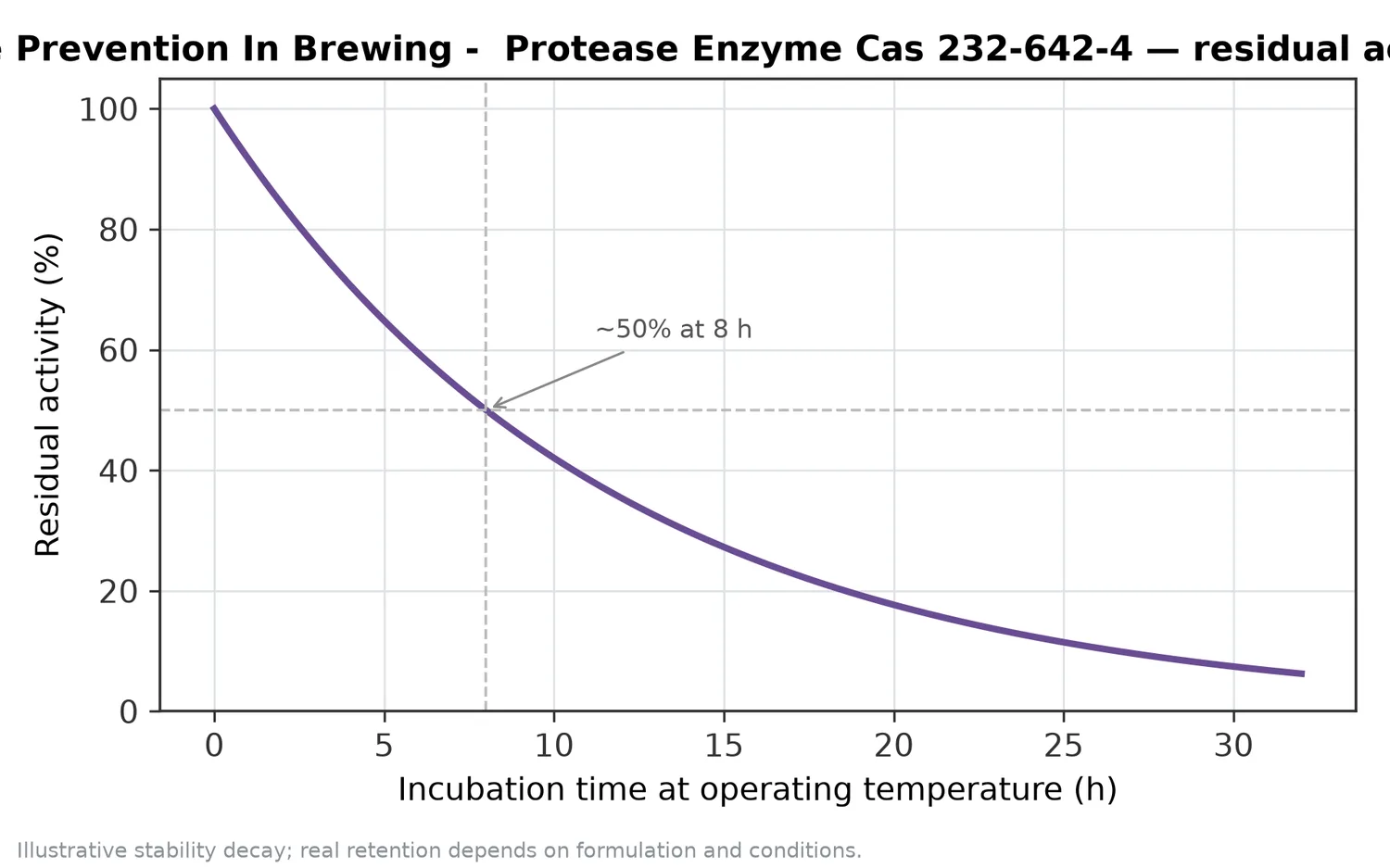
Heat and time also shape protein behavior. Wort boiling coagulates some proteins into hot break, while chilling produces cold break. Fermentation removes additional material through yeast adsorption and sedimentation. Protease treatment changes the population of proteins entering these steps or surviving after them, depending on when it is used. That is why the same enzyme principle can be discussed in both mashing and fermentation contexts in the brewing literature [4].
Enzymes.bio supplies Chill-Haze Prevention In Brewing – Protease Enzyme CAS 232-642-4 as an online product for brewing applications. The product is sold directly by the 1 kg unit: the buyer places the order online, pays online, and the order is then processed and shipped. A Certificate of Analysis and Safety Data Sheet are provided with the order for routine documentation and handling .
The product fits buyers who already want an enzyme-based approach to protein-related chill-haze control in beer. It can be incorporated into a broader brewing stability program where the aim is to reduce haze-active protein behavior while maintaining the intended character of the beer. Enzymes.bio’s brewing enzyme range is presented for beer processing applications including clarification and stability support .
Chill haze is mainly a molecular compatibility problem: haze-active proteins and polyphenols remain small enough to be invisible under some conditions, then associate into larger light-scattering complexes when beer is cooled. Protease helps by cutting susceptible proteins into shorter peptides, reducing their ability to bridge polyphenols into visible aggregates. This is why protease-based chill-proofing has been studied in brewing for decades, including comparative work on different proteases and fermenter addition for chill-haze control [3].
For bright beer styles, Chill-Haze Prevention in Brewing – Protease Enzyme CAS 232-642-4 offers a practical protein-side route to improved cold clarity and colloidal stability. It should be understood as a haze-precursor modification aid: it changes the beer’s protein fraction so fewer protein–polyphenol complexes can form during chilled storage. Purchased directly online from Enzymes.bio by the 1 kg unit, it gives brewers a straightforward way to add enzymatic chill-haze prevention to an existing clarity and stability program .
Sold by the 1 kg unit, in stock and ready to ship. Order directly on our store — pay online and we process your order. A Certificate of Analysis and Safety Data Sheet are included with every order.
Buy Chill-Haze Prevention In Brewing - Protease Enzyme Cas 232-642-4 →Numbered in order of first citation. Open-access sources, each verified reachable at publication; citation numbers in the text link here.