
Coffee Bean Demucilaging Enzyme is a water-dispersed enzyme preparation supplied by Enzymes.bio for loosening mucilage traces and plant-derived surface residues from coffee beans during washing, conditioning, wet polishing, or related water-contact steps. It works by hydrolyzing pectin and associated cell-wall polysaccharides, weakening the “glue” that holds sticky or fibrous residues to the bean surface so that normal rinsing and mechanical movement can remove them more consistently .
The strongest scientific support comes from coffee demucilaging research on pectolytic enzymes, where enzyme-assisted treatment has been shown to promote mucilage removal and improve process control compared with relying only on natural fermentation. For dried green-bean cleaning and polishing, the same substrate chemistry applies, but results depend on how well the remaining residues are hydrated and exposed during the process [1].
Coffee mucilage is the hydrated, sticky layer that remains around the bean after depulping. In wet processing, this layer must be removed before drying, because residual mucilage can hold water, trap fine plant material, support uncontrolled microbial activity, and create uneven bean surfaces. Demucilaging is therefore not just a cosmetic step; it is part of producing clean, stable coffee before drying, storage, grading, and roasting [1].
After primary processing, dried green coffee beans may still carry small amounts of plant-derived material: residual mucilage traces, parchment fragments, silverskin particles, dust, fines, and surface-bound polysaccharide films. These residues are usually thin and irregular rather than a continuous fresh mucilage layer, but they can still affect visual uniformity and cleaning efficiency. Enzymes.bio positions Coffee Bean Demucilaging Enzyme for these practical surface-conditioning uses, especially where water-based washing, soaking, or wet polishing is already part of the workflow .
The difficulty is that these residues are not simply “dirt” sitting loosely on the bean. Mucilage and cell-wall fragments contain pectic substances and other polysaccharides that swell in water and adhere to the rough surface of the coffee seed. Mechanical washing alone can remove loosely attached particles, but when the residue layer is cohesive, fibrous, or dried onto the surface, the limiting step is often weakening the residue matrix rather than applying more force [2].
Coffee Bean Demucilaging Enzyme is described by Enzymes.bio as a multi-enzyme preparation for coffee bean surface treatment and demucilaging applications. Its purpose is to help break down plant polysaccharides associated with mucilage, parchment, and other coffee processing residues, supporting cleaner surfaces and more uniform prepared beans .
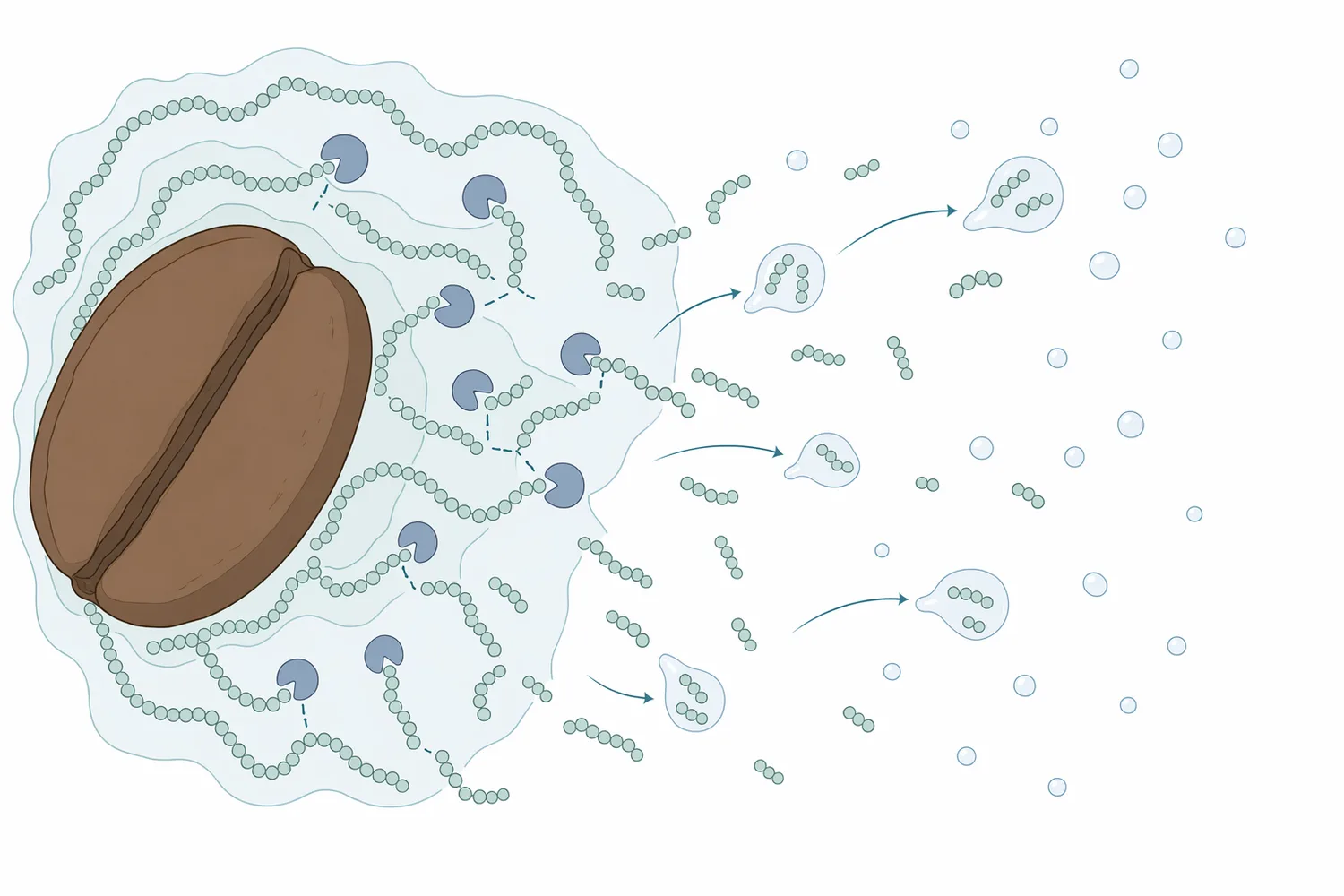
The enzyme concept is based on complementary carbohydrase action. Pectinase activity is central because coffee mucilage is pectin-rich; hemicellulase and cellulase-type activities can support breakdown of associated cell-wall fragments and fibrous residues. In practice, the enzyme does not “scrub” the bean by itself. It changes the residue: long, sticky, water-swollen polysaccharide networks are cut into smaller, less cohesive fragments, making them easier to detach during agitation, rinsing, or polishing [1].
This is why enzyme-assisted demucilaging fits naturally into water-contact operations. Water hydrates and swells the surface residue, allowing enzyme molecules to reach the polysaccharide network. Once hydrated, pectic and hemicellulosic materials become more accessible to enzymatic hydrolysis, and the residue loses the gel-like or adhesive character that makes it difficult to remove by mechanical means alone [2].
The most important target is pectin, a family of acidic plant polysaccharides that helps form the hydrated gel-like structure of fruit mucilage. In coffee processing, pectic substances behave like a natural adhesive around the bean: they bind water, hold suspended solids, and help attach mucilage to the seed surface. Pectolytic enzymes cleave the pectin backbone and side-chain structures, reducing viscosity and cohesion so the mucilage layer breaks apart more readily [1].
A useful way to picture the mechanism is to imagine mucilage as a wet net. The net contains pectin strands, hemicellulose fragments, cellulose-associated particles, proteins, minerals, sugars, and other plant constituents. When pectinase cuts key pectin chains, the net loses continuity. When accessory carbohydrases act on supporting fibers, the net becomes even weaker. Mechanical movement can then lift away pieces that previously stayed attached [2].
This matters for green coffee cleaning because dried residue behaves differently from fresh mucilage. Fresh mucilage is thick and hydrated, so enzyme access can be relatively direct. Dried residue is often thinner, patchier, and more tightly associated with parchment dust or the bean surface. Hydration becomes the first practical step: without enough water contact, the residue remains compact and less accessible, limiting what any enzyme can do .
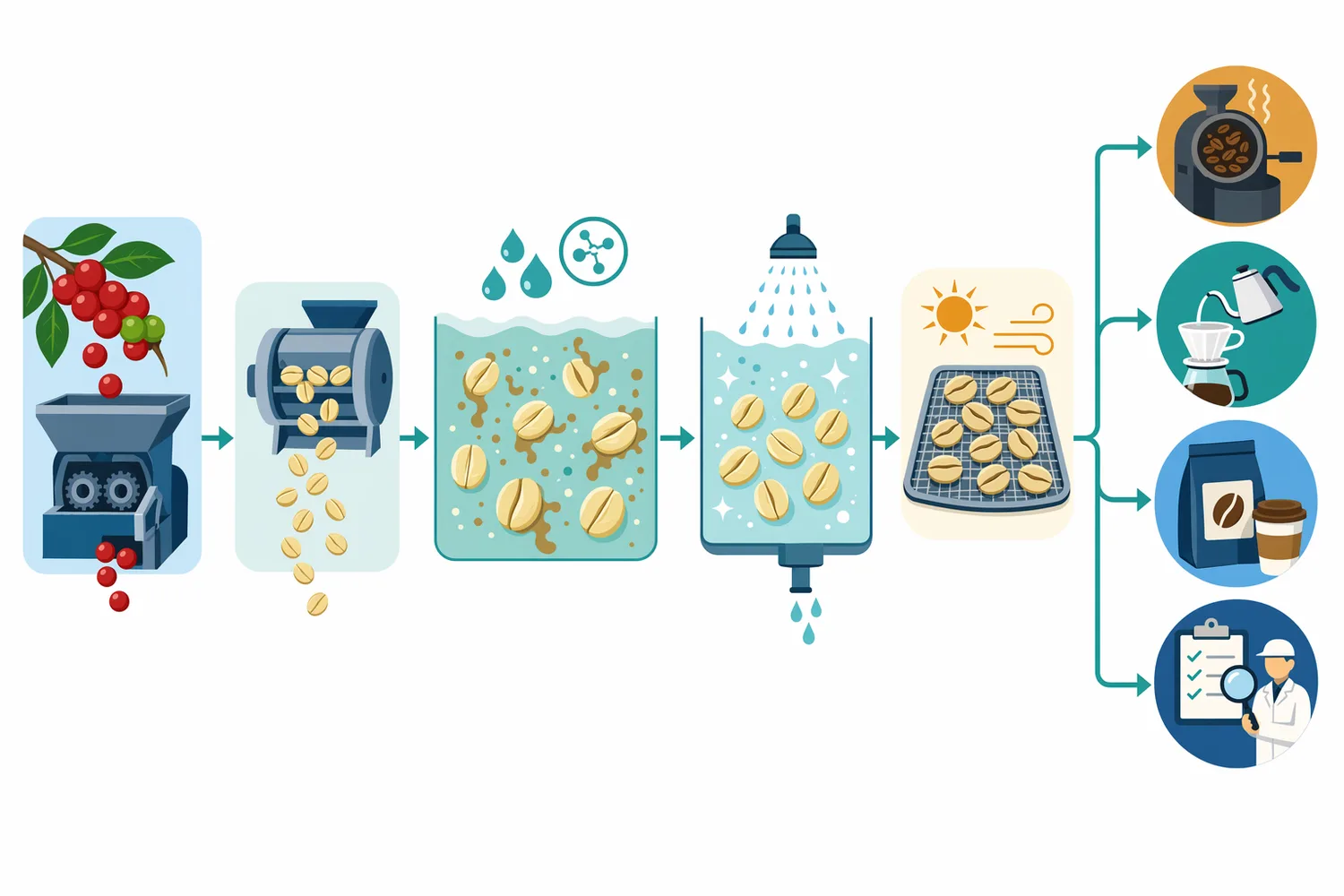
Once hydrated, the enzyme-assisted process has three concrete effects. First, the residue swells and opens. Second, pectin-rich adhesive zones are hydrolyzed into shorter fragments. Third, the weakened residue detaches more easily during washing, tumbling, or wet polishing. The visible outcome is not caused by bleaching or aggressive abrasion; it is caused by biochemical weakening of the material that holds unwanted plant residues to the bean [1].
The most direct evidence comes from studies on pectolytic enzymes for removing mucilage from coffee beans. Work on Coffea arabica has specifically examined the effect of pectolytic enzymes on mucilage removal, showing that enzymatic treatment is a relevant processing approach when the target substrate is coffee mucilage rather than an unrelated plant material [1].
A pectinase study using Bacillus subtilis strain Btk27 is frequently cited in this area because it evaluated the enzyme’s potential for coffee demucilisation and reported complete mucilage removal within 24 hours under the study conditions. That result should not be read as a universal processing time for every plant, lot, or equipment setup; it does show that pectinase can act directly on coffee mucilage at a practical time scale [3].
Comparative coffee-processing work also shows why demucilaging method matters. A study on Robusta coffee evaluated different demucilagination methods and their effects on physical and organoleptic quality of green and roasted coffee, reinforcing that mucilage-removal strategy can influence the final product rather than being a neutral handling detail [4].
Fermentation studies provide supporting evidence because natural coffee fermentation depends heavily on microbial metabolism and enzyme activity. In self-induced anaerobic coffee fermentation, changes in microbial diversity and enzymatic activity were linked with coffee quality improvement, illustrating that enzymes are part of the biological system that transforms mucilage and associated compounds during post-harvest processing [5].
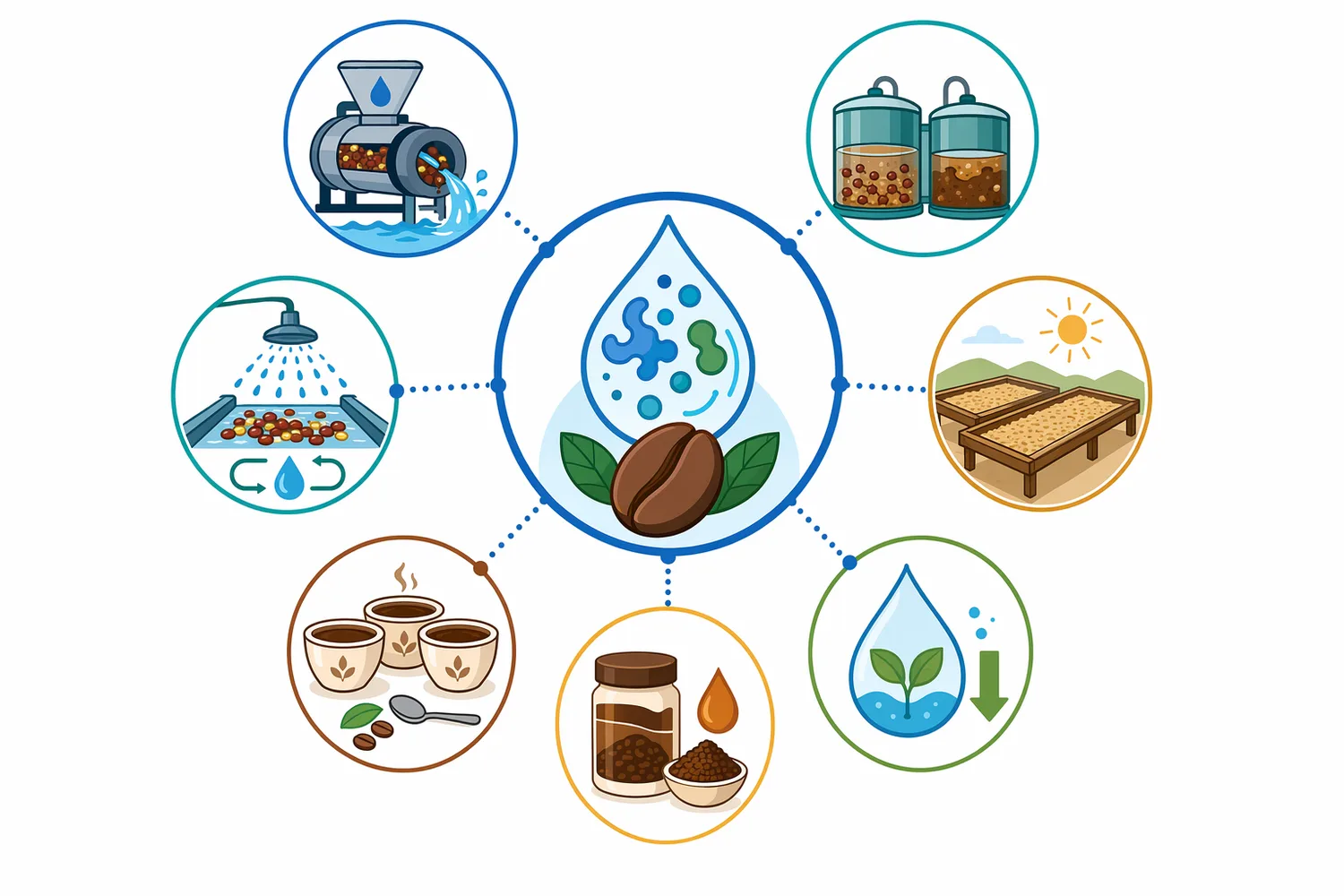
Controlled inoculation studies point in the same direction. Co-inoculation with Pichia fermentans and Pediococcus acidilactici affected metabolites produced during fermentation and the volatile composition of coffee beans, showing that biological control of mucilage-stage processing can change both process behavior and downstream coffee chemistry [6].
More broadly, reviews of enzymatic technology in coffee co-products describe enzymes as useful tools for modifying coffee-derived plant materials, including carbohydrate-rich fractions. Although co-product valorization is not the same as green bean demucilaging, the underlying point is relevant: coffee processing residues contain enzyme-susceptible polysaccharides that can be selectively hydrolyzed under water-based conditions [2].
The evidence strongly supports the principle that pectinase and related carbohydrases can help remove coffee mucilage. This is especially clear for freshly depulped coffee, where the mucilage layer is abundant, hydrated, and directly exposed. Under those conditions, pectolytic enzymes can reduce the structural integrity of the mucilage and make washing more efficient [1].
For dried green coffee bean polishing, the evidence is best understood as application-adjacent rather than identical. The residues are related in composition, but their physical state is different: they may be dehydrated, discontinuous, embedded with dust, or attached to parchment fragments. That means an enzyme can still help, but the process must provide enough water contact and movement for the enzyme to reach the residue layer .
It is also important not to frame demucilaging enzyme as a guaranteed flavor-improvement additive. Coffee quality is shaped by variety, agronomy, fermentation, drying, storage, roasting, and brewing. Post-harvest processing can modify green bean chemistry, including protein interactions with phenolic compounds, so any surface-treatment step should be considered part of the broader quality system rather than an isolated determinant of cup profile [7].
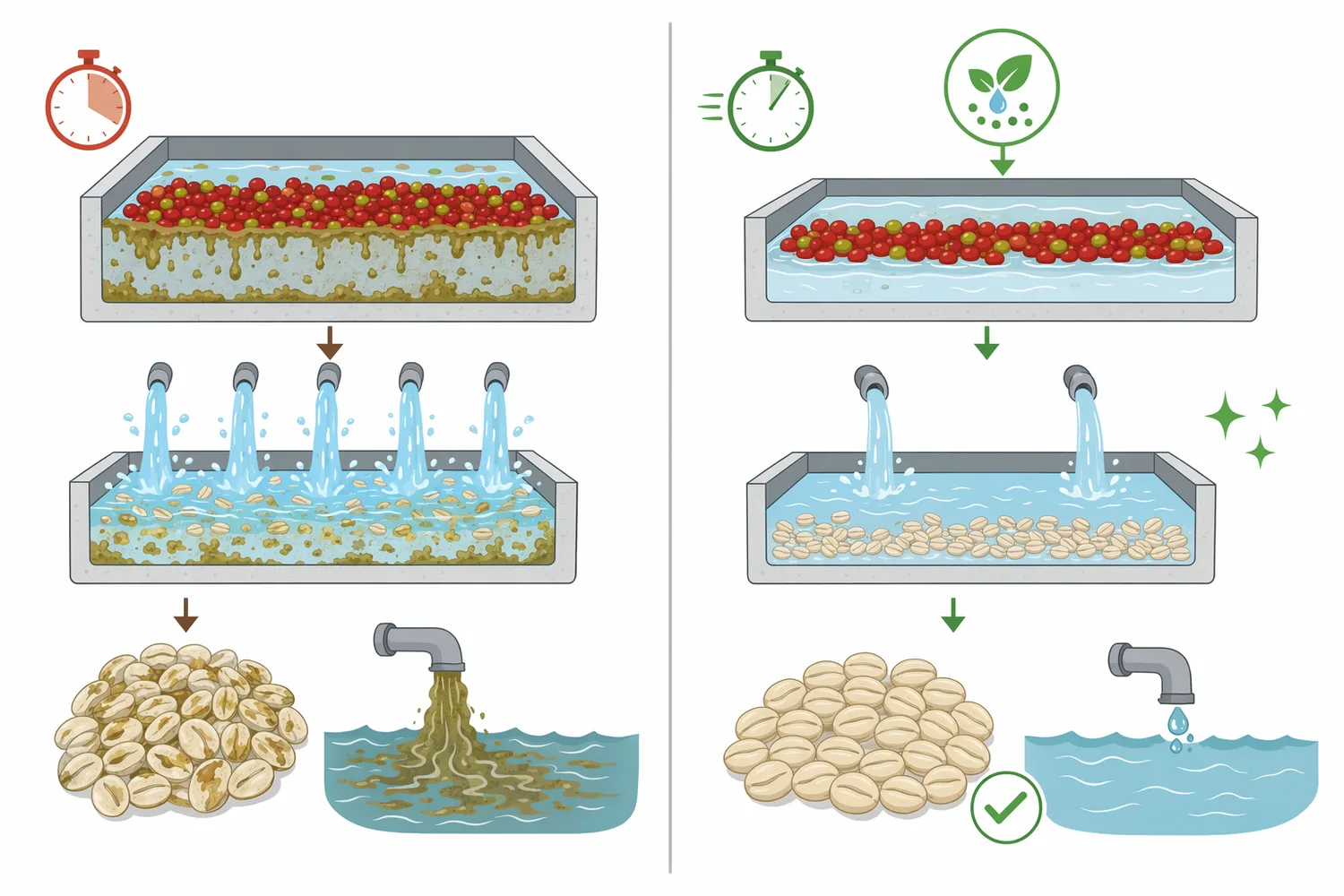
Used appropriately, the enzyme’s practical value is process control: cleaner surfaces, easier residue removal, more uniform appearance, and a more predictable demucilaging or conditioning step. It is not a substitute for cherry selection, hygienic handling, correct drying, sorting, or moisture management [8].
| Approach | Main action on the bean surface | What actually changes in the residue | Practical implication |
|---|---|---|---|
| Natural fermentation | Relies on native microorganisms and their enzymes | Pectin-rich mucilage breaks down as microbial activity develops over time | Can be effective, but timing and outcomes vary with microbial ecology, temperature, and lot conditions [5] |
| Mechanical washing or polishing | Uses water flow, friction, agitation, or abrasion | Loosely attached particles are physically removed; strongly adhered residues may remain | Useful for cleaning, but less effective when mucilage films or dried polysaccharide residues are still cohesive |
| Enzyme-assisted demucilaging | Adds targeted carbohydrase action during water contact | Pectin and related polysaccharides are hydrolyzed, reducing stickiness and cohesion | Helps mechanical steps remove residues more easily and can improve process consistency [1] |
| Controlled microbial fermentation | Uses selected or managed microorganisms | Microbes produce acids, enzymes, and metabolites that alter mucilage and bean chemistry | Can influence both mucilage removal and volatile/metabolite development, requiring careful process control [6] |
In green coffee washing or conditioning, the enzyme is used as part of a water-based step where beans are contacted with an enzyme solution and then rinsed or moved onward to polishing, drying, or further handling. The purpose is to help detach residues that remain after depulping, drying, hulling, or storage, especially where visual cleanliness and lot uniformity are important .
The mechanism is surface-focused. The enzyme is not intended to penetrate and transform the whole bean; it works primarily where water can carry it into contact with exposed mucilage traces and plant residues. The more effectively the process wets and mobilizes the surface layer, the more opportunity the enzyme has to hydrolyze the adhesive polysaccharides that bind that layer to the bean [2].
For buyers using the product in a cleaning or conditioning step, the expected operational pattern is straightforward: disperse the enzyme in water, contact the beans under gentle movement, allow time for biochemical loosening, then remove the released material through rinsing or wet mechanical action. Enzymes.bio supplies the product for these coffee-processing uses as an online 1 kg purchase .
Wet polishing is a useful context for Coffee Bean Demucilaging Enzyme because polishing already combines water contact with mechanical movement. In this setting, the enzyme’s job is not to replace the polishing action. Its job is to make the residue easier for that polishing action to remove .
This distinction matters. Abrasion can dislodge dry dust and weakly attached particles, but it may be inefficient against sticky films or hydrated fragments that smear rather than detach. Enzymatic hydrolysis changes those films before or during movement. Pectin-rich residues lose gel strength; fibrous fragments become less integrated; fine particles are less trapped in the matrix. The polishing step can then carry away the weakened material more cleanly [1].
Because dried residues vary by origin, processing history, and storage, visual improvement may not be identical across lots. A naturally processed coffee with stubborn dried fruit traces presents a different surface challenge from a washed coffee with light parchment dust. The enzyme is best understood as a tool for improving residue release where the residue chemistry is compatible with carbohydrase action [2].
Although Enzymes.bio highlights green coffee bean cleaning and surface conditioning, enzyme-assisted demucilaging is also relevant after depulping, when fresh mucilage is still present. This is the application most closely aligned with published pectolytic enzyme studies [1].
In a depulped-coffee workflow, pectinase-rich enzyme action can shorten or stabilize the breakdown stage by acting directly on hydrated mucilage. Instead of waiting only for native microbial fermentation to generate enough pectolytic activity, the process introduces enzyme activity at the point where the substrate is most accessible. Research reporting complete mucilage removal within 24 hours under specific pectinase study conditions demonstrates the technical plausibility of this approach, while still leaving room for process-specific validation [3].
This does not mean every coffee should be processed as quickly as possible. Fermentation can contribute desirable sensory complexity, and microbial activity can affect metabolites and volatile composition. Enzyme-assisted demucilaging is therefore best viewed as a control option: it helps separate mucilage removal from uncontrolled fermentation time when the production goal is cleaner, more predictable removal [6].
Cleaner green bean surfaces can make physical grading and visual inspection more consistent. When residual mucilage films, parchment fragments, or dust are reduced, defects related to surface contamination are easier to distinguish from inherent bean characteristics. This can support more uniform lots before storage or roasting, especially where the process already includes a washing or polishing stage .
Surface residues can also affect water movement during drying or reconditioning. Sticky or fibrous material may retain moisture differently from the bean surface itself, contributing to local variability. While an enzyme treatment does not replace correct drying practice, removing residue that holds water can support cleaner downstream handling [9].
Roasting is also sensitive to bean uniformity. The enzyme should not be presented as a direct roast-flavor additive, but a cleaner and more consistent green bean surface may help reduce one avoidable source of variability. Coffee research has shown that green coffee quality is connected with active seed metabolism and post-harvest history, so surface preparation should be managed in a way that supports, rather than disrupts, the intended quality profile [8].
Recent coffee research increasingly treats post-harvest processing as a controlled biochemical stage rather than a simple separation step. Studies on microbial and enzymatic modification of coffee beans show that enzymes can alter bean composition and processing outcomes, depending on enzyme type and treatment duration [10].
That broader research is useful context, but Coffee Bean Demucilaging Enzyme has a narrower practical purpose: residue loosening and surface conditioning. It is aimed at hydrolyzing mucilage and plant residue polysaccharides, not at deliberately redesigning the internal chemistry of the bean. This distinction helps keep expectations realistic and process-oriented .
The same distinction applies to enzymatic extraction research on green coffee. Enzymatic extraction can increase the recovery of certain compounds from coffee materials, but extraction studies are designed to release soluble constituents into a liquid phase. Demucilaging is different: the desired outcome is detachment and removal of unwanted surface material while preserving the coffee bean for normal downstream use [11].
Coffee Bean Demucilaging Enzyme fits best as a process aid within an already controlled coffee-processing system. Good raw material selection, hygienic depulping, appropriate washing, careful drying, and stable storage remain the foundation. The enzyme adds a biochemical tool for a specific challenge: breaking down sticky or fibrous plant residues that are difficult to remove by water and movement alone .
The most relevant performance indicators are practical and visible: easier mucilage release, cleaner rinse water after contact, fewer adhered residues, more uniform bean appearance, and smoother transition into grading, drying, storage, or roasting preparation. Where sensory quality is a priority, treated and untreated lots should be compared within the normal quality program, because post-harvest processing can affect chemical and sensory outcomes [4].
It is also sensible to avoid over-treatment. Once the target surface-cleaning effect has been achieved, continued wet contact is not automatically beneficial. Coffee beans are biological materials, and unnecessary exposure to water, heat, or microbial growth conditions can create other quality risks. Enzyme use should therefore be integrated into a clean, controlled, time-bounded handling step [7].
Enzymes.bio supplies Coffee Bean Demucilaging Enzyme directly online by the 1 kg unit. Buyers place the order through the online store, pay online, and the order is processed and shipped. A Certificate of Analysis and Safety Data Sheet are provided with the order .
Enzymes.bio is the product supplier, not a coffee-processing laboratory or the manufacturer of the enzyme. The product page provides the online purchasing route and general application context for buyers who want a 1 kg unit for coffee bean demucilaging, cleaning, or surface-conditioning work .
Coffee Bean Demucilaging Enzyme is a practical enzyme-based processing aid for loosening coffee mucilage traces, parchment-associated residues, and surface-bound plant polysaccharides. Its core mechanism is concrete: pectolytic and related carbohydrase action cuts the hydrated carbohydrate network that makes mucilage sticky and cohesive, allowing washing, rinsing, agitation, or wet polishing to remove the weakened material more effectively [1].
The best-established evidence is for enzyme-assisted mucilage removal from depulped coffee, including research showing pectinase-driven demucilaging within practical processing times under defined study conditions. For green coffee bean surface conditioning, the same chemistry supports the application, provided the residues are sufficiently wetted and exposed during the process [3].
For buyers who want to add an enzyme-assisted cleaning step without entering a custom procurement process, Enzymes.bio offers Coffee Bean Demucilaging Enzyme as a direct online 1 kg purchase with order documentation supplied after purchase .
Sold by the 1 kg unit, in stock and ready to ship. Order directly on our store — pay online and we process your order. A Certificate of Analysis and Safety Data Sheet are included with every order.
Buy Coffee Bean Demucilaging Enzyme →Numbered in order of first citation. Open-access sources, each verified reachable at publication; citation numbers in the text link here.