
Dextranase is an enzyme that breaks down dextran, a glucose-based polysaccharide that can make sugar juices and syrups more viscous, harder to filter, and less predictable during crystallization. Its core function is to hydrolyze dextran chains into smaller fragments, reducing the physical interference caused by high-molecular-weight dextran in sucrose-rich process streams [1].
For sugar processing, dextranase is used when dextran contamination is affecting flow, clarification, filtration, evaporation, or crystal formation. Enzymes.bio supplies Dextranase for direct online purchase by the 1 kg unit; the buyer pays online, the order is processed and shipped, and a Certificate of Analysis and Safety Data Sheet are included with the order.
A practical dextranase definition is straightforward: dextranase is a carbohydrate-degrading enzyme that hydrolyzes dextran, converting long dextran polymers into shorter sugar fragments. Dextran itself is built from glucose units, with a main structure dominated by α-1,6 glycosidic linkages; those linkages are the main target of the dextranase enzyme function in industrial and technical use [1].
This matters because dextran behaves very differently depending on molecular size. A long, high-molecular-weight dextran chain can increase solution viscosity, interact with suspended solids, slow filtration, and interfere with sucrose crystal growth. After dextranase cuts that chain into shorter oligosaccharides, the fragments have less ability to entangle, hold water, and disturb process flow.
The word “dextranase” is sometimes used broadly in commercial and technical searches. Buyers may encounter terms such as dextranase enzyme, dextranase uses, dextranase in sugar industry, dextranase toothpaste, dextranase Sigma, dextranase Sigma Aldrich, dextranase Novozymes, Dextranase Plus L Novozymes, Cytodex dextranase, dextranase Cytodex 1, and dextranase suppliers. Those searches often point to different application contexts—industrial sugar processing, oral-care formulation, laboratory catalog supply, or cell-culture microcarrier handling—so the relevant question is always what dextran problem the enzyme is being used to solve.
Dextran becomes important in sugar processing because it is not simply another dissolved sugar. It is a polymer: many glucose units connected into long chains. When microbial activity produces dextran in sugarcane, sugar beet, juice, or syrup streams, even relatively small amounts can have an outsized effect on viscosity because polymer chains occupy volume, entangle with one another, and alter how the liquid moves through pumps, pipes, screens, filters, and evaporators.
In sugar mills and refineries, dextran contamination is associated with poorer juice handling, slower filtration, clarification difficulties, and crystallization problems. The underlying mechanism is physical as much as chemical: long dextran chains increase resistance to flow, make suspended material harder to separate, and can disturb the controlled movement of sucrose molecules from solution into ordered crystal surfaces.
Dextran is also troublesome because its effects appear downstream. A dextran issue that begins with cane deterioration, beet storage, microbial contamination, or delayed processing may first show up as reduced throughput, filter blinding, syrup handling problems, or irregular crystal growth. This is why dextranase in sugar industry applications is usually discussed as a process-support enzyme rather than a simple additive: it addresses the polymer that is causing the operational disturbance.
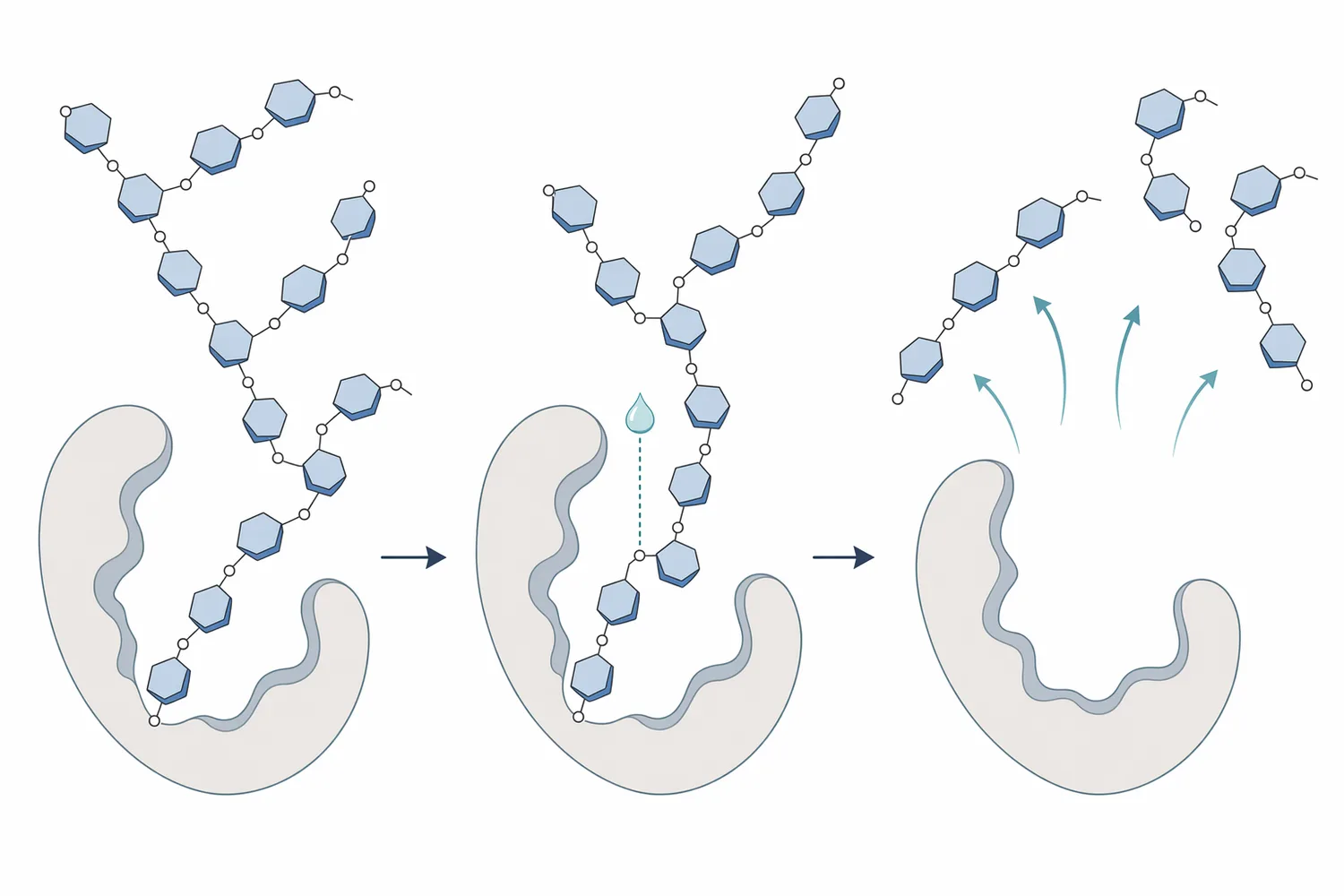
Dextranase works by hydrolysis. In practical terms, the enzyme binds to dextran and uses water to cleave glycosidic bonds in the polymer chain. For dextran dominated by α-1,6 linkages, that means the enzyme cuts the long glucose backbone into shorter pieces, producing lower-molecular-weight dextran fragments and oligosaccharides [1].
The effect is not just a chemical label change; the physical behavior of the process stream changes. A long dextran molecule acts like a flexible coil in solution. It can occupy a large hydrodynamic volume, increase viscosity, and slow liquid movement. When dextranase cuts the chain at multiple points, the polymer coil collapses into smaller fragments. Those fragments have less chain entanglement, lower thickening effect, and less ability to obstruct separation and crystallization.
A useful way to visualize the mechanism is to think of dextran as long strands dispersed through sugar juice. While intact, those strands behave like microscopic ropes that make the liquid more resistant to flow and more likely to clog or slow separation. Dextranase acts like a targeted biochemical cutter: it does not remove sucrose; it cuts the dextran strands so they are less able to create viscosity and surface interference [1].
This specificity is the reason dextranase is not interchangeable with every other carbohydrate enzyme. An amylase is used for starch, a pectinase for pectin, and a cellulase for cellulose-rich materials. Dextranase is used when dextran is the polymer of concern, especially where α-linked glucose polymers are creating viscosity or processing inconsistency.
| Enzyme type | Main substrate it is associated with | What changes in the process stream | Why this distinction matters |
|---|---|---|---|
| Dextranase | Dextran, a glucose polymer mainly associated with α-1,6 linkages | Long dextran chains are cut into smaller fragments; viscosity and dextran-related interference can decrease | Relevant when dextran contamination is affecting sugar juice, syrup, filtration, or crystallization |
| Amylase | Starch and starch-derived polymers | Starch chains are hydrolyzed into shorter dextrins and sugars | Useful for starch problems, but not a substitute for dextran-specific breakdown |
| Pectinase | Pectin and pectic substances | Pectin networks are degraded, often improving extraction or clarification in pectin-rich materials | Targets plant cell-wall pectin rather than microbial dextran |
| Cellulase | Cellulose and cellulose-containing structures | Cellulose fibers are partially hydrolyzed | Relevant to fiber breakdown, not dextran viscosity control |
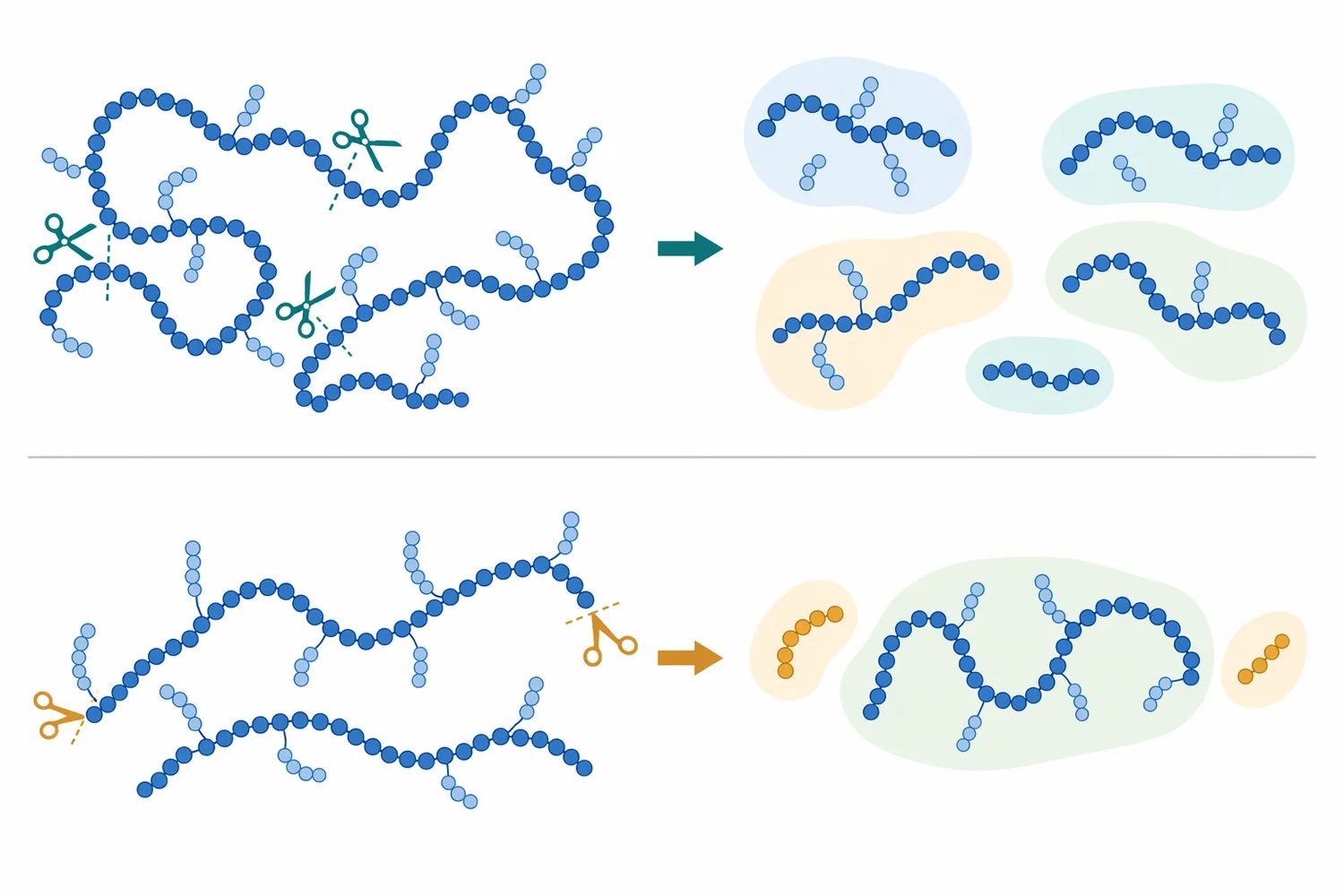
Dextranase action is often described in terms of how the enzyme attacks the dextran molecule. Endo-type action means the enzyme cuts internal bonds along the polymer chain rather than only nibbling from the ends. For a high-molecular-weight polymer, internal chain cutting can rapidly reduce average molecular size because one cut can turn one large molecule into two smaller ones, and repeated cuts quickly reduce the population of long chains [1].
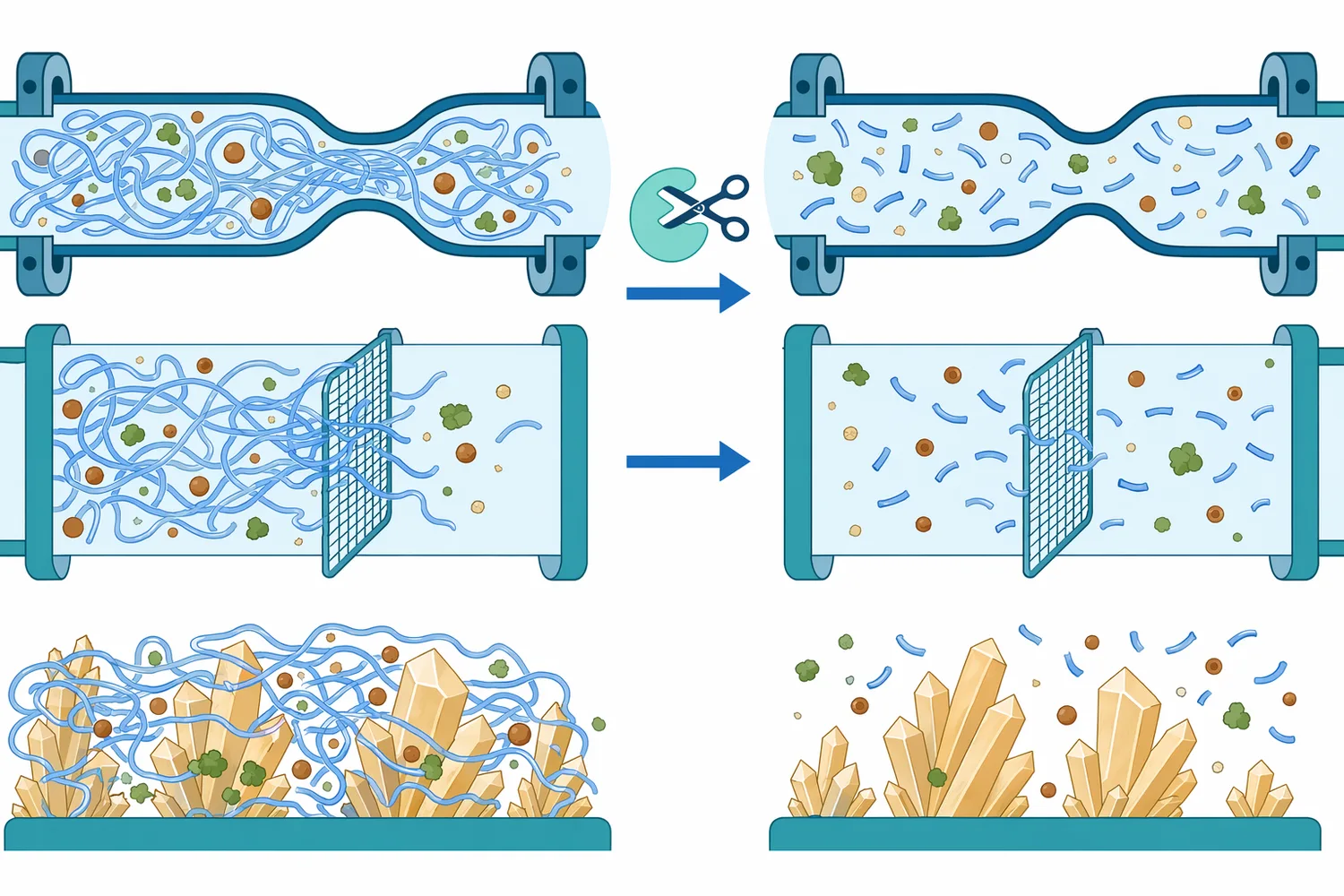
That action pattern is highly relevant for sugar processing because viscosity is disproportionately influenced by the largest polymer molecules. Removing or shortening the longest dextran chains can produce a meaningful change in flow behavior even before all dextran is fully converted to very small sugars. This is why the practical goal is often not “complete disappearance” of every dextran-derived fragment, but reduction of the high-molecular-weight material that causes process disruption.
Technical literature on dextranase action patterns also shows that substrate structure matters. Dextran is not always a perfectly linear molecule; branching and related structural features can affect how readily bonds are reached and hydrolyzed. In industrial terms, this explains why performance should be understood as process-dependent: the same enzyme function—dextran hydrolysis—can appear more or less effective depending on the dextran present, how accessible it is, and how much contact time the enzyme has in the liquid phase [1].
The best-known industrial use of dextranase is in sugar processing, especially where dextran contamination affects cane or beet processing. Application literature describes dextranase as a tool for reducing dextran-related viscosity, filtration issues, and crystallization interference in sugar streams.
When dextran is present early in the process, it can influence everything that follows. Juice extraction, screening, pumping, and transfer all depend on predictable flow. If dextran has already increased viscosity, the liquid can become harder to move, and downstream clarification may receive a more difficult feed.
Dextranase can be applied conceptually as an early intervention because the enzyme targets the polymer before it contributes further to downstream problems. By cutting high-molecular-weight dextran into smaller fragments, the liquid phase becomes less dominated by long-chain polymer behavior. That can support smoother handling through subsequent clarification and filtration stages when dextran is a meaningful contributor to the issue.
Filtration problems caused by dextran are not only about “stickiness” in a general sense. Long dextran chains can increase viscosity around suspended solids and within filter media, making liquid passage slower. They can also contribute to poor separation behavior because polymer-rich liquid drains less freely than lower-viscosity liquid.
Dextranase helps by changing the dextran before it reaches or while it is present in clarification and filtration operations. Once the long chains are hydrolyzed, the process stream is less burdened by the polymer’s thickening effect. The result can be better liquid movement through separation steps when dextran is one of the causes of slow filtration or clarification instability.
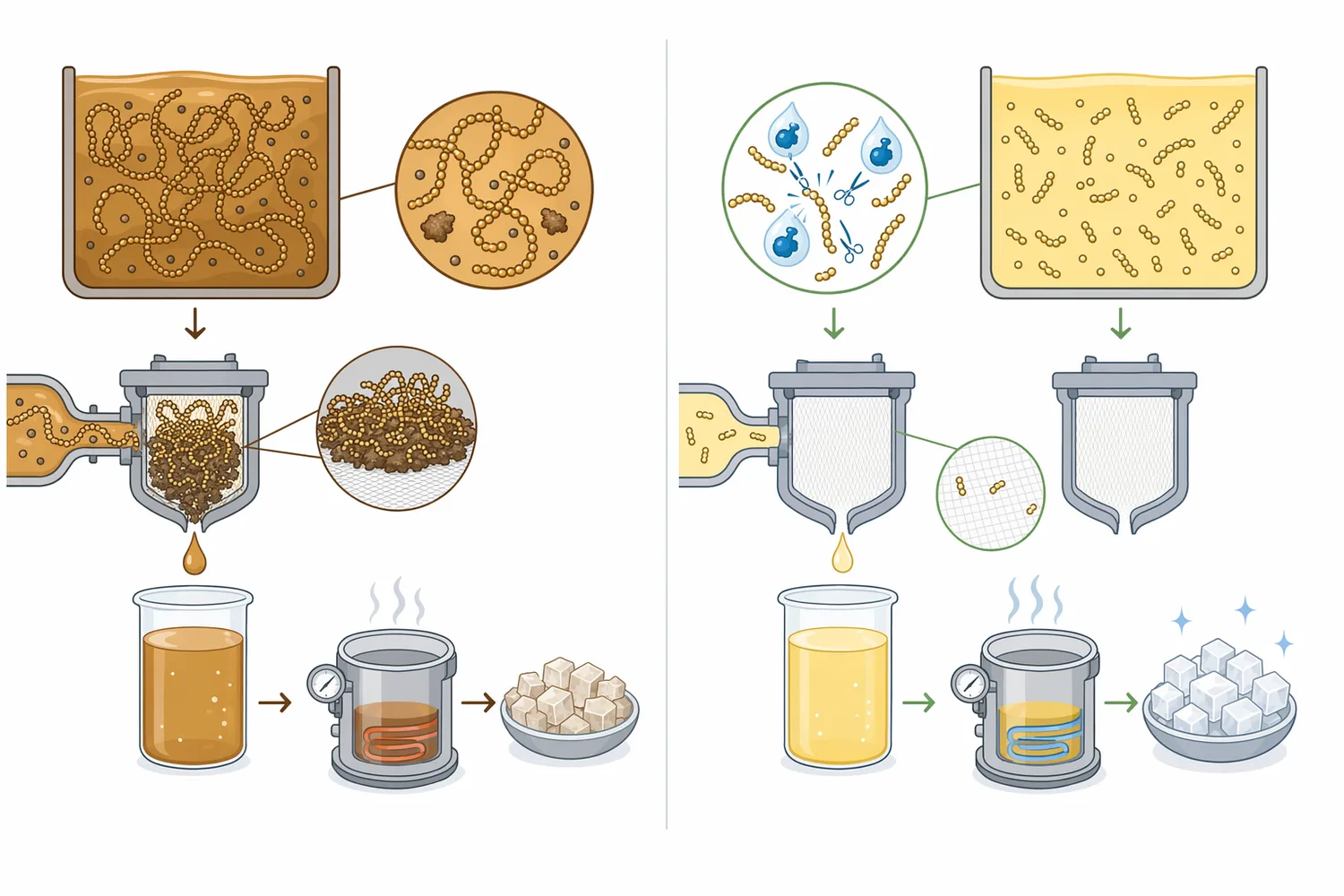
Evaporation is designed to remove water and concentrate sugar, but syrup handling becomes more demanding as solids increase. If dextran is present, concentration can make its viscosity effect more visible. Long-chain dextran in a more concentrated sugar stream can make movement, heat transfer, and downstream handling less efficient.
Dextranase is not an evaporation enzyme, but dextran hydrolysis can support evaporation-related handling by reducing the polymeric contribution to viscosity. The concrete change is molecular: instead of large dextran coils contributing to thick, slow-moving syrup behavior, the hydrolyzed fragments behave more like smaller soluble carbohydrates with less chain entanglement.
Crystallization requires sucrose molecules to organize at the surface of growing crystals. Dextran can interfere with this process because high-molecular-weight polymers affect solution viscosity and may disturb mass transfer near crystal surfaces. When movement of sucrose through the mother liquor is less predictable, crystal growth can become less uniform.
Dextranase supports crystallization by reducing the long-chain dextran fraction before it can exert that interference. Smaller dextran fragments are less able to behave as viscosity-building coils and are less disruptive to the physical environment in which sucrose crystals form. This is why dextranase uses in sugar refining are commonly linked with improved crystallization consistency when dextran contamination is present.
The main benefit of dextranase is targeted removal of dextran’s high-molecular-weight behavior. It does not need to change the whole sugar stream to be useful; it needs to cut the polymer that is responsible for viscosity, separation, and crystallization problems. That specificity is one reason dextranase remains a recognized enzyme in sugar-processing discussions.
Reduced viscosity is usually the most direct benefit. Dextranase reduces the average molecular size of dextran, and lower-molecular-weight fragments produce less thickening than intact long chains. In practice, reduced viscosity can support smoother pumping, better flow through equipment, and more manageable syrup handling where dextran is the source of the problem.
Improved filtration and clarification follow from the same mechanism. If polymer chains are increasing resistance to liquid flow through filter beds, screens, or clarification systems, cutting those chains can reduce the physical barrier they create. This does not replace sound process control, but it directly addresses the dextran component of separation difficulty.
More consistent crystallization is another important benefit. Dextran can disturb crystal growth by changing viscosity and mass transfer behavior in sugar liquors. Dextranase reduces the high-molecular-weight polymer load, making the crystallization environment less affected by dextran-derived interference.
Better process continuity is the operational expression of these molecular changes. When flow, filtration, and crystallization are less disrupted by dextran, the process can be easier to keep stable. The actual scale of improvement depends on how much dextran is present, where it enters the process, and how significant it is compared with other sources of fouling, viscosity, or separation difficulty.
The strongest evidence-backed statement is the biochemical one: dextranase hydrolyzes dextran. Studies of dextranase action patterns describe how the enzyme acts on dextran substrates, including the hydrolysis behavior that converts larger dextran molecules into smaller products [1].
The industrial logic is also strong. If dextran is causing high viscosity or interfering with sugar processing, reducing dextran molecular size should reduce the polymer effect. Sugar-industry application sources consistently describe dextranase as useful for reducing dextran-related viscosity, filtration problems, and crystallization difficulties.
What should be treated more cautiously are fixed performance promises. No responsible dextranase article should claim a universal percentage improvement in yield, filtration time, evaporation efficiency, or crystal quality for every sugar operation. The direction of benefit is well aligned with the enzyme function, but the measured outcome depends on the process stream, dextran level, residence time, mixing, temperature exposure, pH environment, and the presence of other interfering materials.
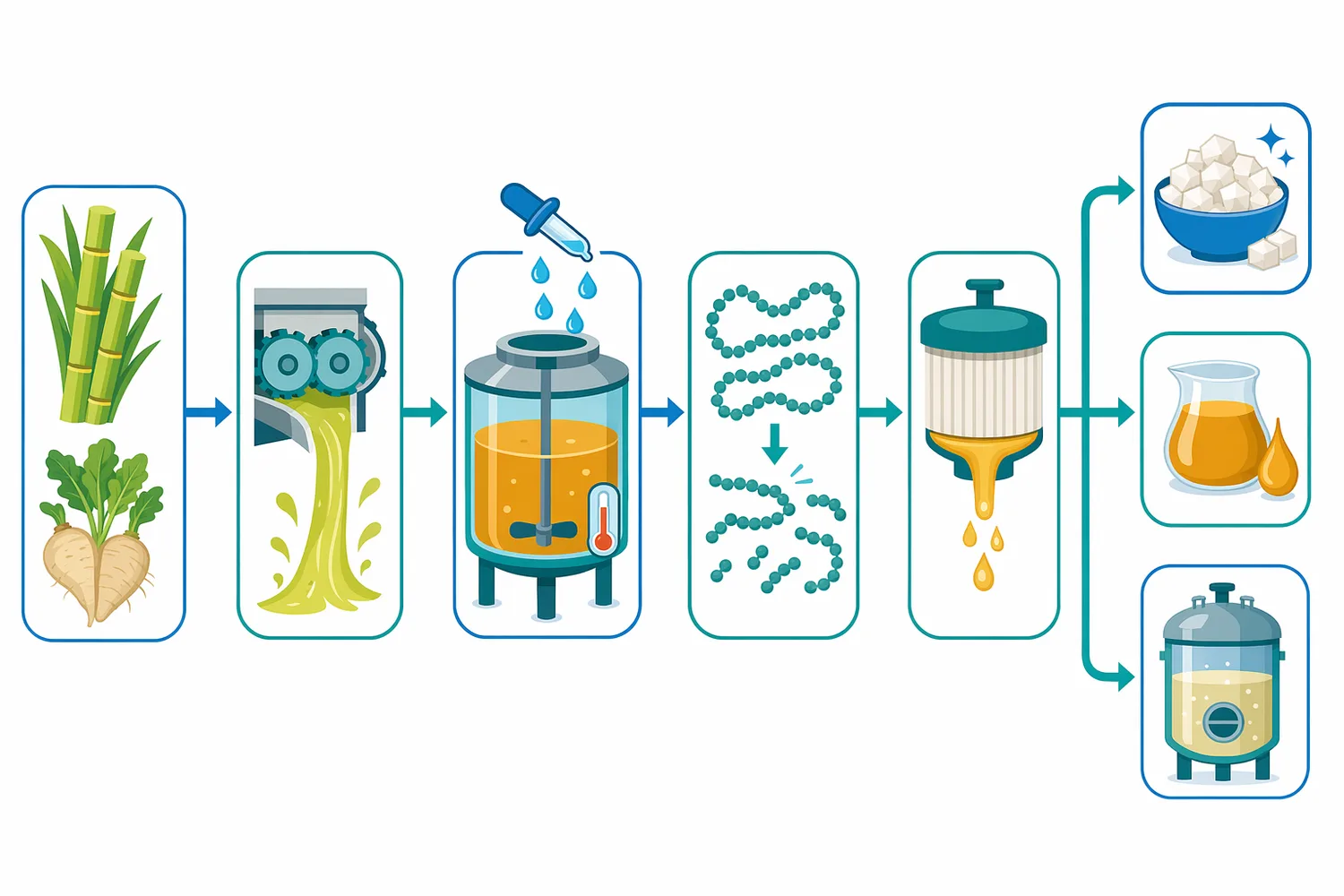
It is also important to distinguish dextran problems from other process problems. If a filtration issue is mainly caused by mineral scale, suspended soil, starch, gums, microbial slime unrelated to dextran, or equipment limitations, dextranase alone will not be expected to solve the full issue. The enzyme is most logical where dextran is known or reasonably suspected to be a meaningful contributor.
Like all enzymes, dextranase must contact its substrate to work. In a sugar stream, that means the enzyme needs access to dextran in the liquid phase. If dextran is present but poorly mixed, trapped in localized deposits, or exposed only briefly before a harsh downstream condition, the observed effect may be limited even though the enzyme function itself is correct.
Time also matters because dextran hydrolysis is a reaction, not an instant physical separation. The enzyme cuts bonds over the period in which it remains active and in contact with dextran. Longer effective contact generally gives more opportunity for chain cutting, while very short exposure may reduce the extent of molecular-size reduction [1].
Temperature and pH influence enzyme structure and reaction rate in general terms. If conditions are too mild, reactions can proceed slowly; if they are too harsh, enzyme structure may be compromised. In sugar processing, this is why dextranase is usually considered in relation to the stage of the process where dextran is accessible and the enzyme has a realistic opportunity to act.
Dextran concentration and molecular structure also influence the observed outcome. A lightly contaminated stream may show a different operational response than a heavily contaminated one, and branched or structurally varied dextran may not behave identically in every case. The core mechanism remains dextran hydrolysis, but the process result reflects the substrate actually present [1].
Although sugar processing is the primary industrial focus for many buyers, dextranase uses extend beyond cane and beet streams. Any application involving unwanted dextran can potentially be relevant, provided the product form, documentation, formulation environment, and regulatory context are appropriate for that use.
One commonly searched example is dextranase toothpaste. The reason this term appears is that dextran-like glucans are associated with plaque structure in oral-care discussions, and dextranase can be considered where enzymatic breakdown of dextran-type polymers is desired. The same substrate logic applies: the enzyme is of interest because it can cut dextran chains, not because it is a general antimicrobial or abrasive agent.
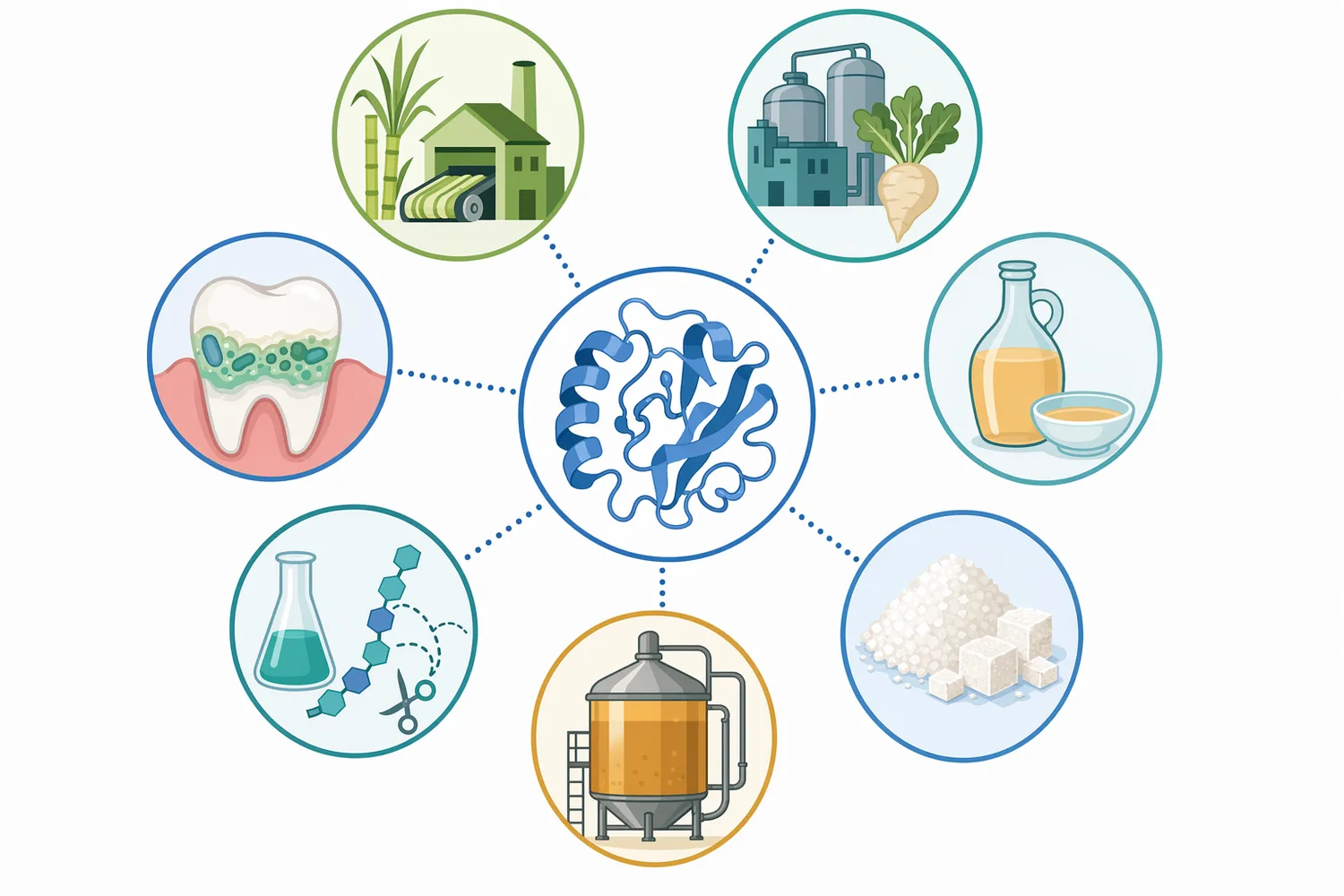
Another area is controlled dextran modification. In technical or industrial carbohydrate work, dextranase can be used to reduce dextran molecular size or alter dextran-derived material properties. In that context, searches such as “dextranase size” may refer either to the enzyme itself or, more practically, to the size of dextran fragments produced after enzymatic hydrolysis [1].
Cell-culture-related searches such as Cytodex dextranase and dextranase Cytodex 1 reflect a different use context from sugar refining. Cytodex microcarriers are dextran-based materials, so dextranase appears in searches where controlled digestion of dextran-based support material is relevant. That does not make every industrial dextranase product automatically suitable for that application; it simply reflects the same core chemistry of dextran hydrolysis.
Dextranase enzyme production is generally associated with microbial enzyme systems, and dextranases have been studied from fungal and bacterial sources. For the buyer, the most important practical point is not the academic taxonomy of every producing organism, but the enzyme’s functional role: it hydrolyzes dextran and is used where dextran creates an unwanted processing effect [1].
Commercial dextranase suppliers may serve different markets, including industrial processing, laboratory catalog supply, oral-care formulation, and specialized technical use. Search terms such as dextranase Sigma, dextranase Sigma Aldrich, dextranase Novozymes, and Dextranase Plus L Novozymes often reflect those different buying contexts rather than a single universal product category.
Enzymes.bio supplies Dextranase as a direct online product sold by the 1 kg unit. The purchase is completed online, payment is made online, and the order is then processed and shipped. A Certificate of Analysis and Safety Data Sheet are included with the order so the buyer receives the standard product documentation needed for responsible receipt and handling.
Dextranase is best understood as a targeted enzyme for a defined substrate problem. If dextran is contributing to viscosity, slow filtration, clarification instability, syrup handling difficulty, or crystallization interference, dextranase has a clear biochemical role: it cuts the dextran polymer into smaller fragments with less disruptive physical behavior.
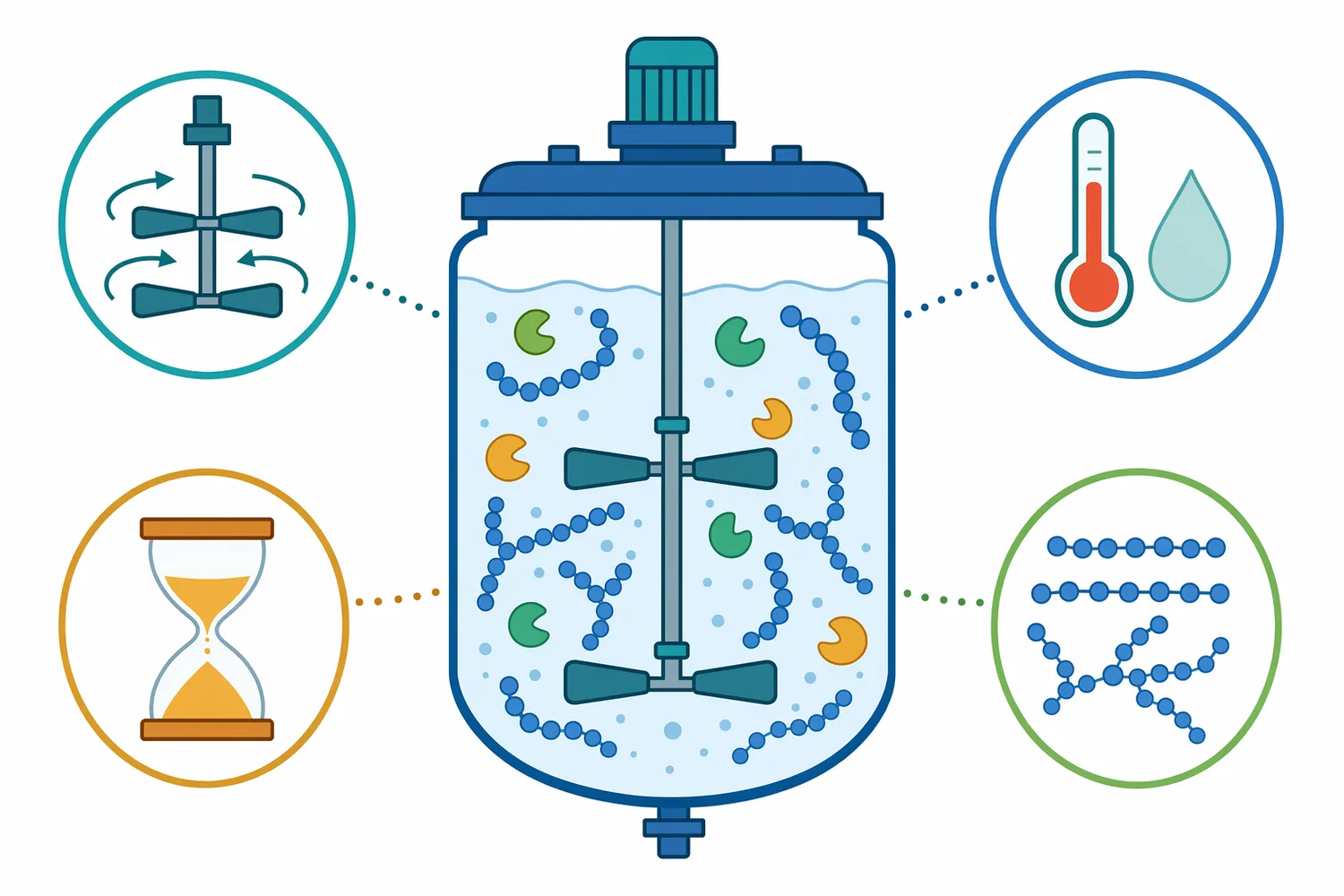
The enzyme should not be viewed as a universal cure for every sugar-processing bottleneck. It is most relevant when the problem is tied to dextran contamination or dextran-derived high-molecular-weight material. Where other materials are responsible, other process controls or enzyme types may be more relevant.
For sugar processors and technical buyers, the key value of dextranase is that the mechanism and the operational problem align closely. Dextran causes trouble because it is a long-chain polymer; dextranase helps because it shortens that polymer. That direct cause-and-effect relationship is what makes the enzyme useful in sugar-industry applications [1].
Enzymes.bio offers Dextranase for direct online ordering in 1 kg units. The buyer places the order online, completes payment online, and the order is processed and shipped. A Certificate of Analysis and Safety Data Sheet are supplied with the order.
For customers searching broadly for dextranase suppliers, the Enzymes.bio model is intentionally simple: online purchase, 1 kg unit size, order documentation included, and shipment after processing. This is suited to buyers who already know they need dextranase as a process or formulation input and want a straightforward online ordering route.
Dextranase is a focused enzyme with a clear technical purpose: it hydrolyzes dextran. In sugar processing, that can translate into lower dextran-related viscosity, improved filtration behavior, smoother clarification, and more reliable crystallization when dextran contamination is part of the process challenge.
Sold by the 1 kg unit, in stock and ready to ship. Order directly on our store — pay online and we process your order. A Certificate of Analysis and Safety Data Sheet are included with every order.
Buy Dextranase →Numbered in order of first citation. Open-access sources, each verified reachable at publication; citation numbers in the text link here.