
Food-grade alpha amylase helps rice wine processors convert cooked rice starch into shorter dextrins, reducing mash thickness and preparing the substrate for downstream saccharification and fermentation. It works by cutting internal alpha-1,4 linkages in amylose and amylopectin, so gelatinized rice paste becomes less viscous and more accessible to saccharifying enzymes and fermentation cultures. Enzymes.bio supplies Food-Grade Alpha Amylase for Rice Wine Processing directly online by the 1 kg unit; buyers pay online, and the order is processed and shipped with a Certificate of Analysis and Safety Data Sheet.
Food-Grade Alpha Amylase for Rice Wine Processing is used at the starch-conversion stage of rice wine production. Rice is naturally rich in starch, but yeast does not efficiently ferment intact starch granules. Before alcohol fermentation can proceed efficiently, the rice starch must be opened, liquefied, and converted into smaller carbohydrates that other enzymes or microorganisms can continue converting into fermentable sugars. Alpha-amylase is one of the main enzyme types used for this first conversion step because it rapidly attacks starch chains internally rather than waiting to remove glucose units from chain ends [1].
In practical rice wine terms, alpha-amylase does not “make alcohol” by itself. Its value is upstream: it changes the physical and chemical state of the cooked rice mash. Large starch molecules that create a heavy, sticky paste are cut into shorter dextrins; as the average chain length falls, viscosity falls, and the mash becomes easier to mix, heat, pump, and ferment evenly. This is why alpha-amylase is commonly associated with liquefaction rather than final saccharification.
Rice wine production can be traditional, enzyme-assisted, or a hybrid of both. Traditional Chinese rice wine and huangjiu systems rely on complex starters such as jiuyao or qu, which contain molds, yeasts, bacteria, and their enzymes; modern defined-starter or enzyme-supported processes may add enzyme preparations to make starch conversion more controlled [2]. In either design, alpha-amylase has the same core function: it opens the starch substrate so that saccharifying organisms and enzymes can produce fermentable sugars more reliably.
Rice starch is mainly composed of two glucose polymers: amylose and amylopectin. Amylose is mostly linear, while amylopectin is highly branched. Both contain alpha-1,4 glycosidic linkages along the main chains; amylopectin also contains alpha-1,6 branch points. Alpha-amylase is an endo-acting enzyme, meaning it cuts inside starch chains at alpha-1,4 bonds. This creates a mixture of shorter dextrins and smaller maltose-type fragments instead of immediately producing only glucose [3].
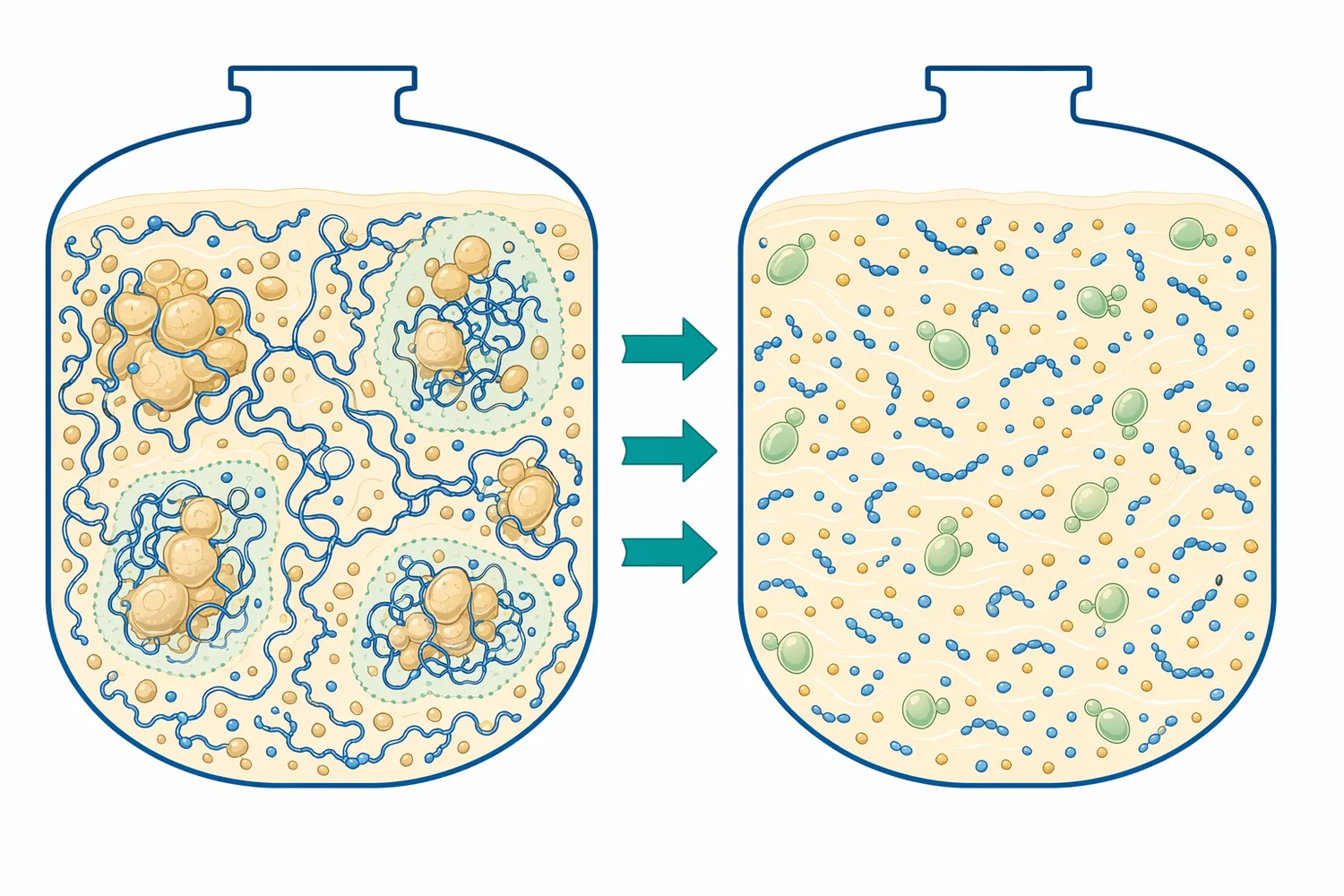
That internal-cutting mechanism is why alpha-amylase is so useful in liquefaction. A cooked rice mash is viscous because swollen starch molecules form a hydrated network with long chains and entangled fragments. When alpha-amylase cuts those chains, the network loses strength. The mash does not simply become “more converted” in an abstract sense; the molecules physically become shorter, less entangling, and easier to disperse. Process operators see this as reduced paste thickness, improved mixing, and less resistance during agitation.
The enzyme’s effect is strongest when starch is gelatinized or otherwise made accessible. Native rice starch granules are semi-crystalline structures; water and enzyme molecules cannot freely access every internal bond. Cooking, steaming, extrusion, or high-shear treatment disrupts granule order, swells the starch, and exposes more alpha-1,4 linkages. Rice wine research using enzymatic extrusion liquefaction of broken rice reflects this principle: thermomechanical treatment and enzymatic liquefaction were studied together because physical opening of the starch and enzymatic cutting are complementary steps [4].
Alpha-amylase also changes the substrate available to downstream enzymes. After liquefaction, glucoamylase-type activity can act on dextrin ends to release glucose, while debranching activity can improve access to alpha-1,6 branch regions in amylopectin. In traditional rice wine starters, these activities may come from molds and mixed microorganisms; in enzyme-assisted processes, they may be introduced as separate enzyme components. Alpha-amylase’s role is therefore foundational but not complete: it prepares rice starch for more complete saccharification.
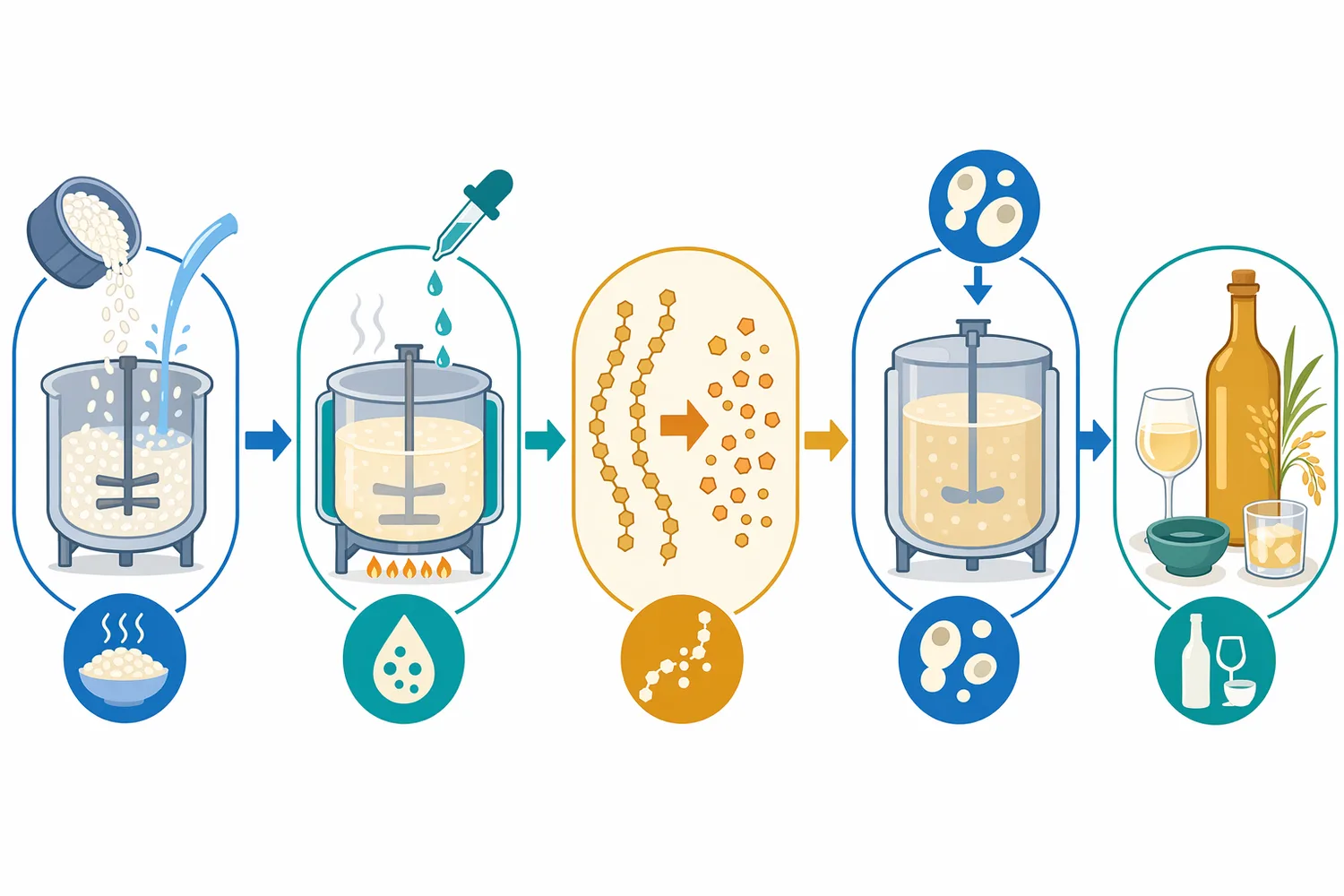
Rice wine fermentation is a two-part biochemical conversion: starch is first converted into fermentable sugars, and then yeasts convert those sugars into ethanol and aroma compounds. If the starch-conversion step is slow or uneven, fermentation can be limited even when yeast performance is otherwise strong. Comparative work on simultaneous saccharification and fermentation and separate hydrolysis and fermentation for rice wine illustrates the importance of coordinating starch hydrolysis with yeast fermentation rather than treating fermentation as a standalone step [5].
In a thick rice mash, poor liquefaction can create several processing issues. Starch pockets may remain under-converted, enzyme and microbial distribution can be uneven, and heat transfer can become less uniform. The effect is not only mechanical. If starch remains locked in dense paste or insufficiently opened granules, saccharifying enzymes cannot generate fermentable sugars at the expected rate. Alpha-amylase helps by reducing viscosity early, which allows the rest of the saccharification system to contact more of the starch.
Broken rice is a particularly relevant substrate because it is widely available and starch-rich, but its particle size, damage level, and hydration behavior can differ from whole polished rice. The Chinese rice wine study on broken rice used enzymatic extrusion liquefaction as a pretreatment, directly linking alpha-amylase-assisted liquefaction with preparation of broken rice for wine fermentation [4]. This supports a practical conclusion: when rice raw material is inexpensive or variable, controlled enzymatic liquefaction can help turn it into a more uniform fermentation substrate.
Rice variety also matters. Glutinous rice, non-glutinous rice, high-amylose rice, and damaged rice starches differ in gelatinization behavior and enzyme accessibility. Research in rice seeds has long identified alpha-amylase as a key enzyme in natural starch breakdown during germination, reinforcing that rice starch conversion depends on enzyme expression, starch structure, and access to granules [6]. In processing, the same biological logic applies, but the enzyme is supplied intentionally to support predictable liquefaction.
When cooked rice enters the liquefaction stage, starch granules have absorbed water and swollen. Amylose may leach out, amylopectin-rich regions soften, and the mixture can become very thick. At this stage, alpha-amylase diffuses into the hydrated starch phase and begins cleaving exposed alpha-1,4 bonds. Each cut reduces the length of a starch chain, and many cuts across many molecules rapidly lower the average molecular size of the starch fraction [1].
The first visible effect is a drop in viscosity. This is not because the starch has disappeared; it is because long, water-binding, entangled molecules have been converted into shorter dextrins that flow more easily. A rice mash that was difficult to stir can become more mobile, which improves contact between starch, enzymes, and microorganisms. In production language, this is the liquefaction benefit.
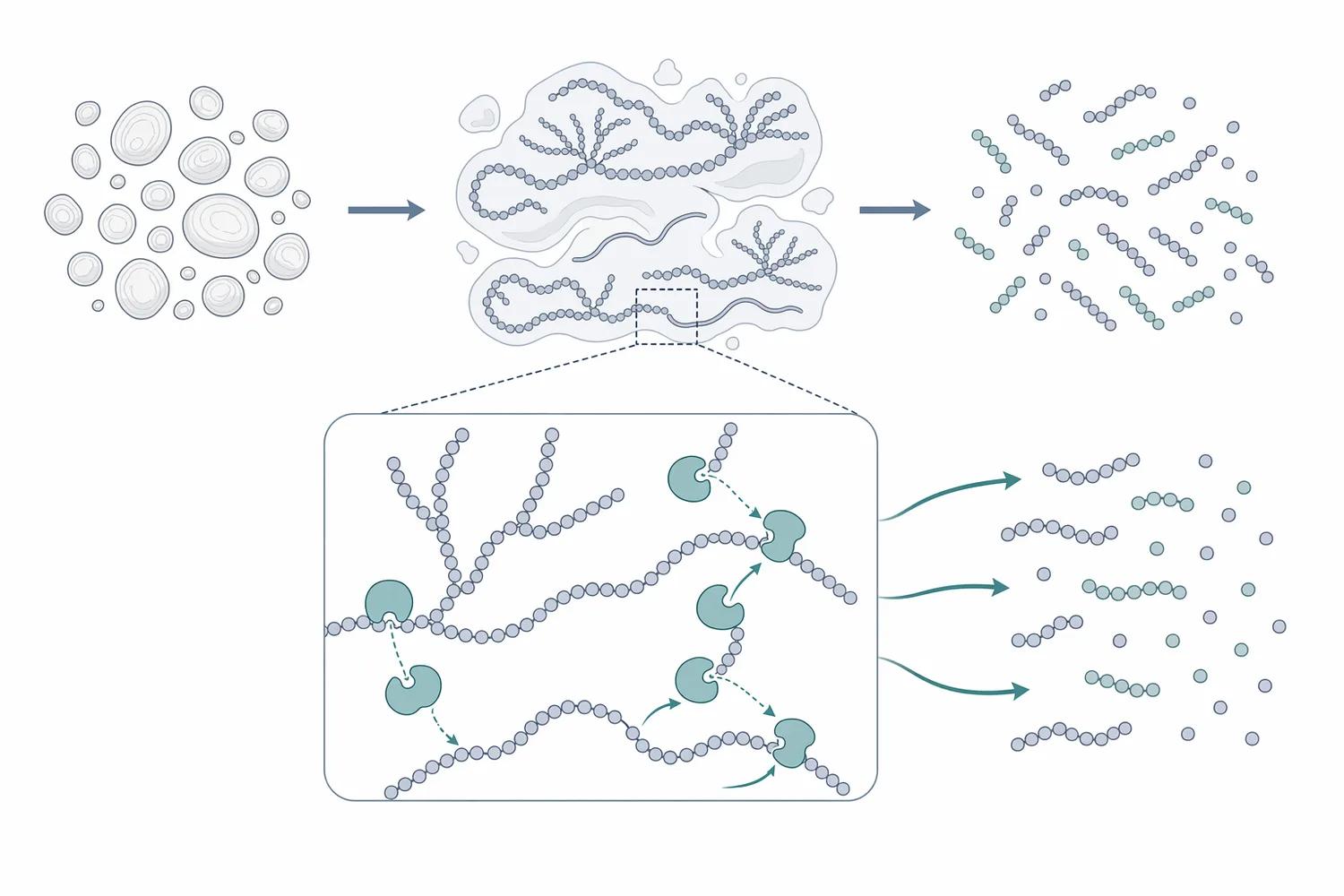
The second effect is improved enzymatic access. Shorter dextrins expose more chain ends, which can be acted on by glucoamylase and other saccharifying enzymes. Alpha-amylase therefore increases the number of attack points for subsequent conversion, even though it does not fully hydrolyze all starch into glucose. This distinction matters for rice wine: a processor may use alpha-amylase to make the mash manageable and then rely on a starter culture, koji-like system, or added saccharifying enzymes to generate fermentable sugars.
The third effect is improved fermentation uniformity. Yeast ferments simple sugars, not large dextrins or intact starch. When liquefaction is uneven, some regions may supply sugar quickly while other regions release sugar slowly. That can lead to uneven fermentation kinetics. Enzyme-supported rice wine studies using added enzymes with defined fungal starters show that the enzymatic component can influence the fermentation behavior of Chinese rice wine systems, which is consistent with the need to manage saccharification and fermentation together [7].
Alpha-amylase is often discussed together with glucoamylase and debranching enzymes, but their functions are not interchangeable. For rice wine processing, the distinction is important because a mash can be well liquefied but still require further saccharification before yeast can fully use the carbohydrate pool.
| Enzyme type | Main action on starch | What changes in rice mash | Typical role in rice wine processing |
|---|---|---|---|
| Alpha-amylase | Cuts internal alpha-1,4 bonds in starch chains | Rapidly shortens starch molecules, reduces viscosity, creates dextrins | Liquefaction and substrate opening |
| Glucoamylase-type activity | Releases glucose from chain ends and can continue dextrin conversion | Increases fermentable glucose formation | Saccharification after or alongside liquefaction |
| Debranching activity | Opens alpha-1,6 branch points in amylopectin | Makes branched dextrins more accessible | Supports more complete conversion of amylopectin-rich starch |
| Natural starter enzymes | Mixed enzyme activities from molds and microorganisms | Converts rice starch progressively during fermentation | Traditional or hybrid rice wine fermentation systems |
This comparison helps explain why alpha-amylase is frequently the first enzyme associated with rice liquefaction. It is fast at reducing chain length, and chain length is the main reason a cooked starch paste becomes difficult to handle. However, because it leaves dextrins rather than converting everything to glucose, it works best as part of a broader saccharification-fermentation system. Studies on mold screening for brewing rice wine also show that rice wine production depends on organisms capable of producing relevant hydrolytic activities, not only yeast alcohol production [8].
The most application-specific evidence is the study on simultaneous saccharification and fermentation of broken rice using enzymatic extrusion liquefaction pretreatment for Chinese rice wine production. The title itself identifies the core process sequence: broken rice was pretreated by enzymatic extrusion liquefaction, then used in Chinese rice wine production. This is directly relevant because it connects rice raw material, enzyme-assisted liquefaction, and wine fermentation in one process model [4].
Another rice wine study compared simultaneous saccharification and fermentation with separate hydrolysis and fermentation using Pichia kudriavezii. That comparison matters because rice wine production can be arranged so saccharification and fermentation occur together, or starch hydrolysis can be performed first and fermentation afterward. In both designs, successful conversion depends on making rice starch available as fermentable carbohydrate at the right point in the process [5].
High-shear extrusion combined with enzymatic hydrolysis has also been studied for its impact on rice properties and Chinese rice wine fermentation. This line of work supports a practical mechanism: mechanical energy can disrupt rice starch structure, while enzymatic hydrolysis cuts the opened starch into smaller fragments. Together, these steps can change both rice material properties and fermentation behavior [9].
The role of alpha-amylase in rice starch degradation is also supported outside conventional rice wine. In Monascus ruber, the alpha-amylase MrAMY1 was reported as better than MrAMY2 for rice starch degradation and promoted Monascus pigment production. Although pigment production is not rice wine fermentation, the study is relevant because it shows that alpha-amylase properties can materially affect how efficiently rice starch is degraded by fermentation organisms [10].
Natural rice biology reinforces the same mechanism. Classic work on germinating rice seeds examined alpha-amylase isozymes and the enzymic mechanism of starch breakdown. During germination, rice mobilizes stored starch using amylolytic enzymes; in rice wine processing, the processor intentionally supplies or encourages similar starch-degrading activity to support fermentation [6].
Alpha-amylase performance is shaped by the condition of the rice, not only by the enzyme itself. Gelatinized starch is easier to hydrolyze than compact native granules because heating disrupts crystalline structure and allows water to penetrate. In a rice wine mash, steaming, cooking, or extrusion therefore does more than soften the rice for handling; it changes starch accessibility at the molecular level. Enzymatic extrusion work on broken rice for Chinese rice wine demonstrates this combined physical-enzymatic approach [4].
Moisture distribution is also important. Enzymes act in the aqueous phase, so dry pockets or poorly hydrated rice particles can remain under-converted even when the bulk mash contains enzyme. As alpha-amylase begins cutting starch and lowering viscosity, mixing generally becomes easier, which can further improve hydration and enzyme distribution. This creates a positive processing sequence: initial hydrolysis reduces resistance, and improved mixing supports more uniform hydrolysis.
Temperature history affects both starch opening and enzyme function. Cooking helps gelatinize starch, but excessive heat after enzyme addition can reduce enzyme effectiveness depending on the enzyme type and process design. Thermostable alpha-amylases are often used where liquefaction is integrated with heated starch processing, while other rice wine systems rely on lower-temperature saccharification by microbial starters. Reviews of alpha-amylase structure and industrial application emphasize that different alpha-amylases have different stability profiles, which is why the process context matters [3].
pH also influences enzyme behavior and microbial fermentation. Rice wine mashes typically develop acidity as fermentation progresses, while enzymatic liquefaction may occur before or during early saccharification. The practical point is that alpha-amylase should be understood as part of a timed process: liquefaction, saccharification, and fermentation are related but not identical stages. Studies comparing rice wine process arrangements such as simultaneous versus separate hydrolysis and fermentation highlight the importance of matching hydrolysis timing with fermentation needs [5].
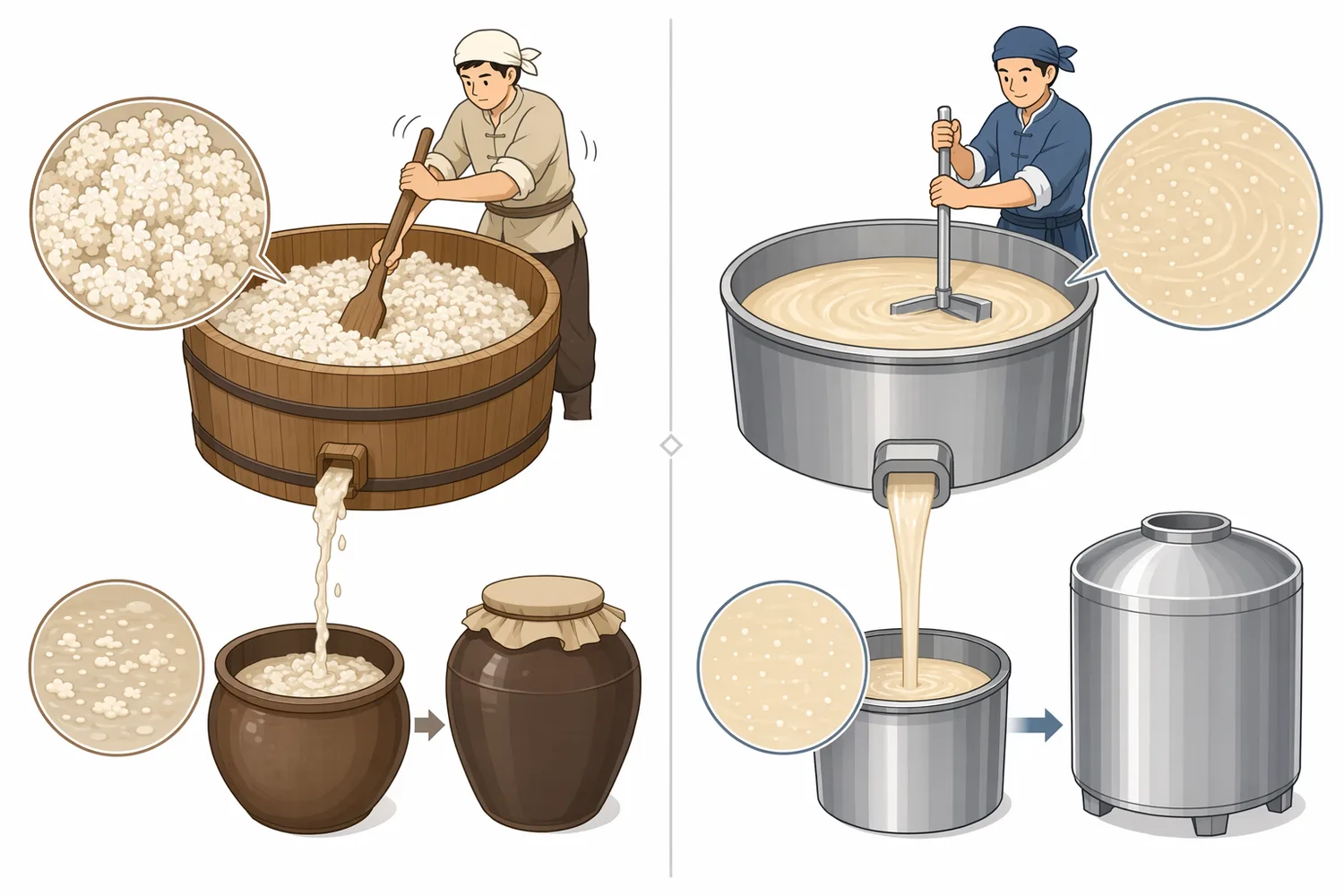
Mechanical pretreatment can further improve starch accessibility. High-shear extrusion combined with enzymatic hydrolysis has been studied specifically in relation to rice properties and Chinese rice wine fermentation, reflecting the value of disrupting starch structure before or during enzyme action [9]. Ultrasound has also been investigated as a way to influence alpha-amylase activity and starch hydrolysis, showing that physical treatment can interact with enzymatic breakdown rather than acting independently [11].
The primary application is liquefaction: converting a thick cooked rice mash into a more fluid slurry. This improves handling and creates a more consistent substrate for saccharification. Alpha-amylase’s endo-acting cleavage pattern makes it especially suitable for this stage because viscosity drops quickly when long starch chains are cut internally [1].
Broken rice can be a cost-effective starch source for rice wine, but it may require careful processing to create a uniform mash. Enzymatic extrusion liquefaction of broken rice has been studied directly for Chinese rice wine production, making this one of the most relevant research-backed applications for alpha-amylase in the rice wine context [4]. The key benefit is not simply using broken rice; it is converting it into a more accessible and fermentable substrate.
Traditional rice wine starters contain complex microbial communities that contribute saccharification, fermentation, flavor formation, and acid development. Research on microbial community succession in Shaoxing huangjiu jiuyao shows that rice wine starters are dynamic biological systems rather than single-organism inoculants [2]. Food-grade alpha-amylase can support such systems by assisting the early starch breakdown step while the starter organisms continue broader biochemical development.
Modern rice wine research has also examined enzyme addition in fermentation using defined fungal starters. This is relevant to producers seeking more predictable conversion than fully spontaneous or highly variable mixed starters may provide [7]. Alpha-amylase fits naturally into these systems because it performs a specific, measurable biochemical role: cutting starch chains to reduce viscosity and produce dextrins.
Rice starch liquefaction is not limited to alcoholic beverages. Studies on enzymatic saccharification of waste broken rice for ethanol production show that rice starch residues can be converted into fermentable substrates when enzymatic hydrolysis is properly integrated into the process [12]. While fuel ethanol is not rice wine, the starch-to-sugar principle is the same: rice starch must be hydrolyzed before fermentation organisms can use it efficiently.
The first expected benefit is a more manageable mash. A thick rice paste can be difficult to mix, especially at high solids levels. By cutting starch chains into shorter dextrins, alpha-amylase reduces the molecular causes of viscosity. The processing effect is practical: the mash can become easier to agitate and more uniform, which supports downstream saccharification and fermentation.
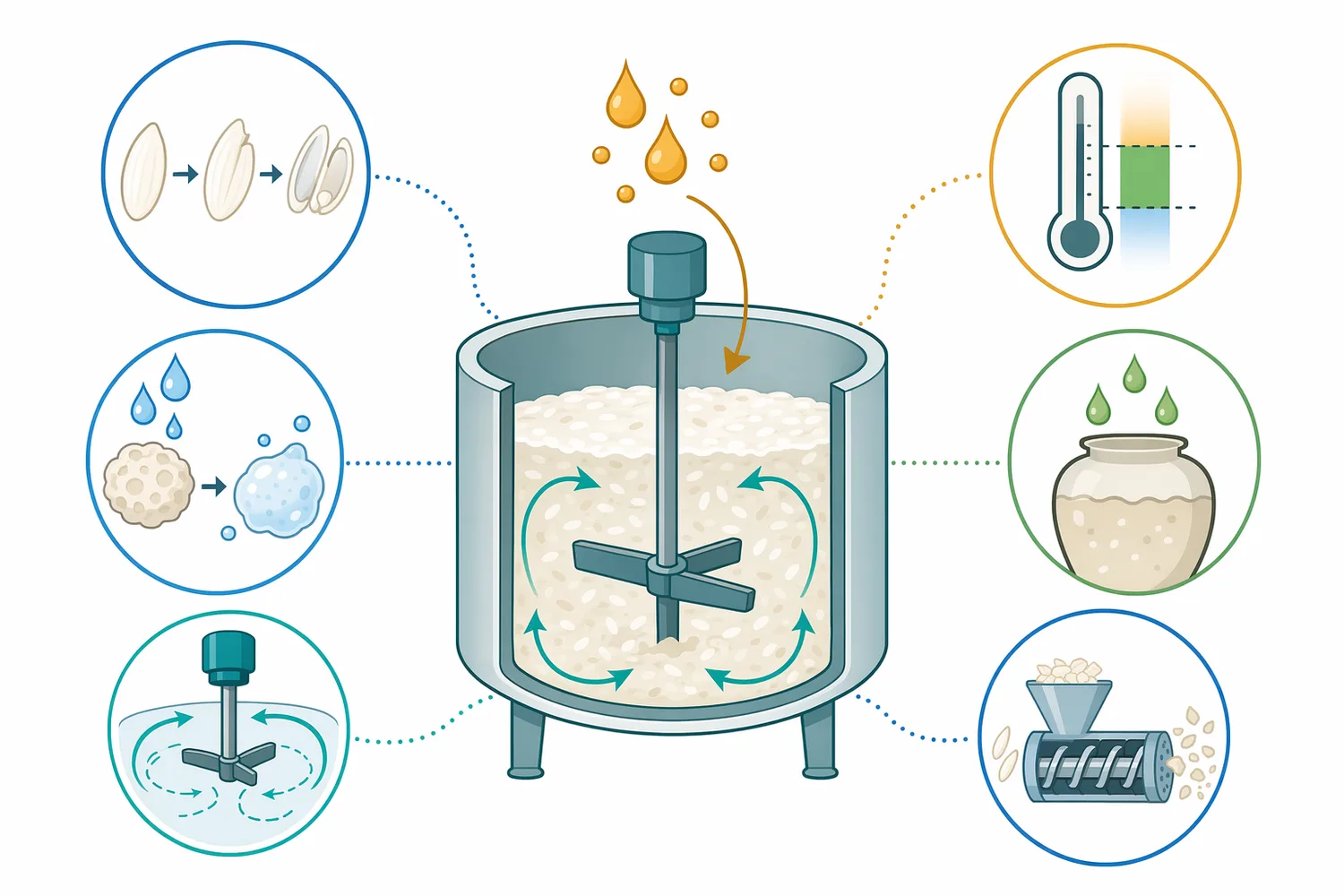
The second benefit is more controlled starch conversion. Traditional starters can supply amylolytic activity, but their enzyme output may vary with culture composition, temperature, raw material, and fermentation stage. Adding food-grade alpha-amylase gives the liquefaction stage a defined enzymatic function, while still allowing the rice wine culture or companion saccharification system to shape sugar release and flavor development. Research on enzyme addition with defined fungal starters supports the broader idea that targeted enzyme use can influence Chinese rice wine fermentation systems [7].
The third benefit is better use of rice starch. Alpha-amylase opens long starch molecules into shorter fragments that are more available for further hydrolysis. In rice wine, this can support more complete substrate preparation, provided the rest of the process supplies sufficient saccharifying activity and suitable fermentation conditions. Work on alpha-amylase-mediated rice starch degradation in Monascus systems reinforces that differences in amylase performance can affect how effectively rice starch is used by fermentation organisms [10].
The fourth benefit is process flexibility. Alpha-amylase can be used in processes that separate liquefaction from fermentation, as well as in simultaneous saccharification and fermentation designs where starch conversion and alcohol production overlap. Comparative rice wine research on these two process modes shows that both arrangements are technically meaningful, and that the chosen process sequence affects how hydrolysis and fermentation interact [5].
Food-Grade Alpha Amylase for Rice Wine Processing should be understood as a liquefaction and starch-opening tool, not a complete rice wine production system. It does not replace yeast, traditional starter culture, sanitation, temperature management, or recipe design. It also does not fully convert all starch into glucose by itself. Where high levels of fermentable glucose are needed, glucoamylase-type activity or saccharifying microorganisms remain important.
The enzyme’s apparent performance depends strongly on rice preparation. If rice is undercooked, poorly hydrated, or insufficiently disrupted, alpha-amylase has fewer accessible bonds to attack. If the mash is not mixed well, enzyme distribution can be uneven. If saccharification and fermentation are not coordinated, liquefaction may improve handling without automatically producing the desired alcohol yield or sensory profile. Rice wine studies involving enzymatic extrusion and high-shear enzymatic hydrolysis demonstrate that the physical condition of rice is part of the enzyme result, not a separate issue [9].
It is also important not to overstate the evidence. The literature supports alpha-amylase’s role in starch hydrolysis, viscosity reduction, and rice substrate preparation, and rice wine studies support the relevance of enzyme-assisted liquefaction and hydrolysis. However, no single enzyme addition guarantees the same outcome in every rice wine recipe. Rice variety, solids level, cooking method, starter culture, fermentation timing, and companion enzyme activity all influence results.
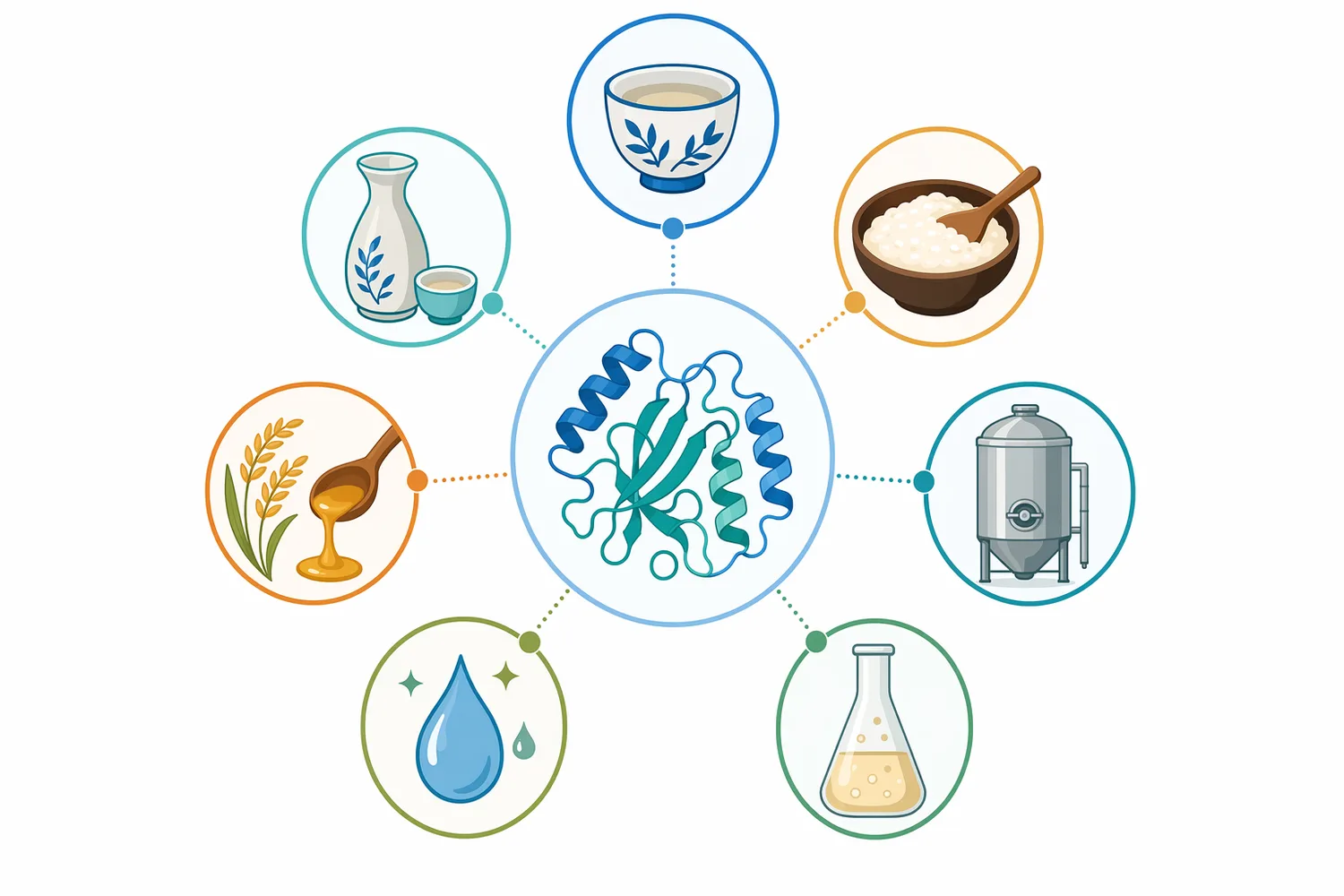
A practical way to frame the enzyme is this: alpha-amylase improves the readiness of rice starch for fermentation. It helps turn cooked rice from a dense starch mass into a more fluid dextrin-rich substrate. The final fermentation result still depends on the complete system, especially the organisms and enzymes that convert those dextrins into fermentable sugars and then into alcohol.
Enzymes.bio supplies Food-Grade Alpha Amylase for Rice Wine Processing as a directly purchasable online product by the 1 kg unit. Buyers can place the order online, pay online, and the order is then processed and shipped. A Certificate of Analysis and Safety Data Sheet are supplied with the order.
This supply model is intended for customers who already understand their rice wine process and need a food-grade alpha-amylase ingredient for starch liquefaction support. The product is positioned for the practical enzymatic role described in the research: reducing rice mash viscosity, creating dextrins from gelatinized starch, and supporting downstream saccharification and fermentation.
Alpha-amylase is widely recognized as a versatile industrial enzyme, with applications across starch processing, brewing, baking, and other food-related processes [13]. In rice wine production specifically, its value is clear and focused: it helps make rice starch usable. By cleaving internal alpha-1,4 bonds, it turns a thick cooked starch matrix into a more workable substrate that the rest of the rice wine fermentation system can convert into alcohol and flavor.
Food-Grade Alpha Amylase for Rice Wine Processing is best understood as a liquefaction enzyme for cooked or otherwise opened rice starch. It cuts long starch chains into shorter dextrins, lowers mash viscosity, improves substrate accessibility, and supports the next stages of saccharification and fermentation. Direct rice wine research on enzymatic extrusion liquefaction of broken rice and comparative saccharification-fermentation process designs supports its relevance to Chinese rice wine production [4].
For buyers using rice as the primary starch source, the most credible benefits are improved mash handling, more consistent starch opening, and better preparation of the rice substrate for fermentation. Enzymes.bio supplies the product online by the 1 kg unit, with online payment, order processing and shipping, and documentation supplied with the order.
Sold by the 1 kg unit, in stock and ready to ship. Order directly on our store — pay online and we process your order. A Certificate of Analysis and Safety Data Sheet are included with every order.
Buy Food-Grade Alpha Amylase For Rice Wine Processing →Numbered in order of first citation. Open-access sources, each verified reachable at publication; citation numbers in the text link here.