
Direct answer: Food-grade α-amylase helps sweet potato drying by partially hydrolyzing starch before dehydration, cutting long α-1,4-linked starch chains into shorter dextrins that form less viscous, less gel-like material. In sweet potato mash, puree, flakes, powders, or surface-treated slices, this can improve handling, spreading, moisture release, and final texture when the main processing limitation is starch gelatinization or paste thickness.
Enzymes.bio supplies Food-Grade α-Amylase — Special for Sweet Potato Drying directly online by the 1 kg unit. After online payment, the order is processed and shipped, with a Certificate of Analysis and Safety Data Sheet included with the order.
Sweet potato is a starch-rich raw material, and starch is often the component that makes drying difficult. When sweet potato tissue is heated, blanched, cooked, mashed, or milled with water present, starch granules absorb water, swell, lose part of their ordered structure, and release molecular chains into the surrounding phase. That hydrated starch can create a thick paste, sticky surface, or dense gel network that slows heat and moisture movement during drying. Reviews on sweet potato starch modification describe sweet potato starch as a functional carbohydrate material whose structure and physicochemical behavior can be changed by physical, chemical, and enzymatic treatments, which is why starch control is central to sweet potato ingredient processing [1].
α-Amylase is useful because it acts directly on the starch structure responsible for viscosity. It is an endo-acting starch enzyme: instead of removing glucose units one by one from the end of a molecule, it cuts internal α-1,4-glycosidic bonds along amylose and amylopectin chains. The result is a rapid reduction in average chain length and molecular weight, producing shorter dextrins and oligosaccharides that cannot build the same long-chain, water-binding network as intact gelatinized starch [2].
For sweet potato drying, the enzyme does not “perform drying” by itself. Airflow, heat transfer, pressure, bed depth, slice size, drum surface, spray conditions, or vacuum conditions still remove the water. The enzyme’s contribution is upstream and physical: it changes the carbohydrate matrix so that sweet potato mash, puree, slurry, or surface starch behaves less like a cohesive paste and more like a processable food material.
Sweet potato starch consists mainly of amylose and amylopectin packed into semi-crystalline granules. Amylose is largely linear, while amylopectin is highly branched, with α-1,4 linkages forming the main chains and α-1,6 linkages forming branch points. In intact raw tissue, much of this starch is locked inside plant cells or partially protected by granule architecture; after heating and hydration, the granules swell and become more accessible to enzymatic attack. Research on granular native and mildly heat-treated tapioca and sweet potato starches shows that enzymatic hydrolysis is strongly affected by the physical condition of the granule, with heat treatment increasing susceptibility even under sub-gelatinization conditions [3].
At the molecular level, α-amylase reduces the length of starch chains. Long chains tangle, hydrate, and entrap water, which increases viscosity. Shorter dextrins move more freely and form weaker networks. In a sweet potato puree, that means the same solids content can feel less pasty after controlled enzymatic treatment. In a drying process, lower paste resistance can allow more even spreading, thinner layers, improved contact with heated surfaces, or better atomization where liquid processing is involved.
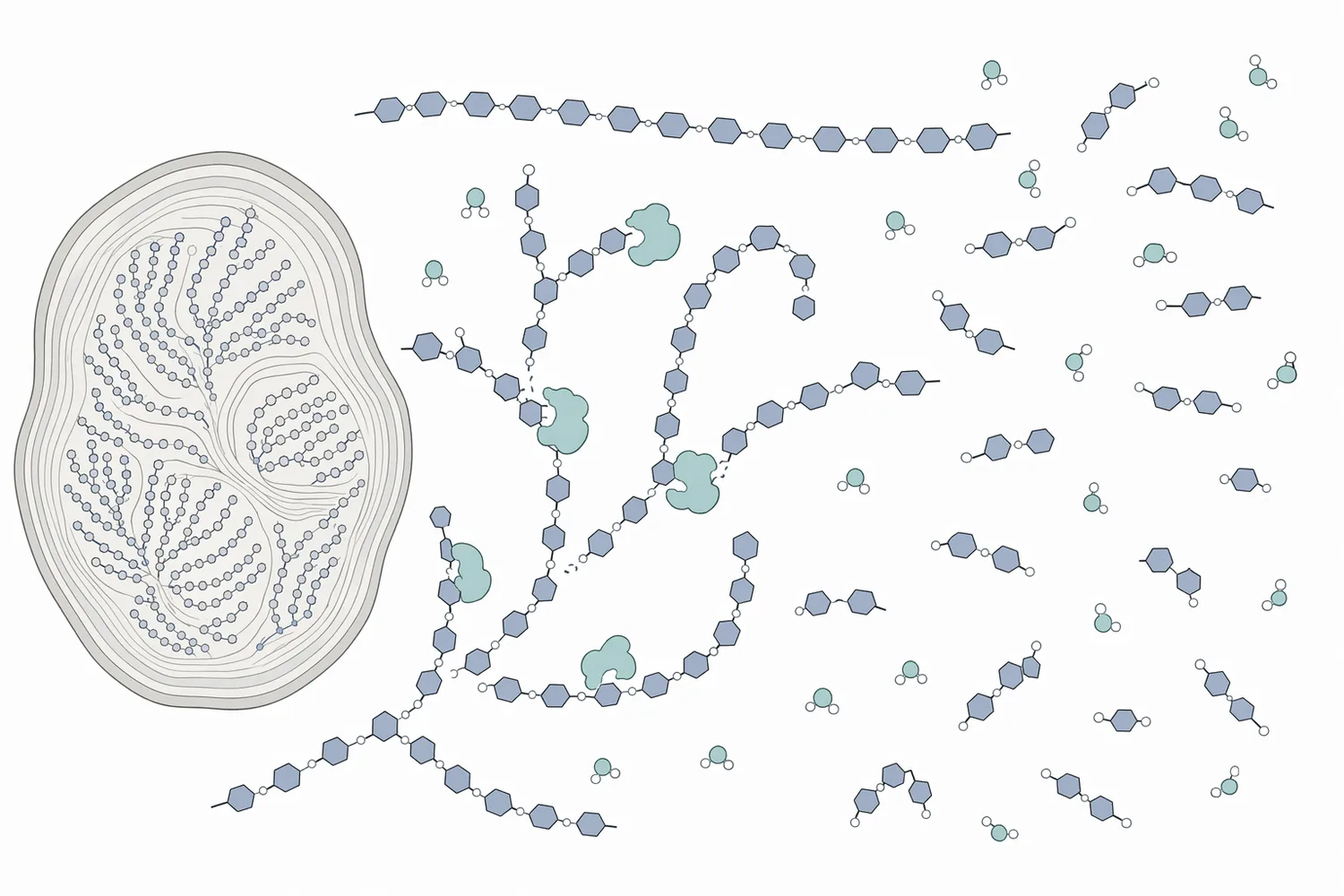
The change is especially relevant after cooking or blanching. Heat-moisture treatment studies on sweet potato and other tuber starches show that processing history changes starch digestibility and enzyme accessibility; in other words, starch is not a passive filler, but a structure that responds measurably to heat, moisture, and subsequent enzymatic action [4]. In practical sweet potato drying, the most responsive materials are typically hydrated, heat-softened, mashed, pulped, or otherwise disrupted enough for enzyme and starch to contact one another.
α-Amylase does not primarily break α-1,6 branch points. That distinction matters. It reduces viscosity quickly by cutting main-chain α-1,4 bonds, but it does not fully debranch amylopectin in the way pullulanase-type enzymes are studied for branch-point modification. Work on pullulanase modification of granular sweet potato starch, including assisted physical pretreatment, shows that different enzymes target different structural features and therefore produce different property changes [5].
One of the most important benefits is viscosity reduction. In sweet potato puree or mash, gelatinized starch can make the material difficult to pump, mix, spread, or feed evenly into drying equipment. α-Amylase shortens the hydrated starch chains that create this viscosity. The practical effect is not simply “more sugar”; it is a change in flow behavior caused by fewer long-chain polymers spanning the water phase.
This is the same reason α-amylase is used in starch conversion processes before more complete saccharification steps. In research on purple sweet potato flour for liquid sugar production, α-amylase was used as part of an enzymatic saccharification approach with other carbohydrate-active enzymes, reflecting its established role in converting sweet potato starch-containing material into smaller soluble carbohydrates [6].
In drying operations, the target is usually partial hydrolysis rather than complete conversion. For a dried sweet potato ingredient, too much hydrolysis can create excess soluble sugars, change sweetness, increase browning potential, and alter hygroscopic behavior. The desirable zone is controlled starch breakdown sufficient to improve handling and drying behavior while preserving the product’s intended identity.
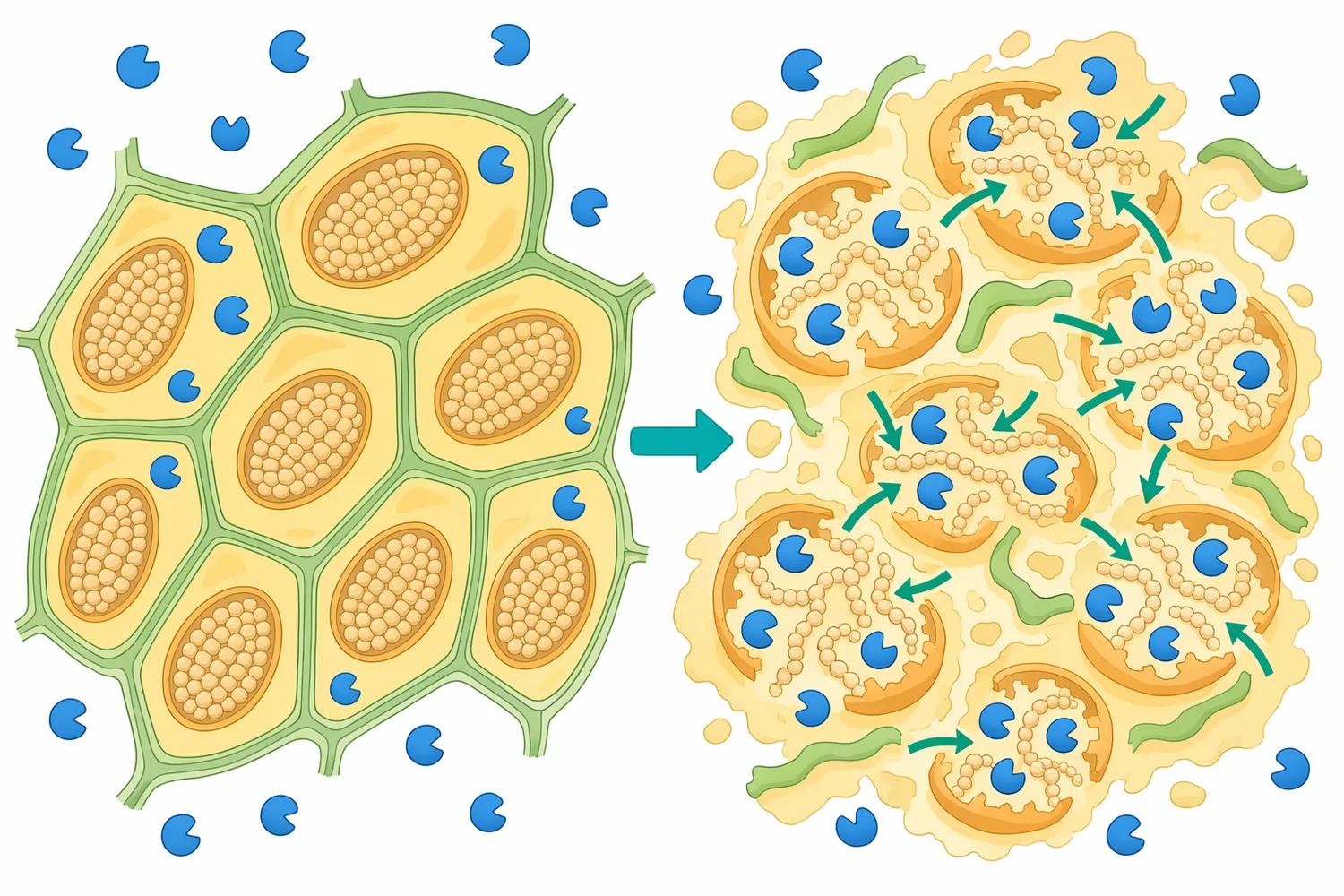
For drum drying, belt drying, tray drying, or heated-surface drying, physical contact and layer uniformity matter. A very thick sweet potato paste may form ridges, lumps, or uneven sheets. These variations dry at different rates, which can create overdried edges and wet centers. By reducing the long-chain starch contribution to viscosity, α-amylase can help create a more spreadable material.
The mechanism is concrete: long amylose and amylopectin fragments in a gelatinized matrix behave like hydrated polymers. They increase resistance to shear and hold water in a structured network. Once α-amylase cuts enough internal α-1,4 bonds, the fragments become shorter, the network weakens, and the material can level more easily under mechanical force.
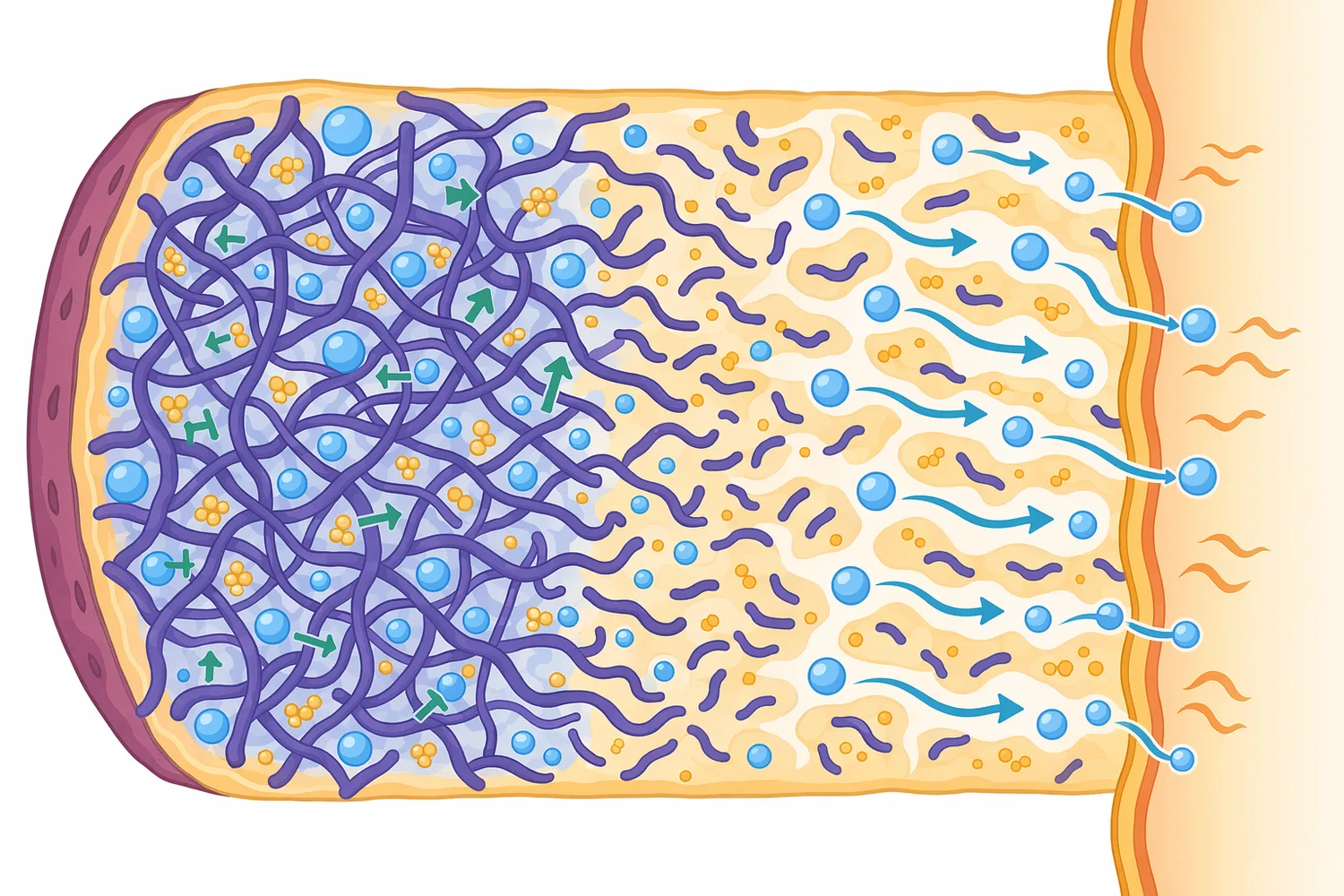
Water in sweet potato material exists in different physical environments: free water between particles, water in plant tissue, water associated with fiber and protein, and water bound or immobilized by swollen starch. α-Amylase does not remove bound water chemically, but it can reduce the gel-like starch structure that restricts water movement. A less cohesive starch matrix can allow moisture to migrate more evenly toward the drying surface.
This is particularly relevant for purees, pulps, and high-solids sweet potato slurries, where starch has already been released from tissue structure. For intact slices or cubes, enzyme effects may be more surface-limited unless the tissue has been softened or disrupted. Studies on porous sweet potato starch demonstrate that enzymatic treatment can create structural openings and alter the internal morphology of starch granules, supporting the broader principle that enzyme attack can change not only molecular size but also physical porosity [7].
After drying, sweet potato powder or flakes may be rehydrated in beverages, bakery mixes, instant foods, sauces, noodles, snacks, or nutrition products. If the starch has been heavily gelatinized and remains largely intact, rehydration can produce clumps or an overly thick paste. Partial α-amylase treatment can reduce that tendency by lowering the concentration of long, swelling starch chains.
This does not mean every dried sweet potato product should be thin on reconstitution. Some products need body. The value of α-amylase is that it gives the processor a way to moderate excessive starch-driven thickness when a smoother, more dispersible ingredient is desired.
Different enzymes can all be described as “starch-modifying,” but they do not do the same job. For sweet potato drying, α-amylase is especially relevant because it rapidly reduces viscosity by cutting inside starch chains. Other enzymes may be useful in saccharification, resistant-starch development, debranching, or fiber modification, but their main process effects are different.
| Enzyme or treatment type | Main target in sweet potato material | Typical structural effect | Relevance to sweet potato drying |
|---|---|---|---|
| α-Amylase | Internal α-1,4 bonds in amylose and amylopectin | Shortens long starch chains into dextrins and oligosaccharides | Most directly linked to viscosity reduction, flow improvement, and easier handling before drying |
| Glucoamylase / amyloglucosidase | Chain ends of starch fragments | Produces more glucose from dextrins | More relevant to sugar production or fermentation than simple drying control |
| Pullulanase-type debranching enzymes | α-1,6 branch points in amylopectin | Changes branch architecture and linear-chain distribution | Useful for specialized starch modification; not the same rapid liquefying action as α-amylase |
| Xylanase / mannanase | Hemicellulose and non-starch polysaccharides | Loosens cell-wall carbohydrate structure | Can support saccharification of whole flour systems, but does not directly liquefy starch |
| Physical pretreatments | Granule order, tissue structure, water accessibility | Heat, pressure, or other energy input can make starch more enzyme-accessible | Often increases the effect of enzymatic hydrolysis when moisture and access are limiting |
Research on sweet potato starch modified by dual-enzyme systems shows that enzyme choice changes digestibility and starch structure in different ways, reinforcing that α-amylase should be understood as a viscosity- and dextrin-forming tool rather than a universal starch-modification enzyme [8]. Similarly, purple sweet potato flour saccharification work combining α-amylase with xylanase, mannanase, and amyloglucosidase illustrates how α-amylase often performs the liquefaction role while other enzymes broaden carbohydrate conversion [6].
The strongest sweet potato-specific evidence comes from studies showing that sweet potato starch can be enzymatically hydrolyzed and that its physical pretreatment state affects the result. In the study of native and mildly heat-treated tapioca and sweet potato starches at sub-gelatinization temperature, the comparison was important because it showed that enzymatic hydrolysis is not limited to fully cooked paste; even granular starch can be attacked, with susceptibility depending on how the granule has been physically altered [3].
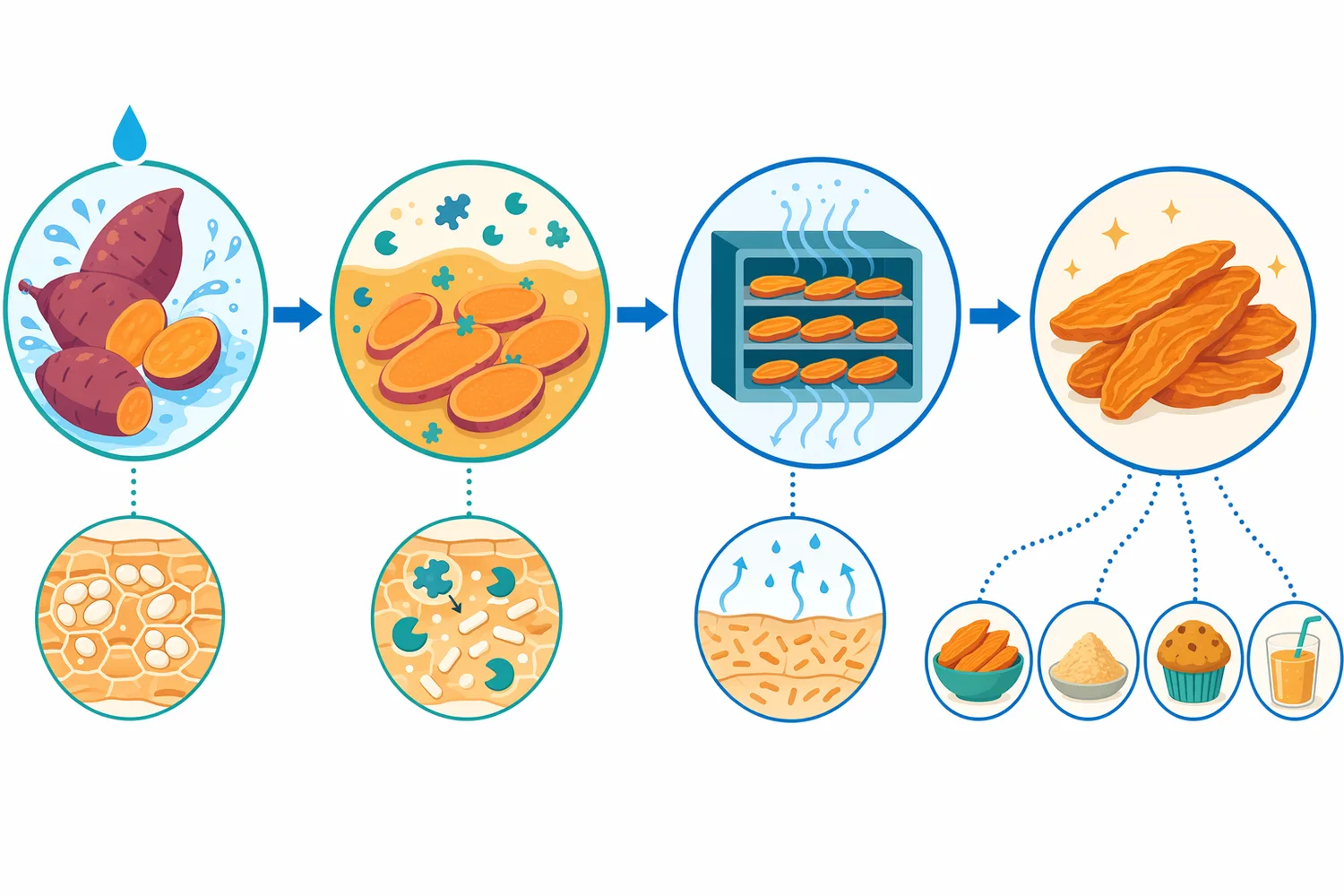
This matters for drying because many sweet potato processes operate between raw tissue and fully gelatinized paste. Blanching, steaming, soaking, cooking, milling, and partial dehydration all change access to starch. α-Amylase activity is therefore not only a question of the enzyme itself; it also depends on whether the sweet potato starch is exposed, hydrated, swollen, damaged, or protected inside intact cells.
Purple sweet potato porous starch has been produced by enzymatic treatment for use as a food-based adsorbent in microencapsulation. Although that application is different from drying, it demonstrates a useful structural principle: enzymes can erode or open starch granules, increasing pores and changing how the material interacts with water and other molecules [7].
In sweet potato drying, the same broad structural change is valuable when starch contributes to dense, slow-drying matrices. A more open or less continuous starch structure can reduce the physical barrier to moisture movement. The effect is strongest where the starch is accessible, which is why mash, puree, slurry, or softened tissue usually responds more predictably than hard, intact raw pieces.
Research on purple sweet potato flour saccharification used α-amylase along with xylanase, mannanase, and amyloglucosidase to produce liquid sugar. That type of study is more aggressive than a drying pretreatment because the goal is high carbohydrate conversion, but it confirms that sweet potato flour is a suitable substrate for enzymatic starch breakdown [6].
For drying, the lesson is controlled application. The same biochemical capacity that supports liquid sugar production can be used at a lower degree of conversion to reduce viscosity. If pushed too far, however, starch hydrolysis shifts the product toward a sweeter, more soluble carbohydrate profile, which may not be desired for powders, flakes, or dried vegetable ingredients.
Sweet potato roots have also been studied as raw materials for glucose and high-fructose syrup production by direct conversion techniques. That research places sweet potato alongside cassava as a starchy root crop suitable for enzymatic carbohydrate conversion, not only as purified starch but as a root-derived substrate [9].
This is relevant because industrial sweet potato drying often works with whole-root-derived material rather than isolated starch. The presence of fiber, pigments, proteins, minerals, and native sugars does not prevent starch conversion, but it does make the process matrix more complex. α-Amylase remains useful because its substrate—starch—is abundant and functionally important in sweet potato solids.
Sweet potato has been investigated for bioethanol production using enzymatic liquefaction followed by simultaneous saccharification and fermentation. In such systems, liquefaction is the step that reduces starch paste viscosity and makes carbohydrates more available for later conversion and fermentation [10].
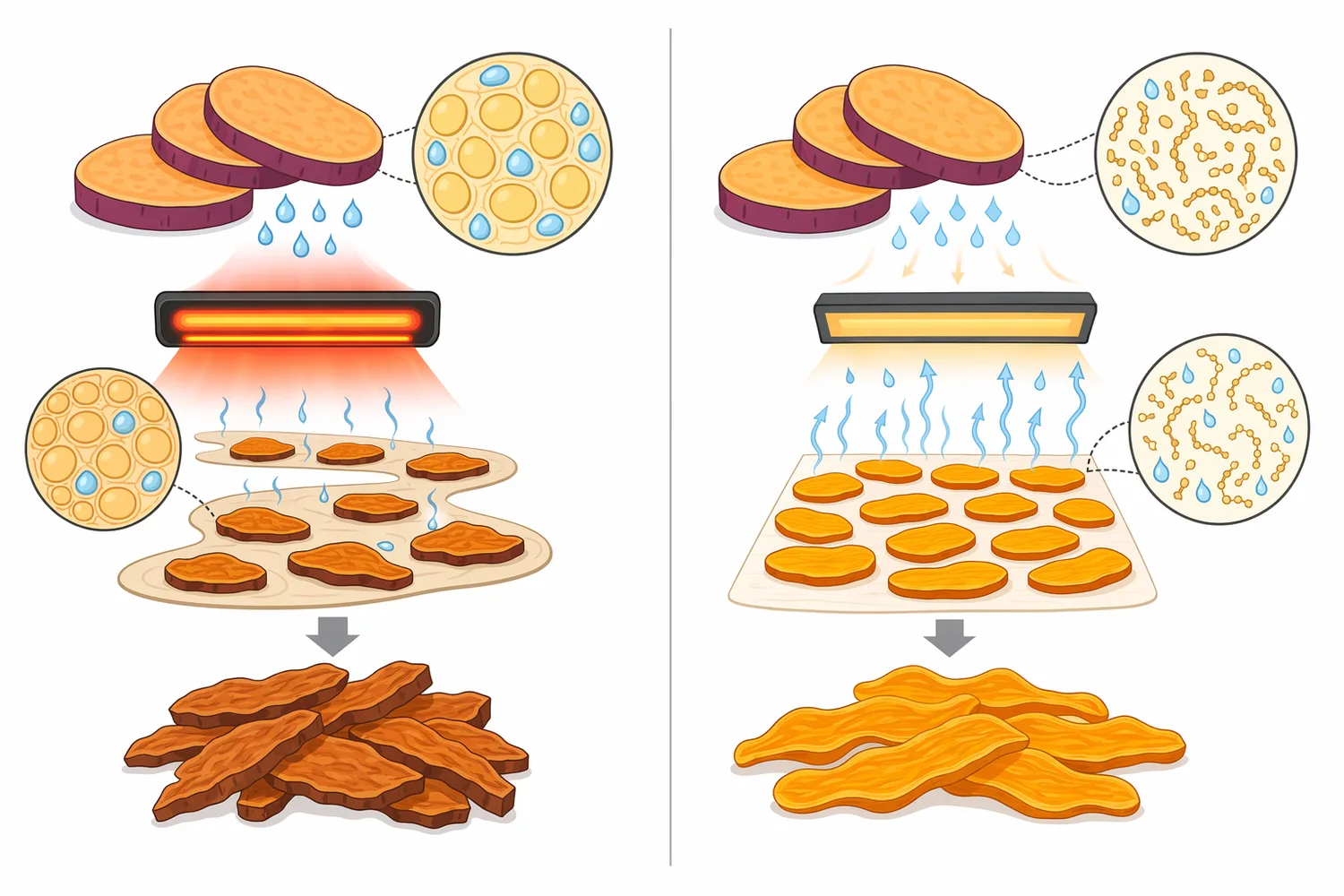
The drying application borrows the liquefaction concept without necessarily pursuing fermentation-level sugar release. The practical objective is easier movement, spreading, and dehydration. This distinction is important: α-amylase can be used as a processing aid for physical handling even when the finished product is not intended to be a syrup, fermentable mash, or ethanol feedstock.
High-pressure treatment has been studied for saccharification of starch in sweet potato tuberous roots. Such work shows that physical pretreatment can change how starch becomes available for enzymatic conversion, especially inside plant tissue where granules are embedded in cell structures [11].
For drying operations, this reinforces a practical mechanism: α-amylase works best when moisture and access are present. Cutting or mashing exposes cells; heating swells starch; mixing distributes enzyme; and physical softening reduces diffusion barriers. The enzyme acts at the molecular level, but process preparation determines how much substrate it can reach.
Sweet potato drying is not only about removing water. Color, flavor, sweetness, rehydration behavior, and nutritional profile all matter. Pre-soaking treatments have been shown to affect the nutritional profile and browning index of sweet potato and yam flours, illustrating that pretreatment before drying can materially influence final flour quality [12].
α-Amylase can influence browning indirectly. By producing shorter dextrins and some smaller sugars, it may increase the pool of soluble carbohydrates available during heating. In a product where a light color is required, that can be a consideration because browning reactions depend on raw-material composition, temperature, time, moisture, and reducing sugar availability. In a product where roasted or caramel-like notes are acceptable, limited sugar formation may be less problematic.
Texture also changes with hydrolysis. Moderate treatment can reduce gumminess, improve spreadability, and make dried powder easier to disperse. Excessive treatment can make wet material too soft, syrupy, or sticky, especially because small sugars and low-molecular-weight carbohydrates hold moisture differently from intact starch. That is why α-amylase for sweet potato drying is best understood as a controlled starch-management ingredient rather than a simple “more is better” additive.
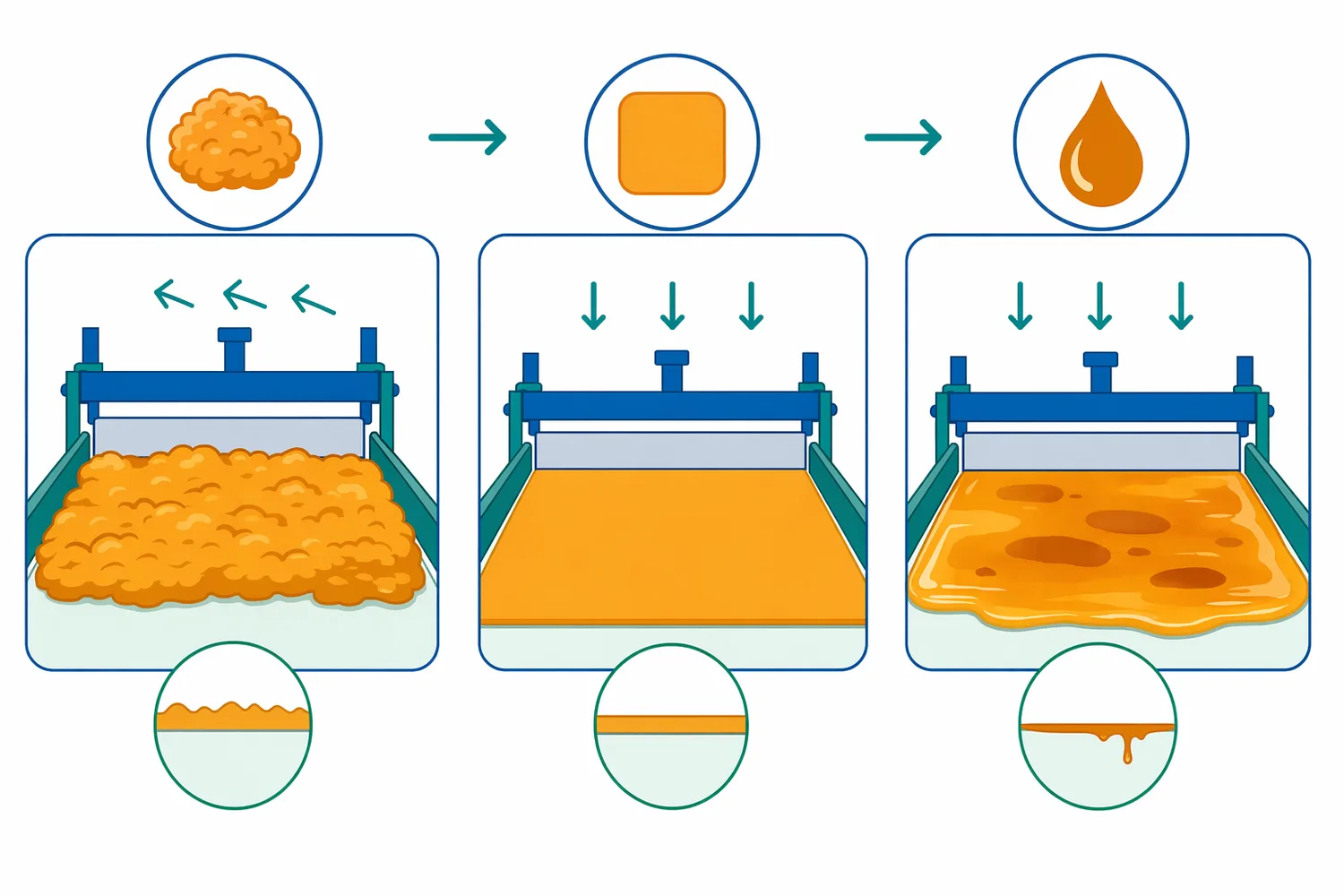
Sweet potato powder is commonly used in bakery mixes, beverages, extruded snacks, soups, sauces, noodles, nutrition blends, and plant-based formulations. In powder production, α-amylase is most relevant before drying, when the material is still hydrated enough for enzyme action. By reducing starch-chain length in a mash or slurry, it can help create a feed material that dries more evenly and mills into a more functional powder.
The finished powder may show improved dispersibility if excessive gelatinized starch was the original cause of clumping. However, powder behavior still depends on particle size, drying method, residual moisture, sugar content, packaging, and storage environment.
Flake production often requires a balance between sheet formation and final rehydration. If the mash is too stiff, sheet thickness becomes uneven; if it is over-hydrolyzed, the product may become sticky or too soluble. α-Amylase can support a middle ground by reducing excessive starch viscosity while keeping enough body for flake structure.
Granules and instant products benefit when the carbohydrate matrix rehydrates predictably. Controlled starch hydrolysis can reduce the tendency toward dense lumps or overly thick pastes in reconstituted products, particularly when the sweet potato ingredient is intended to blend with other dry components.
For slices and cubes, the enzyme’s effect is usually strongest where starch is exposed at cut surfaces or where heat has softened tissue. α-Amylase can help reduce surface tackiness caused by gelatinized starch, but it will not penetrate intact raw tissue as uniformly as it acts in puree or slurry. Its value in these formats is therefore more dependent on pretreatment sequence, tissue disruption, and surface contact.
Physical pretreatment studies on sweet potato starch show that structure and accessibility are central to enzymatic response, so intact pieces should be expected to behave differently from fully dispersed starch systems [13].
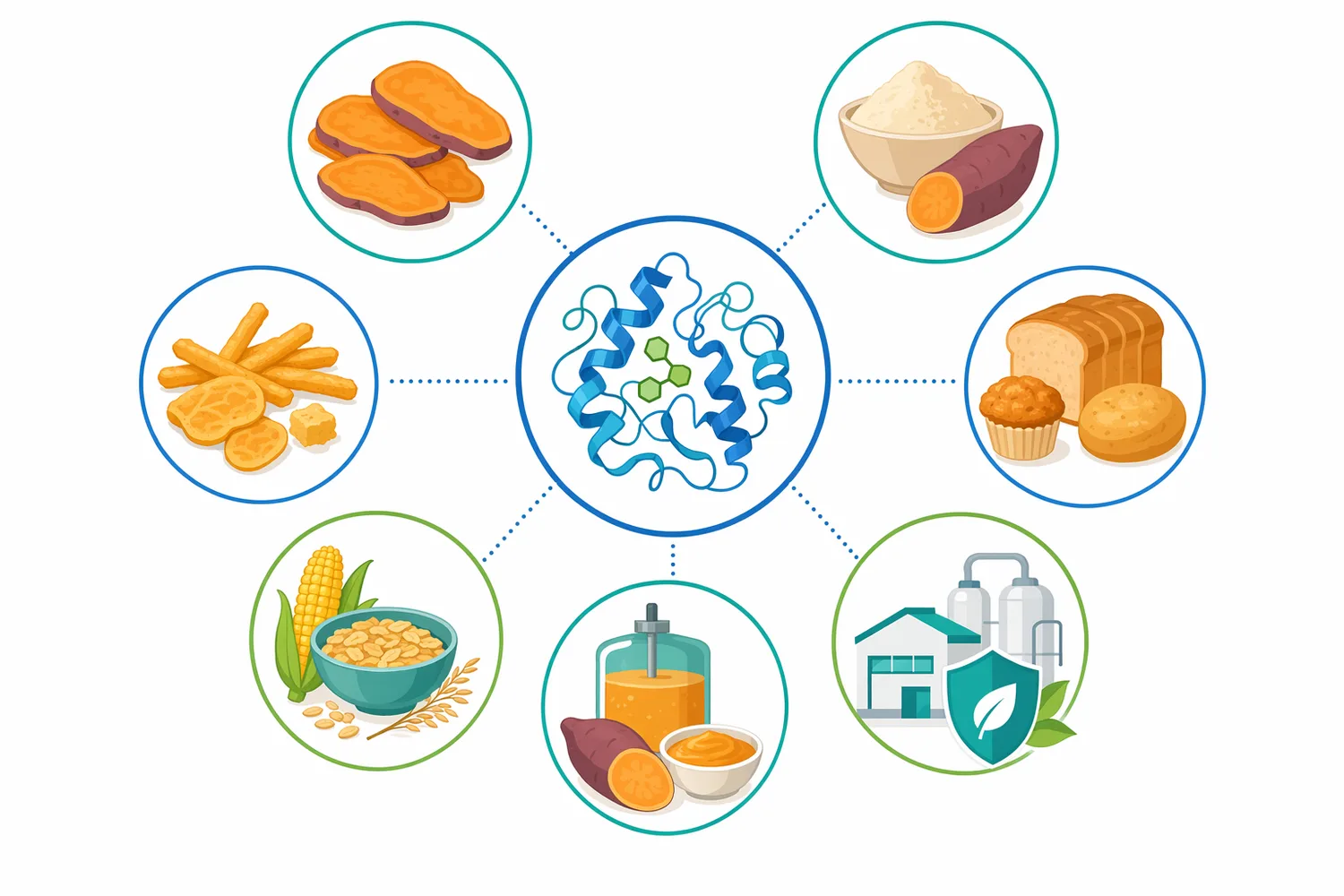
Puree is often the most suitable format for α-amylase use because starch is hydrated, heated, and mechanically accessible. The enzyme can reduce puree thickness, improve flow, and help the material spread or feed more consistently into drying equipment. This is where the molecular mechanism of α-1,4 bond cleavage most directly translates into visible processing improvements.
Puree applications also make it easier to obtain uniform enzyme contact, because mixing distributes the enzyme through the water phase. Uniform contact helps avoid a product with over-treated areas and under-treated areas, which can otherwise create inconsistent texture after drying.
Food-Grade α-Amylase — Special for Sweet Potato Drying is a starch hydrolysis tool. It can help where the limiting factor is starch-driven viscosity, gel formation, paste thickness, surface tackiness, or poor dispersion caused by gelatinized starch. It can support easier handling before dehydration and more consistent dried ingredient behavior.
It cannot compensate for inadequate dryer capacity, poor airflow, excessive loading depth, uneven slicing, insufficient sanitation, poor raw-material quality, or moisture ingress after packaging. It also does not replace drying validation or food safety controls. The enzyme modifies starch; the drying system still has to remove water safely and consistently.
It is also not a color-protection enzyme, preservative, anti-microbial treatment, fiber-degrading system, or protein-modifying enzyme. Sweet potato contains starch, fiber, native sugars, pigments, phenolics, minerals, and other solids, and each contributes differently to finished-product quality. α-Amylase addresses the starch fraction specifically.
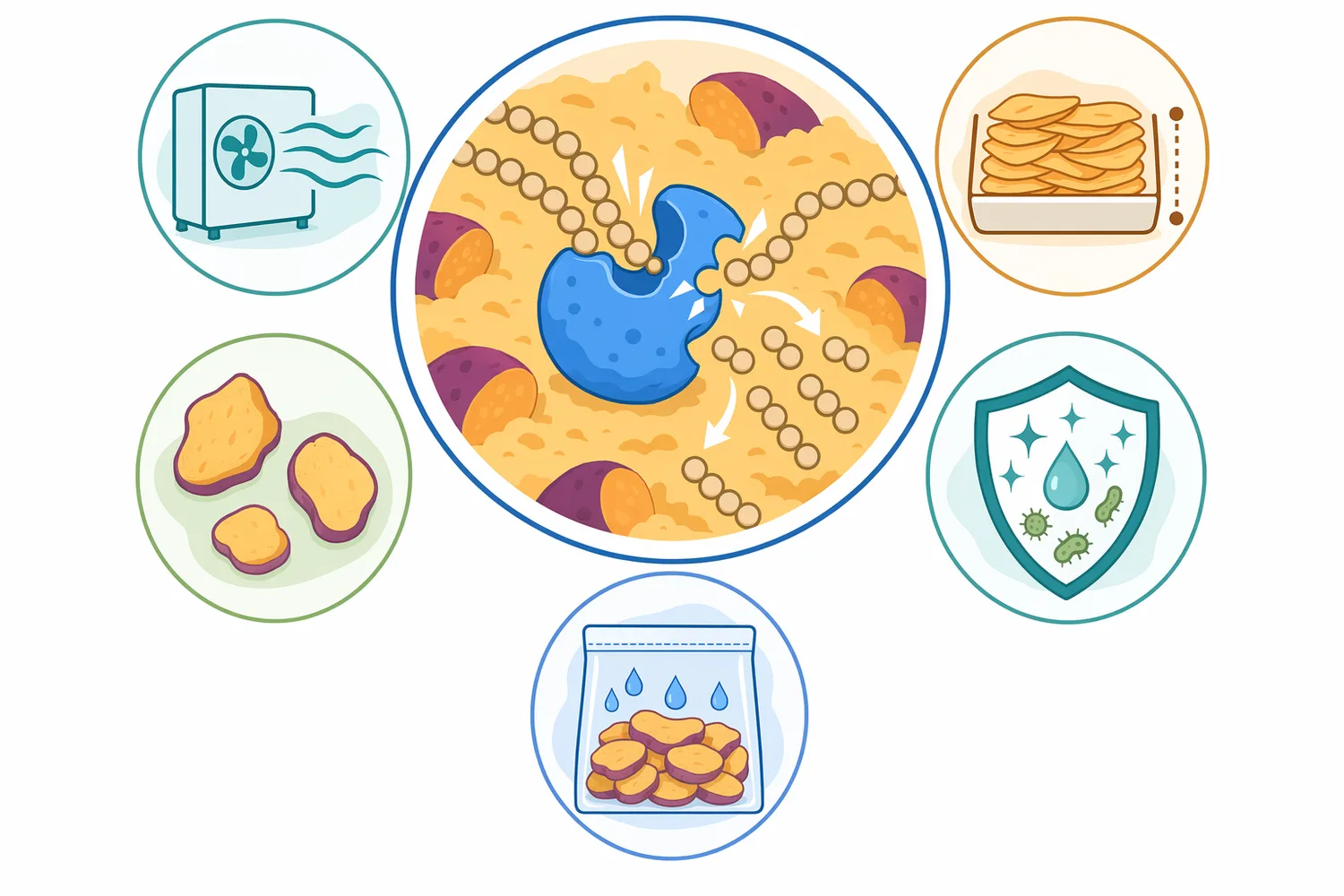
Enzymes.bio supplies this food-grade α-amylase for buyers who need a starch-liquefying enzyme for sweet potato drying workflows and related sweet potato ingredient processing. The product is available for direct online purchase by the 1 kg unit; after online payment, the order is processed and shipped.
A Certificate of Analysis and Safety Data Sheet are included with the order. The product should be handled as a food-processing enzyme according to the accompanying documentation and the buyer’s established production controls.
Food-grade α-amylase supports sweet potato drying by changing the starch before water removal. It cuts internal α-1,4 linkages in amylose and amylopectin, reducing long-chain starch into shorter dextrins and oligosaccharides. That molecular shortening weakens paste structure, lowers viscosity, improves flow, and can make sweet potato mash, puree, slurry, flakes, powders, or surface-treated pieces easier to dry when starch gelatinization is the main processing constraint [2].
The scientific basis is well supported by sweet potato starch hydrolysis research, porous sweet potato starch studies, purple sweet potato flour saccharification, direct conversion of sweet potato roots to syrups, and enzymatic liquefaction work for fermentation processes [3]. Direct performance in any drying line remains process-dependent because enzyme access, moisture, heat history, tissue disruption, and drying equipment all affect the result.
For buyers looking for a food-grade α-amylase specifically positioned for sweet potato drying, Enzymes.bio offers the product online in 1 kg units with order documentation included.
Sold by the 1 kg unit, in stock and ready to ship. Order directly on our store — pay online and we process your order. A Certificate of Analysis and Safety Data Sheet are included with every order.
Buy Food-Grade Α-Amylase -Special For Sweet Potato Drying →Numbered in order of first citation. Open-access sources, each verified reachable at publication; citation numbers in the text link here.