
Food Grade Pectinase for Pear Juice Processing is used to break down pectic substances in pear mash and juice so the liquid separates more readily from fruit solids. In practical pear juice operations, that can mean easier pressing, lower viscosity, faster clarification, improved filtration and reduced pectin-related haze.
Enzymes.bio supplies Food Grade Pectinase directly online by the 1 kg unit. After online purchase, the order is processed and shipped, and a Certificate of Analysis and Safety Data Sheet are supplied with the order.
Pear juice production is shaped by the structure of the fruit. Pear tissue contains plant cell walls, middle-lamella material, soluble pectin, insoluble pectic substances, hemicellulose, cellulose, suspended pulp and other colloidal particles. When pears are milled or crushed, part of the juice is released immediately, but part remains trapped in the disrupted cell-wall network. Pectinase helps convert that thick, water-holding matrix into a looser system where juice can drain, solids can separate and clarification equipment can work more efficiently. Reviews of pectinase technology describe these enzymes as important tools in fruit juice clarification because they act directly on pectin, a major contributor to juice cloudiness and viscosity [1].
In pear processing, pectinase is best understood as a pectin-management aid rather than a general “juice improver.” It does not create good fruit quality, replace hygienic processing or correct an unsuitable filtration train. Its value is specific: it changes the pectin fraction of the mash or juice so that mechanical separation steps—pressing, settling, centrifugation, flotation, depth filtration or membrane filtration—face a less viscous and less gel-forming material [1].
“Pectinase” is also not usually a single enzyme. It is a functional term for enzyme activities that modify or break down pectin and related pectic polysaccharides. Depending on the preparation, this may include enzymes that split the pectin backbone, remove methyl ester groups or cleave pectin by lyase-type reactions. Food enzyme literature commonly groups pectinases into families such as polygalacturonases, pectin lyases, pectate lyases and pectin methylesterases, each acting at a different point in the pectin structure [1].
Pears are attractive for clear juice, cloudy juice, nectar, concentrates, beverage bases, pear blends and fermented pear beverages because of their mild sweetness, aroma and smooth mouthfeel. Those same fruit characteristics can make processing demanding. Pear pulp can be soft, fine-textured and rich in soluble colloids, and the juice phase can carry enough pectin to resist settling and filtration. In clear pear juice production, even a modest amount of residual soluble pectin can keep fine particles suspended and make the juice appear hazy or opalescent [1].
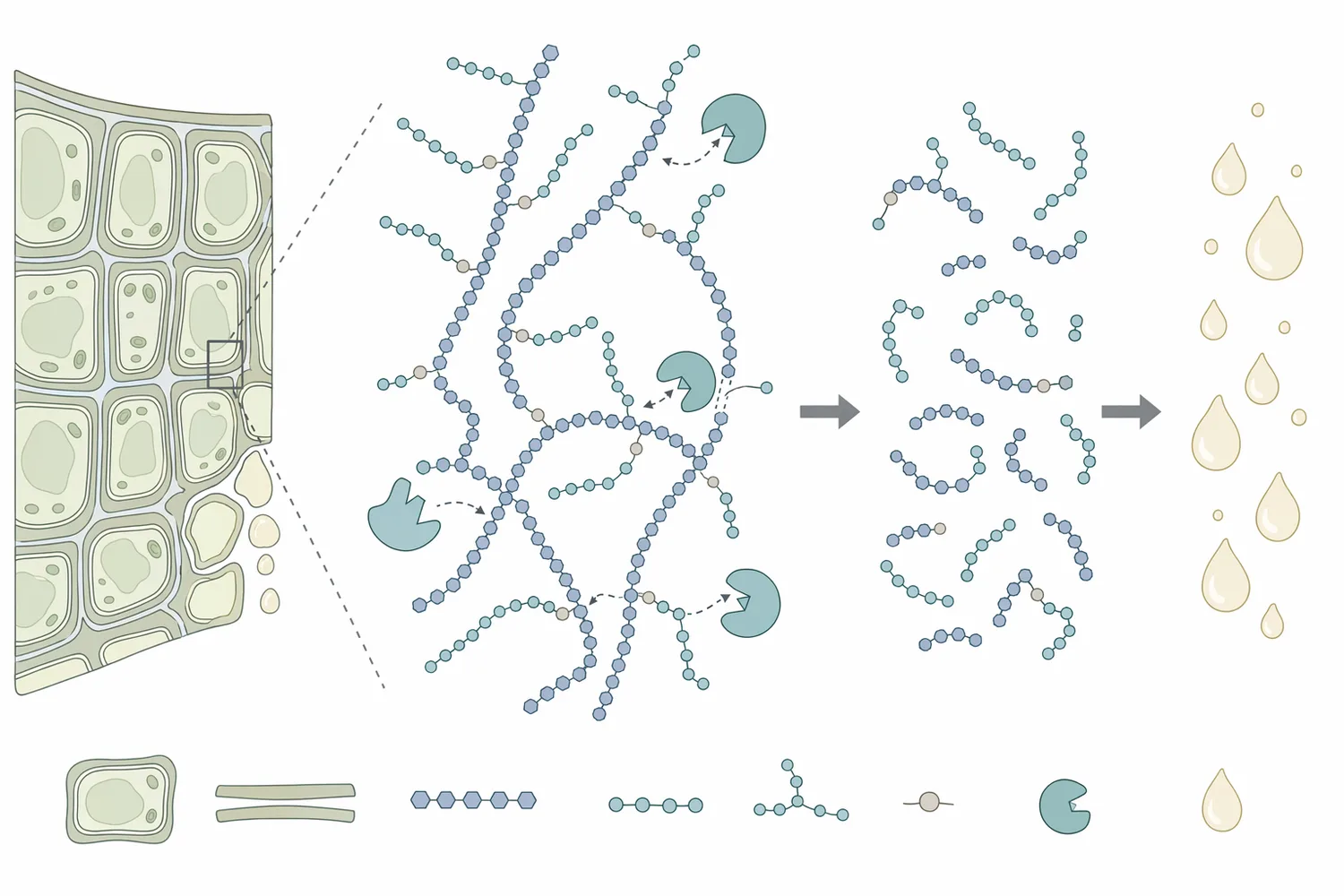
The main processing issue is the physical behavior of pectin in water. Long-chain pectin molecules increase viscosity because they occupy space, bind water and form networks or entanglements. In mash, this makes the pulp less free-draining. In pressed juice, it keeps small particles dispersed and slows the movement of liquid through filters. Pectinase reduces the average size and structural integrity of these molecules, so the juice behaves less like a weak gel and more like a pumpable, separable liquid [1].
Pear variability also matters. Cultivar, maturity, storage history, milling intensity and heat exposure can all influence how the fruit breaks down. A firmer or less ripe pear may hold liquid more tightly in the cell-wall structure, while a softer pear may produce a fine pulp that is difficult to clarify. Pectinase provides a controlled biochemical route for reducing the pectin contribution to these differences, although the final effect still depends on the complete process design [1].
Pectin is a family of acidic polysaccharides, with homogalacturonan regions made largely from galacturonic acid units linked in a chain. In fruit tissue, pectin helps cement neighboring cells together in the middle lamella and contributes to the hydrated network of the cell wall. During crushing, that network is damaged but not fully destroyed. The result is a mash that contains ruptured cells, intact cell-wall fragments, soluble pectin and entrapped liquid. Pectinase attacks the pectin portion of this network [1].
Polygalacturonase-type activity hydrolyzes linkages in the galacturonic acid backbone. In practical terms, long pectin chains become shorter fragments. Shorter fragments do not thicken the juice as strongly, do not form the same continuous hydrated network and do not stabilize suspended particles as effectively. This is one reason pectinase treatment can lower viscosity and improve the movement of juice through press cloths, filter beds or membranes [1].
Pectin lyase and pectate lyase activities cleave pectin chains by a different chemical route, but the processing consequence is similar: the polymer backbone is cut, the molecular size distribution shifts downward and the gel-forming character of the pectin is reduced. Pectin methylesterase removes methyl ester groups from pectin, changing charge and reactivity. In a mixed pectinase preparation, these modes of action can complement each other by making pectin more accessible to backbone-cleaving enzymes or by changing how pectin interacts with other juice components [1].
For the process operator, the visible change is not molecular—it is physical. Pear mash becomes easier to mix and press. Pressed juice can become less viscous. Haze particles lose part of the colloidal support that keeps them suspended. Filtration can become less prone to pectin-related blinding. These effects arise because pectinase changes the structure of the substrate itself, rather than simply masking haze or forcing separation mechanically [1].
| Pectinase-related action | What changes in pear mash or juice | Practical processing effect |
|---|---|---|
| Backbone cleavage of pectin chains | Large pectin polymers become shorter fragments | Lower viscosity and less gel-like behavior |
| Loosening of middle-lamella structure | Fruit cells and cell-wall fragments separate more readily | Improved juice release during mash treatment and pressing |
| Reduction of colloidal pectin support | Fine suspended particles are less stabilized by soluble pectin | Faster clarification by settling, flotation, centrifugation or filtration |
| Lower pectin-related fouling tendency | Less hydrated polymer reaches the filter surface | Better filterability and fewer pectin-driven bottlenecks |
| Modification of pectin charge and structure | Pectin interactions with particles and other polysaccharides change | More predictable clarification behavior in pectin-rich juice systems |
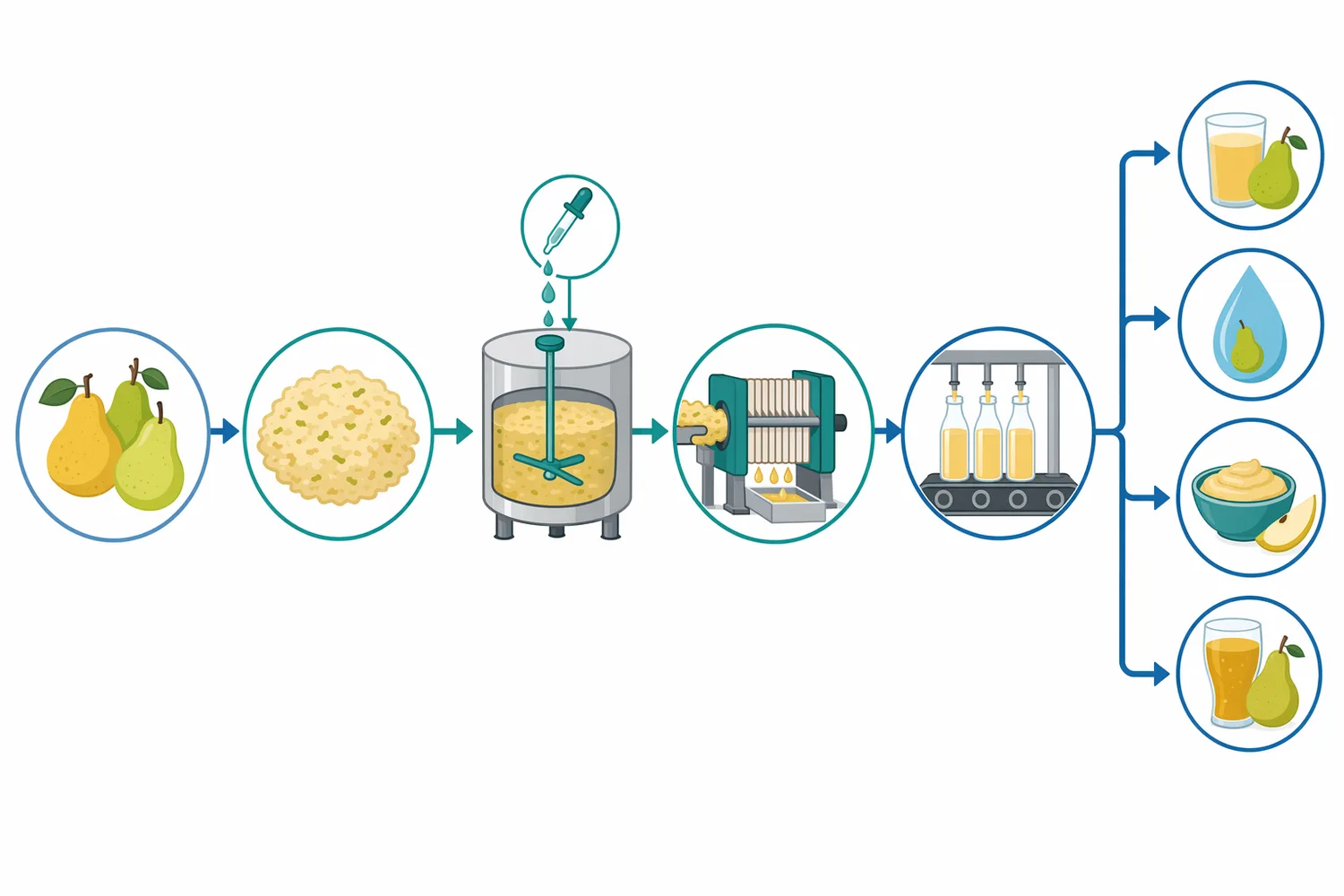
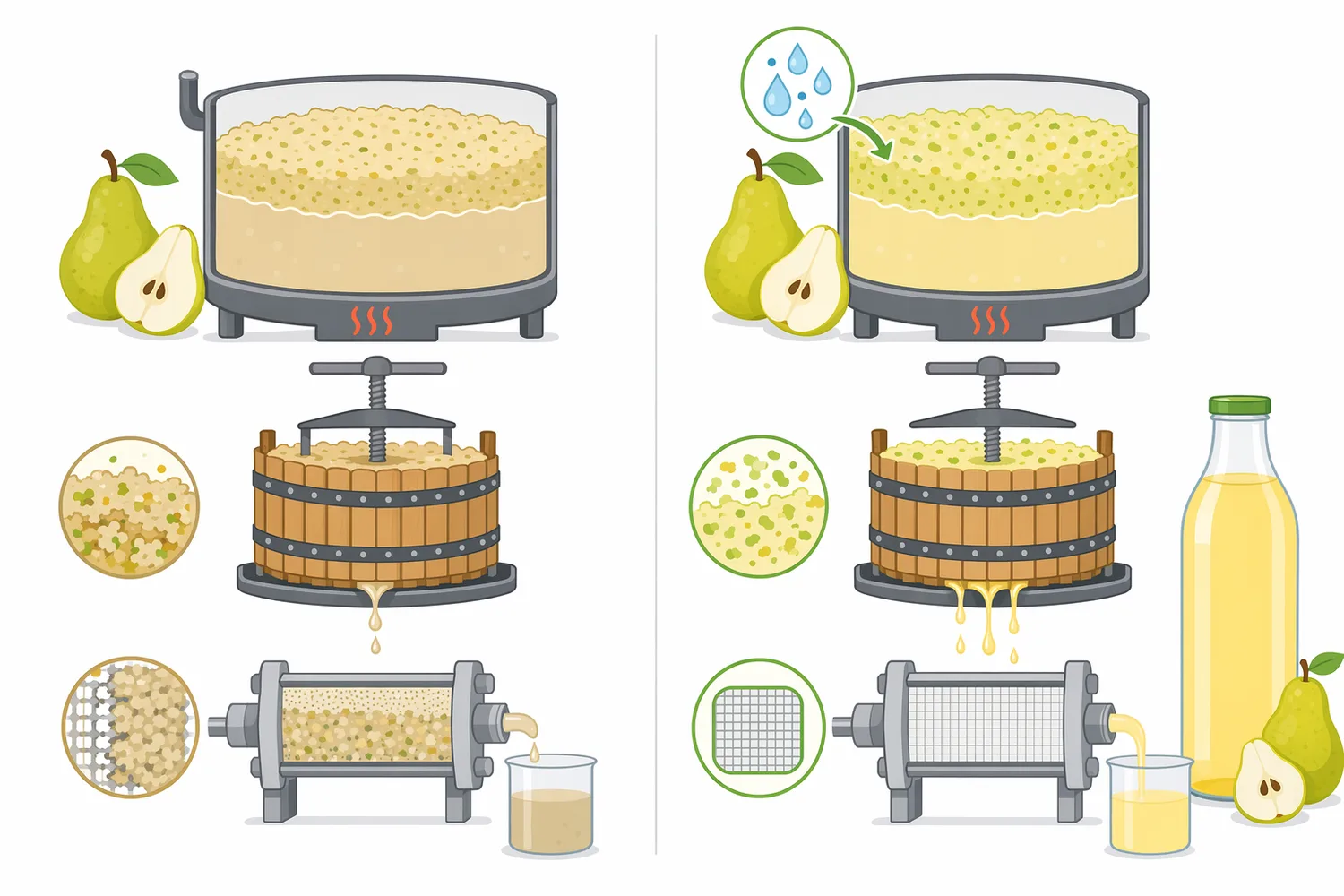
Mash treatment is one of the most important use points for pectinase in pear juice processing. After washing, sorting and milling, pectinase can be dispersed into the pear mash during a controlled holding step before pressing. At this stage the enzyme has direct access to fruit cell-wall material and insoluble pectic substances, not only to the soluble pectin already released into the juice. By weakening the pectin-rich middle-lamella structure, the enzyme helps liquid separate from the pulp matrix during pressing [1].
The practical result may be improved free-run juice, better press drainage and less liquid retained in the pomace. The effect is strongest when pectin is one of the factors limiting juice release. If pressing is limited mainly by equipment configuration, milling too fine or excessive oxidation-related pulp changes, pectinase can still help with pectin breakdown but will not solve every mechanical constraint. The value comes from combining enzymatic tissue loosening with appropriate pressing and solids handling [1].
Pectinase may also be applied to pressed pear juice before clarification. This step targets soluble and colloidal pectin in the juice phase. In clear pear juice, depectinization is often important because soluble pectin can keep fine particles suspended and interfere with bright clarification. By breaking down those pectin molecules before separation, the juice becomes more responsive to sedimentation, flotation, centrifugation and filtration [1].
Post-press pectinase treatment is particularly relevant where the pressing step already performs adequately but the juice remains difficult to clarify. In this case, the enzyme’s main role is not to release more juice from tissue but to convert a cloudy, pectin-stabilized liquid into one that downstream clarification can polish more effectively. This distinction matters because mash treatment and juice depectinization solve overlapping but not identical problems [1].
Filtration is often where residual pectin becomes most visible as a production problem. Pectin can form hydrated layers on filter media, increase resistance through a filter bed and contribute to membrane fouling. In a pear juice line, pre-filtration pectinase conditioning helps reduce the pectin load before the juice reaches the most sensitive filtration step. This can support longer, more consistent filtration runs when pectin is a significant part of the fouling mechanism [1].
The benefit is not simply that the enzyme “clears” the juice by itself. Rather, it prepares the juice so that physical separation works better. After pectinase treatment, particles that were stabilized by pectin are more likely to be removed by the chosen clarification process, and the liquid phase is less likely to behave like a viscous colloidal gel at the filter surface [1].
For clear pear juice, pectinase is used to support brilliance, stability and predictable filtration. A clear product needs more than visual removal of pulp; it also needs control of soluble colloids that can create haze later. Residual pectin can allow small particles to remain suspended or re-form haze after processing. Pectinase reduces this risk by degrading the pectin fraction before final clarification and stabilization [1].
This is especially important when pear juice is used in products where appearance is part of the quality expectation. A bright, transparent pear juice shows defects quickly: slight haze, sediment or filter instability can be obvious. Pectinase helps address the pectin-driven portion of that challenge by making the juice less resistant to clarification [1].
Concentrate production benefits from well-clarified, lower-viscosity juice. When juice is concentrated, any viscosity issue in the starting juice can become more pronounced as water is removed. Residual pectin can also complicate pre-concentration filtration and handling. Pectinase treatment before concentration can help reduce pectin-related viscosity and improve the consistency of the clarified juice entering evaporation or concentration steps [1].
In concentrate applications, the enzyme’s function is still substrate-specific. It breaks down pectic polysaccharides; it does not control all causes of browning, flavor change or microbial risk. Those issues depend on fruit handling, oxygen exposure, thermal history and overall process control. Pectinase is most valuable when pectin is a limiting factor for clarification, filtration or viscosity management [1].
Pear juice is often used as a base ingredient because it contributes sweetness and a mild fruit profile without overpowering other flavors. In beverage bases and blends, residual pectin in the pear component can interact with other juice solids, botanicals, tea extracts, flavors or mineral systems. These interactions may contribute to haze, sediment or inconsistent mouthfeel. Treating the pear juice component with pectinase before blending can reduce the pectin-driven contribution to those stability issues [1].
This is particularly useful when pear juice is blended with ingredients that already bring their own colloids, tannins or suspended solids. Pectinase does not guarantee total beverage stability, but it can make the pear portion less likely to add unwanted pectin viscosity or haze support. That makes the pear ingredient easier to integrate into clear beverages, lightly cloudy products or fruit bases where predictable appearance is important [1].
Not every pear product is intended to be brilliant and clear. Cloudy pear juice, nectar and puree-containing beverages may rely on body and pulp character for consumer appeal. In these applications, pectinase can still be useful, but the objective is different. Rather than complete depectinization, the goal may be controlled viscosity reduction, improved extraction or more uniform pulp behavior [1].
Because pectin contributes to mouthfeel, excessive breakdown can make a cloudy product seem thinner than intended. The processing decision is therefore about balance: enough enzymatic action to release juice and manage flow, but not so much that the product loses desired body. This is another example of why pectinase should be viewed as a tool for changing pectin structure, with the final treatment intensity aligned to the target product style [1].
In perry and other pear-based fermented beverages, pectinase may be used before fermentation to improve juice extraction and clarification. A clearer, lower-pectin juice can be easier to ferment and polish when the target style is bright. For rustic or naturally cloudy products, the enzyme may be used more conservatively or not at all, depending on the desired appearance and texture [1].
The same biochemical principles apply in fermented beverages as in non-fermented juice: pectinase reduces pectin chain size and weakens pectin-supported haze. Fermentation adds further variables, including yeast behavior, phenolics, solids load and maturation, so pectinase should be understood as one part of the process rather than the only determinant of final clarity or sensory character [1].
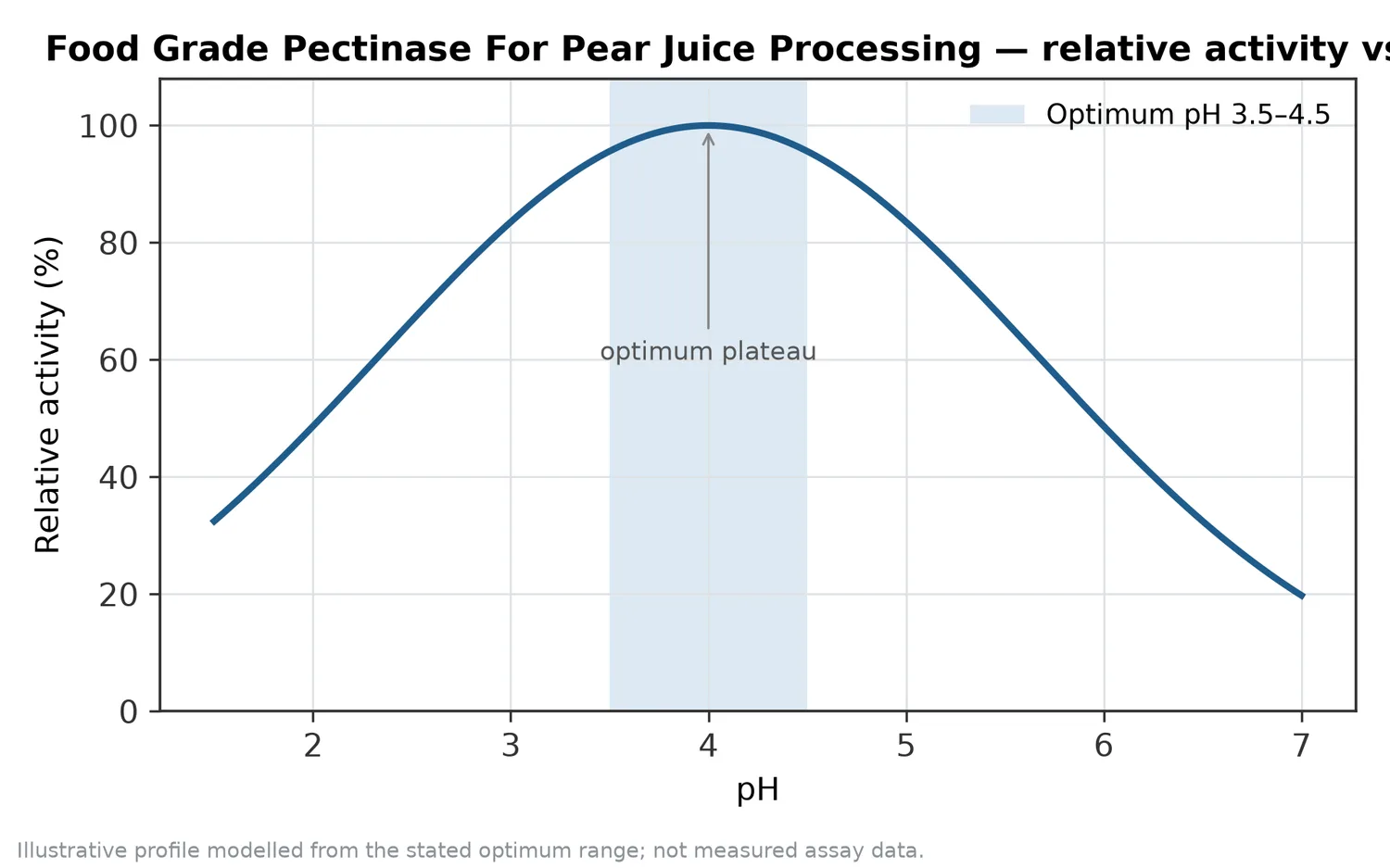
Pectinase must contact the pectin substrate under conditions where the enzyme remains active long enough to do useful work. Temperature, pH, contact time, mixing and raw material condition all influence the outcome. Food enzyme reviews emphasize that pectinase performance depends on the enzyme type and operating environment, which is why fruit juice applications are normally managed within established processing controls rather than treated as a one-size-fits-all reaction [1].
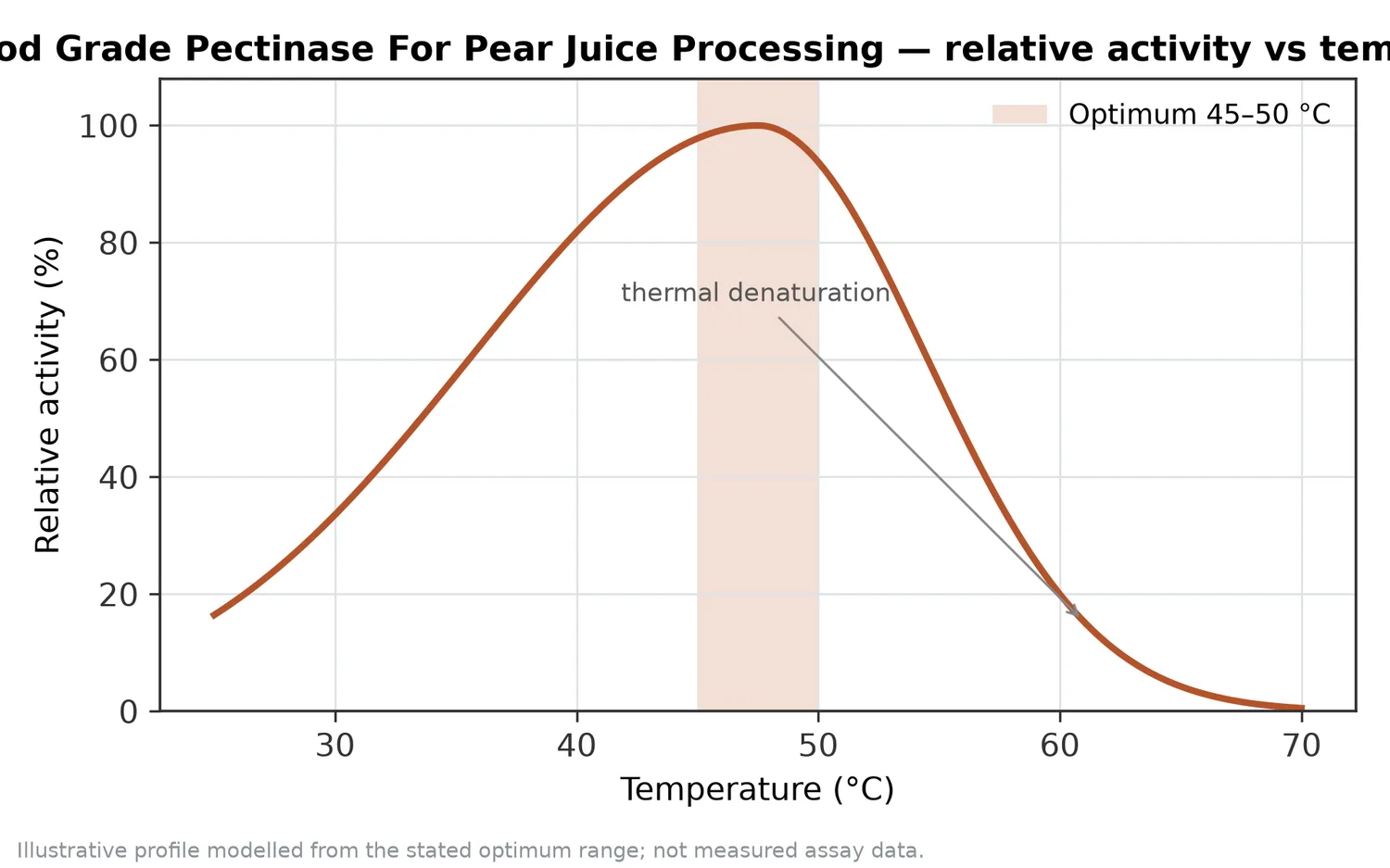
Temperature affects the reaction rate. Warmer conditions generally accelerate enzyme action within the enzyme’s suitable working range, while very low temperatures slow the reaction. Excessive heat can reduce or stop enzyme activity by damaging the protein structure of the enzyme. In pear juice processing, the practical aim is to give the enzyme enough activity during mash holding or juice treatment while protecting juice quality and avoiding unnecessary process delays [1].
pH is also important because pears are naturally acidic and pectinase enzymes differ in their preferred acidity. Many food pectinases used in fruit juice processing are designed for acidic juice environments, but performance still depends on the specific preparation and the juice matrix. In pear juice, cultivar, maturity and formulation can shift acidity, which in turn affects how quickly the enzyme modifies pectin [1].
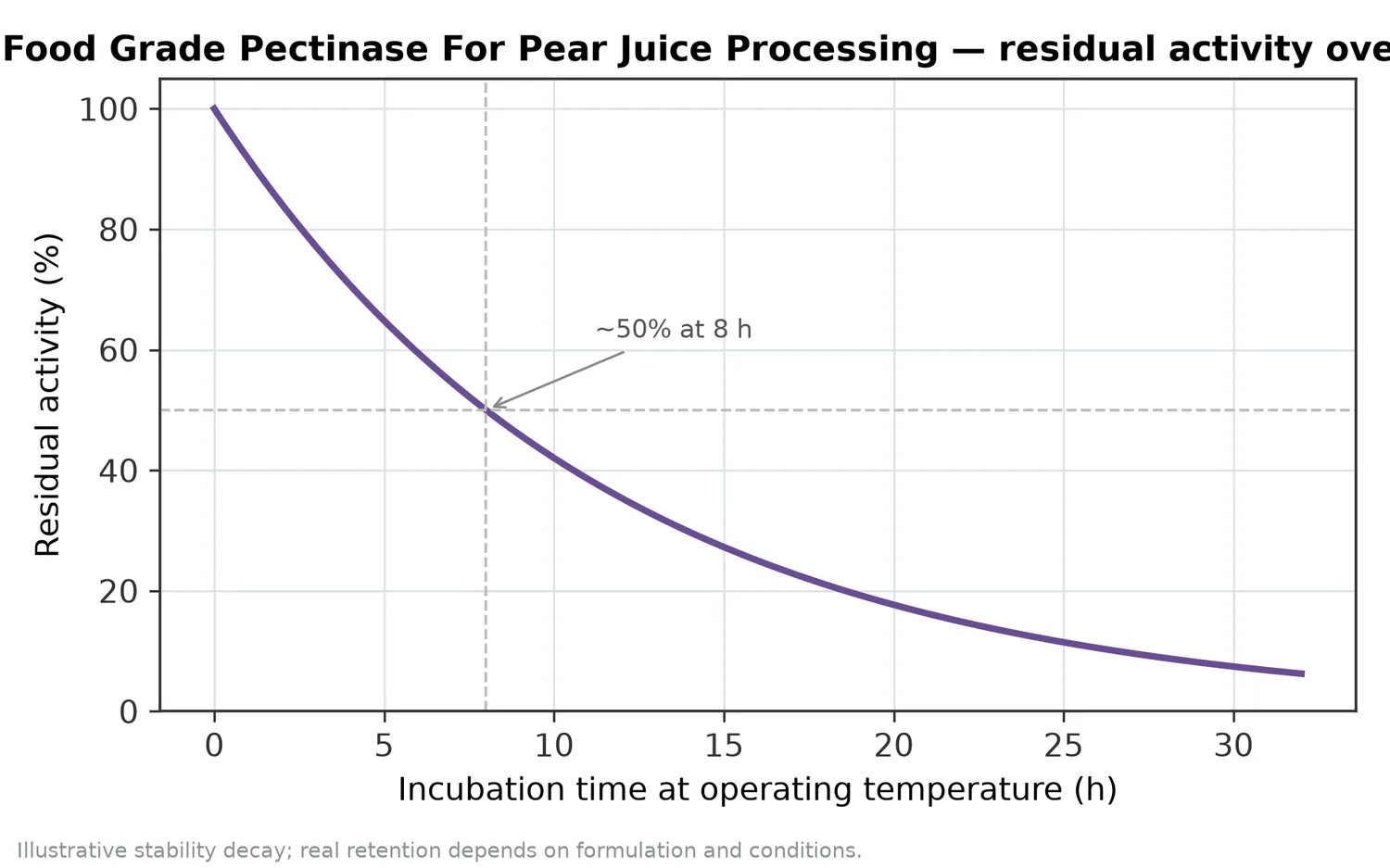
Contact time determines how far the reaction proceeds. Short treatment may partially reduce viscosity or improve filterability, while longer treatment can produce more extensive pectin breakdown. However, longer holding is not automatically better. Pear juice can be sensitive to oxidation, browning and microbial risk if held without adequate process control. The practical balance is to allow sufficient pectin modification while maintaining product quality and production flow [1].
Mixing determines whether the enzyme reaches the pectin evenly. In pear mash, poor distribution can leave pockets of untreated pulp and other zones that receive more enzyme contact than intended. Gentle, thorough mixing helps the enzyme contact cell-wall material without excessive air incorporation. In pressed juice, mixing supports uniform depectinization before clarification or filtration [1].
Raw material condition affects the enzyme response. Ripe pears, underripe pears and stored pears do not behave identically under milling and pressing. Differences in tissue firmness, soluble solids, pectin state and pulp particle size can change how much benefit is seen from pectinase treatment. The enzyme acts on pectin, but the process result reflects the whole fruit matrix and the downstream separation system [1].
Pectinase can be applied at different points in a pear juice line. The best stage depends on where the pectin problem appears: in pulp drainage, in pressed juice clarity, in filtration or in final product stability. The table below compares the main use points conceptually without turning the enzyme into a rigid formula.
| Processing stage | Main pectin target | What pectinase changes | Typical processing benefit |
|---|---|---|---|
| Pear mash before pressing | Insoluble pectin, middle-lamella material and released soluble pectin | Loosens fruit tissue and reduces mash viscosity | Easier pressing and improved juice release when pectin limits drainage |
| Pressed juice before clarification | Soluble and colloidal pectin | Reduces haze support and lowers viscosity | Faster settling, flotation, centrifugation or clarification |
| Juice before filtration | Residual pectin reaching filter media | Lowers pectin-related filter resistance | Better filterability and more consistent filtration |
| Juice before concentration | Pectin that would concentrate with the juice | Reduces viscosity before water removal | Easier concentrate handling and preparation |
| Pear component before blending | Pectin that may destabilize blended beverages | Reduces pectin contribution to haze and sediment | More predictable appearance in beverage bases and blends |
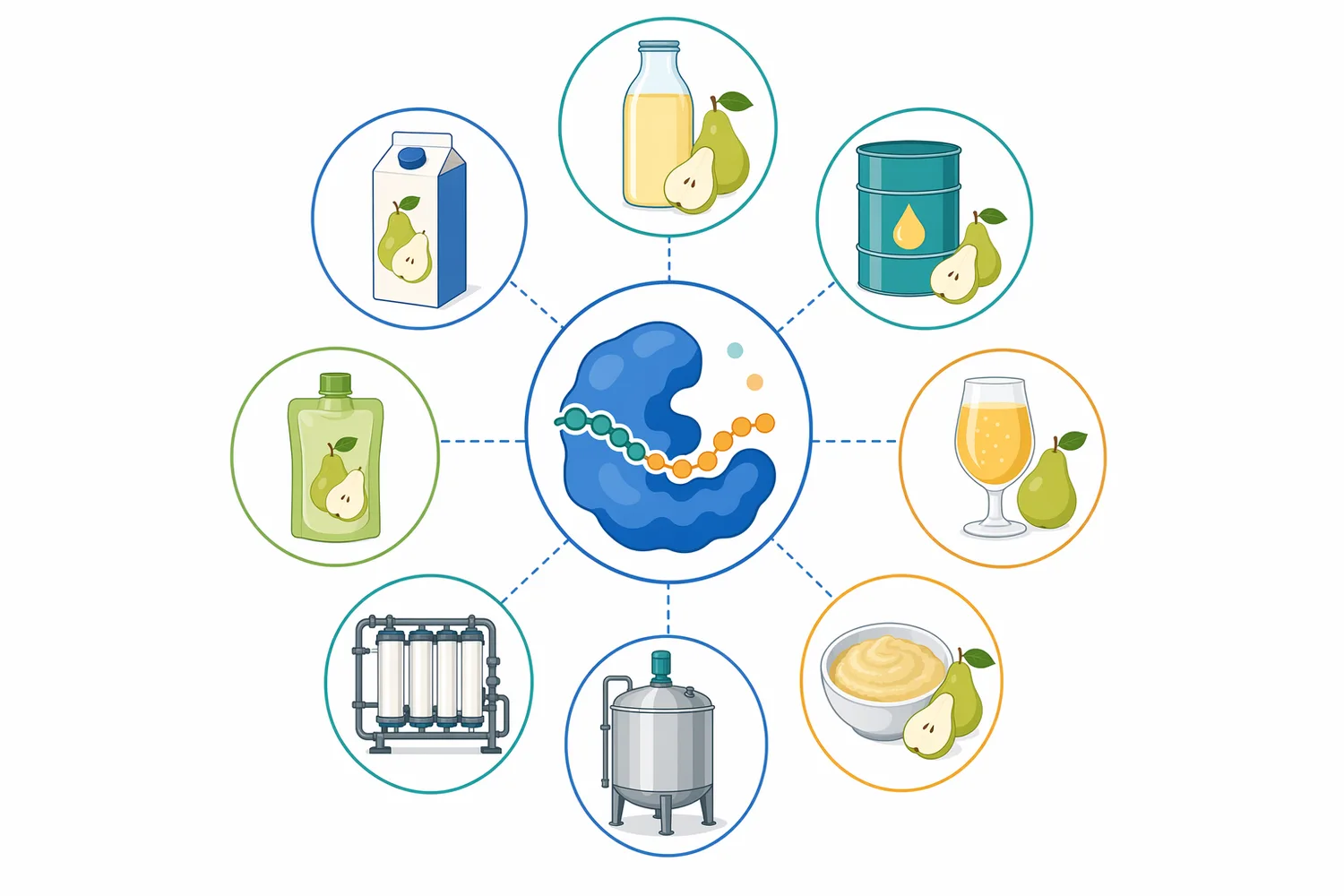
This comparison also shows why pectinase is not tied to a single product type. The same enzyme category can support clear pear juice, concentrates, beverage bases and selected cloudy products, but the reason for using it changes with the process stage. In mash, the focus is tissue breakdown and liquid release. In juice, the focus is depectinization, clarification and filterability [1].
The scientific basis for pectinase in fruit juice processing is strong: pectinases degrade or modify pectic substances, and pectic substances contribute to fruit tissue structure, viscosity and haze stability. The reviewed literature recognizes pectinases as widely used enzymes in fruit juice clarification and discusses their properties, mechanisms and processing relevance [1].
For pear juice specifically, the same substrate logic applies because pear tissue and juice contain pectic materials that influence extraction, viscosity and clarity. Direct results in any individual pear process will still depend on the fruit and equipment. A line producing clear pear concentrate from stored fruit may value pectinase mainly for filtration and viscosity control, while a fresh cloudy pear nectar operation may value it for mash handling without fully removing body [1].
The most reliable expectations are pectin-specific: easier pectin breakdown, reduced pectin viscosity, improved depectinization and better compatibility with clarification and filtration. Benefits such as higher yield, shorter processing time or improved final stability are practical outcomes that may follow when pectin is a limiting factor. They should not be treated as automatic in every situation, because non-pectin variables can dominate the process [1].
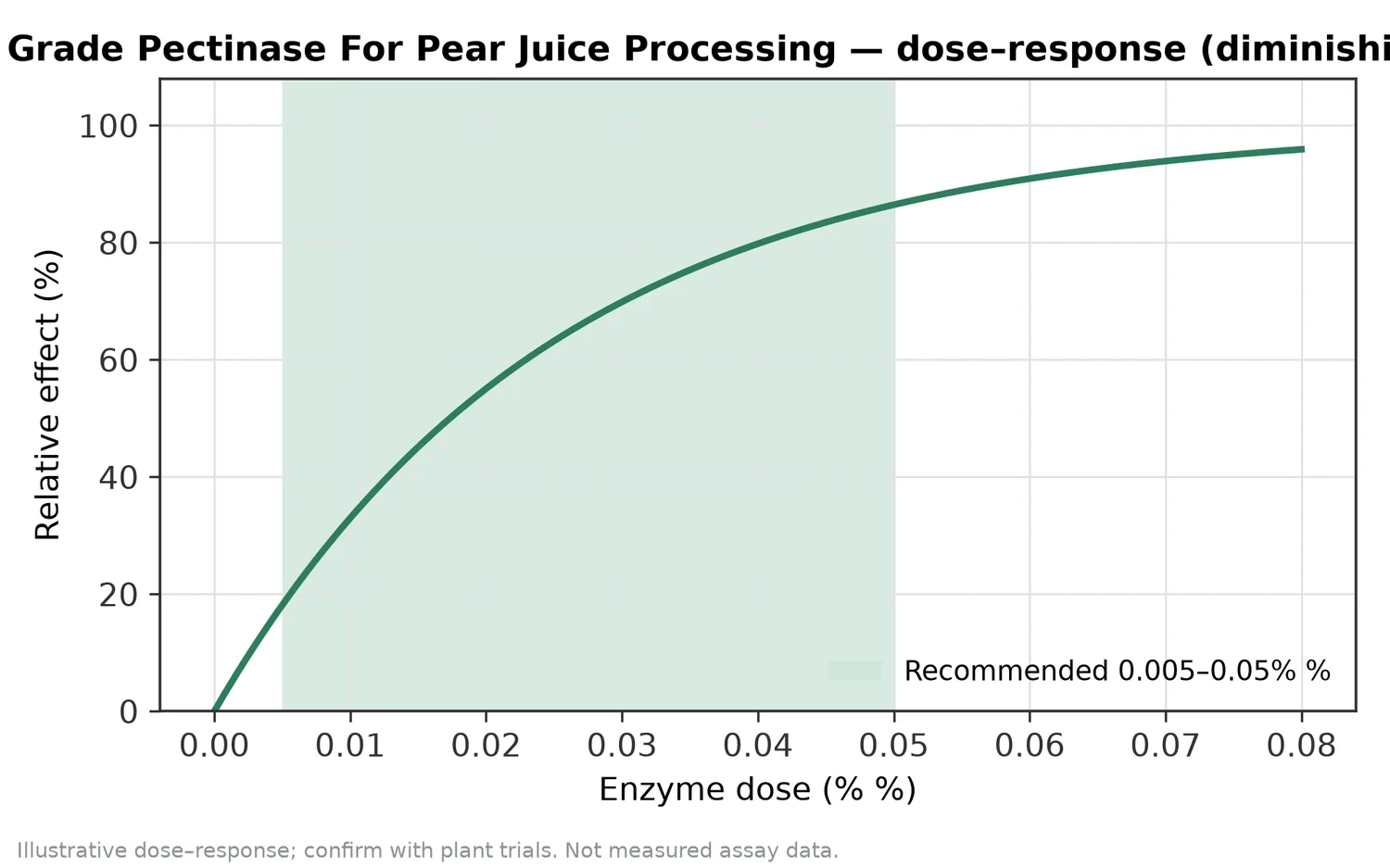
Claims about flavor, aroma, color or nutritional improvement should be treated more cautiously. Pectinase can indirectly affect these attributes by changing extraction and solids release, but the direction and desirability of the effect depend on fruit condition and process goals. More tissue breakdown can release desirable soluble material, but it can also release compounds that influence browning, bitterness or haze in some systems. The core function remains pectin modification [1].
Pectinase fits into conventional pear juice operations rather than replacing them. Washing, sorting and milling remain essential for raw material preparation. Pressing still provides the primary mechanical separation of liquid from solids. Clarification, centrifugation, flotation and filtration still remove particles and polish the juice. Pectinase improves the behavior of the mash or juice so those operations can work against a less pectin-rich, less viscous matrix [1].
In clear juice production, this integration is especially important. Enzymatic depectinization helps destabilize pectin-supported haze, but the physical removal of destabilized particles still requires a separation step. Similarly, lower viscosity can support filtration, but it does not eliminate the need for appropriate filter operation. Pectinase makes the substrate more processable; the process equipment completes the separation [1].
Heat treatment or other stabilization steps may also be used later in a pear juice process, depending on the product. From an enzyme perspective, heat can stop or reduce further enzyme action once the desired processing effect has been achieved. From a juice-quality perspective, stabilization is part of the broader product safety and shelf-life system, not a function of pectinase alone [1].
Food Grade Pectinase for Pear Juice Processing is intended as a food-processing aid for applications where controlled pectin breakdown is useful. It should be handled according to the Safety Data Sheet supplied with the order and used within the buyer’s established food safety, quality and production controls. The Certificate of Analysis supplied with the order supports routine receiving and documentation needs.
Enzymes.bio supplies this product directly online by the 1 kg unit. The purchase is completed online, after which the order is processed and shipped. This sales model is designed for buyers who want a straightforward way to obtain food grade pectinase for pear juice processing without a custom quotation workflow.
Enzymes.bio is a supplier, not a manufacturer or testing laboratory. This article is therefore intended to explain the processing role, mechanism and evidence base for pectinase in pear juice systems, not to replace plant-level validation or product-specific process control. Buyers should apply the enzyme within their own established production procedures.
Food Grade Pectinase for Pear Juice Processing helps break down the pectin structures that make pear mash thick, water-holding and difficult to press, and that make pear juice cloudy, viscous and harder to filter. By cutting or modifying pectin molecules, pectinase lowers the gel-forming and colloid-stabilizing behavior of the juice matrix, supporting easier extraction, clarification, filtration and concentrate preparation [1].
Its main applications include mash treatment before pressing, depectinization after pressing, pre-filtration conditioning, clear pear juice production, pear juice concentrate, beverage bases, blends and selected fermented pear beverages. The enzyme is most effective when pectin is a genuine process bottleneck and when it is integrated with appropriate fruit handling, mixing, clarification, filtration and stabilization practices.
Enzymes.bio supplies Food Grade Pectinase for Pear Juice Processing online by the 1 kg unit. Orders are paid for online, processed and shipped, with a Certificate of Analysis and Safety Data Sheet supplied with the order.
Sold by the 1 kg unit, in stock and ready to ship. Order directly on our store — pay online and we process your order. A Certificate of Analysis and Safety Data Sheet are included with every order.
Buy Food Grade Pectinase For Pear Juice Processing →Numbered in order of first citation. Open-access sources, each verified reachable at publication; citation numbers in the text link here.