
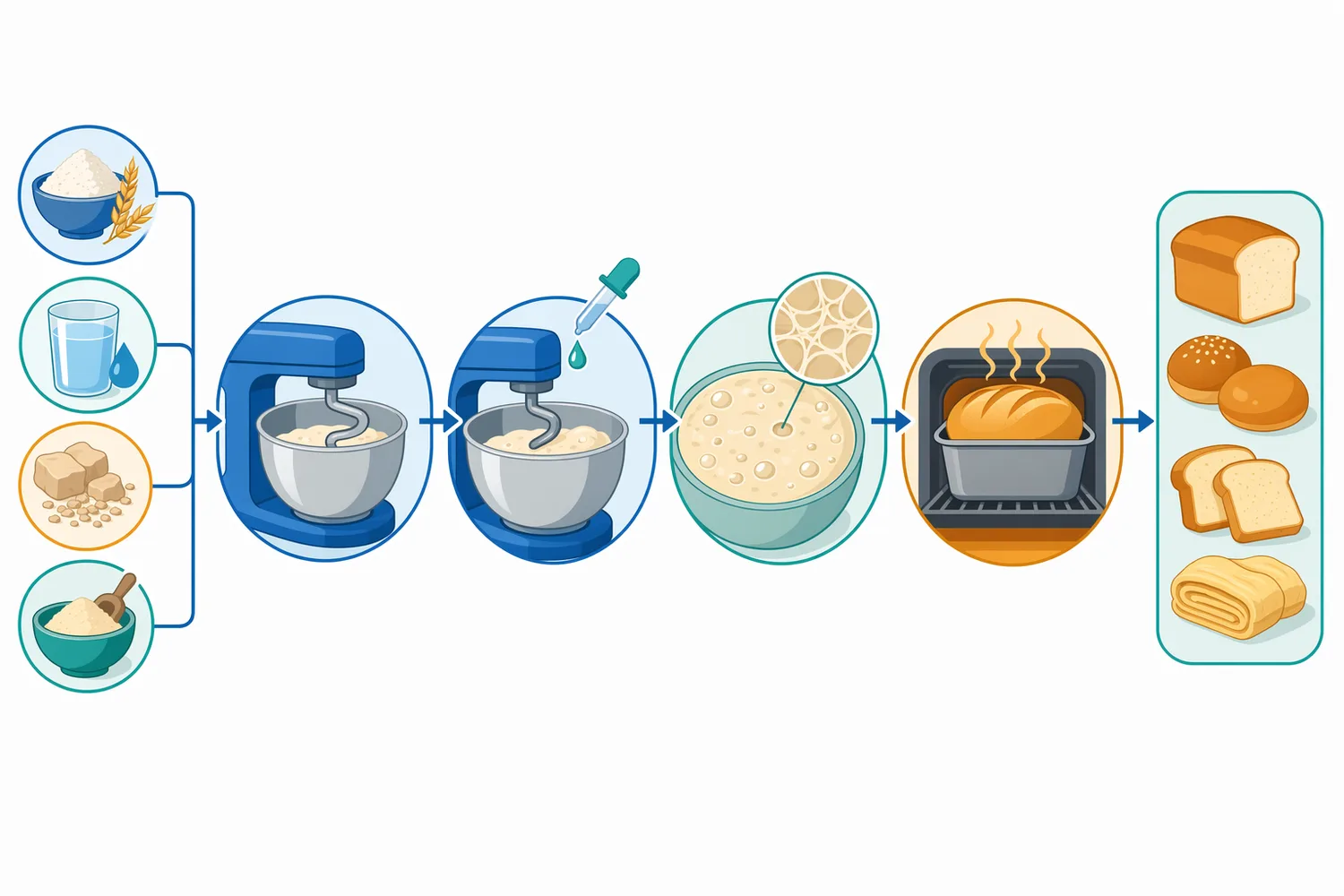
Glucose oxidase enzyme is used in bakery systems to strengthen dough through controlled oxidation. In wheat dough, it converts glucose and oxygen into gluconic acid and hydrogen peroxide; the hydrogen peroxide then promotes oxidative changes that reinforce the gluten network, helping dough become less sticky, more elastic and more tolerant during mixing, proofing and baking [1].
For bakery businesses producing bread, buns, rolls and other yeast-raised products, the practical value is consistency: better dough handling, improved gas retention, more stable proofing and more uniform finished structure when the enzyme is integrated into a balanced formula. Enzymes.bio supplies enzyme products for industrial and food-processing buyers, with Glucose Oxidase Enzyme available for direct online purchase by the 1 kg unit; the buyer pays online, and the order is processed and shipped with a Certificate of Analysis and Safety Data Sheet.
Glucose oxidase, often abbreviated as GOX, is an oxidoreductase enzyme. Its core reaction is simple to describe but powerful in dough systems: the enzyme uses glucose as a substrate and oxygen as the electron acceptor, producing gluconic acid and hydrogen peroxide as reaction products [1].
In bakery use, the key functional product is hydrogen peroxide. In controlled amounts inside wheat dough, hydrogen peroxide acts as a mild oxidizing agent. That oxidation can convert sulfhydryl groups in gluten proteins into disulfide linkages, which helps create a more connected and resilient gluten structure [1].
The simplified reaction is:
Glucose + Oxygen → Gluconic acid + Hydrogen peroxide
This matters because wheat dough is not just a mixture of flour and water. It is a viscoelastic network: gluten proteins hydrate, unfold, stretch and link together during mixing. Yeast fermentation then produces gas that must be held inside that network. If the network is too weak, the dough can become sticky, spread excessively, tear during machining, lose gas during proofing or collapse in the oven. Glucose oxidase supports the network from within by generating a controlled oxidative effect during dough development.
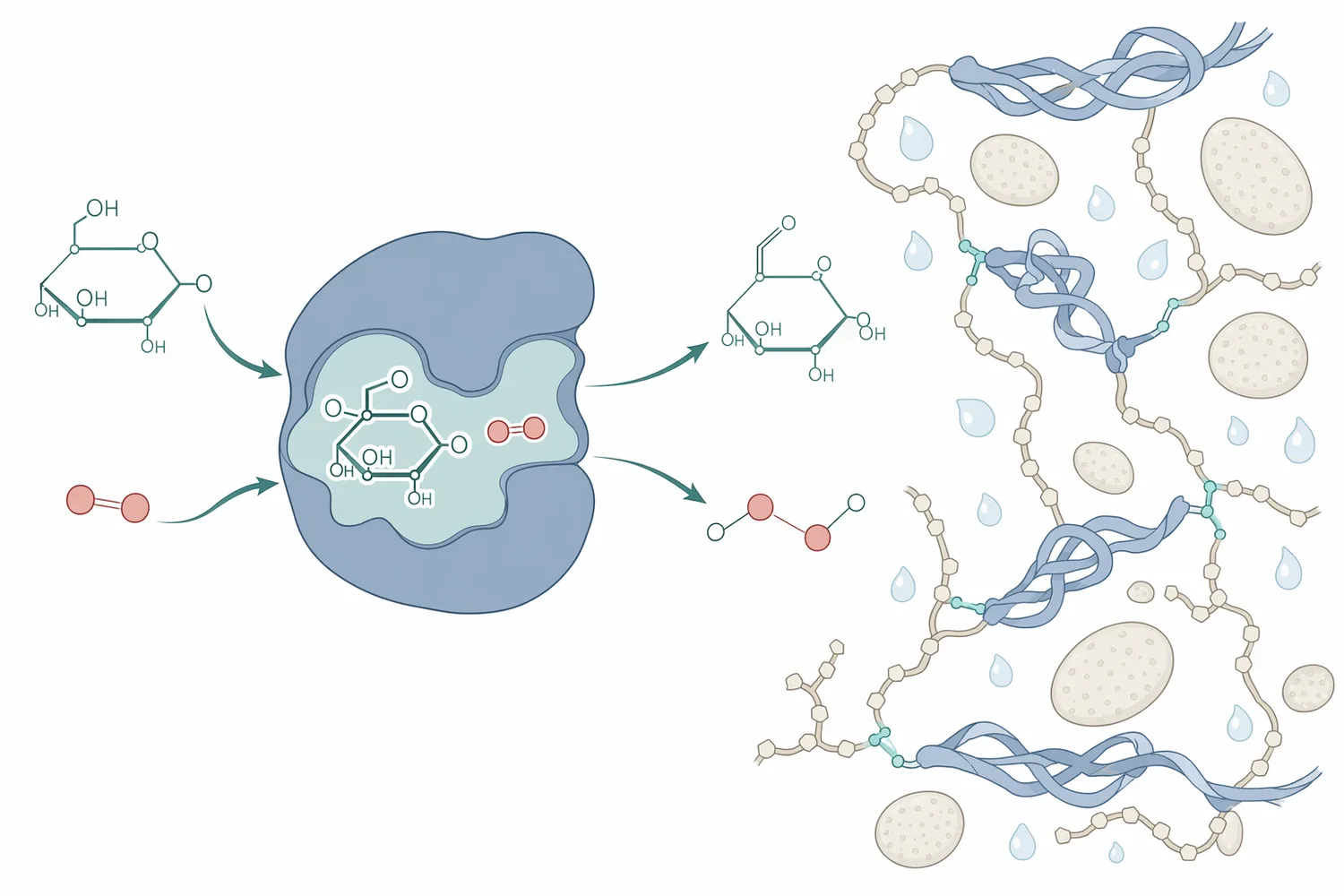
Unlike a direct chemical oxidant that is added already “active,” glucose oxidase depends on the dough environment. It needs available glucose, oxygen incorporated during mixing, moisture and suitable processing conditions. This is one reason its effect is often described as progressive rather than instant: it works as the dough is mixed and developed, rather than simply tightening the dough the moment it is added [1].
The main structural target in bread dough is the gluten matrix. Gluten is formed primarily from hydrated wheat proteins that create elasticity and extensibility. Elasticity allows dough to spring back; extensibility allows it to stretch without tearing. A commercially useful dough needs both. If it is too weak, it cannot hold shape or gas; if it is too tight, it may resist expansion. Glucose oxidase is used because it can shift weak or sticky dough toward better strength and tolerance.
At the molecular level, gluten proteins contain reactive sulfhydryl groups, often written as –SH. Under oxidative conditions, two –SH groups can form a disulfide bond, written as –S–S–. These bonds are important because they connect protein chains more strongly. When more of these reinforcing links are formed in the right balance, the dough network becomes better able to resist mechanical stress [1].
The hydrogen peroxide produced by glucose oxidase is central to this effect. The enzyme does not “make gluten” and does not replace flour protein. Instead, it changes the redox environment of the dough so existing gluten proteins can form stronger connections. In practical bakery language, this can show up as dough that is drier to the touch, less adhesive on equipment surfaces, more resistant to tearing and better able to maintain structure during fermentation.
There is also a process benefit. Industrial bread and bun dough often travels through high-stress steps: intensive mixing, dividing, rounding, sheeting or moulding, conveying, proofing and oven transfer. Each step can stretch, compress or shear the dough. A strengthened gluten network helps the dough recover from those stresses and retain gas cells more evenly, supporting better loaf symmetry and crumb uniformity.
The bakery value of glucose oxidase is not sweetness modification, flavour development or starch breakdown. Its main role is dough strengthening. That makes it especially relevant where production depends on repeatable dough handling and finished-product consistency.
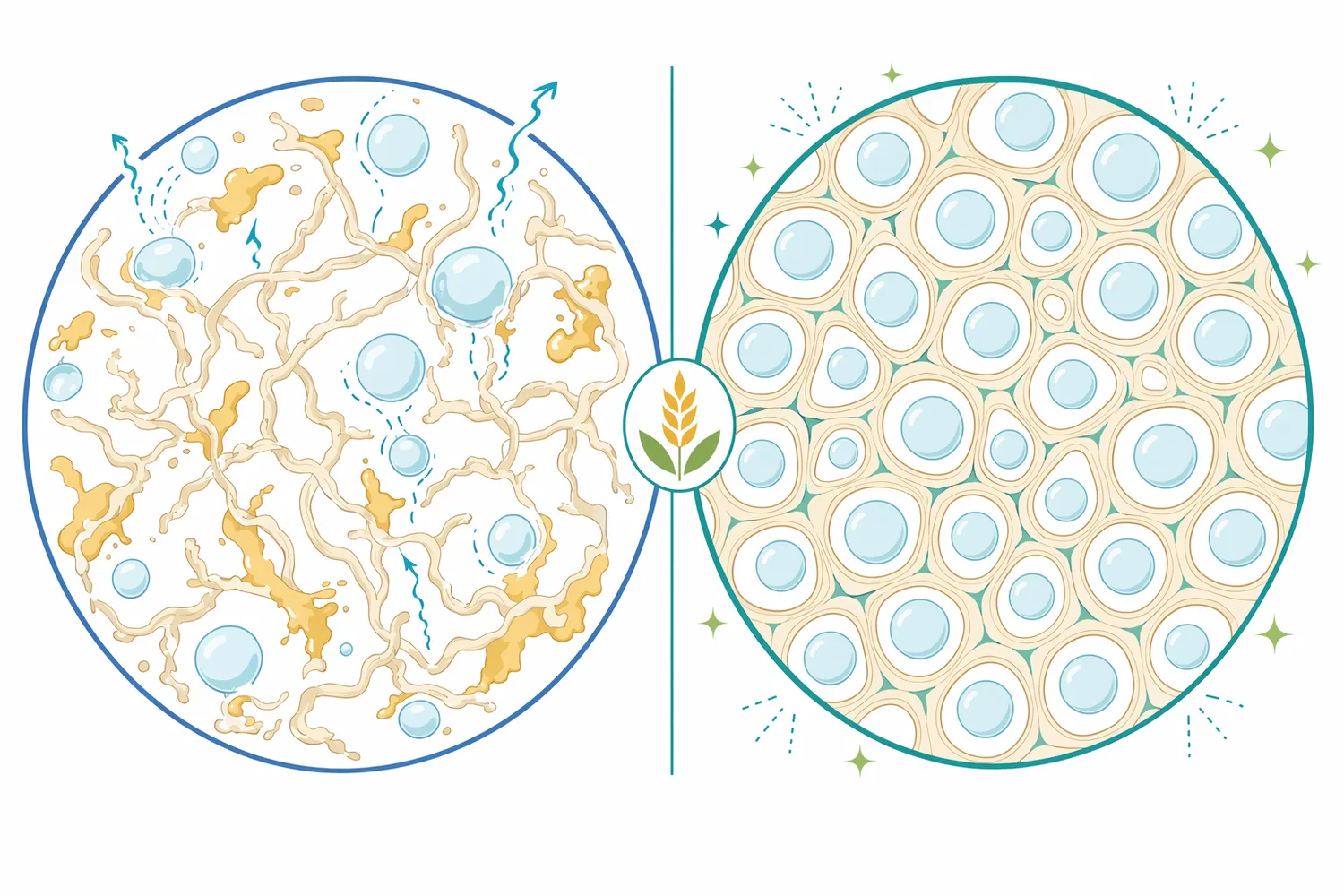
Common bakery challenges that glucose oxidase can help address include sticky dough during machining, slack dough after mixing, poor tolerance during dividing or moulding, weak gas retention during proofing, irregular expansion in the oven and uneven crumb structure. These problems are often linked to insufficient dough strength, variable flour quality or processing conditions that place heavy physical stress on dough.
For bread, buns and rolls, the enzyme is typically used as part of a broader improver system. Other ingredients or enzymes may support fermentation, crumb softness, volume, shelf life or dough relaxation. Glucose oxidase contributes primarily to strength and oxidation balance. It should not be confused with amylases that act mainly on starch, or with anti-staling systems designed primarily to maintain crumb softness after baking.
In commercial production, the benefits are often operational as much as sensory. A dough that is less sticky can pass through dividers, moulders and conveyors with fewer interruptions. A dough that holds gas more evenly can produce more uniform pieces after proofing and baking. A dough that tolerates variation better can reduce the visible impact of small shifts in flour quality, process temperature or mixing intensity.
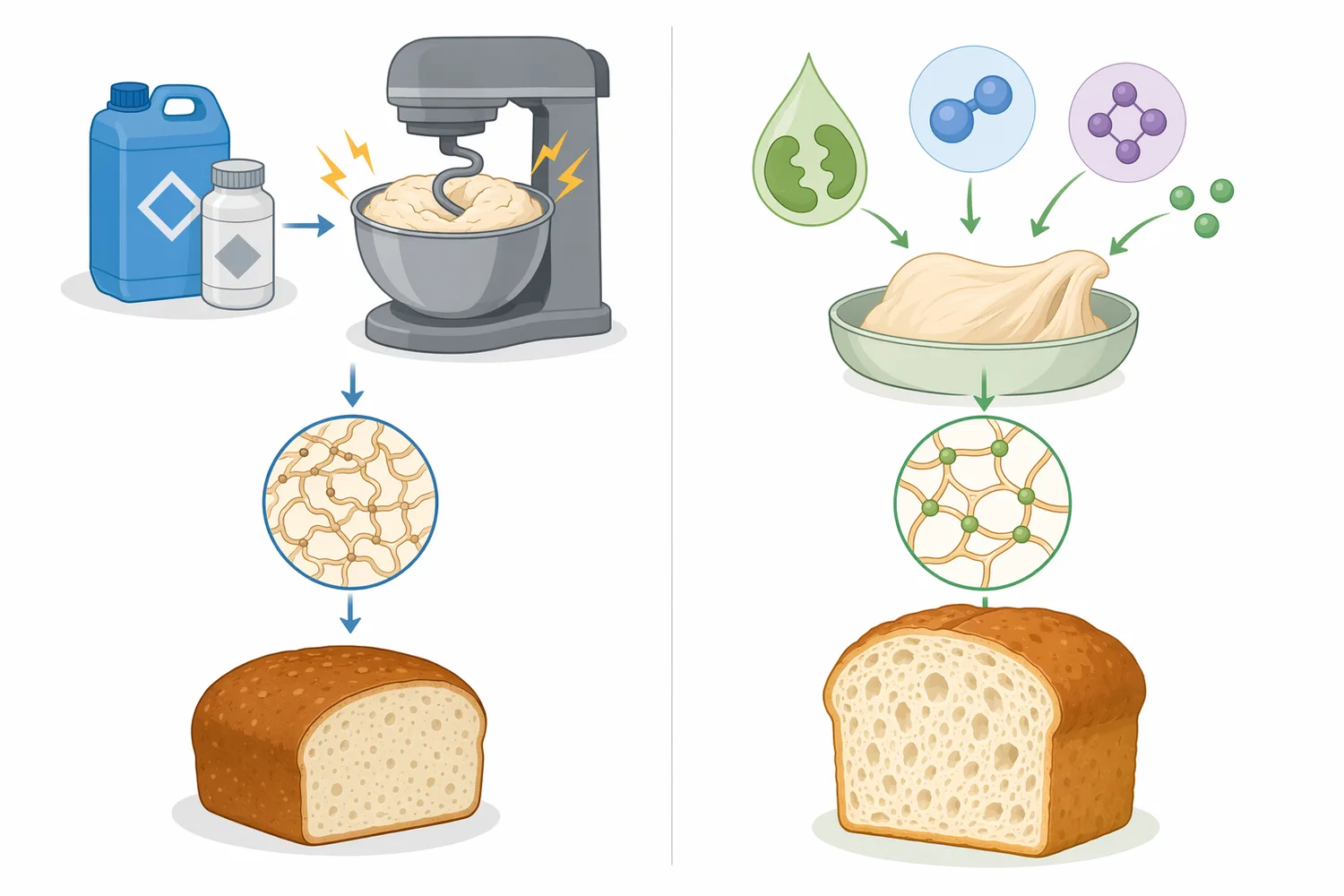
Glucose oxidase is often discussed alongside oxidants and dough improvers because the functional outcome can be similar: stronger dough and better tolerance. The difference is how the effect is generated. Glucose oxidase produces hydrogen peroxide enzymatically inside the dough system, while traditional chemical oxidants act more directly after addition [1].
| Dough-strengthening approach | How it works in dough | Typical practical effect | Important distinction |
|---|---|---|---|
| Glucose oxidase enzyme | Converts glucose and oxygen into gluconic acid and hydrogen peroxide; the hydrogen peroxide supports oxidation of gluten sulfhydryl groups into stronger disulfide linkages | Supports stronger, less sticky, more tolerant dough with improved gas retention | Enzymatic and process-dependent; effect depends on glucose, oxygen and dough conditions [1] |
| Ascorbic acid systems | Functions as an oxidizing improver after conversion in the dough environment | Can improve dough strength and loaf volume in suitable systems | Often fast and well established, but not enzymatic in the same way as glucose oxidase |
| Traditional chemical oxidants | Provide direct oxidative strengthening effects in dough | Can create strong dough tolerance and processing stability | Regulatory and label expectations vary by market; glucose oxidase is often considered in reduced-chemical-oxidant strategies |
| Gluten addition or flour correction | Increases or adjusts the structural protein base of the flour system | Can increase dough strength and water absorption potential | Changes the protein foundation rather than generating oxidation inside the dough network |
This comparison is not a ranking. Each approach works differently, and many bakery systems use more than one functional component. The reason glucose oxidase is valued is that it gives formulators an enzymatic route to controlled oxidation, which can be useful in modern bread and bun systems where dough strength, label direction and process tolerance are all important.
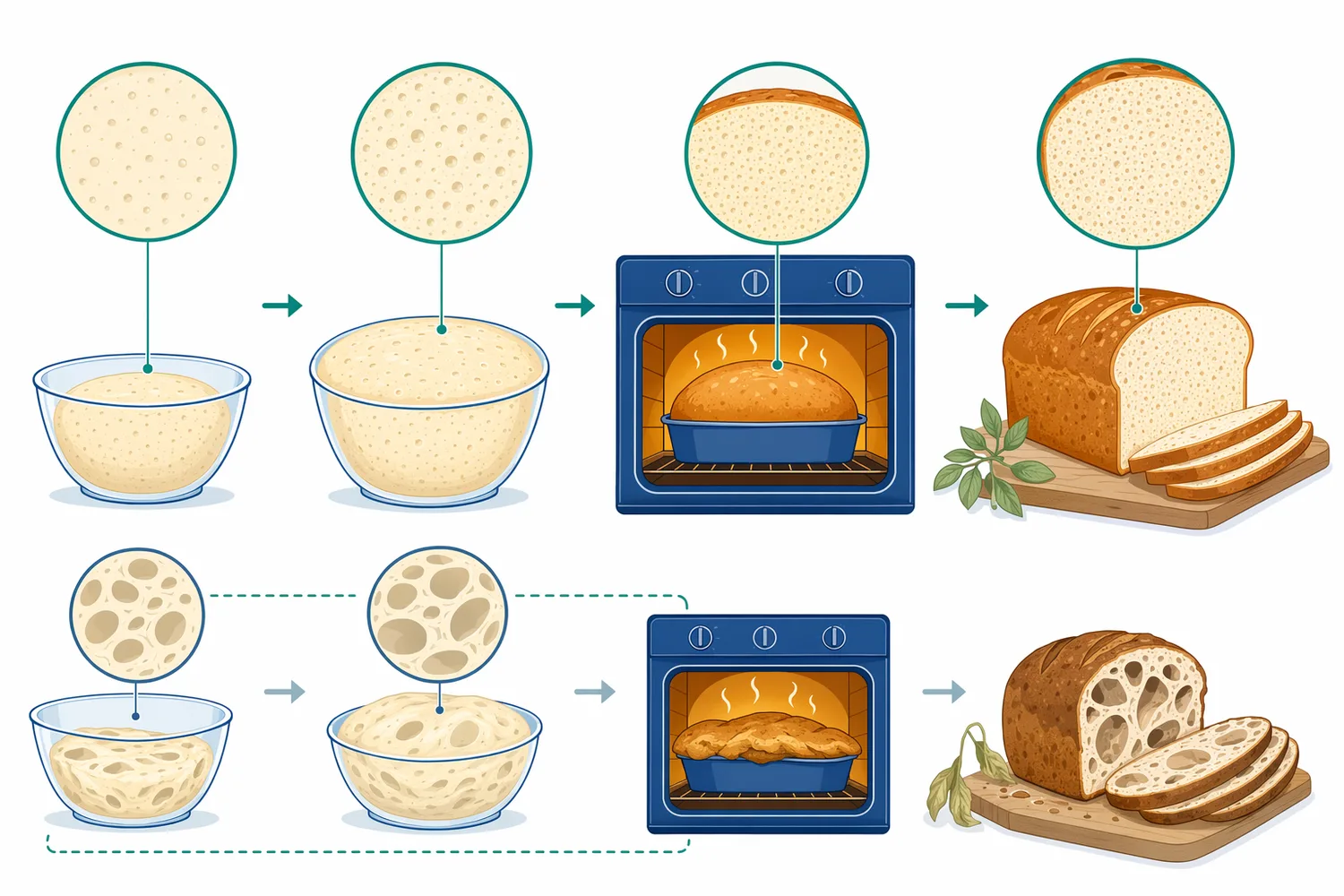
Glucose oxidase is particularly relevant in yeast-raised wheat products because those systems depend on gas production and gas retention. Yeast generates carbon dioxide during fermentation, but volume and structure depend on whether the dough can trap and expand around that gas. A weak gluten network lets gas escape or merge into large, irregular cells. A stronger, balanced network holds gas more evenly.
In pan bread, glucose oxidase can support loaf height, sidewall strength and crumb regularity when the rest of the formula is properly balanced. During proofing, the dough must expand without losing its shape; during oven spring, it must stretch quickly without rupturing. Strengthened gluten helps maintain the thin walls around gas cells so the loaf rises more evenly.
In buns and rolls, handling tolerance is often just as important as final volume. Dough pieces may be divided at high speed, rounded, deposited, proofed and transferred before baking. If the dough surface is too sticky or weak, pieces can deform, smear, tear or vary in height. Glucose oxidase can help the dough surface and internal structure stay more stable through those mechanical steps.
In laminated or sheeted yeast doughs, the same principle applies, although the ideal balance may differ. The dough must tolerate sheeting without tearing, but it must also remain extensible enough to open during proofing and baking. Glucose oxidase is therefore best understood as a strengthening tool, not a universal “more is always better” additive.
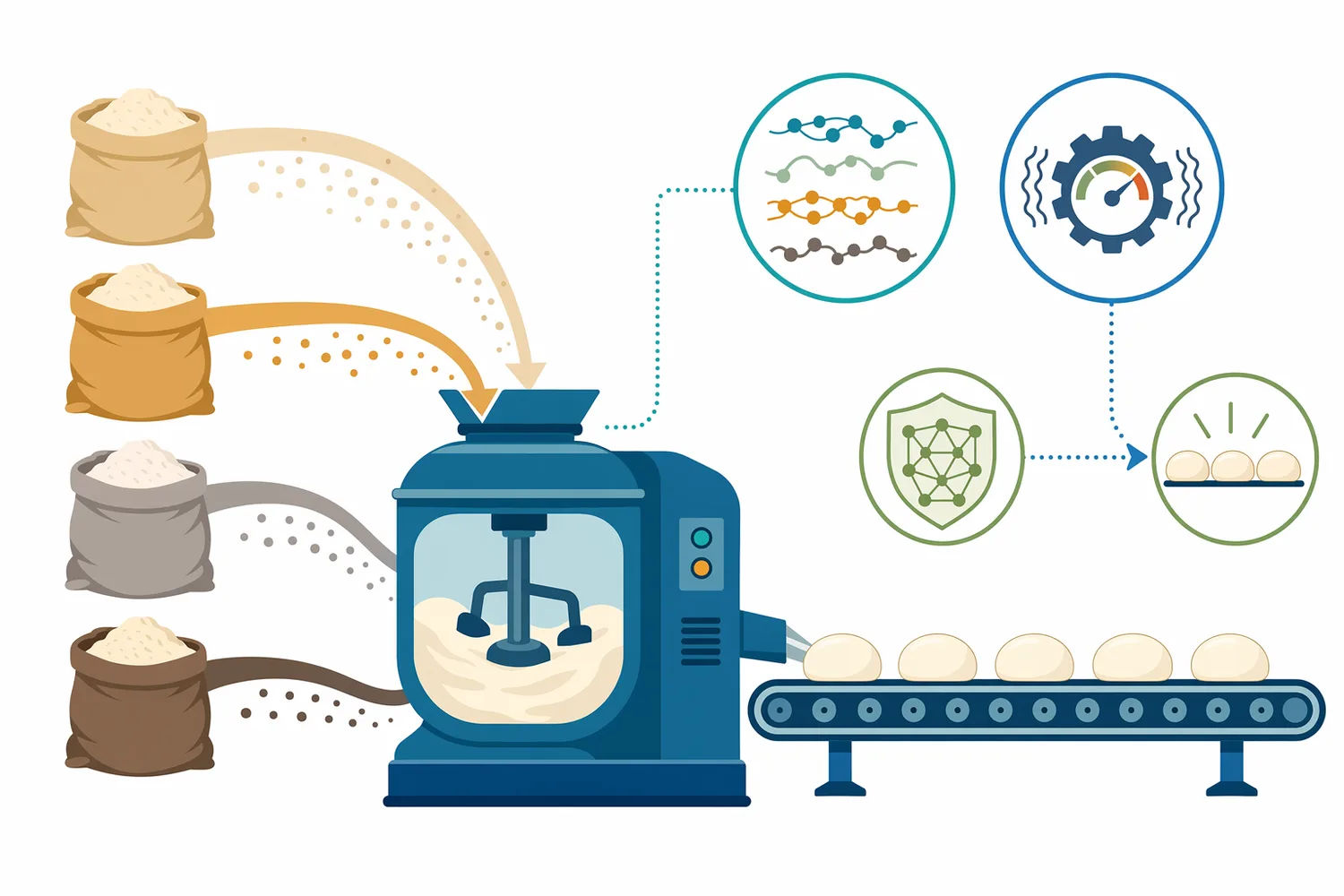
Wheat flour is naturally variable. Protein level, protein quality, damaged starch, enzyme background and growing conditions can all influence dough behaviour. Even when flour meets a purchase specification, two lots can mix differently or respond differently on an automated bakery line.
Glucose oxidase can help reduce the practical effect of some variability by reinforcing the gluten network during dough development. If a flour produces dough that is slightly weak, sticky or less tolerant, controlled oxidation can shift the dough toward better handling. The enzyme does not make poor flour identical to premium flour, but it can support more predictable processing within a well-designed baking system.

This is one reason glucose oxidase is used in flour treatment and improver applications. Flour mills, premix blenders and bakeries may include it where consistent dough strength is a priority. Its function is structural: it helps the dough behave more reliably under mixing, fermentation and mechanical handling stresses.
The practical advantage is most visible when the bakery process has little room for variation. Manual bakers can often compensate by feel, adjusting mixing time or handling. Automated lines have less flexibility. Dough must divide cleanly, round consistently, proof predictably and bake uniformly. A more tolerant dough gives the process a wider operating window.
Because glucose oxidase is an enzyme, its effect depends on the dough environment. The substrate, glucose, must be available. Oxygen must also be present, and in bread dough much of that oxygen is incorporated during mixing. Moisture, temperature and the physical development of the dough also affect how the reaction proceeds [1].
Mixing is especially important because it does two things at once. It hydrates and develops gluten, and it introduces oxygen into the dough. That oxygen allows glucose oxidase to catalyse its reaction. If oxygen incorporation is limited, the oxidative pathway generated by the enzyme may also be limited. If mixing is very intensive, the enzyme may have more opportunity to support strengthening during dough development [1].
Fermentation conditions matter as well. Long proofing, warm dough temperatures and extended floor time can expose weaknesses in gluten structure. As yeast produces gas and dough acidity changes, a weak dough may spread, lose gas or collapse. Glucose oxidase can help by increasing the dough’s resistance to weakening, but the final outcome still depends on the full process.
Formula balance is equally important. Bread improver systems may include enzymes, emulsifiers, oxidants, reducing agents, gums, gluten or other functional ingredients. Some components strengthen dough; others soften, relax or open structure. Glucose oxidase fits into that balance as a strengthening enzyme. If the system is already very strong, additional oxidation may make the dough too tight; if the system is weak, it may improve tolerance.
When glucose oxidase performs well in a balanced bakery formula, the finished product benefits are usually linked to improved dough structure. Better gas retention can support more consistent volume. Stronger cell walls can help create a finer, more uniform crumb. Improved proofing stability can reduce collapse, shrinkage or irregular loaf shape.
The effect starts before baking. During proofing, the gluten network expands around gas cells. If the network is weak, gas cells can coalesce into large holes or escape. If the network is strengthened appropriately, gas cells remain more evenly distributed. That gives the oven a better starting structure for oven spring and final crumb formation.
During baking, the dough undergoes rapid expansion before the structure sets. A stronger gluten network can stretch while holding shape, helping the loaf or bun expand without tearing or slumping. As starch gelatinizes and proteins set, the gas-cell structure becomes the crumb structure. This is why dough strengthening during mixing and proofing can be visible later as more uniform crumb and shape.
For sliced bread and sandwich products, uniform structure also matters after baking. Loaves that are symmetrical, adequately supported and free from large internal holes are easier to slice, package and use. Glucose oxidase is not a slicing aid by itself, but by supporting crumb regularity and loaf stability it can contribute to products that handle better downstream.
Many bakery businesses evaluate enzyme systems because they want functional performance with a different label profile from some traditional chemical oxidants. Glucose oxidase is often considered in this context because it generates oxidative strengthening through an enzymatic reaction in the dough rather than by adding a direct oxidant as the primary strengthening mechanism.
This should be interpreted carefully. Glucose oxidase is not automatically a one-to-one replacement for every oxidizing agent in every bread formula. Its performance is linked to flour quality, available glucose, oxygen incorporation, mixing, fermentation and the other improver components in the system. In some formulas it may reduce reliance on traditional oxidants; in others it may be one part of a combined improver approach.
The advantage is that the mechanism is well aligned with dough development. Instead of forcing an immediate chemical effect, the enzyme produces hydrogen peroxide as the dough is mixed and oxygen is incorporated. That makes the strengthening effect part of the dough’s development pathway, which is why it can be useful in systems that need tolerance without harsh or excessive tightening [1].
The goal with glucose oxidase is balanced strengthening, not maximum oxidation. Too little effect may leave dough sticky or weak. Too much strengthening can make dough tight, less extensible and harder to expand. In practical terms, over-strengthened dough may resist moulding, show reduced expansion or produce a tighter crumb than intended.
The reason is mechanical. Bread dough needs to stretch as gas pressure increases. Disulfide bonding strengthens the gluten network, but if the network becomes too rigid, the dough may not expand freely. A good bakery result requires the correct balance between strength and extensibility: strong enough to hold gas, extensible enough to grow [1].
This is why glucose oxidase is typically viewed as part of an improver system rather than an isolated fix. Its effect interacts with flour protein quality, mixing intensity, fermentation time, water absorption and other functional ingredients. The enzyme supports structure, but the whole formula determines the final handling and eating quality.
For the buyer using a 1 kg supply in production or development work, the responsible expectation is not that glucose oxidase will solve every dough issue by itself. Its strongest and most defensible role is improving dough strength and tolerance where the baking system can make use of controlled enzymatic oxidation.
Enzymes.bio is an enzyme supplier serving industrial and food-processing customers, including buyers working in food and beverage applications . For Glucose Oxidase Enzyme, the purchasing model is straightforward: the product is sold directly online by the 1 kg unit, the buyer pays online, and the order is processed and shipped.
This online unit format suits bakery businesses that want access to enzyme materials without a quote-based buying process. The product is supplied as a 1 kg order unit, and a Certificate of Analysis and Safety Data Sheet come with the order for routine documentation.
Enzymes.bio should be understood as a product supplier, not as a laboratory testing service or enzyme manufacturer. The role is to provide access to the enzyme product in a clear online purchasing format for business users who already understand their bakery process and can incorporate the material within their own formulation controls .
For bakery businesses, glucose oxidase is valuable because it addresses a high-impact production variable: dough strength. Dough that is too weak creates problems early in the process and carries those problems into the finished product. Stickiness, tearing, poor gas retention and proofing instability all reduce consistency.
By supporting oxidation within the dough, glucose oxidase helps create a gluten network that can better withstand industrial handling. This can improve the way dough moves through mixers, dividers, moulders and proofers. It can also support more uniform expansion and crumb structure after baking.

The enzyme is especially relevant where wheat quality varies, where production lines run at high speed, where dough is exposed to long or warm fermentation, or where the bakery is reducing dependence on certain traditional oxidizing systems. In each case, the same underlying mechanism applies: glucose oxidase generates hydrogen peroxide from glucose and oxygen, and that hydrogen peroxide supports gluten-strengthening oxidation [1].
Used appropriately, glucose oxidase is not simply an additive for “better bread” in a vague sense. It is a functional processing enzyme with a clear substrate, a clear reaction and a clear structural outcome. It changes dough behaviour by influencing the bonds and interactions that allow gluten to hold gas and resist mechanical stress [1].
Glucose Oxidase Enzyme for bakery business is a dough-strengthening enzyme for bread, buns, rolls and related wheat-based bakery systems. It works by converting glucose and oxygen into gluconic acid and hydrogen peroxide; the hydrogen peroxide supports oxidation of gluten sulfhydryl groups, helping form stronger disulfide-linked protein networks [1].
In commercial baking, that mechanism can translate into less sticky dough, better machining tolerance, improved gas retention, more stable proofing, more uniform oven expansion and a finer crumb structure when the formula and process are balanced. Enzymes.bio supplies Glucose Oxidase Enzyme for direct online purchase by the 1 kg unit, with the order processed and shipped after online payment and accompanied by a Certificate of Analysis and Safety Data Sheet.
Sold by the 1 kg unit, in stock and ready to ship. Order directly on our store — pay online and we process your order. A Certificate of Analysis and Safety Data Sheet are included with every order.
Buy Glucose Oxidase Enzyme For Bakery Business →Numbered in order of first citation. Open-access sources, each verified reachable at publication; citation numbers in the text link here.