
High-Concentration Wide-Temperature Desizing Enzyme is an enzyme-based textile pretreatment product used to remove starch-based sizing from woven fabrics before dyeing, printing, bleaching, or finishing. It works by enzymatically hydrolyzing starch size into shorter, more water-soluble fragments that can be washed out, leaving the fabric more accessible to water, dyes, and downstream finishing chemistry.
For buyers who need a practical desizing aid, the value is straightforward: starch size protects yarn during weaving, but after weaving it becomes a barrier to absorbency and uniform processing. Enzymatic desizing is one of the most established uses of enzymes in textile wet processing, especially for cotton and cotton-blend fabrics where starch or starch derivatives are present as sizing agents [1].
Enzymes.bio supplies High-Concentration Wide-Temperature Desizing Enzyme directly online by the 1 kg unit. The buyer pays online, the order is processed and shipped, and a Certificate of Analysis and Safety Data Sheet are provided with the order.
Sizing is applied to warp yarns before weaving to increase yarn strength, reduce abrasion, and improve weaving performance. Starch has historically been one of the most important sizing materials because it forms a film on the yarn surface, adds temporary body, and helps yarn withstand the mechanical stress of loom operation; however, this same film must be removed before the fabric can be processed evenly in wet finishing [2].
Once the cloth has been woven, starch size is no longer beneficial. It sits on and between yarns, reduces wetting, blocks access to the fiber surface, and can carry into scouring, bleaching, dyeing, printing, or finishing if not removed adequately. In practical terms, residual starch can contribute to uneven absorbency, patchy dye uptake, poor handle, inconsistent bleaching, and unnecessary load in later washing stages.
Desizing is therefore an early preparation step, not a cosmetic afterthought. A fabric that has been properly desized allows water and process chemicals to penetrate more uniformly into the yarn structure, so later steps can act on the fiber rather than on a partially obstructing size film. Reviews of enzyme use in textile processing consistently treat desizing as a core wet-processing application, with amylase-based desizing especially well established for starch-sized cotton fabrics [3].
“High-concentration” describes a concentrated enzyme preparation rather than a highly diluted auxiliary. For a textile user, this means the product is supplied in a compact form suitable for controlled addition into an aqueous pretreatment process. The phrase does not change the basic chemistry of desizing: the functional purpose remains the enzymatic breakdown of starch size so that the resulting fragments can be removed during washing.
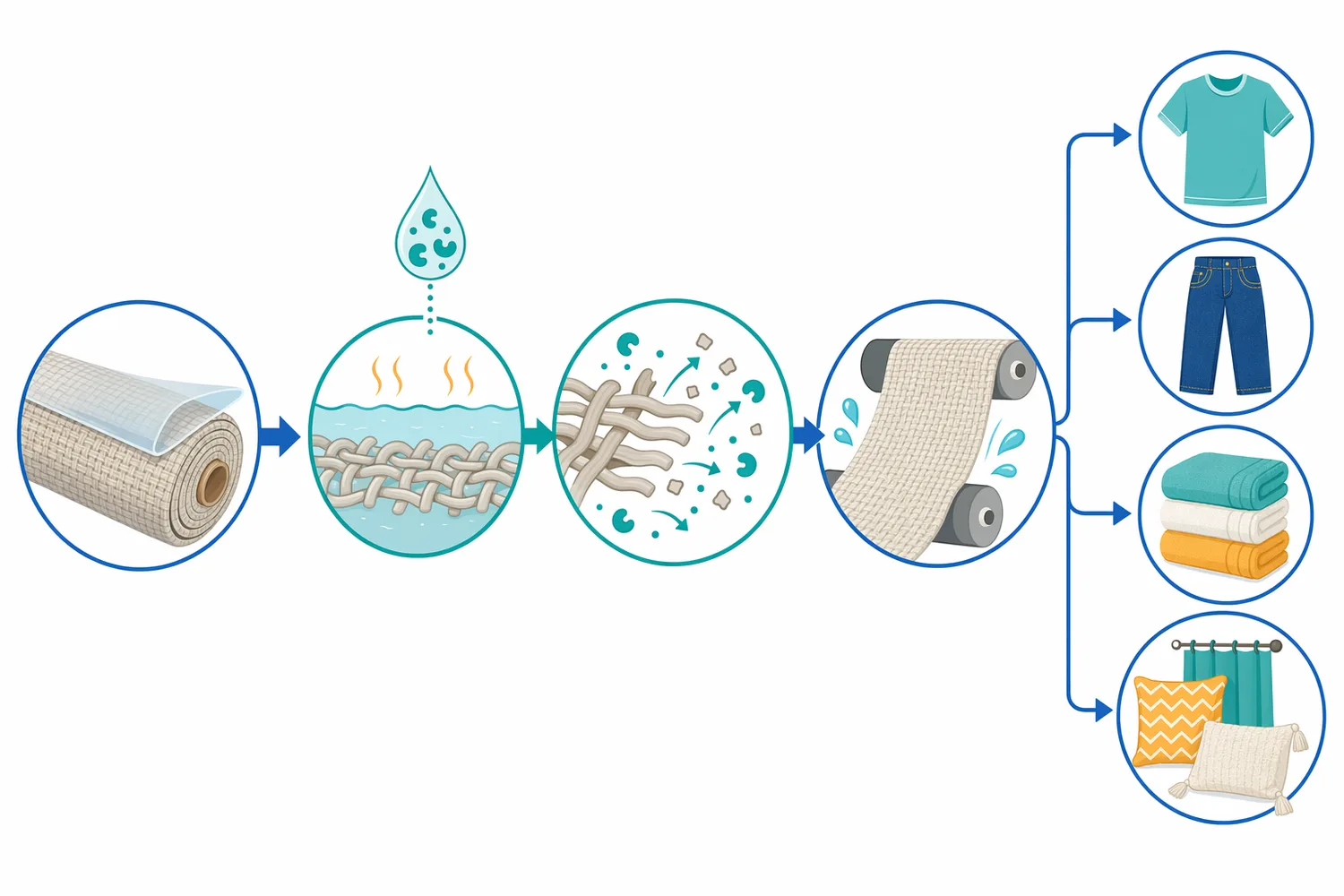
“Wide-temperature” describes the intended processing flexibility of the enzyme. In textile wet processing, bath temperature can vary with fabric construction, machine type, liquor movement, process sequence, and whether desizing is carried out as a standalone step or integrated with other pretreatment operations. A desizing enzyme with a broader usable temperature window is useful because the enzyme is less restricted to a narrow operating point, making it easier to fit into existing process routines without treating desizing as a completely isolated specialty step.
The industrial reason this matters is that enzymes are proteins, and their catalytic shape is affected by temperature. At low temperatures, reaction rates may be slower because molecular movement is reduced; at excessive temperatures, an enzyme can lose the three-dimensional structure that holds its active site in the correct shape. Reviews on industrial enzyme thermostability describe temperature stability as a central factor in practical enzyme performance, because industrial processes often need a balance between reaction speed and retention of enzyme structure [4].
A wide-temperature desizing enzyme is therefore best understood as a practical processing aid: it supports starch hydrolysis across a broader working range than narrow-window products, while still relying on the same enzyme mechanism. The buyer should still treat desizing as an enzyme-compatible wet process: the size must be wetted, the enzyme must be allowed to contact the starch film, and the hydrolyzed fragments must be rinsed away.
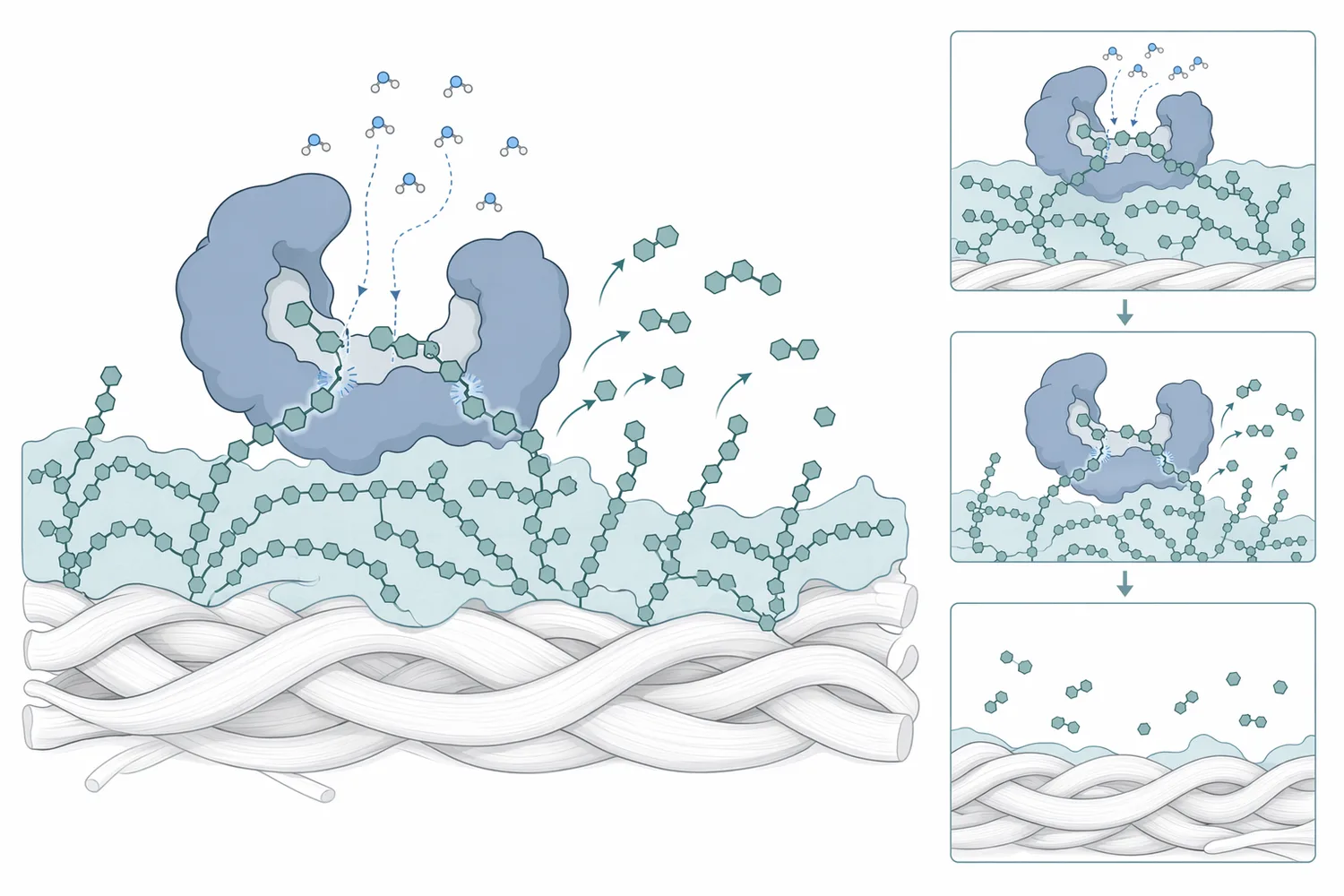
Starch is a carbohydrate polymer made from glucose units joined mainly through glycosidic bonds. In a size film, these long chains form a coating that is strong enough to protect yarn during weaving but difficult to remove by water alone. Amylase-type desizing enzymes act on those glycosidic linkages, cutting the long starch chains into shorter dextrins and sugars that are more soluble and easier to wash away.
The useful point is not simply that “the enzyme cleans the fabric.” The enzyme changes the size layer chemically. A long starch chain behaves like a film-forming barrier; after hydrolysis, the same material becomes a mixture of shorter fragments with lower film strength and higher water dispersibility. The physical result is that the rigid starch coating loosens, breaks up, and can be removed from the yarn surface during rinsing and washing.
This selectivity is the reason enzymatic desizing is so widely used on cotton. Cotton fiber is cellulose, another glucose-based polymer, but amylases used for desizing are selected for starch hydrolysis rather than general cellulose degradation. The enzyme acts mainly on the starch size, helping remove the temporary weaving aid while avoiding the broad, non-specific attack associated with harsher chemical treatments. Reviews of textile enzyme applications emphasize enzyme specificity as one of the main reasons enzymes are attractive in wet processing [5].
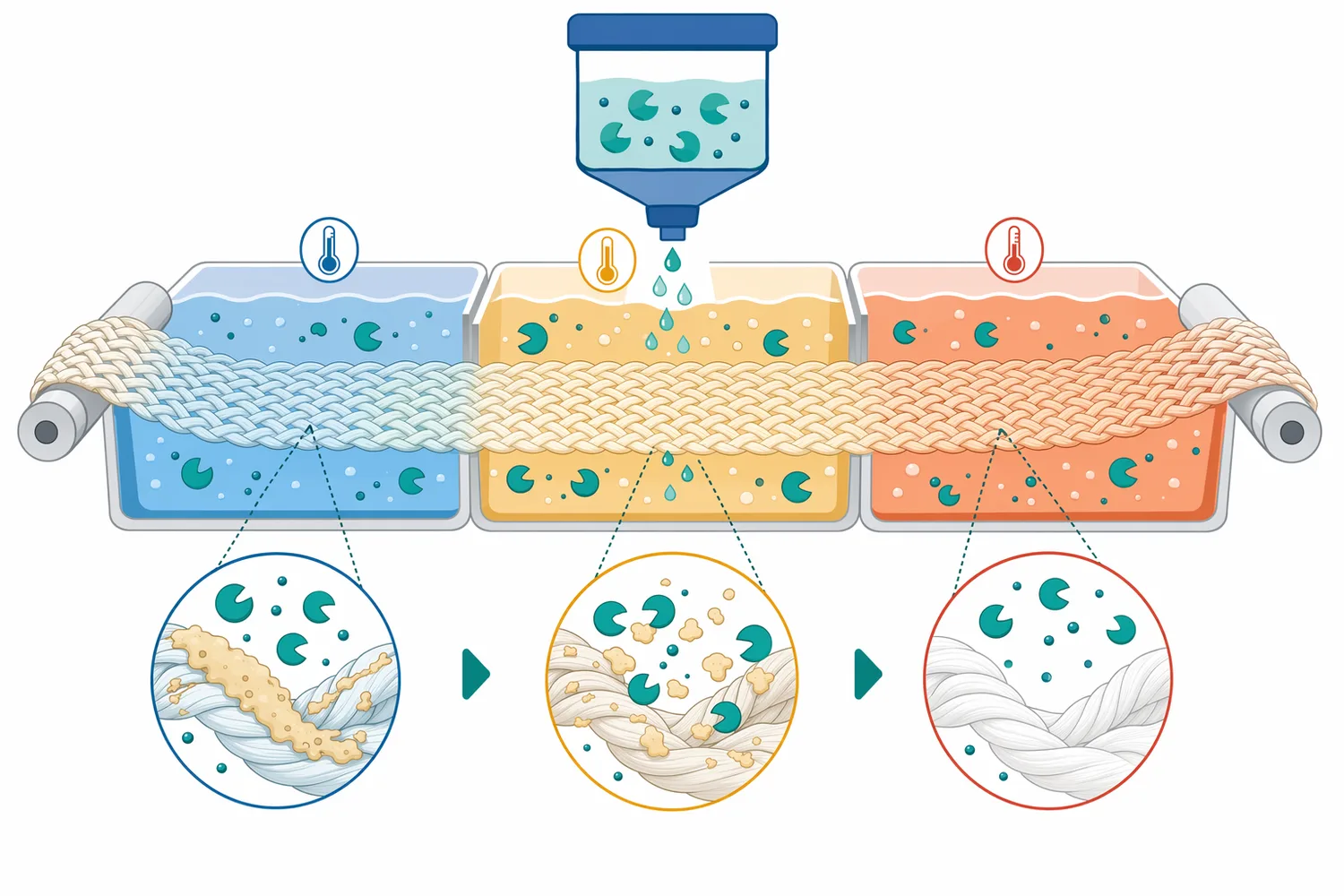
Good wetting is important because the enzyme acts where it can physically reach the substrate. If a dense size layer, oil, wax, or trapped air prevents bath penetration, hydrolysis may occur unevenly. Once the bath reaches the starch film, the enzyme repeatedly binds starch segments, cleaves susceptible bonds, releases smaller fragments, and continues acting on remaining polymer chains until the starch is sufficiently degraded for removal.
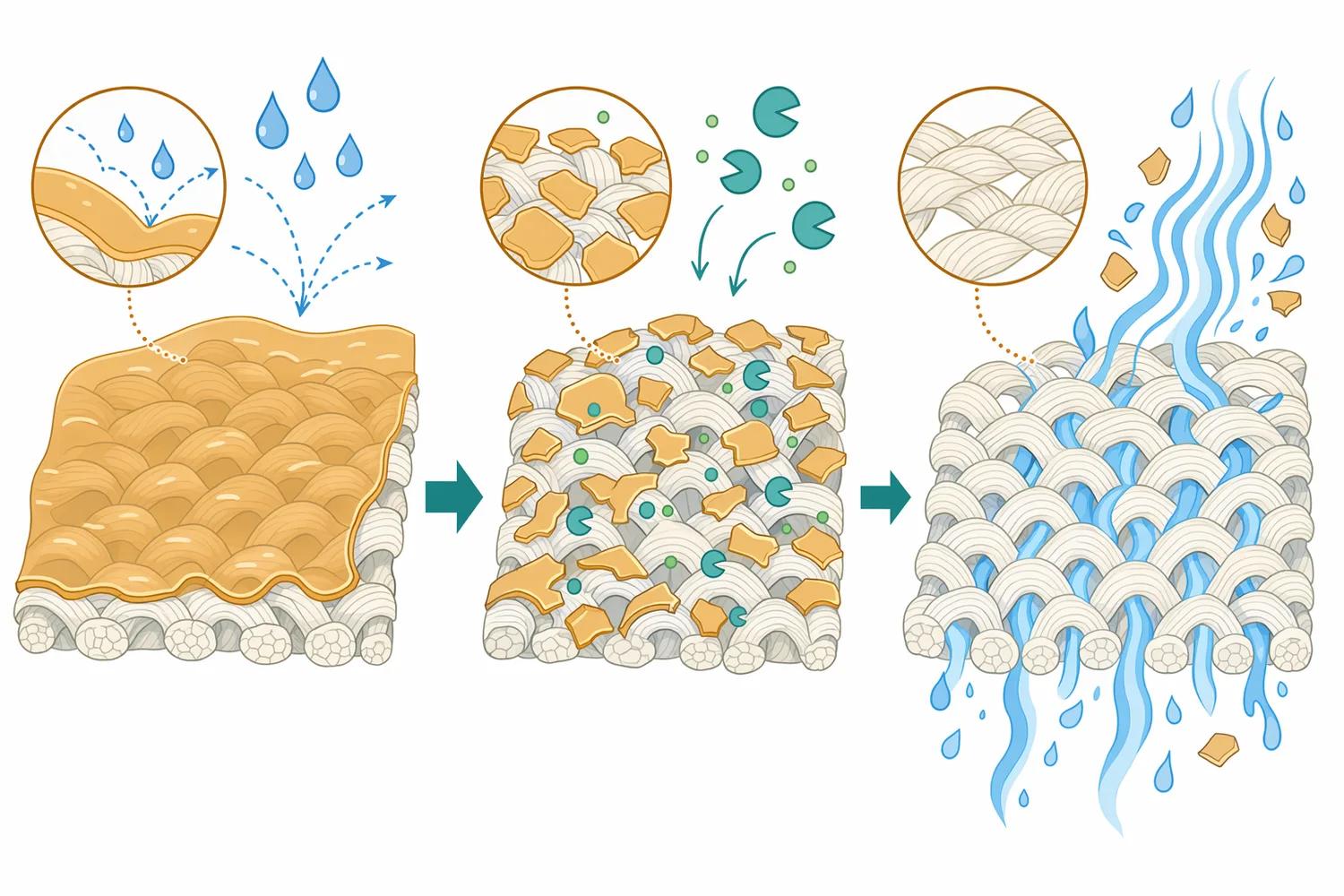
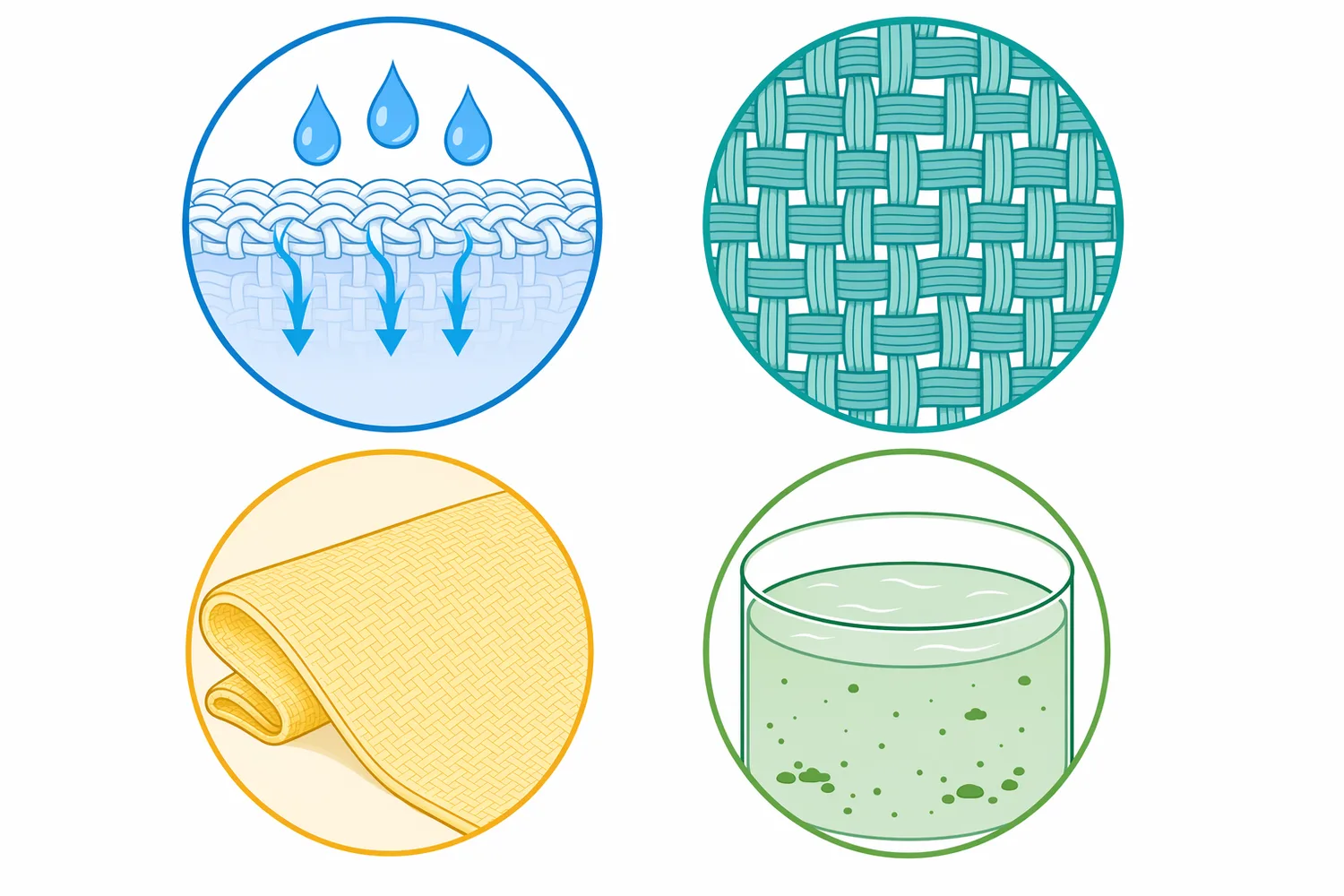
Before desizing, a starch-sized woven fabric has yarns coated or partially filled with a film that limits absorbency. Water tends to sit on or move slowly through the structure because the size film reduces capillary access to the fiber and yarn spaces. During enzymatic desizing, the starch film loses molecular length and cohesion; it swells, fragments, and becomes more removable under washing action.
After effective desizing, the fabric surface is more open to water. Capillary movement improves because liquid can enter the yarn structure instead of being blocked by the size layer. This is why desizing performance is commonly linked in the literature with absorbency-related outcomes and preparation quality before dyeing or finishing [3].
The removal of starch also reduces an unnecessary organic load carried into later baths. If starch remains during bleaching or dyeing, it can consume chemicals, interfere with penetration, or create localized differences in fabric response. When starch is hydrolyzed and washed out early, later chemistry works more directly on the fiber and natural impurities rather than on a leftover weaving aid.
For printed or dyed goods, the benefit is visible as better process uniformity. The enzyme does not create color by itself and does not replace dyeing chemistry; it prepares the fabric so dye liquor, printing paste, or finishing agents encounter a more consistent substrate. This is the practical reason desizing is positioned near the start of woven fabric preparation.
Textile desizing can be approached through several routes. The best-known distinction is between targeted enzymatic hydrolysis and broader chemical degradation. The table below summarizes the conceptual differences without reducing the choice to a single universal rule.
| Desizing route | Main action on starch size | Typical process character | Main practical strength | Main practical limitation |
|---|---|---|---|---|
| Enzymatic amylase desizing | Hydrolyzes starch chains into shorter, washable fragments | Selective catalytic treatment in water | Targets starch while supporting milder textile pretreatment concepts | Requires enzyme-compatible conditions and effective washing after hydrolysis |
| Acid desizing | Chemically hydrolyzes starch under acidic conditions | Non-enzymatic chemical degradation | Can break down starch without relying on enzyme activity | Less selective; process control is important to avoid unwanted fabric effects |
| Oxidative desizing | Oxidizes or degrades size materials chemically | Often linked with stronger chemical treatment conditions | Can support rapid chemical breakdown in some processes | May add chemical load and requires control to prevent over-processing |
| Alkali-associated preparation | Swells, removes, or helps dislodge impurities as part of broader pretreatment | Often tied to scouring or preparation chemistry | Useful for removing non-starch impurities and preparing cotton | Starch removal may be incomplete without a starch-specific mechanism |
Enzymatic desizing is valued because it gives the process a starch-specific mechanism. Instead of relying mainly on aggressive chemical breakdown, the enzyme catalyzes a defined hydrolysis reaction on the size polymer. Sustainable textile processing reviews describe enzymes as important tools for reducing reliance on harsh chemistry in selected wet-processing stages, while still recognizing that each operation must be judged in its full process context [1].
This comparison also shows why desizing should not be confused with scouring. Desizing focuses on removing size, especially starch size. Scouring targets natural oils, waxes, pectins, and other impurities from fibers such as cotton. In many workflows the two steps are sequential or combined, but the mechanisms are different. An amylase-rich desizing enzyme is chosen for starch hydrolysis; scouring chemistry or enzymes address other impurity classes.
The strongest evidence for this product category is the long-standing use and study of enzymatic desizing in textile wet processing. Enzymes and their application in textile processing, especially desizing, have been reviewed as a mature area because amylases provide a direct route for removing starch-based sizes from woven fabrics [2].
Sustainable textile processing literature places desizing among the most successful and established enzyme applications. Reviews describe enzyme-assisted desizing and scouring as extensively studied and industrially relevant, particularly because these operations occur early in the fabric preparation chain and strongly affect later wet-processing quality [1].
More recent reviews of microbial enzyme applications in textile processing continue to identify desizing as a key application area. They discuss enzymes as tools for sustainable textile processing and waste-management improvement, while noting that the appeal of enzyme use comes from specificity, milder processing potential, and the ability to reduce the severity of some conventional chemical treatments [5].
Research also continues to explore improved starch-degrading systems. A 2024 study reported a starch-active lytic polysaccharide monooxygenase discovered through bioinformatics screening and evaluated its application in textile desizing, showing that starch removal remains an active topic for enzyme innovation rather than a closed historical process [6].
The broader industrial enzyme literature is relevant because desizing performance depends on maintaining useful enzyme structure during processing. Reviews of thermostable industrial enzymes explain that high-temperature operation can improve reaction rates and process efficiency, but enzyme stability must be sufficient for the protein to keep its active form under the conditions encountered [4].
Textile pretreatment is rarely a perfectly uniform laboratory operation. Fabric weight, construction, size add-on, bath circulation, wet-out, machine loading, and process sequence can all affect how quickly starch becomes available to the enzyme. A wider usable temperature range helps because it gives the process more tolerance to practical variation while still allowing the enzyme to hydrolyze starch.
Temperature affects two things at once. First, it changes reaction speed: warmer systems generally allow faster molecular motion, which can increase the rate at which enzyme and starch encounter each other. Second, it affects enzyme structure: too much heat can unfold the protein or distort the active site, reducing its ability to bind and cleave starch. Industrial enzyme research treats this balance between catalytic rate and structural stability as a central issue in enzyme design and use [7].
For desizing, temperature also affects the substrate. Starch films can swell and become more accessible in warm water, which can improve enzyme access. However, accessibility is not the same as removal. The enzyme must still cleave the polymer, and the fragments must be carried away by washing. Wide-temperature performance is useful because it supports hydrolysis over a more forgiving operating window, but it does not remove the need for good wetting and rinse-out.
In practical terms, a wide-temperature desizing enzyme can fit into different textile preparation layouts more easily than an enzyme with a very narrow operating window. It can be used where the process benefits from enzyme action but where bath temperature may vary across production routines. This flexibility is especially relevant in plants that process more than one fabric construction or that integrate desizing with other wet steps where temperature is already defined by the broader workflow.
Cotton woven fabrics are the classic setting for enzymatic desizing because cotton yarns are commonly sized for weaving and starch-based sizes have long been used in that role. After weaving, the size must be removed before the fabric can be scoured, bleached, dyed, printed, or finished to the required standard. Textile enzyme reviews consistently highlight cotton preparation as a major area for enzyme use [3].
Cotton blends may also be suitable where the size system includes starch or starch derivatives. The relevant question is not only the fiber content but the chemistry of the size applied during weaving. If the barrier that needs removal is starch-based, an amylase-type desizing mechanism is directly relevant; if the size is mainly synthetic or non-starch, a starch-specific enzyme will not be the main removal mechanism.
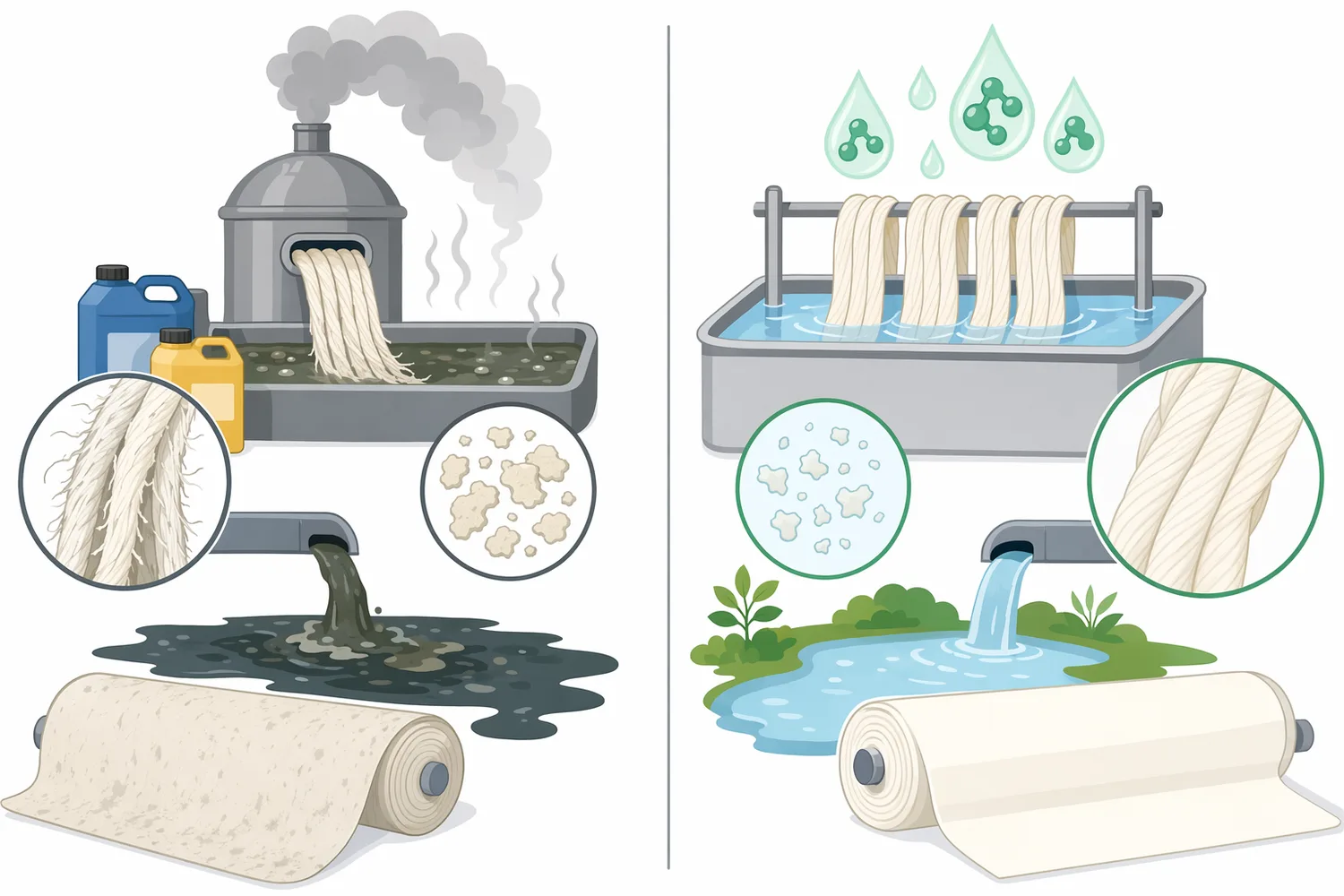
In cotton preparation, effective desizing helps subsequent scouring and bleaching operate more consistently. Scouring can then address waxes, pectins, oils, and other non-cellulosic impurities more directly, while bleaching can act on a fabric surface that is less obstructed by residual starch. This sequence is one reason desizing is usually treated as an early step in woven-fabric wet processing rather than as a late correction.
The enzyme’s contribution is therefore preparatory and enabling. It does not replace every pretreatment step, and it does not remove every impurity class. Its role is to convert starch size from a persistent film into washable fragments, improving the fabric’s readiness for the wet-processing steps that follow.
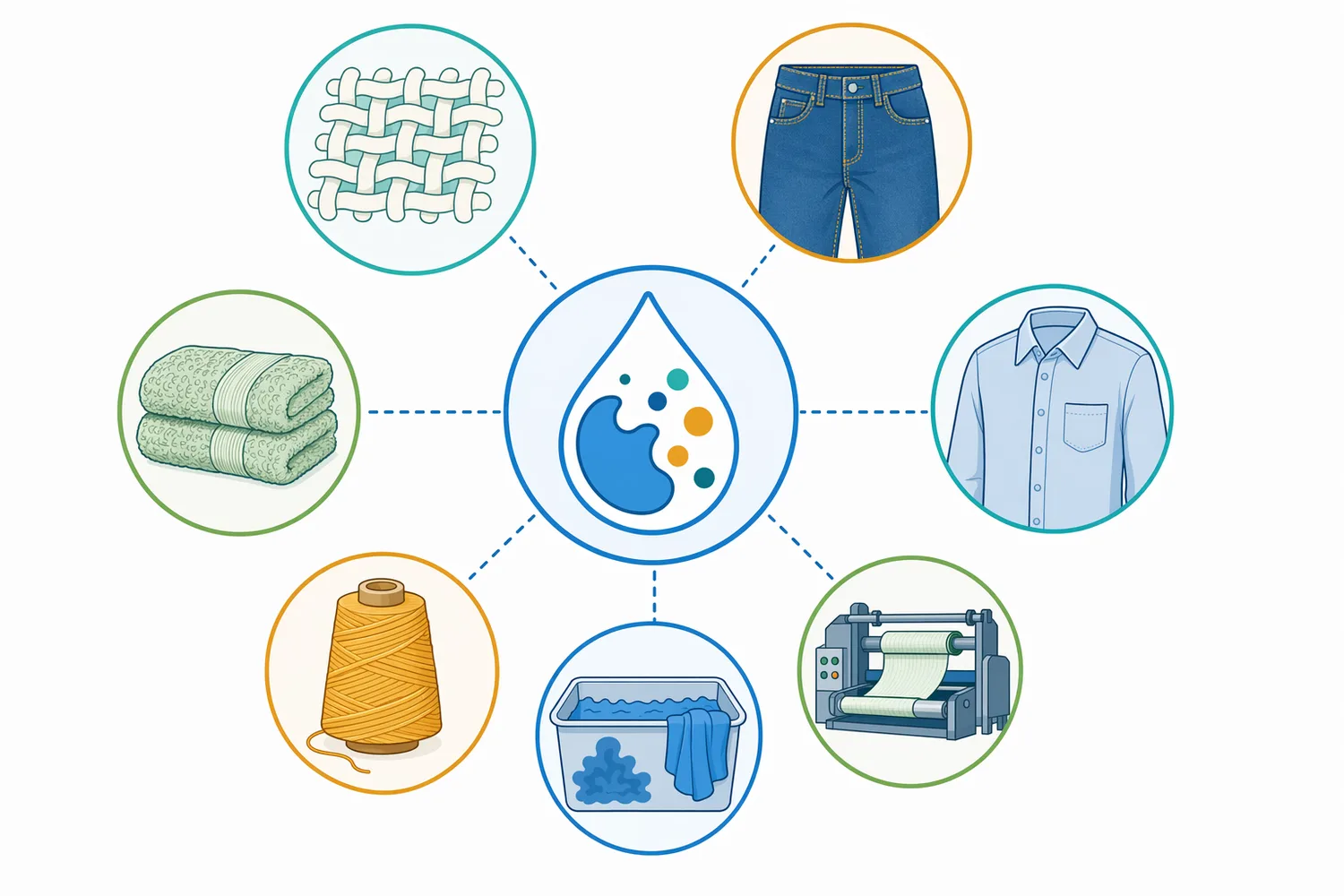
Desizing enzymes are also relevant in denim and garment processing when starch-based size remains on the fabric or garment. Denim production often includes robust woven constructions and finishing steps where absorbency, surface cleanliness, and controlled washing effects matter. If starch size remains, it can interfere with later washing, abrasion, color development, or finishing uniformity.
In garment workflows, desizing may occur before or alongside other wet treatments, depending on the process design. The enzyme breaks down starch left from weaving so the garment can respond more evenly to washing and finishing. This is distinct from cellulase bio-polishing or abrasion effects, which act on cellulose fiber surfaces; an amylase-based desizing enzyme acts on starch size.
The distinction matters because denim finishing often uses multiple enzyme types. Amylases support desizing, cellulases can modify cotton fiber surfaces, and oxidative enzymes may be studied for dye-related effects. Reviews of microbial enzyme applications in textile processing describe a broad enzyme toolkit across desizing, scouring, finishing, and wastewater-related applications, but each enzyme class has its own substrate and mechanism [5].
For buyers using a 1 kg online order format, the practical takeaway is simple: High-Concentration Wide-Temperature Desizing Enzyme is best matched to workflows where starch size removal is the required function. It can be part of fabric-stage pretreatment, garment preparation, or denim-related washing when starch is the material that needs to be degraded and removed.
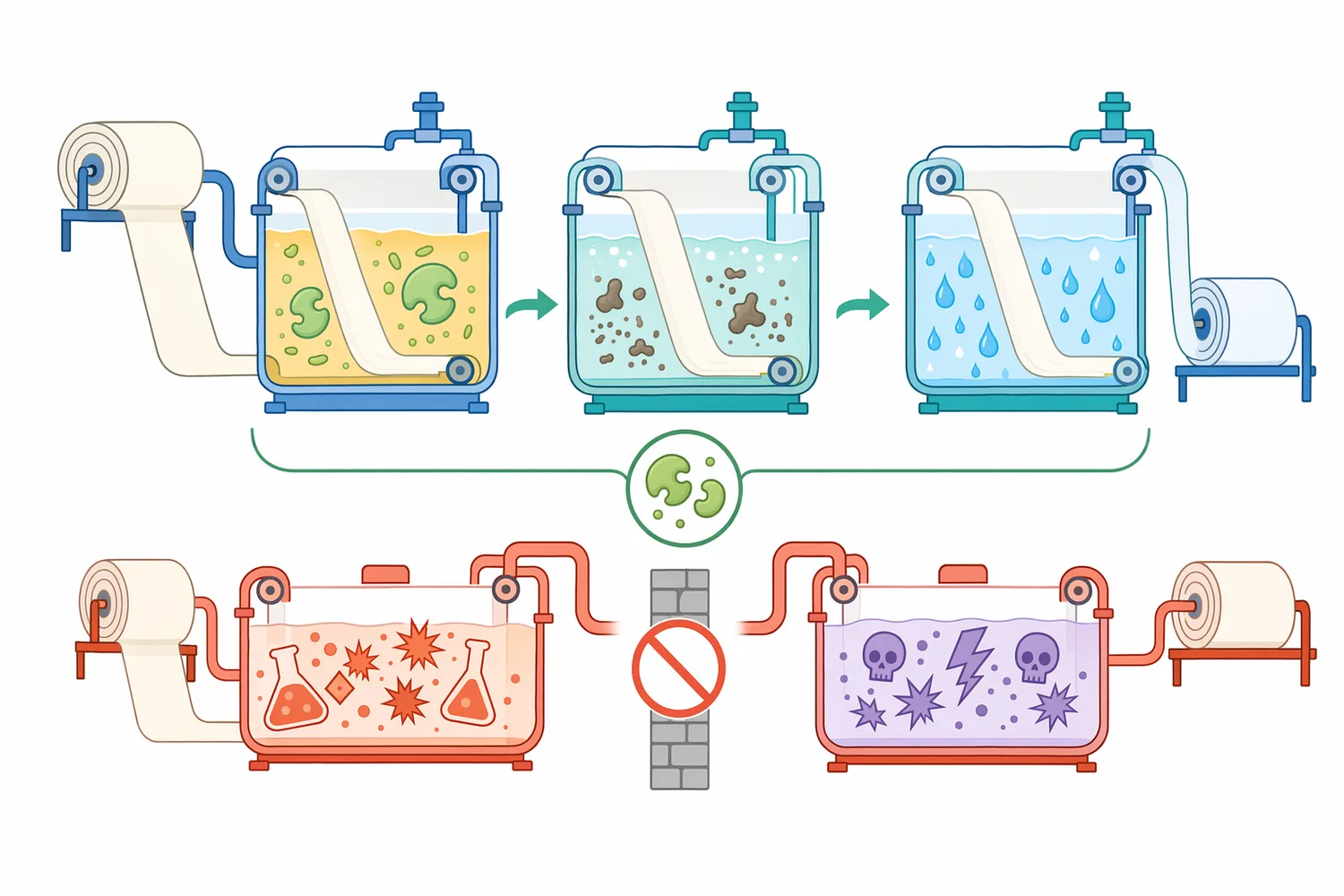
Modern textile processing often looks for ways to reduce separate baths, shorten process routes, and lower water or energy use. Enzymatic desizing can sometimes be integrated with other pretreatment concepts, but the mechanism remains starch hydrolysis. When desizing is combined with scouring or bleaching, the process must still give the enzyme enough access and suitable conditions to break down starch before the fragments are washed away.
The literature on sustainable textile wet processing discusses enzymes across several preparation and finishing operations, including desizing, scouring, bleaching support, bio-polishing, and finishing. This wider context is useful because it shows how desizing fits into a larger movement toward more selective treatment of textile substrates [3].
A combined bath can be attractive because it may reduce handling and process time. However, compatibility is not automatic. A bath designed primarily for oxidative bleaching, strong alkalinity, or aggressive scouring chemistry may not be ideal for enzyme stability. Conversely, an enzyme-friendly desizing bath may not deliver the whiteness or impurity removal expected from a separate scouring and bleaching sequence.
The balanced view is that desizing enzymes can support process simplification where the surrounding chemistry is compatible. The enzyme’s specific role should remain clear: it hydrolyzes starch. Any combined process still needs to remove the hydrolysis products and address the other impurities or finishing goals with appropriate chemistry or process steps.
The textile industry is under continuing pressure to reduce the environmental burden of wet processing. Wastewater from textile operations can contain dyes, auxiliaries, salts, suspended solids, organic matter, and residues from multiple processing stages. Reviews of textile waste-management practices identify wastewater and chemical load as major environmental concerns for the sector [8].
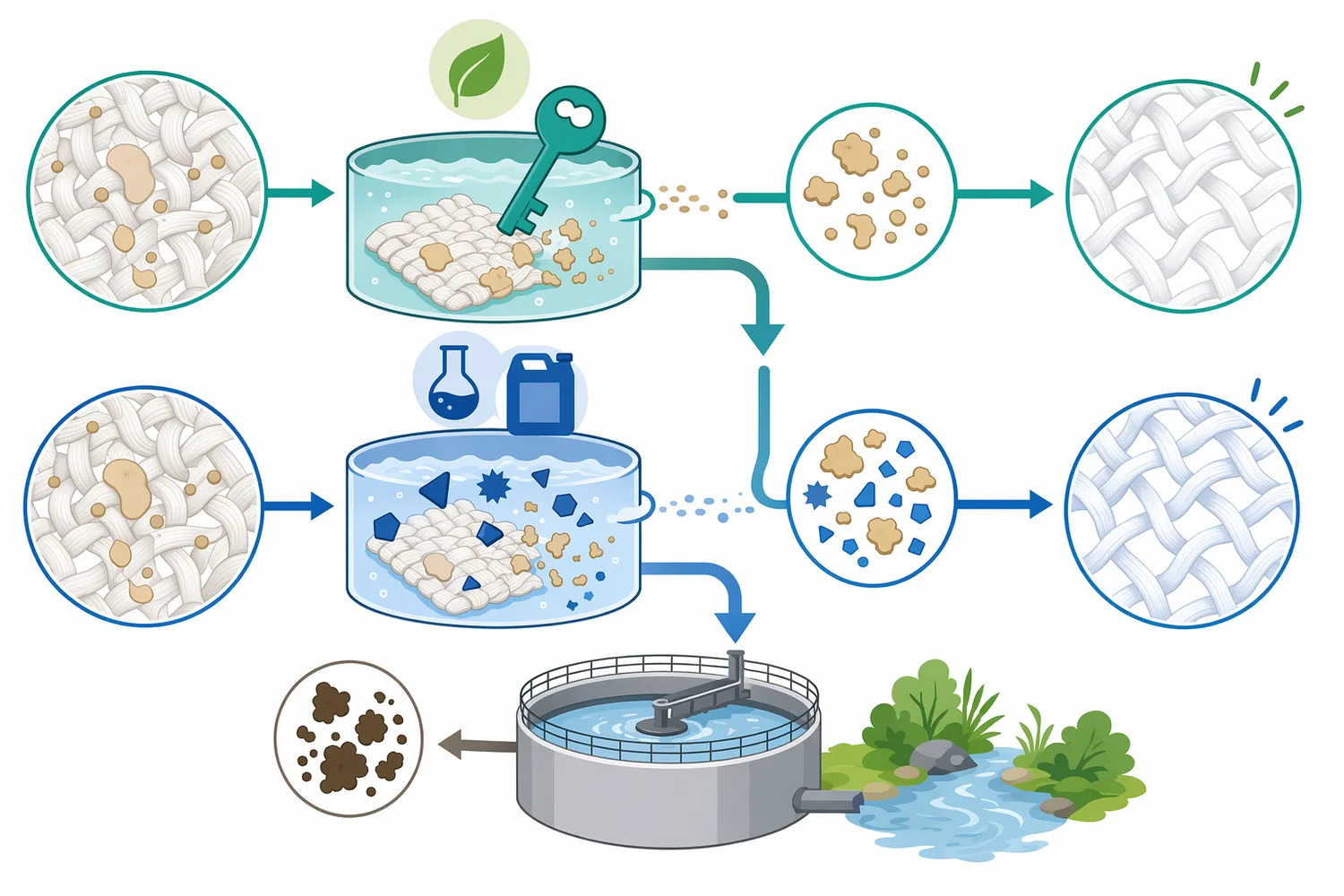
Enzymatic desizing contributes to sustainability in a targeted way. Because the enzyme catalyzes starch hydrolysis, it can reduce dependence on harsher starch-removal approaches in suitable processes. The potential benefit is not that an enzyme makes the entire textile process impact-free; rather, it helps one important preparation step work through a more selective biochemical mechanism.
This selectivity can help reduce unnecessary over-processing. If starch is the problem, an amylase-type desizing enzyme acts directly on starch. Less selective chemical routes may affect starch but also increase the risk of unwanted reaction with the fiber or add more chemical intensity to the bath. Sustainable textile processing reviews describe this targeted enzyme action as one reason enzymes are widely studied for cleaner production in wet processing [1].
Wastewater outcomes still depend on the full process. Hydrolyzed starch fragments leave the fabric and enter the wash liquor; they do not disappear. The advantage is that the size is converted into removable soluble material under milder catalytic conditions, potentially allowing better-controlled pretreatment and reducing the need for more severe chemical degradation. Water use, wash efficiency, bath reuse practices, and downstream effluent treatment all remain important.
High-Concentration Wide-Temperature Desizing Enzyme belongs near the beginning of a woven fabric preparation sequence. The typical process logic is: wet the fabric, expose the starch size to the enzyme bath, allow enzymatic hydrolysis to proceed, wash out the degraded size, and then continue with scouring, bleaching, dyeing, printing, or finishing as required.
The wash-out stage is essential. Enzymatic hydrolysis changes the starch into smaller fragments, but those fragments must leave the fabric. If washing is inadequate, partially degraded size or other loosened impurities may remain in the fabric and continue to interfere with later processing. This is why desizing should be treated as enzyme-assisted removal, not simply enzyme addition.
Mechanical action and liquor circulation also matter because they help bring enzyme to the size layer and carry hydrolysis products away. In tightly woven fabrics or heavy constructions, penetration can be slower than in lighter fabrics. A wide-temperature enzyme can support processing flexibility, but the physical movement of bath through the fabric is still part of real desizing performance.
The product’s high-concentration format supports use as a compact process aid in textile operations where starch removal is required. Enzymes.bio supplies the product by the 1 kg unit for direct online purchase, with order documentation included for the shipped product.
The first quality outcome is improved wetting. When starch size is removed, water can enter the fabric structure more readily. This is important because nearly every later wet-processing step depends on uniform liquid penetration. Poor wetting at the start often becomes uneven reaction later.
The second outcome is more consistent dyeing and printing preparation. Residual starch can behave as a barrier, creating localized differences in how dye liquor or printing systems contact the fiber. By converting starch into washable fragments, enzymatic desizing helps make the fabric surface and yarn structure more uniform before color application.
The third outcome is better readiness for scouring and bleaching. Scouring chemistry can act more effectively on natural fiber impurities when it is not also fighting a persistent starch film. Bleaching can then work on a more uniformly prepared substrate, which supports more even results in processes where whiteness or shade brightness matters.
The fourth outcome is process cleanliness. Removing size early prevents it from being dragged through later baths, where it may increase organic load or interact with chemicals not intended for starch degradation. This is one reason desizing has remained a core step in textile preparation, even as equipment and finishing methods have evolved [2].
The evidence for enzymatic desizing is strong, but it should be stated accurately. Enzymatic desizing is a proven and widely discussed textile application, particularly for starch-sized woven cotton and cotton-blend fabrics. It is not a universal treatment for every size chemistry, every synthetic sizing agent, or every impurity present on fabric.
The enzyme’s main substrate is starch. If the weaving size is based on non-starch polymers, the desizing mechanism may need other chemistry or a different treatment strategy. If the fabric contains oils, waxes, pectins, seed-coat fragments, or spinning lubricants, those are typically addressed through scouring or other pretreatment operations rather than by an amylase-focused desizing enzyme.
Temperature flexibility is also not the same as unlimited stability. Wide-temperature performance means broader practical usability, but enzymes remain proteins whose activity depends on maintaining a functional structure. Industrial enzyme research continues to treat temperature stability as a key performance factor precisely because heat can both accelerate reactions and destabilize proteins [4].
The most accurate expectation is therefore: High-Concentration Wide-Temperature Desizing Enzyme supports reliable starch size removal when used in an enzyme-compatible aqueous pretreatment process and followed by effective washing. Its value is highest where starch removal is the specific preparation problem and where process flexibility across temperature conditions is useful.
High-Concentration Wide-Temperature Desizing Enzyme is available from Enzymes.bio for direct online purchase by the 1 kg unit. The buyer places the order online, pays online, and the order is then processed and shipped.
A Certificate of Analysis and Safety Data Sheet are provided with the order. These documents support routine product identification, handling, and receiving records for the supplied 1 kg product.
High-Concentration Wide-Temperature Desizing Enzyme is a practical amylase-based pretreatment aid for removing starch size from woven fabrics. It works by cutting long starch chains into shorter, more water-soluble fragments, so the size film loses strength, loosens from the yarn surface, and can be washed out before dyeing, printing, bleaching, or finishing.
The research foundation for enzymatic desizing is strong: textile enzyme reviews consistently identify desizing as one of the most established enzyme applications in wet processing, especially for starch-sized cotton fabrics [1]. The product’s wide-temperature positioning adds practical flexibility for textile preparation workflows where temperature conditions can vary, while the underlying value remains the same: targeted starch hydrolysis, cleaner fabric preparation, and better readiness for downstream wet processing.
Sold by the 1 kg unit, in stock and ready to ship. Order directly on our store — pay online and we process your order. A Certificate of Analysis and Safety Data Sheet are included with every order.
Buy High-Concentration Wide-Temperature Desizing Enzyme →Numbered in order of first citation. Open-access sources, each verified reachable at publication; citation numbers in the text link here.