
High Temperature Alpha-Amylase for Alcohol & Brewing Starch Liquefaction is used to thin cooked starch mashes by cutting internal α-1,4 bonds in gelatinized starch, converting long amylose and amylopectin chains into shorter soluble dextrins. In alcohol and brewing workflows, that liquefaction step reduces mash viscosity and prepares starch-based raw materials for downstream saccharification and fermentation rather than completing fermentation on its own .
Enzymes.bio supplies this enzyme directly online in 1 kg units. Buyers can purchase the product online, pay at checkout, and the order is processed and shipped; a Certificate of Analysis and Safety Data Sheet are included with the order .
High Temperature Alpha-Amylase is a liquefaction enzyme for starch-rich raw materials used in alcohol and brewing production. Its practical job is to act on cooked starch while the mash is hot, reducing the size of starch polymers so the slurry becomes less thick, more pumpable, and more suitable for later conversion into fermentable sugars .
Starch liquefaction is an early conversion step, not the final sugar-making step. When milled corn, cassava, wheat, sorghum, or other starch-bearing materials are mixed with water and heated, the starch granules absorb water, swell, and gelatinize; this opens the granule structure but can also create a heavy, viscous mash. Alpha-amylase attacks the exposed starch chains after gelatinization, producing soluble dextrins that can then be further converted by saccharifying enzymes or malt enzymes depending on the process [1].
This distinction matters in both alcohol and brewing. In alcohol production, liquefaction creates a manageable dextrin-rich substrate before saccharification and yeast fermentation. In brewing, alpha-amylase contributes to wort formation by breaking starch into shorter fragments that interact with other mash enzymes, especially beta-amylase, to shape fermentability, attenuation, and residual body [2].
Starch is made mainly from two glucose polymers: amylose and amylopectin. Amylose is largely linear, while amylopectin is branched; both contain α-1,4 glycosidic linkages along the chain, and amylopectin also contains branch points. Alpha-amylase is an endo-acting enzyme, meaning it cuts bonds inside the starch chain rather than removing glucose units only from the chain ends [3].
The result is a rapid drop in average molecular size. A cooked starch mash can be imagined as a mass of long hydrated chains that entangle with each other and hold water, creating viscosity. When alpha-amylase makes internal cuts, those chains become shorter dextrins; shorter chains tangle less, flow more easily, and present more chain ends and soluble fragments for later saccharification [1].
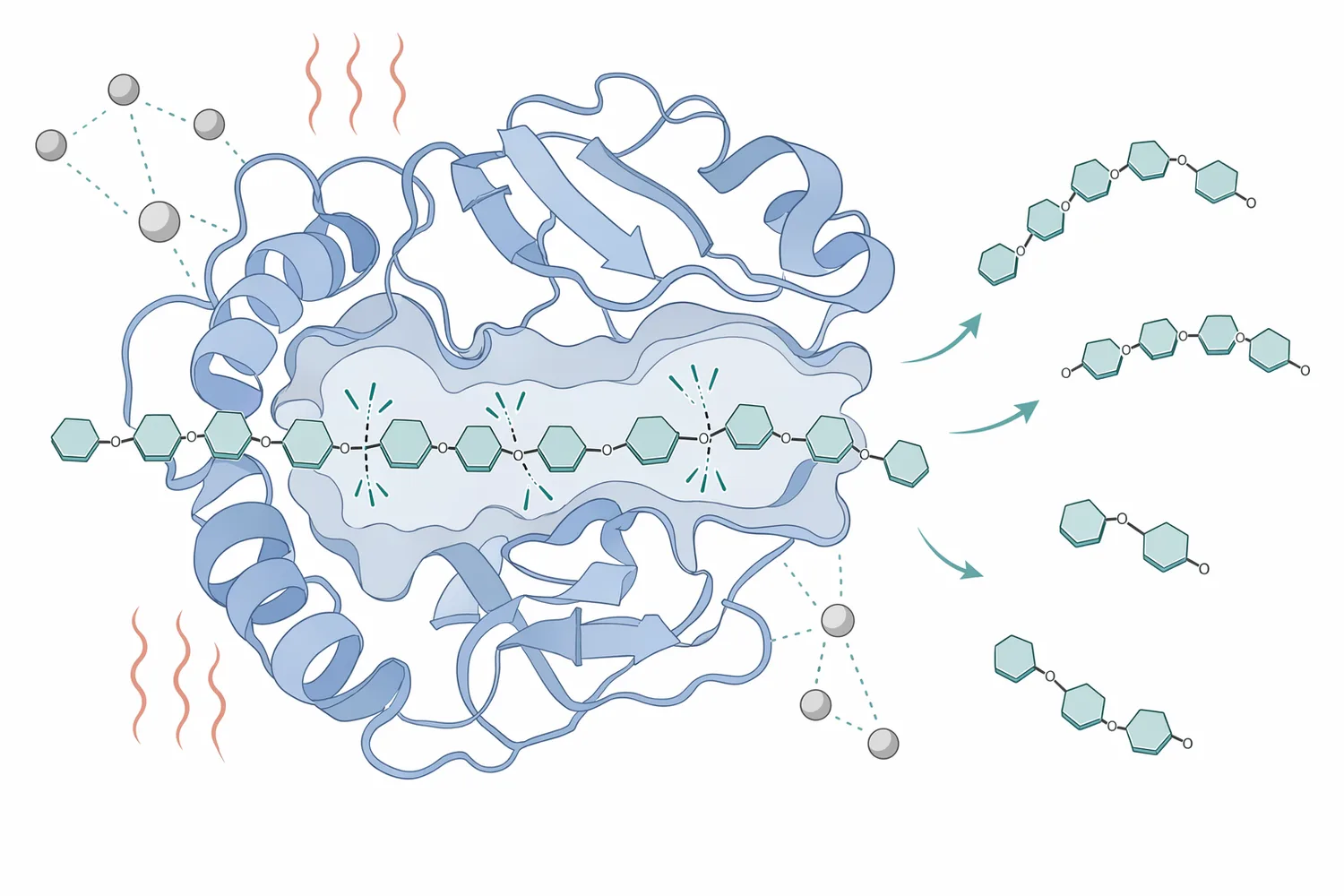
In practical terms, alpha-amylase changes the physical state of the mash before it changes the final alcohol result. It does not simply “make sugar” in the same way glucoamylase is used for glucose production. Instead, it converts gelatinized starch into lower-molecular-weight dextrins, reducing viscosity and improving access for the next enzymatic stage .
Liquefaction commonly takes place under hot cooking conditions because heat is needed to gelatinize starch and disrupt granule structure. Ordinary enzymes can unfold and lose function under these conditions, so thermostable alpha-amylases are used where the enzyme must remain active long enough to act on hot, gelatinized starch [4].
Thermostability is not just a convenience; it affects how evenly starch can be treated. If the enzyme loses activity too quickly while starch is still swelling or thickening, the mash may not thin uniformly. A high-temperature alpha-amylase supports liquefaction during the heating and holding stage, when starch is most accessible but the process environment is also most demanding .
Research on thermostable alpha-amylases from Bacillus species supports this industrial logic. Studies on Bacillus subtilis and other bacterial alpha-amylases describe enzymes characterized for stability under elevated temperature conditions, and Bacillus licheniformis is widely investigated as a source of heat-tolerant alpha-amylase for starch-processing applications [4].
During cooking, starch granules pass from a compact, semi-crystalline state into a swollen and disrupted state. This process exposes amylose and amylopectin chains to water and to enzymes. Without enough hydrolysis, the swollen polymers can create high viscosity; with alpha-amylase, internal cleavage reduces chain length and changes the mash from a thick gel-like suspension toward a more fluid dextrin solution [1].
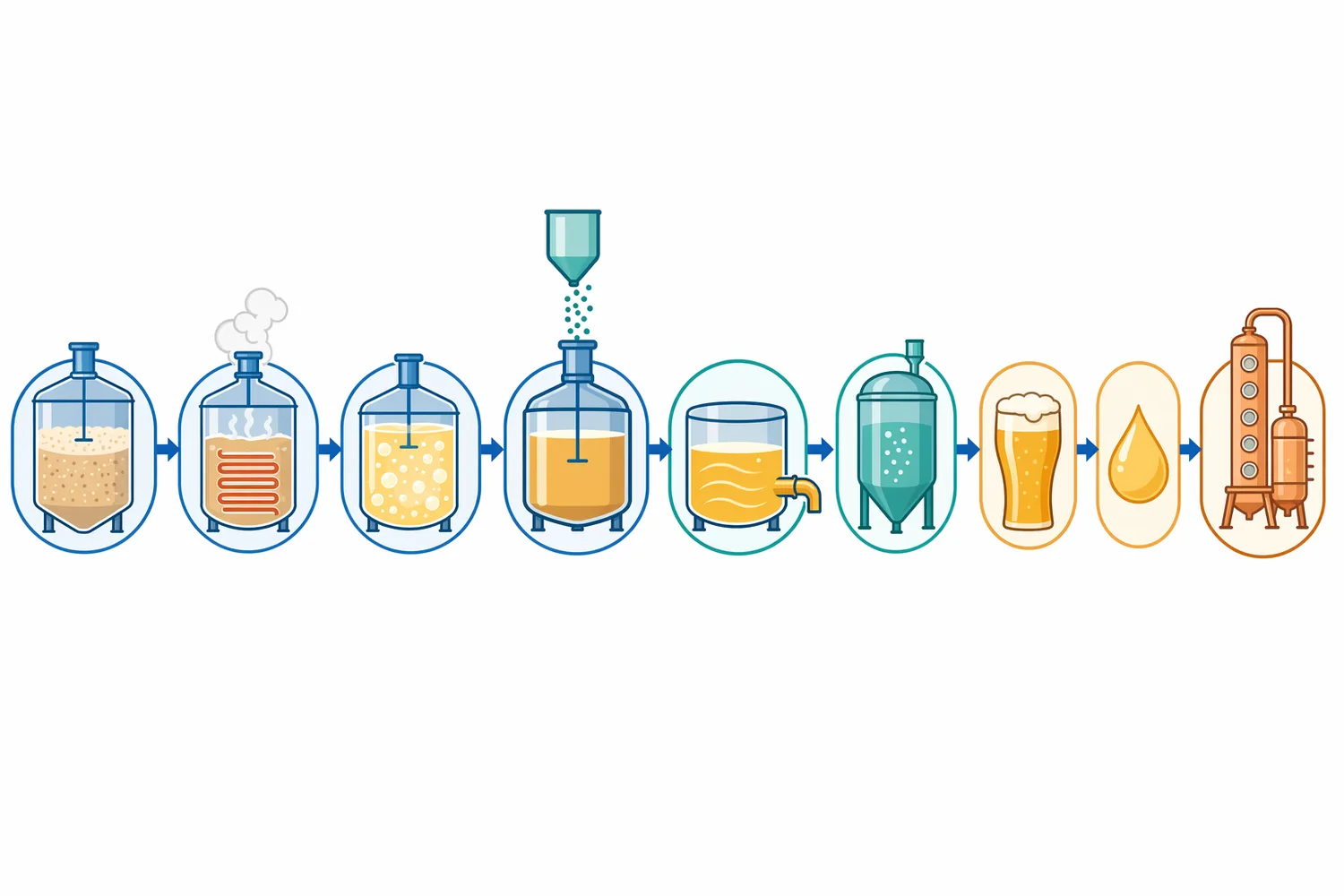
The enzyme’s action is catalytic. It binds to accessible regions of starch, positions an α-1,4 linkage in its active site, hydrolyzes that bond using water, releases shorter fragments, and repeats. Because it acts internally, one enzyme molecule can rapidly reduce the size of many large starch molecules, which is why alpha-amylase is especially useful for viscosity reduction during liquefaction [3].
The products of alpha-amylase action are mainly dextrins and shorter oligosaccharides rather than a single pure sugar. In alcohol workflows, those dextrins are usually passed to saccharification, where enzymes such as glucoamylase convert them further toward fermentable glucose. In brewing, the dextrin and sugar balance depends on the broader mash enzyme system, including malt alpha-amylase and beta-amylase activity [2].
A common source of confusion is treating liquefaction, saccharification, and fermentation as one step. They are connected, but each has a different function. Liquefaction reduces the physical and molecular size of starch; saccharification converts dextrins into fermentable sugars; fermentation converts those sugars into alcohol and other fermentation products [5].
In cassava starch ethanol work, for example, the process is described as enzymatic hydrolysis followed by fermentation, showing that starch conversion and yeast alcohol production are distinct stages. The same principle applies across corn, wheat, cassava, sorghum, and other starch-based raw materials: alpha-amylase prepares the starch, but yeast needs fermentable sugars produced by the wider conversion process [5].
For brewing, the boundary is slightly different because malt itself contains enzymes. Alpha-amylase breaks starch into smaller fragments, while beta-amylase releases maltose from non-reducing chain ends. The balance between these enzyme activities during mashing affects wort fermentability and the amount of residual dextrin that contributes beer body [2].
| Enzyme or conversion stage | Main action on starch | Typical process role | Main outcome |
|---|---|---|---|
| High-temperature alpha-amylase | Cuts internal α-1,4 bonds in gelatinized starch | Liquefaction during hot starch cooking | Lower viscosity and soluble dextrins |
| Beta-amylase | Releases maltose from chain ends | Brewing mash fermentability development | Maltose-rich wort contribution |
| Glucoamylase / saccharifying enzymes | Convert dextrins toward fermentable sugars | Saccharification before or during alcohol fermentation | Higher fermentable sugar availability |
| Yeast fermentation | Metabolizes fermentable sugars | Alcohol production | Ethanol, CO₂, and fermentation metabolites |
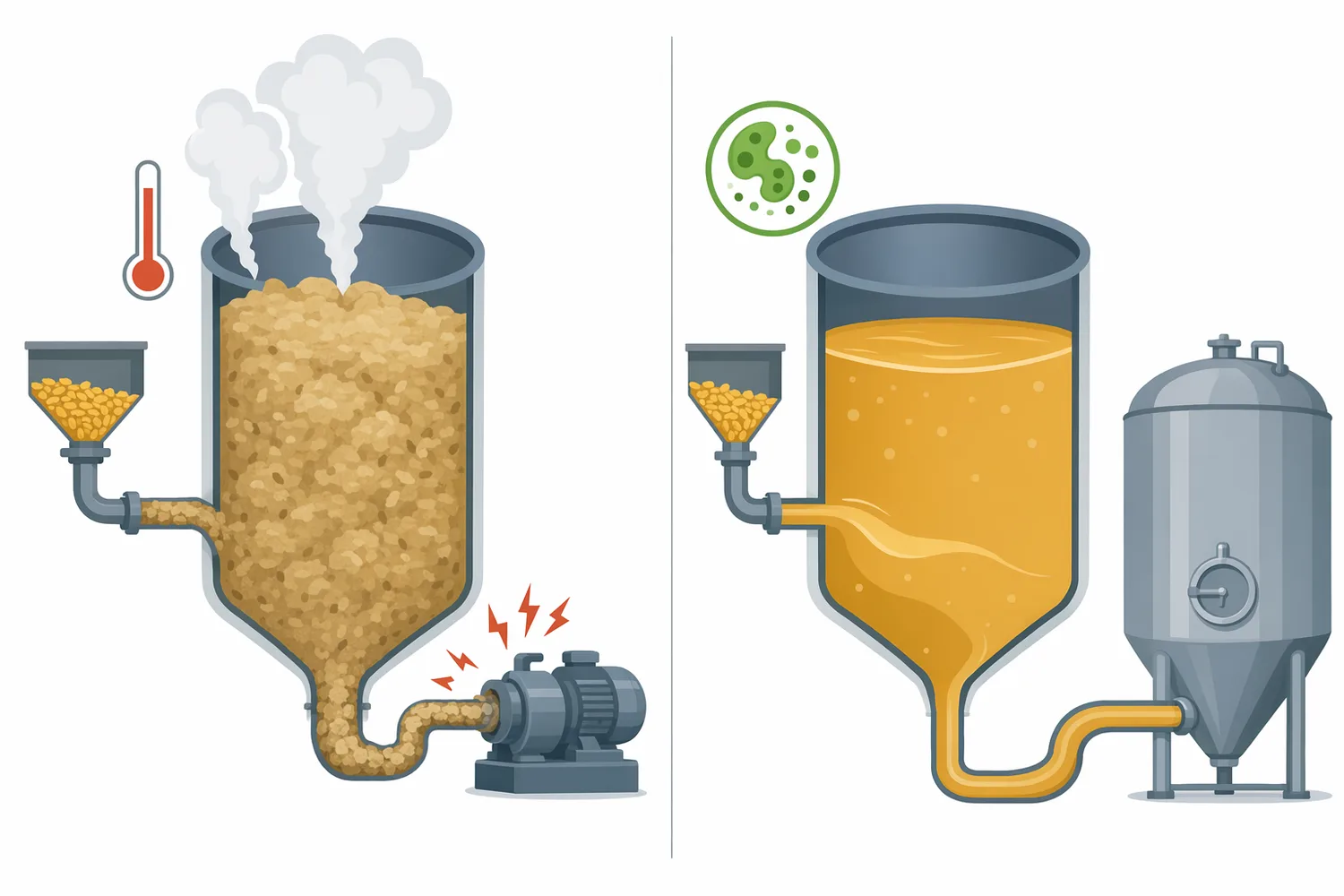
In starch-based alcohol production, the first practical benefit of high-temperature alpha-amylase is mash thinning. Once starch granules gelatinize, viscosity can rise sharply; alpha-amylase reduces that viscosity by shortening starch molecules into dextrins, helping the mash move through mixing, heating, and transfer steps more consistently .
The second benefit is better preparation for saccharification. Saccharifying enzymes act more effectively on soluble, accessible dextrins than on intact or poorly gelatinized starch granules. By creating shorter soluble chains, alpha-amylase increases the amount of starch material available for downstream conversion to fermentable sugars [6].
Studies on enzymatic hydrolysis of different starch sources illustrate the same process sequence. Wheat starch hydrolysis research for glucose syrup production uses enzymatic conversion to move starch toward fermentable or sweetener-relevant sugars, while sorghum starch studies examine the influence of enzyme addition and liquefaction time on liquid sugar production [6], [7].
For cassava-based ethanol, enzymatic hydrolysis before fermentation is particularly important because cassava starch must be converted into sugars that yeast can metabolize. Research on cassava starch bioethanol production follows the path of enzymatic hydrolysis, fermentation, and downstream processing, reinforcing why liquefaction is a preparatory but essential step [5].
In brewing, alpha-amylase contributes to starch conversion during mashing. It acts on gelatinized starch from malt and adjuncts, producing shorter dextrins that can be further processed by beta-amylase and other malt enzymes. This interaction helps determine wort composition, including the relative amount of fermentable sugars and residual dextrins [2].
The brewing value of alpha-amylase is not only “more conversion.” It is controlled conversion. More extensive dextrin breakdown can increase fermentability when paired with appropriate saccharifying activity, while retained dextrins can contribute body and mouthfeel. Because mash temperature, pH, grist composition, and enzyme survival all influence the sugar spectrum, alpha-amylase sits at the center of wort design rather than acting as a standalone solution [2].
High-temperature alpha-amylase is especially relevant when brewing processes use adjunct starches or raw materials that need additional liquefaction support. Adjuncts can add starch without bringing the same enzyme contribution as malt, so exogenous alpha-amylase may be used to improve dextrinization before the wort is fermented [3].
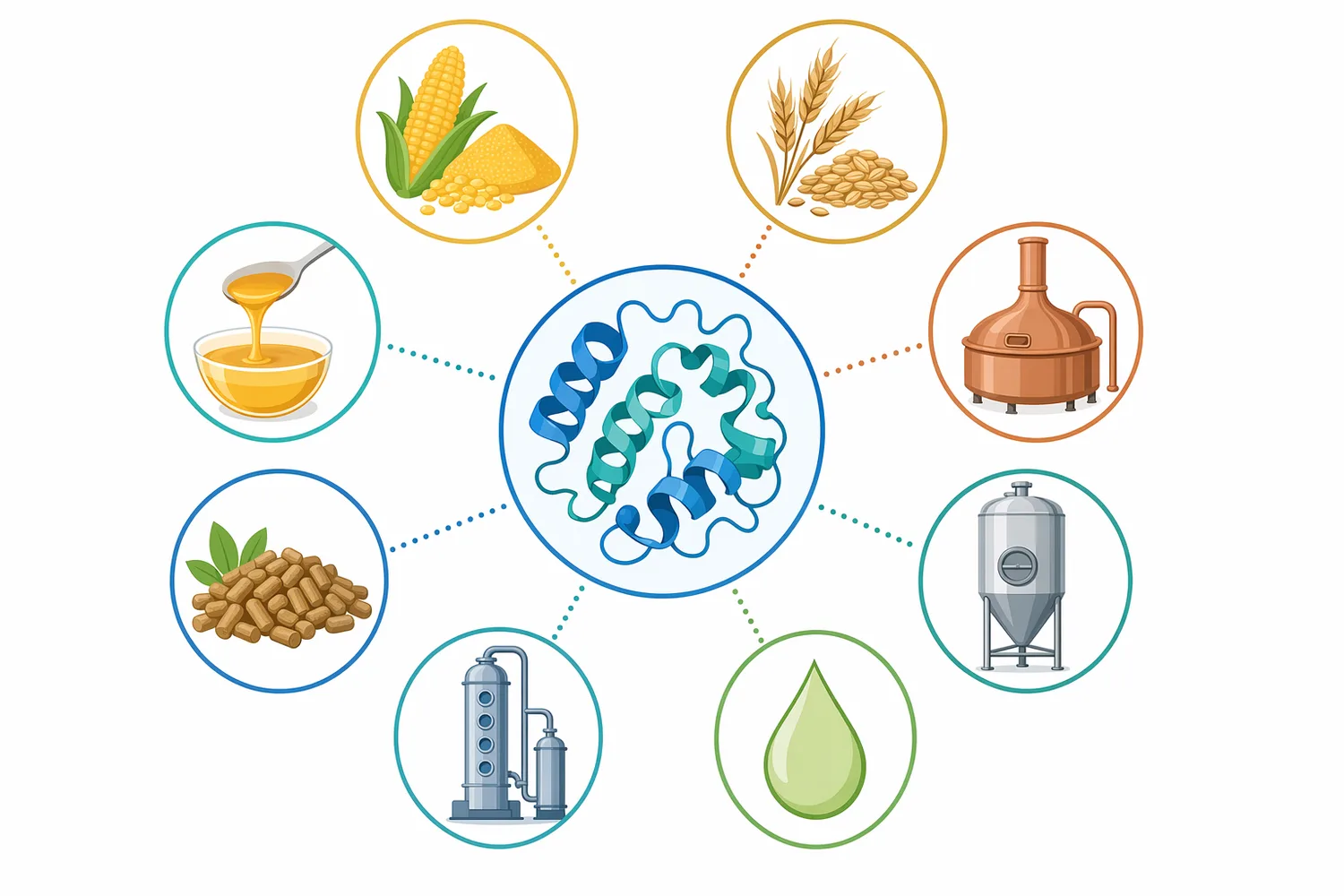
High Temperature Alpha-Amylase is relevant to common starch-rich raw materials used in alcohol and brewing, including corn, cassava, wheat, and similar agricultural substrates. These feedstocks differ in granule structure, protein and fiber matrix, gelatinization behavior, and non-starch components, but the central target remains the same: gelatinized starch polymers .
Corn and wheat are widely used in alcohol and brewing-related starch conversion, while cassava is important in many ethanol and liquid sugar applications because of its high starch content. Studies on cassava, wheat, and sorghum starch hydrolysis show that enzymatic treatment is a standard route for converting these raw materials into dextrins and sugars for further processing [8].
Mixed or processed starch-containing materials can also be converted enzymatically when starch remains available. Research on mixed waste baked products for bioethanol production, for example, examines liquefaction temperature and enzymatic treatment as variables affecting conversion, showing how process history and raw material form influence starch accessibility [9].
Alpha-amylase works best when starch is accessible. That usually means the raw material has been milled or otherwise prepared, dispersed in water, and heated sufficiently for gelatinization. If starch granules remain intact or trapped inside plant tissue, the enzyme has fewer accessible α-1,4 bonds to attack, so liquefaction may be slower or less complete [1].
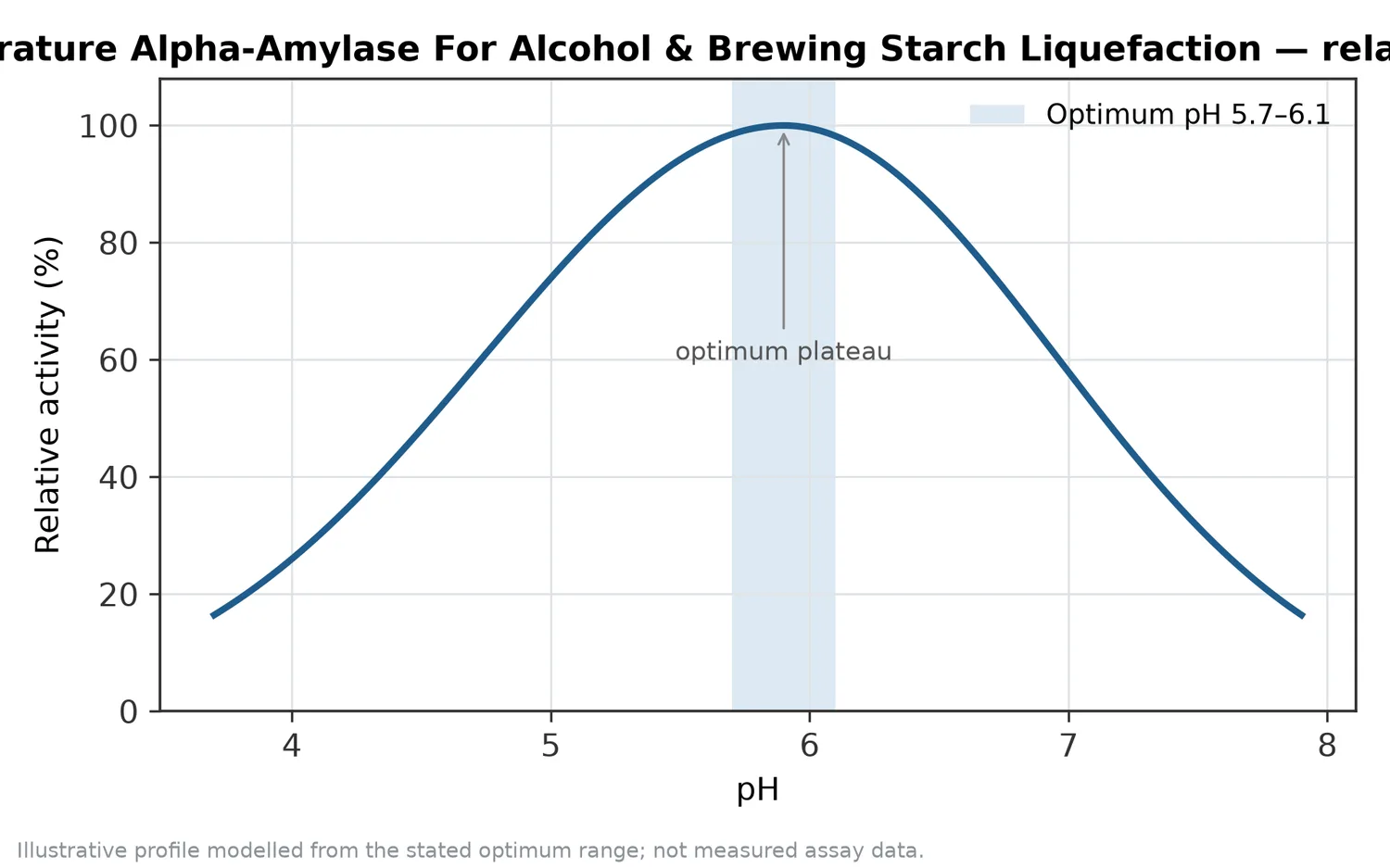
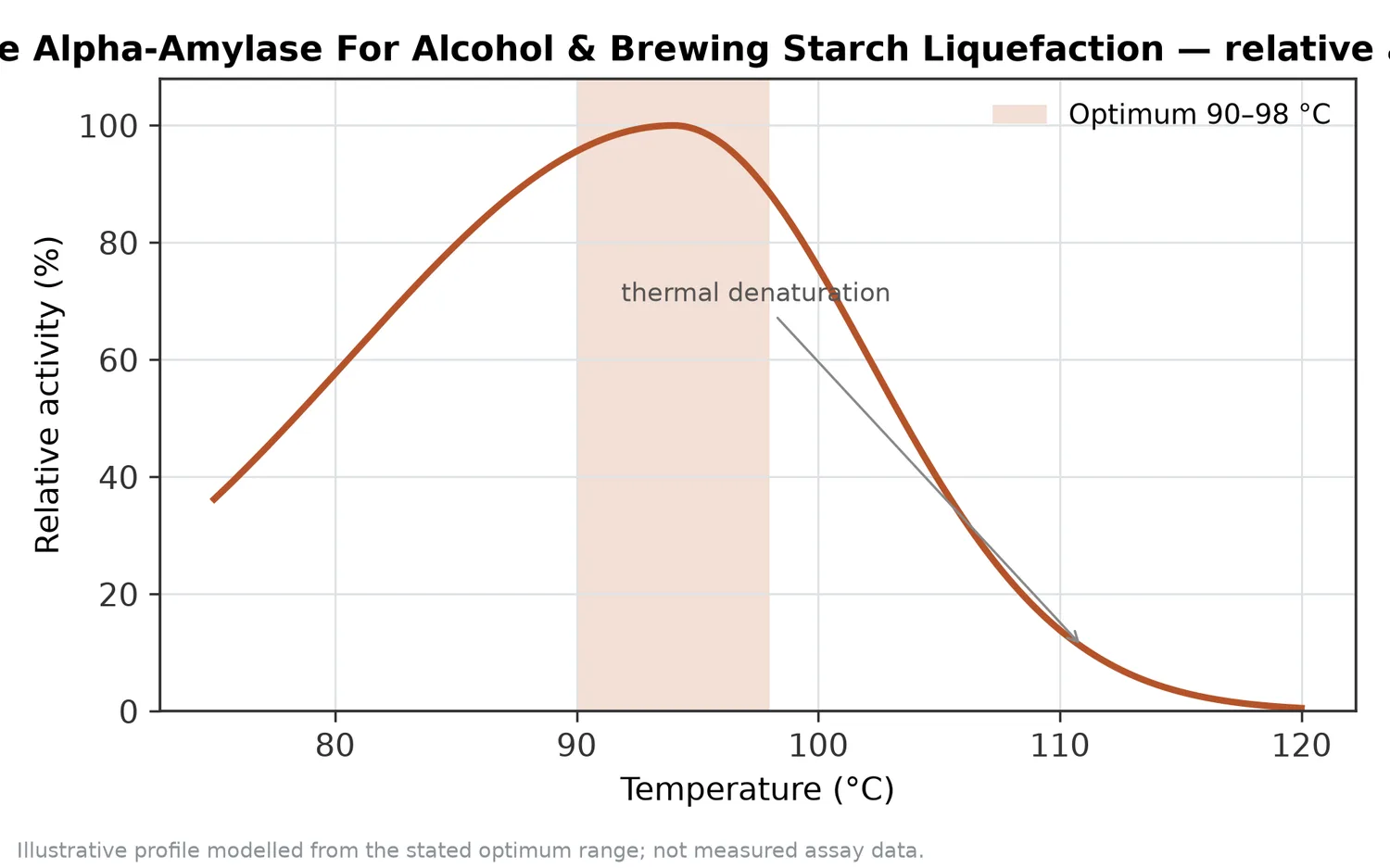
Temperature has two opposing effects. Higher temperature helps gelatinize starch and reduce microbial contamination risk, but excessive heat can denature enzymes. A high-temperature alpha-amylase is designed for hot liquefaction environments, where a useful balance is needed between starch opening and enzyme survival .
Mash composition also matters. Starch concentration affects viscosity and enzyme access; proteins, fibers, lipids, and polyphenols can alter water binding, granule swelling, or enzyme-substrate contact. Studies on starch hydrolysis repeatedly show that substrate type and process variables influence conversion outcomes, which is why results differ between cassava, wheat, sorghum, and mixed starch streams [10].
Many alpha-amylases are metalloenzymes whose structure can be stabilized by bound calcium ions. Calcium can help maintain the enzyme’s folded form under heat stress, supporting activity during liquefaction. This is a general property of many alpha-amylases rather than a reason to treat calcium as the only determinant of performance [11].
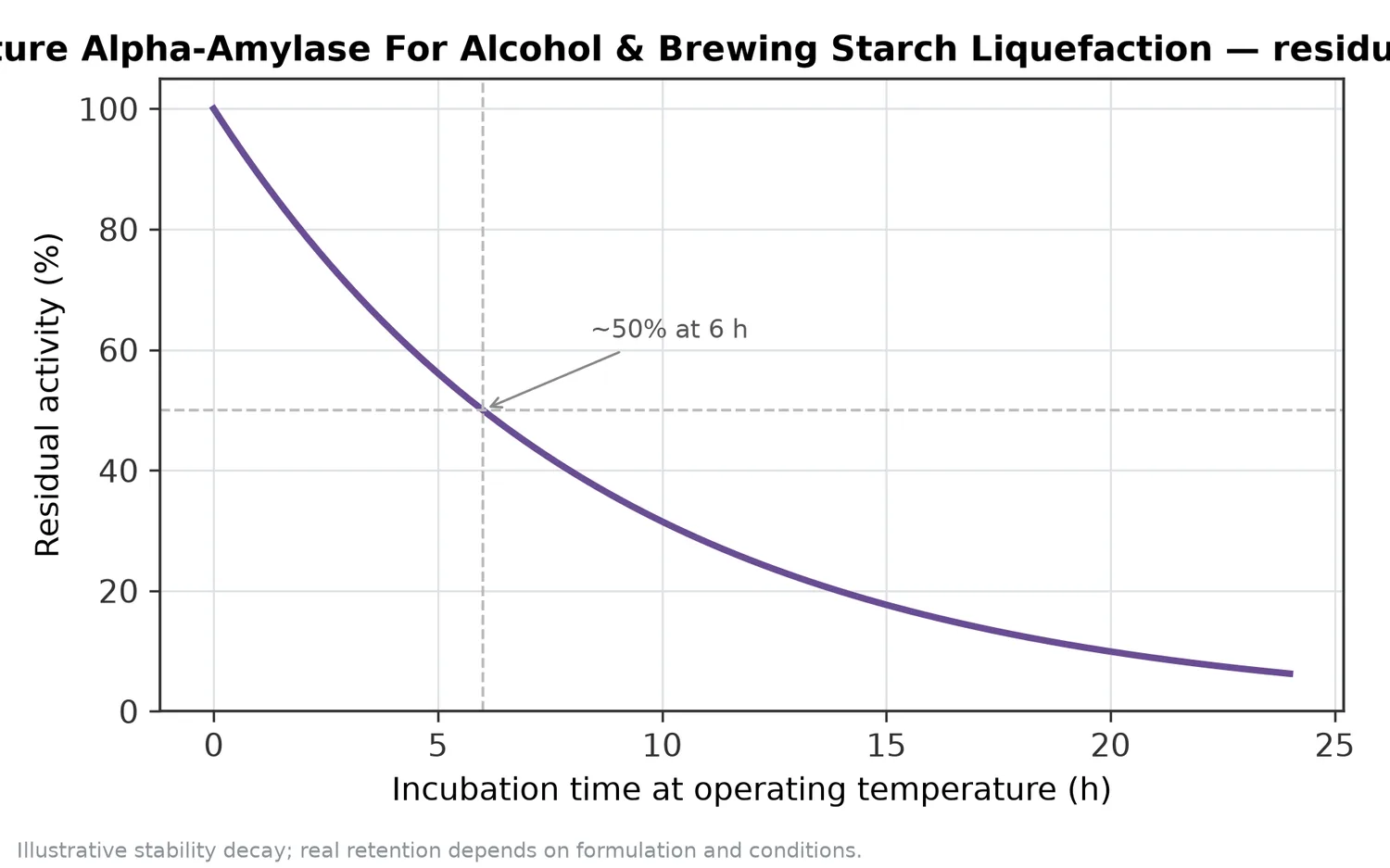
The practical meaning is straightforward: thermal stability depends on enzyme structure and process environment. Heat, pH, shear, substrate concentration, and mineral composition can all influence how long active enzyme remains available in the mash. Research on improving alpha-amylase stability, including immobilization and stabilization approaches, reflects the importance of preserving enzyme structure under processing conditions [11].
For the Enzymes.bio high-temperature product, the important customer-facing point is that it is intended for hot starch liquefaction in alcohol and brewing workflows. It is supplied as a ready-to-purchase enzyme product for use in industrial and food-processing contexts, with documentation included after purchase .
The core evidence for using alpha-amylase in liquefaction comes from starch enzymology: alpha-amylase hydrolyzes internal α-1,4 linkages in starch and produces dextrins. This mechanism is consistently reflected in brewing science, starch hydrolysis studies, and alcohol-production workflows [3].
Wheat starch hydrolysis research demonstrates the use of enzymatic treatment to produce glucose syrup, a process that depends on first opening and hydrolyzing starch polymers. While glucose syrup production is not the same as alcohol fermentation, it relies on the same fundamental conversion pathway from starch to shorter soluble carbohydrates [6].
Sorghum studies similarly show how enzyme addition and liquefaction time affect liquid sugar production from starch. These findings are relevant because they connect process variables during liquefaction with the amount and type of soluble carbohydrate generated downstream [7].
Research on cassava starch bioethanol production provides a direct alcohol example. The process includes enzymatic hydrolysis before fermentation, confirming that starch liquefaction and saccharification are necessary preparation steps before yeast can convert sugars into ethanol [5].
Brewing research on monitoring alpha-amylase and beta-amylase during mashing reinforces the same principle from a beer perspective. Wort production depends on the dynamic activity of these enzymes during mash conditions, and their combined action determines how starch becomes fermentable sugars and residual dextrins [2].
Thermostable alpha-amylases are used beyond alcohol and brewing because many starch-processing operations involve heat. Industrial starch conversion, glucose syrup production, citric acid fermentation feed preparation, and maltodextrin-related processing all rely on controlled starch hydrolysis under conditions where enzyme stability and viscosity control matter [12].
In citric acid production, for example, fine regulation of starch liquefaction has been studied as a way to improve downstream fermentation performance. This supports a broader lesson for alcohol and brewing: liquefaction is not merely a mechanical thinning step, but a biochemical preparation step that affects the quality of the substrate entering fermentation [12].
Research on high-concentration starch pretreatment for cyclodextrin production also highlights the importance of enzyme pretreatment under swelling conditions. Even though cyclodextrin production differs from alcohol production, the shared challenge is converting concentrated starch into a form that enzymes can process effectively without unmanageable viscosity [13].
A successful liquefaction stage produces visible and measurable process changes. The mash becomes less thick because long hydrated starch chains are cut into shorter fragments. Mixing becomes more uniform because the enzyme reduces localized gel-like regions, allowing heat and substrate to distribute more evenly .
The carbohydrate profile also changes. Intact starch decreases, soluble dextrins increase, and the number of chain ends available for saccharifying enzymes rises. This prepares the mash for glucoamylase or related enzymes in alcohol production, or for the continued action of malt enzymes in brewing [2].
Importantly, liquefaction does not necessarily mean maximum sugar formation at this stage. If alpha-amylase is doing its intended job, the main immediate outcome is dextrinization and viscosity reduction. Higher fermentable sugar formation usually follows in saccharification or during an integrated mash program where other enzymes are active [5].
High Temperature Alpha-Amylase supports process stability, but it does not remove the need for appropriate raw material preparation, cooking, saccharification, and fermentation control. Poorly gelatinized starch, coarse particles, uneven heating, or unsuitable mash conditions can limit how much starch the enzyme can reach [1].
Final alcohol yield or beer profile depends on more than liquefaction. Yeast strain, fermentable sugar spectrum, nutrients, fermentation temperature, residence time, and downstream handling all influence the finished result. Alpha-amylase provides the upstream dextrinization needed for those later steps to work from a more consistent substrate [5].
In brewing, especially, more enzyme action is not always better. The brewer may want a defined balance between fermentable sugars and dextrins. Alpha-amylase helps create that balance by opening starch chains, while mash design and complementary enzyme activity determine how far those dextrins are converted [2].
Enzymes.bio supplies High Temperature Alpha-Amylase for Alcohol & Brewing Starch Liquefaction directly online in 1 kg units. The product can be purchased through the website, paid for online, and then processed and shipped as an order; a Certificate of Analysis and Safety Data Sheet accompany the shipment .
The product is intended for industrial and food-processing applications where starch liquefaction is required. Its role is educationally clear and technically established: it hydrolyzes gelatinized starch into shorter dextrins, reduces mash viscosity, and prepares starch-based substrates for downstream saccharification and fermentation .
For buyers working with alcohol, brewing, or starch-rich process streams, the value of high-temperature alpha-amylase is its contribution to a smoother and more controllable liquefaction step. It is best understood as a practical enzyme tool for hot starch conversion—turning thick cooked starch into a more manageable dextrin-rich mash that the rest of the process can use effectively.
Sold by the 1 kg unit, in stock and ready to ship. Order directly on our store — pay online and we process your order. A Certificate of Analysis and Safety Data Sheet are included with every order.
Buy High Temperature Alpha-Amylase For Alcohol & Brewing Starch Liquefaction →Numbered in order of first citation. Open-access sources, each verified reachable at publication; citation numbers in the text link here.