
Indigo Decolorizing Enzyme for Denim Washing is used in denim wet processing to create controlled indigo wash-down, softer handle, and worn or aged garment effects. In practical denim finishing, “decolorizing” usually means controlled removal or modification of visible surface indigo—not complete destruction of every dye molecule in the garment. The strongest technical basis for this application is cellulase-assisted denim washing, often supported by oxidative dye-decolorizing enzyme concepts such as laccase systems for broader dye treatment and effluent-color reduction [1].
Indigo-dyed denim is designed to fade. In most conventional denim, indigo is concentrated near the outer region of cotton yarns rather than distributed uniformly through the fiber cross-section, so surface modification has a large visual effect. Indigo Decolorizing Enzyme for Denim Washing is used to help produce that surface-level wash-down in a controlled wet process, giving denim garments a lighter, worn, vintage, or abraded look while also improving fabric feel [2].
The enzyme effect in denim is different from simple chemical bleaching. Bleach attacks color broadly through oxidation and can rapidly shift shade, but enzyme washing acts more selectively at the fiber surface. In cellulase-based denim washing, the enzyme hydrolyzes accessible cellulose fibrils on the cotton surface; those loosened microfibrils carry surface indigo away as the garment tumbles, rinses, and rubs against other garments or the machine wall [1].
This distinction matters because denim finishing is not just about making fabric paler. The target is usually a controlled balance of shade loss, high-low contrast, seam abrasion, soft hand, acceptable strength retention, and limited backstaining. Research on cellulase action in textile processes shows that enzyme finishing changes the cotton surface and must be controlled because the same hydrolysis that improves appearance and handle can also reduce weight or mechanical strength if pushed too far [1].
Enzymes.bio supplies Indigo Decolorizing Enzyme for Denim Washing as an online 1 kg product for customers who want to purchase directly, pay online, and have the order processed and shipped. A Certificate of Analysis and Safety Data Sheet are provided with the order, supporting straightforward use as a textile-processing ingredient rather than a custom development project .
In garment washing, “indigo decolorizing” should be understood as controlled shade reduction and surface dye removal. Indigo is highly insoluble in water after oxidation on the fiber, and much of the visible blue color sits at or near the yarn surface. When enzymes loosen the cellulose-rich fuzz and fibrils that hold surface indigo particles, the wash bath and mechanical action remove some of the visible color, creating a faded garment appearance [3].
That is why enzyme washing can produce a natural worn look instead of a flat, uniformly bleached tone. The garment does not simply lose color everywhere at the same rate. Areas exposed to higher mechanical action—seams, edges, folds, thighs, knees, pocket edges, and raised yarn regions—can release more indigo-bearing material, creating the familiar contrast associated with denim wash-down [2].
The term can also include dye-decolorizing enzyme systems that act more directly on dye molecules. Laccases, for example, are multicopper oxidases that remove electrons from suitable dye structures and generate reactive intermediates that can break or rearrange chromophores, reducing visible color in solution or on textile surfaces. Laccase-catalyzed decolorization has been demonstrated for multiple synthetic dyes, supporting the broader principle of enzyme-based color removal beyond cellulose surface hydrolysis [4].
For denim garments, however, the best-established mechanism remains surface modification of cotton by cellulases. The enzyme does not need to penetrate deeply into the yarn to create a visible effect because the dyed surface layer is what the eye sees first. Controlled removal of that surface layer is enough to shift shade, soften the hand, and reduce the harsh, rigid feel of unwashed denim [1].
Cotton is primarily cellulose: long chains of glucose units linked through β-1,4-glycosidic bonds and organized into crystalline and less ordered regions. Cellulase enzymes hydrolyze accessible portions of this cellulose network. In denim finishing, the most accessible material is not the dense interior of the cotton fiber but the protruding surface fibrils, fuzz, and damaged microfibrils created during spinning, weaving, dyeing, garment making, and mechanical washing [1].
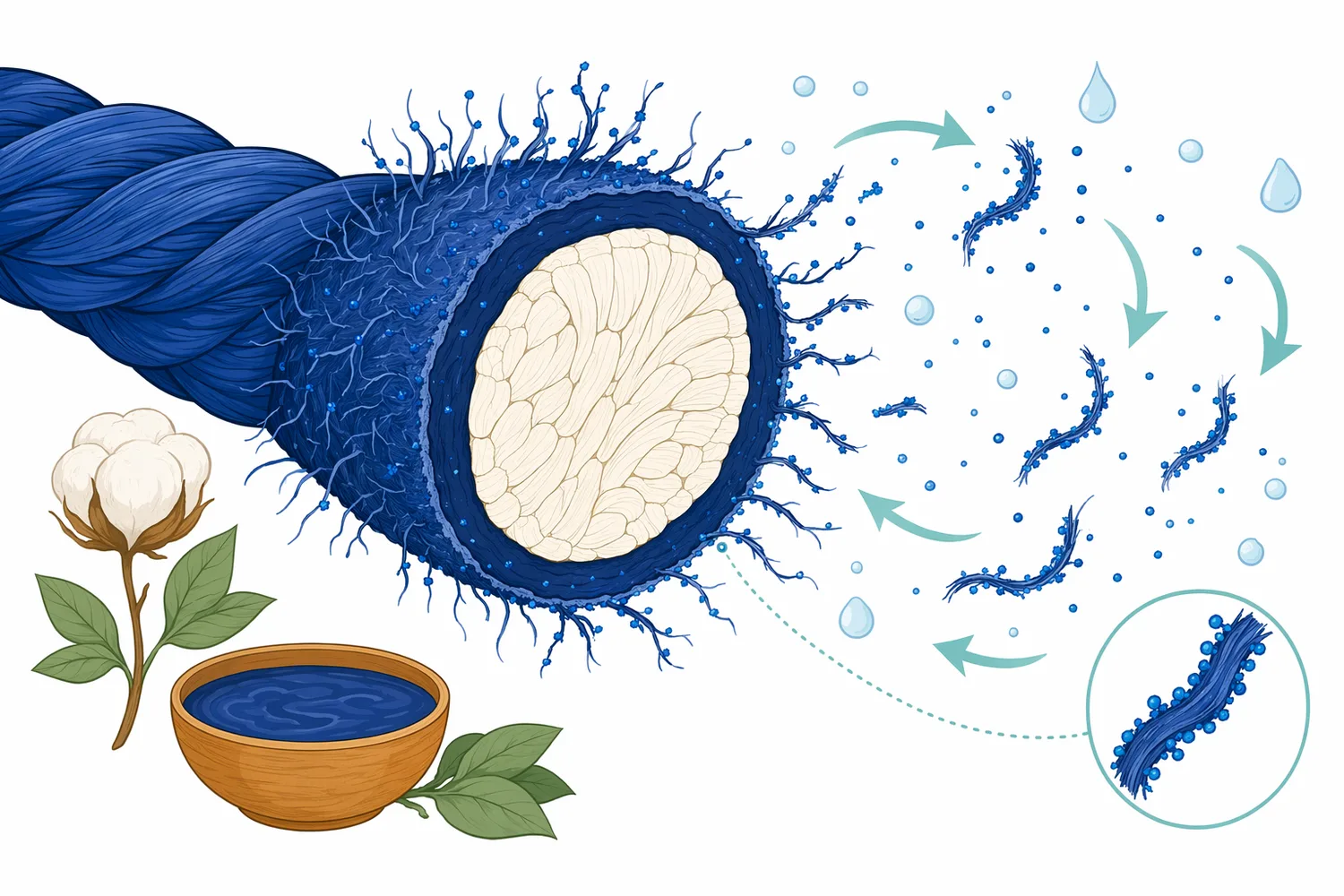
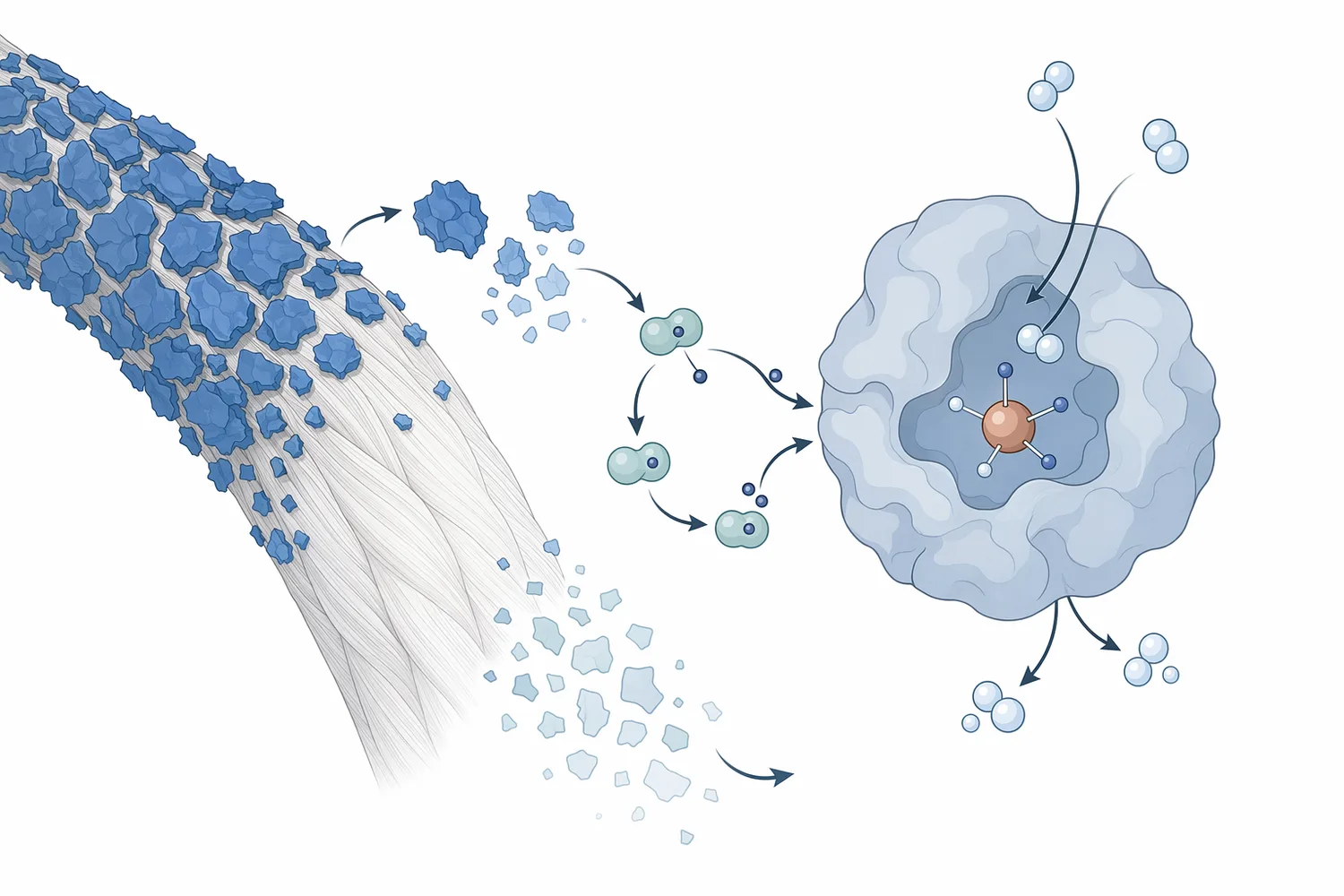
As the cellulase acts, it cuts cellulose chains in those exposed surface regions. This weakens the attachment of tiny fibrils to the yarn body. Once weakened, garment-to-garment rubbing, liquor flow, machine rotation, and occasional abrasive contact detach the loosened material into the wash bath. Because indigo is concentrated on the fiber and yarn surface, the detached cellulose fragments also carry blue dye away from the garment [3].
The visual result is shade loss and surface cleaning. The tactile result is a softer, less stiff garment because the enzyme removes some of the rough, protruding fiber ends that contribute to harsh handle. This same principle is used in textile biopolishing: controlled enzymatic removal of surface fuzz improves smoothness, drape, and appearance, but excessive hydrolysis can lead to avoidable weight loss or strength reduction [2].
Cellulase systems are not all identical. Textile literature distinguishes between cellulase components that attack cellulose in different ways, including enzymes that open internal cellulose chains and enzymes that act more processively from chain ends. The balance of these activities influences how aggressively the enzyme removes surface fiber, how much strength loss occurs, and how the garment’s final hand and shade develop [1].
Indigo itself also affects the process. During cellulase washing, indigo particles released from the garment can remain suspended in the liquor or redeposit onto lighter areas such as weft yarns, pocketing, labels, or already-faded garment zones. Research specifically on indigo backstaining during cellulase washing shows that managing released dye is a central technical issue in denim enzyme finishing [3].
Although cellulase is the classic enzyme for denim wash-down, oxidative enzymes help explain the broader category of indigo decolorizing technologies. Laccases catalyze one-electron oxidation of dye molecules or dye-related structures. When oxidation disrupts the conjugated chemical system responsible for visible absorption, the color can fade or shift because the molecule no longer absorbs light in the same way [4].
This mechanism is chemically different from cellulase action. Cellulase modifies the cotton surface that carries indigo; laccase modifies suitable chromophores or associated dye structures by oxidation. In practice, denim-related research has explored combined cellulase and laccase approaches because they address two different parts of the problem: the fiber surface and the dye color system [5].
Co-immobilization research using cellulase and laccase on reversible soluble polymers has investigated denim fabric decolorization with both enzymes present. The significance is not that every denim process must use both enzymes, but that the literature recognizes a complementary mechanism: cellulase can expose and release dye-bearing cellulose material, while laccase can contribute oxidative color change under suitable conditions [5].
Indigo decolorization is also relevant beyond the garment itself. Textile wastewater can contain residual dye, auxiliaries, and colored particulates. Research on engineered plant enzymes for indigo dye detoxification and microfibre pollution highlights that enzyme-based approaches are being studied not only for appearance effects on fabric, but also for reducing the environmental burden associated with indigo-containing textile streams [6].
The table below summarizes the main enzyme concepts relevant to indigo denim washing. It is not a product specification table; it is a practical way to understand why different enzyme classes can produce different garment effects.
| Enzyme concept | Main substrate or target | What changes on denim | Typical finishing role | Key process implication |
|---|---|---|---|---|
| Acid cellulase | Accessible cellulose on cotton surface | Strong surface fibril removal can release indigo-bearing fuzz and create visible wash-down | Traditional denim enzyme wash, aged effects, stone-enzyme looks | Can give pronounced fading, but uncontrolled action may increase strength loss or backstaining risk [3] |
| Neutral cellulase | Accessible cellulose, often with milder surface attack profile | Surface cleaning, softening, controlled shade loss | Denim fading where lower backstaining and fabric preservation are important | Often used where a balanced hand, shade, and fabric integrity are desired [2] |
| Alkaline or thermostable cellulase | Cotton surface cellulose under less acidic process environments | Biopolishing and surface modification under broader processing conditions | Denim biopolishing and processes needing compatibility with alkaline or higher-temperature stages | Alkalothermophilic cellulases have been studied specifically for denim biopolishing applications [7] |
| Laccase or oxidative decolorizing enzyme | Oxidizable dye structures or dye-related compounds | Chromophore oxidation can reduce or alter visible color where the dye is susceptible | Dye decolorization, denim decolorization research, effluent-color treatment concepts | Works by redox chemistry rather than cellulose hydrolysis; performance depends on dye chemistry and process environment [4] |
| Combined cellulase–laccase systems | Cotton surface plus dye-color chemistry | Fiber-surface release and oxidative color change can occur together | Investigated for denim fabric decolorization | Research supports complementary mechanisms, especially where both surface modification and color reduction are desired [5] |
This comparison also explains why “indigo decolorizing enzyme” can refer to more than one biochemical route. In denim garment washing, the dominant commercial logic is usually controlled surface release of indigo through cellulase action. In dye-treatment and decolorization research, oxidative enzymes such as laccases are important because they act more directly on chromophore chemistry [4].
Backstaining is one of the most important practical limits in denim enzyme washing. As indigo-bearing particles detach from the cotton surface, they enter the wash bath. If those particles are not kept dispersed and rinsed away, they can redeposit onto fabric areas that should remain clean or bright. This can dull contrast, blue the weft, reduce pocket whiteness, and make the garment look dirty rather than naturally faded [3].
The mechanism is physical as well as chemical. Indigo is hydrophobic and poorly soluble in its oxidized blue form. Released particles can associate with cotton surfaces, especially if liquor circulation, rinsing, dispersancy, or wash sequencing is not sufficient to keep them moving out of the garment load. Cellulase washing therefore needs enough mechanical action to release surface material but not so much uncontrolled redeposition that the shade becomes muddy [3].
This is why enzyme fading is usually evaluated together with fabric properties, not by color change alone. A strong enzyme effect that removes a large amount of surface fiber can create fast fading, but it may also increase loose indigo in the bath and create more opportunity for redeposition. Conversely, a gentler process may better preserve contrast but require a longer or more carefully staged wash to reach the target shade [2].
The published focus on indigo backstaining during cellulase washing is especially relevant for fashion denim because the visual target often depends on contrast. High-low abrasion, seam highlights, and clean weft exposure can be more valuable than maximum color removal. Enzyme washing works best when the release of indigo-bearing cellulose is matched by enough washing and rinsing to remove the released color from the system [3].
Research and industry literature consistently show that enzyme washing outcomes depend on the environment in which the enzyme works. Temperature, pH, wash time, fabric construction, liquor movement, and mechanical action all influence how much cellulose surface is hydrolyzed and how much indigo-bearing material is detached. These variables also affect strength loss, weight loss, handle, and backstaining [2].
Published denim-enzyme discussions commonly describe cellulase washing in moderately warm aqueous systems, with treatment times measured in tens of minutes rather than seconds. Industry-facing denim enzyme wash descriptions often present working examples around mildly acidic to neutral conditions and temperatures in the approximate 40–60°C zone, while research on alkalothermophilic cellulases has examined denim biopolishing under more alkaline and higher-temperature-compatible conditions [7].
The important technical point is that the enzyme is not a simple dye stripper. It is a biological catalyst whose action rate changes with process environment. If the bath is too cold for the enzyme system, surface hydrolysis may be slow and fading may be weak. If conditions are too aggressive or exposure continues too long, cellulase action can go beyond desirable fuzz removal and begin to reduce fabric strength or garment weight more than intended [1].
Mechanical action is equally important. The enzyme weakens surface fibrils, but denim shade development also depends on the physical removal of those weakened fragments. A low-mechanical process may soften the surface without strong contrast, while higher garment movement can increase abrasion and visible high-low effects. The enzyme and the machine action therefore work together: biochemical loosening followed by physical detachment [2].
The first visible change is shade. As indigo-bearing surface fibrils are removed, the garment becomes lighter. Because denim yarns are not uniformly dyed through their full cross-section, removing a thin outer layer can create a significant visual change without needing to remove much total fiber mass. This is why enzyme washing can produce a noticeable wash-down effect while still being considered a surface-finishing process [1].
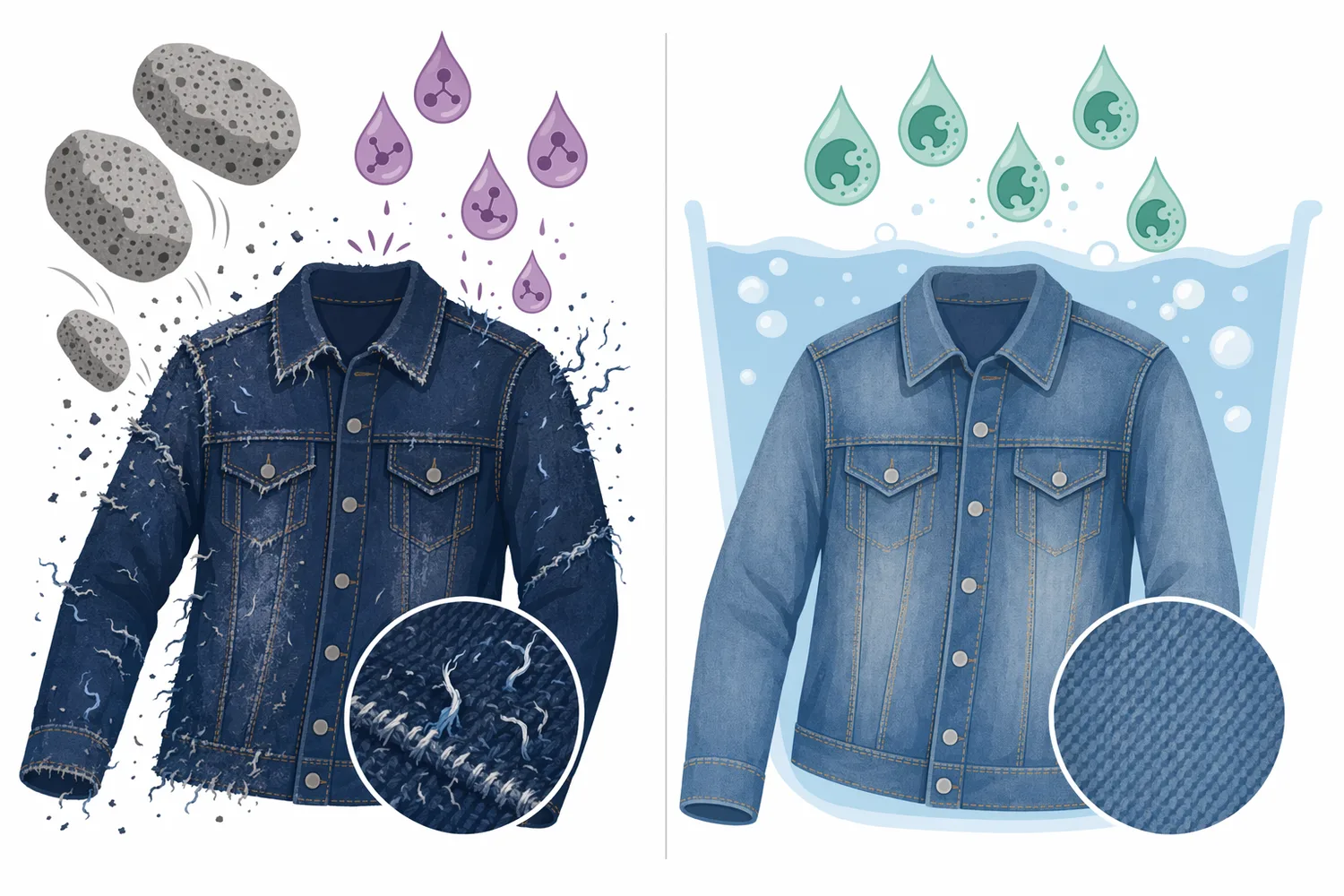
The second change is handle. Raw or minimally washed denim can feel stiff because of fabric construction, finishing residues, surface hairiness, and yarn rigidity. Enzymatic surface polishing removes some protruding fibers and reduces roughness, making the garment feel softer and more flexible. Textile enzyme reviews describe this type of biopolishing as one of the central uses of enzymes in fiber processing [2].
The third change is surface morphology. Under magnification, cellulase-treated cotton surfaces typically show reduced fuzz and altered fibril structure compared with untreated material. In wearer terms, that means less hairiness, a cleaner fabric surface, and improved drape. In wash-development terms, it means the fabric is being physically modified, not merely recolored [1].
The fourth change can be strength or weight. Properly controlled enzyme washing focuses on accessible surface fibrils, but cellulose hydrolysis still removes material from cotton. If carried too far, the process can increase weight loss, reduce tensile or tear strength, or affect seam performance. This is why denim enzyme washing is best understood as controlled surface engineering rather than unlimited fading chemistry [2].
The most direct use is post-sewing wash-down of indigo-dyed denim garments such as jeans, jackets, skirts, shirts, and fashion accessories. The enzyme helps create a worn appearance by removing surface indigo-bearing fibers during washing. This is aligned with the established use of enzymes in textile finishing to modify cotton surfaces and improve garment aesthetics [2].
For jeans, the value is especially clear because denim styling depends on differential fading. Enzyme-assisted wash-down can create a softer and more naturally aged effect than a purely uniform chemical fade. When combined with garment movement, seams and raised areas can fade more strongly, while recessed areas retain more color, creating contrast [3].
Enzyme washing is often used alongside mechanical abrasion to intensify vintage effects. The enzyme weakens surface fibrils, and the abrasive component or garment-to-garment friction removes them more readily. This can reduce the need for purely mechanical attack while still producing visible wash-down and high-low contrast [2].
The key mechanism remains the same: cellulase loosens cellulose microfibrils, and mechanical action removes the loosened, indigo-containing material. Compared with abrasion alone, the enzyme contributes biochemical selectivity at the cotton surface. Compared with enzyme alone, abrasion increases the physical removal needed for stronger visual contrast [1].
Not every denim enzyme process is intended to create heavy fading. Some fabrics need surface cleaning, reduced fuzz, and improved hand without an extreme color shift. Alkalothermophilic cellulases have been studied for denim biopolishing, showing the relevance of cellulase systems beyond classic stonewash-style garment aging [7].
Biopolishing is particularly useful where the desired appearance is cleaner, smoother, and more premium rather than heavily destroyed. The enzyme reduces protruding fibers that can trap loose dye or create a fuzzy look. This can help the garment feel softer and look more refined while still preserving much of the original indigo character [2].
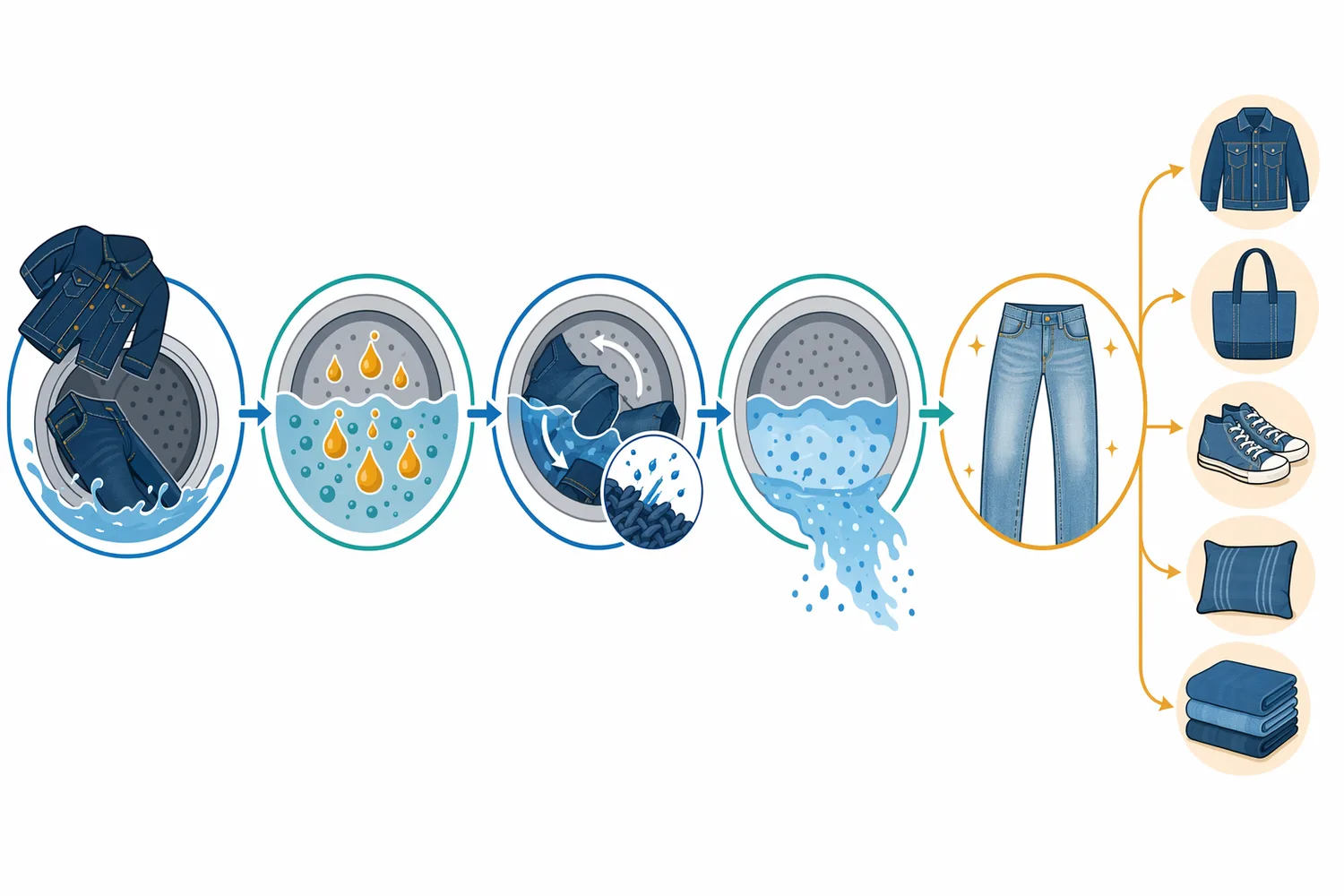
Combined cellulase and laccase systems have been investigated for denim fabric decolorization. In this type of approach, cellulase contributes fiber-surface modification while laccase contributes oxidative dye decolorization. Research using co-immobilized cellulase and laccase demonstrates that the two mechanisms can be studied together for denim color reduction [5].
This is useful for understanding why some denim enzyme products are described as “decolorizing” rather than simply “cellulase.” The application may involve surface indigo release, oxidative color alteration, or both depending on the enzyme system. For garment finishing, the visible result is still judged by shade, contrast, handle, and fabric integrity [5].
Indigo decolorizing enzymes are also relevant to wastewater and dye-treatment research. Laccase-catalyzed decolorization of synthetic dyes has been studied for environmental applications, and indigo-focused enzyme research has examined both dye detoxification and microfibre pollution reduction. These studies support the broader role of enzymes in reducing the impact of colored textile streams [6].
For denim washing, this does not mean the garment process becomes impact-free. Water, energy, auxiliaries, sludge handling, and effluent management still matter. But enzyme technology can fit into lower-impact finishing strategies because it uses catalytic biological action rather than relying only on harsh chemical oxidation or heavy mechanical abrasion [2].
Bleaching can create fast and dramatic color loss because oxidants attack indigo’s chromophore. However, strong oxidation can also damage cotton, weaken elastane, create harsh shade shifts, and increase the burden of neutralization and effluent control. Enzyme washing takes a different route by preferentially modifying the cotton surface and releasing visible indigo from the outer yarn region [1].
Pure mechanical abrasion can also fade denim, but it works by force. Stones, friction, and machine action break and remove surface fibers. This can produce attractive high-low contrast, yet excessive abrasion may damage seams, increase fabric loss, and generate more solid waste. Enzyme assistance lets the biochemical step weaken surface fibrils so that less purely mechanical force may be needed for a comparable surface effect [2].
Laccase-type decolorization occupies a third category. Instead of cutting cellulose or abrading the surface, oxidative enzymes alter dye chemistry where the dye structure is susceptible. Laccase research on synthetic dyes shows that enzymatic redox reactions can reduce visible color, although performance varies with dye class, molecular structure, and reaction environment [4].
In practice, denim finishing often blends these principles. A garment may be desized, enzyme washed, mechanically abraded, softened, rinsed, or combined with newer technologies such as laser fading. Indigo Decolorizing Enzyme is best viewed as one controllable tool within that finishing sequence, especially where the goal is surface-level indigo wash-down and improved hand [2].
Enzyme washing is widely associated with more sustainable textile processing because enzymes are catalytic, work in water-based systems, and can reduce reliance on aggressive chemicals or heavy mechanical treatments. Reviews of enzymes in fiber processing describe their role in replacing or moderating conventional textile operations, including cotton surface modification and denim finishing [2].
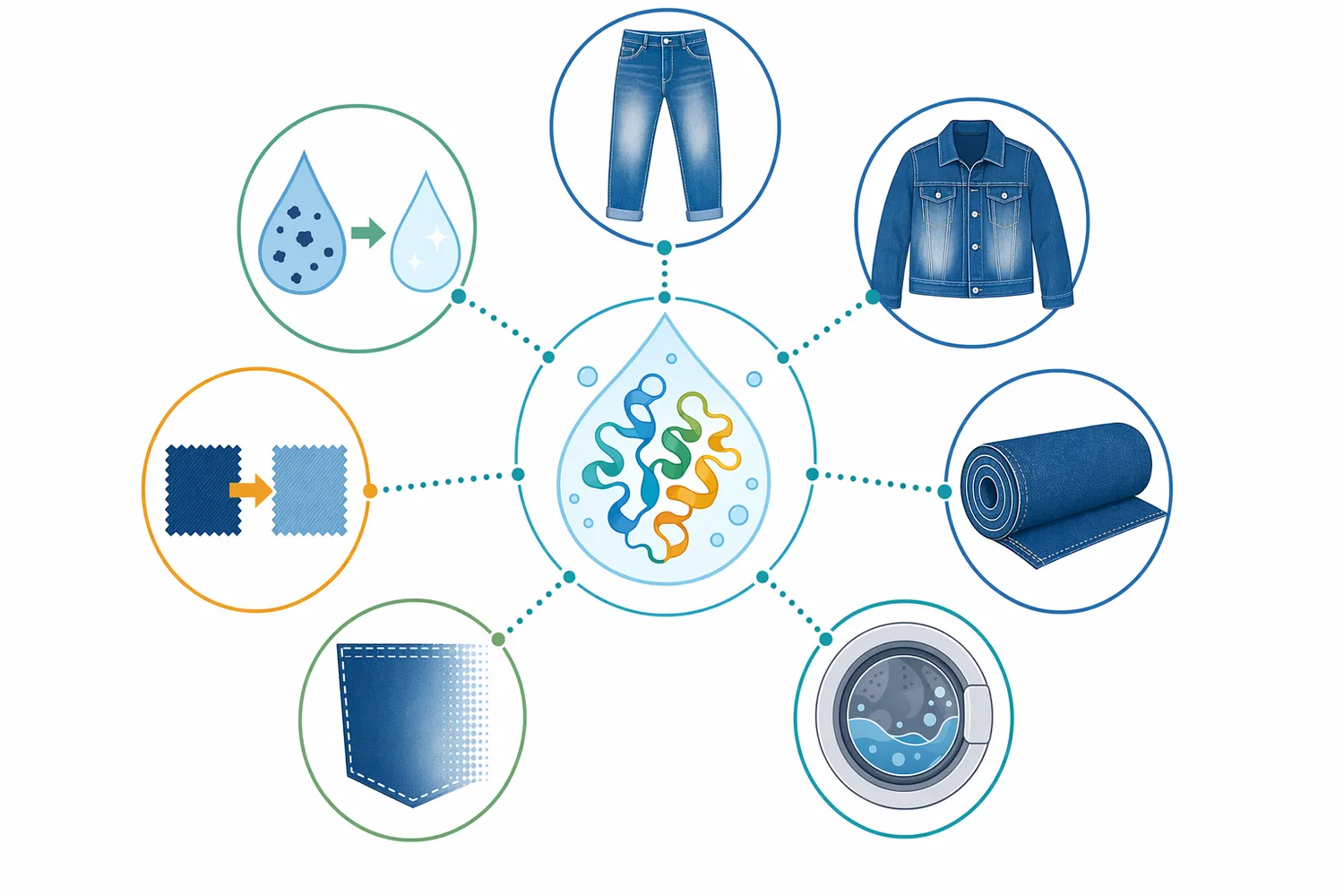
The sustainability value is strongest when enzyme washing is part of an optimized process. If a wash is poorly controlled, excessive rinsing, reprocessing, high reject rates, or over-processing can offset the advantages. The environmental result depends on the full workflow: garment loading, water use, temperature, processing time, rinsing, effluent handling, and how consistently the target shade is achieved [6].
Indigo-specific enzyme research also points to wider benefits. Engineered plant enzyme work on indigo dye detoxification and microfibre pollution shows that enzymatic strategies are being investigated for both color removal and reduction of textile-related environmental impacts. This supports the idea that indigo decolorizing enzyme technology has relevance beyond appearance effects alone [6].
A balanced view is therefore important. Enzyme washing is not a universal solution to every denim sustainability issue, but it is a technically credible method for reducing dependence on harsher routes in appropriate applications. Its main strengths are controlled surface modification, softer handle, potential reduction in abrasive severity, and compatibility with modern denim finishing concepts [2].
Enzymes.bio makes Indigo Decolorizing Enzyme for Denim Washing available for direct online purchase by the 1 kg unit. The buyer places the order and pays online, after which the order is processed and shipped. A Certificate of Analysis and Safety Data Sheet are included with the order for documentation and safe handling support .
This format suits customers who already run denim washing, garment finishing, or wash-development work and need an enzyme product for controlled indigo fading trials or production use in their own process. The product should be treated as a textile-processing enzyme ingredient, with results governed by the wash system, fabric type, dyeing style, and finishing sequence [2].
For best interpretation of results, the key technical principle is simple: enzyme action changes the garment surface before it changes the final look. The visible fade comes from a combination of biochemical cellulose modification, release of indigo-bearing material, mechanical movement, rinsing, and control of redeposition. Understanding that mechanism helps set realistic expectations for denim shade development and fabric feel [3].
Indigo Decolorizing Enzyme for Denim Washing is most useful where the desired effect is controlled denim fading with improved hand, rather than blunt, uniform color stripping. Cellulase-based action loosens the cotton surface and releases indigo-bearing fibrils; oxidative dye-decolorizing enzymes such as laccases show how enzymatic redox chemistry can also reduce color in suitable dye systems [4].
The science supports enzyme washing as a practical denim-finishing method, but it also shows why process control matters. The same enzyme mechanisms that create softness and shade loss can also influence backstaining, weight loss, and strength if the wash is not managed as a controlled surface-modification process. For customers purchasing the 1 kg Enzymes.bio product online, the right expectation is a catalytic finishing aid for denim wash-down—not a one-step substitute for the full denim washing process .
Sold by the 1 kg unit, in stock and ready to ship. Order directly on our store — pay online and we process your order. A Certificate of Analysis and Safety Data Sheet are included with every order.
Buy Indigo Decolorizing Enzyme For Denim Washing →Numbered in order of first citation. Open-access sources, each verified reachable at publication; citation numbers in the text link here.