
Industrial Grade Neutral Pectinase E3100 is a paper-industry enzyme supplied by Enzymes.bio for reducing pectin-derived dissolved and colloidal substances in pulp systems. In suitable pulp furnishes, neutral pectinase breaks long anionic pectic polymers into shorter fragments, lowering their interference with cationic wet-end chemistry and supporting retention, drainage, and cleaner process water behavior .
For papermaking operations affected by pectin-related cationic demand—especially mechanical pulps and peroxide-bleached systems—the value of neutral pectinase is not that it replaces retention aids, but that it helps those cationic additives work against fibers, fines, and fillers instead of being consumed by dissolved anionic trash. Published work on pectinase-treated bleached thermomechanical pulp reported substantial reductions in cationic demand and improved effectiveness of cationic retention polymers under the studied conditions.
Industrial Grade Neutral Pectinase E3100 is supplied as a liquid pectinase preparation for industrial paper applications, with online purchase available by the 1 kg unit through Enzymes.bio. After online payment, the order is processed and shipped, and a Certificate of Analysis and Safety Data Sheet are supplied with the order .
In a paper mill context, the enzyme’s practical role is to act on pectin and pectin-derived materials present in pulp suspensions and process water. These materials can enter the system from wood, mechanical pulps, recycled fiber streams, agricultural residues, or plant-derived furnish components; once solubilized, they may behave as dissolved and colloidal substances that complicate wet-end chemistry [1].
E3100 is described as a neutral pectinase because it is intended for neutral-compatible processing rather than strongly acidic treatment alone. Product information describes use across neutral-to-mildly acidic and mildly alkaline papermaking conditions, with warm-process compatibility that fits many pulp slurry environments .
The product should be understood as a process-support enzyme for pulp and paper use, not as a finished-paper additive and not as a consumer product. Its main technical purpose is to reduce pectin-related chemical interference before or during stages where pulp slurry chemistry affects retention, drainage, refining response, cleanliness, or downstream water quality .
Pectin is a plant cell-wall polysaccharide, and its most relevant structural feature for papermaking chemistry is the presence of galacturonic acid units. These acidic groups carry negative charge when ionized, so dissolved pectic polymers can behave as anionic macromolecules in pulp water [2].
In papermaking, anionic dissolved and colloidal substances are troublesome because many wet-end chemicals are cationic. Cationic retention aids, fixatives, and other charged polymers are intended to interact with fibers, fines, fillers, and pitch-like particles, but anionic pectic substances can bind or consume them first [1].
This is why the same retention-aid dosage may behave differently from one furnish to another. A pulp stream with high pectin-derived anionic load can show weaker retention response, higher chemical demand, variable drainage, and more solids circulating in the white-water loop, even when the paper machine hardware and retention program have not changed.
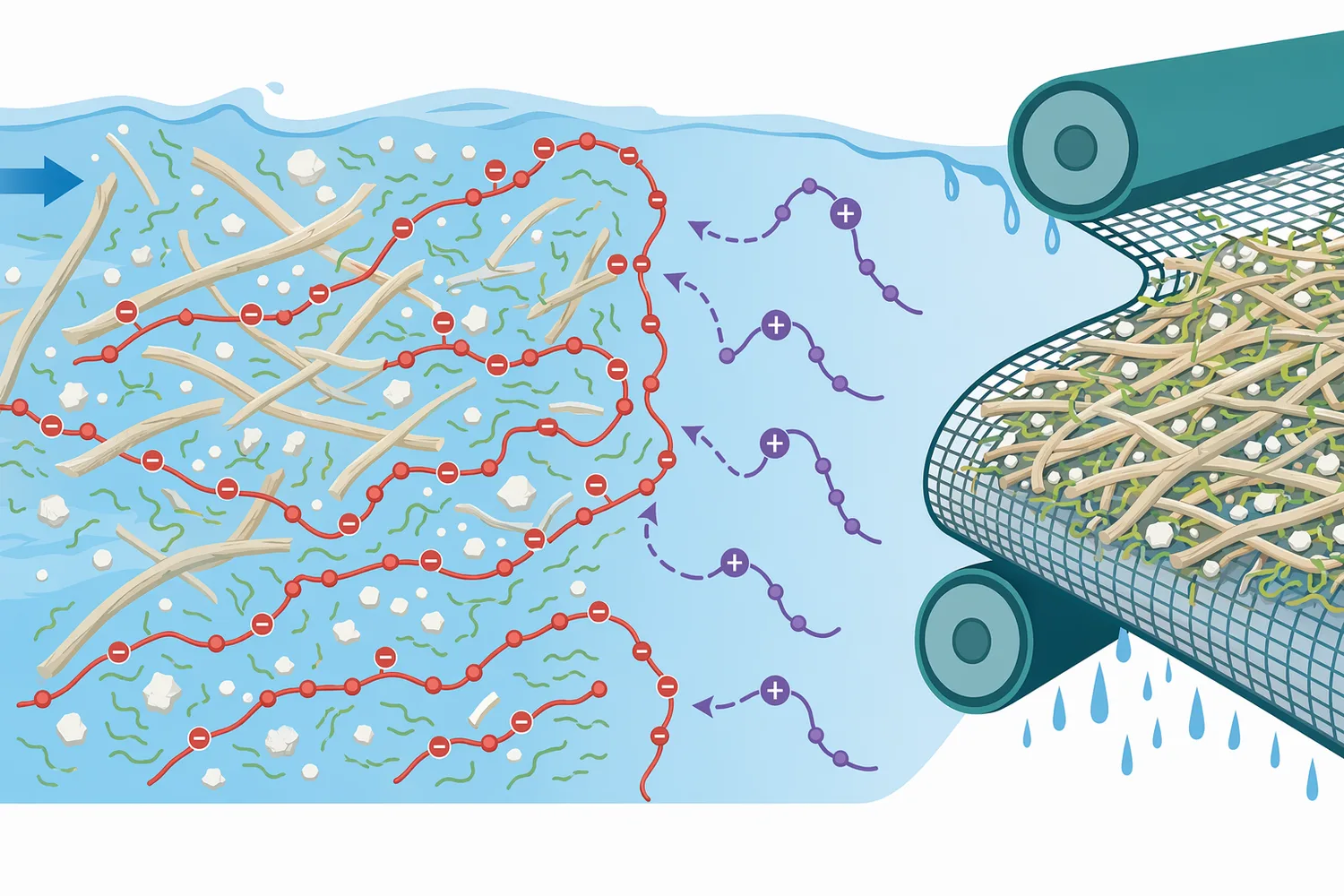
The issue is especially important in mechanical pulp and peroxide-bleached mechanical pulp systems. Research cited in the papermaking literature describes how alkaline peroxide bleaching can solubilize acidic polysaccharides, including pectins or polygalacturonic acids, into the water phase, where they contribute to cationic demand.
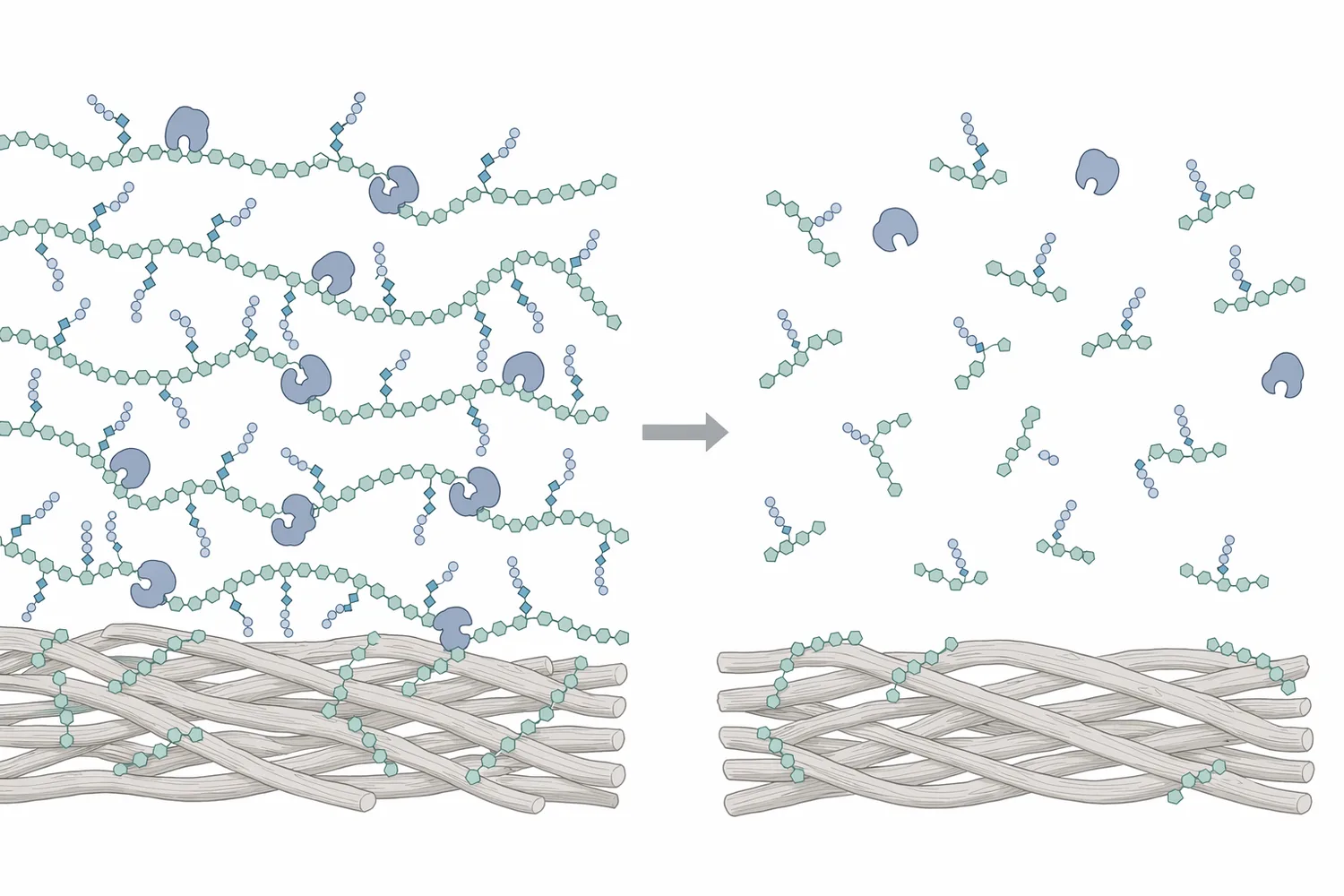
Neutral pectinase works by catalyzing cleavage of pectic polymers. In practical terms, it takes long pectin-derived chains and cuts them into shorter fragments; the chemical charge does not simply disappear, but the polymer’s size, binding behavior, and ability to interfere with cationic additives are changed [2].
That chain-length change is central. Published work on polygalacturonic acid showed that cationic demand depends strongly on degree of polymerization: short galacturonic acid fragments such as monomers, dimers, and trimers did not show measurable cationic demand in the cited work, while longer chains contributed strongly.
This explains why an enzyme can reduce interference without acting like a conventional charge-control chemical. A cationic chemical neutralizes or fixes anionic materials by binding them; pectinase instead modifies the anionic polymer itself, making the pectin-derived material less able to consume cationic wet-end additives.
In pulp slurry, the expected physical and chemical changes are therefore specific: long pectic chains become shorter; polymeric anionic demand falls; cationic retention polymers are less strongly diverted into dissolved pectin complexes; and more of the retention program remains available for fines, filler, and fiber flocculation.
The most relevant pectinase behavior for rapid cationic-demand reduction is internal cleavage of the polymer chain. Endo-acting activity reduces average chain length efficiently because each cut divides a larger polymer into smaller molecules, whereas purely end-attacking action would shorten the chain more gradually.
Pectinases are not one single enzyme type. The category includes enzymes that hydrolyze pectic chains, cleave them by lyase mechanisms, or modify ester groups that affect charge and accessibility; different microbial pectinases are therefore useful in different industrial environments [2].
The table below gives a conceptual comparison for paper-industry readers. It is not a product-selection checklist; it simply explains why a neutral pectinase such as E3100 is positioned differently from acid-oriented or strongly alkaline pectinase systems.
| Pectinase concept | Typical process fit | Main substrate effect | Relevance to pulp and paper |
|---|---|---|---|
| Acid-oriented pectinase | Common in fruit, plant-material maceration, and some acidic extraction processes | Depolymerizes pectin where the process itself is acidic | Useful in acidic biomass settings, but not always aligned with neutral papermaking circuits [3] |
| Neutral pectinase | Compatible with neutral and mildly shifted pulp slurry conditions | Cuts pectin-derived polymers while fitting many wet-end and stock-preparation environments | Well matched to pectin-related DCS and cationic-demand control in pulp systems |
| Alkaline or alkali-tolerant pectinolytic systems | Studied in alkaline biomass processing and bleaching-support contexts | Can act on pectic materials under more alkaline process chemistry | Relevant in selected agrowaste or bleaching-support applications, often alongside xylanase or cellulase-free enzyme systems [4] |
For E3100, the practical distinction is compatibility with the pulp environment where pectin interference is occurring. A neutral enzyme can be introduced into pulp slurry conditions without requiring the strongly acidic environment associated with many traditional pectinase applications .
The strongest application evidence for pectinase in papermaking is associated with peroxide-bleached thermomechanical pulp, where dissolved acidic polysaccharides can raise cationic demand. In published work, pectinase treatment of bleached TMP reduced cationic demand and improved the performance of cationic polymers used for fines and filler retention.
A key finding from that work is mechanistically important: pectinase did not function as a standalone retention aid. The improvement appeared when cationic retention polymers were used, supporting the conclusion that pectinase reduced interfering dissolved anionic material and thereby allowed the cationic polymers to perform more effectively.
The reported magnitude was meaningful for papermaking chemistry. The study described destruction of about half of the cationic demand in the bleached pulp under the studied conditions, which is a large enough change to explain why retention-aid response can improve after enzymatic treatment.
The same research connected the observed reduction to pectin depolymerization. Release of galacturonic acid fragments and the decrease in cationic demand moved together, supporting the interpretation that pectin-derived polymers—not unrelated wet-end variables—were the enzyme’s functional target.
Importantly, the presence of pulp fibers did not prevent the enzyme from acting in the reported experiments. That matters because a model solution may not predict behavior in real pulp slurry, where fibers, fines, fillers, extractives, dissolved organics, and shear all coexist.
The study also reported that enzyme treatment did not damage pulp strength properties under the conditions examined. For paper producers, this is an essential distinction: an enzyme that solves wet-end chemistry but weakens the fiber network would be difficult to justify, while targeted pectin modification is intended to act on non-cellulosic interfering material.
Retention in papermaking depends on the controlled interaction of charged polymers with fibers, fines, fillers, and colloidal particles. If pectin-derived anionic polymers consume cationic retention aid in the water phase, less active polymer remains available to form the desired bridges and attachment points among useful solids [1].
By lowering pectin-related cationic demand, neutral pectinase can make a given retention program behave more predictably. The enzyme does not create filler retention by itself; instead, it reduces a competing reaction that prevents cationic retention aids from attaching to the solids they are meant to retain.
Fine-fiber retention can also benefit from this mechanism. Fines have high surface area and are easily lost to white water if retention chemistry is inefficient; when cationic additives are less depleted by dissolved pectin, more of the retention mechanism can operate on fines and filler surfaces .
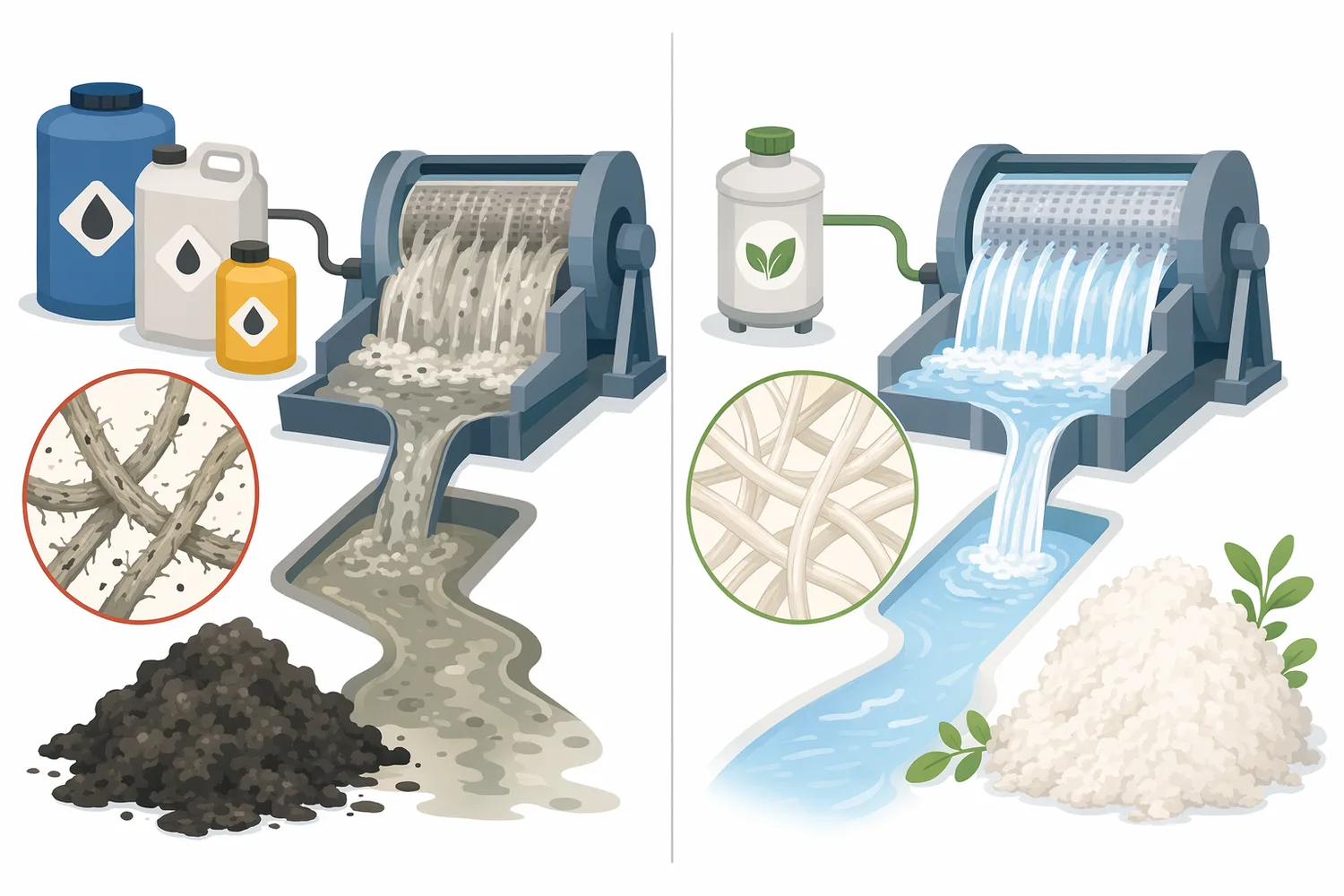
Drainage support follows the same logic. A cleaner, less interference-heavy wet end generally allows flocculation and water release to respond more consistently to the paper machine’s retention and drainage program, whereas high anionic trash can create unstable response and higher recirculating solids [1].
System cleanliness is another practical reason to address pectin-derived DCS. Dissolved and colloidal plant polymers can contribute to deposits, microbial nutrient load, and circulating-water complexity; reducing the polymeric pectin fraction can support cleaner operation when pectin is a meaningful component of the DCS burden [5].
E3100 is positioned for use in pulp processing where pectin-derived dissolved and colloidal substances create operating friction. This includes pulp streams where plant cell-wall polysaccharides have been solubilized and remain in the aqueous phase as anionic, charge-demanding materials .
The enzyme’s role is most credible where pectin is part of the actual interference mechanism. In peroxide-bleached mechanical pulps, the literature directly connects pectic substances and polygalacturonic acids with cationic demand, making this a strong fit for pectinase treatment.
The most direct paper-machine value is improved response from cationic retention aids. Published TMP work showed that after pectinase treatment, several cationic polymers performed better in dynamic drainage jar experiments, while nonionic polymers and no-polymer conditions did not show the same mechanism-based improvement.
That distinction prevents overstatement. Neutral pectinase should be viewed as a way to reduce pectin interference with cationic wet-end chemistry, not as a universal fix for retention problems caused by unrelated variables such as poor formation control, inappropriate shear, filler chemistry, or excessive fiber fines.
When retention aids work more efficiently, useful solids are more likely to remain in the sheet instead of circulating in white water. E3100 is therefore relevant to fine-fiber and filler retention where the limiting factor is pectin-derived anionic demand rather than a purely mechanical or furnish-balance problem .
In practical papermaking terms, better retention of fines and fillers can support more stable solids balance, less solids loading in process water, and more consistent sheet formation when the rest of the wet-end program is properly controlled. These outcomes are consistent with the mechanism demonstrated for pectinase-treated TMP systems.

Drainage is influenced by fiber morphology, fines content, filler loading, refining history, temperature, wet-end chemistry, and water-loop closure. Pectinase does not override those factors, but it can reduce one important chemical source of variability when pectin-derived DCS are present [1].
Because E3100 acts on pectin polymers rather than cellulose fiber as its intended target, its contribution is best described as wet-end chemistry support. Lower pectin-related cationic demand can help the existing drainage and retention program respond more consistently .
The product information also positions E3100 for debarking and chip-processing support. Pectin occurs in plant tissues as part of the matrix that helps bind cell-wall structures, so pectinase can be relevant where pectinaceous material contributes to slurry stickiness, colloidal load, or downstream interference .
The evidence base is strongest for pulp slurry and wet-end cationic-demand reduction, so raw-material handling applications should be understood through the same substrate logic: if pectin-derived polymers are part of the material causing process difficulty, enzymatic depolymerization is a plausible support mechanism [2].
E3100 is also positioned for beating and refining assistance in paper applications. This should be interpreted carefully: pectinase is not a mechanical refiner replacement, but by lowering pectin-derived interference in pulp slurry, it may support more manageable stock behavior in processes where chemistry and refining response interact .
Pulp characteristics and processing parameters strongly affect paper production efficiency, including fiber dimensions, refining intensity, drainage behavior, and sheet properties. Enzyme treatment is one process lever within that broader system, and its value depends on whether the targeted substrate is relevant to the furnish [6].
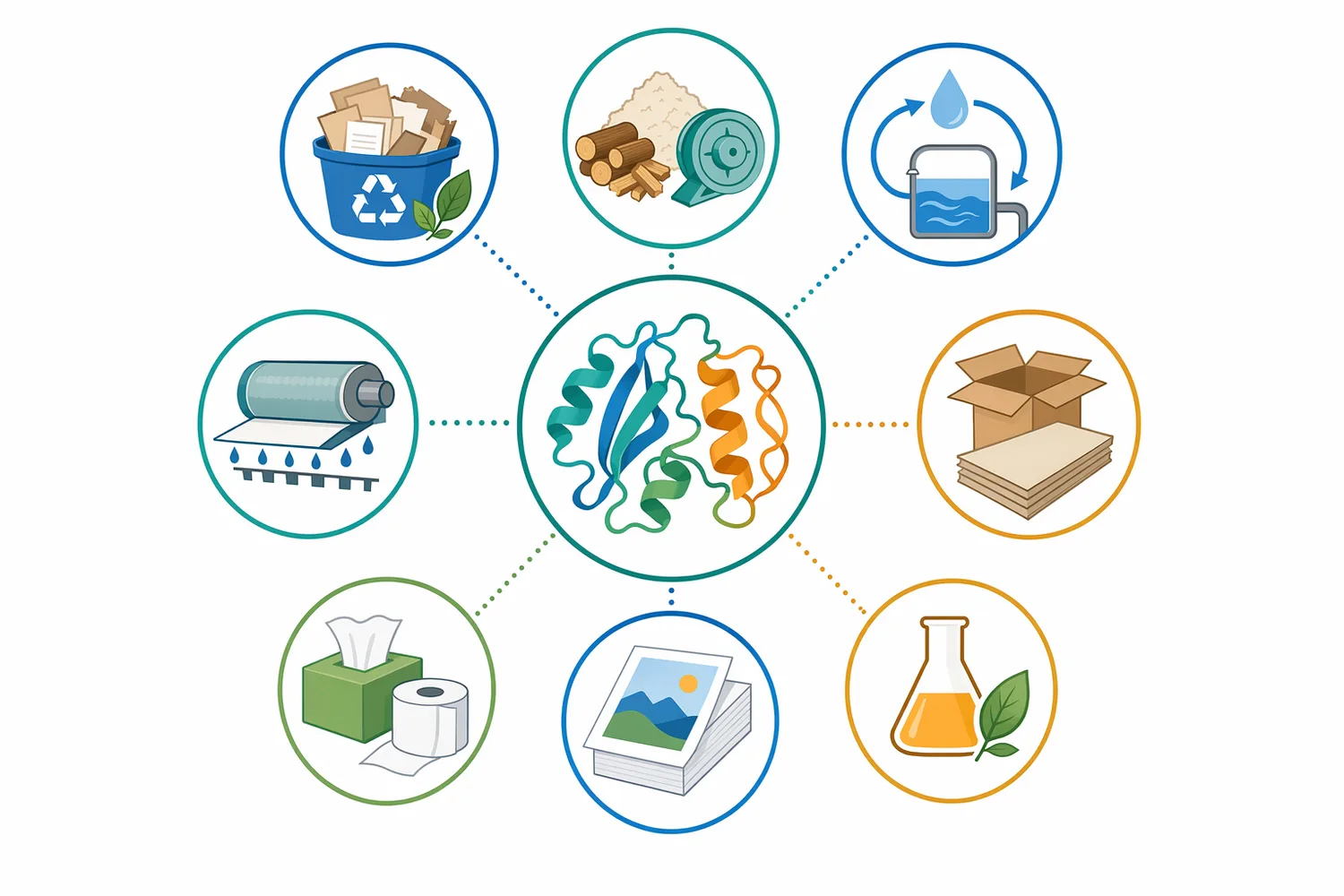
Enzymes are used in pulp and paper processing because they can act selectively on particular biomass components under comparatively mild process conditions. Biotechnology references for pulp and paper describe enzyme applications in areas such as bleaching support, deinking, drainage improvement, pitch control, and fiber modification [1].
Pectinase fits into that broader toolkit by targeting pectic substances rather than lignin, cellulose, hemicellulose, or triglyceride pitch. That specificity matters because the paper sheet depends on cellulose fiber integrity; an enzyme used for wet-end support should address the interfering substrate without broadly degrading the fiber network [2].
Other enzyme families illustrate the importance of matching enzyme action to substrate. Xylanases are widely discussed for pulp bleaching support because they act on xylan and can improve access to lignin-associated structures, while cellulase and xylanase combinations are studied for lignocellulosic processing where controlled synergy is desired [7].
Pectinase’s role is different from xylanase. Instead of primarily opening hemicellulose-lignin associations for bleaching, pectinase reduces the molecular size and charge-impact of pectin-derived substances that interfere with wet-end polymer chemistry.
This distinction is useful when comparing enzyme-assisted process goals. Xylanase may be chosen in bleaching-support contexts, cellulase may be relevant in selected fiber-modification or drainage applications, lipase may address triglyceride-related pitch, and pectinase is most directly linked to pectin-derived DCS and cationic-demand control [1].
Pectinase is also discussed in broader biomass and bleaching-support research, particularly where agricultural residues contain mixed plant polymers. Studies on sugarcane bagasse and wheat straw have examined xylanase and pectinase systems for more eco-friendly bleaching approaches and reduced effluent toxicity in agrowaste pulp contexts [8].
Those studies are not identical to E3100’s wet-end DCS application, but they support the larger principle that pectinolytic enzymes can modify non-cellulosic plant polymers in pulp-related materials. In agrowaste pulps, pectin and hemicellulose can both influence chemical accessibility, drainage behavior, and effluent composition [4].
Paper-industry wastewater is also a major area for biological and enzyme-related process improvement. Reviews describe microbial and enzymatic approaches for treating pulp and paper wastewater, including reduction of organic load and improved biodegradation of complex process effluents [5].
For E3100 specifically, the environmental contribution is upstream and process-oriented: when pectin-derived DCS are reduced in the pulp system, wet-end chemicals may be used more efficiently, and less interfering organic material may circulate in process water. That is a credible sustainability mechanism, but it should not be overstated as a complete wastewater-treatment solution .
E3100 is intended for pulp slurry use in neutral-compatible papermaking environments. Product information describes an operating window centered around neutral papermaking conditions, including moderate warm-process temperatures typical of many stock-preparation and pulp-treatment systems .
Residence time matters because enzymes require contact with their substrate. In the pectinase-TMP research, commercial pectinase was reported to act within short residence times under temperature and pH conditions relevant to papermaking, which supports practical feasibility in industrially realistic pulp handling rather than only extended laboratory incubation.
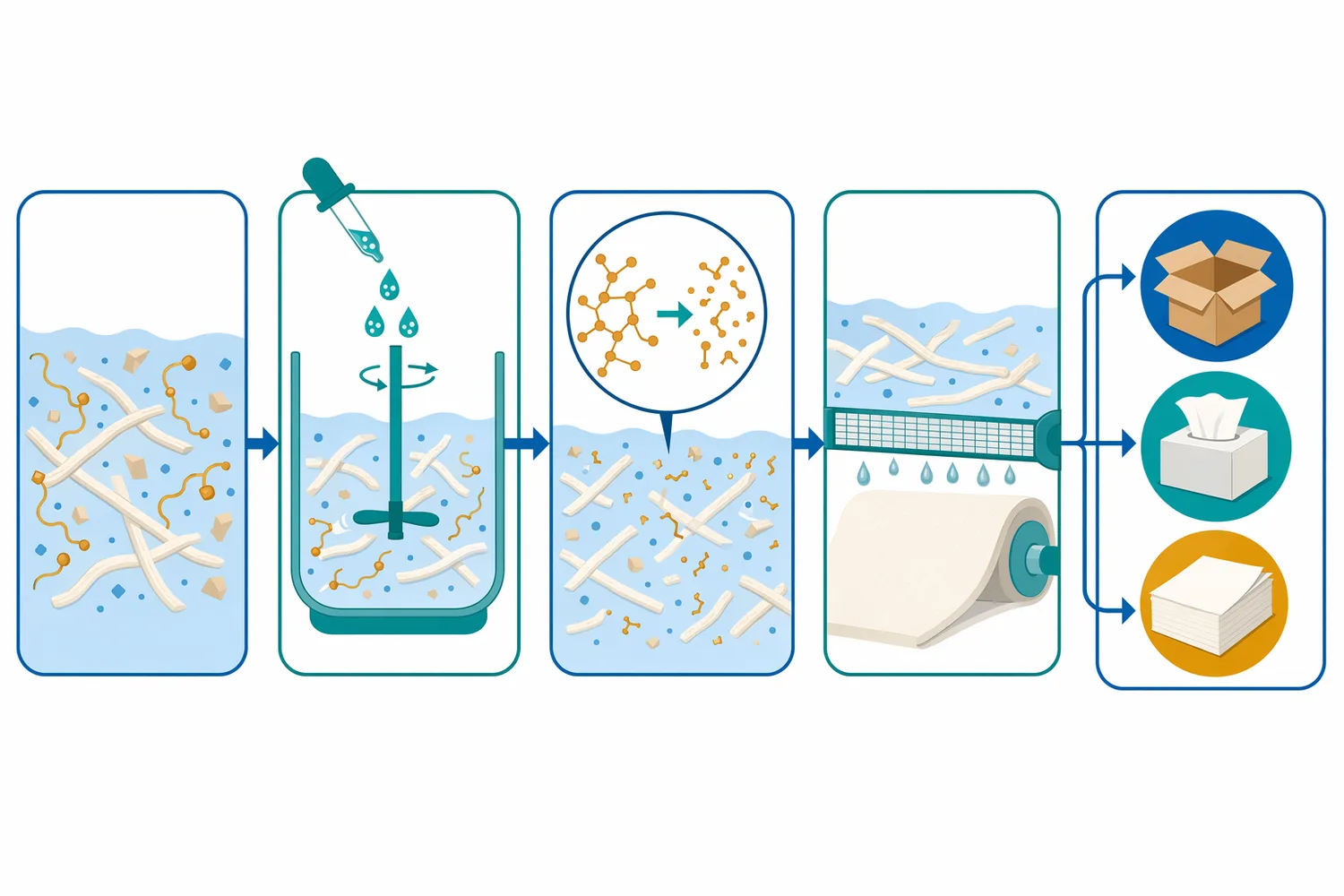
The enzyme’s effect will naturally vary with furnish composition. A system rich in peroxide-bleached mechanical pulp and pectin-derived anionic substances can respond differently from a furnish dominated by fibers with low pectin release or by interference mechanisms unrelated to pectic polymers.
Water-loop closure can also influence results. More closed papermaking systems tend to accumulate dissolved and colloidal materials, so any enzyme aimed at DCS control is operating within a dynamic balance of incoming raw materials, chemical additions, white-water recirculation, microbial activity, and solids removal [5].
Because pectinase is a biocatalyst, it should be introduced where it has access to the pectin-containing water phase and enough contact time before the wet-end chemistry it is intended to support. This is a general process principle rather than a replacement for the site’s established operating controls [1].
The clearest benefit is lower cationic demand. When long pectic polymers are cleaved into shorter fragments, their ability to consume cationic additives is reduced, which directly addresses one of the major chemical burdens in pectin-rich pulp systems.
A second benefit is improved retention-aid response. TMP studies showed that pectinase-treated systems responded better to cationic polymers, indicating that enzymatic depolymerization can make existing wet-end chemistry more effective when pectin-derived anionic trash is present.
A third benefit is support for fine and filler retention. By reducing dissolved polymeric competition for cationic additives, pectinase can help the retention program act on useful suspended solids rather than dissolved pectin chains .
A fourth benefit is more stable drainage behavior. Drainage problems have many causes, but when unstable wet-end charge balance is part of the problem, lowering pectin-related cationic demand can help the machine’s drainage and retention response become more predictable [1].
A fifth benefit is cleaner circulating water behavior. Reduced polymeric pectin load can contribute to lower DCS interference and may lessen the chemical complexity of the white-water loop, especially in systems where plant-derived colloids accumulate [5].
The strongest evidence for pectinase in papermaking is not a broad claim that every paper furnish will improve. It is the specific, mechanistically supported finding that pectinase can reduce cationic demand in peroxide-bleached mechanical pulp systems and improve the performance of cationic retention polymers.
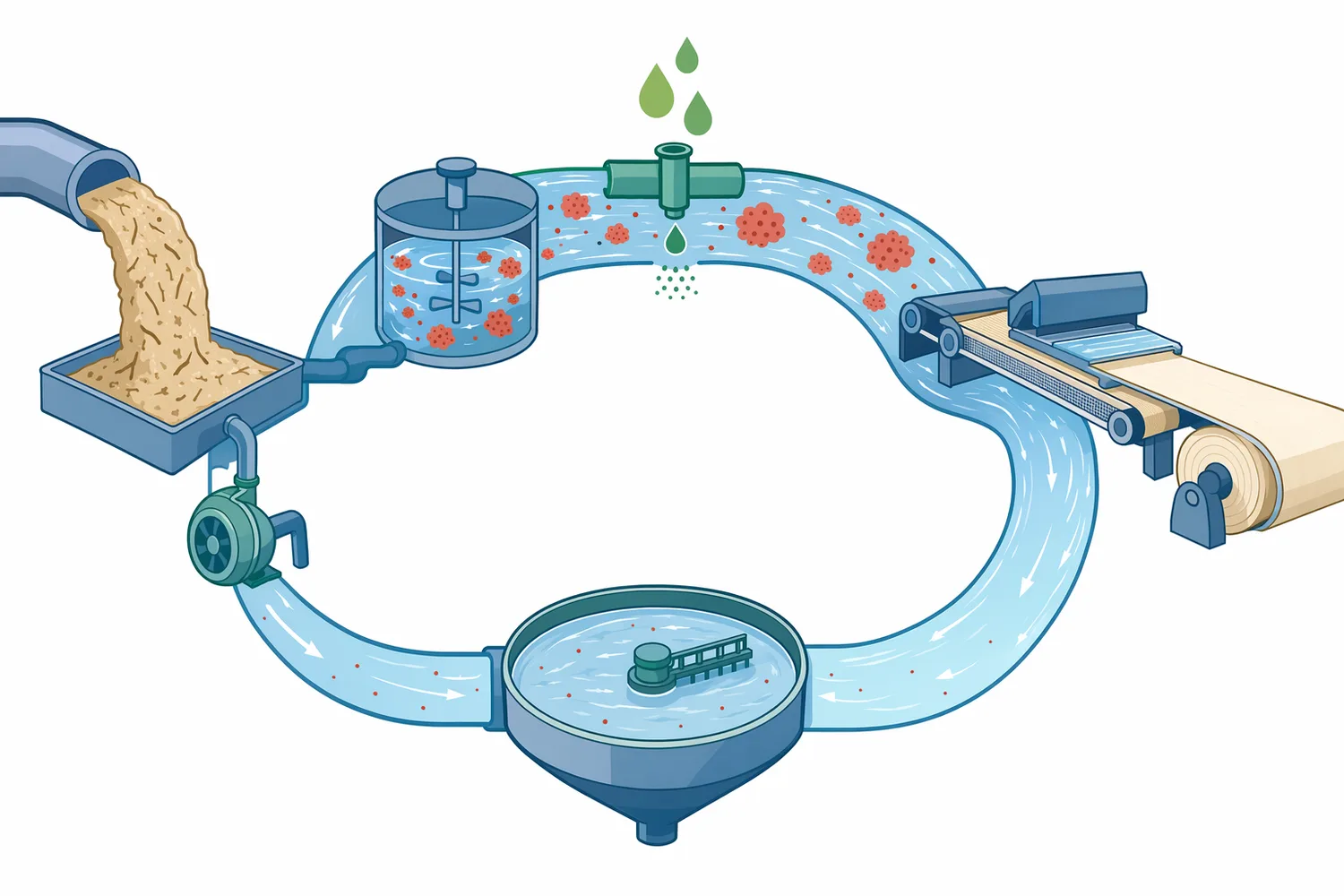
The mechanism is also well supported: pectin-derived acidic polysaccharides become dissolved during relevant processing, longer polygalacturonic acid chains create cationic demand, and enzymatic depolymerization reduces that demand by shortening the chains.
Applications such as improved drainage, fine retention, chemical-use efficiency, debarking support, and refining assistance are best understood as downstream or adjacent benefits that depend on the same substrate being relevant. If pectin-derived DCS are not a major contributor to the operating issue, a pectinase will naturally have less impact [2].
This is why E3100 is most appropriately positioned as a targeted enzyme for pectin-related interference in pulp and paper systems. It belongs in the same practical category as other substrate-specific papermaking enzymes: valuable when the substrate and process problem match, but not a universal replacement for mechanical, chemical, or operational controls [1].
Enzymes.bio supplies Industrial Grade Neutral Pectinase E3100 as an online industrial enzyme product for pulp and paper applications. The product is sold directly online by the 1 kg unit; after online purchase and payment, the order is processed and shipped .
A Certificate of Analysis and Safety Data Sheet are included with the order. These documents support normal receiving, handling, and quality-record needs for industrial use without changing the product’s role: E3100 is a neutral pectinase process aid for pectin-derived DCS and wet-end chemistry support .
Industrial Grade Neutral Pectinase E3100 is most useful where pectin-derived dissolved and colloidal substances are contributing to high cationic demand, weaker retention-aid response, drainage variability, or process-water cleanliness issues. Its core action is concrete and substrate-specific: it cuts long anionic pectin chains into shorter fragments that are less disruptive to cationic wet-end chemistry.
The strongest published support comes from peroxide-bleached thermomechanical pulp research showing reduced cationic demand and improved effectiveness of cationic retention polymers after pectinase treatment. For paper operations where pectin-related anionic trash is part of the problem, E3100 provides a scientifically credible neutral pectinase option available for direct online purchase in 1 kg units from Enzymes.bio .
Sold by the 1 kg unit, in stock and ready to ship. Order directly on our store — pay online and we process your order. A Certificate of Analysis and Safety Data Sheet are included with every order.
Buy Industrial Grade Neutral Pectinase E3100 – Paper Industry Enzyme →Numbered in order of first citation. Open-access sources, each verified reachable at publication; citation numbers in the text link here.