
Direct answer: Keratinase is a proteolytic enzyme used to break down keratin-rich materials such as poultry feathers, hair, wool, horn, hoof, nail, and scale into smaller peptides and amino acids. Its highest-value industrial use is in animal feed preparation and feather meal processing, where enzymatic hydrolysis can make resistant keratin protein more accessible for digestion and protein recovery [1].
Enzymes.bio supplies Keratinase as an online 1 kg enzyme product for animal feed preparation, including hydrolysis of keratin proteins in feather meal to improve amino acid digestibility for livestock. The buyer purchases directly online, pays at checkout, and the order is processed and shipped with a Certificate of Analysis and Safety Data Sheet supplied with the order .
Keratinase is an enzyme that hydrolyzes keratin, the tough structural protein found in feathers, wool, hair, nails, claws, hooves, horns, beaks, fish scales, and the outer keratinized layer of skin. When buyers search “what is keratinase,” the practical answer is that it is a keratin-degrading protease: it cuts peptide bonds in protein, but it is distinguished by its ability to act on keratin structures that ordinary proteases often attack only weakly [2].
Keratin is difficult to process because it is not simply “protein.” It is a densely packed fiber system stabilized by disulfide crosslinks between cysteine residues, hydrogen bonding, hydrophobic packing, and crystalline or semi-crystalline alignment of protein chains. These features make feathers and hair mechanically strong, water-resistant, and resistant to digestive enzymes; the same structure also makes raw keratin-rich byproducts hard to convert into useful feed protein without thermal, chemical, microbial, or enzymatic treatment [3].
Keratinase enzymes solve that problem by combining surface attack with progressive protein hydrolysis. The enzyme first adsorbs to exposed regions of the keratin fiber, then cleaves accessible peptide bonds; as the fiber surface weakens, more internal protein becomes exposed, allowing further hydrolysis. In microbial keratin degradation, proteolysis is often paired with chemical or enzymatic reduction of disulfide bonds, because opening those sulfur crosslinks makes the protein chains less tightly locked together and easier to cut [2].
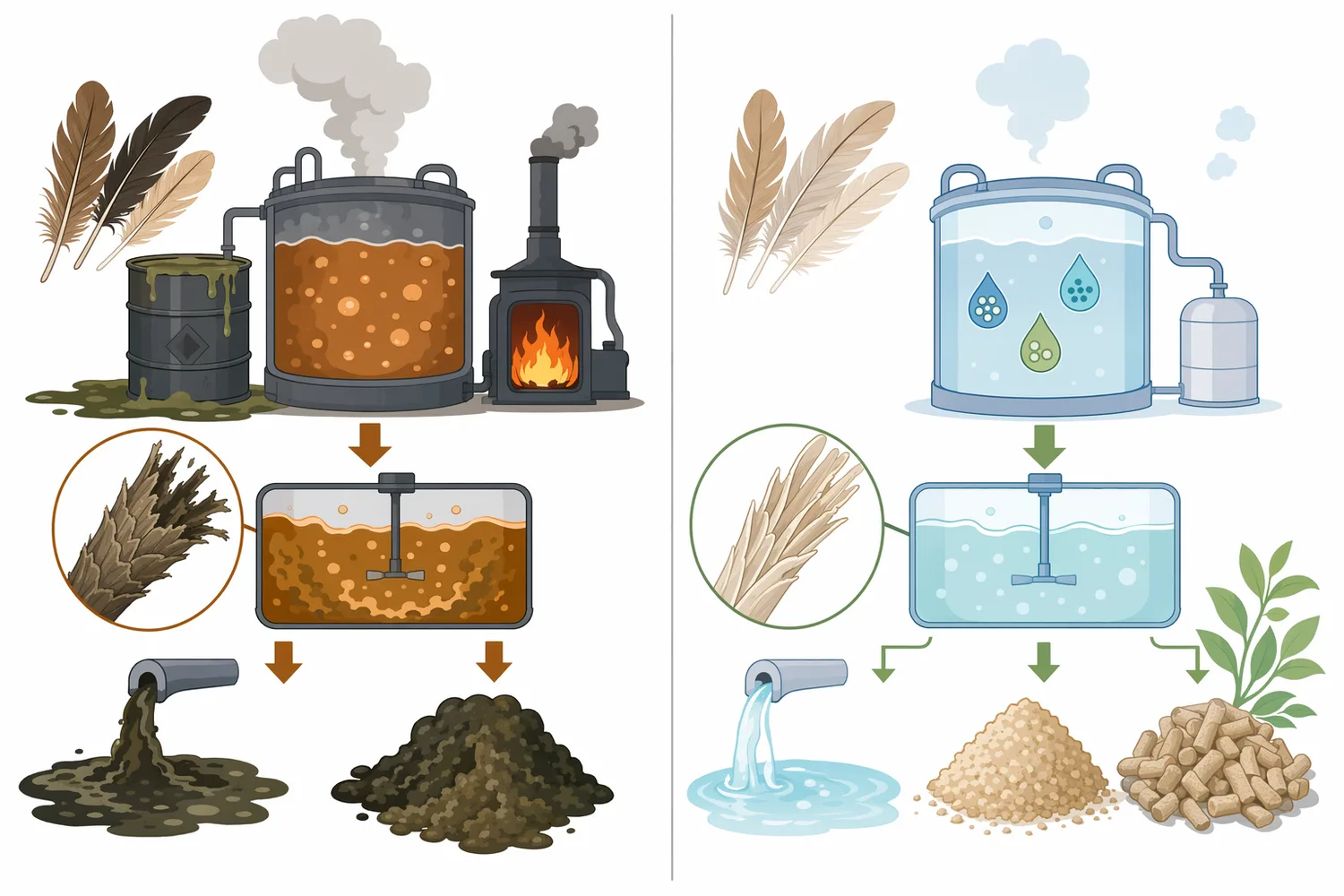
Industrial interest in keratinase is strongest where keratin-rich byproducts are abundant but underused. Poultry feathers are the clearest example: they are protein-rich and produced at large scale, but native feather keratin is poorly digestible. Reviews on feather waste biodegradation describe microbial keratinases as practical tools for converting feather waste into hydrolysates, protein supplements, bioactive peptide mixtures, and other valorized materials rather than treating feathers only as a disposal burden [4].
Keratinase treatment changes keratin in three connected ways: it opens the compact fiber structure, reduces protein chain length, and increases soluble peptide and amino acid fractions. In a feather meal or wool process, the visible material may soften, lose rigidity, fragment more easily, or release soluble nitrogen-containing compounds into the surrounding liquid; at the molecular level, long insoluble keratin chains become shorter peptides that other enzymes and digestive systems can access more readily [1].
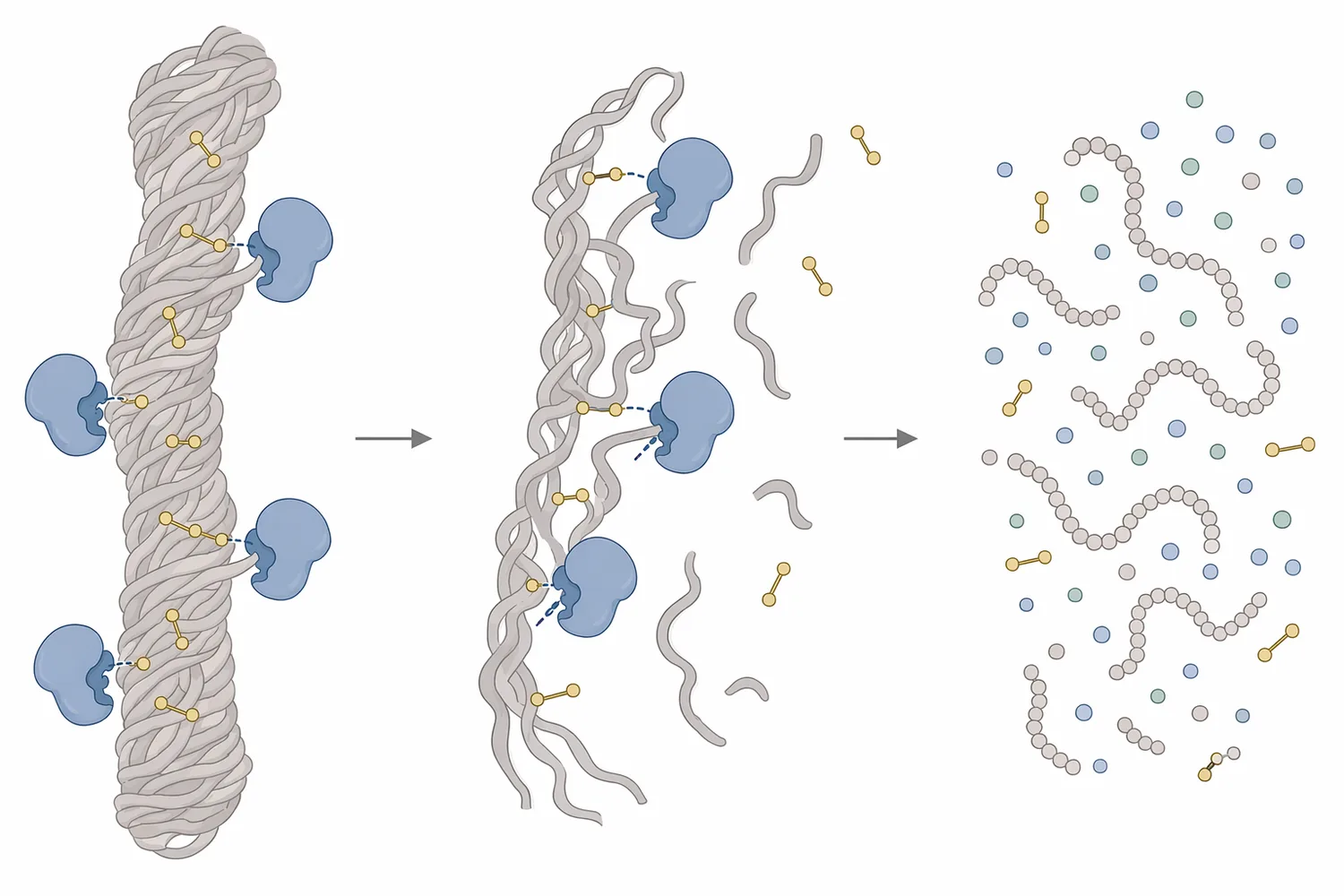
The key structural barrier is the disulfide network. Keratin contains cystine bridges that behave like molecular staples between protein chains. If those bridges remain intact, a protease may cut exposed loops on the surface but still struggle to penetrate the compact material. Keratinolytic systems therefore work best when peptide-bond cleavage and disulfide-bond disruption occur together, because reduction of crosslinks creates a more open protein matrix and proteolysis then converts that opened matrix into smaller fragments [3].
This is why keratinase is different from a general digestive protease in practical use. A standard protease may hydrolyze casein, gelatin, soy protein, or other accessible proteins, but keratin has fewer easily available cleavage sites because the chains are shielded inside a rigid structure. Keratinase enzymes are associated with organisms that evolved to use keratin as a nutrient source, and their catalytic behavior is adapted to substrates such as feathers, wool, hair, and horn rather than only soluble proteins [2].
Dynamic wool-fiber research helps illustrate the mechanism. In a study tracking fluorescently labeled keratinase on wool, the enzyme’s movement and binding on the fiber showed that degradation is not an instant bulk reaction; keratinase interacts with the fiber surface and progressively affects the structure as accessible regions are hydrolyzed. That matters for processing because contact, hydration, time, and surface exposure strongly influence how much keratin is actually converted [5].
Keratinase can be produced by diverse microorganisms, including bacteria, actinomycetes, and fungi. In industrial biotechnology, keratinase-producing bacteria are especially important because many bacterial strains grow quickly, secrete extracellular proteases, and have been studied for feather degradation, leather processing, detergent compatibility, and keratin waste treatment [6].
The phrase “keratinase is an enzyme produced by dermatophytes” is partly correct but incomplete. Dermatophytes are keratin-degrading fungi associated with keratinized tissues, and studies have measured keratinase activity from dermatophytes and yeast species for applications such as poultry waste and wastewater treatment. However, dermatophytes are only one biological source; many useful keratinase enzymes come from non-pathogenic or industrially studied bacteria and other microbes [7].
For searches such as “keratinase in the body” or “which organs in the body would keratinase proliferate in,” the wording needs clarification: enzymes do not proliferate—organisms do. Keratinase-producing fungi such as dermatophytes are associated mainly with keratinized tissues such as skin, hair, and nails, because those tissues contain keratin; keratinase itself is not normally described as an enzyme that proliferates in internal organs [7].
Research on keratinase enzyme production has moved beyond simple isolation. Studies have reported keratinase production in scale-up fermenters, directed evolution of improved variants for feather degradation, and characterization of new keratinase-producing organisms from keratin-rich environments such as feather waste, poultry soil, and fish-scale dumpsites [8]. This does not mean every keratinase product behaves identically; it means the enzyme class is well established across multiple biological sources and processing contexts.
Keratinase is often discussed alongside other proteases, but the application logic is different. The table below compares common protease categories conceptually, without treating them as interchangeable purchasing specifications.
| Protease type | Typical substrate fit | What happens to protein | Practical difference from keratinase |
|---|---|---|---|
| Acid protease | More accessible proteins under acidic processing conditions | Hydrolyzes exposed peptide bonds in proteins that are already unfolded or soluble enough for enzyme access | May be effective on food proteins but usually does not address keratin’s disulfide-reinforced fiber structure by itself |
| Neutral protease | General protein hydrolysis in near-neutral systems | Produces peptides from proteins with accessible cleavage sites | Useful in many protein processes, but keratin remains difficult if the fiber network stays closed |
| Alkaline protease | Protein soils, some feed and industrial hydrolysis systems | Hydrolyzes proteins under alkaline-compatible conditions | Some keratinases are alkaline proteases, but keratinase performance depends on keratinolytic capability, not alkalinity alone |
| Keratinase enzyme | Feathers, wool, hair, horn, hoof, nail, scale, and keratin-rich meals | Opens keratin structure and hydrolyzes resistant protein into smaller peptides and amino acid fractions | Targets the combination of compact packing, insolubility, and disulfide crosslinking that makes keratin resistant [2] |
Many reported keratinases are neutral to alkaline proteases, and several feather-degrading studies focus on alkaline β-keratinase or bacterial keratinases that work well in industrially relevant processing environments. For example, an alkaline β-keratinase from a mutant Brevibacillus strain was studied for chicken-feather biodegradation, showing why alkaline keratinase enzymes are prominent in feather-processing research [9].
The most direct keratinase enzyme application for Enzymes.bio customers is animal feed preparation, particularly hydrolysis of feather keratin in feather meal. Feathers contain a high proportion of protein, but in native form that protein is locked in a β-keratin structure that animals cannot fully digest. Keratinase treatment helps convert the insoluble keratin matrix into smaller peptides and amino acids, improving the accessibility of nitrogen and amino acid fractions for downstream feed use .
The practical value is not only “more breakdown,” but better use of a difficult raw material. When feather keratin is hydrolyzed, the material shifts from rigid, crosslinked fiber toward a peptide-rich hydrolysate. Smaller peptides expose more terminal amino and carboxyl groups, disperse more readily in aqueous systems, and are more accessible to digestive enzymes than intact feather barbs and rachis fragments [4].
Feather waste research consistently frames keratinase-producing bacteria as a route to valorization. Park and co-authors describe keratinase-producing bacteria as useful for biodegradation and conversion of feather waste, with potential application in industrial processes where untreated feathers create environmental and handling problems. This supports the use of keratinase treatment as part of a circular protein-recovery strategy rather than simple disposal [4].
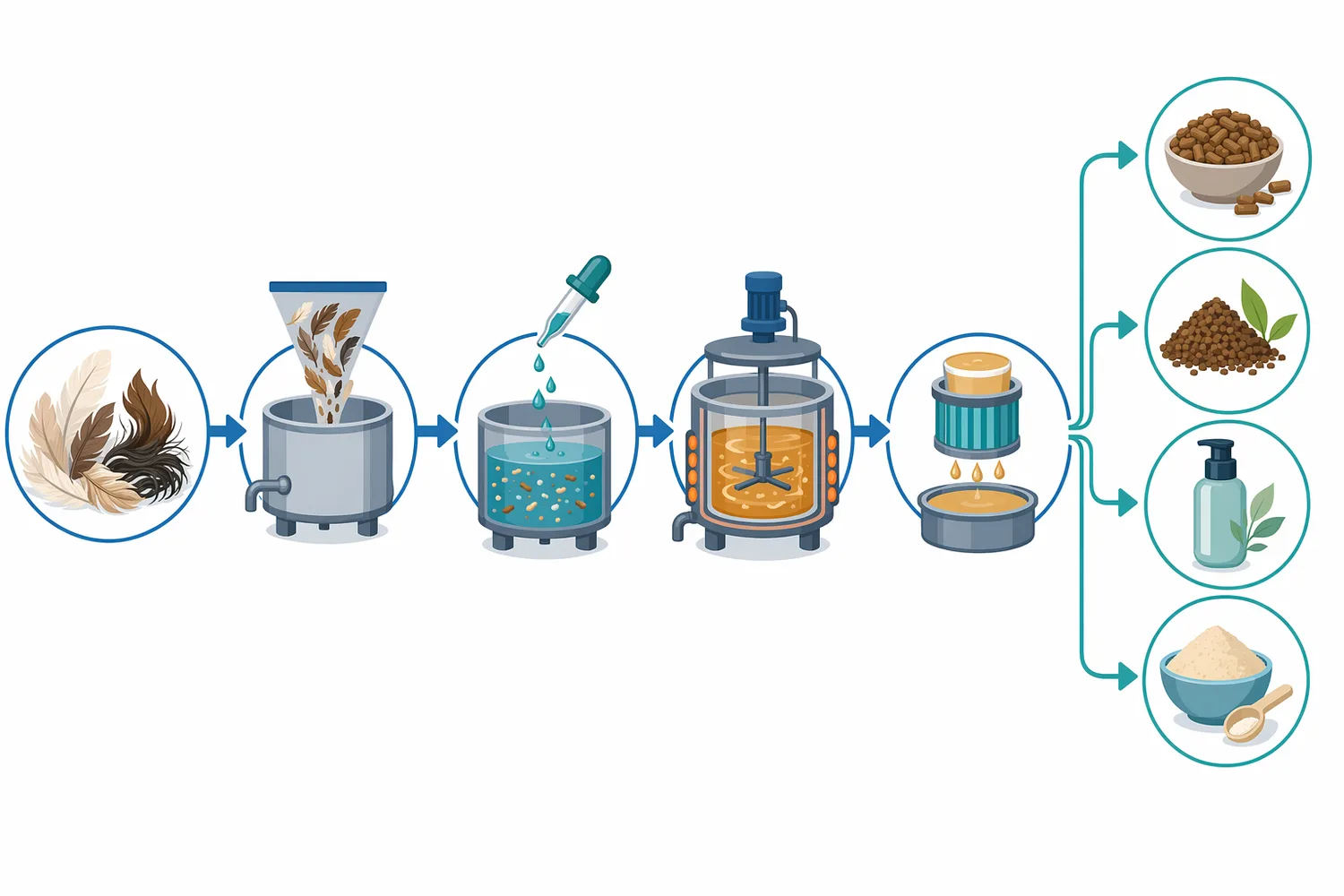
Halotolerant and other robust keratinases also show why the enzyme class is relevant to real processing streams. A halotolerant keratinase from Salicola marasensis was studied for efficient keratinolysis of poultry feather waste, indicating that keratinase research includes enzymes intended to function in more demanding process environments, not only in clean laboratory substrates [10].
In feed preparation, keratinase is valuable because animals benefit from amino acids, not from intact indigestible feather structure. Enzymatic treatment reduces the average size of keratin-derived protein fragments and can increase the fraction of soluble or more digestible peptides. That is the biochemical reason keratinase treatment is associated with improved amino acid availability in feather meal applications .
This does not mean keratinase automatically determines final animal performance on its own. Feed outcomes depend on the complete formula, species, age, processing history of the feather meal, inclusion level, and the balance of amino acids in the final ration. The strongest evidence supports the substrate transformation—keratin hydrolysis—while performance outcomes must be understood as the result of the complete feed system [1].
The same principle can apply beyond feathers when resistant protein limits nutrient access. Keratinase and keratinolytic proteases have been studied for improving bioaccessibility of other protein materials, including work examining keratinase use to enhance soybean protein bioaccessibility. In that context, the enzyme is used not because soybean is keratin, but because proteolysis can release smaller peptides and improve access to protein fractions that are otherwise less available [3].
For buyers considering a keratinase product in feed preparation, the practical point is simple: the enzyme acts before or during processing to convert resistant protein structures into smaller hydrolysis products. Enzymes.bio’s Keratinase product is positioned for animal feed preparation and feather meal hydrolysis, and it is sold online by the 1 kg unit for direct purchase and shipment .
Poultry processing generates large quantities of feathers, and feather waste has long been a challenge because it is bulky, slow to degrade naturally, and rich in nitrogen that can become an environmental burden if poorly managed. Microbial feather degradation research treats feathers as an underused protein resource rather than only waste, and keratinase is the central enzyme class enabling that conversion [1].
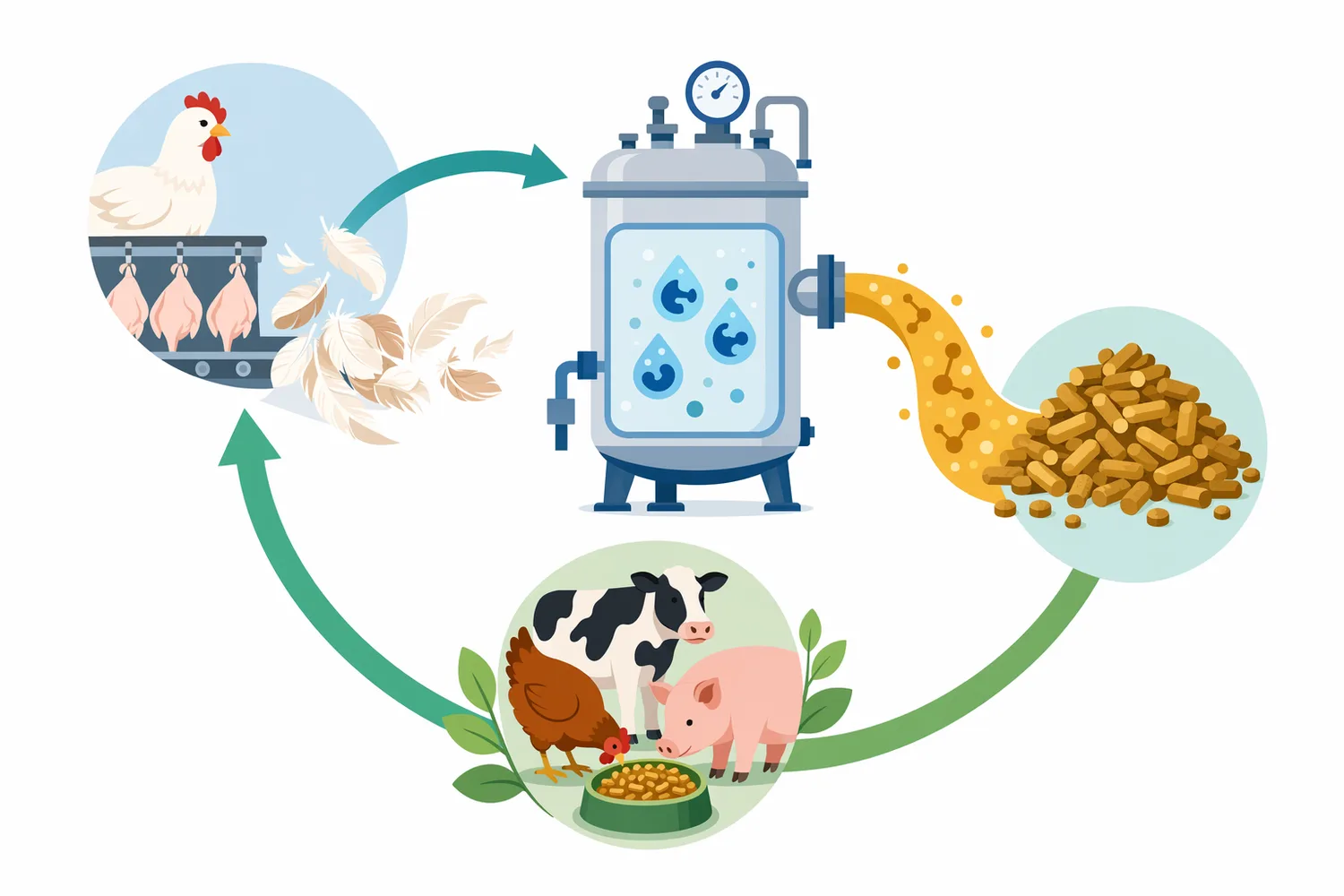
Keratinase-producing bacteria can use feather keratin as a carbon, nitrogen, or sulfur source, secreting enzymes and associated reducing systems that progressively break down the feather structure. This microbial logic has been translated into bioprocess thinking: instead of relying entirely on harsh chemical or high-energy treatment, keratinase can contribute to milder conversion of feather waste into hydrolysates suitable for feed or further processing [4].
Scale-up studies are important because feather degradation must work beyond small flasks to be useful. Fang and co-workers studied biodegradation of wool waste and keratinase production by Stenotrophomonas maltophilia BBE11-1 in a scale-up fermenter with different operating strategies, showing that keratinase production and keratinous waste conversion have been examined in process-oriented systems rather than only microbial screening [8].
Directed evolution studies add another layer of evidence. Zhang and co-authors used directed evolution to generate a more efficient keratinase variant to facilitate feather degradation, reflecting ongoing work to improve enzyme performance against real keratin substrates. This matters because feathers are heterogeneous: soft barbs, tougher rachis regions, and different pretreatment histories can respond differently to the same enzyme [11].
Keratinase also has a clear role in leather processing, especially dehairing. Hair removal in leather making requires weakening or degrading hair keratin while preserving the collagen-rich hide matrix. That distinction is critical: an enzyme that attacks collagen strongly can damage the hide, while an enzyme with keratinolytic activity and low collagenase activity is more suitable for selective hair removal [12].
A metallo-keratinase from a newly isolated Acinetobacter strain R-1 was reported with low collagenase activity and potential application in the leather industry. The mechanism is straightforward: keratinase helps break down the keratin in hair shafts and hair-root structures, loosening hair from the hide, while low collagen attack helps reduce unwanted damage to the leather-forming collagen network [12].
This application demonstrates why “protease” is not specific enough. In leather, the desired substrate is hair keratin, not the hide collagen. Keratinase enzymes with appropriate selectivity can support cleaner dehairing concepts, but the process must be controlled because excessive general proteolysis can reduce grain quality, tensile properties, or yield [12].
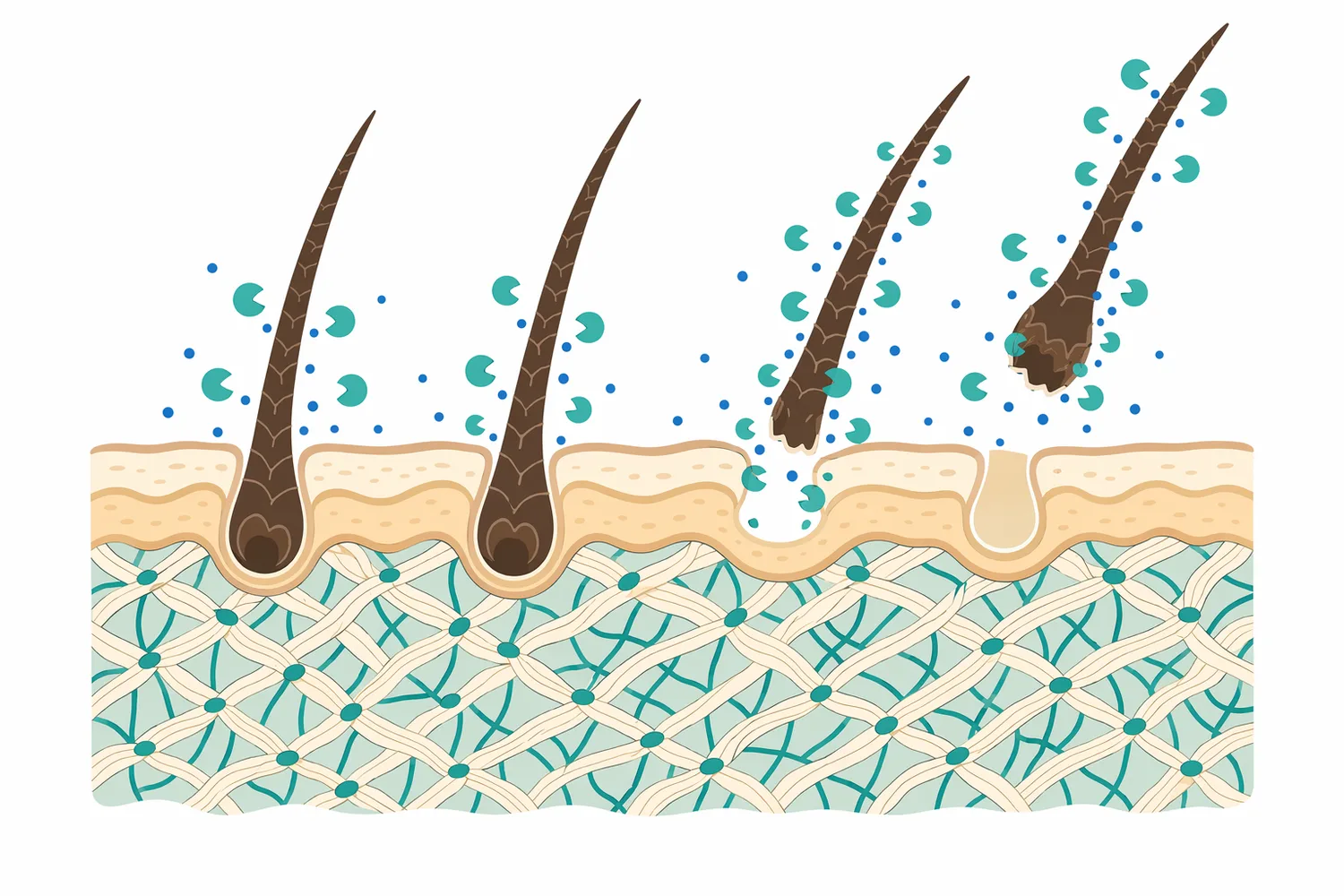
Keratinase has documented textile relevance because wool is a keratin fiber. Wool’s scale structure and crosslinked keratin matrix affect shrinkage, handle, dyeing behavior, and processing performance. Keratinase can modify the wool surface by hydrolyzing exposed keratin regions, which may change surface roughness, fiber friction, and accessibility to finishing treatments [5].
A study on immobilization of keratinase on chitosan-grafted β-cyclodextrin evaluated improved enzyme properties and included application of free keratinase in the textile industry. Immobilization research is useful because it shows how enzyme stability, reuse, and process behavior are studied for keratinase systems, even though a buyer using a supplied enzyme product does not need to run immobilization chemistry to benefit from keratin hydrolysis [13].
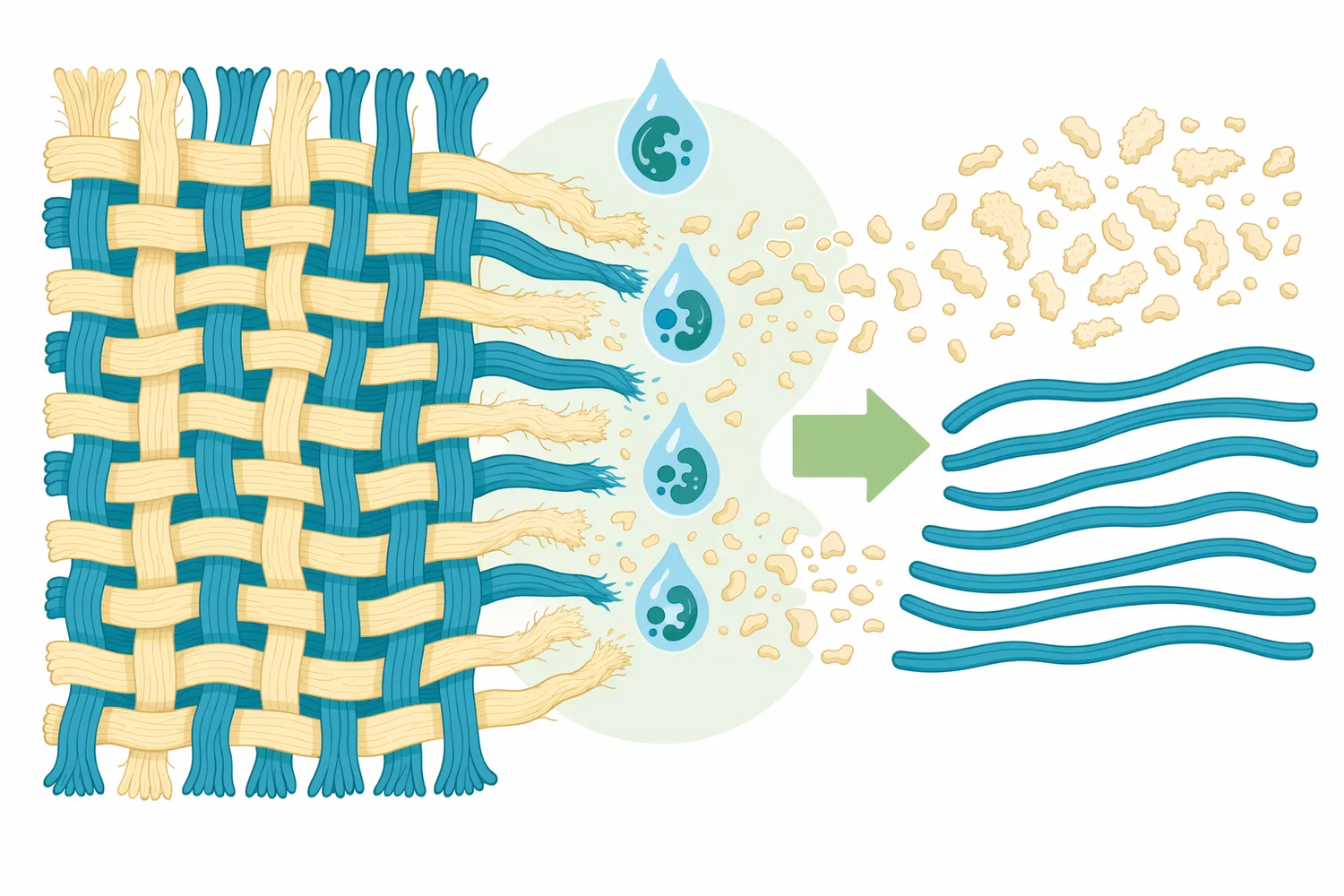
Keratinase also supports textile recycling where wool is blended with synthetic fibers. Navone and co-workers studied enzymatic fiber separation and recycling of wool/polyester fabric blends, using enzymatic degradation of the wool fraction as a way to separate materials that are otherwise difficult to recycle mechanically. In that case, keratinase attacks the wool keratin while polyester remains chemically distinct, enabling a route toward fiber separation [14].
This same substrate selectivity explains why keratinase must be matched to the intended material outcome. In feed, deeper hydrolysis may be desirable; in wool finishing, excessive hydrolysis could weaken fibers. Keratinase enzyme application therefore ranges from complete degradation of feather waste to controlled surface modification of wool, depending on the process goal [5].
Search interest around “keratinase shampoo,” “keratinase hair products,” “keratinase skin care,” and “keratinase treatment” often comes from the idea that an enzyme capable of degrading keratin might remove buildup, modify hair, or exfoliate keratinized skin. Scientifically, keratinase can act on hair and skin-associated keratin because those materials contain keratin, but industrial keratinase products are not the same as finished personal-care formulations [2].
A keratinase shampoo or cosmetic keratinase treatment would require formulation controls for skin compatibility, exposure time, enzyme concentration, preservation, irritation risk, and regulatory category. Enzymes.bio’s Keratinase is supplied as an enzyme product for animal feed preparation and industrial processing, not as a finished keratinase hair product, shampoo, or skin care product .
The biological caution is important because keratin is protective. Hair shafts, nails, and the stratum corneum of skin rely on keratin structure for barrier function and mechanical strength. An enzyme designed to hydrolyze keratin-rich industrial materials should not be assumed suitable for direct personal use simply because it acts on the same protein family [7].
Keratinase enzymes are also studied for detergents and cleaning because many difficult soils contain structural or denatured proteins. Hair fragments, skin flakes, animal residues, and other keratin-rich or protein-rich materials can resist simple surfactant cleaning; proteolytic enzymes help by cutting protein chains so residues detach, disperse, or rinse more easily [1].
The mechanism is again material-level hydrolysis. A protein soil adheres to a surface partly because large protein chains form films and networks. Protease action reduces the size and cohesion of those networks. Keratinase adds value where the residue includes keratin or keratin-like resistant material rather than only soluble food protein [2].
Detergent use remains formulation-dependent. Surfactants, builders, oxidants, pH, moisture, storage conditions, and wash temperature all affect enzyme performance. The scientific literature supports keratinase relevance in detergent and stain-removal concepts, but a finished detergent product requires compatibility work at the formulation level [1].
Keratinase production has been studied using many microbial sources, including Bacillus, Brevibacillus, Stenotrophomonas, Acinetobacter, Salicola, and other bacteria isolated from keratin-rich environments. These organisms are often found where feathers, hair, scales, or other keratin materials are present, because keratin-degrading capability gives them access to a nutrient source many microbes cannot easily use [6].
Isolation studies from fish-scale dumpsites and poultry-associated environments show the breadth of keratinase-producing organisms. Fish scales contain keratinous and collagenous structural materials, while poultry soil and feather waste provide selective pressure for microbes that secrete extracellular enzymes able to attack resistant protein substrates [15].
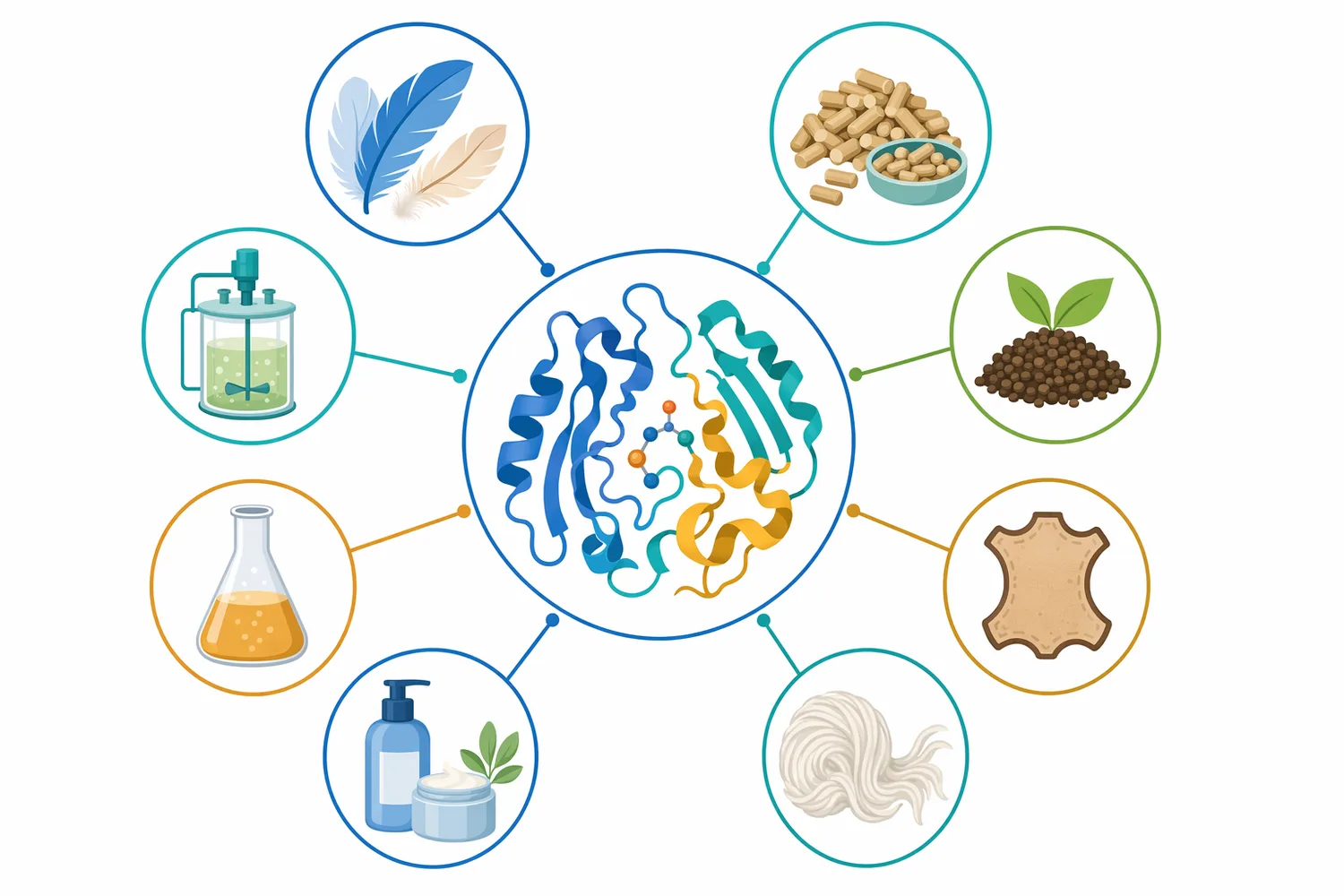
Research on keratinase enzyme production includes fermentation strategy, strain improvement, enzyme purification, immobilization, and protein engineering. The purpose is to improve practical features such as stability, substrate conversion, reusability, and performance on real feather or wool materials, while maintaining the core function: breaking down keratin into smaller, more useful protein fragments [11].
For an enzyme buyer, the takeaway is not that all keratinase enzymes are identical. It is that keratinase is a mature research category with multiple documented production routes and application studies. Enzymes.bio supplies a Keratinase product for direct online purchase in 1 kg units, with the commercial focus on animal feed preparation and feather meal hydrolysis .
Keratinase works when the enzyme can physically contact hydrated keratin under conditions that allow catalytic activity. In processing terms, that means the substrate must be wetted, mixed, and held long enough for enzyme molecules to adsorb onto the keratin surface, cut accessible bonds, and progressively expose new regions for further hydrolysis [5].
Particle size and pretreatment affect results because they change surface area and structural accessibility. Finely divided feather meal gives enzyme molecules more contact points than intact feathers, while prior heat or mechanical processing may either open the structure or, if too severe, create less favorable protein modifications. The enzyme does not “melt” keratin instantly; it works by repeated molecular cleavage events across available surfaces [3].
The desired endpoint also matters. Feather meal hydrolysis may aim for improved digestibility and peptide release; wool processing may aim for surface modification; textile recycling may aim for selective removal of the wool fraction from a blend; leather dehairing may aim for hair loosening while preserving collagen. These are different uses of the same fundamental keratinolytic chemistry [14].
Enzymes.bio keeps the buying process simple: Keratinase is purchased directly online by the 1 kg unit, payment is completed at checkout, and the order is processed and shipped as a packaged enzyme product. A Certificate of Analysis and Safety Data Sheet are supplied with the order, supporting routine receiving and handling documentation without requiring a separate technical procurement process .

Keratinase is a protein enzyme, and enzyme powders or aerosols should be handled with care because proteins can irritate or sensitize susceptible individuals. Standard industrial hygiene practices—avoiding inhalation of dust, preventing unnecessary skin and eye contact, and following the Safety Data Sheet supplied with the order—are appropriate for responsible handling .
The product should be understood as an industrial enzyme ingredient, not a consumer keratinase treatment, shampoo, hair product, or skin care product. Its function is to hydrolyze keratin-rich substrates in controlled processing environments such as feed preparation, feather meal treatment, and related industrial protein applications .
Keratinase is best supported where the substrate is genuinely keratin-rich and where the desired outcome is protein breakdown: poultry feather meal, feather waste valorization, wool modification, wool/polyester textile separation, leather dehairing, and resistant protein hydrolysis. Across these uses, the mechanism is consistent: the enzyme helps open a crosslinked keratin matrix and hydrolyzes long insoluble protein chains into shorter peptides and amino acid-containing fractions [2].
The strongest customer-facing case is animal feed preparation from feather meal. Keratinase directly addresses the main limitation of feather-derived protein: native keratin is abundant but poorly accessible. Enzymatic hydrolysis improves access to the protein fraction and supports more efficient use of a byproduct that otherwise requires harsher processing or disposal [4].
Enzymes.bio supplies Keratinase online in 1 kg units for buyers who want a practical enzyme product for feed-related keratin hydrolysis and industrial protein processing. The order is placed and paid for online, then processed and shipped with the accompanying Certificate of Analysis and Safety Data Sheet .
Sold by the 1 kg unit, in stock and ready to ship. Order directly on our store — pay online and we process your order. A Certificate of Analysis and Safety Data Sheet are included with every order.
Buy Keratinase →Numbered in order of first citation. Open-access sources, each verified reachable at publication; citation numbers in the text link here.