
Acid Protease Enzyme CAS 9040-76-0 is a leather-processing enzyme aid used where controlled protein hydrolysis is useful under acidic or mildly acidic conditions. In practical leather terms, it helps modify selected protein materials in the hide or wet blue matrix so fibers can open more evenly, unwanted protein residues can be reduced, and downstream tanning or post-tanning chemicals may penetrate more uniformly when the process is controlled [1].
Enzymes.bio supplies Leather Tanning Enzymes: Acid Protease Enzyme CAS 9040-76-0 for direct online purchase by the 1 kg unit. Buyers place the order and pay online; the order is then processed and shipped, with a Certificate of Analysis and Safety Data Sheet included with the order.
Acid protease is a proteolytic enzyme preparation associated with CAS 9040-76-0. Its function is to cleave peptide bonds in proteins, converting larger protein structures into smaller peptide fragments. In leather processing, that activity is valuable only when it is controlled, because the hide is not a single uniform protein substrate; it is a layered biological material containing collagen, elastin, keratin-containing hair structures, albumins, globulins, natural interfibrillary proteins, fats, and other ground substances [2].
The key leather-making challenge is selective modification. Collagen is the main structural protein that becomes leather after tanning, so the goal is not to digest the hide. Instead, protease action is used to loosen, remove, or modify non-structural and interfibrillary proteins that can block fiber opening, restrict chemical penetration, or contribute to uneven handle. When the enzyme cuts accessible protein chains around fiber bundles, those materials become more soluble or easier to displace, and the collagen fiber network can separate more cleanly during mechanical action in the drum [1].
Acid protease should therefore be understood as a process aid, not as a tanning agent. Tanning itself is the stabilization of collagen by tanning chemistry, such as chromium salts, vegetable tannins, aldehyde systems, or other tanning agents. Acid protease may support preparation, bating-style modification, pickling-adjacent processing, wet blue re-bating concepts, or post-tanning uniformity, but it does not replace the chemistry that converts raw hide into leather [3].
Leather processing moves through changing chemical environments. Early beamhouse operations often include alkaline steps, while later stages such as pickling and chrome tanning are acidic. A protease designed for acidic or mildly acidic conditions is relevant because it can retain practical protein-cutting function in process windows where alkaline proteases are less suited. This matters when the processor wants proteolytic modification without returning the material to strongly alkaline conditions [1].
Acidic-stage proteolysis can be useful because hides and semifinished leather still contain protein barriers after earlier processing. Some proteins remain in interfibrillary spaces; others are partially modified but not fully removed. If they stay in place, they may slow diffusion of tanning agents, retanning chemicals, dyes, or fatliquors. By partially hydrolyzing selected accessible proteins, acid protease can help reduce these diffusion barriers and make the internal structure more receptive to later chemistry [1].
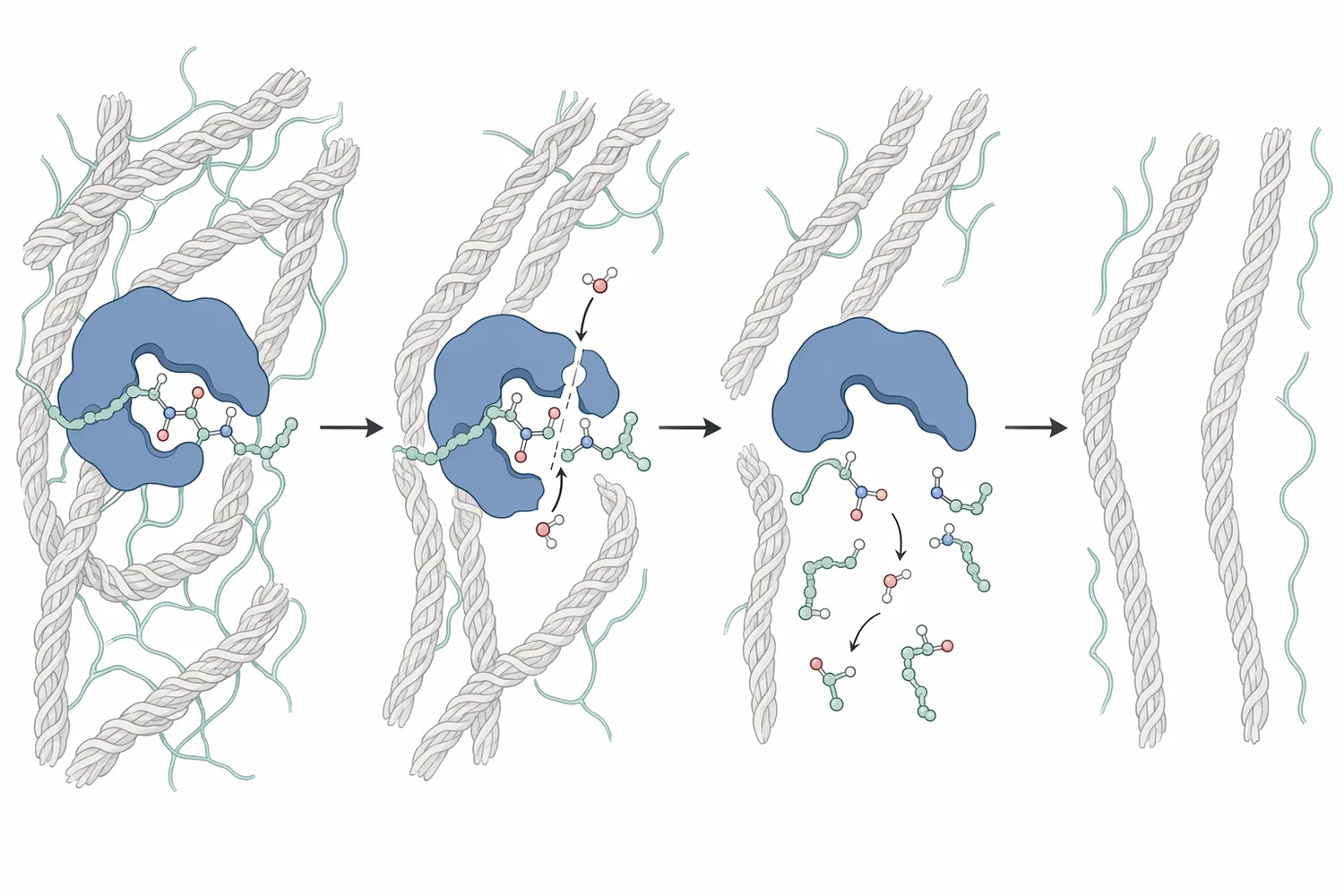
The same mechanism explains why overuse must be avoided. Collagen is also a protein, and collagen can be affected when protease treatment is too strong, too long, too concentrated at the surface, or poorly matched to the process stage. Studies on enzymatic leather processing emphasize that protease specificity and enzyme penetration are central to obtaining useful effects without damaging the desirable leather-forming matrix [2].
A hide is built around collagen fiber bundles. Collagen molecules assemble into fibrils, fibrils group into fibers, and those fibers form a dense three-dimensional network. The grain layer is tighter and more delicate, while deeper corium regions contain larger fiber bundles. Between these structures are non-collagenous proteins and other biological materials that influence swelling, softness, opening, and penetration of process chemicals [2].
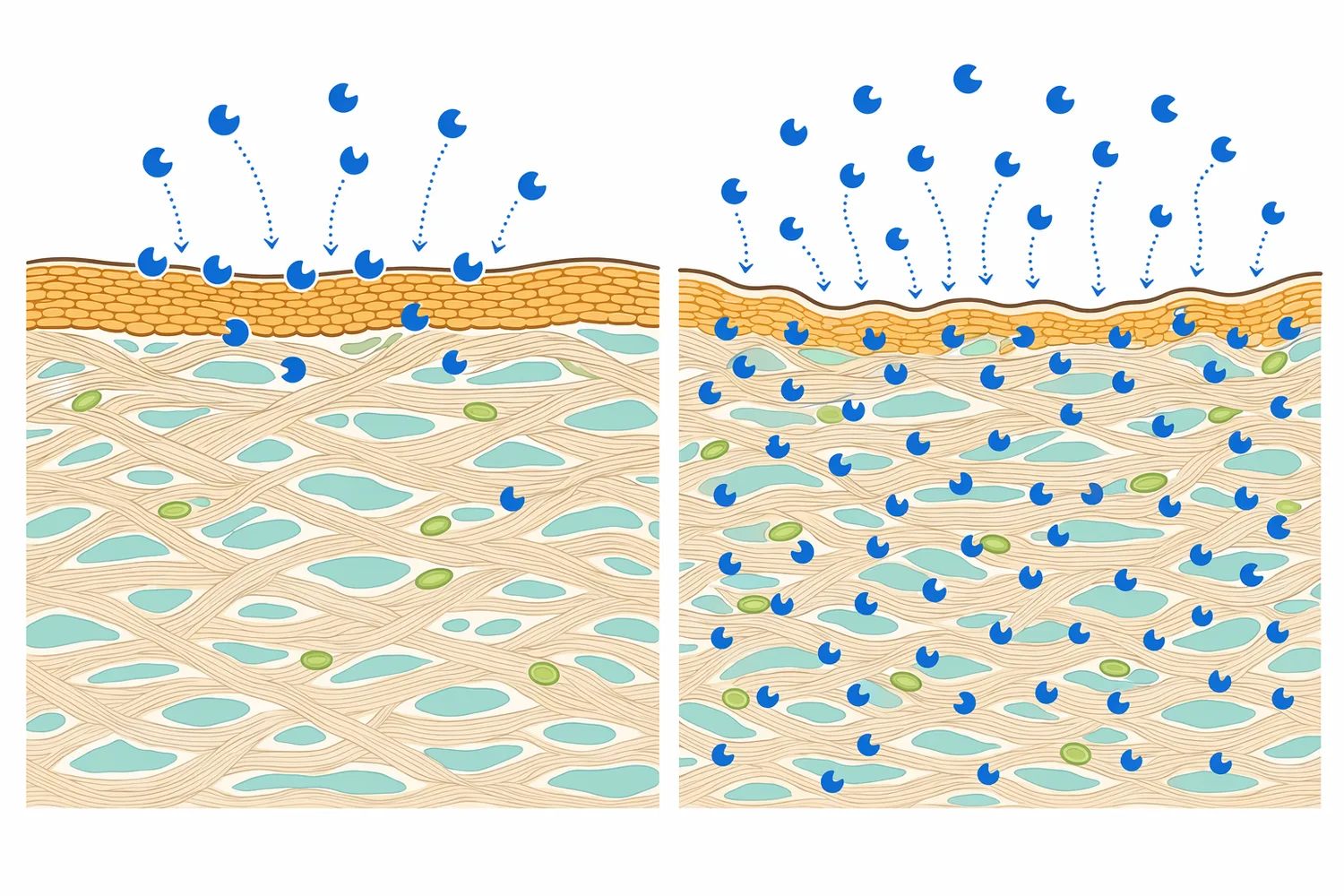
Acid protease acts primarily where protein chains are accessible to water and enzyme molecules. It does not cut through the hide like a chemical solvent. Instead, the enzyme diffuses into hydrated spaces, adsorbs near susceptible protein regions, and hydrolyzes peptide bonds that are physically available. As those protein chains are shortened, they lose some of their ability to bind surrounding structures together, and the fragments can move into the float more easily during drum action [1].
This is why hydration, prior beamhouse treatment, mechanical action, and process timing all affect the outcome. If the enzyme remains mostly near the surface, the grain can be over-modified while the interior remains insufficiently opened. If penetration is more even, the same basic chemistry can give a more uniform effect across the cross-section. Research on protease permeation in hide has specifically linked enzyme distribution with bating effectiveness and with the risk of excessive surface enzymolysis [2].
The practical effect of acid protease begins with peptide-bond hydrolysis. A protein chain is held together by peptide links between amino acids. Protease active sites bind to susceptible regions of those chains and add water across the peptide bond, splitting one longer chain into two shorter fragments. Repeated cuts reduce molecular size, weaken gel-like or adhesive protein networks, and increase the mobility or solubility of the resulting fragments [4].
In the hide matrix, this molecular change translates into physical changes. Interfibrillary proteins that previously filled spaces between collagen bundles become less capable of binding water and holding fibers together. Fiber bundles can separate more readily under drum movement, giving improved opening and a softer handle. At the same time, diffusion paths become less obstructed, so tanning and post-tanning chemicals can move more uniformly through the leather cross-section [1].
The change is not simply “softening.” It is a controlled reduction in selected protein barriers. Good enzyme action preserves the collagen network that gives leather its strength while reducing the non-structural materials that make processing uneven. Poorly controlled enzyme action can move beyond that useful zone and begin weakening the matrix itself. That is why the literature repeatedly treats protease specificity, charge interactions, and penetration behavior as critical parts of enzymatic leather technology [2].
Different proteases are used in leather processing because different process stages have different chemical environments and different target proteins. Acid protease is most relevant when the process is acidic or mildly acidic. Neutral proteases are associated with moderate conditions, while alkaline proteases are more commonly discussed in beamhouse operations such as dehairing and bating under alkaline conditions. The strongest published evidence for enzymatic dehairing is generally associated with alkaline or keratin-active proteases, not acid protease [5].
| Protease type | Typical leather-processing context | Main practical role | Key technical caution |
|---|---|---|---|
| Acid protease | Acidic or mildly acidic stages, pickling-adjacent concepts, wet blue bating or re-bating concepts | Controlled hydrolysis of accessible proteins under lower-pH process conditions | Must avoid excessive collagen modification, especially when enzyme action is concentrated near the surface |
| Neutral protease | Moderate process environments where mild protein modification is desired | Gentle bating-style action and controlled softening | Effect depends strongly on hide condition, penetration, and exposure |
| Alkaline protease | Beamhouse operations, especially dehairing and conventional bating contexts | Protein removal, hair-loosening support, fiber opening under alkaline conditions | Dehairing selectivity is critical because keratin, epidermal proteins, and collagen-adjacent structures respond differently |
| Keratin-active protease systems | Enzymatic unhairing and hair-saving dehairing strategies | Attack hair-root and keratin-associated structures to loosen hair | Evidence from alkaline dehairing should not be automatically transferred to acidic tanning-adjacent use |
This comparison matters because “protease” is not one interchangeable function in leather. A protease used for unhairing under alkaline conditions is not necessarily appropriate for acidic wet blue modification, and evidence from one process stage should be applied cautiously to another. Acid Protease Enzyme CAS 9040-76-0 is best positioned around acidic-stage protein modification rather than as a general substitute for alkaline dehairing enzymes [1].
The broad evidence base for proteases in leather processing is strong. Proteases are widely studied for soaking, dehairing, bating, softening, and cleaner processing because they can modify biological substrates under milder conditions than many conventional chemical treatments. Research on enzymatic dehairing shows that protease movement into the hide and regulation of charge interactions affect how successfully the enzyme reaches its substrate and how selectively it acts [2].
Evidence for acid protease specifically is more focused but directly relevant. A study on acid protease in the wet blue bating process examined how enzymatic treatment affected leather production after chrome tanning. The reported effects included changes in collagen behavior, improved wet blue processing characteristics, and better performance in downstream operations such as dye penetration and chromium-related post-treatment behavior [1].
That same evidence also supports a cautious interpretation. Acid protease can influence collagen-containing semifinished leather, which is exactly why it can be useful and why process control matters. The desired result is limited modification: enough hydrolysis to improve opening, uptake, or uniformity, but not so much that the structural collagen network is weakened or the grain is damaged [1].
Newer enzyme-assisted leather research also points to the importance of delivery and controlled contact. For example, studies on protease-based unhairing systems and assisted dehairing approaches are aimed at improving how enzymes interact with hair and hide structures while reducing reliance on harsher chemical loads. Although those studies often focus on alkaline or unhairing applications rather than acid protease, they reinforce the same principle: enzyme location, substrate access, and controlled reaction intensity determine the quality of the leather outcome [6].
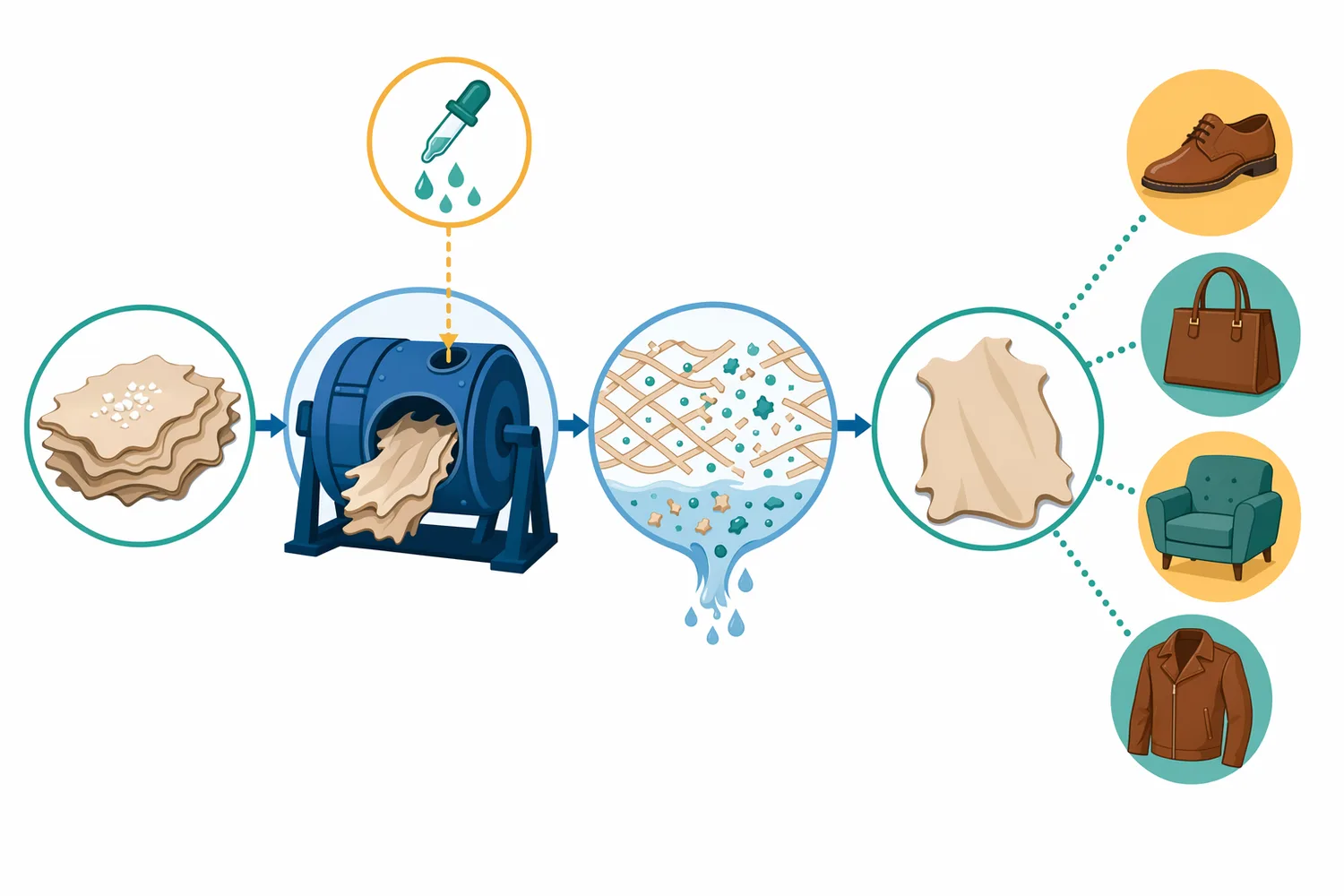
Wet blue leather is chrome-tanned semifinished leather. It is already stabilized compared with raw hide or pelt, but it is still a collagen-based matrix with internal structure that can influence retanning, dyeing, fatliquoring, softness, and final article performance. Acid protease is relevant here because wet blue and related post-tanning operations occur in acidic to mildly acidic environments where acid-compatible enzymatic action can be more practical than alkaline protease treatment [1].
In wet blue bating or re-bating concepts, the enzyme can hydrolyze accessible protein regions and modify the internal fiber matrix after chrome tanning. The practical intention is not to remove large amounts of material, but to improve uniformity and responsiveness. When selected protein barriers are reduced, water movement and chemical diffusion may improve, which can support more even dye penetration and more consistent post-tanning effects [1].
The 2020 wet blue bating research is especially relevant because it connects acid protease treatment with measured leather-processing outcomes rather than only general protein hydrolysis. The study reported that acid protease affected collagen during wet blue treatment and was associated with improvements in properties such as shrinkage behavior, water vapor absorption, chromium exhaustion during re-chroming, and dye penetration. Those outcomes align with the practical role of acid protease as a controlled post-tanning process aid [1].
The important point for buyers is that wet blue enzymatic treatment is a precision application. The enzyme changes the substrate; it does not simply “condition” the leather in a cosmetic way. The benefit comes from carefully limited hydrolysis of accessible protein structures, and the risk comes from allowing that hydrolysis to proceed too far or too unevenly [1].
Pickling prepares hides for certain tanning systems, especially chrome tanning, by acidifying the pelt and creating conditions under which tanning agents can penetrate. Acid protease is technically relevant to pickling-adjacent operations because it is designed for lower-pH protein hydrolysis. In this context, the enzyme may help modify residual proteins or diffusion barriers before or around tanning chemistry, but it should not be described as the tanning chemistry itself [3].
The scientific evidence for acid protease in pickling is more limited than the evidence for proteases in dehairing and conventional bating. That distinction is important. Leather research strongly supports proteases as a class, and the wet blue acid-protease work is directly relevant, but acid protease should be positioned conservatively for pickling-adjacent use: as a controlled aid for protein modification under acidic conditions, not as a universal replacement for established pickling or tanning systems [1].
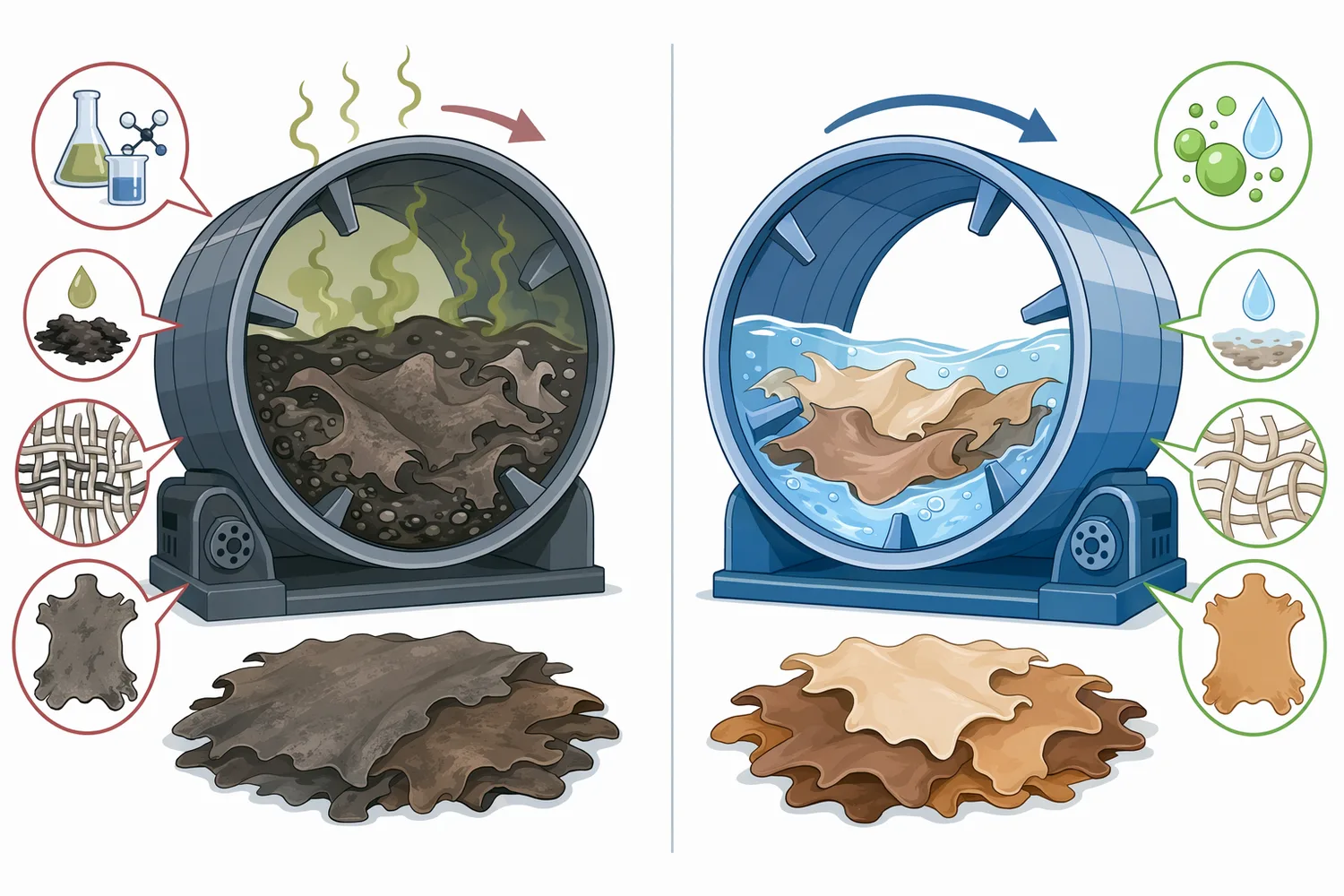
Mechanistically, the potential benefit is clear. If residual non-collagenous proteins restrict penetration, limited acid protease hydrolysis can shorten those proteins and reduce obstruction within the matrix. The tanning agent then encounters a more accessible fiber structure. However, the collagen network must remain sufficiently intact to be stabilized by the tanning agent, which is why acidic enzyme use should be treated as controlled partial hydrolysis rather than aggressive digestion [2].
Acid protease is not the same as an alkaline dehairing protease, but the broader enzymatic dehairing literature helps explain why enzymes are valuable in leather processing. Conventional dehairing often relies on strong alkaline and sulfide chemistry to break down hair-root and epidermal structures. Enzymatic alternatives and enzyme-assisted systems aim to loosen hair and reduce environmental burden by targeting protein structures more selectively [5].
Research on protease-assisted dehairing highlights the importance of enzyme penetration into animal hide. If protease permeates poorly, it may act mainly at the surface, causing uneven results. If charge conditions and substrate access are better controlled, enzyme distribution improves and the process can become more effective. These findings are directly relevant to acid protease because the same physical constraints apply: an enzyme must reach the right protein regions inside a complex hide matrix [2].
Recent work on protease systems for unhairing and soft leather production also illustrates the industry’s interest in enzyme delivery, controlled action, and lower-impact processing. Liposome-encapsulated protease, for example, has been studied as a way to combine unhairing and softness benefits while managing enzyme interaction with the substrate. Although that is not the same product or process as acid protease tanning support, it reinforces the move toward enzyme-assisted leather processing where specificity and contact control are central [6].
Fiber opening is one of the most important practical outcomes of controlled protease treatment. When interfibrillary proteins are partially hydrolyzed, collagen bundles can separate more easily under mechanical action. This can reduce tightness, improve softness, and support more uniform chemical access across the leather thickness. The effect is physical as well as chemical: shorter protein fragments no longer bind the fiber structure as strongly as the original larger proteins [1].
Softness and handle depend on how much the fiber network is opened without damaging the load-bearing collagen architecture. A useful acid protease treatment can make the leather feel less tight because the bundles move more freely. Excessive hydrolysis, however, can reduce strength or affect grain quality. This is why enzymatic leather processing is often described in terms of specificity and controlled permeation rather than simply “more enzyme gives more effect” [2].
Dye penetration can also improve when diffusion barriers are reduced. The wet blue acid-protease study reported improved dye penetration after enzymatic treatment, which is consistent with the mechanism of opening pathways through the matrix. A dye molecule still depends on pH, charge, fixation chemistry, and retanning system, but a more uniformly opened structure can reduce the tendency for surface-heavy coloration or uneven cross-sectional penetration [1].
Chromium-related behavior may also be influenced in post-tanning contexts. In the wet blue bating study, acid protease treatment was associated with improved chromium exhaustion during re-chroming. This does not mean the enzyme tans leather; rather, it suggests that controlled protein modification can make the collagen matrix more responsive to subsequent chromium chemistry under the conditions studied [1].
Leather processing faces ongoing pressure to reduce harsh chemical loads, wastewater burden, and variability while maintaining leather quality. Enzyme-assisted processing is one route toward that goal because enzymes can target biological materials under comparatively mild conditions. In dehairing research, proteases are studied as alternatives or complements to conventional chemical systems, with the aim of reducing the environmental impact of beamhouse operations [5].
Acid protease contributes to this broader cleaner-processing direction in a different way. It is not primarily a sulfide-lime replacement for unhairing; instead, it supports controlled protein hydrolysis in lower-pH stages. Where an acidic-stage enzyme treatment helps improve penetration or uniformity, it may reduce the need for harsher reworking or excessive chemical correction later in the process. The environmental value is therefore linked to process fit and controlled use, not to a claim that acid protease eliminates conventional tanning chemistry [1].
Leather by-products and collagen-containing wastes are also increasingly studied for enzymatic hydrolysis and valorization. Research on leather waste and collagen hydrolysis shows that proteases can convert collagen-rich materials into smaller fragments for downstream uses, which demonstrates the strong protein-modifying power of these enzymes. In finished leather production, that same power must be deliberately limited so the enzyme supports quality rather than digesting valuable structure [7].
Acid Protease Enzyme CAS 9040-76-0 can support controlled protein hydrolysis under acidic or mildly acidic leather-processing conditions. It may be relevant in acidic bating concepts, pickling-adjacent treatment, wet blue bating or re-bating, and post-tanning uniformity work where partial protein modification is desired. Its practical value comes from changing accessible protein structures that influence fiber opening, penetration, softness, and uniformity [1].
It should not be expected to tan leather by itself. Tanning requires stabilization of collagen through tanning agents and the process chemistry that fixes or complexes those agents within the collagen matrix. Acid protease can help prepare or modify the matrix, but it does not provide the crosslinking or stabilization function of chrome, vegetable, aldehyde, or other tanning systems [3].

It should also not be treated as a direct substitute for alkaline dehairing proteases or keratinases. Enzymatic dehairing targets hair-root and epidermal structures under conditions very different from acidic wet blue or pickling-adjacent processing. The broad protease principle is shared, but the substrate access, process pH, target proteins, and quality risks are different [5].
Most importantly, acid protease should not be over-applied. The useful zone is controlled partial hydrolysis. Once the enzyme begins modifying structural collagen too aggressively, the same chemistry that improves opening can begin to weaken the leather. This is why leather enzyme research places so much emphasis on permeation, specificity, and avoiding excessive surface action [2].
Leather Tanning Enzymes: Acid Protease Enzyme CAS 9040-76-0 from Enzymes.bio is supplied for buyers who want a direct online purchase route for a 1 kg enzyme product. After online payment, the order is processed and shipped, and the accompanying Certificate of Analysis and Safety Data Sheet are provided with the order.
The most accurate way to view this product is as an acidic-stage protease process aid for leather applications. It is suitable for consideration where controlled protein hydrolysis is desired under acidic or mildly acidic conditions, especially in bating-style, wet blue, pickling-adjacent, or post-tanning uniformity concepts. The strongest research support is for proteases broadly in leather processing, with direct acid-protease evidence in wet blue bating and a more cautious evidence base for pickling-adjacent use [1].
For buyers, the practical takeaway is straightforward: acid protease changes leather substrates by cutting accessible protein chains. When controlled, that action can improve fiber opening, softness, penetration, and uniformity. When uncontrolled, it can affect collagen and leather strength. That balance is exactly why Acid Protease Enzyme CAS 9040-76-0 is best described as a controlled leather-processing enzyme aid, not a standalone tanning chemistry or a universal replacement for other leather enzymes [2].
Sold by the 1 kg unit, in stock and ready to ship. Order directly on our store — pay online and we process your order. A Certificate of Analysis and Safety Data Sheet are included with every order.
Buy Leather Tanning Enzymes: Acid Protease Enzyme Cas 9040-76-0 →Numbered in order of first citation. Open-access sources, each verified reachable at publication; citation numbers in the text link here.