
Liquid Pectinase Enzyme CAS 9032-75-1 is a liquid pectin-degrading enzyme preparation used to break down pectin-rich plant material, helping processors reduce viscosity, improve juice and wine clarification, support pressing, and release soluble plant components. Enzymes.bio supplies this product directly online in 1 kg units; buyers complete payment online, after which the order is processed and shipped with a Certificate of Analysis and Safety Data Sheet included. The product is positioned for fruit and vegetable processing, wine and cider, beverage clarification, and plant extract applications where pectin limits separation or clarity .
Pectinase is not a single narrow reaction in practical processing; it is the common industrial name for enzymes that act on pectin, a plant cell-wall polysaccharide concentrated in the primary wall and middle lamella of fruits, vegetables, peels, pulps, stems, and many botanical raw materials. Pectin behaves like a hydrated cement between plant cells: it binds water, increases viscosity, stabilizes suspended solids, and can trap juice, pigments, aromas, phenolics, and other soluble compounds inside partially intact tissue structures [1].
When pectinase is added to a fruit mash, grape must, apple pulp, berry slurry, citrus peel extract, or botanical suspension, the enzyme attacks the pectin network rather than simply “thinning” the material by dilution. The pectin chains are cut, de-esterified, or otherwise modified depending on the enzyme activities present, which weakens the gel-like matrix that holds cells together. As the pectin network loses molecular size and structure, the pulp releases liquid more readily, suspended particles settle or filter more easily, and the process stream often becomes less viscous and easier to clarify [2].
This is why pectinase is widely used in juice processing, wine and cider production, plant extraction, and other pectin-rich systems. The practical value is especially clear in materials where pectin causes cloudiness, slow filtration, poor pressing, unstable haze, thick puree texture, or incomplete extraction from plant cells. Reviews of fruit-processing applications describe pectinase as a useful tool for increasing juice extraction, improving clarification, and reducing pectin-related problems in finished beverages [1].
Enzymes.bio supplies Liquid Pectinase Enzyme CAS 9032-75-1 as a liquid enzyme product for industrial and food-processing use. The buying model is straightforward: the product is sold directly online by the 1 kg unit, payment is completed online, and the order is then processed and shipped. The accompanying Certificate of Analysis and Safety Data Sheet support routine receiving and workplace handling documentation without requiring the buyer to request a separate technical consultation .
The product is intended as a processing aid for pectin-containing plant materials rather than a consumer ingredient. Typical use contexts include fruit and vegetable juice processing, wine and cider clarification, beverage transparency improvement, puree or pulp viscosity adjustment, and botanical extraction. These are applications where pectinase can convert a difficult, gelatinous, or cloudy plant matrix into a stream that separates, presses, filters, or clarifies more predictably .
Because Enzymes.bio is a supplier, the product information should be read as application-oriented guidance rather than as a custom process design service. The science behind pectinase is well established, but the visible result in a factory or pilot process depends on the raw material, degree of ripeness, particle size, mixing, solids level, contact time, downstream separation method, and final product target. Those variables explain why pectinase is best understood as a controllable processing tool, not as a one-condition-fits-all additive [1].
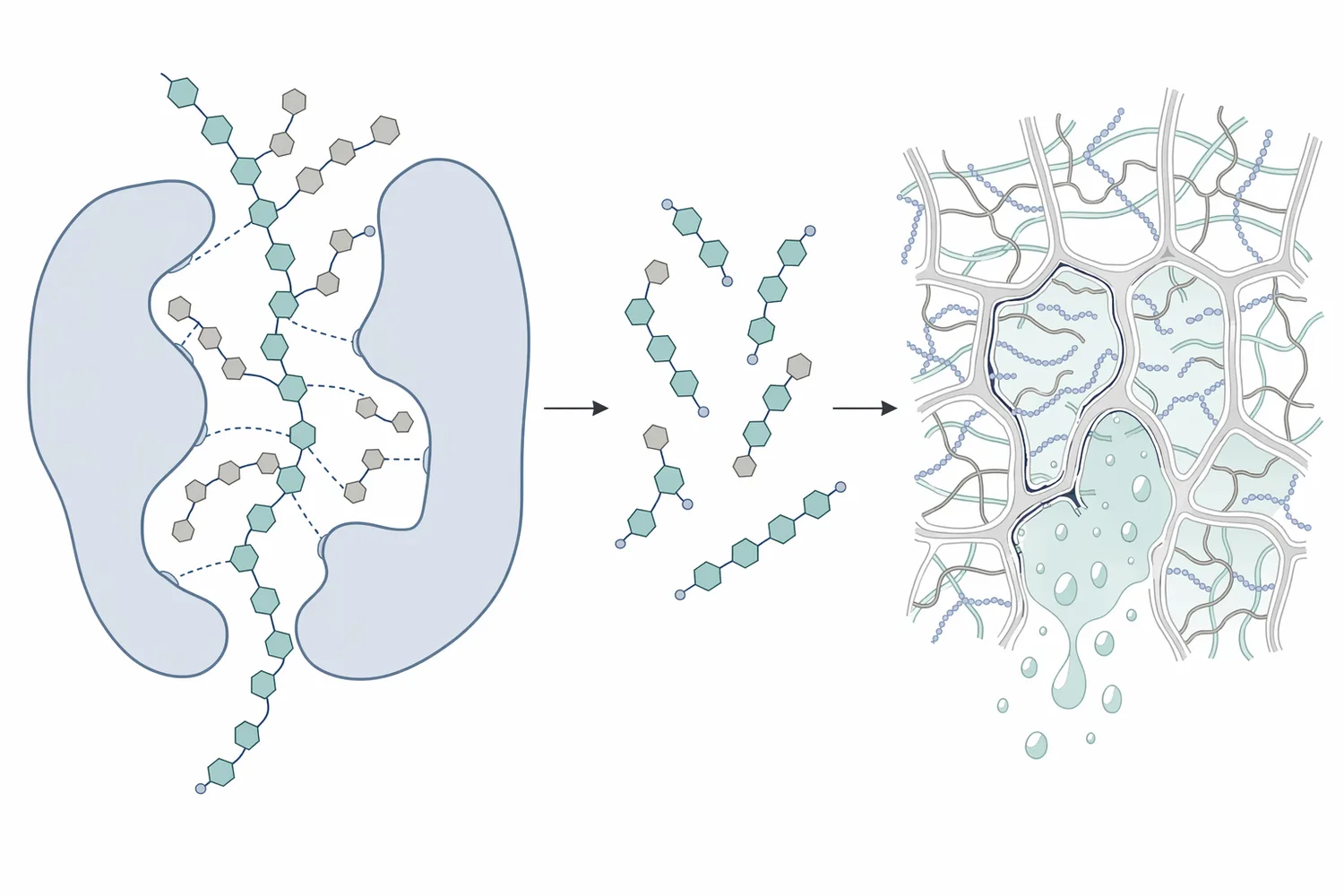
Pectin is a complex acidic polysaccharide, with major regions built around galacturonic acid residues and side-chain structures that vary by fruit, tissue, maturity, and processing history. In intact plant tissue, pectin hydrates strongly and forms a matrix that contributes to firmness, pulp body, suspended cloud, and resistance to liquid release. Pectinases reduce those effects by changing pectin’s chain length, charge pattern, solubility, and ability to form gels or stabilize colloidal particles [1].
Different pectinolytic activities act in different ways. Polygalacturonases hydrolyze glycosidic bonds in pectic chains, shortening the backbone. Pectin lyases and pectate lyases cleave pectin chains by a different reaction pathway, also reducing chain length and weakening the polymer network. Pectin esterases remove methyl ester groups, changing pectin’s charge and making it more accessible to other pectin-degrading enzymes. In a real fruit mash or botanical slurry, these actions can combine to loosen the cell wall, reduce water-binding, and release trapped liquid [3].
| Pectinolytic activity | Main action on pectin | What changes in the process stream | Typical processing relevance |
|---|---|---|---|
| Polygalacturonase-type activity | Cuts pectic backbone chains by hydrolysis | Lower average pectin chain length; weaker gel structure | Juice release, viscosity reduction, clarification |
| Pectin lyase-type activity | Cleaves methylated pectin chains | Faster disruption of intact pectin networks in some fruit systems | Fruit mash maceration, clarification, aroma and color release |
| Pectate lyase-type activity | Cleaves de-esterified pectate regions | Breakdown of negatively charged pectin regions | Plant tissue softening and cell-wall loosening |
| Pectin esterase-type activity | Removes methyl ester groups from pectin | Changes charge pattern and enzyme accessibility | Supports staged pectin breakdown when compatible activities are present |
The visible effect is physical as much as chemical. A pectin-rich mash can behave like a hydrated sponge: liquid remains held in the cell-wall network, particles remain suspended, and filters blind quickly. After pectinase action, the “sponge” is partially dismantled. Water and soluble solids are less tightly retained, pulp particles can compact differently, and filtration or settling has less pectin-driven resistance [2].
Pectin-related haze forms because soluble and colloidal pectin can keep fine particles suspended and can interact with other juice components. In apple, pear, berry, tropical fruit, citrus, and mixed-fruit systems, this can cause persistent turbidity even after coarse solids are removed. Pectinase reduces haze by breaking the long pectin chains that stabilize these particles, making the liquid less viscous and allowing suspended material to settle, centrifuge, or filter more readily [1].
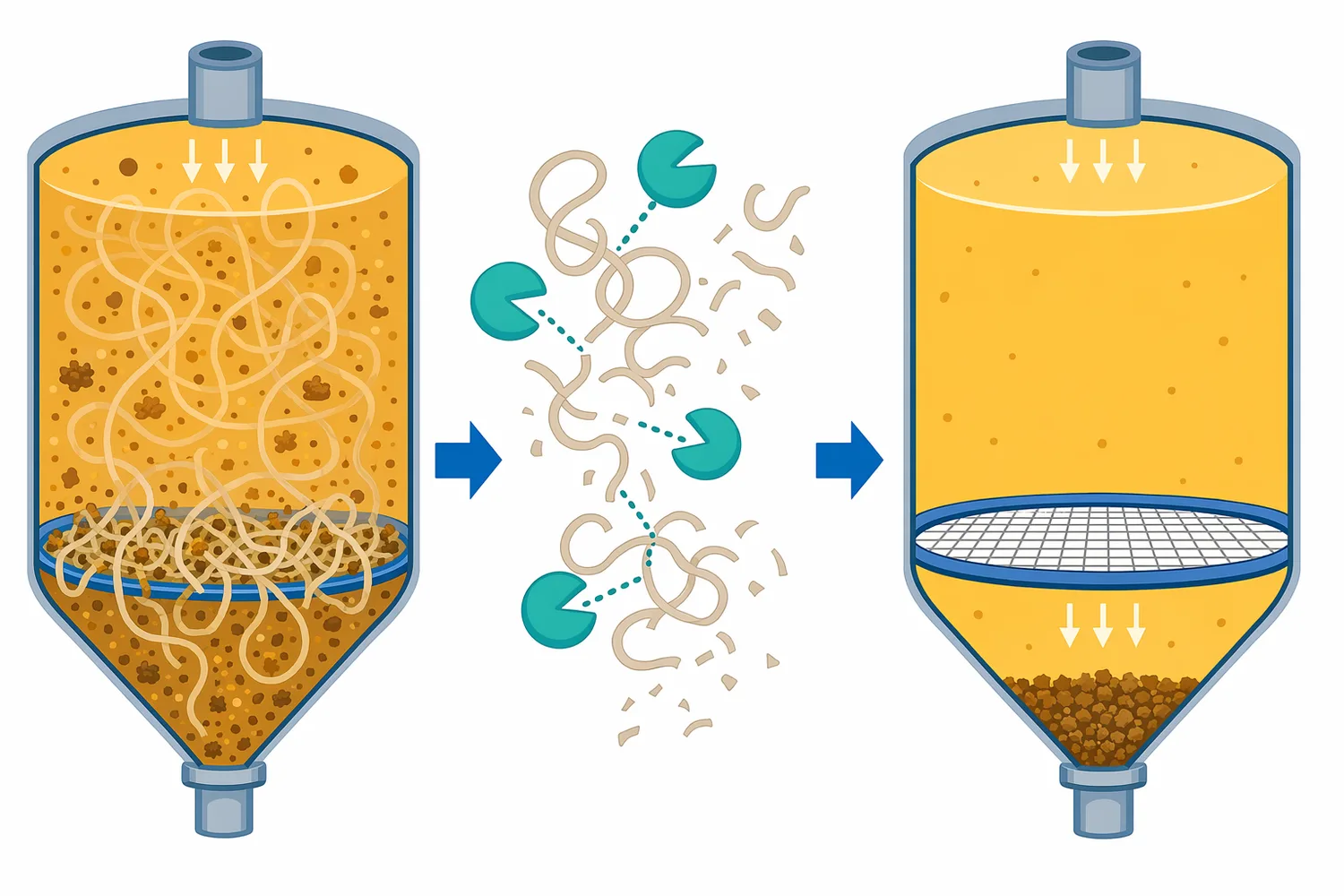
In clarification, the enzyme does not need to remove every plant particle to be valuable. The key improvement is that pectin no longer acts as a strong stabilizing colloid. Once the pectin network is weakened, clarification aids, filtration media, centrifuges, decanters, or settling tanks can work against a less gel-like liquid. Studies on extracellular pectinase from Chryseobacterium indologenes specifically evaluated its application in fruit juice clarification, reflecting the continuing research interest in pectinase as a practical clarification tool [2].
The same mechanism explains why pectinase is useful before filtration. Long hydrated pectin molecules can clog filter structures and create compressible cakes that slow flow. By reducing polymer size and disrupting the gel-forming character of pectin, pectinase can improve filterability and help a process move from slow, cloudy separation toward clearer liquid recovery. Reviews of pectinase use in fruit industries consistently connect enzyme treatment with improved clarification and processing performance [1].
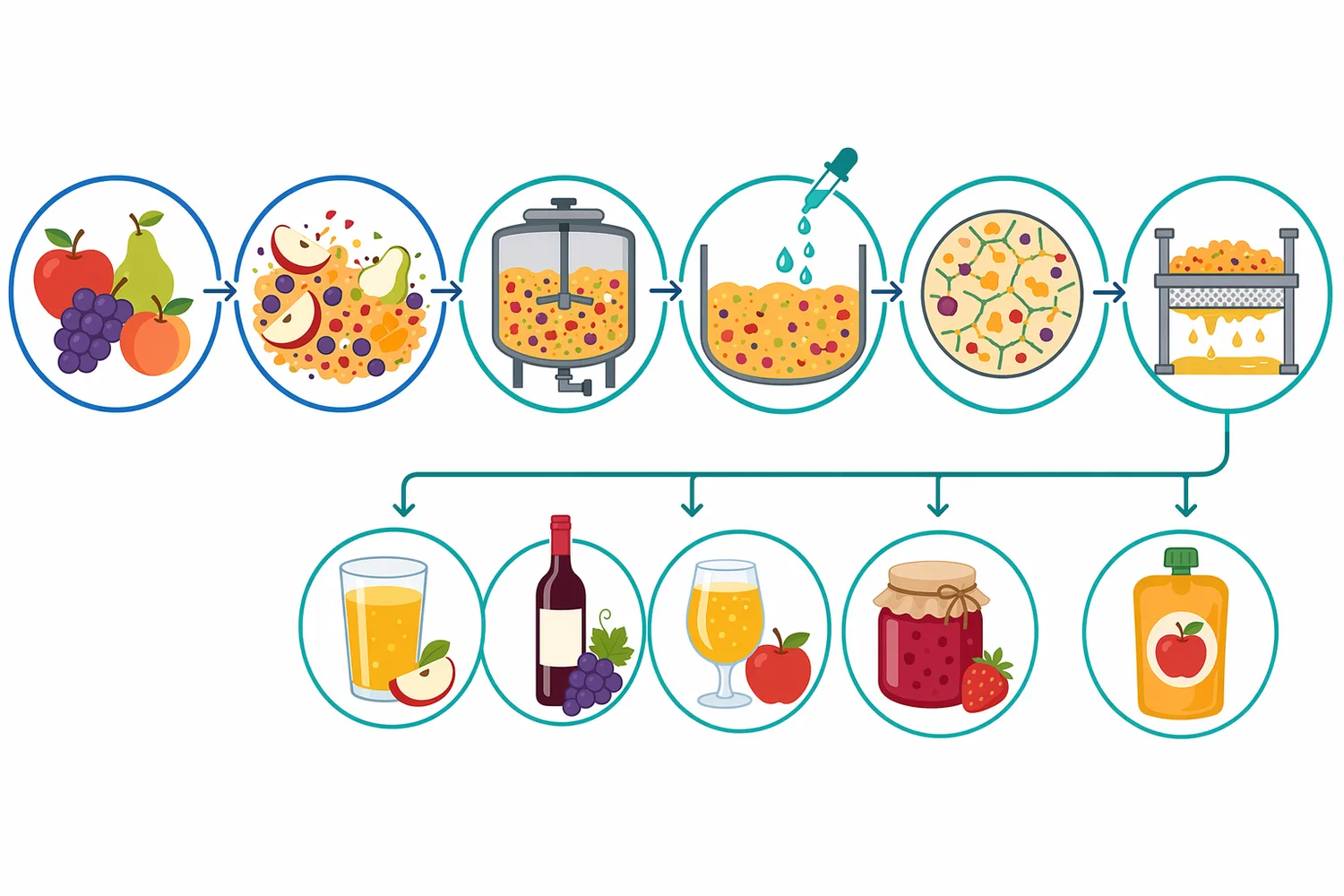
In wine and cider, pectinase is used where fruit solids, must viscosity, color release, pressing efficiency, and pectin haze matter. Grapes, apples, pears, berries, and other fruit-wine raw materials contain pectin in skins, pulp, and cell walls. During crushing and maceration, that pectin can either help form body or create unwanted haze and processing resistance, depending on the product style and process stage [4].
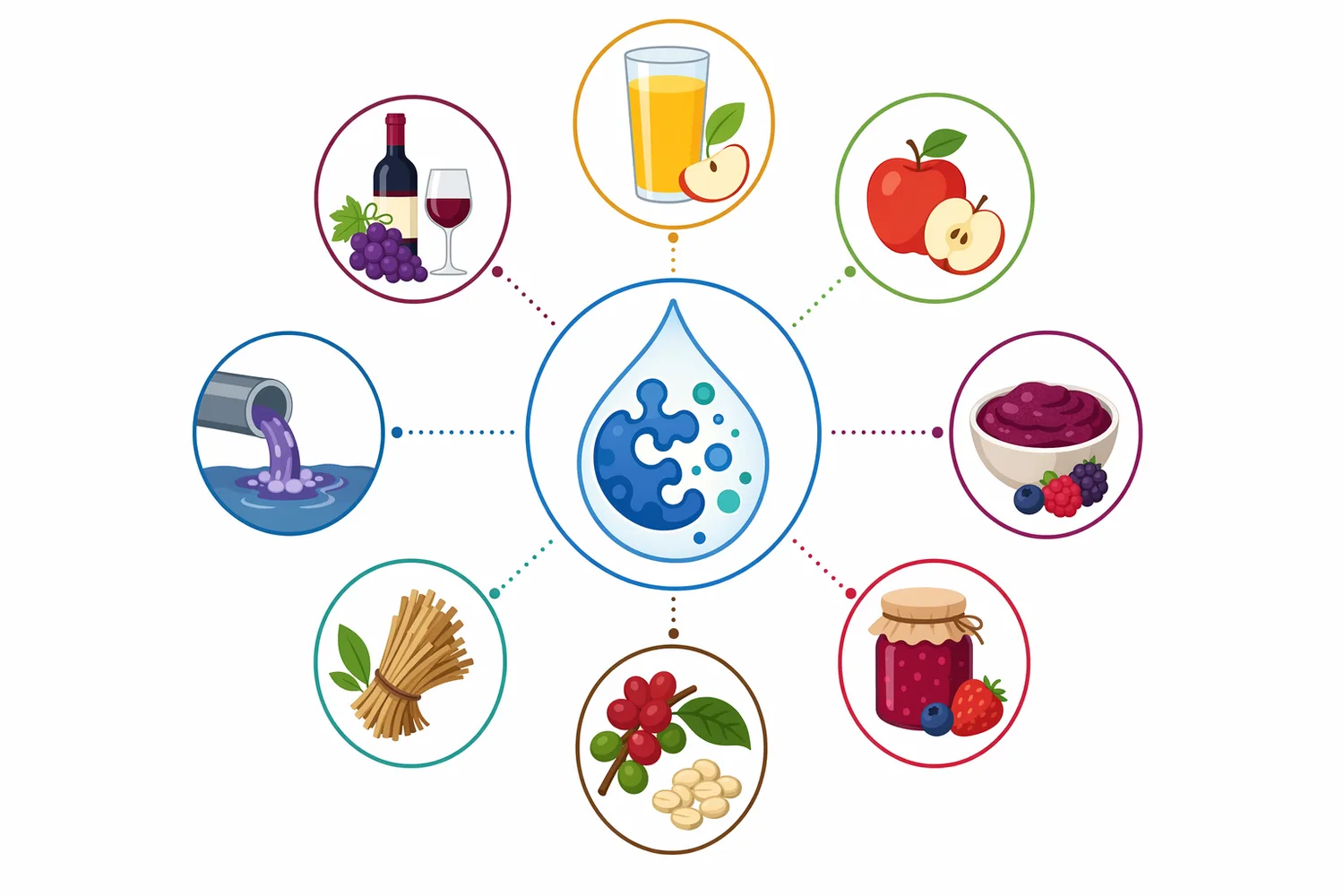
Pectinase helps by loosening the pectin-rich structure around fruit cells. In red and fruit wines, that can support release of color and aroma compounds from skins and pulp because the cell-wall barrier is weakened. In white wines, ciders, and clear fruit wines, pectin degradation can improve pressing and reduce the risk that soluble pectin remains as a haze-forming material after fermentation or clarification [4].
Recent work on immobilized enological pectinase for wine clarification highlights the continuing importance of pectinolytic enzymes in beverage processing. Immobilized systems are a research and process-development direction rather than the default format for a supplied liquid product, but they reinforce the central point: pectinase remains valuable because pectin is a persistent cause of turbidity and difficult clarification in wine-type systems [4].
Many botanical raw materials contain valuable compounds inside plant cells or associated with cell-wall structures. Leaves, peels, flowers, roots, herbs, spices, pomace, and fruit residues may contain phenolics, pigments, aromas, sugars, acids, and other soluble materials that do not release efficiently if the pectin-rich wall and middle lamella remain intact. Pectinase improves extraction by opening that matrix and improving mass transfer from solid plant particles into the liquid phase [5].
A study on ultrasonic-assisted enzymatic extraction from orange processing waste examined the effects of pectinase concentration, ultrasonic time, and pH on phenolic compound extraction. The important processing lesson is that pectinase performance in extraction is tied to both enzyme action and physical mass transfer: ultrasound can disrupt tissue and improve solvent contact, while pectinase chemically weakens the pectin barrier that restricts release [5].
Recent work on grape, cherry, and strawberry pulp pre-treatment with pectinase and cellulase also reflects this combined cell-wall approach. Pectinase targets the pectin fraction, while cellulase acts more directly on cellulose-rich wall components; together or separately, these enzymes can change the release profile of organic compounds in extracts. The best result depends on which part of the plant wall is limiting extraction for a given raw material [6].
Pectin’s water-binding capacity is one reason fruit pulps and vegetable purees can be thick, stringy, or resistant to pumping. In some finished products, that body is desirable; in others, it causes inefficient heat transfer, difficult mixing, slow filling, filtration problems, or poor drying behavior. Pectinase is useful when the process goal is to reduce pectin-driven viscosity rather than preserve maximum pulp structure [1].
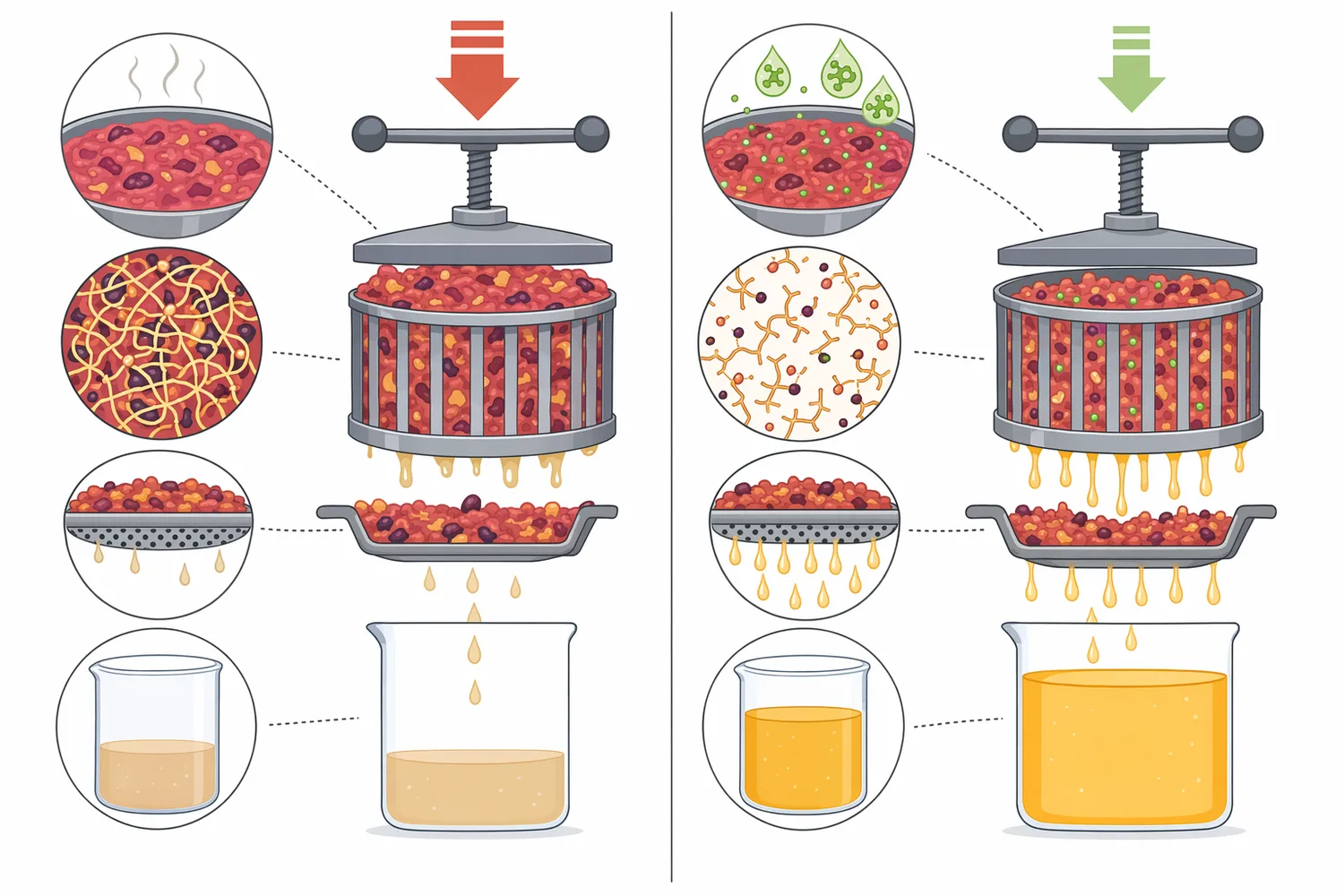
The mechanism is straightforward: long pectin chains increase apparent viscosity because they hydrate, entangle, and create a weak gel network. Cutting those chains reduces entanglement and weakens the water-holding matrix. The material can then flow more easily under shear, release serum or juice more readily, and pass through downstream equipment with less resistance. This is especially relevant in high-solids pulps, fruit preparations, puree bases, and extract slurries .
Vegetable systems can also benefit when pectin is a limiting structural component. Tomato, carrot, pepper, and mixed vegetable pulps may contain enough pectic material to influence separation and texture. Pectinase is not a universal viscosity reducer for every vegetable matrix, because cellulose, hemicellulose, starch, protein, and insoluble fiber may also control flow, but it is highly relevant when pectin is a major contributor to the processing problem [1].
Citrus peels and fruit-processing residues are especially pectin-rich, which makes them both challenging materials and valuable substrates for pectinase-assisted processing. Pectin can make peel slurries thick and resistant to extraction, but controlled degradation can improve release of soluble compounds and reduce physical barriers. Studies on pectinase production using orange peel waste also illustrate how closely pectinase technology is linked to citrus-processing streams [7].
Orange processing waste has been studied as a substrate for pectinase-associated phenolic extraction, and orange peel waste has been investigated for microbial pectinase production. For a buyer using a supplied liquid pectinase, the key point is not the production route but the substrate logic: citrus residues are pectin-rich, and pectinase is one of the enzyme classes most directly suited to modifying that matrix [5].
Older work on pectolytic enzyme treatment for grapefruit segment membrane peeling also demonstrates a related principle. The membranes around citrus segments contain pectin-rich structures; pectolytic enzymes weaken those structures so separation can occur with less mechanical damage. That example is useful because it shows pectinase acting not only as a clarifier, but as a tissue-disassembly tool where pectin is the “glue” holding plant structures together [8].
Although Enzymes.bio’s Liquid Pectinase Enzyme CAS 9032-75-1 is positioned for fruit, beverage, wine, and plant extraction applications, textile and fiber studies help explain the same pectin-removal mechanism in another substrate. Cotton, banana pseudostem fiber, and other plant fibers contain pectic substances that bind surface impurities and hold fiber bundles together. Pectinase can remove or loosen those pectins under milder conditions than harsh chemical scouring [9].
A 2023 study on biosoftening banana pseudostem fiber used cellulase and pectinase from Aspergillus niger for textile industry applications. The relevance to plant processing is mechanistic: when pectinase breaks pectin in a fibrous plant matrix, the structure becomes softer, more open, and more accessible. In fruit or botanical extraction, that same wall-loosening effect supports juice release and soluble-compound transfer [10].
A 2024 study on Thermomyces lanuginosus polygalacturonase applied the enzyme in biomass hydrolysis and textile bioscouring, again showing that pectin backbone degradation has practical effects outside beverages. These studies reinforce that pectinase is not merely a “clarity additive”; it is a cell-wall-modifying enzyme with applications wherever pectin controls structure, access, or separation [11].
Real plant cell walls are composite materials. Pectin is important, but it is interwoven with cellulose microfibrils, hemicelluloses, proteins, minerals, phenolics, and other structural elements. That is why pectinase can be highly effective in one fruit mash yet less dramatic in a matrix where cellulose, hemicellulose, starch, or insoluble fiber is the main barrier. In practice, pectinase often works best when the processing problem is clearly pectin-driven or when it is part of a broader cell-wall breakdown strategy [6].
Research comparing pectinase and cellulase in plant-material pre-treatments illustrates this point. Pectinase primarily reduces the pectin cement and gel fraction, while cellulase opens cellulose-rich wall structures. If the target compounds are trapped behind both barriers, the combined or staged action of multiple enzymes may release more than either enzyme alone. If the raw material is already low in pectin, pectinase may improve clarification less than expected because another polymer is controlling the process behavior [6].
This is also why results should be interpreted in relation to the substrate, not only the enzyme name. Apple, citrus, grape, berry, cherry, strawberry, papaya, banana pseudostem, cotton fiber, and orange peel waste all contain pectin, but the amount, esterification, distribution, and interaction with other wall polymers differ. Pectinase acts on pectin, while the finished process result reflects the whole plant matrix [1].
Pectinase is commonly used at points where plant structure is still present and the enzyme can contact pectin before final separation. In juice processing, that may be after crushing or milling and before pressing, settling, centrifugation, or filtration. In wine and cider, it may be used during maceration, must preparation, or clarification, depending on whether the aim is extraction, pressing, color release, or haze reduction [4].
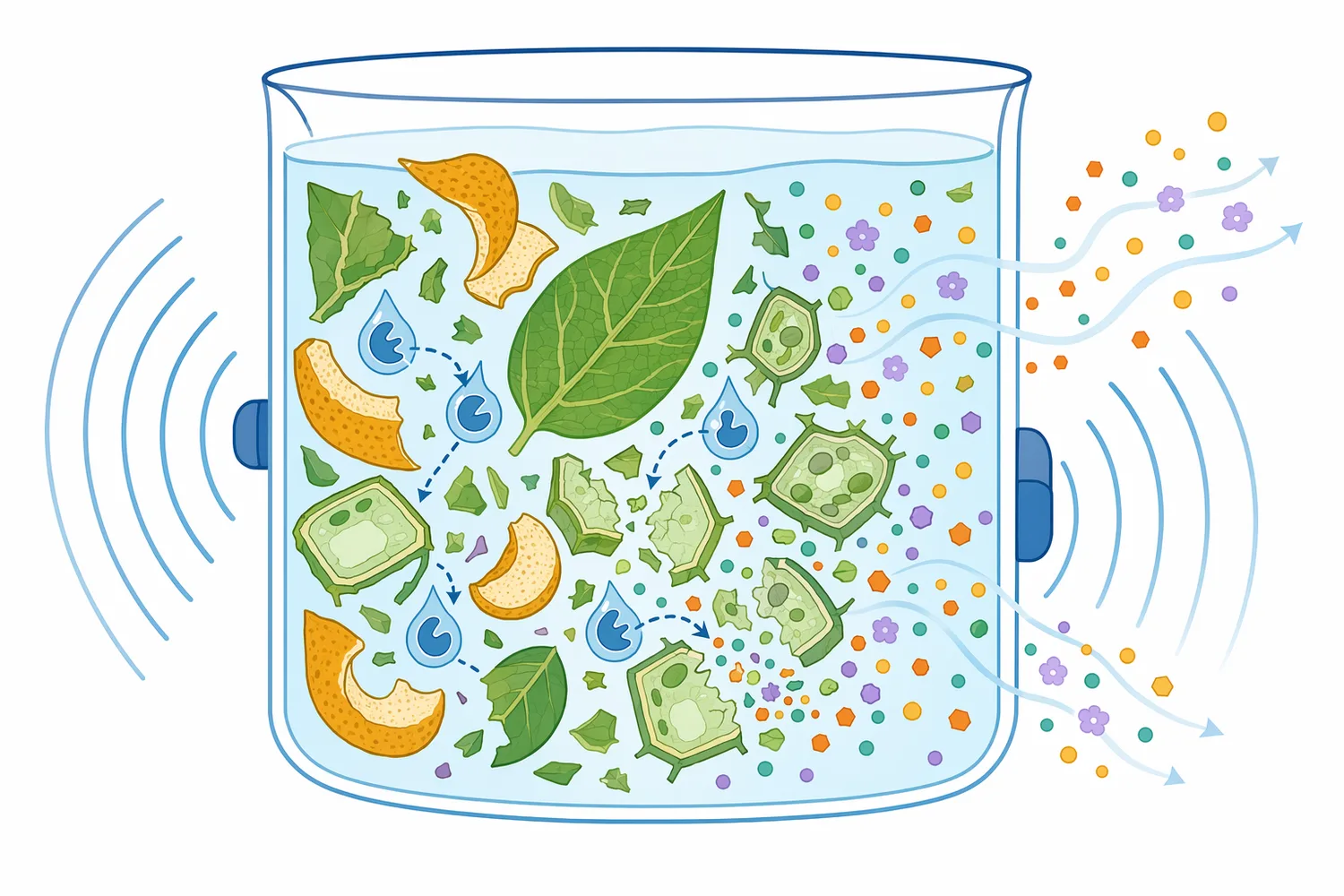
For botanical extraction, pectinase is typically most useful while the solid plant material is still in contact with the extraction liquid. The enzyme needs access to hydrated pectin, so mixing and contact between the liquid enzyme preparation and the plant particles are important. Once the solids have already been removed, pectinase may still help with dissolved pectin haze, but it can no longer open intact cells that have been discarded [5].
In puree and pulp operations, pectinase may be applied before a viscosity-sensitive step such as pumping, heating, evaporation, filtration, or drying preparation. The goal is not always maximum breakdown; sometimes the desired result is a controlled reduction in viscosity while maintaining enough body for the finished product. This is why plant processors usually treat pectinase as a process lever that must be aligned with product texture and downstream separation needs .
Pectinase is a protein catalyst, so its performance depends on conditions that preserve enzyme structure and allow contact with pectin. Excessive heat can denature enzyme proteins, while unsuitable acidity or alkalinity can reduce catalytic efficiency or change the substrate. At the same time, plant matrices are variable: fruit maturity, cultivar, storage, particle size, and thermal history all influence how accessible the pectin is [1].
It is helpful to think of pectinase performance as a balance of four practical factors: enzyme contact with the substrate, sufficient time for pectin breakdown, conditions compatible with enzyme activity, and a downstream separation step that can take advantage of the changed matrix. If any of these is missing—for example, poor mixing in a thick mash, too short a holding stage, or filtration equipment already overloaded with insoluble fiber—the visible process improvement may be limited even though pectinase is the correct enzyme class [2].
The enzyme also cannot reverse every source of cloudiness. Protein-polyphenol haze, starch haze, insoluble mineral turbidity, microbial contamination, or fine insoluble fiber may require different process controls. Pectinase is most directly relevant when the cloud, viscosity, or extraction barrier is related to pectin or pectin-rich tissue structure [1].
Liquid pectinase preparations should be handled as enzyme protein products in an industrial workplace. Enzymes can be irritating or sensitizing for susceptible individuals, especially if splashes or aerosols contact the eyes, skin, or respiratory tract. Normal good industrial hygiene—avoiding direct contact, preventing unnecessary mist formation, cleaning spills promptly, and following the Safety Data Sheet supplied with the order—is appropriate for routine handling .
Before use, the product should remain sealed and protected according to the supplied product documentation. In liquid enzyme products, visual appearance can vary, and minor settling may occur in some enzyme preparations; gentle homogenization before measured addition is commonly used in processing environments when a liquid product has been standing. The essential point is to keep the enzyme in a condition that preserves protein functionality until it is added to the process stream .
Enzymes.bio supplies this liquid pectinase directly online in 1 kg units. A buyer selects the product, pays online, and the order is processed and shipped. The Certificate of Analysis and Safety Data Sheet accompany the order, supporting receiving, documentation, and safe workplace use without turning the purchase into a custom development project .
For buyers working with fruit, beverage, wine, cider, puree, or botanical materials, the main value is access to a ready liquid pectinase preparation aligned with common pectin-degradation applications. The product is not presented as a universal fix for every separation problem; it is a practical enzyme tool for processes where pectin is a known contributor to viscosity, haze, poor pressing, or restricted extraction .
Liquid Pectinase Enzyme CAS 9032-75-1 is useful because it targets one of the most important structural polymers in fruit and plant processing: pectin. By cutting or modifying pectin chains, the enzyme weakens the plant cell-wall cement, reduces pectin’s ability to bind water and stabilize haze, and helps release liquid and soluble compounds from plant tissues. Those changes explain its roles in juice clarification, wine and cider processing, botanical extraction, puree viscosity adjustment, and beverage clarity improvement [1].
The strongest applications are those where pectin is clearly part of the processing limitation: cloudy juice that resists clarification, fruit mash that presses slowly, grape or apple material that holds juice in pulp, citrus or peel residues that are thick and hard to extract, or botanical slurries where cell-wall structure limits mass transfer. Research across juice clarification, citrus waste extraction, wine clarification, fruit pulp pre-treatment, and plant-fiber bioscouring supports the same central mechanism: pectinase opens or destabilizes pectin-rich structures so separation and extraction become easier [5].
For online purchase, Enzymes.bio supplies the product in 1 kg units with order documentation included. Used in an appropriate pectin-containing process, liquid pectinase is a direct way to address pectin-related viscosity, haze, pressing, filtration, and extraction challenges while keeping the buying process simple and product-focused .
Sold by the 1 kg unit, in stock and ready to ship. Order directly on our store — pay online and we process your order. A Certificate of Analysis and Safety Data Sheet are included with every order.
Buy Liquid Pectinase Enzyme 60,000U/Ml Cas 9032-75-1 →Numbered in order of first citation. Open-access sources, each verified reachable at publication; citation numbers in the text link here.