
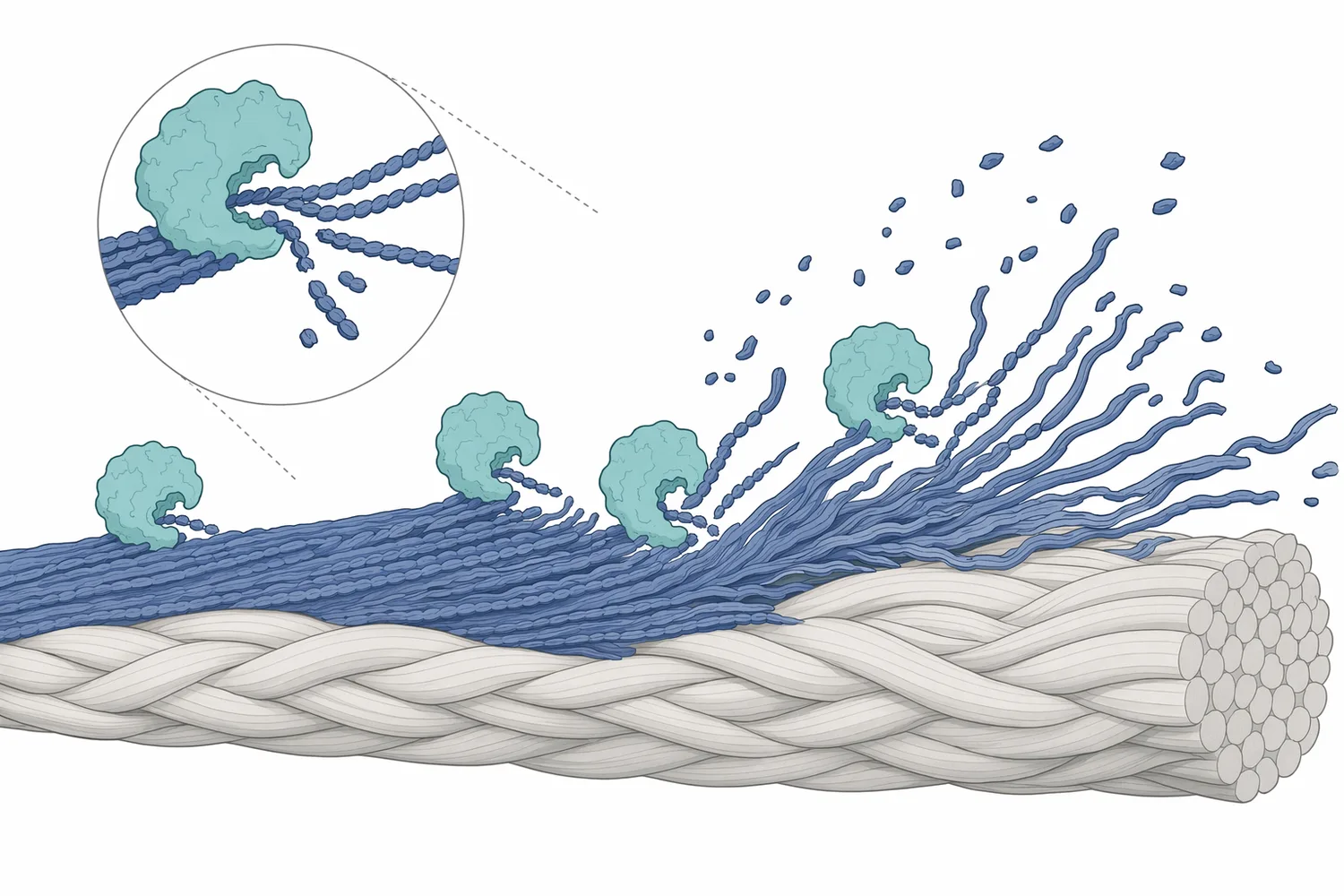
Low-temperature enzyme powder for denim washing is a cellulase-based textile enzyme used to create faded, softened, stone-wash-style effects on cotton denim at cooler or moderate wash conditions. It works by selectively weakening tiny cellulose fibrils on the garment surface; as those fibrils detach during tumbling, indigo attached to the surface is released, giving visible fading without relying only on pumice stones or harsh chemical abrasion. Cellulase denim washing is widely documented as an established bio-finishing and bio-stoning method for cotton textiles and denim garments [1].
Enzymes.bio supplies this product as a 1 kg enzyme powder for denim washing applications, sold directly online: the buyer places the order, pays online, and the order is processed and shipped. A Certificate of Analysis and Safety Data Sheet are provided with the order .
Denim finishing is different from ordinary fabric cleaning. The target is not simply to remove soil; it is to change the fabric surface in a controlled way so jeans, jackets, shirts, and other garments develop a worn-in look, a softer handle, and shade contrast at seams, folds, edges, and raised areas. Cellulase enzymes are useful because denim is usually made from cotton, and cotton is mainly cellulose, a chain-like carbohydrate arranged into microfibrils that give the fiber much of its strength and surface character [2].
Indigo-dyed denim is especially suited to this type of surface modification because indigo is usually concentrated near the outside of the yarn rather than distributed evenly through the whole cotton fiber. When a cellulase wash lightly hydrolyzes exposed cellulose fibrils on the surface, those weakened microfibrils are more easily removed by garment-to-garment rubbing, machine action, water flow, and, if used, stones. The visible effect is fading because some dye leaves with the removed surface material rather than being chemically bleached throughout the fiber [3].
This mechanism explains why enzyme washing is often called bio-stoning. In conventional stone washing, pumice creates abrasion mechanically. In enzyme washing, cellulase adds a biochemical route to the same visual direction: it makes the surface easier to abrade in a more selective way. The result can be a softer, cleaner, more worn appearance with reduced dependence on heavy stone loading, which is one reason cellulases have become important in denim finishing and broader textile bio-processing [4].
Cellulase is not one single action. Microbial cellulase systems are commonly described as combinations of enzymes that act at different points on cellulose: some open up cellulose chains in the middle, some work from chain ends, and others help convert soluble fragments further downstream. On denim, the important practical outcome is surface fibril weakening and removal, not deep digestion of the garment; controlled surface action is what creates fading and softening while preserving the garment’s usable structure [1].
A low-temperature cellulase powder is intended for wash processes where useful enzyme action is desired under cooler or moderate bath conditions rather than high-heat processing. Temperature affects enzyme motion, substrate contact, and reaction rate, so the phrase “low temperature” should not be read as “temperature does not matter.” It means the enzyme is designed for denim washing workflows where the processor wants visible cellulase action without depending on strongly heated baths [5].
Lower-temperature operation can matter for several practical reasons. Heating water is an energy cost, and repeated warm or hot steps add up in garment washing. Cooler washing can also be gentler on stretch components, trims, labels, coatings, sewing threads, and garment constructions that may be more sensitive to heat. In textile processing more broadly, enzyme-based routes are valued because they can reduce reliance on severe chemical and physical treatments while operating under comparatively mild conditions [6].
Cold-active and low-temperature enzymes are studied because protein flexibility can allow catalytic movement at temperatures where many conventional enzymes slow down sharply. That does not mean every low-temperature enzyme behaves the same way on every garment, but it does explain the technical logic: an enzyme with useful mobility at cooler conditions can still bind exposed cellulose and catalyze bond cleavage at the fabric surface while the washer supplies mechanical action [7].
For denim laundries and garment finishers, the benefit is process flexibility. A low-temperature cellulase can support stone-wash and worn effects when the desired look, garment sensitivity, energy target, or workflow favors cooler processing. The final shade and hand still depend on the garment, machine movement, wash time, liquor movement, pH environment, rinsing, and use or non-use of stones; published denim washing work consistently treats enzyme washing as a multi-variable finishing process rather than a single additive event [8].
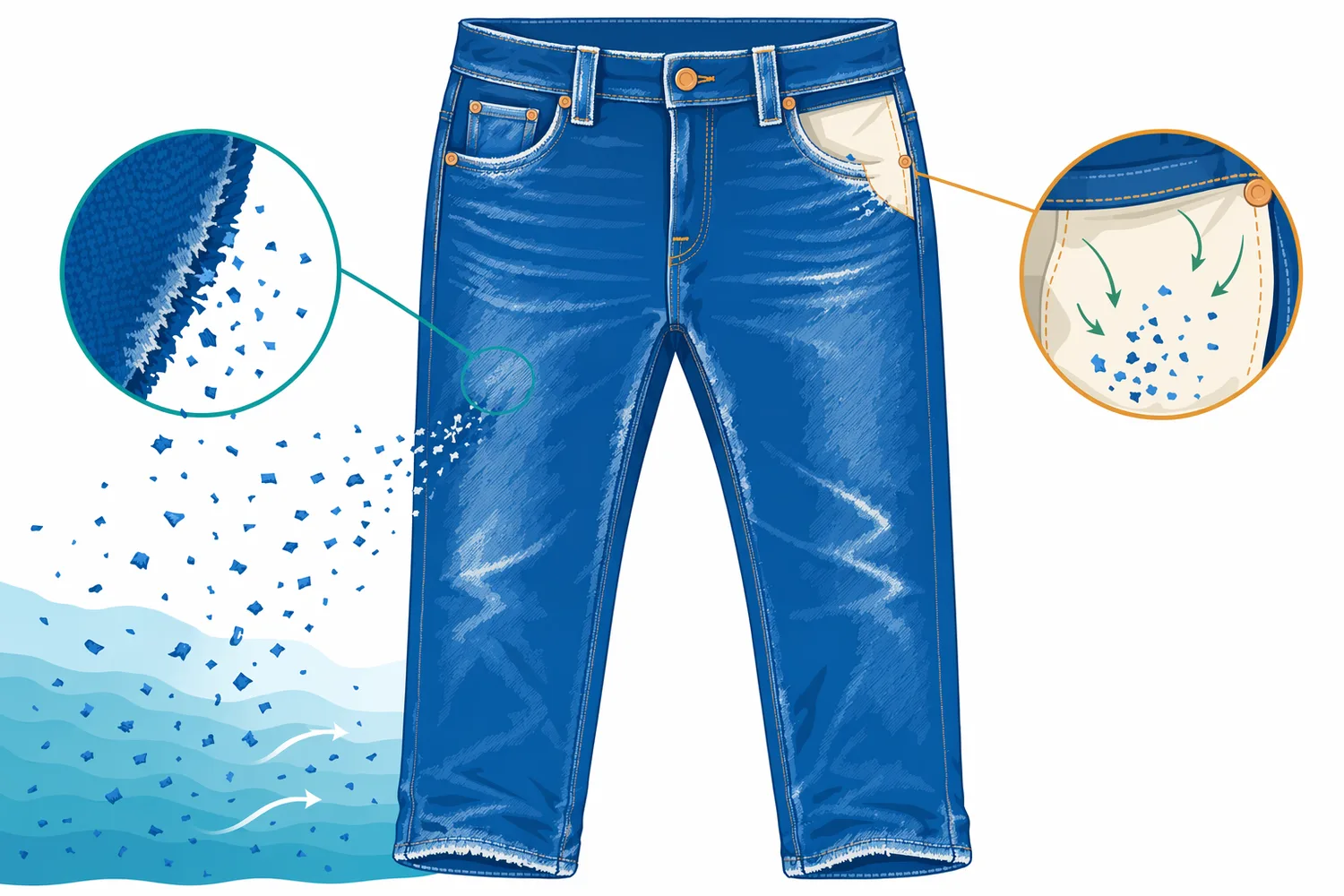
During enzymatic denim washing, the first visible changes usually occur on exposed and high-friction zones: seams, pocket edges, hems, whisker-prone folds, belt loops, and raised fabric areas. These zones receive more mechanical contact, so once cellulase has weakened the fine cellulose hairs and fibrils, they shed more readily. The garment therefore develops contrast because the most exposed points lose surface indigo faster than flatter, protected regions [3].
The hand feel changes because surface fuzz and protruding fibrils contribute to roughness and stiffness. When these surface features are reduced, the fabric can feel smoother and more flexible. This overlaps with the textile process often called bio-polishing, where cellulase treatment removes microfibrils to reduce fuzz and improve surface appearance. In denim, bio-polishing and fading are linked because the same surface fibrils that create fuzz can also carry surface color [9].
Weight loss can occur because cellulase removes a small amount of cellulosic material from the fabric surface. In a controlled denim wash, the intention is limited surface modification rather than excessive fiber degradation. Research on denim enzyme washing commonly monitors fabric strength, weight change, stiffness, shrinkage, water absorption, and color change because these properties move together: stronger fading and softer handle can come with more material removal if the process is pushed too far [8].
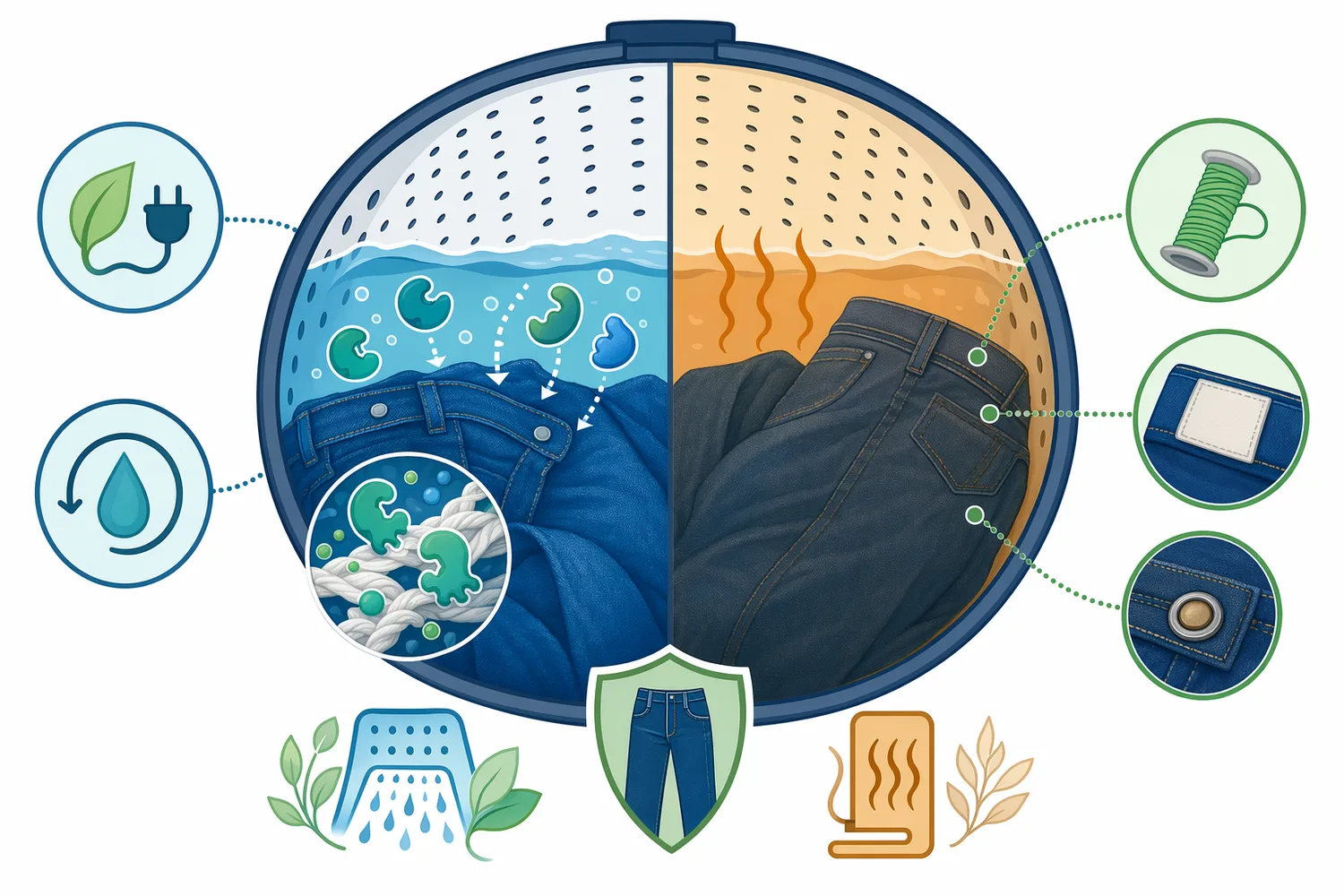
Back staining is another surface-level issue. When indigo particles or dye-associated fragments are released into the bath, some can redeposit on weft yarns, pocketing, lighter garment areas, or already-faded zones. This reduces brightness and contrast. Enzyme washing therefore needs adequate rinsing and bath movement so loosened indigo leaves the garment surface instead of settling back where it is not wanted [3].
Cellulase washing does not replace every denim finishing method, but it changes the balance between chemical, biological, and mechanical effects. Stone-only washing depends heavily on physical abrasion from pumice. Chemical fading methods can create strong shade change but may be less selective and can place more stress on fabric and effluent management. Enzyme washing sits between these approaches: it uses biological specificity on cotton cellulose and relies on washer motion to translate surface hydrolysis into a visible worn effect [4].
Pumice stones are effective but create operational burdens: stone dust, pocket residue, machine wear, garment damage, and the need to remove stone fragments. Studies and reviews on sustainable denim processing describe cellulases as a route to reduce pumice dependence while still producing a stone-washed appearance. In practice, some finishes use enzyme alone, while others combine cellulase with a reduced stone component for a more irregular vintage effect [3].
Oxidative or acid-based effects can create dramatic fading, but they work through different chemistry and can be harsher on fabric if not carefully managed. Cellulase does not “bleach” indigo in the same way. It removes or loosens indigo-bearing surface material through selective cellulose hydrolysis, so the look is developed by the combination of enzyme action and abrasion rather than direct dye destruction throughout the garment [10].
| Denim finishing route | Main driver of effect | What happens on the garment | Practical character of the finish |
|---|---|---|---|
| Stone-only washing | Mechanical abrasion from pumice or similar media | Raised areas are physically rubbed; surface yarns and dye-bearing material are abraded | Strong vintage effects, but more stone residue, machine wear, and garment damage risk |
| Cellulase enzyme washing | Enzymatic weakening of cotton surface fibrils plus washer movement | Exposed cellulose microfibrils loosen; indigo-associated surface fragments detach during tumbling | Controlled fading, softer hand, reduced reliance on aggressive abrasion |
| Enzyme plus reduced stones | Combined biochemical and mechanical action | Cellulase makes surface fibrils easier to remove while stones create localized contrast | Useful for bio-stone effects where irregular abrasion is desired |
| Chemical fading routes | Chemical modification or oxidation of color/fiber surface | Shade change is driven more by chemical reaction than selective cellulase hydrolysis | Can create strong effects, but may increase fabric stress and process-control burden |
This comparison is conceptual rather than a recipe. The most important distinction is the mode of action: cellulase is substrate-specific to cellulose, while stones are non-specific mechanical tools and chemical systems act through their own reaction pathways. That specificity is why enzymes are widely discussed in sustainable textile processing as tools for milder, more targeted finishing [6].
Commercial denim enzyme washing has historically used cellulase systems described by their working environment, especially acid and neutral cellulases. These categories matter because pH environment influences enzyme shape, binding, reaction rate, and the balance between fading, back staining, and fabric strength. The names should be understood as process families, not as universal performance guarantees, because each formulation and wash process has its own behavior [11].
Acid cellulases have been widely associated with strong denim fading because they can aggressively act on cotton surface fibrils under suitable acidic wash conditions. However, stronger surface hydrolysis may also require careful control to avoid excess strength loss or back staining. Neutral cellulases are often discussed where reduced back staining and more controlled action are important, although visual intensity can differ depending on garment and process design [2].
Alkaline-compatible cellulase systems are relevant to textile wet processing where other steps may occur closer to alkaline conditions, but denim fading behavior still depends on the enzyme and fabric. In all cases, cellulase does not create a stone-wash look by pH alone; it must bind accessible cellulose, weaken fibrils, and work with agitation so loosened material can leave the garment surface [1].
| Cellulase system concept | General denim-processing role | Mechanism emphasis | Typical watch-point |
|---|---|---|---|
| Acid cellulase concept | Strong surface attack and visible fading in suitable acidic processes | Hydrolysis of exposed cotton fibrils, releasing indigo-bearing surface material | Can be powerful; excessive action can affect strength and increase loose dye in bath |
| Neutral cellulase concept | Controlled bio-stoning and surface cleanup where neutral processing is preferred | Fibril weakening with attention to shade control and redeposition behavior | May need process balance to reach the desired abrasion intensity |
| Alkaline-compatible cellulase concept | Textile wet-processing compatibility where milder alkaline environments are involved | Cellulose-surface action under conditions where enzyme structure remains active | Denim effect depends strongly on formulation, garment, and mechanical action |
The table is useful because it separates mechanism from marketing language. What matters in the garment is not the label alone, but how much surface cellulose is opened, weakened, and removed under the actual movement and wash environment. The scientific literature on cellulases emphasizes this relationship between enzyme structure, substrate accessibility, and process conditions [7].
The strongest evidence is for cellulase use in cotton textile processing and denim finishing generally. Reviews of microbial cellulases describe their industrial relevance in textiles because they act on cellulose-rich fibers and can be used for bio-polishing, surface modification, and finishing effects. Denim bio-stoning is one of the best-known garment applications because the surface-localized indigo system makes cellulose surface removal visually obvious [1].
Recent textile enzyme reviews also place cellulases within a broader shift toward sustainable wet processing. Enzymes can reduce the need for severe chemical conditions, lower processing intensity in selected steps, and make surface modification more targeted. The sustainability benefit is not automatic; it depends on correct process integration, water management, rinsing, and garment quality control, but enzyme-based textile processing is a well-established area of industrial development [6].
Denim-specific research continues to focus on how wash variables affect final garment properties. Experimental design studies examine enzyme washing as a controlled finishing operation, where changes in treatment conditions influence color fading, weight loss, stiffness, dimensional change, and mechanical performance. This supports the practical observation that cellulase washing is tunable, but not infinitely forgiving [8].
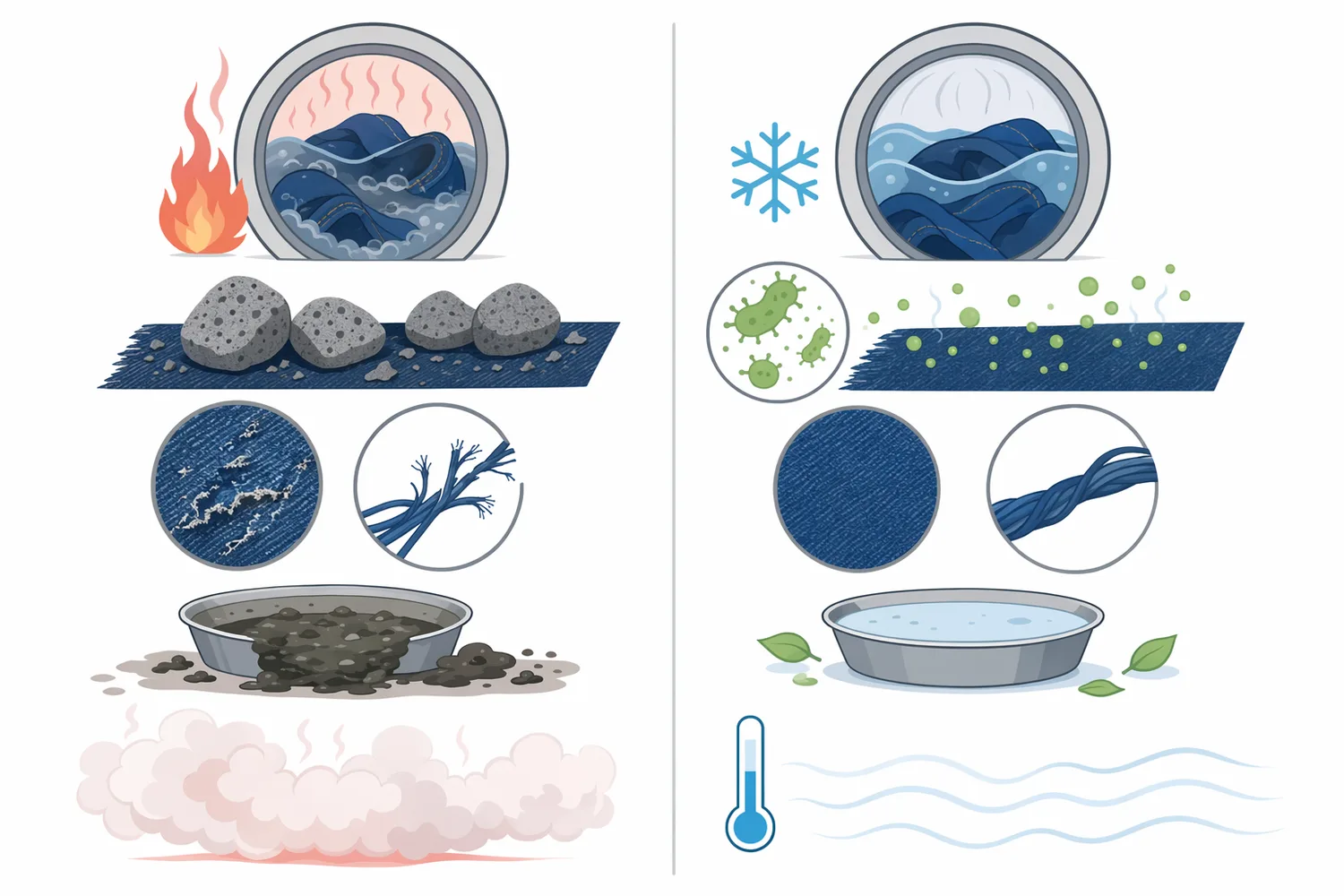
Research on reducing pumice consumption is particularly relevant to stone-wash effects. Cellulase can partially substitute for the mechanical work of stones because it weakens the surface before or during abrasion. This is why enzyme-assisted stone washing can achieve a worn appearance while reducing some of the burdens associated with heavy pumice use, including residue and fabric damage [3].
There is also research into enzyme recovery and reuse concepts, such as immobilized cellulase systems for denim fading. These studies are scientifically useful because they confirm the central role of cellulase-cotton interaction in producing fading effects, even though the commercial workflow for a supplied powder product is different from an immobilized research system [12].
The low-temperature value proposition is best understood as enabling useful cellulase activity under cooler or moderate conditions, not as eliminating process trade-offs. Enzymes are proteins, and their active sites must remain flexible enough to bind substrate and catalyze cellulose bond cleavage. At lower temperatures, many enzymes slow down because molecular motion is reduced; cold-active or low-temperature-active enzymes are studied because they can retain useful movement and catalytic behavior under cooler conditions [5].
In denim washing, lower bath temperature can support energy reduction and garment protection, but visible fading still requires time and mechanical action. If a fabric has compact yarns, heavy construction, resin finish, coating, or low surface accessibility, cellulase has fewer exposed fibrils to attack. If agitation is weak, loosened fibrils may not detach efficiently. If rinsing is insufficient, loosened indigo may redeposit and dull contrast [8].
This is why low-temperature enzyme powder should be viewed as a finishing tool rather than a fixed visual outcome. Two garments washed with the same enzyme can look different if one has open-ring yarns and pronounced seams while another has compact yarns, stretch content, coating, or darker over-dyeing. The enzyme supplies selective cellulose hydrolysis; the garment construction and washing action determine where that hydrolysis becomes visible [2].
Lower-temperature use can also be attractive for stretch denim and trim-sensitive garments, but compatibility must be judged by the garment’s actual construction and finish goals. Cellulase acts on the cotton portion of the fabric, while elastane, polyester sewing thread, metal hardware, leather patches, and printed labels respond to wash chemistry and temperature in their own ways. Textile enzyme reviews consistently emphasize that enzyme performance is substrate- and process-dependent [4].
The first benefit is controlled aesthetics. Cellulase can create a worn-down look by modifying cotton fiber surfaces rather than relying entirely on high abrasion or strong chemical fading. This can help produce softer highs and lows, cleaner seam contrast, and a garment surface that feels washed rather than merely chemically lightened [3].
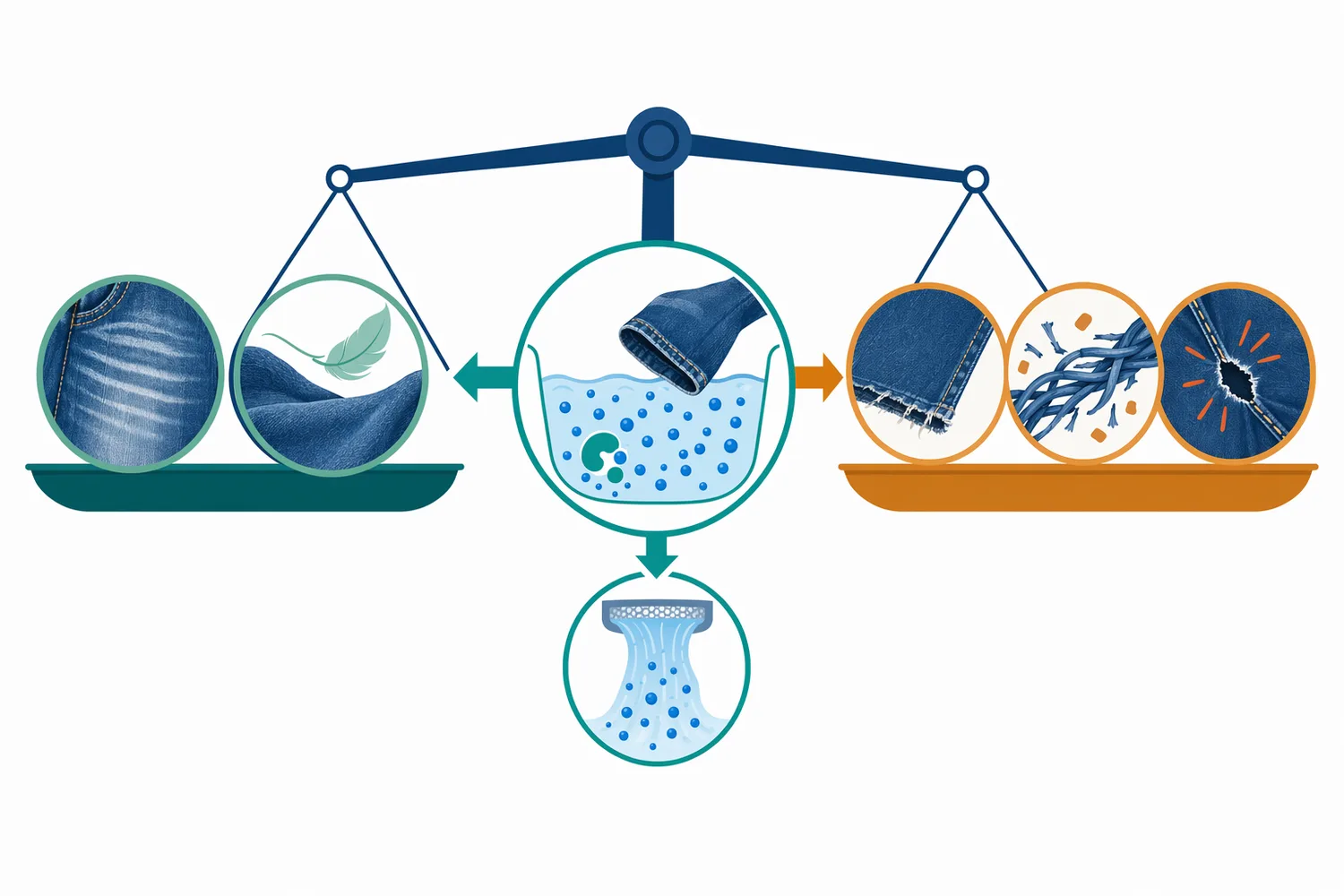
The second benefit is softness. As cellulase reduces surface fibrils, the fabric surface becomes smoother and less harsh to the touch. In cotton bio-finishing, this reduction of protruding microfibers is one of the main reasons enzymes are used to improve handle and appearance, and denim washing applies the same principle to a heavier, indigo-dyed construction [9].
The third benefit is reduced stone dependence. Full stone washing can deliver dramatic vintage looks, but stones add handling, cleanup, and wear. Enzyme-assisted washing can lower the amount of physical abrasion needed for many looks because the fabric surface becomes easier to abrade after enzymatic weakening [3].
The fourth benefit is alignment with more sustainable textile processing goals. Enzymes are not magic replacements for water, energy, and process control, but they are part of the industry’s move toward milder and more targeted wet-processing tools. Reviews of sustainable textile processing repeatedly identify enzymes as important alternatives to harsher conventional treatments when they are applied appropriately [4].
The fifth benefit is flexibility for contemporary denim fashion. Modern denim finishing may combine enzyme washing with laser, ozone, reduced-water systems, tinting, softening, and other effects. Environmentally oriented denim processing research has explored technologies that reduce water and chemical burden, and cellulase washing fits within that broader movement toward lower-impact garment finishing [10].
The main technical balance is fading versus fabric integrity. More cellulase action can mean stronger surface removal and a more pronounced worn look, but excessive action can reduce fabric strength, increase weight loss, and create an over-washed or weakened garment. That is why denim enzyme washing studies measure not only shade but also tensile or tear-related performance, shrinkage, stiffness, and other physical properties [8].
Shade reproducibility depends on more than enzyme presence. Garment load size, machine design, liquor movement, fabric weight, yarn type, dyeing depth, previous finishing, seam construction, and rinsing all influence the final look. Cellulase creates the biochemical opportunity for surface modification; mechanical action determines where that opportunity becomes a visible abrasion pattern [2].
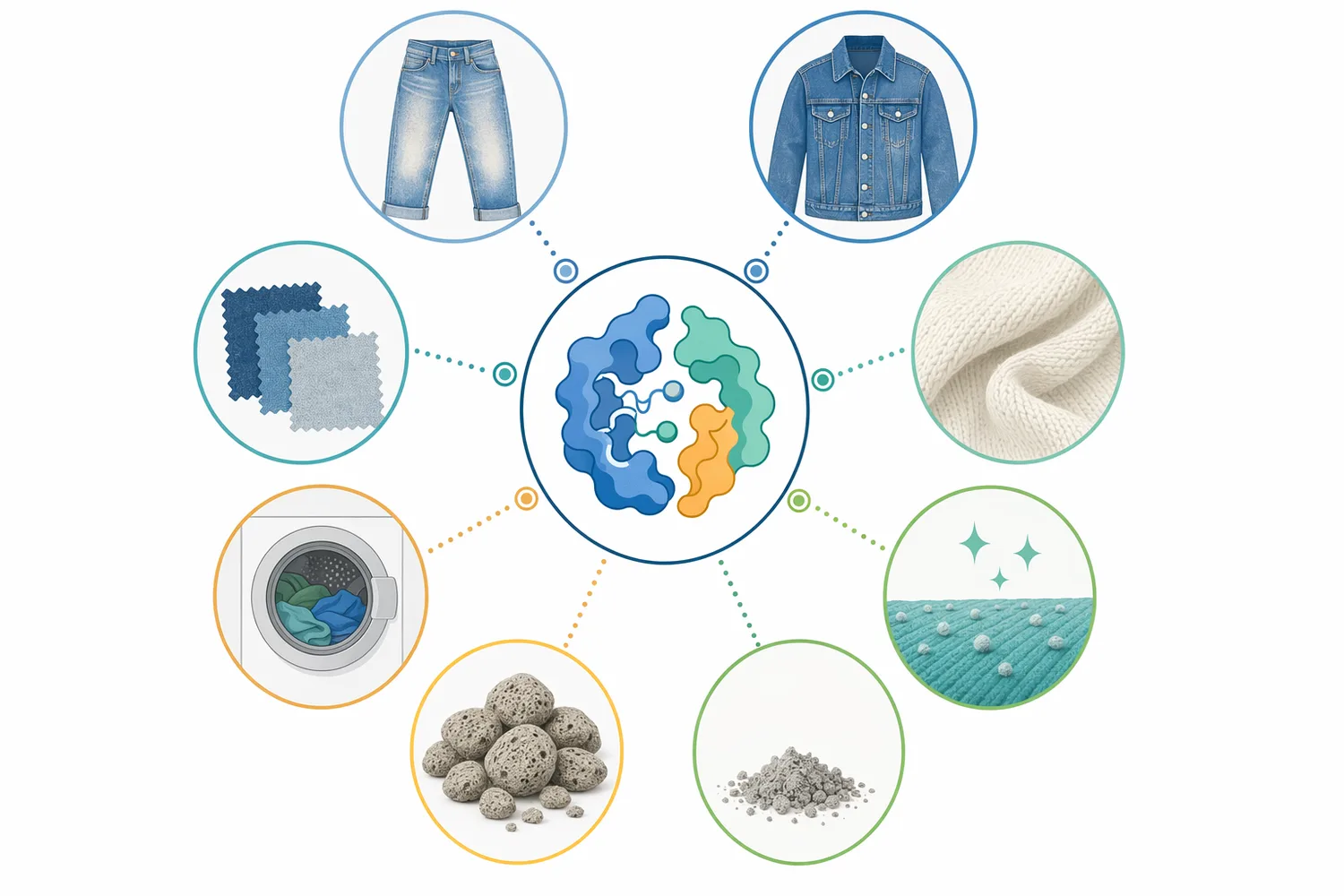
Back staining must be managed because released indigo is mobile in the wash bath. When dye-bearing fragments detach, they can redeposit on lighter zones if bath conditions and rinsing do not carry them away effectively. This is one reason enzyme washing is often integrated with well-controlled rinsing and finishing steps rather than treated as a simple one-step color removal process [3].
Garment strength is also affected by where the enzyme acts. Cellulase mainly targets accessible cellulose, so raised areas and already-abraded zones can continue to weaken if the process is extended too far. This is useful for creating seam contrast and vintage character, but the same mechanism can over-thin edges, hems, and stress points if the wash is not controlled [1].
Low-temperature cellulase enzyme powder is most relevant where the desired denim look depends on surface fading, softening, and bio-stone character. It can support enzyme-only washes for softer, cleaner fading, or enzyme-assisted stone effects where additional localized abrasion is wanted. In both cases, the enzyme’s role is to make cotton surface fibrils easier to remove under the mechanical conditions already present in garment washing [3].
For a vintage look, the wash process depends on contrast. Cellulase alone tends to act wherever accessible cellulose and bath contact are present, while machine action creates more removal on exposed surfaces. Stones intensify that difference by striking and rubbing raised areas. The combination can produce more irregular highs and lows than a uniform chemical fade because the effect follows garment geometry [10].
For a smoother fashion wash, cellulase can be used to reduce surface fuzz and stiffness while producing a gentler shade change. This is closer to bio-polishing than aggressive stone washing. The mechanism remains the same, but the visual target is cleaner surface appearance and hand improvement rather than heavy abrasion [9].
For darker denim where only mild wash-down is desired, low-temperature enzyme action can contribute subtle surface cleaning and softening. For heavily distressed looks, enzyme treatment may be one component among several finishing technologies. The enzyme is therefore best understood as a controllable biological surface modifier within a denim finishing sequence [6].
Enzymes.bio supplies Low-Temperature Enzyme Powder for Denim Washing and Stone-Wash Effects as a 1 kg online product. The purchase process is direct: add the product to the online order, pay online, and the order is processed and shipped. The product is supplied for denim washing and stone-wash effect applications, and a Certificate of Analysis and Safety Data Sheet are included with the order .
Enzymes.bio is a supplier, not a manufacturer or testing laboratory. The product page is intended to make ordering straightforward for buyers who already need a cellulase enzyme powder for denim washing workflows, without turning the purchase into a custom development project.
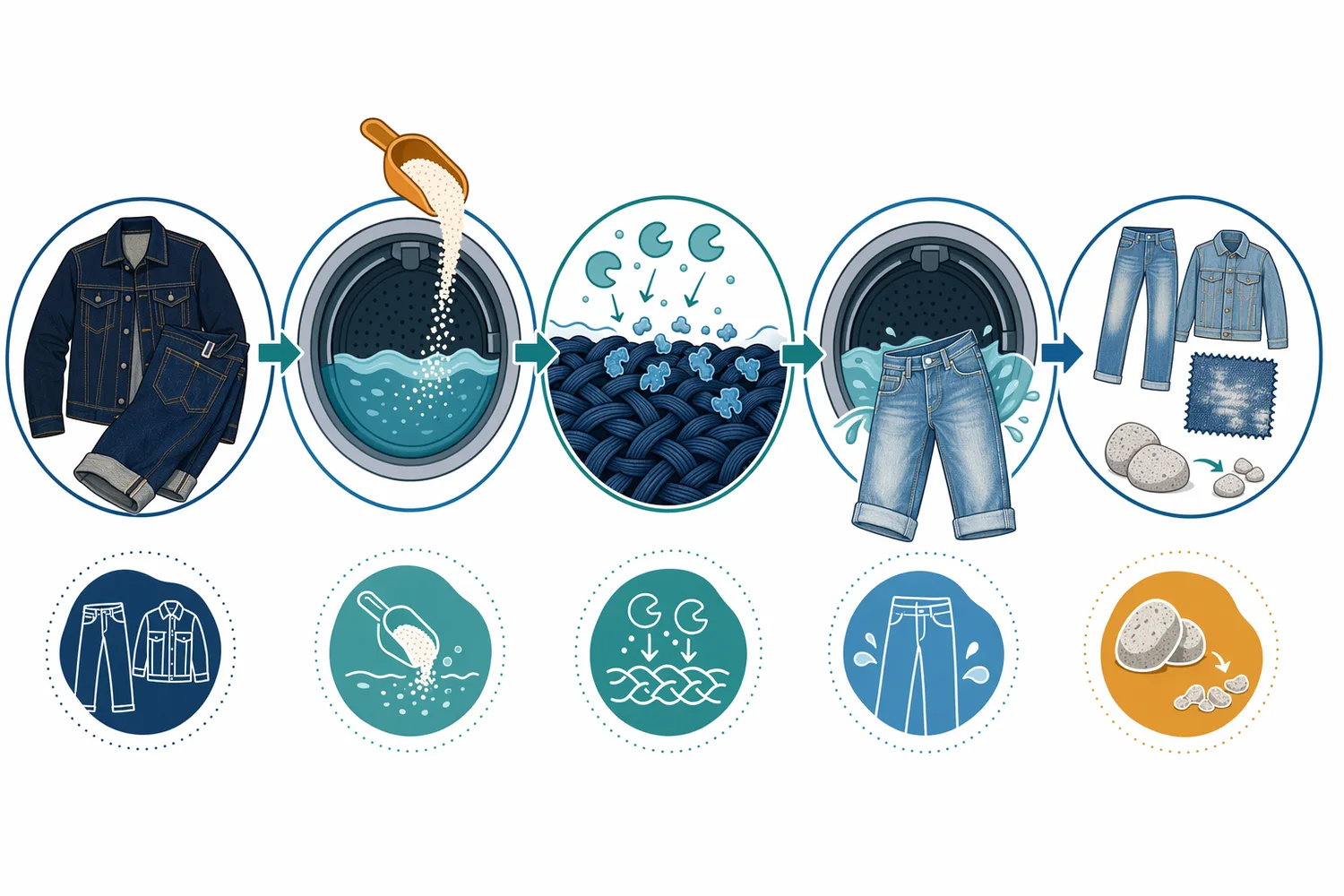
Low-temperature cellulase enzyme powder helps create stone-wash and worn denim effects by acting on the cotton surface rather than by directly bleaching the fabric. The enzyme weakens fine cellulose fibrils, tumbling removes them, and surface indigo leaves with the detached material. This produces fading, softness, and surface cleanup in a way that can reduce reliance on heavy stone abrasion [1].
The strongest scientific support is for cellulase as an established textile and denim bio-finishing enzyme. Evidence for low-temperature enzyme categories supports the technical basis for useful activity under cooler conditions, while denim washing research shows that final results still depend on the interaction of enzyme action, garment construction, mechanical movement, rinsing, and finishing targets [5].
For buyers who need a ready online purchase, Enzymes.bio offers the product in a 1 kg unit with online payment and shipment processing. Used as part of a controlled denim washing workflow, low-temperature cellulase powder can support faded, softened, bio-stone effects while aligning with the industry’s broader move toward more targeted and sustainable textile finishing [4].
Sold by the 1 kg unit, in stock and ready to ship. Order directly on our store — pay online and we process your order. A Certificate of Analysis and Safety Data Sheet are included with every order.
Buy Low-Temperature Enzyme Powder For Denim Washing & Stone-Wash Effects →Numbered in order of first citation. Open-access sources, each verified reachable at publication; citation numbers in the text link here.