
Lysophospholipase is an enzyme that acts on lysophospholipids: one-tailed phospholipid molecules that can strongly influence emulsification, phase behavior, membrane-like structures, flavor release, and downstream separation. In practical processing terms, lysophospholipase helps convert these surface-active lyso-lipids into simpler products, typically a free fatty acid plus a more polar glycerophospho-head-group compound.
For buyers working with phospholipid-rich materials, the value of lysophospholipase is targeted lipid transformation rather than broad “general improvement.” Enzymes.bio supplies Lysophospholipase directly online by the 1 kg unit; buyers place and pay for the order online, and the order is processed and shipped with a Certificate of Analysis and Safety Data Sheet.
Lysophospholipase is a lipid-processing enzyme associated with lysophospholipid metabolism. A lysophospholipid is formed when a normal phospholipid loses one fatty-acid chain, leaving a molecule with a polar head group and one hydrophobic acyl chain. That “one-tail” structure makes lysophospholipids more detergent-like than many intact phospholipids: they can sit at oil-water interfaces, disturb membrane-like structures, change emulsion behavior, and interact strongly with proteins and other amphiphilic ingredients.
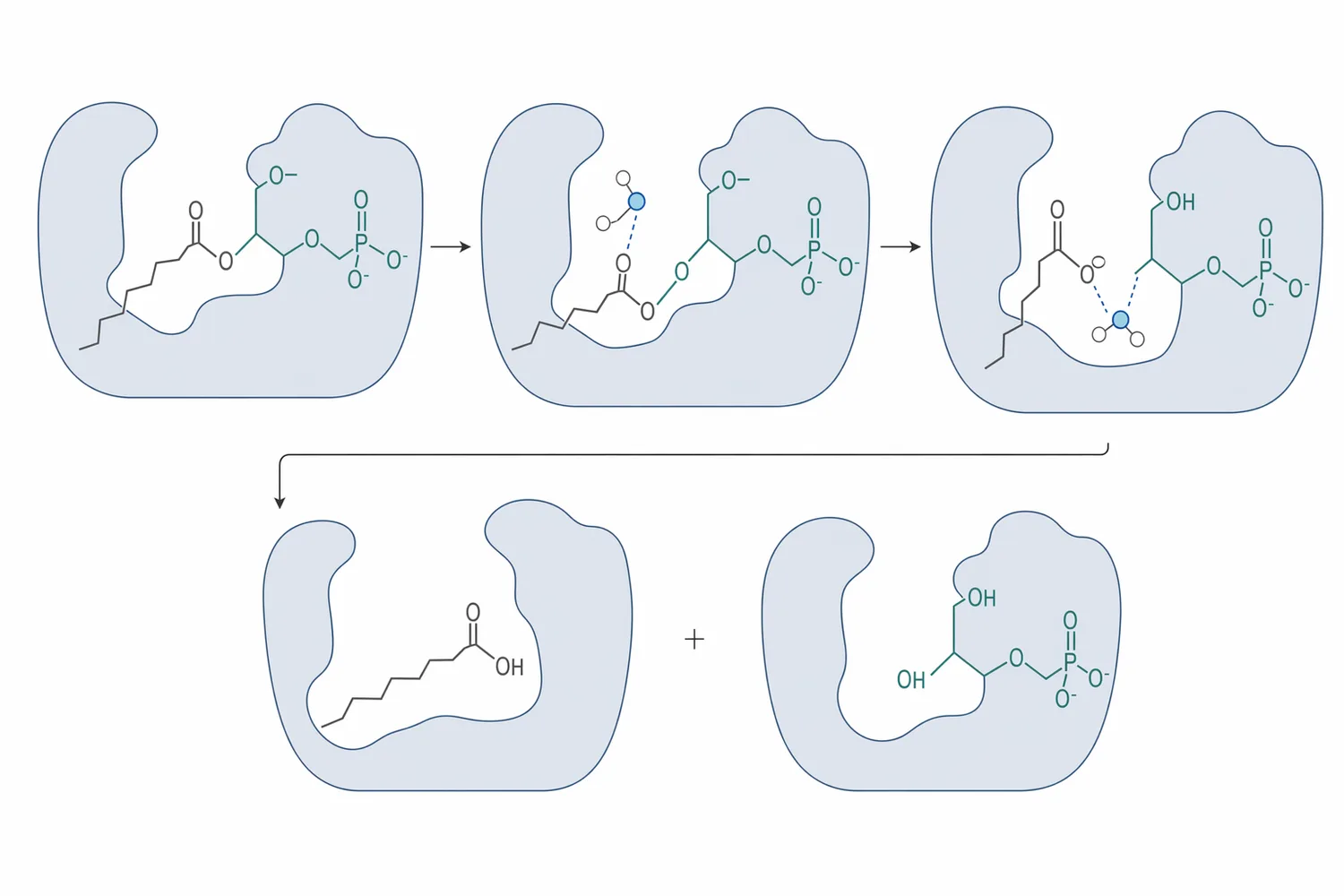
The core lysophospholipase function is hydrolysis of the remaining fatty-acid ester bond on a lysophospholipid. In simplified form:
Lysophospholipid + water → free fatty acid + glycerophospho-head-group product
For example, a lysophosphatidylcholine-type substrate can be converted into a free fatty acid and a glycerophosphocholine-type product, depending on the enzyme and substrate. Mechanistic work on lysophospholipase-transacylase has also shown why terminology must be handled carefully: some related enzymes do more than simple hydrolysis and may transfer acyl groups under certain biochemical conditions [1].
In customer-facing language, the answer to “what does lysophospholipase do?” is straightforward: it changes a one-tailed phospholipid into products that behave differently in a mixture. The original lysophospholipid is amphiphilic and interface-active; after enzymatic hydrolysis, the free fatty acid partitions differently, while the glycerophospho-head-group product is more polar. This shift can alter emulsification, separation, viscosity, foaming tendency, and compatibility with other lipid or protein ingredients.
Lysophospholipids are not minor in behavior just because they may be minor in concentration. Their molecular shape gives them high interfacial activity: a polar head group is attracted to water, while the remaining acyl chain remains lipid-compatible. In emulsions, dispersions, cell extracts, lecithin fractions, and oil-water process streams, that structure allows lysophospholipids to accumulate at interfaces and change how droplets, particles, or membrane fragments behave.
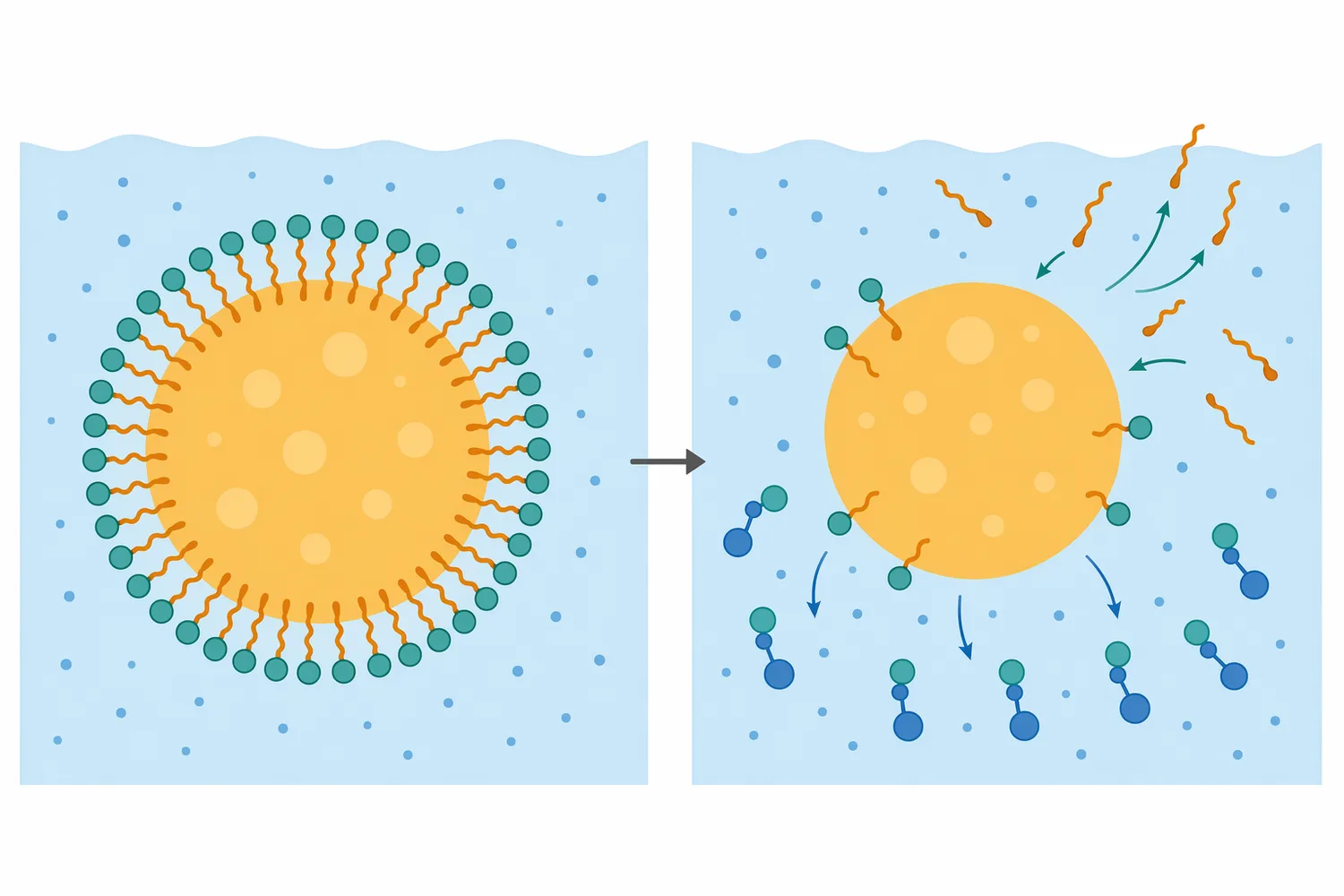
This is why lysophospholipase can be useful in phospholipid-rich systems. Instead of treating all lipids indiscriminately, the enzyme targets a class of molecules that often has disproportionate effects on material performance. Removing or converting lysophospholipids can change the balance between intact phospholipids, free fatty acids, and water-compatible phospho-head-group products.
The practical effect depends on the matrix. In one material, reducing lysophospholipid content may support cleaner phase separation; in another, it may adjust emulsion strength or reduce unwanted surface activity. In biotechnology streams, lyso-lipids may affect filtration, extract viscosity, or impurity behavior. In ingredient processing, they may influence mouthfeel, texture, flavor release, or compatibility with proteins and minerals. The enzyme does not “fix” every lipid system; it changes a defined substrate class, and the process outcome follows from that chemical change.
A lysophospholipid contains a glycerol backbone, a phosphate-containing head group, and one remaining fatty-acid chain. The fatty acid is attached through an ester bond. Lysophospholipase catalyzes hydrolysis of that ester bond by using water as the chemical participant that breaks the bond.
At the molecular level, the reaction has three practical consequences:
The acyl chain is released as a free fatty acid.
This product no longer has the same polar head group attached, so it behaves differently at interfaces and in oil-rich phases.
The glycerophospho-head-group product becomes more water-compatible.
Once the hydrophobic fatty-acid chain is removed, the remaining molecule is much less lipid-like.
The original lysophospholipid’s surfactant behavior is reduced or redirected.
The substrate that previously helped stabilize, destabilize, or modify an interface has been converted into two chemically different products.
That distinction matters in applications. A process issue caused by amphiphilic lyso-lipids will not respond the same way to every lipid enzyme. Phospholipase A-type enzymes can generate lysophospholipids from intact phospholipids. Lysophospholipase can then act on those lysophospholipids. Lysophospholipase D is different again: in common biochemical usage, lysophospholipase D activity is associated with conversion of lysophosphatidylcholine to lysophosphatidic acid, not simple removal of the remaining fatty-acid chain. Mechanistic literature on lysophospholipase-transacylase reinforces that closely named lipid enzymes can have distinct reactions and product profiles [1].
The name “lysophospholipase” is sometimes confused with phospholipase A, phospholipase B, and lysophospholipase D. The differences are important because each activity changes the substrate in a different way.
| Enzyme or activity | Main substrate focus | Typical conceptual reaction | What changes in the material |
|---|---|---|---|
| Phospholipase A1 or A2 | Intact phospholipids | Removes one fatty-acid chain from a phospholipid | Generates lysophospholipids, often increasing one-tail amphiphiles |
| Lysophospholipase | Lysophospholipids | Hydrolyzes the remaining fatty-acid ester bond | Converts lyso-lipids into free fatty acid plus a polar glycerophospho product |
| Phospholipase B | Phospholipids and/or lysophospholipids, depending on enzyme | Can remove acyl chains more broadly | May overlap conceptually with lysophospholipase activity |
| Lysophospholipase-transacylase | Lysophospholipids | Hydrolysis and/or acyl transfer, depending on system | Can remodel lyso-lipids rather than only hydrolyzing them |
| Lysophospholipase D | Lysophospholipid head-group chemistry | Often associated with lysophosphatidylcholine conversion to lysophosphatidic acid | Produces a different signaling-type lysophospholipid rather than fully deacylating it |
This table is not a product specification; it is a way to interpret the chemistry. In industrial use, the key point is to match the expected material change to the actual reaction. If the problem is accumulation of one-tailed lysophospholipids, a lysophospholipase enzyme is conceptually different from an enzyme that creates more lyso-lipid as an intermediate.
Lysophospholipase reactions depend on contact between the enzyme, water, and the lysophospholipid substrate. Because many lipid substrates do not dissolve evenly in water, the physical form of the process stream matters. The enzyme often acts at interfaces: oil-water boundaries, micelles, dispersed lipid particles, membrane fragments, or hydrated phospholipid phases.
Water is essential because the reaction is hydrolysis. In an oil-rich material, simply adding an enzyme does not guarantee useful conversion if the lysophospholipid is poorly hydrated or inaccessible. Dispersion, hydration, and mixing can influence whether the enzyme reaches the substrate. The goal is not necessarily aggressive homogenization; it is sufficient contact between the aqueous enzyme phase and the lyso-lipid-containing interface.
Temperature and pH affect enzyme structure and reaction rate, as they do for most enzymes. Warmer conditions often increase reaction speed up to the point where protein stability becomes limiting. The pH environment affects ionization of the enzyme’s active-site residues, the substrate head group, and other components in the mixture. In practice, lysophospholipase use is usually considered within the broader process conditions already needed for the material, rather than as an isolated reaction in a simplified buffer.

The surrounding matrix can also change the outcome. Salts, proteins, sugars, minerals, solvents, surfactants, preservatives, and high lipid loads may alter substrate presentation or enzyme stability. This is especially important in food ingredients, feed ingredients, fermentation biomass, plant extracts, and cosmetic bases, where the lysophospholipid is only one part of a complex formulation.
Lecithin and phospholipid fractions are common examples of materials where lysophospholipase may be relevant. These systems contain a mixture of intact phospholipids, lysophospholipids, neutral lipids, free fatty acids, glycolipids, and other minor components. Small changes in the ratio of those components can produce visible differences in viscosity, dispersibility, emulsion strength, and compatibility with oils or water phases.
In lecithin modification, phospholipase A-type treatment may be used to create lyso-phospholipids because lyso-lecithin can have desirable emulsifying properties. Lysophospholipase represents a different processing direction: it can reduce or further transform lysophospholipids when the goal is to move beyond partial hydrolysis. That distinction is important because “more lyso-lipid” and “less lyso-lipid” are not interchangeable outcomes.
Where lysophospholipids are causing excessive surface activity, unwanted viscosity change, or inconsistent separation, lysophospholipase may help shift the lipid profile toward less lyso-phospholipid character. The actual effect depends on the starting composition and the intended product. A lecithin system designed for strong oil-water emulsification may not benefit from reducing lyso-lipid content, while a process stream needing cleaner fractionation may.
Phospholipids and their derivatives can complicate oil processing because they sit between oil-soluble and water-soluble behavior. In degumming and refining contexts, the way phospholipids hydrate, aggregate, and separate affects yield, clarity, filtration, and downstream quality. Lysophospholipids can be particularly influential because their single-chain structure changes how they distribute between oil, water, and interfaces.
Lysophospholipase may be relevant in specialized lipid-refining workflows where conversion of lyso-lipids supports a cleaner process objective. For example, transforming lysophospholipids can change the balance of amphiphiles in a gum phase or alter how lipid-derived impurities behave during separation. The enzyme should not be described as a universal degumming substitute; its role is narrower and tied to lyso-phospholipid transformation.
This makes lysophospholipase most useful when the process challenge is linked to lysophospholipid behavior rather than total phospholipid content alone. If intact phospholipids are the dominant issue, another phospholipase route may be more chemically aligned. If one-tailed lyso-lipids are the problem, lysophospholipase provides a more direct reaction path.
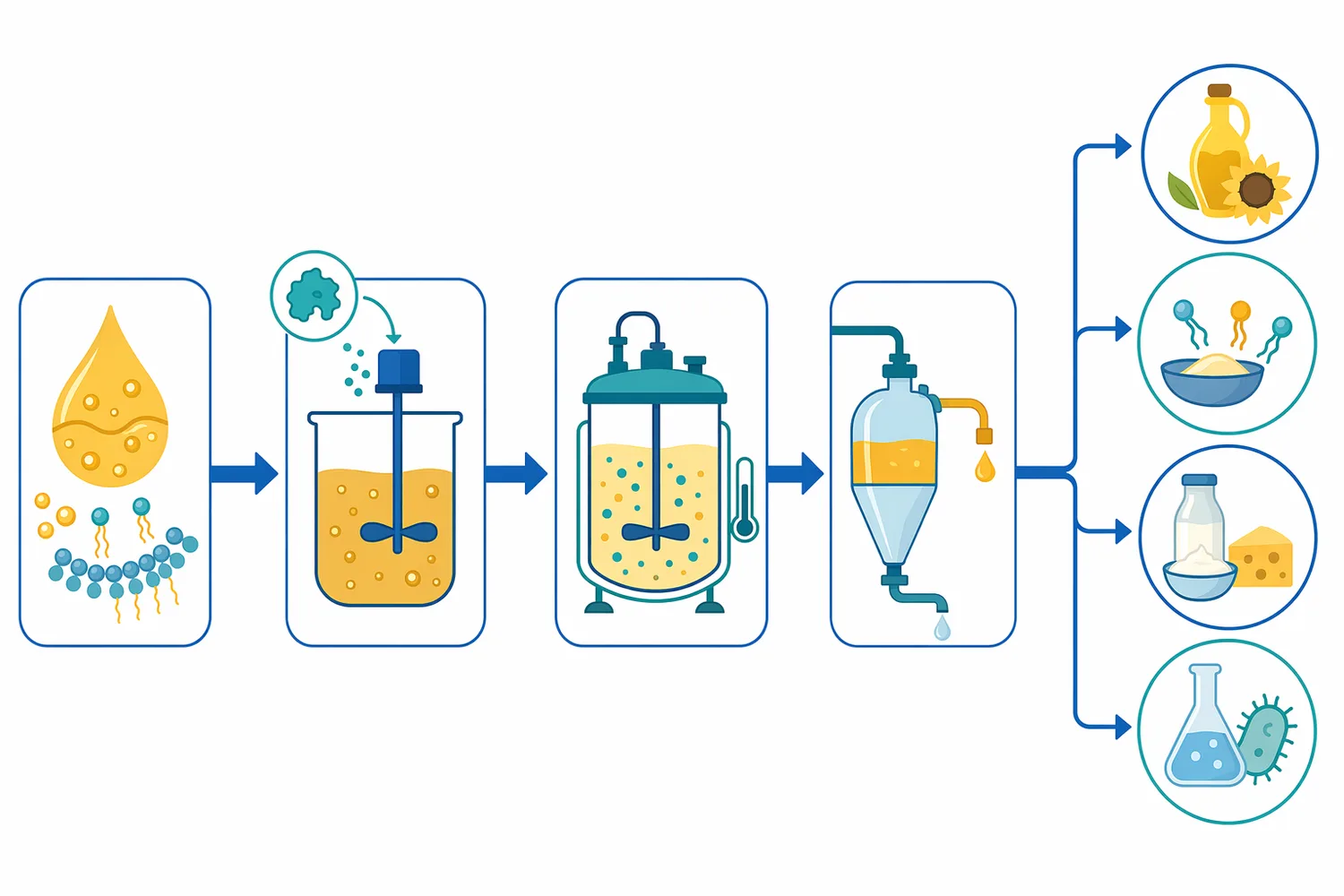
Food ingredients derived from egg, soy, dairy, meat, microbial biomass, and plant materials may contain phospholipids and lysophospholipids naturally or generate them during processing. Heat, endogenous enzymes, mechanical disruption, fermentation, and storage can all shift lipid composition. Because lysophospholipids are surface-active, they may influence texture, emulsion stability, fat dispersion, flavor release, and interactions with proteins or starches.
In a food ingredient process, lysophospholipase can be used as a targeted way to change lyso-lipid composition under comparatively mild conditions. The important word is targeted. The enzyme does not act like a broad stabilizer or emulsifier; it changes the chemical identity of lysophospholipid substrates. The resulting material behavior depends on how those substrates were contributing to the original functionality.
For example, if a lyso-lipid fraction is helping stabilize a desired emulsion, reducing it may be counterproductive. If the same class of molecules is contributing to foaming, harsh interfacial behavior, separation inconsistency, or off-note release, conversion may be beneficial. The same enzyme reaction can therefore produce different practical outcomes in different food matrices.
Feed ingredients can include oilseed meals, fermentation co-products, marine materials, animal-derived by-products, and concentrated lipid fractions. These materials often contain complex lipid mixtures, including phospholipids and lyso-phospholipid derivatives. In feed processing, the value of enzyme treatment may relate to physical handling, dispersion, nutrient availability, or consistency of ingredient behavior.
Lysophospholipase may be considered where lyso-phospholipid breakdown is part of the intended processing strategy. The chemical change is clear: one-tailed phospholipid substrates are converted into a free fatty acid and a polar head-group product. The nutritional or processing significance depends on the feed material and the broader formulation.
Because feed matrices are highly variable, lysophospholipase should be understood as one possible lipid-modification tool rather than a stand-alone solution. Its relevance is highest when lysophospholipids are known or expected to influence the handling or performance of the ingredient.
Fermentation and cell-based production streams often contain lipid-rich biomass. When cells are disrupted, membrane phospholipids and lysophospholipids can enter the process liquor. These molecules may affect viscosity, emulsification, filtration, centrifugation, chromatography behavior, or impurity carryover.
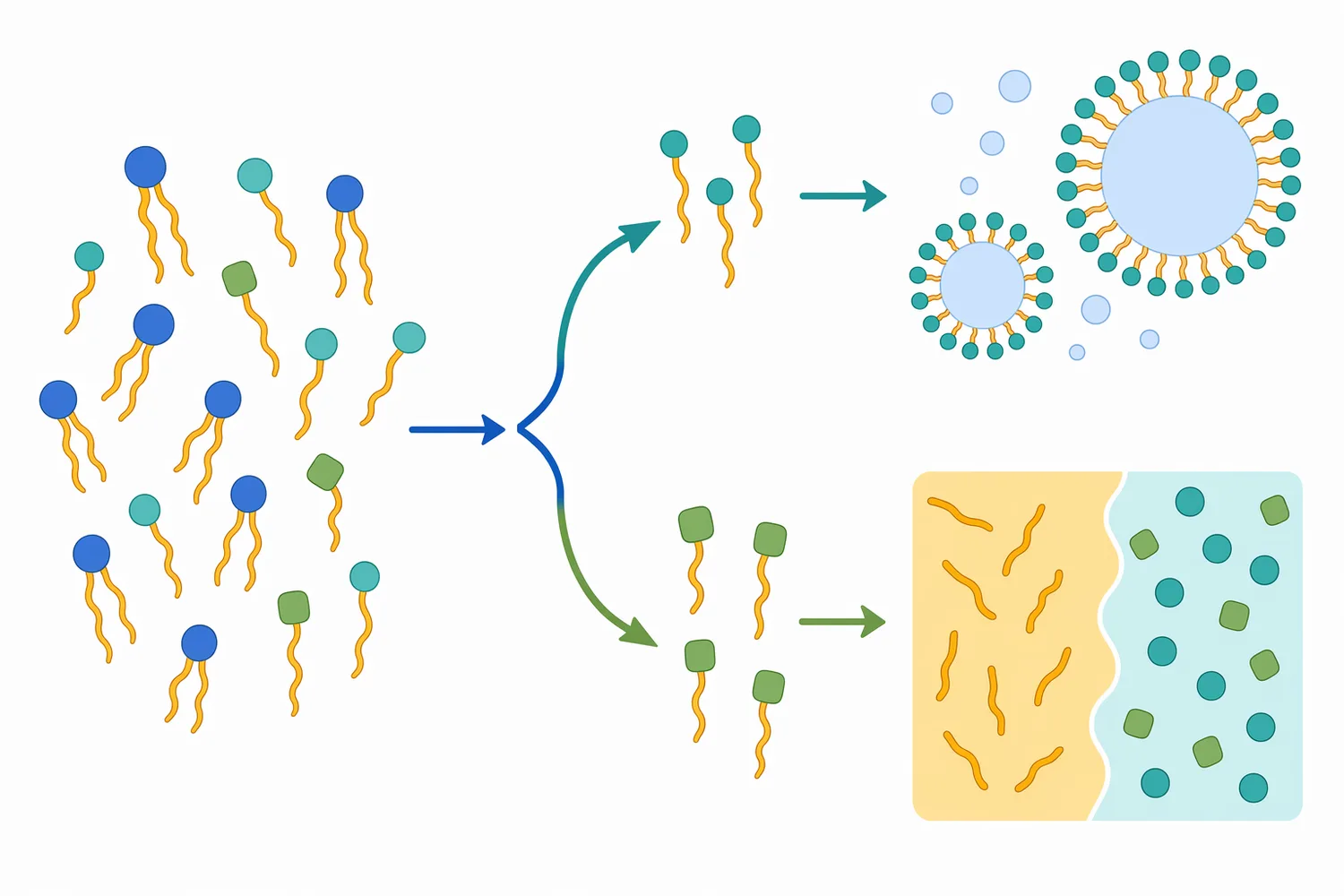
Lysophospholipase can help transform lyso-lipids in such streams when those molecules interfere with downstream handling. The mechanism is again concrete: the enzyme reduces the population of one-tailed amphiphiles and produces components with different solubility and interfacial behavior. In some matrices, that can make separations more manageable; in others, the effect may be modest if lysophospholipids are not the main cause of the processing issue.
This application area also explains why the scientific literature pays close attention to lysophospholipase function. In biological systems, lysophospholipids are not just passive structural residues; they participate in membrane remodeling and lipid signaling networks. The mechanistic study of lysophospholipase-transacylase from rat lung is one example of how closely related hydrolysis and acyl-transfer activities have been investigated in biological lipid metabolism [1].
Cosmetic and personal-care formulations frequently use plant oils, phospholipids, lecithin-derived ingredients, microbial lipids, and bio-based emulsifiers. These systems are highly sensitive to interfacial chemistry. A small amount of a strongly amphiphilic lipid can affect spreadability, emulsion stability, skin feel, clarity, and compatibility with actives or preservatives.
Lysophospholipase may be useful in producing or refining lipid fractions where the lyso-lipid profile needs adjustment. By converting lysophospholipids into less lyso-lipid-like products, the enzyme can shift the polarity and interface behavior of the lipid blend. This can support ingredient modification under relatively mild processing conditions compared with non-selective chemical hydrolysis.
The final formulation result still depends on the full ingredient system. Oils, waxes, alcohols, surfactants, polymers, electrolytes, and actives can all interact with the products of lysophospholipase treatment. The enzyme provides a defined chemical transformation; formulation performance follows from how that transformation changes the overall balance of amphiphiles.
Lysophospholipase is also relevant in research workflows focused on lipid metabolism, membrane turnover, lysophospholipid signaling, and enzyme mechanism. Researchers may use the enzyme to remove or transform lysophospholipids, interpret lipid composition, or study how lyso-lipid levels influence biological systems.

The phrase “lysophospholipase enzyme” can refer to more than one biological source or related activity. Some enzymes primarily hydrolyze lysophospholipids; others show associated transacylase behavior. The rat lung lysophospholipase-transacylase literature is a useful reminder that enzyme names in lipid metabolism often describe overlapping but not identical activities [1].
For industrial readers, the research relevance is practical: it reinforces that product outcomes are reaction-specific. A lysophospholipase used for hydrolysis should not be assumed to behave like lysophospholipase D, phospholipase A, or a broad lipase. Closely related names can produce very different lipid profiles.
The main benefit of lysophospholipase is specificity toward lysophospholipid-type substrates. When lyso-lipids are the molecules causing a processing or formulation issue, selective enzymatic conversion can be cleaner than broad chemical treatment. Instead of exposing the entire lipid matrix to harsh conditions, the enzyme acts on a defined class of ester bonds.
A second benefit is the relatively mild nature of enzymatic processing. Many lipid-containing ingredients are sensitive to heat, oxidation, strong pH, or solvent exposure. Enzymatic treatment can often be integrated into hydrated or dispersed systems without the same level of chemical severity. This can be important for food, feed, cosmetic, and biotechnology materials where maintaining ingredient integrity matters.
A third benefit is process interpretability. Because lysophospholipase changes a known substrate class into predictable product categories, it gives process engineers a clearer chemical explanation for observed changes. If emulsification decreases, separation improves, or viscosity changes after treatment, the likely cause is not mysterious: the population of one-tailed amphiphiles has been altered.
Lysophospholipase should be used with realistic expectations. It is not a universal oil-processing enzyme, not a general degumming replacement, and not an all-purpose emulsifier modifier. Its usefulness depends on whether lysophospholipids are present, accessible, and relevant to the processing objective.
The enzyme also cannot overcome poor substrate presentation. If the lysophospholipids are trapped in a poorly hydrated phase or inaccessible structure, reaction may be limited. Lipid systems are often heterogeneous, and enzyme access is controlled by physical mixing, water distribution, interfacial area, and matrix composition.
Nomenclature is another limitation. “Lysophospholipase,” “lysophospholipase D,” “phospholipase B,” and “lysophospholipase-transacylase” are not interchangeable terms. The mechanistic study of lysophospholipase-transacylase underscores that hydrolysis and acyl-transfer behavior can be linked in some enzymes, which is scientifically important but not the same as assuming every commercial lysophospholipase preparation has the same activity pattern [1].
The most responsible way to view lysophospholipase is as a targeted tool for lyso-phospholipid conversion. When that reaction matches the process objective, it can be valuable. When the issue is unrelated to lysophospholipids, another lipid enzyme or non-enzymatic process may be more appropriate.
Enzymes.bio supplies Lysophospholipase as an enzyme product sold directly online by the 1 kg unit. Buyers can place the product in the online order flow, pay online, and the order is then processed and shipped. A Certificate of Analysis and Safety Data Sheet are provided with the order.
This article is intended to clarify what lysophospholipase does and where the enzyme is technically relevant. For industrial use, food or feed use, cosmetic applications, biotechnology workflows, or research settings, the buyer remains responsible for confirming suitability within the intended process and applicable regulatory framework.
Lysophospholipase converts lysophospholipids—one-tailed, surface-active phospholipid derivatives—into products with different physical and chemical behavior. That change can matter in lecithin modification, lipid refining support, food and feed ingredient processing, fermentation streams, cosmetic lipid systems, and research workflows where lyso-lipids affect emulsification, separation, or interpretation.
The enzyme’s value comes from the chemistry: it targets lyso-phospholipid substrates rather than treating the whole lipid matrix indiscriminately. Understanding that mechanism helps buyers use lysophospholipase for the right reason—controlled transformation of lysophospholipids—rather than expecting a generic lipid-processing effect.
Sold by the 1 kg unit, in stock and ready to ship. Order directly on our store — pay online and we process your order. A Certificate of Analysis and Safety Data Sheet are included with every order.
Buy Lysophospholipase →Numbered in order of first citation. Open-access sources, each verified reachable at publication; citation numbers in the text link here.