
Lysozyme is a naturally occurring antimicrobial enzyme used where targeted bacterial control is useful in compatible food, beverage, biotechnology, personal-care, coating, and material applications. Its primary function is muramidase activity: the lysozyme protein weakens bacterial cell walls by cleaving structural bonds in peptidoglycan, making susceptible bacteria less able to maintain shape and survive stress [1].
For buyers looking for lysozyme in a straightforward format, Enzymes.bio supplies Lysozyme directly online in 1 kg units. The product can be purchased and paid for online; the order is then processed and shipped, with a Certificate of Analysis and Safety Data Sheet provided with the order.
A practical lysozyme definition is: lysozyme is an enzyme protein that attacks the peptidoglycan framework of bacterial cell walls. In industrial language, that means lysozyme is not simply “an antimicrobial” in the broad chemical-preservative sense; it is a protein lysozyme catalyst with a specific substrate, a specific biological target, and performance that depends on whether the target cell wall is accessible [1].
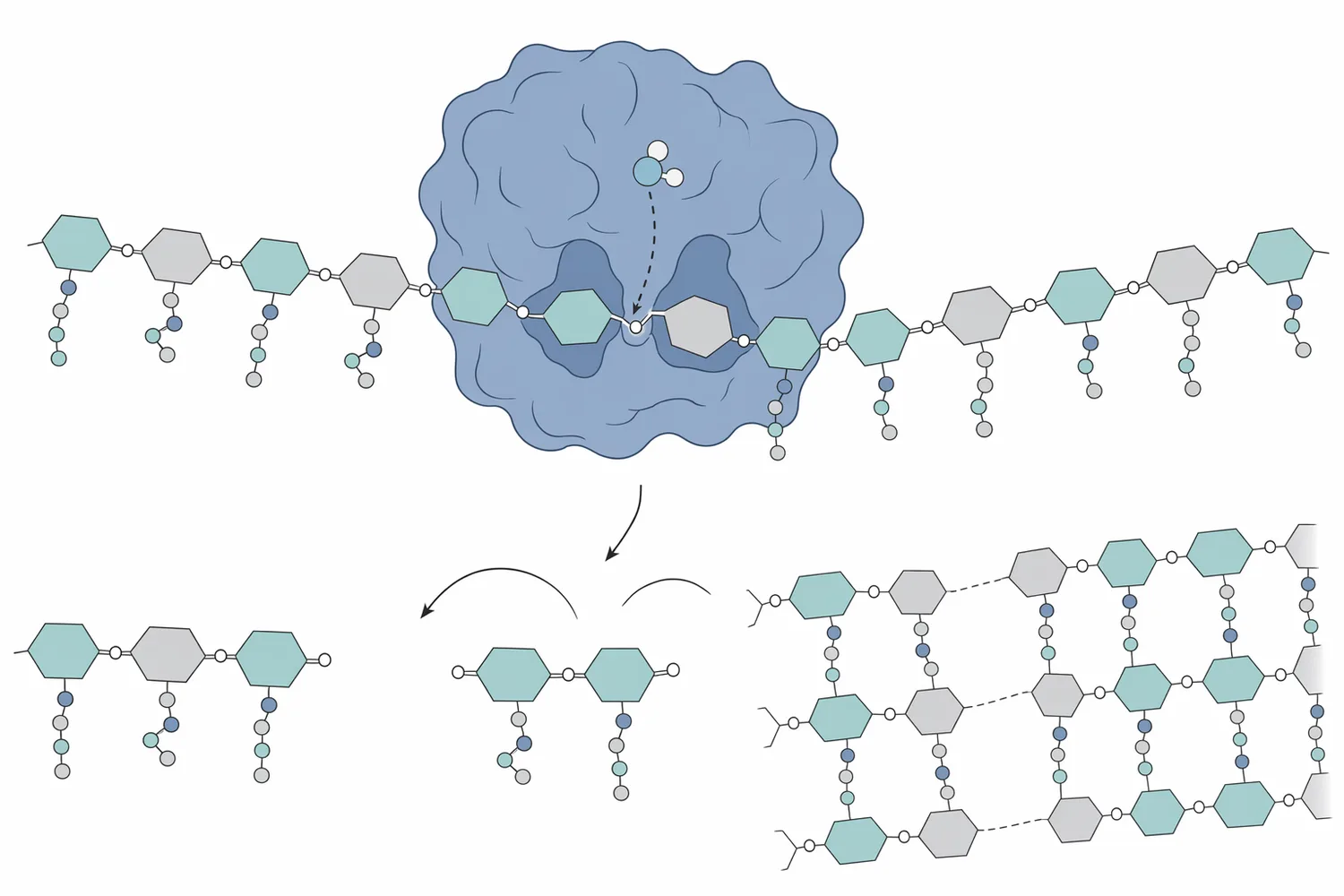
When customers search “what is lysozyme,” “what is a lysozyme,” or “what does lysozyme do,” the essential answer is that lysozyme helps break down bacterial wall structure. The enzyme is often described as lysozyme muramidase because it hydrolyses glycosidic linkages in the repeating sugar backbone of peptidoglycan, the rigid mesh that gives many bacteria their mechanical strength [1].
The phrase “lysozyme function” is sometimes used broadly because lysozymes occur across many organisms and biological contexts. For example, research on a crustacean i-type lysozyme found a clot-destabilizing function, while fish C-type lysozyme has been studied for expression and antibacterial activity during infection with Aeromonas salmonicida [2]. That diversity is useful scientifically, but for applied purchasing and formulation the most relevant function of lysozyme remains its targeted antibacterial cell-wall action.
It is also worth separating “lysozyme vs lysosome.” Lysozyme is an enzyme; a lysosome is a membrane-bound compartment inside eukaryotic cells that contains many degradative enzymes. The similar spelling causes confusion, but “lysosome vs lysozyme” compares a cellular organelle with a specific antimicrobial protein, not two interchangeable materials.
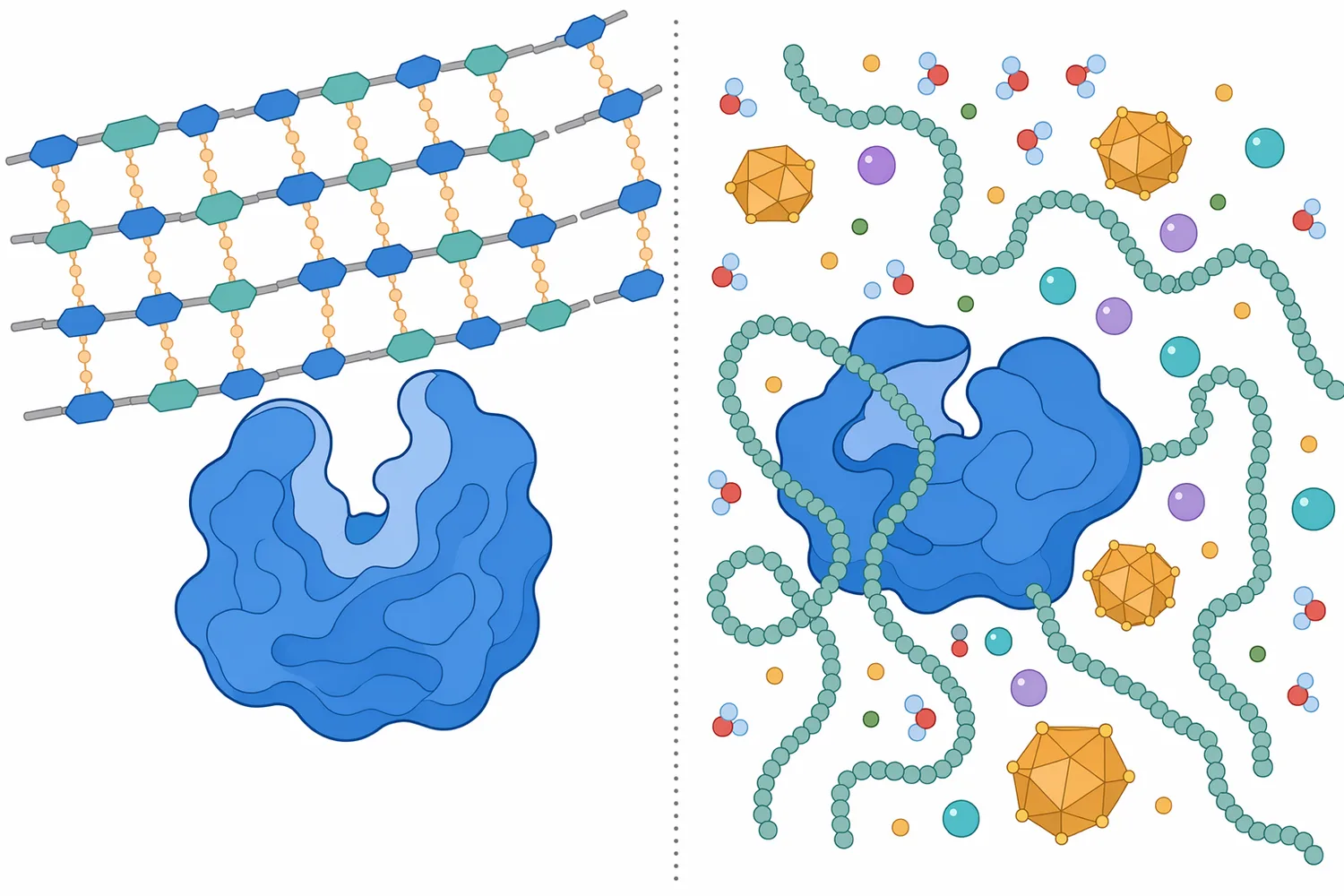
Bacterial peptidoglycan is a load-bearing network made from long sugar chains cross-linked by short peptides. Lysozyme binds into this wall material and cleaves the sugar backbone, so the continuous mesh becomes cut into shorter pieces; once enough local bonds are broken, the wall loses stiffness and the bacterium becomes more vulnerable to osmotic pressure, other preservation factors, and normal process stresses [1].

This mechanism explains both the value and the limits of lysozyme. If the enzyme can reach the peptidoglycan, it can weaken the cell envelope directly; if an outer barrier, matrix component, or surface condition restricts access, the same amount of enzyme may have less visible effect. That is why lysozyme is best understood as a targeted antimicrobial processing aid rather than a universal sterilant.
The structural basis matters. Lysozyme protein structure includes a folded active-site cleft that positions the peptidoglycan sugar chain so catalytic groups can distort and cleave the bond. Structure–function work on destabilase-lysozyme catalytic sites shows that lysozyme-family enzymes are not generic proteins: their biological effect depends on the relationship between active-site architecture and the substrate being cut [1].
Lysozyme’s protein conformation can also be affected by the surrounding environment. Studies on lysozyme exposed to nanoplastics combined with norfloxacin reported changes in conformation and function, while work with choline chloride-based deep eutectic solvents compared how different hydrogen-bond donors influenced lysozyme behavior [3]. In practical terms, this means a formulation environment can change how exposed, flexible, or functional the lysozyme protein remains.
Lysozyme is often used alongside broader preservation and process-control measures. The table below shows where its mechanism fits conceptually; it does not replace application-specific validation, hygiene, or regulatory review.
| Antimicrobial hurdle | Main action on microorganisms | What physically changes | Practical implication |
|---|---|---|---|
| Lysozyme | Enzymatic cleavage of bacterial peptidoglycan | Cell wall mesh loses continuity and strength | Most relevant where susceptible bacterial cell walls are accessible |
| Organic acids / acidity | pH stress and acid penetration | Internal pH regulation becomes harder for cells | Broadly useful in acidic systems, but not the same targeted wall-cutting mechanism |
| Heat treatment | Protein denaturation and membrane damage | Cellular enzymes and structures lose function | Powerful but may affect product sensory or functional quality |
| Salt, sugar, or reduced water activity | Osmotic stress and limited available water | Microbial growth becomes energetically difficult | Often supportive, but organism tolerance varies |
| Packaging and barrier systems | Limits oxygen, moisture transfer, or contamination | Growth environment changes after processing | Works best as part of a complete preservation design |
| Immobilized or composite lysozyme materials | Localized enzyme-based antibacterial surface action | Bacterial contact with treated surface can weaken cell walls | Useful in coatings, films, hydrogels, and packaging research |
Recent materials research shows why this comparison matters. Lysozyme has been immobilized on zwitterionic polymer thin films to create surfaces with both antifouling and antimicrobial function, showing how a fixed enzyme layer can be used to influence bacterial interaction at an interface rather than being dispersed throughout a liquid product [4].
The most established industrially relevant lysozyme function is antibacterial activity. Research on C-type lysozyme in crucian carp, for example, reports expression characteristics and in vitro antibacterial properties against Aeromonas salmonicida, illustrating how lysozyme-family proteins participate in host defense against bacteria [5].
Applied studies also show that lysozyme can remain functional when associated with compatible carriers. Carboxymethyl konjac glucomannan has been investigated as an association partner for lysozyme, with the study focused on antibacterial activity after complex formation; this supports the idea that lysozyme can be incorporated into structured matrices rather than only used as a free soluble enzyme [6].
Nanohybrid and composite systems provide additional evidence of lysozyme’s antibacterial relevance. Selenium nanoparticle–lysozyme systems have been studied for synergistic antibacterial properties, and antibacterial enzyme–silver–polymer nanocomposites have also been reported, showing how lysozyme can contribute to multi-component antimicrobial designs [7].
This does not mean every lysozyme-containing material is automatically appropriate for every end use. It means the literature consistently treats lysozyme as a functional antibacterial protein whose effect can be combined with films, polymers, nanoparticles, hydrogels, or surfaces when the material design preserves enough enzyme function and presents it to bacteria effectively [8].
In soluble form, lysozyme disperses through a liquid or hydrated matrix and can encounter susceptible bacteria directly. This is the simplest way to think about the enzyme: the protein must remain folded, mobile enough to contact bacterial wall material, and not blocked by incompatible ingredients.
In immobilized systems, lysozyme is fixed to or trapped within a surface, film, hydrogel, or particle. Immobilization changes the application logic: instead of moving freely through the product, the enzyme acts at a boundary where bacteria attach or pass across the treated material. Lysozyme immobilized on zwitterionic polymer films has been investigated specifically for combining antifouling and antimicrobial function, an approach relevant to surface hygiene and biointerface design [4].
Hydrogels are another important research format. Cross-linked chitosan/lysozyme hydrogels have been studied for inherent antibacterial activity and tunable drug-release properties in cutaneous administration, demonstrating that lysozyme can be part of a hydrated polymer network while still contributing antibacterial function [9].
Packaging and film systems are also active areas of study. Lysozyme composite antibacterial films immobilized by calcium alginate-gelatin have been reported, and lysozyme-modified nanocellulose has been studied for enhanced nucleation and antibacterial properties in polylactide composites [10].

For a buyer, the useful takeaway is not that every composite format should be copied directly. The evidence shows a consistent design principle: lysozyme function is strongest when the protein structure is protected enough to remain active and positioned so bacterial peptidoglycan can be reached.
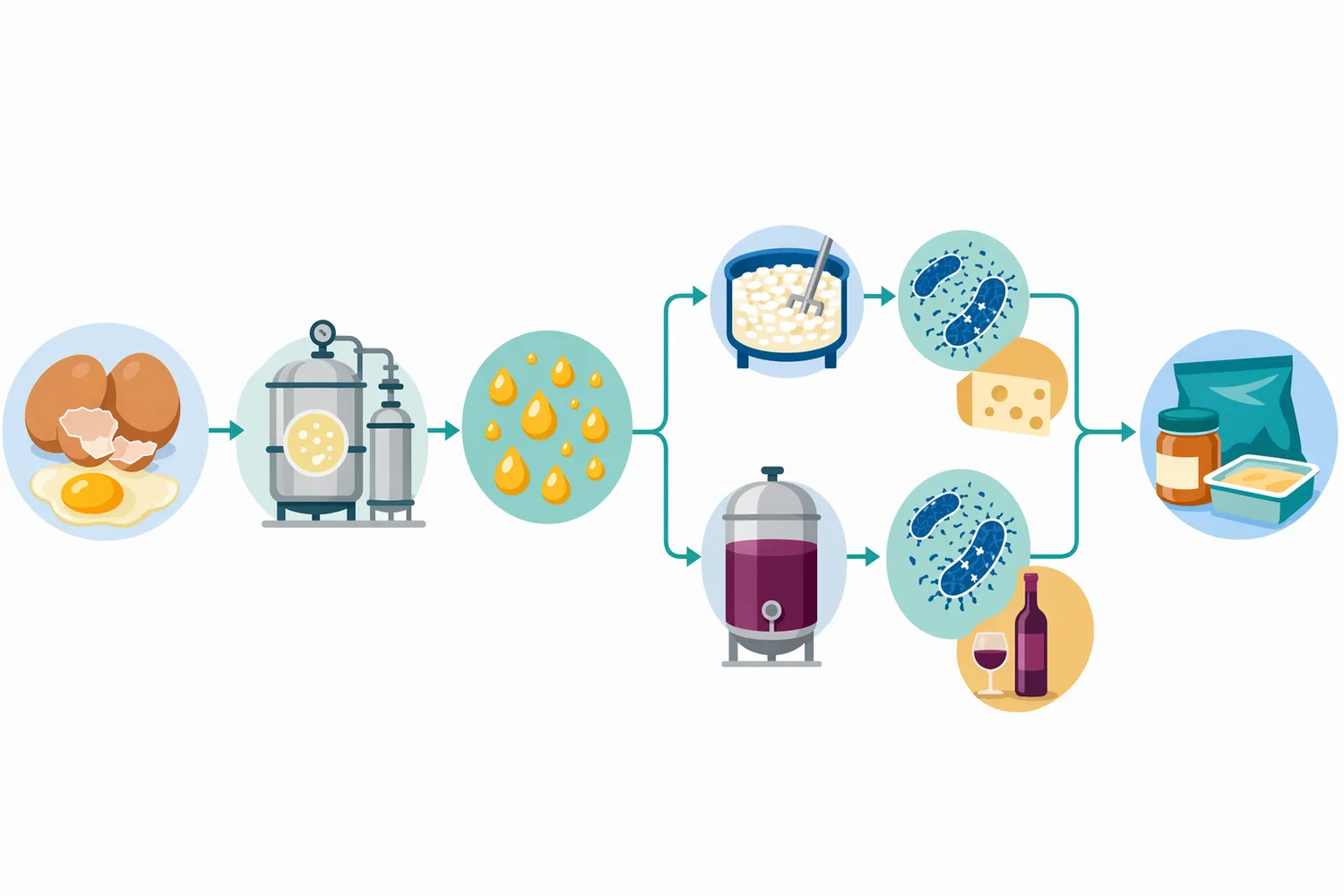
Lysozyme is relevant to food and beverage systems because many quality defects are microbial rather than purely chemical. Unwanted bacteria can drive gas formation, turbidity, acidity shifts, off-aromas, texture defects, and shortened shelf life; lysozyme is useful where the target problem involves bacteria susceptible to cell-wall attack.
Egg research illustrates the natural-food context of lysozyme. A study on eggs examined temperature and storage duration effects on trimethylamine content, lysozyme activity, and lysozyme content, connecting lysozyme to food quality systems where natural antibacterial components are part of the matrix [11].
Food packaging and freshness-monitoring research also intersects with antimicrobial design. While not every intelligent film uses lysozyme, recent work on antibacterial nanofibrous films for shrimp freshness monitoring reflects the broader industry interest in materials that combine preservation support with quality indication [12].
Lysozyme-containing films are especially relevant to this trend because they place the enzyme at the product-contact interface. Controlled fabrication of lysozyme composite antibacterial film immobilized by calcium alginate-gelatin shows how food-contact-style material concepts can use lysozyme as the active antibacterial component while the polymer network provides structure [10].
Lysozyme’s wall-cutting mechanism also explains its long-standing relevance in biotechnology workflows involving bacteria. When bacterial cells need to be opened, weakening the peptidoglycan wall makes them more susceptible to lysis by mechanical, osmotic, or formulation steps.
The same mechanism applies: lysozyme does not “dissolve” everything in the cell; it targets the wall scaffold that helps the bacterium resist rupture. Once that scaffold is weakened, downstream disruption can proceed more readily because the envelope no longer provides the same mechanical resistance [1].

Single-enzyme research also reinforces why lysozyme is a useful model protein in biochemical science. Work resolving dynamics and function of transient states in single enzyme molecules highlights that enzyme action depends not only on static structure, but also on short-lived conformational states that can influence catalytic function [13].
In practical applied use, that means lysozyme should be treated as a functional protein, not an inert additive. Conditions that preserve protein folding and keep the active site accessible support performance, while conditions that unfold, aggregate, bind, or mask the enzyme can reduce the desired effect.
Lysozyme appears frequently in research on antimicrobial biomaterials because it offers a biological mode of action that can be combined with soft materials, coatings, and responsive systems. Hydrogel microspheres encapsulating lysozyme/MXene have been investigated for photothermally enhanced antibacterial activity and infected wound healing, combining enzyme function with material-assisted bacterial control [14].
Chitosan–lysozyme systems are particularly intuitive because chitosan itself is widely studied as an antimicrobial and film-forming biopolymer. Cross-linked chitosan/lysozyme hydrogels demonstrate how lysozyme can be incorporated into a polymer network that contributes both structural behavior and inherent antibacterial activity [9].
Surface coatings are another strong research area. Lysozyme-modified titanium surfaces and lysozyme-based antibacterial coatings have been explored, including construction of an HBPL antibacterial coating on a phase-transition lysozyme-modified titanium surface [15].
For cosmetic and personal-care product language, lysozyme should be positioned carefully. It can support antimicrobial or bioactive formulation concepts where permitted, but disease-treatment, infection-treatment, or drug-like claims require an appropriate regulatory basis and should not be inferred simply because lysozyme appears in biomedical material research.
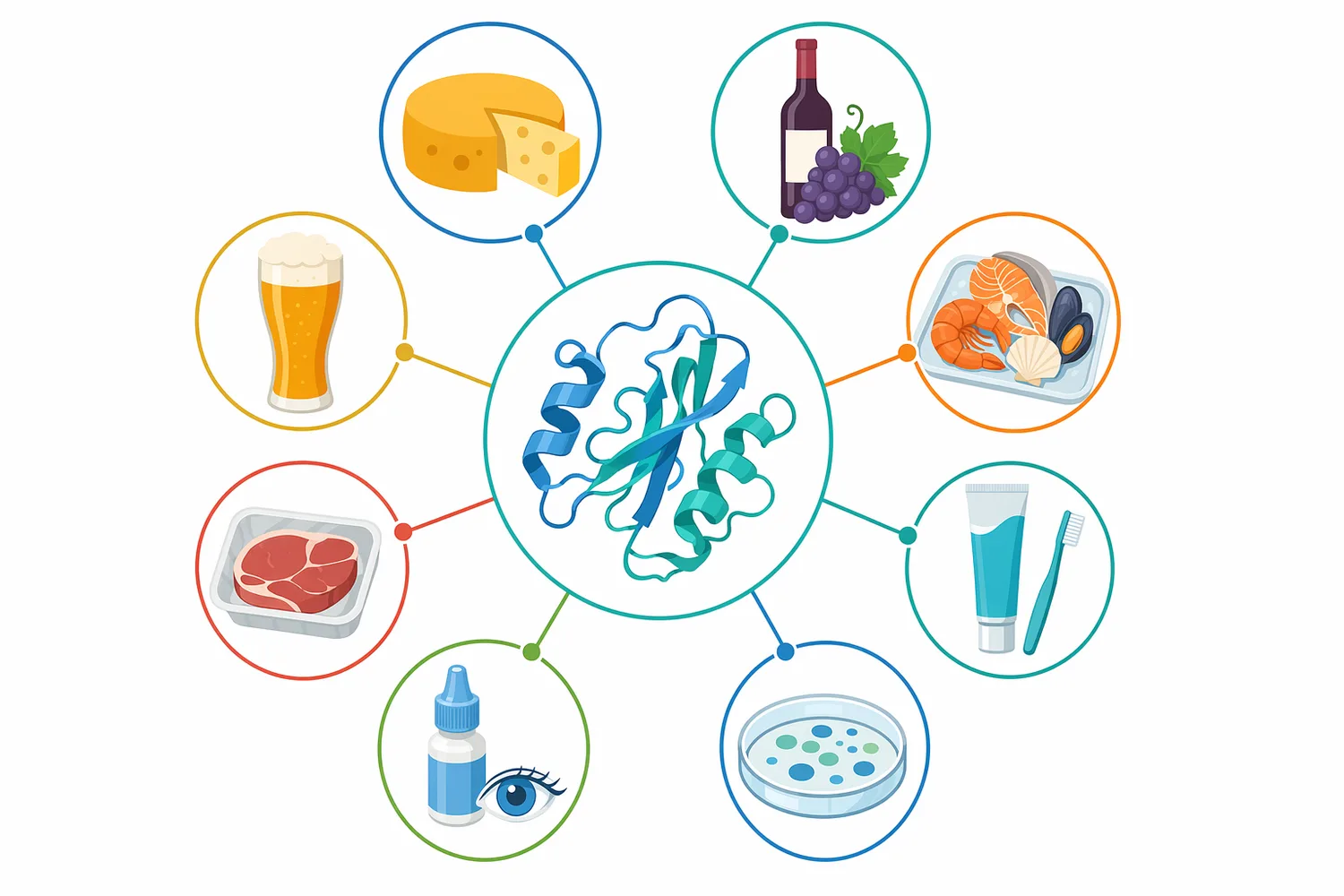
Lysozyme is also used as a biomarker and functional endpoint in animal nutrition and aquaculture studies. In geese, dietary Artemisia annua supplementation was evaluated for growth performance, antioxidant capacity, immune function, and gut microbiota, with lysozyme appearing in the context of immune-related assessment [16].
Aquaculture studies frequently track lysozyme because it is associated with innate defense. Bee venom supplementation in thinlip mullet has been studied for performance and immune function, and cyanobacteria used as an aquafeed additive for whiteleg shrimp postlarvae has been evaluated for growth, immunity, digestive function, and gene expression [17].
These studies do not mean that industrial lysozyme should be described as a veterinary treatment. They do show why lysozyme is a familiar term in aquaculture and animal-health literature: it is connected to innate antibacterial defense and is commonly discussed when researchers evaluate immune status or microbial resilience [18].
For feed, aquaculture, and agricultural product concepts, the responsible framing is enzyme-based antimicrobial functionality or support within a defined product category. Any claims about health, immunity, disease resistance, or treatment must follow the rules and evidence standards of the intended market.
Because lysozyme is a compact, folded protein, its function depends on maintaining the shape of the active region that binds and cleaves peptidoglycan. If that shape is distorted, blocked, or destabilized, the enzyme may still be present as protein but perform differently.
Several studies show how surrounding materials can influence lysozyme structure and function. MPA-capped CdTe quantum dots have been examined for their influence on lysozyme using spectroscopic and calorimetric methods, reflecting wider interest in how nanomaterials interact with the lysozyme protein structure [19].
Deep eutectic solvent studies make the same point from a formulation perspective. Choline chloride-based systems with fructose or formic acid donors were compared for their influence on lysozyme, showing that even systems built from small molecules can affect enzyme behavior depending on their hydrogen-bonding and solvent environment [20].
Self-assembled lysozyme systems add another layer. Light-responsive spiropyran–lysozyme nanoparticles have been reported with enzymatic function, and reduced-glutathione-induced lysozyme nanofilms have been studied for antibacterial properties, demonstrating that lysozyme can be engineered into organized structures while retaining useful activity under the right design [21].
Searches for “lysozyme blood test” or “lysozyme lab test” usually refer to clinical or diagnostic contexts, not to buying lysozyme enzyme for industrial use. Those phrases can involve measurement of lysozyme-related biomarkers in biological samples, whereas this page concerns lysozyme as a supplied enzyme ingredient for applied processing and material use.
That distinction matters because the same word appears in different professional settings. In life science, lysozyme may be studied as an immune-related protein, a model enzyme, or a biological marker; in applied processing, the relevant question is whether the lysozyme protein can perform its muramidase function against accessible bacterial cell-wall substrate [5].
Enzymes.bio supplies the enzyme product; it does not position lysozyme as a clinical diagnostic service, blood-test material, or therapeutic product. Buyers using lysozyme in regulated applications should ensure their finished-product claims and category-specific obligations match the intended market.
Lysozyme is not a universal antimicrobial and should not be described as one. Its strongest action is against susceptible bacteria whose peptidoglycan can be reached; yeasts, molds, viruses, spores, and bacteria with protective outer structures may not respond in the same way.
Matrix effects can also be substantial. Nanoplastics, solvents, nanoparticles, polymers, salts, phenolics, proteins, and other components may alter enzyme conformation, enzyme accessibility, or bacterial susceptibility, so the same lysozyme addition can behave differently in different systems [3].
This is why lysozyme is best used as part of a broader preservation or process-control approach. Hygiene, appropriate processing, packaging, temperature management, acidity, and other hurdles remain important; lysozyme adds a targeted wall-degrading mechanism rather than replacing the entire microbial-control system.
Allergen awareness may also be relevant depending on source, final use, and local labeling rules. Lysozyme is widely associated with egg-derived commercial material in many contexts, so buyers working in food, beverage, supplement, or personal-care categories should treat allergen and labeling considerations as part of their own finished-product compliance process.
Enzymes.bio supplies Lysozyme for buyers who need access to the enzyme in a simple online purchasing format. The product is sold directly online by the 1 kg unit: place the order, pay online, and the order is processed and shipped.
A Certificate of Analysis and Safety Data Sheet are provided with the order. These documents support normal receiving, handling, and internal quality procedures without requiring a separate quote or sample-request process.
For applied use, lysozyme should be understood as a targeted antimicrobial enzyme protein with a clear biochemical function. It weakens susceptible bacterial cell walls by acting on peptidoglycan, and it is most useful in systems where that mechanism matches the microbial challenge and product environment [1].
Sold by the 1 kg unit, in stock and ready to ship. Order directly on our store — pay online and we process your order. A Certificate of Analysis and Safety Data Sheet are included with every order.
Buy Lysozyme →Numbered in order of first citation. Open-access sources, each verified reachable at publication; citation numbers in the text link here.