
Mannanase Enzyme Powder for Detergent Applications is used to help detergents break down sticky, plant-gum residues from ingredients such as guar gum and locust bean gum. It works by hydrolyzing mannan-type polysaccharides into smaller, more water-dispersible fragments so the wash liquor and detergent surfactants can lift the residue from fabric more effectively.
For laundry and cleaning formulations, mannanase is best understood as a targeted support enzyme: it does not replace protease, amylase, lipase, or cellulase, but it adds coverage for gum-thickened food and personal-care stains that those enzymes do not specifically attack.
Enzymes.bio supplies Mannanase Enzyme Powder for Detergent Applications directly online by the 1 kg unit. Buyers can purchase through the website, pay online, and the order is processed and shipped with a Certificate of Analysis and Safety Data Sheet.
Many modern stains are not simple oil, starch, or protein stains. Processed foods, sauces, dressings, low-fat dairy products, desserts, cosmetics, shampoos, conditioners, and skincare products often rely on plant-derived gums to create viscosity, stability, and a smooth texture. In laundry, these gums can leave sticky films on cotton, blends, towels, uniforms, napkins, and household textiles, making stains feel tacky or resistant even after surfactant washing. Industry detergent guidance specifically identifies gum stains from guar gum and locust bean gum as a practical target for mannanase in laundry systems.
The reason these stains behave differently is structural. Guar gum and locust bean gum are galactomannans: long carbohydrate polymers based on a mannan backbone, with side groups that affect hydration and viscosity. When such gums dry onto fabric, they can form a hydrated, adhesive network that traps other stain components—color bodies, fats, proteins, starch particles, or soil—close to the textile surface. A surfactant can wet and emulsify many soils, but it does not selectively cut the long carbohydrate chains that give gum stains their cohesive, sticky character.
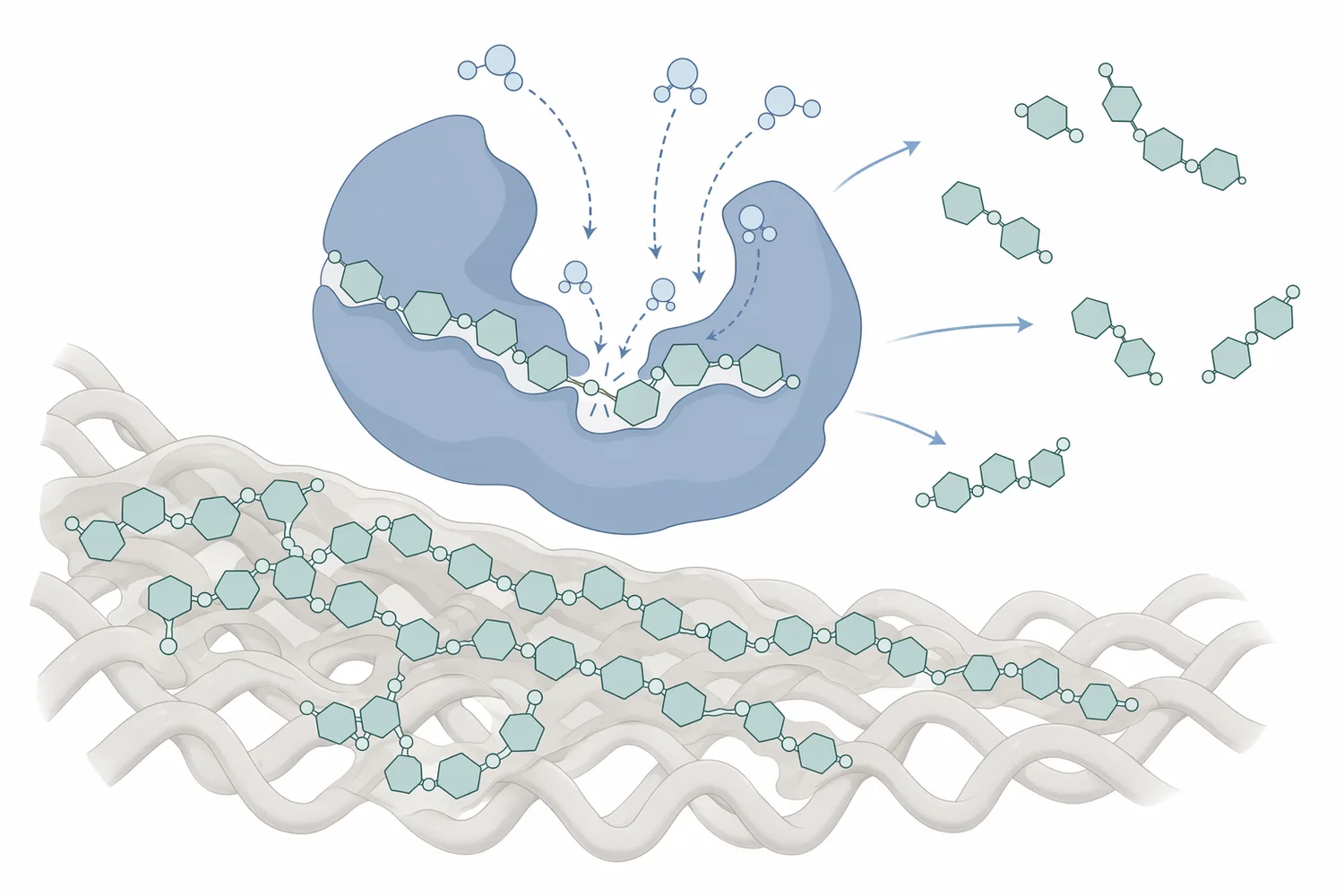
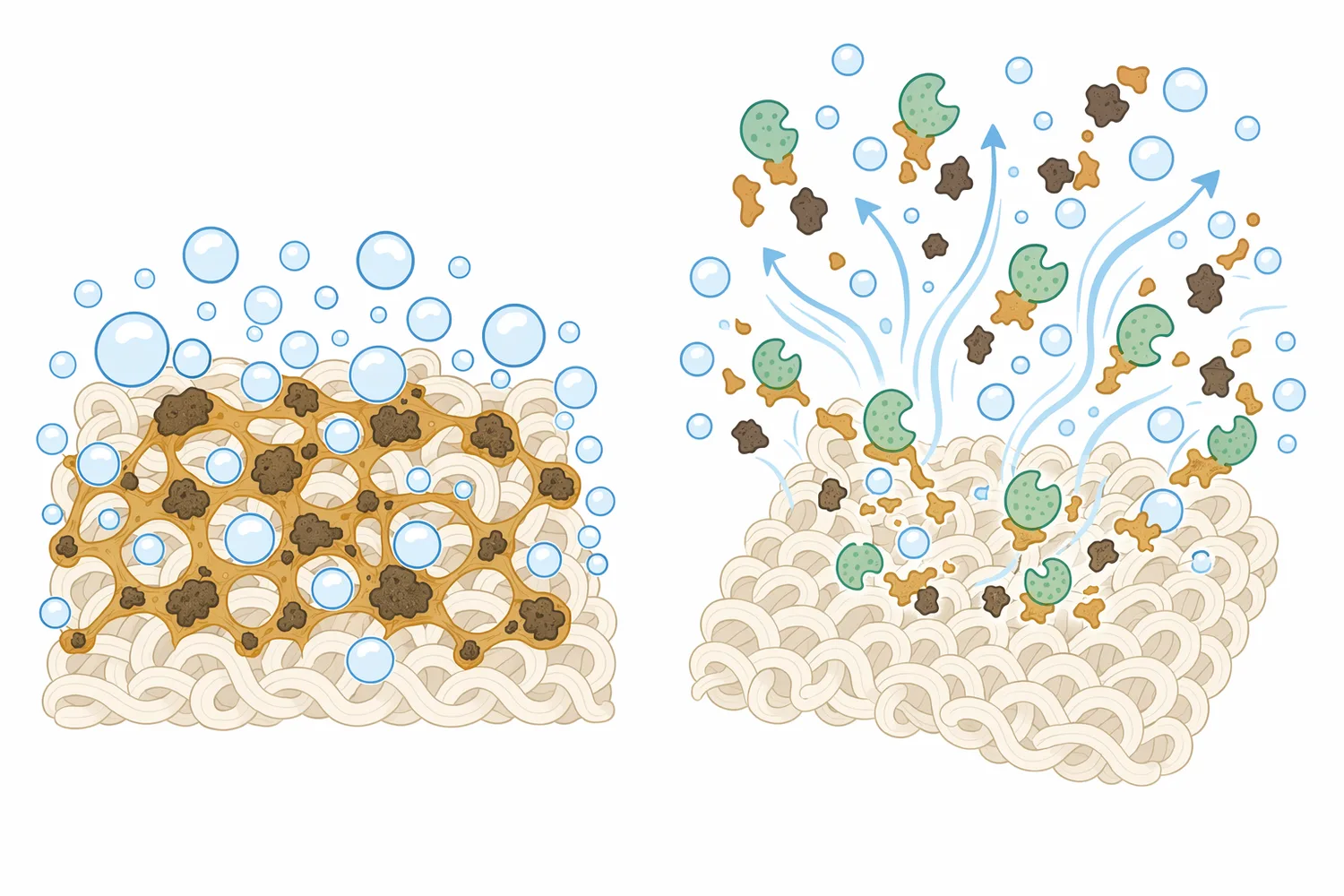
Mannanase adds that missing biochemical action. Instead of only dispersing the stain from the outside, the enzyme cleaves the mannan portion of the gum structure. Once the large polymer is cut into shorter fragments, the residue loses much of the chain length and network strength that helped it cling to the fabric. The detergent system can then do its normal job more effectively: wet the surface, suspend loosened soil, emulsify compatible components, and carry the smaller fragments away in the wash water.
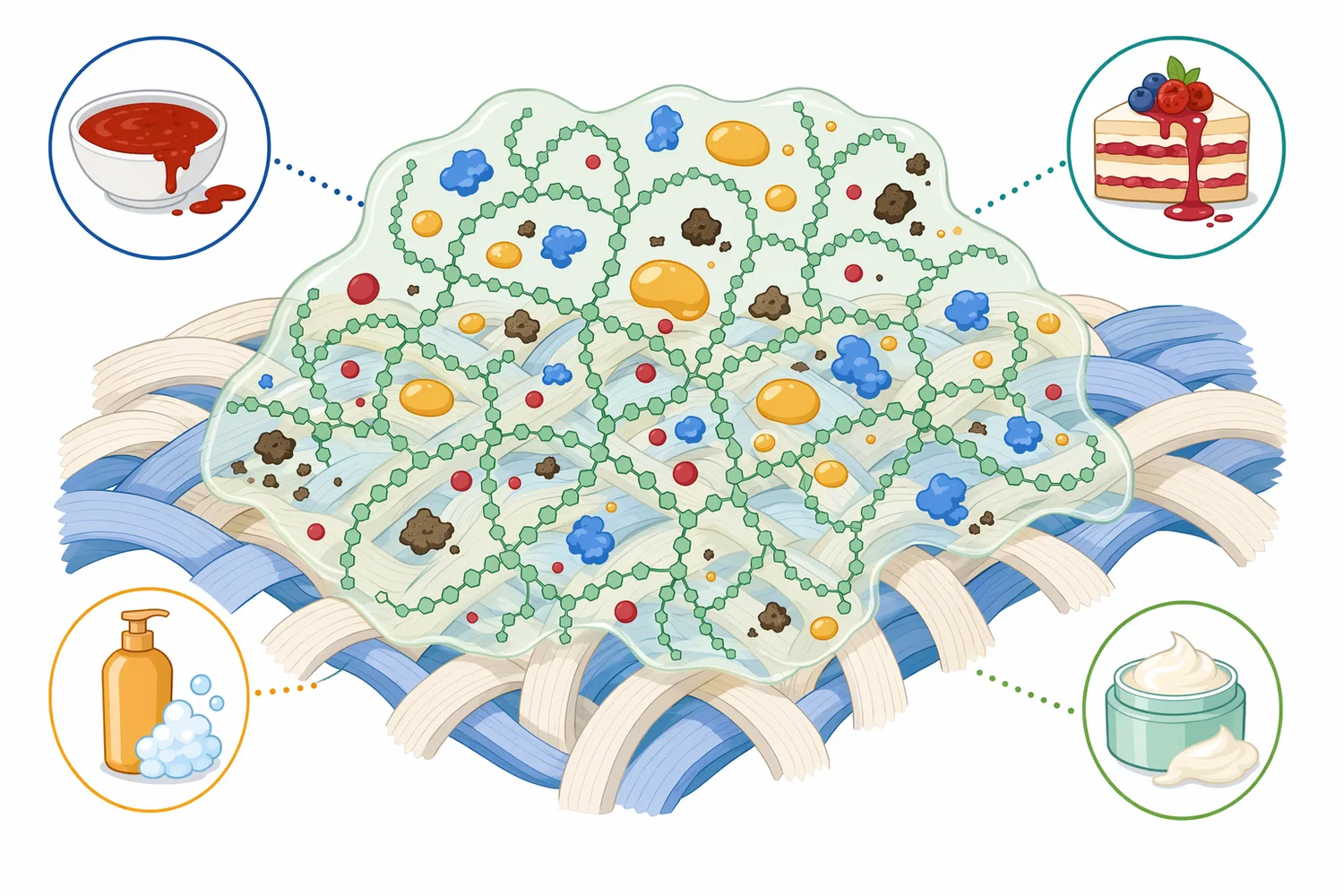
Mannanase is a carbohydrate-hydrolyzing enzyme that acts on mannan-type polysaccharides. The key chemical feature is the β-1,4-linked mannose backbone found in mannans and many galactomannans. Endo-β-mannanase attacks internal β-1,4-mannosidic bonds, meaning it cuts within the polymer chain rather than only trimming from the ends. That internal cleavage is important because a few well-placed cuts can rapidly reduce the average chain length of a large gum molecule [1].
This chain-length reduction is what changes the stain physically. Long hydrated polysaccharide chains produce viscosity and tack because they entangle, bind water, and bridge surfaces. On fabric, that can mean a stain film remains coherent even after wetting. When mannanase cuts those chains, the polymer becomes a mixture of shorter mannooligosaccharides and related fragments. These fragments no longer form the same strong, continuous gum network, so the stain becomes easier to disperse and rinse away [1].
The mechanism is substrate-specific. Mannanase is not a general-purpose “stain dissolver”; it is effective where the stain includes mannan-rich gums or related hemicellulosic material. That specificity is the reason detergent enzymes are commonly combined. A real stain from a sauce, dessert, baby food, cosmetic, or dairy product may contain gum stabilizers, starch, proteins, fats, pigments, and particulate soil. Mannanase addresses the mannan-gum fraction, while the rest of the detergent system and any other enzymes address their own targets.
This also explains why visible performance can be disproportionate to the amount of gum in the stain. A gum may be only one component of a food or personal-care residue, but it can act as a binder that holds the whole stain matrix together. Weakening that binder can make the combined stain more removable, even though mannanase is not chemically attacking every component present. In practical detergent terms, the enzyme helps unlock stains where plant gums are part of the adhesion and residue structure.
Modern enzyme detergents are built around the principle that different stain chemistries require different catalytic tools. Proteases hydrolyze proteins, amylases hydrolyze starch, lipases act on fats and oils, cellulases modify cellulose-associated residues and cotton surface effects, and mannanases target mannan-based gums. The benefit is not that any one enzyme covers everything, but that the detergent system can address several stain architectures at once.
| Enzyme type | Main stain target | What changes in the stain | Practical detergent contribution |
|---|---|---|---|
| Mannanase | Guar gum, locust bean gum, mannan-rich plant gums | Long mannan chains are cut into shorter fragments | Reduces sticky gum structure so residues disperse and rinse more easily |
| Protease | Protein stains such as egg, milk, blood, grass-associated proteins | Protein chains are hydrolyzed into smaller peptides | Helps remove proteinaceous films and mixed food stains |
| Amylase | Starch from pasta, rice, cereals, sauces, thickeners | Starch polymers are broken into smaller dextrins and sugars | Helps prevent starchy residues from binding soil to fabrics |
| Lipase | Fats, oils, sebum, greasy food soils | Lipids are hydrolyzed into more removable components | Supports removal of greasy residues in the detergent matrix |
| Cellulase | Cotton surface fibrils and cellulose-associated residues | Surface cellulose microfibrils are modified | Can support fabric appearance and removal of particulate soils from cotton |
In mixed stains, this division of labor matters. A salad dressing stain, for example, may contain oil droplets, proteinaceous ingredients, starch or modified starch, and a gum stabilizer. If only the oil phase is emulsified, the remaining gum network may still hold residue on the fabric. If only the protein fraction is hydrolyzed, the gum may continue to bind the stain matrix. Mannanase gives the detergent an additional route: break the gum scaffold so other cleaning actions are not working against an intact sticky polymer network.
The biochemical basis for mannanase use is supported by studies that directly monitor enzymatic hydrolysis of mannan substrates. Work on ivory nut mannan, for example, followed the breakdown of a mannan-rich material during enzymatic treatment, demonstrating the core reaction that detergent applications rely on: mannan polymers are converted into smaller soluble carbohydrate products through enzymatic cleavage [1].
That mechanism is also consistent with broader biomass-processing research, where enzymatic hydrolysis is used to depolymerize mannan-rich or hemicellulosic materials. Palm kernel cake is one such substrate because it contains substantial lignocellulosic and mannan-associated carbohydrate fractions. Research on hot-water pretreatment followed by enzymatic hydrolysis showed that pretreatment and enzymes can work together to increase depolymerization of resistant plant material, illustrating how enzyme access and substrate structure affect the release of smaller carbohydrate products [2].
For detergent use, the most important translation is not that laundry fabrics resemble biomass-processing feedstocks. The relevant point is that mannanase acts on the same type of chemical architecture: β-linked mannan or galactomannan chains that resist simple rinsing when they are part of a hydrated plant-gum matrix. When those chains are shortened, the material’s viscosity, cohesion, and surface adhesion can fall, which is exactly what a detergent needs when it is trying to remove a sticky gum stain.
Detergent education sources describe enzymes as ingredients that bind to specific stain components and catalyze their breakdown into smaller, more washable materials. Mannanase fits this model closely because the substrate is well defined: mannan-rich gums rather than all carbohydrates. This makes the enzyme especially relevant where consumer products contain guar gum, locust bean gum, or related gum systems that can leave adhesive residues on textiles.
Surfactants are essential in detergents because they reduce surface tension, wet textile fibers, help detach soils, emulsify greasy components, and keep removed soil suspended in the wash liquor. However, surfactants do not cut covalent bonds in a polysaccharide chain. If a stain’s persistence comes partly from the long-chain structure of a hydrated gum, then a surfactant can loosen the outside of the residue while the internal polymer network remains largely intact.
Gum-based stains also behave like binders. They can glue together fine particles, oils, pigments, and proteinaceous residues, then attach the combined mass to the textile surface. In that situation, the gum is not always the most visible part of the stain, but it may be the component that gives the stain its resistance to removal. Mannanase changes the binder itself by reducing the mannan chain length, weakening the physical network that holds the stain together.
This is why mannanase can be valuable even in detergents that already contain strong surfactant systems. The enzyme contributes a chemical transformation that surfactants cannot provide. Once hydrolysis has opened up the gum network, surfactants and mechanical agitation have better access to the stain components. The result is not magic or bleaching; it is a more complete cleaning pathway for a class of residues that are otherwise structurally persistent.
Mannanase is most relevant in laundry detergents designed to handle real household and institutional stain loads: sauces, dressings, desserts, dairy products, personal-care residues, and gum-thickened processed foods. These soils are common because gums are widely used to stabilize texture and viscosity in consumer products. Detergent-industry information highlights mannanase for “gum stains” specifically because guar and locust bean gum residues can remain sticky and visible on fabrics after ordinary washing.
During a wash cycle, the enzyme needs water, contact time, and access to the substrate. Water hydrates the gum stain and allows the enzyme to diffuse into the residue. The enzyme then cleaves accessible mannan bonds. As the gum matrix is cut, the residue becomes less cohesive and more dispersible. At that point, surfactants, builders, water movement, and fabric-to-fabric action can remove the loosened material more effectively.
Temperature and pH can influence enzyme performance because enzymes are proteins with three-dimensional structures that must remain functional while they catalyze reactions. Detergent mannanases are therefore used in the context of aqueous wash systems rather than as dry stain removers. General detergent-enzyme guidance describes enzymes as active cleaning ingredients that operate during the wash, where water and detergent chemistry bring the enzyme into contact with its target stain.
It is important to frame performance accurately. Mannanase supports removal of mannan-containing gum stains; it should not be presented as a universal solution for every soil. A grease-only stain is primarily a lipase and surfactant challenge. A protein film is primarily a protease challenge. A starchy residue is primarily an amylase challenge. Mannanase earns its place when gum thickeners are present or likely to be part of the stain matrix.
Although laundry is the most common association, the same gum chemistry can appear on dishes, utensils, processing surfaces, and hard surfaces where sauces, dressings, desserts, or personal-care residues are present. Gum-thickened foods can dry into films that are slippery when wet yet stubborn when partially dehydrated. Mannanase can help by attacking the mannan-based thickener fraction, especially where guar or locust bean gum contributes to the residue structure.
In dishwashing or hard-surface cleaning, mannanase should be viewed as a support for gum-film breakdown rather than as a degreaser. Oils and fats still rely on surfactants and, where applicable, lipid-targeting chemistry. Proteins and starches require their own cleaning mechanisms. Mannanase contributes by cutting the plant-gum polymer that may be binding the mixed residue together, improving the ability of the rest of the cleaning system to detach and disperse the soil.
This distinction matters for realistic expectations. A gum-stabilized sauce film may respond better to mannanase-containing cleaning chemistry than to surfactant action alone because the enzyme changes the polymer network. A mineral scale, oxidized pigment, or purely oily residue would not be expected to respond in the same way. The enzyme is powerful when the substrate is present, but the substrate determines the benefit.
Enzymes are widely used in cleaning because they perform selective catalytic work under conditions compatible with water-based washing. Rather than relying only on higher heat, stronger alkalinity, or more aggressive mechanical action, enzyme detergents use substrate-specific hydrolysis to convert difficult soils into smaller, more removable components. This is the same basic logic behind mannanase use: target the gum structure directly, then let the detergent system remove the fragments.
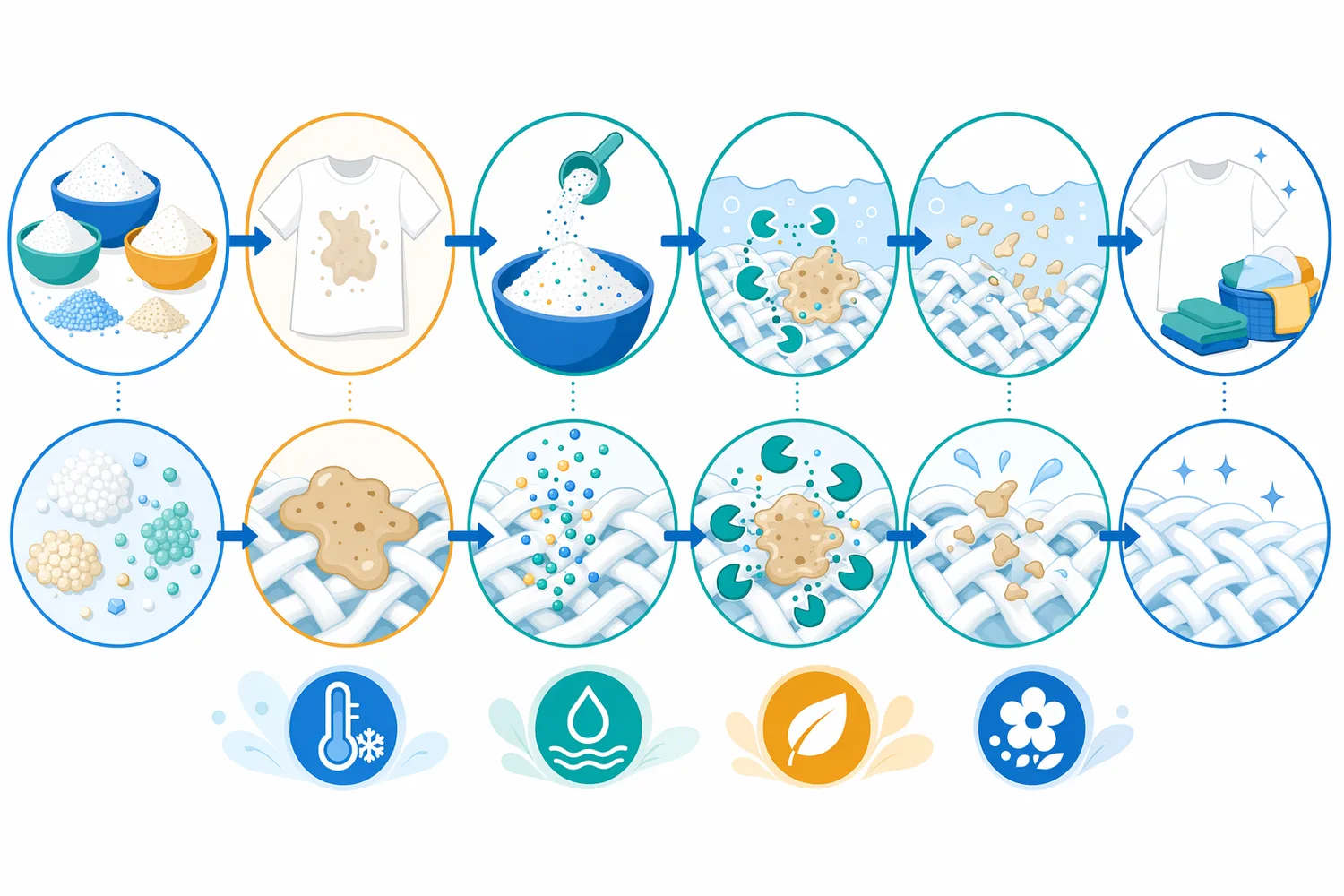
The broader industrial use of enzymatic hydrolysis supports this logic. In biomass and by-product processing, enzymes are used because plant polysaccharides can be structurally resistant until the correct bonds are cleaved. Research on agro-industrial residues shows that enzymatic treatment can convert complex plant carbohydrate structures into smaller products, especially when substrate accessibility is improved [3].
For detergents, the substrate is smaller and the exposure time is shorter, but the underlying chemistry is comparable. A plant-derived polymer is present; it resists simple rinsing; an enzyme specific to that polymer hydrolyzes key bonds; the resulting fragments are easier to remove. That concrete sequence is the reason mannanase is a credible detergent ingredient rather than a generic “natural cleaner” claim [1].
A well-positioned mannanase detergent claim should focus on gum-based stains. Strong wording would be: “helps break down mannan-containing gums such as guar gum and locust bean gum in sticky food and personal-care residues.” This is precise because it names the substrate and describes the enzyme’s function without implying that the enzyme removes all stains or replaces a complete detergent system.
Claims should also recognize that finished-product performance depends on the whole formula and use context. Surfactants, builders, alkalinity, water hardness, oxidizing ingredients, perfumes, physical format, wash time, and temperature can all affect how much enzyme activity reaches the stain during real cleaning. That does not reduce the value of mannanase; it simply reflects that enzymes operate inside a larger detergent environment.
The most accurate positioning is as part of a multi-enzyme cleaning strategy. Mannanase expands stain coverage by adding a gum-focused mechanism. It is especially useful where residues from thickened foods, dressings, sauces, dairy products, cosmetics, shampoos, and conditioners are expected. In these applications, the enzyme’s role is tangible: cut the mannan-gum backbone, weaken the sticky matrix, and make the residue easier for the detergent to remove.

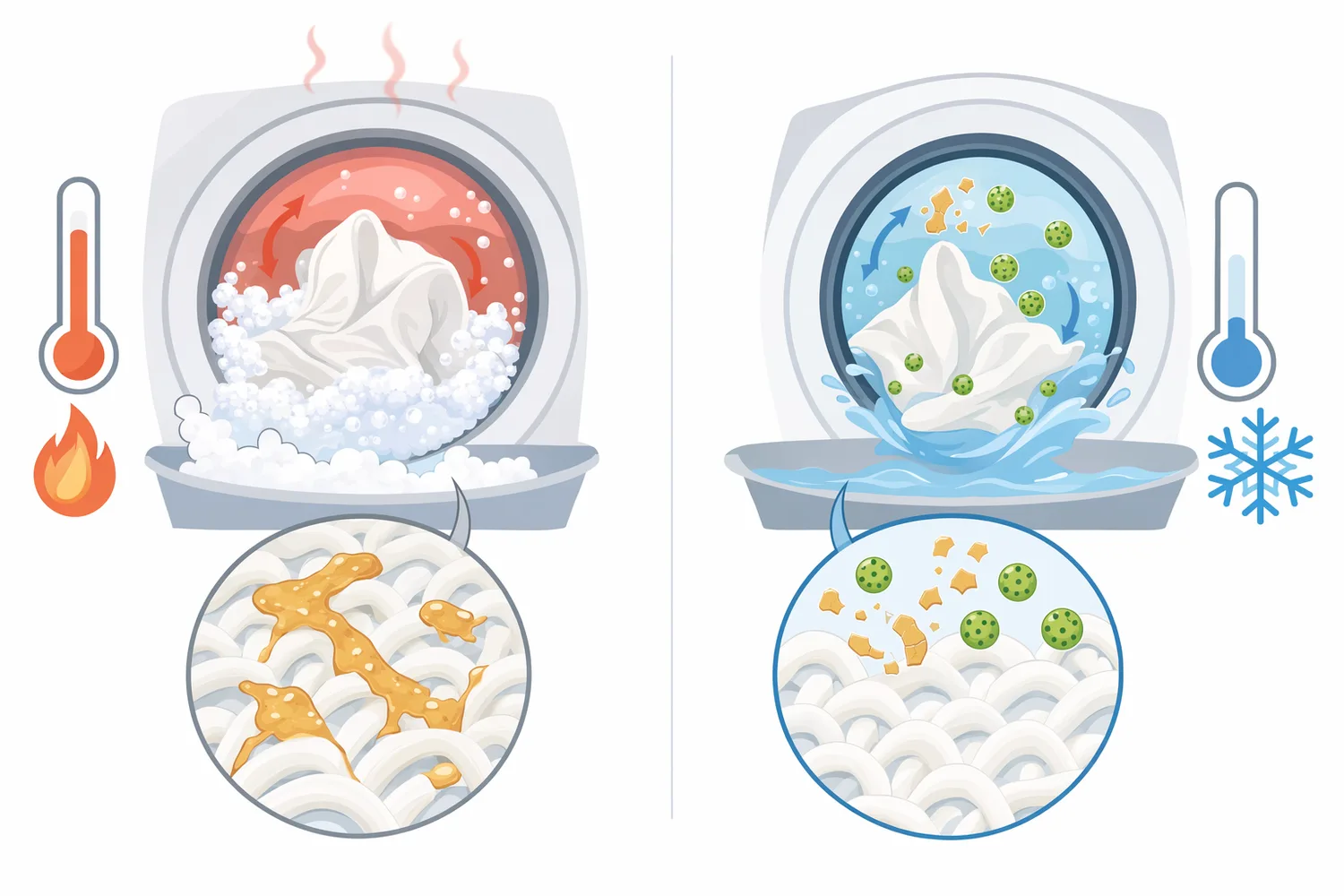
Enzyme-supported detergents are often associated with efficient cleaning at lower wash temperatures because enzymes catalyze specific reactions that do not depend solely on heat. For a gum stain, the key event is not melting or dissolving the residue by temperature alone; it is hydrolysis of the mannan backbone. When that reaction occurs during the wash, the detergent may achieve better removal of certain stains without requiring more aggressive conditions.
This should be stated responsibly. The overall environmental profile of a detergent depends on the full formulation, packaging, wash habits, wastewater pathway, and energy use. Mannanase itself is only one ingredient. Its practical contribution is that it can help target sticky gum residues through catalytic hydrolysis, supporting the broader detergent design goal of effective cleaning under normal wash conditions.
Because enzymes are proteins, they are also biodegradable in the general sense of being biological macromolecules, but that does not by itself define the environmental performance of a finished cleaning product. The more defensible sustainability statement is narrower: enzyme chemistry can help reduce reliance on heat or harsh mechanical action for specific stains, provided the finished detergent is designed and used appropriately.
Mannanase enzyme powder should be handled responsibly in professional cleaning-product environments. Enzymes are proteins, and powders should be managed to avoid unnecessary dust exposure, inhalation, and eye or skin contact. The Safety Data Sheet supplied with the order provides the applicable handling information for the product as supplied.
It is also useful to separate enzyme handling from the safety profile of finished cleaning products. A detergent is a mixture, and its overall hazard profile can reflect surfactants, alkalinity, solvents, fragrances, preservatives, and other ingredients in addition to any enzyme component. Reviews of cleaning-product ingredients emphasize that laundry, dish, and all-purpose cleaning products must be considered as complete formulations when assessing exposure and hazard potential [4].

For buyers using Mannanase Enzyme Powder as an ingredient, the practical approach is straightforward: treat it as a professional enzyme powder, follow the supplied SDS, and evaluate the finished cleaning product according to its complete composition and intended use. This keeps the safety discussion accurate and avoids attributing the properties of a full detergent mixture to the enzyme alone [4].
Enzymes.bio supplies Mannanase Enzyme Powder for Detergent Applications directly online by the 1 kg unit. The purchase process is simple: order through the website, pay online, and the order is processed and shipped. A Certificate of Analysis and Safety Data Sheet accompany the order.
Enzymes.bio is a supplier, not the manufacturer or laboratory originator of the enzyme. This document is intended to give buyers a clear, evidence-based understanding of what mannanase does in detergent applications: it targets mannan-rich gum residues, cuts the polymer backbone into smaller fragments, and supports more effective removal of sticky food and personal-care stains when used as part of a detergent system.
Mannanase is a targeted detergent enzyme for sticky gum-based stains from mannan-containing ingredients such as guar gum and locust bean gum. Its practical value comes from a concrete mechanism: it hydrolyzes β-1,4-linked mannan chains, weakening the gum network that helps stains adhere to fabric or surfaces. Used alongside surfactants and other detergent enzymes, mannanase broadens cleaning coverage for modern processed-food and personal-care residues without needing to claim universal stain removal.
Sold by the 1 kg unit, in stock and ready to ship. Order directly on our store — pay online and we process your order. A Certificate of Analysis and Safety Data Sheet are included with every order.
Buy Mannanase Enzyme Powder For Detergent Applications →Numbered in order of first citation. Open-access sources, each verified reachable at publication; citation numbers in the text link here.