
Neutral cellulase enzyme helps create denim abrasion by weakening tiny cotton surface fibrils so normal washing-machine friction can remove dye-bearing fibers from the outer yarn surface. The result is a controlled faded or worn appearance, often with less reliance on pumice stones and harsh chemical finishing routes.
For denim laundries and garment finishers, the value of neutral cellulase is practical: it supports abrasion, surface cleaning, softer handle, and more repeatable wash-down effects while acting mainly on accessible cellulose at the garment surface. Enzymes.bio supplies Neutral Cellulase Enzyme for Efficient Denim Abrasion directly online in 1 kg units; buyers pay online, and the order is processed and shipped with the accompanying Certificate of Analysis and Safety Data Sheet .
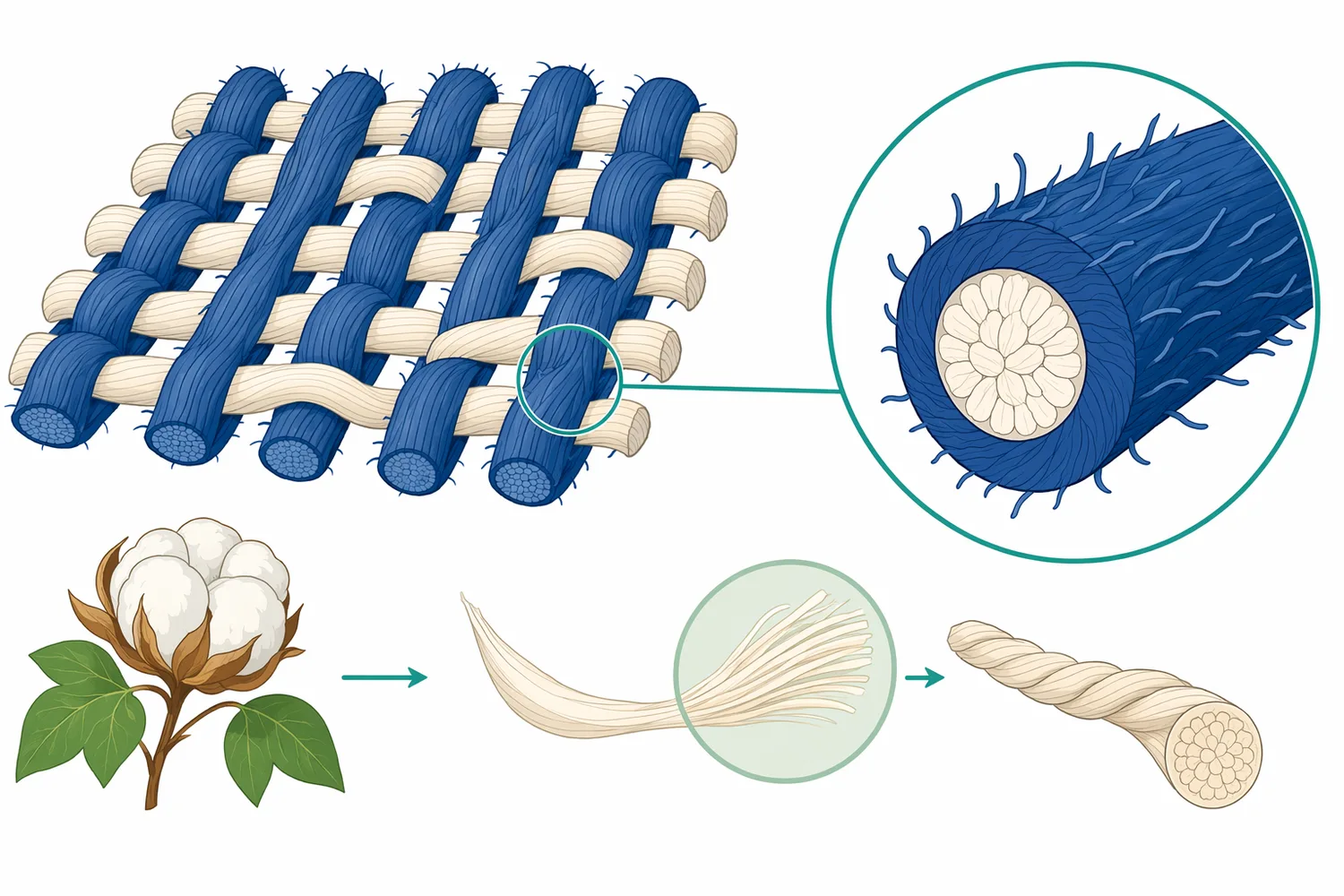
Neutral cellulase is an enzyme preparation used on cotton denim to modify the outermost cellulose fibers during garment washing. Denim is especially suited to enzyme abrasion because the visible blue shade comes from dyed warp yarns, commonly associated with indigo color on the yarn surface, while the yarn interior and weft areas are lighter; controlled surface removal therefore changes the visual shade without needing to bleach the entire fabric mass [1].
Cellulose, the main structural polymer in cotton, is made of glucose units linked in long chains. Cellulase enzymes hydrolyze cellulose by cutting bonds in those chains, and textile reviews describe cellulases as important enzymes for cotton treatments such as biopolishing, surface cleaning, and denim finishing [2].
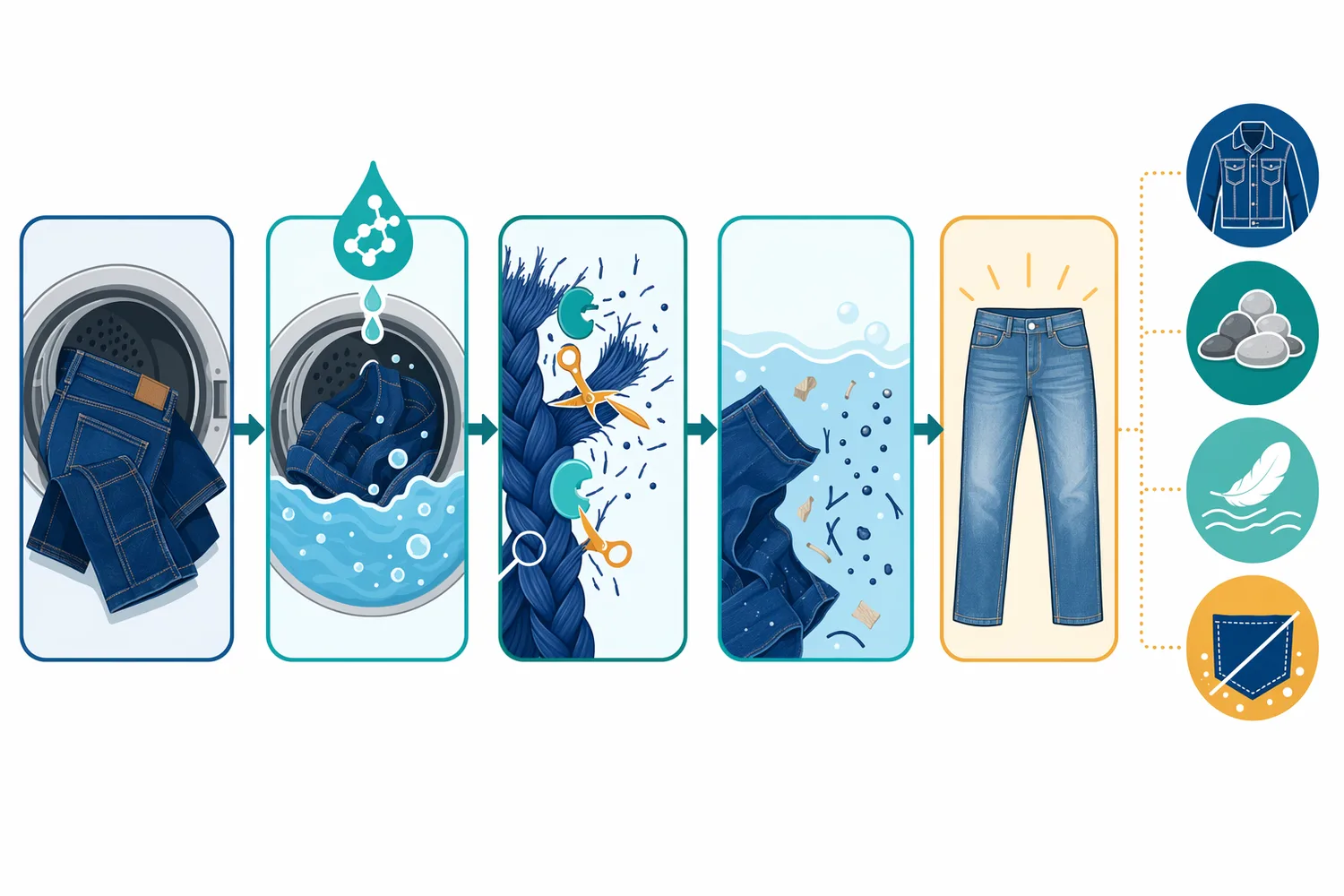
In denim abrasion, the intended effect is not full fiber degradation. The practical target is the raised fuzz, loose fibrils, and accessible cellulose on the surface of the yarn: when cellulase weakens those protruding microfibers, mechanical action in the washer removes them along with the indigo attached to them, exposing lighter areas and creating a stonewashed look [3].
The word “neutral” refers to the enzyme system being used around a near-neutral washing environment rather than a strongly acidic bath. This matters in garment finishing because acid, neutral, and alkaline cellulase systems can differ in abrasion intensity, backstaining behavior, fabric impact, and compatibility with the rest of a wash recipe [4].
The mechanism begins with denim structure. In typical blue denim, the surface of the warp yarn carries much of the visible indigo shade, while the interior of the cotton yarn is paler; abrasion is therefore a surface-removal process, not a uniform color-stripping process through the whole yarn [1].
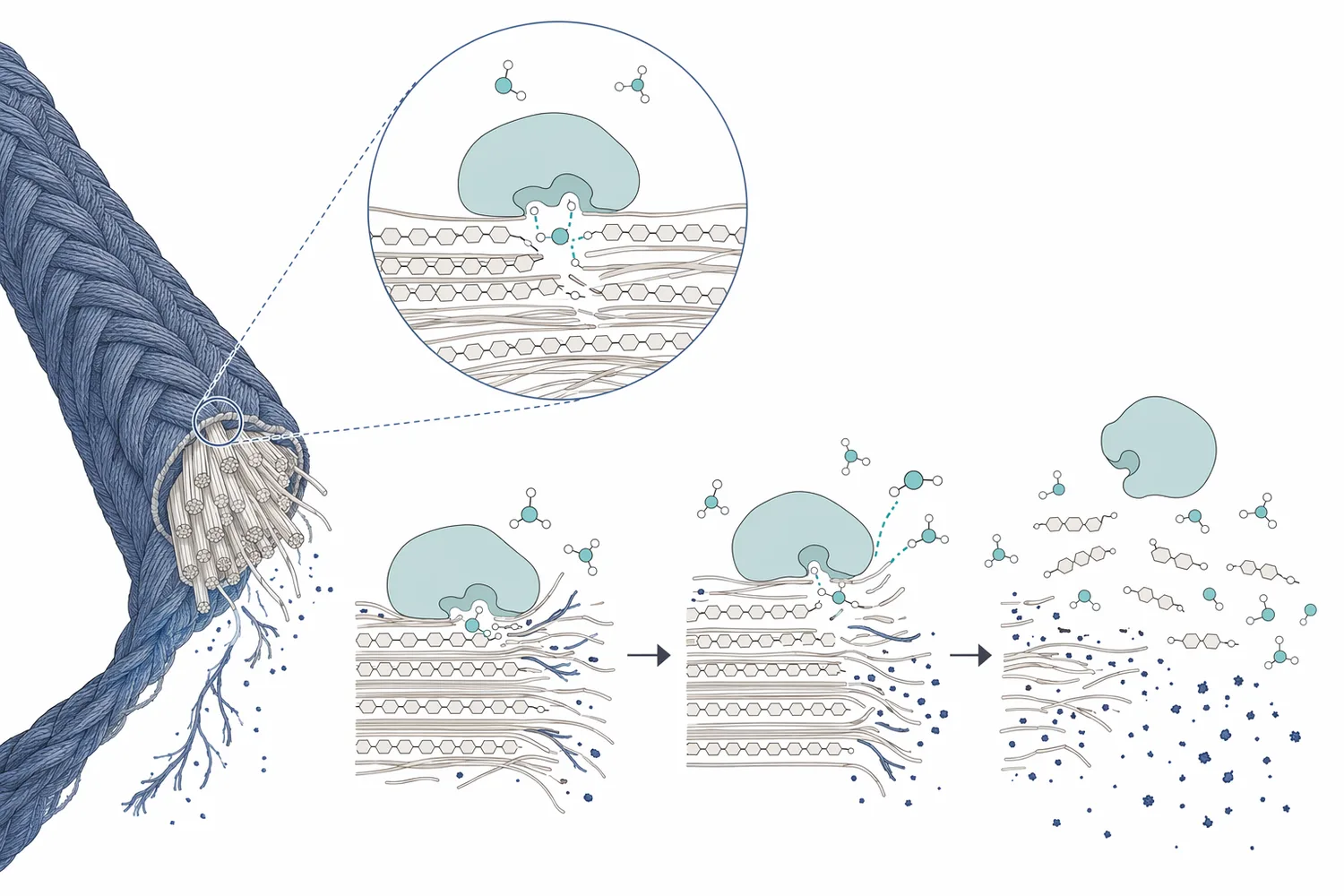
Once the garment is wet and moving in the machine, the cotton surface swells and protruding fibrils become more exposed. Neutral cellulase adsorbs onto accessible cellulose, especially on loose or damaged fiber ends, and hydrolyzes cellulose chains in those exposed fibrils; this shortens and weakens the microscopic fibers that hold surface fuzz and dye at the yarn exterior [2].
Mechanical action then completes the effect. Drum movement, garment-to-garment rubbing, and fabric flexing detach the weakened fibrils, and because those fibrils carry surface indigo, their removal produces visible shade reduction, seam highlights, localized abrasion, and a cleaner yarn surface [3].
This is different from simple chemical bleaching. Bleaching changes chromophores chemically across the exposed fabric, whereas cellulase changes the fabric surface physically and enzymatically: it removes dye-bearing cellulose material from the top layer of the yarn, so the visual result depends strongly on yarn structure, dye distribution, garment construction, and mechanical action [5].
The same surface mechanism also explains the softer handle often associated with enzyme-washed denim. When protruding fibrils and stiff surface fuzz are reduced, the fabric surface feels smoother and less harsh, while excessive treatment can go beyond surface cleaning and begin to affect weight, strength, or tear properties [6].
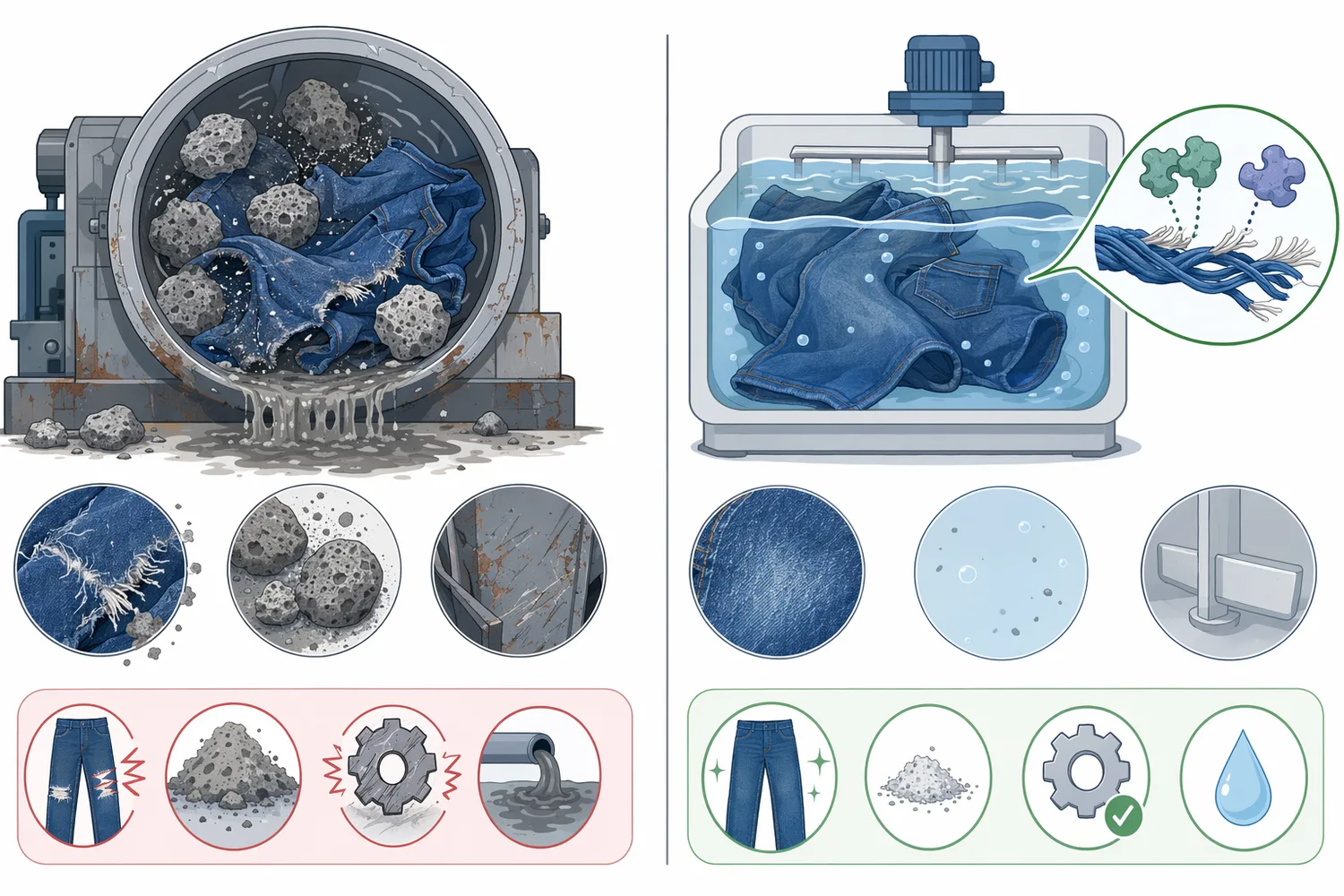
Traditional stonewashing relies on pumice stones to physically beat and abrade garments. It can produce strong contrast, but it also generates stone dust, sludge, broken stones, machine wear, garment damage, pocketing problems, and variation from load to load; enzymatic washing has been widely discussed as a greener route for modern denim finishing [3].
Neutral cellulase allows part of the abrasion work to be transferred from heavy mineral abrasion to biological surface hydrolysis. The enzyme weakens the cotton surface selectively, so the washer’s mechanical action can remove microfibers with less dependence on large stone loads; industry denim-abrasion literature also presents enzyme systems as a way to reduce stone use and improve process cleanliness.
This does not mean stones are never used. Many wash recipes still combine enzymes with controlled mechanical abrasion when a specific high-low contrast or vintage look is desired, but neutral cellulase gives finishers another lever: instead of relying only on stone impact, they can use enzyme-driven surface weakening to build abrasion more gradually [7].
The practical advantage is control. Pumice abrasion is largely mechanical and can be uneven depending on garment position, stone condition, machine loading, and contact pattern; cellulase contributes a chemical-biological action on exposed cellulose, so the fading effect is generated through both enzyme contact and mechanical release of loosened surface material [4].
Cellulase systems are often described by the washing environment in which they are intended to work. The table below is a conceptual comparison for denim finishing; actual results still depend on fabric construction, dye system, machine action, time, water level, garment loading, and the rest of the wash process [4].
| Cellulase type | Typical processing character | Denim abrasion behavior | Main practical consideration |
|---|---|---|---|
| Acid cellulase | Used in acidic washing conditions | Often associated with stronger and faster abrasion effects | Can increase risk of backstaining or harsher fabric impact in some denim systems |
| Neutral cellulase | Used around near-neutral washing conditions | Supports controlled surface abrasion and biopolishing with a milder process character | Often chosen where shade control, cleaner contrast, and fabric preservation are priorities |
| Alkaline cellulase | Used in alkaline-compatible wet processing | Can fit processes where the bath chemistry is not acidic or neutral | Compatibility with the full garment recipe is the key issue |
Research comparing different enzymatic treatments on denim garments shows that enzyme type and processing conditions influence color change, surface effect, and fabric properties, which is why neutral cellulase is treated as a process tool rather than a universal one-step shade formula [4].
For many denim applications, neutral cellulase is attractive because it can develop abrasion without the more aggressive character often associated with acid cellulase systems. In practical garment washing, that may help preserve a cleaner blue-white contrast and reduce the risk of excessive cellulose attack when the process is controlled [3].
Backstaining occurs when released indigo particles or dye-bearing fragments redeposit onto lighter fabric areas such as the weft, pocketing, labels, seams, or already abraded zones. The visual result is reduced contrast: whites look duller, blue areas appear dirtier, and the garment may lose the crisp high-low effect expected from denim washing [3].
Neutral cellulase helps address this problem indirectly by supporting controlled abrasion rather than uncontrolled fiber destruction. When cellulase action is moderated and the released material is properly removed through rinsing and after-wash steps, the process can reveal lighter yarn areas while limiting the amount of loose dye-bearing debris available for redeposition [4].
The risk is not eliminated by the enzyme category alone. Indigo chemistry, sulphur top-dyes or bottom-dyes, fabric construction, water level, machine motion, auxiliary chemistry, and wash duration all influence whether released color stays suspended, redeposits, or is rinsed away [1].
This is why neutral cellulase is especially useful for finishers who want a more measured abrasion effect. It provides biological surface weakening at the cellulose level, but the final shade is created by the whole wash system: enzyme action, mechanical detachment, liquor movement, rinsing, and fabric architecture all contribute to the final garment appearance [5].
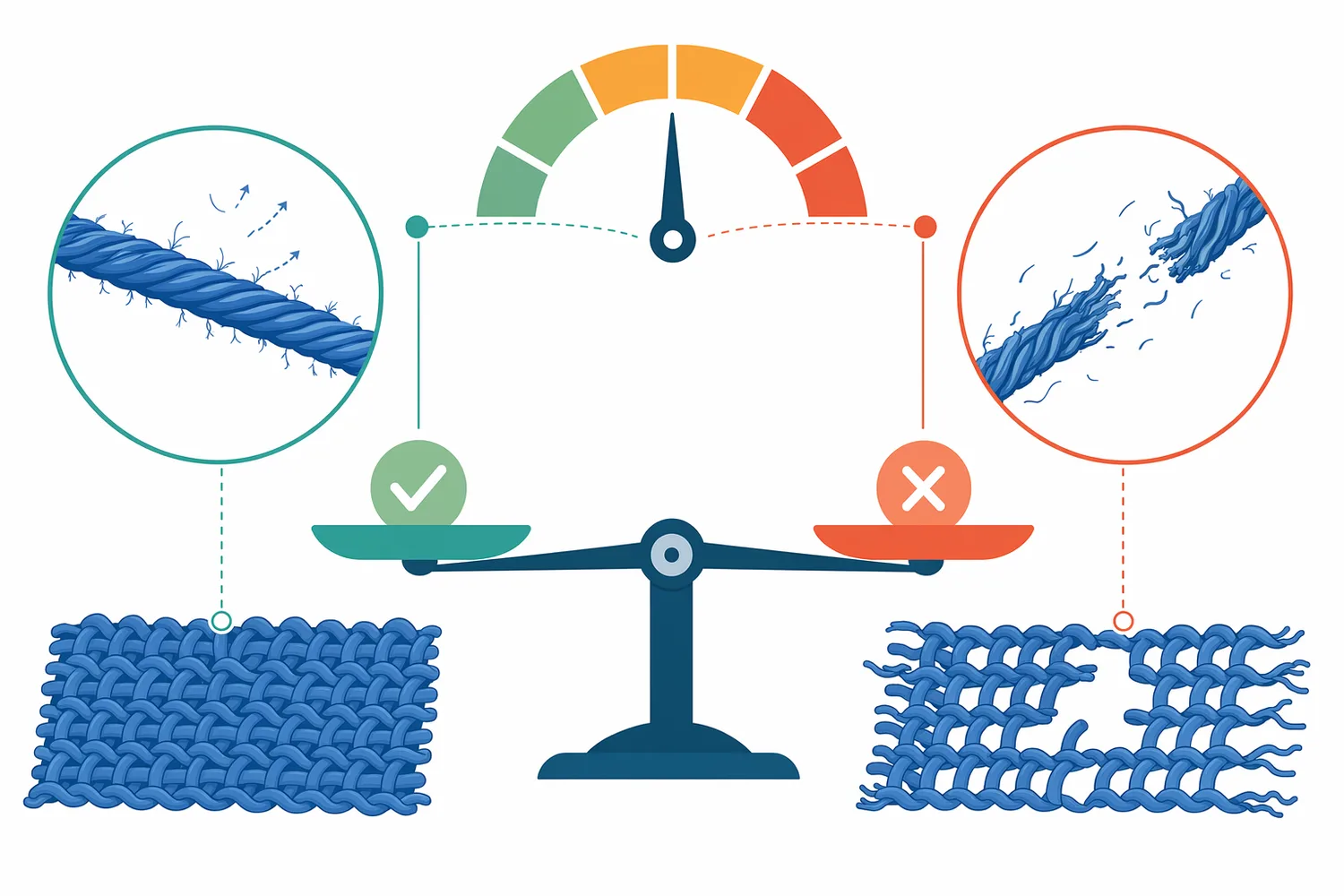
Every cellulase process acts on cellulose, so it must be controlled. A useful enzyme wash removes unwanted surface fibrils and dye-bearing fuzz; an excessive process can continue hydrolyzing accessible cotton and lead to measurable fabric weight loss or reduced mechanical performance [6].
The distinction is microscopic but important. Surface fibrils are thin, exposed, and easily reached by the enzyme, while the main cotton fiber body is more ordered and less accessible; under appropriate garment-washing conditions, cellulase preferentially works where cellulose is exposed, raised, abraded, or loosened [2].
Denim research often evaluates enzyme effects by looking at both visual change and fabric properties because a successful wash must balance appearance with garment integrity. Mechanical-property studies on denim after finishing treatments show that wet-processing and enzyme-washing steps can alter tensile, tear, and related performance characteristics if the combined treatment is too severe [6].
Neutral cellulase is therefore best understood as a controlled abrasion aid, not a fabric-safe treatment under all circumstances. Its advantage lies in delivering surface modification in a milder near-neutral process window, while still requiring sensible control of time, temperature, mechanical action, water level, and post-wash removal steps at the garment-laundry level [4].
Neutral cellulase performance depends on the full washing environment. The enzyme can only act where it contacts accessible cellulose, and mechanical abrasion only removes fibers that have been sufficiently loosened, so the final effect reflects the interaction between enzyme contact, garment movement, and fabric structure [3].
Water level affects both enzyme distribution and abrasion intensity. A low-water process may increase garment-to-garment friction, while a higher water level may improve movement and rinsing but reduce mechanical impact; studies and industry development work on alternative denim-washing methods continue to examine how application technique changes abrasion and process efficiency [7].
Treatment time also matters. A short process may clean surface fuzz but produce limited shade change, while prolonged exposure can increase abrasion, weight loss, or fabric weakening; denim enzyme-treatment studies repeatedly identify processing variables as central to the balance between wash-down effect and material preservation [4].
Temperature influences enzyme reaction rate and cotton swelling, while pH influences enzyme conformation and activity. Neutral cellulase is designed for use around a near-neutral environment, so large shifts in bath chemistry can change how strongly it attacks the cotton surface or how consistently it performs across a garment load [2].
Mechanical action is equally important. Without sufficient rubbing and flexing, hydrolyzed fibrils may remain attached and the visible abrasion will be muted; with excessive action, abrasion can become too harsh or uneven, especially on seams, pocket edges, hems, and high-stress construction points [5].
Fabric history also changes the result. Desizing, resin treatment, coating, softening, pigment application, sulphur dyeing, stretch content, and previous washing can all alter enzyme access to cellulose or change how released indigo behaves in the bath [1].
Although denim abrasion is the headline application, the same enzyme mechanism is also used for biopolishing cotton. Biopolishing removes small protruding fibers that cause fuzz, pilling tendency, dullness, and rough touch, improving surface clarity and handle on cellulosic fabrics [2].
On denim, biopolishing and abrasion overlap. A light neutral cellulase treatment may primarily clean the surface and soften the hand, while a stronger denim wash uses the same fibril-removal mechanism to create visible shade loss and high-low contrast [3].
This makes neutral cellulase useful across several denim aesthetics. It can support a clean dark rinse with reduced surface fuzz, a moderate aged look with improved handle, or a more visible worn-down effect when paired with stronger mechanical action and a suitable wash sequence [4].
The important point is that cellulase changes the surface, not just the color. A garment may look brighter because loose fuzz is removed, feel softer because stiff fibrils are reduced, and show abrasion because dye-bearing surface cellulose has been detached [2].
Textile enzyme biotechnology is widely discussed as a route to lower-impact processing because enzymes work under milder conditions than many conventional chemical treatments and act selectively on targeted substrates. In cotton and denim finishing, cellulase is one of the best-established enzyme classes for replacing or reducing more abrasive or chemically intensive operations [8].
For denim, the sustainability value is especially clear where enzyme abrasion reduces pumice use. Less stone handling can mean less solid waste, less machine damage, fewer stone residues in pockets and seams, and a cleaner wash house environment [3].
Enzyme-based abrasion can also support lower-water or alternative application concepts when matched with appropriate equipment and wash design. Recent denim-washing development work has examined alternative materials and application techniques, including foam-based approaches, as the industry continues to reduce the burden of conventional stonewashing [7].
The environmental benefit is not automatic in every wash. A poorly controlled enzyme process can still require reprocessing, extra rinsing, or corrective treatments, so the real advantage comes from using neutral cellulase as part of a stable process that reaches the target shade and handle efficiently [8].
Neutral cellulase is commonly used for stonewashed and vintage denim looks where the goal is controlled fading rather than full chemical color removal. It is especially relevant to cotton-rich garments because its substrate is cellulose, the structural material of cotton fibers [2].
It is also useful for seam and edge highlights. These areas experience higher mechanical stress during washing, and when the enzyme weakens exposed cellulose on raised construction points, mechanical rubbing can reveal lighter tones on seams, waistbands, pocket edges, hems, and creases [5].
For indigo denim, neutral cellulase helps remove surface-dyed fibrils to reveal the paler yarn interior. For black or sulphur-influenced denim, the same basic mechanism applies, but dye chemistry and redeposition behavior can differ, so the final contrast and backstaining profile may not match a standard indigo fabric [1].
Neutral cellulase can also fit finishing sequences where a softer hand is desired without making the garment look heavily bleached. By reducing fuzz and loosening surface roughness, it can improve touch while maintaining the character of the fabric and wash design [3].
Neutral cellulase can help produce controlled abrasion, cleaner surfaces, softer handle, and a more worn denim appearance. It is a process aid that modifies exposed cotton fibrils; the final look comes from the combination of enzyme hydrolysis and mechanical removal of loosened dye-bearing fibers [2].
It can reduce reliance on pumice stones, but it is not simply a one-for-one chemical replacement for every stonewash recipe. Heavy vintage effects, localized scraping, ozone effects, laser marking, resin creases, or bleach-based shade changes may still involve other finishing steps depending on the garment design [7].
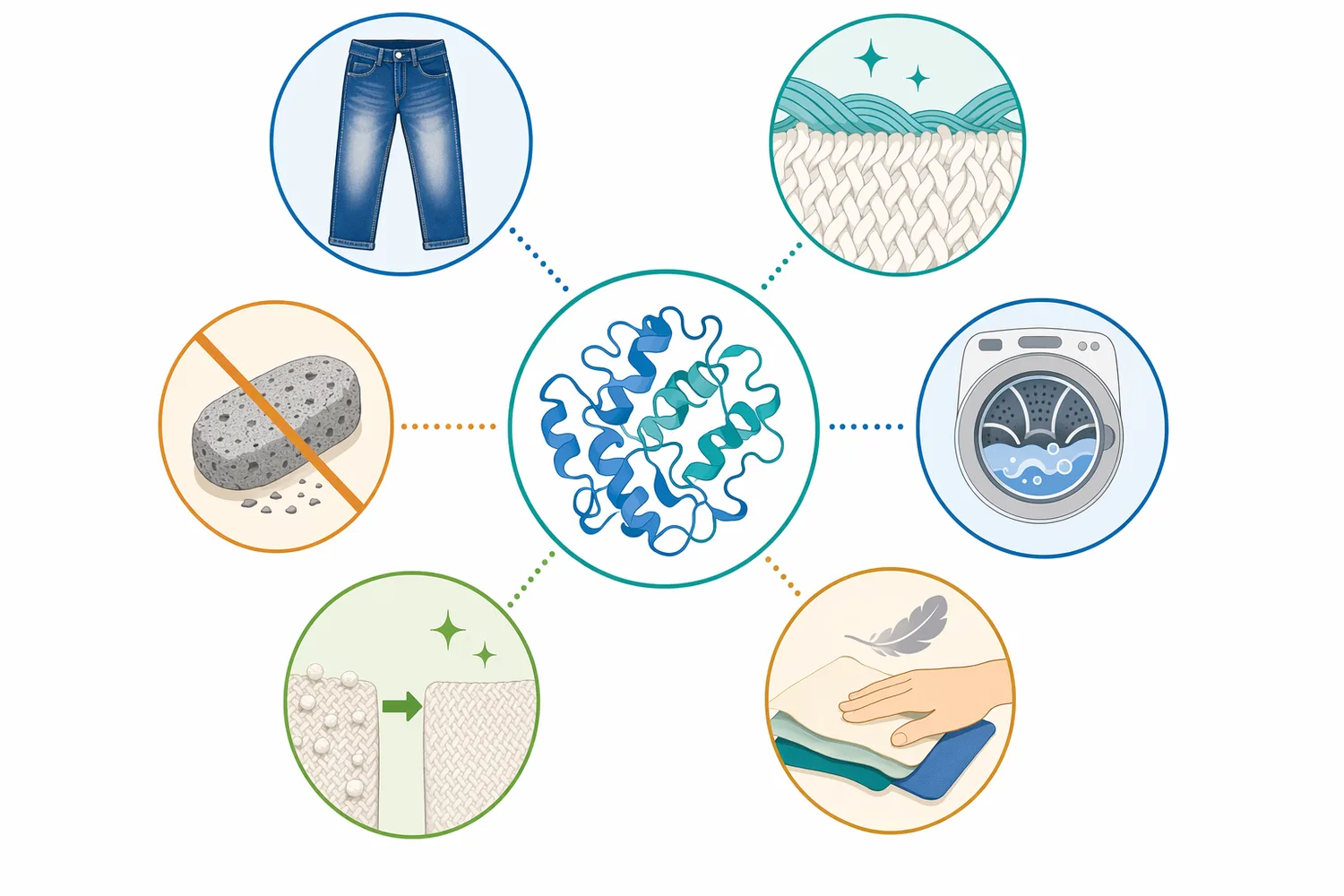
It can support better consistency, but it cannot make every fabric respond identically. Denim weight, weave, yarn twist, ring-dye depth, indigo build, sulphur topping, stretch fiber content, garment construction, and previous treatments all influence how quickly abrasion develops and how much contrast appears [5].
It can support lower-impact finishing, but only when the process is controlled well enough to avoid over-washing and rework. The enzyme should be viewed as part of a complete garment-washing system that includes preparation, enzyme treatment, rinsing, deactivation or removal, and final finishing [8].
Enzymes.bio supplies Neutral Cellulase Enzyme for Efficient Denim Abrasion as a product available for direct online purchase in 1 kg units. The buyer pays online, after which the order is processed and shipped; the Certificate of Analysis and Safety Data Sheet are provided with the order .
This product is intended for garment washing and textile-finishing users who want an enzyme-based route to denim abrasion. It fits applications where neutral cellulase is used to loosen cotton surface fibrils, assist indigo-bearing microfiber removal, improve surface feel, and reduce dependence on purely mechanical stone abrasion [3].
Neutral cellulase works because denim abrasion is fundamentally a surface process. By hydrolyzing exposed cellulose fibrils on cotton denim, it weakens the dye-bearing outer layer so washing-machine friction can remove loosened fibers and reveal lighter yarn areas [2].
For efficient denim abrasion, the practical benefit is controlled biological surface modification: softer handle, cleaner fabric surface, stonewashed appearance, reduced pumice dependence, and compatibility with more sustainable garment-finishing goals. The final result still depends on the fabric and wash process, but neutral cellulase is a well-established enzyme category for modern denim finishing [3].
Sold by the 1 kg unit, in stock and ready to ship. Order directly on our store — pay online and we process your order. A Certificate of Analysis and Safety Data Sheet are included with every order.
Buy Neutral Cellulase Enzyme For Efficient Denim Abrasion →Numbered in order of first citation. Open-access sources, each verified reachable at publication; citation numbers in the text link here.