
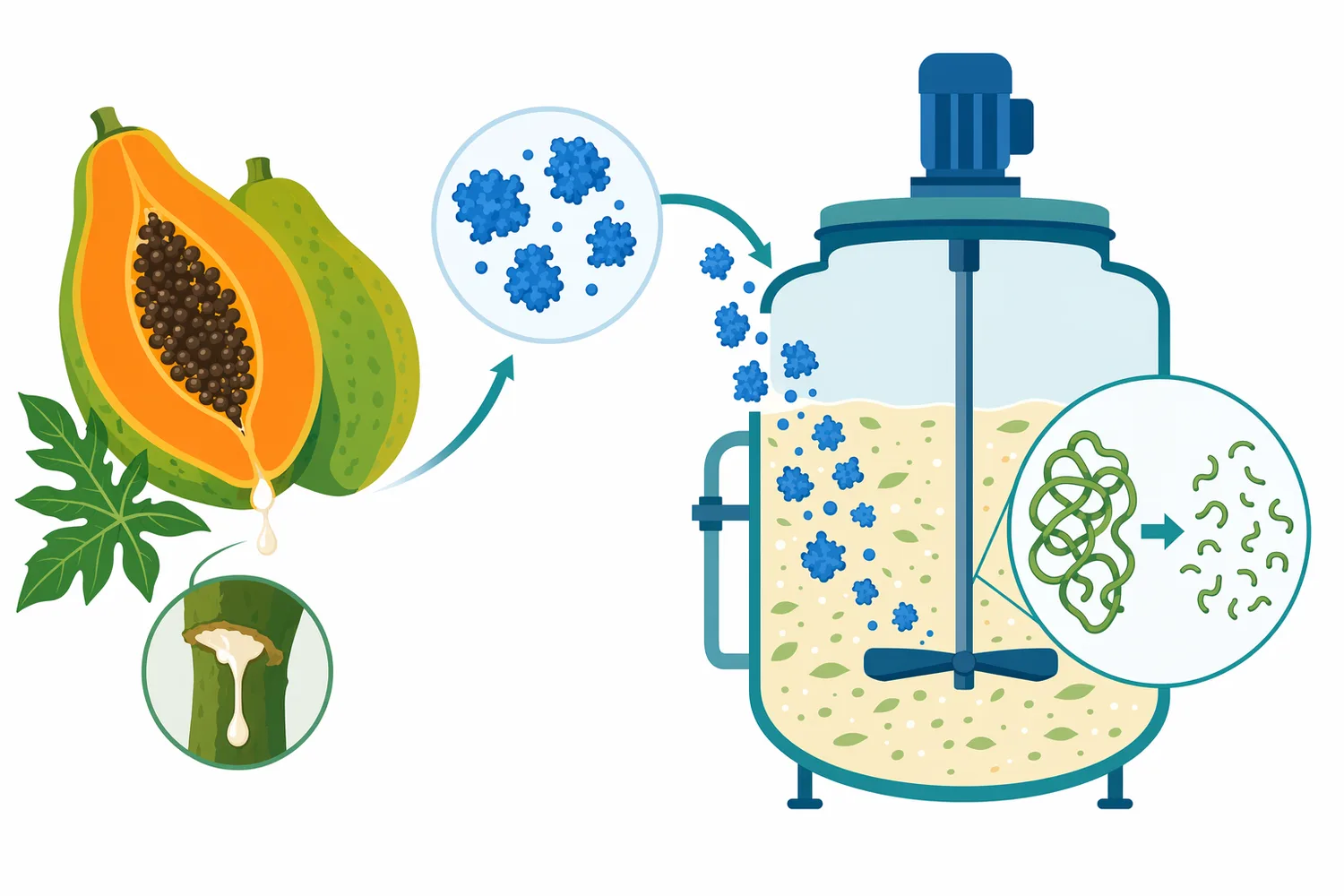
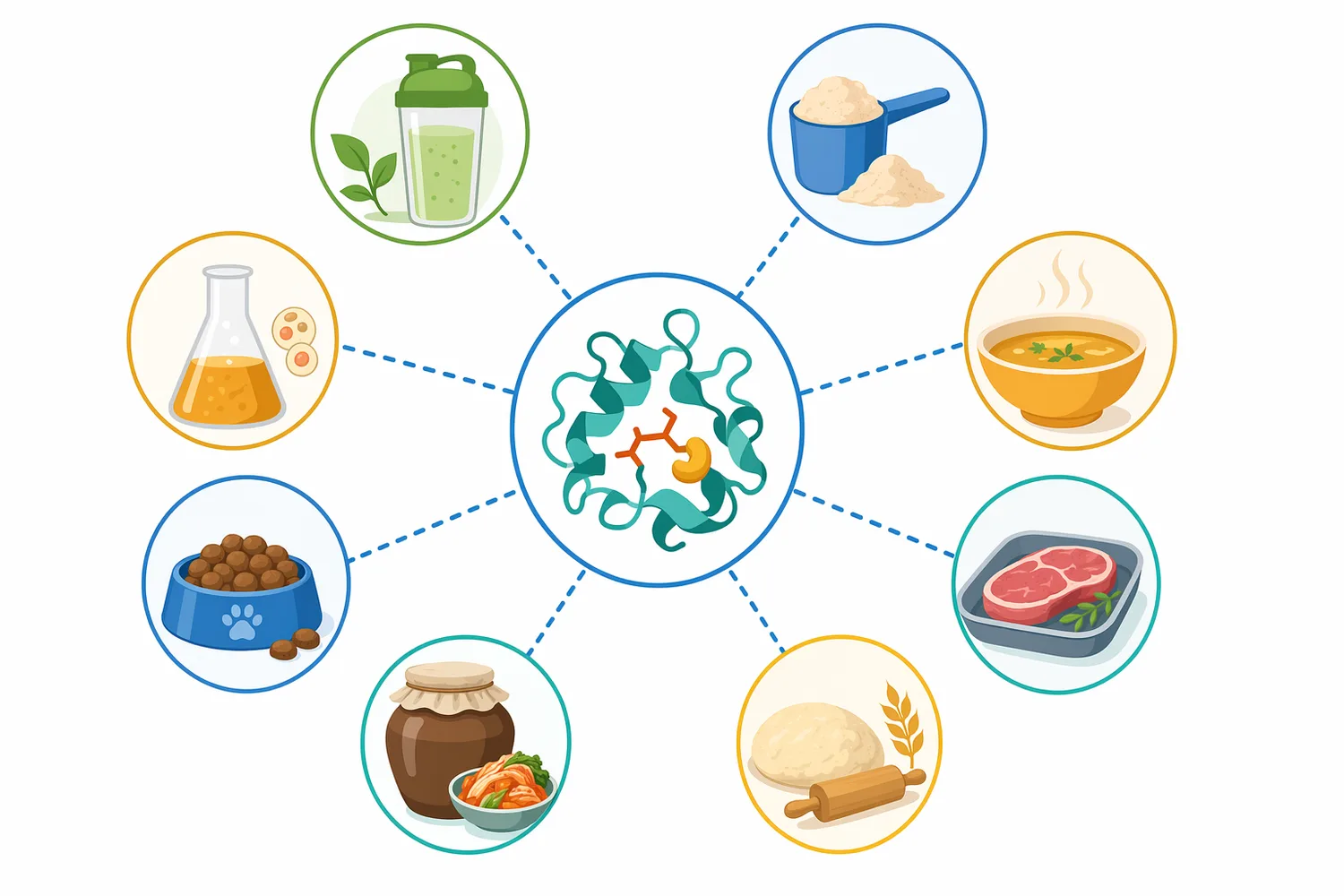
Papain is a papaya-derived cysteine protease used to cut protein chains into smaller peptides, making plant proteins easier to disperse, modify, digest, and formulate. In plant protein hydrolysis, its value comes from controlled structural change: papain reduces large protein aggregates, exposes buried chemical groups, and changes how proteins interact with water, oil, air, and heat.
Enzymes.bio supplies food-grade papain directly online by the 1 kg unit. Buyers place and pay for the order online; the order is then processed and shipped, with a Certificate of Analysis and Safety Data Sheet included.
Papain is one of the best-known plant proteases associated with Carica papaya. Reviews on papain isolation and purification describe it as a proteolytic enzyme obtained from papaya material, especially latex, with long-standing relevance in food, pharmaceutical, textile, and other processing applications [1]. For food processing, the key point is simple: papain does not add protein, emulsifier, or flavour by itself; it changes the existing protein structure by hydrolysing peptide bonds.
In a plant-protein slurry, papain acts on proteins as a molecular cutting tool. Large folded proteins—such as seed storage proteins, cereal prolamins, pulse globulins, or leaf/seed proteins—are held together by peptide chains, hydrophobic interactions, hydrogen bonding, electrostatic interactions, and sometimes disulfide-linked aggregation. When papain cuts accessible peptide bonds, the protein population shifts from large, compact, or aggregated molecules toward smaller fragments and peptides with new end groups and more exposed surfaces [1].
That structural shift is why papain is useful in plant protein hydrolysis. Poorly soluble proteins may disperse more readily because large aggregates are broken down. Proteins that previously moved slowly to air–water or oil–water interfaces may adsorb faster because smaller peptides diffuse more easily. Compact proteins may become more digestible because enzymes have already opened the structure and reduced the size of the fragments entering digestion [2].
Papain should therefore be understood as a controlled modification tool. Limited hydrolysis can improve solubility, emulsification, foaming, water binding, texture, and digestibility, while excessive hydrolysis can remove too much structure, reduce viscosity, weaken foams or gels, or create bitterness from small hydrophobic peptides. The same enzyme can produce very different outcomes depending on the protein source, hydration, processing history, acidity, heating step, and reaction time [3].
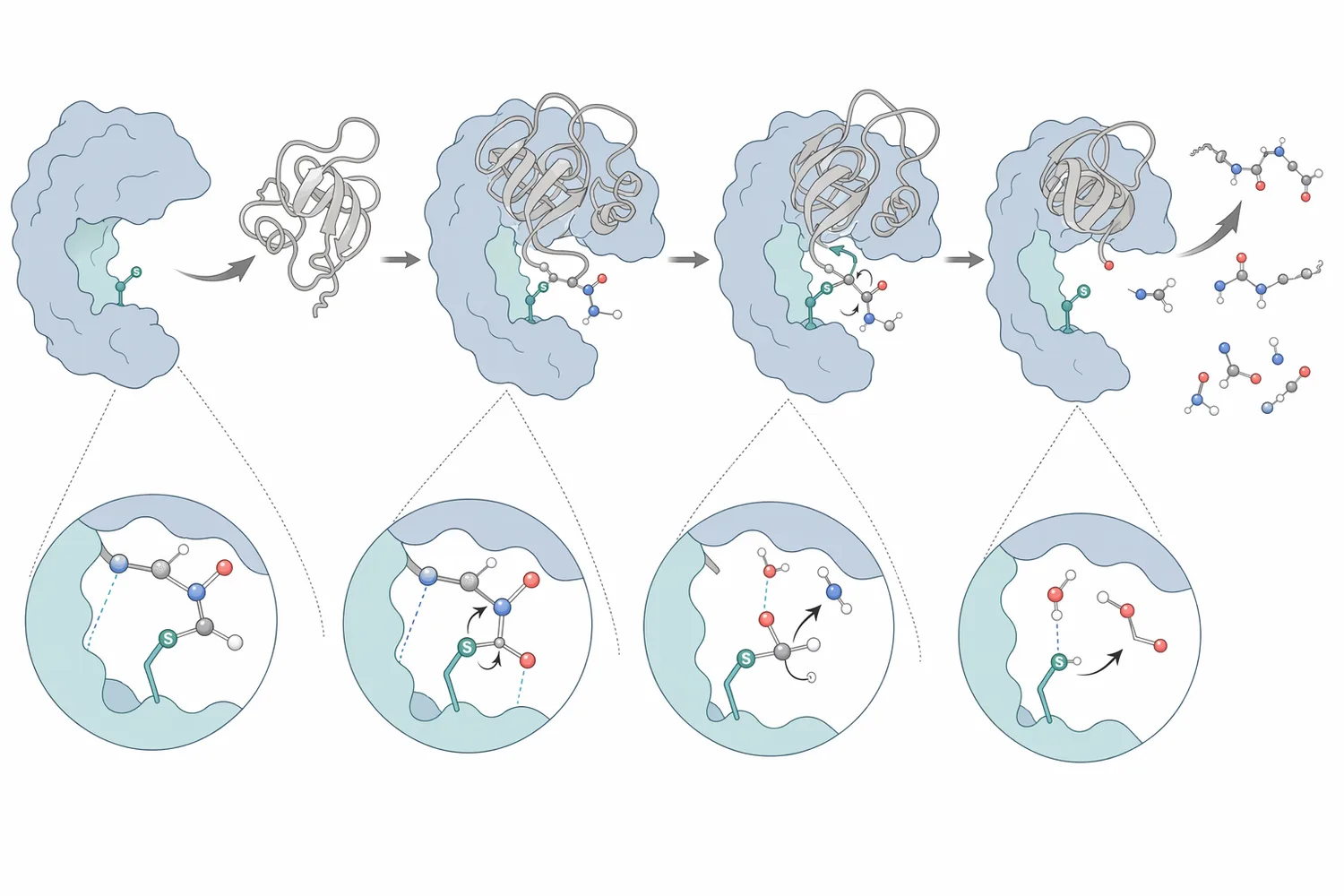
Papain belongs to the cysteine protease family. In practical terms, this means its active site uses a reactive sulfur-containing cysteine residue to attack the carbonyl carbon of a peptide bond. The peptide bond is temporarily converted into an enzyme-bound intermediate, one side of the protein chain is released, water participates in the second step, and the remaining fragment is released as a shorter peptide [1].
This biochemical mechanism matters because papain does not simply “soften” or “dissolve” proteins in a vague way. It chemically cleaves backbone bonds. Every cleavage creates two shorter molecules and new terminal groups. These new termini can change charge distribution, water interaction, and how the fragment behaves during heating, mixing, drying, or emulsification [1].
Plant proteins often contain regions that are difficult for water to access. Cereal prolamins such as kafirin, for example, are known for compact, hydrophobic behaviour that limits food functionality; recent work on kafirin modification has investigated enzyme and thermal treatment as a way to expand its food application potential [2]. Papain-style hydrolysis helps because cutting accessible regions can loosen the protein, expose previously buried polar or hydrophobic residues, and reduce the size of insoluble particles.
The result is not one single molecule but a distribution of fragments. A mildly hydrolysed protein system may still contain medium-sized peptides that can form films, bind water, and contribute body. A more extensively hydrolysed system may contain smaller peptides that dissolve readily and digest easily, but may no longer provide the same gel network, foam stability, or viscosity. That balance is the central technical issue in papain-assisted plant protein hydrolysis [3].
Many plant proteins are excellent raw materials nutritionally, but they are not always easy to formulate. Pulse proteins, cereal proteins, seed proteins, and leaf proteins may show low solubility, gritty dispersions, sedimentation, heat aggregation, limited foaming, weak emulsification, or dense textures. Some of these issues come from the original seed or plant matrix; others come from extraction, drying, concentration, heat treatment, or pH shifts during ingredient production [4].
Moringa seed research, for example, reflects the broader challenge of recovering useful protein from plant matrices. Comparative work on extraction techniques for Moringa oleifera seeds highlights that plant protein performance is influenced not only by the protein itself but also by how it is extracted and processed [4]. Once a plant protein has been isolated or concentrated, papain hydrolysis can be used as a secondary modification step to improve how that protein behaves in the final food system.
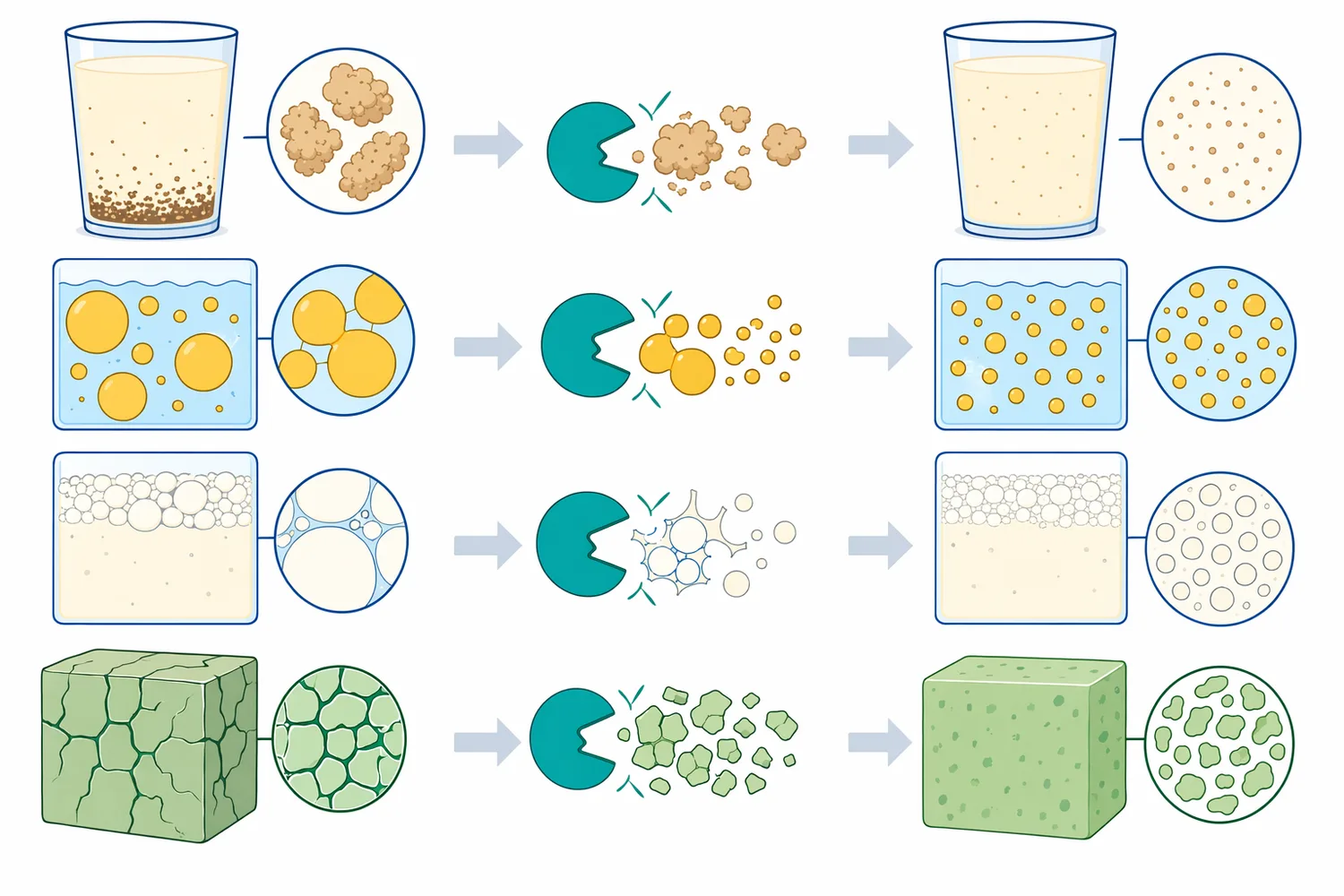
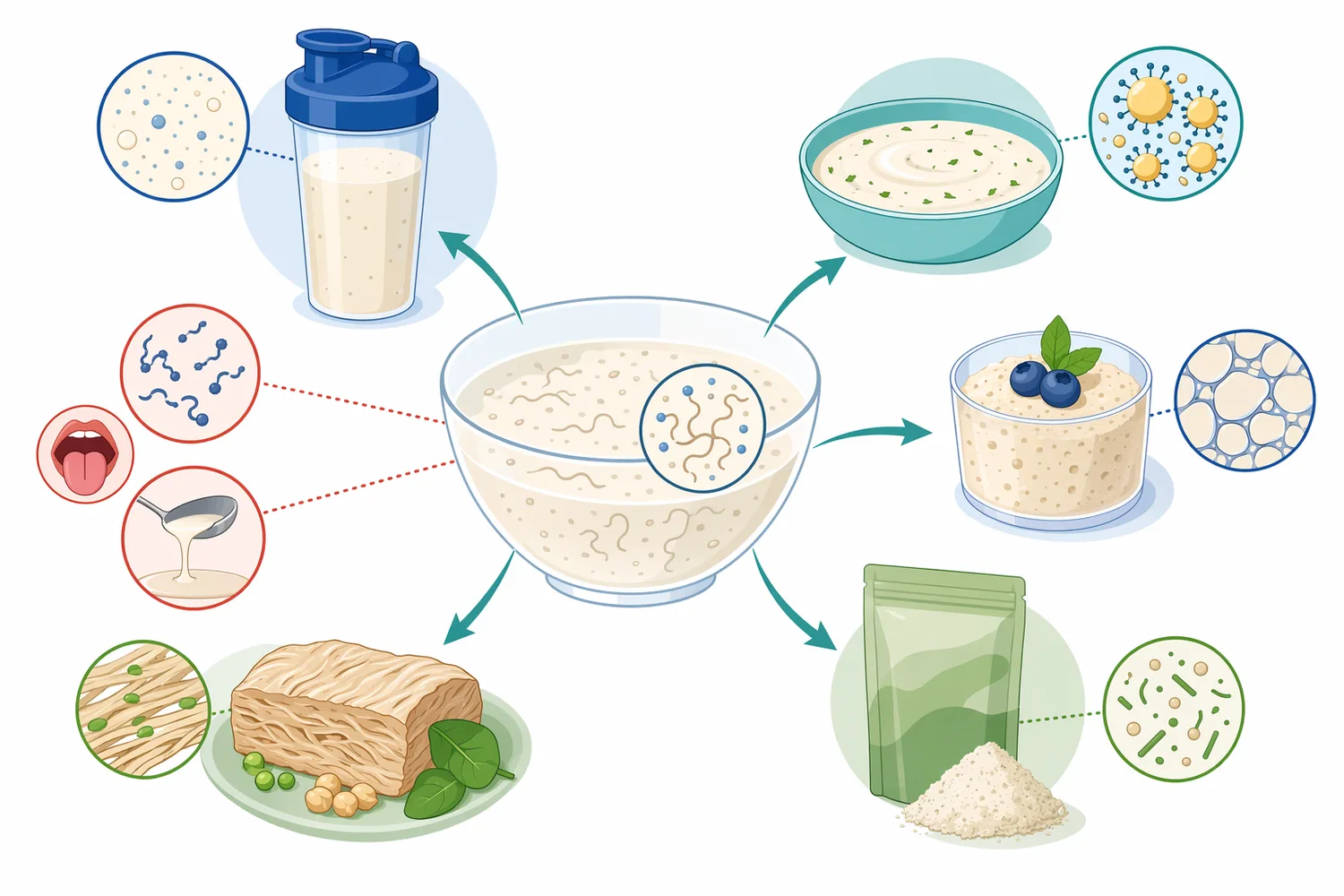
Papain is particularly relevant where the formulation needs protein functionality rather than just protein content. In a beverage, the protein must stay suspended and avoid sediment. In an emulsion, it must migrate to the oil–water interface and build a stabilising layer. In a foam, it must adsorb at the air–water interface and resist collapse. In a gel or meat analogue, it must retain enough structure to form a network after hydration and heating [2].
Hydrolysis changes all of these behaviours by changing molecular size and surface chemistry. Smaller fragments can hydrate faster and reduce visible particulates. Exposed polar groups can increase water interaction. Exposed hydrophobic patches can help proteins anchor at oil droplets or air bubbles. At the same time, too many cuts can reduce the number of long protein chains available to build strong networks. This is why controlled papain treatment is often more useful than aggressive protein breakdown [3].
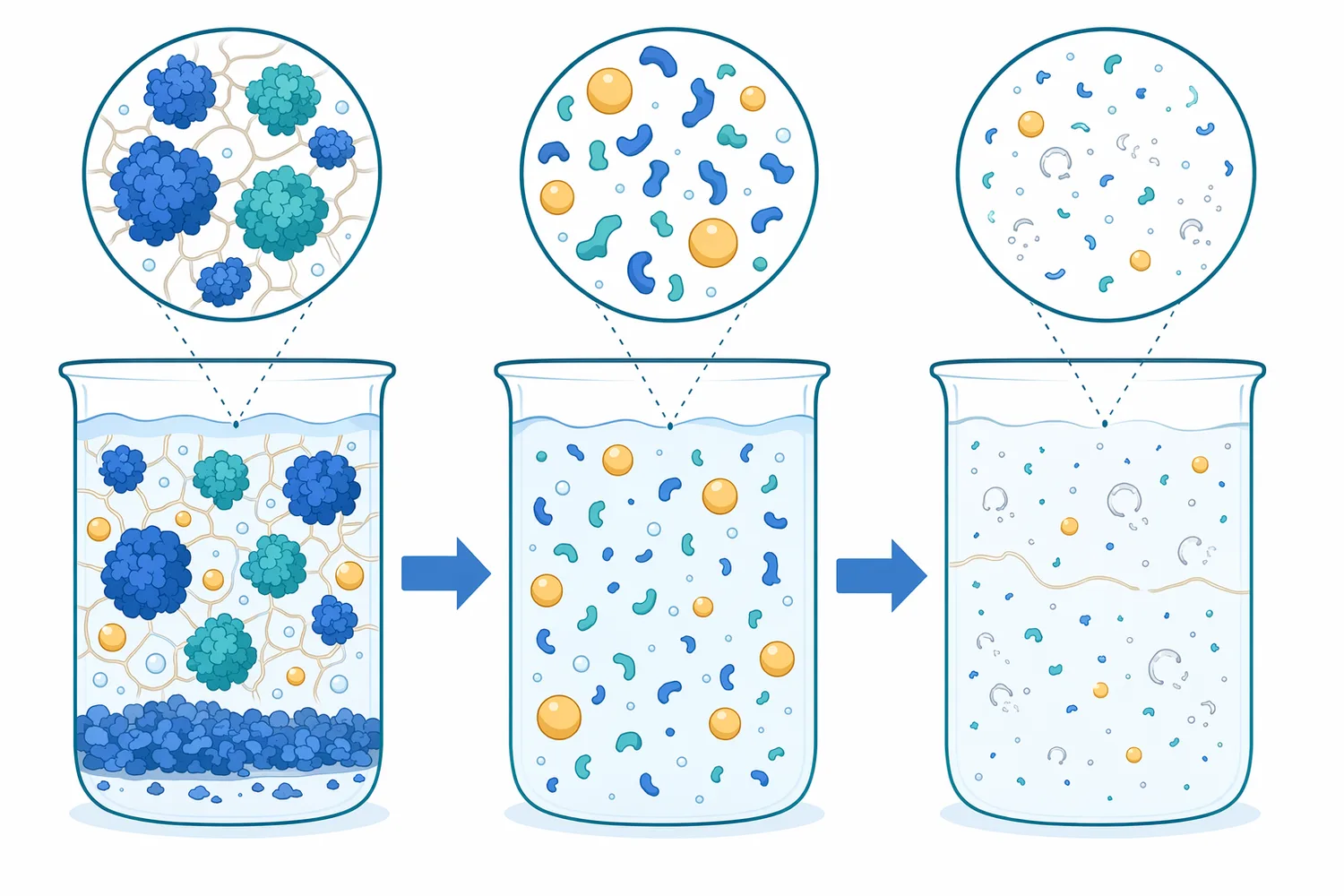
Solubility is often the first practical benefit buyers look for when working with plant proteins. Poor solubility creates sediment, chalkiness, processing losses, inconsistent viscosity, and weak performance in beverages or liquid concentrates. Papain hydrolysis can improve dispersion by reducing large protein particles into smaller fragments and by exposing groups that interact better with water [1].
The mechanism is concrete. A large aggregated plant protein may have hydrophobic regions buried inside the aggregate and only limited charged or polar groups available to hydrate. Papain cuts accessible peptide bonds, weakens the aggregate, and creates smaller fragments with fresh terminal amino and carboxyl groups. Those fragments can separate more readily during mixing and remain suspended more easily than the original aggregate [2].
This does not mean every papain-treated protein becomes completely soluble under all food conditions. Acidity, minerals, salts, heat history, gums, starches, fat, and polyphenols all influence the final dispersion. However, the direction of change is often useful: less large-particle behaviour, more hydrated surface area, and a protein population that can be incorporated more evenly into liquid or semi-solid systems [4].
Plant-based sauces, dressings, creamers, dips, desserts, and meat analogues often depend on oil-in-water emulsions. A protein emulsifier must reach the oil droplet quickly, unfold or rearrange at the interface, and form a protective film that resists coalescence. Intact plant proteins sometimes do this slowly because they are too large, too aggregated, or too rigid [2].
Papain can improve emulsification when it creates fragments that are still large enough to form an interfacial layer but small and flexible enough to move rapidly. The newly exposed hydrophobic regions help anchor the peptide at the oil side of the interface, while charged and polar residues remain in the water phase. This dual interaction—one part oil-facing, one part water-facing—is the physical basis of protein-assisted emulsion stabilisation [1].
The practical caution is that over-hydrolysis can go too far. Very small peptides may adsorb quickly but form weak interfacial films, so an emulsion may be easy to create but less stable over time. For this reason, papain is best viewed as a way to tune emulsifying behaviour, not as a universal replacement for every stabiliser or structuring system [3].
Foams require proteins or peptides to form a film around air bubbles. In whipped toppings, mousses, bakery systems, and some plant-based dairy alternatives, the protein must diffuse to the air–water interface, reduce surface tension, and form a viscoelastic layer that slows bubble coalescence and drainage [2].
Papain can increase foaming capacity by producing smaller, more mobile peptides that reach the interface faster than intact proteins. When the hydrolysis is moderate, these fragments can unfold and spread at the bubble surface, improving air incorporation. The effect is especially useful when the starting protein is too aggregated or insoluble to participate efficiently at the interface [1].
Foam stability is more sensitive. If the hydrolysate contains enough medium-sized fragments, the interfacial film can remain cohesive. If the hydrolysis produces mostly small peptides, the film may be thin and weak, giving good initial foam but poor holding. This explains why papain treatment can improve foaming in one plant-protein system while reducing foam stability in another [3].
Texture development in plant-protein foods depends on hydration, unfolding, protein–protein interaction, and network formation. Papain can support these mechanisms when controlled hydrolysis exposes reactive or hydrophobic regions that participate in heat-induced aggregation and gel formation [2].
In a structured plant-protein system, limited papain hydrolysis can make a dense protein more mobile. The fragments hydrate more evenly and can rearrange during heating. Exposed hydrophobic patches may associate during cooling or setting, while polar groups help retain water inside the network. This can improve mouthfeel, reduce dry or sandy texture, and support water-holding in certain gelled systems [1].
The same mechanism can also weaken texture if hydrolysis is excessive. Long protein chains contribute to elasticity and network continuity; if too many are cut into short peptides, the material may lose body. For meat analogues, high-protein desserts, plant-based yogurts, or fillings, the best outcome is usually a controlled middle point: enough cleavage to improve hydration and mobility, but not so much that the network loses strength [3].
Protein hydrolysis is also used to support digestibility. Papain pre-cuts large proteins into smaller fragments, reducing the structural work required during gastrointestinal digestion. This is especially relevant for compact plant proteins, proteins embedded in seed matrices, or proteins that have been heat-treated and aggregated [2].
Bitter gourd seed protein hydrolysate research illustrates how enzymatic hydrolysis can generate plant-derived peptide mixtures evaluated for biological activity in vitro, including antidiabetic-related activity [5]. Such studies do not mean every papain-treated plant protein will have the same effect, but they show why controlled hydrolysis is widely explored for nutrition-oriented protein ingredients.
Hydrolysis can also generate peptides with antioxidant, antihypertensive, or other bioactivity-related properties, depending on the starting protein sequence and process. Work on protein hydrolysates produced using plant proteases in food-related substrates supports the broader principle that protease choice and process conditions shape the functional and bioactive peptide profile [6].
Different proteases are used in food protein hydrolysis because they cut proteins in different ways and are suited to different process environments. Papain is valued because it is a plant-derived cysteine protease with broad protein-cutting usefulness and a long history in food applications [1].
| Protease style | General processing character | What it tends to change in proteins | Where it may be useful | Practical watch-out |
|---|---|---|---|---|
| Acid proteases | Used in acidic systems where proteins may already be partially unfolded | Can generate hydrolysates under low-acidity-compatible conditions | Acidified beverages, fermented-style systems, flavour hydrolysates | May not fit neutral plant-protein processes without formulation adjustment |
| Papain / cysteine plant proteases | Broad proteolytic action from a plant source; widely associated with papaya latex | Cuts accessible peptide bonds, reduces molecular size, exposes hydrophobic and polar groups | Plant protein dispersions, hydrolysates, texture tuning, meat tenderising, nutrition-oriented peptides | Over-hydrolysis may reduce foam stability, viscosity, or gel strength |
| Neutral proteases | Often used where moderate food-processing conditions are preferred | Can modify proteins while retaining some native-like functionality | Protein concentrates, dairy and plant blends, emulsions | Final functionality depends strongly on substrate and reaction control |
| Alkaline proteases | Often associated with stronger protein breakdown in more alkaline-compatible processes | Can rapidly reduce large proteins and produce smaller peptides | Protein hydrolysate manufacture, solubility improvement, certain industrial food processes | May require careful downstream neutralisation or flavour management |
This table is conceptual rather than a buying checklist. In real food systems, the decisive factor is not the enzyme category alone but the structure of the starting protein, the degree of hydrolysis, and how the hydrolysate is later heated, dried, blended, or incorporated into the finished product [3].
Papain’s relevance starts with its source and identity. Comparative studies of papain from different papaya fruits and papaya latex sources show that papain is a real, variable biological enzyme system rather than a generic processing chemical [7]. This matters because papain’s food-processing value is linked to its natural proteolytic function: cutting proteins in papaya latex and, when applied deliberately, cutting proteins in food matrices.
Reviews on papain isolation from papaya fruit describe the enzyme’s broad use and the importance of obtaining functional enzyme material from papaya sources [1]. For a food processor, the practical conclusion is that papain is not an experimental concept; it is an established protease category with a long application history.
Kafirin modification research is especially relevant to plant protein hydrolysis because kafirin is a cereal storage protein with difficult functionality. The reported use of enzyme and thermal treatment to expand kafirin’s food application shows the same principle that applies to papain-treated plant proteins: targeted structural modification can convert a difficult protein into a more useful ingredient platform [2].
Bitter gourd seed protein hydrolysate work demonstrates another important direction: enzymatic hydrolysis can convert underused plant seed proteins into hydrolysates evaluated for bioactivity-related potential [5]. For food developers, this supports papain’s role in value creation from plant materials, especially when the goal is a peptide-rich ingredient rather than an intact protein concentrate.
Research on protein recovery from moringa seeds also reinforces the importance of processing route. Extraction method influences protein yield, composition, and likely functionality; hydrolysis then adds another layer of modification after protein recovery [4]. In practice, papain treatment works best when the starting protein has been properly hydrated and made accessible to enzymatic action.
Work using plant proteases on food protein substrates also shows that protease-generated hydrolysates can have functional and bioactive properties beyond simple solubility changes [6]. Although each substrate must be evaluated on its own merits, the underlying mechanism—enzyme cleavage creating new peptide populations—is directly relevant to papain-based hydrolysis.
In beverages, papain can help reduce the large-particle behaviour that causes sedimentation and gritty mouthfeel. The most useful hydrolysates are usually not completely broken down; they are modified enough to disperse more evenly while still contributing body and nutritional protein content [1].
Papain-treated plant proteins may be useful in high-protein drinks, plant-based milk alternatives, acidic beverage bases, powdered beverage mixes, and liquid concentrates. The mechanism is the same in each case: smaller fragments hydrate faster, aggregates are reduced, and exposed polar groups help the protein interact with the water phase [4].
Creamers, spoonable desserts, dressings, and sauces require both water compatibility and oil stabilisation. Papain can help by producing peptides that reach oil droplets more easily and form a protein film at the interface [2].
This is especially relevant when a plant protein has nutritional value but weak emulsifying performance. Hydrolysis can convert part of the protein population into surface-active fragments, while unhydrolysed or mildly hydrolysed material can still contribute viscosity and mouthfeel. The balance between those fractions determines whether the final emulsion feels creamy, thin, stable, or unstable [3].
Plant-based meat systems depend on hydration, binding, fat retention, heat setting, and bite. Papain is not a crosslinking enzyme; it does not build structure by joining proteins together. Instead, it modifies the protein so that subsequent mixing, heating, and structuring steps can work differently [1].
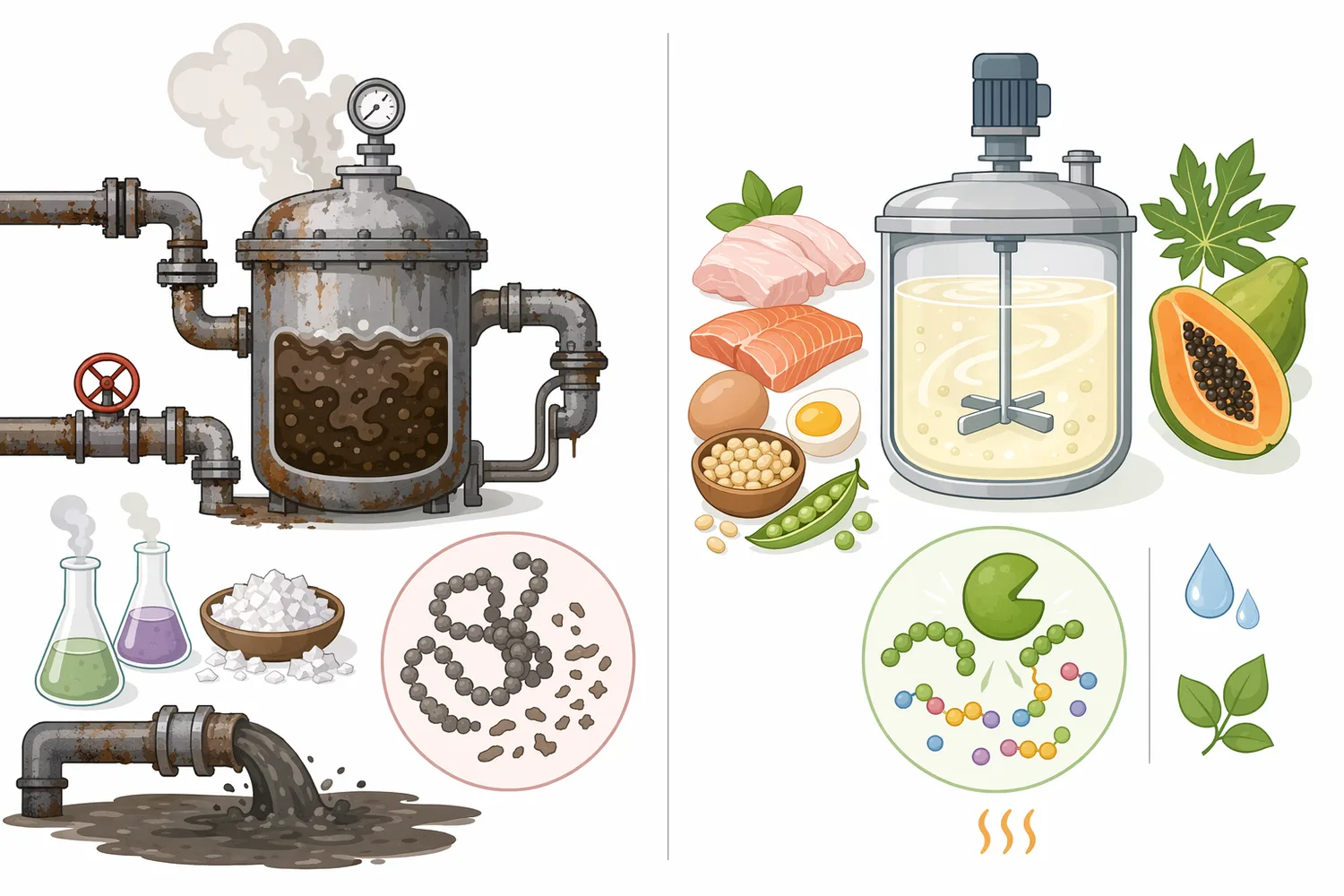
A controlled papain step may soften overly tough protein fractions, improve water distribution, or expose hydrophobic regions that participate in heat-set structuring. But if hydrolysis is too extensive, the protein may lose the chain length needed for elasticity and chew. In structured foods, papain is therefore most useful where the target is textural tuning rather than complete protein breakdown [2].
For nutrition-oriented products, papain can be used to produce peptide-rich hydrolysates from plant proteins. These hydrolysates may be easier to disperse, easier to digest in vitro, and suitable for use in powders, beverages, bars, or specialised food formats where intact protein texture is not desired [5].
The main formulation advantage is that hydrolysates behave differently from intact concentrates or isolates. They can dissolve more readily, reduce heavy mouthfeel, and support faster digestion-related positioning where permitted by the finished product’s regulatory context. However, flavour must be considered because smaller hydrophobic peptides can contribute bitterness if hydrolysis is pushed too far [6].
Papain can also support value creation from plant side streams or underused seed proteins. Many plant materials contain proteins that are nutritionally interesting but difficult to use because of insolubility, colour, flavour, fibre association, or compact structure [4].
Enzymatic hydrolysis can convert some of those proteins into functional hydrolysates. This does not automatically make every stream suitable for premium food use, but it gives processors a biochemical route to improve utility without relying only on harsh chemical modification. In that context, papain is part of a broader enzyme-based approach to improving plant protein functionality [2].
Papain is typically used after the plant protein has been dispersed or hydrated enough for the enzyme to contact accessible peptide bonds. Good hydration matters because enzymes act in the water phase; dry protein particles or dense aggregates limit contact and give uneven hydrolysis [1].
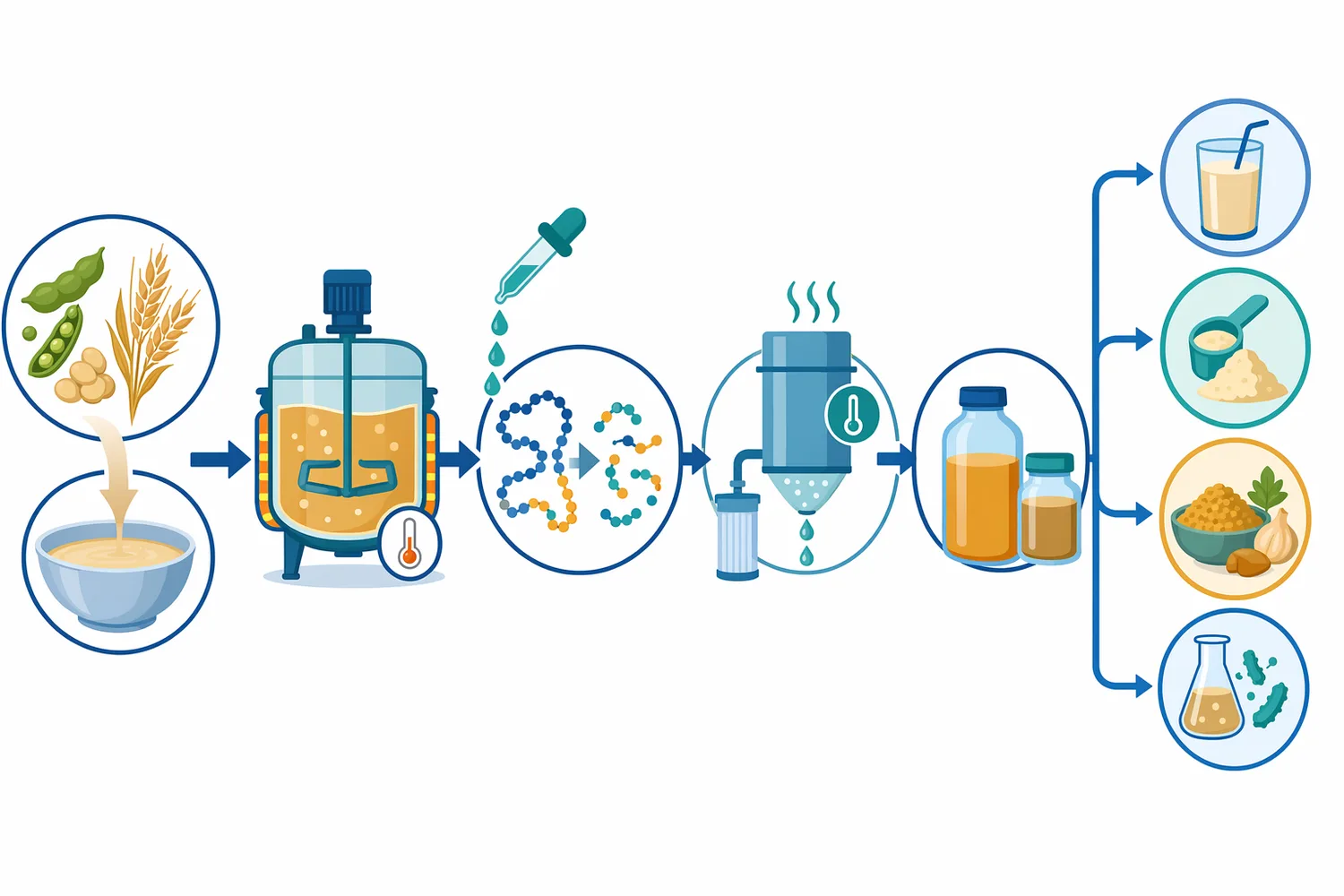
A general process flow is straightforward: hydrate the protein, add papain under food-process conditions, allow controlled contact, stop the reaction with a validated inactivation step, and then use or further process the hydrolysate. Downstream steps may include blending, heating, homogenising, drying, or incorporation into a finished food system [3].
The most important operational idea is consistency of hydrolysis. If the reaction is stopped too early, the protein may remain poorly soluble or too aggregated. If it continues too long, the product may lose viscosity, gel strength, or foam stability. For this reason, papain is best used as a deliberate process step rather than an uncontrolled additive [2].
Food matrix effects are significant. Salt can alter protein charge and hydration. Fat changes interfacial demand. Sugar and polyols influence water availability. Starch and gums can compete for water and alter viscosity. Heat can unfold proteins before or after hydrolysis. Acidity changes both protein charge and enzyme–substrate accessibility [4].
Papain hydrolysis can improve mouthfeel by reducing graininess and improving dispersion, but it can also change flavour. Protein hydrolysates sometimes develop bitterness because hydrophobic amino acid sequences become exposed as small peptides. This is not unique to papain; it is a common feature of protein hydrolysis [6].
Texture can also move in either direction. A mildly hydrolysed plant protein may feel smoother and less chalky. A more heavily hydrolysed protein may feel thinner because long chains that previously contributed viscosity have been cut. In gelled products, moderate hydrolysis may assist network formation, while excessive hydrolysis may weaken the structure [2].
Colour and aroma depend mainly on the starting plant material and downstream processing, but hydrolysis can influence both indirectly. Smaller peptides and amino groups may participate differently during heating, especially in systems containing reducing sugars. This can be useful in savoury or roasted applications but may require care in neutral beverages or light-coloured foods [1].
Papain is an enzyme protein, and enzyme powders should be handled responsibly to minimise dust and inhalation exposure. Published medical literature has reported allergic sensitisation associated with papain exposure in industrial and food contexts, so practical handling should follow the Safety Data Sheet provided with the order [8].
This safety point does not reduce papain’s value as a food-processing enzyme; it simply reflects the normal care required for concentrated enzyme materials. Avoiding dust, using appropriate workplace controls, and following the product documentation are standard expectations when working with enzyme powders [8].
Enzymes.bio supplies food-grade papain for food applications directly online by the 1 kg unit. The purchase process is simple: the buyer places the order online, pays online, and the order is processed and shipped.
Each order includes a Certificate of Analysis and Safety Data Sheet. These documents support normal receiving, quality, and safe-handling procedures without requiring a separate technical enquiry process.
Papain is a practical food-grade protease for modifying plant proteins through controlled hydrolysis. It works by cutting peptide bonds, reducing protein size, opening compact structures, and changing how proteins interact with water, oil, air, heat, and digestive enzymes [1].
For plant-protein foods, those changes can support better dispersion, smoother mouthfeel, improved emulsification, stronger or more tunable texture, easier digestion, and peptide-rich hydrolysate development. The best results come from controlled hydrolysis, because the same cutting action that improves solubility can also weaken foam, viscosity, or gel strength if pushed too far [2].
Enzymes.bio offers food-grade papain online in 1 kg units for buyers who want a straightforward way to purchase papain for plant protein hydrolysis and related food-processing applications.
Sold by the 1 kg unit, in stock and ready to ship. Order directly on our store — pay online and we process your order. A Certificate of Analysis and Safety Data Sheet are included with every order.
Buy Papain 1.5 Million U/G High Enzyme Activity For Plant Protein Hydrolysis Food Grade →Numbered in order of first citation. Open-access sources, each verified reachable at publication; citation numbers in the text link here.