
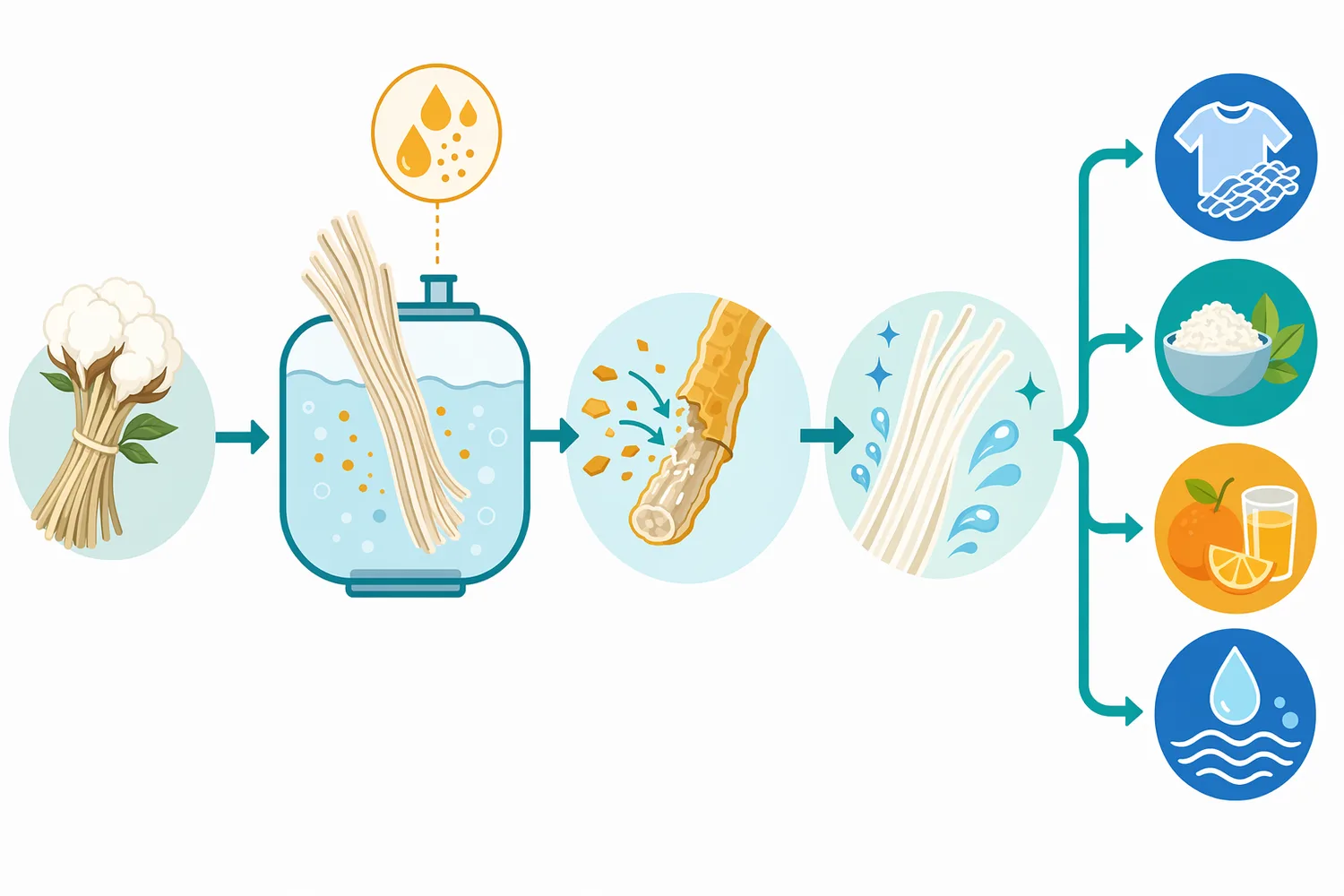
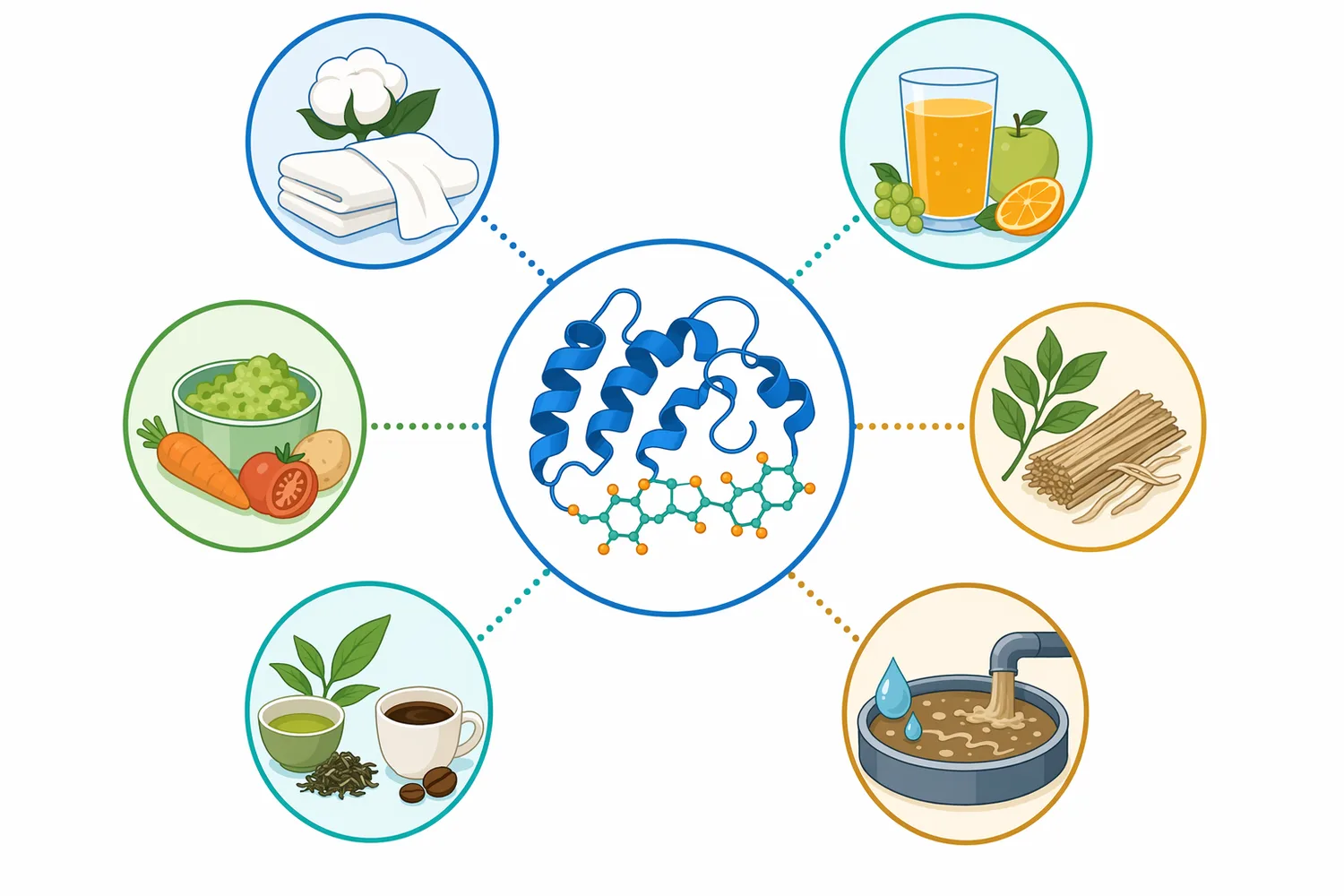
Pectate lyase is a pectin-degrading enzyme that cleaves pectate and low-methylesterified pectin by β-elimination, weakening the plant “cement” that holds cells, fibers and pectin-rich particles together. In practical processing, the pectate lyase enzyme is used to support cleaner bast-fiber degumming, cotton bioscouring, pectin-rich biomass treatment and selected fruit-processing applications where controlled pectin breakdown is useful.
Enzymes.bio supplies Pectate Lyase for direct online purchase by the 1 kg unit. After online payment, the order is processed and shipped, and the product is supplied with a Certificate of Analysis and Safety Data Sheet.
Pectate lyase acts on pectate, the de-esterified or low-methylesterified form of pectin found in plant cell walls and middle lamellae. Pectin is not a single simple polymer: it is a family of acidic polysaccharides, with homogalacturonan as a major linear region made from α-(1→4)-linked D-galacturonic acid units. When this pectin network is intact, it helps bind plant cells and fiber bundles; when it is cut into shorter fragments, the physical “glue” effect is reduced, and the plant material becomes easier to soften, separate, wash, clarify or open for further treatment. Reviews of pectate lyase origins and applications describe this enzyme class as important in industrial processes where pectin removal or modification is central to performance [1].
The key pectate lyase function is chain cleavage without hydrolysis. Instead of adding water across the glycosidic bond as polygalacturonases do, pectate lyases use a β-elimination reaction that breaks the polymer and generates an unsaturated bond in the product. This difference matters in processing because pectate lyase is especially associated with pectate-like substrates and alkaline or near-alkaline environments, whereas other pectinases may target methylated pectin or work best under acidic food-processing conditions. Biochemical studies of pectate lyases from bacterial and fungal sources repeatedly identify β-elimination on polygalacturonic-acid-type substrates as the defining reaction [2].
In practical language, pectate lyase cuts the pectin backbone so that long, structure-building chains become shorter and less able to hold water, bind calcium, bridge cell-wall components or keep plant particles attached. On cotton, ramie and other bast or seed fibers, this can reduce pectin-associated impurities that interfere with wetting and finishing. In fruit and juice systems, it can help reduce the viscosity and particle-binding behavior associated with pectic substances. In biomass processing, it can help loosen a pectin-rich matrix so that other enzymes and process water can reach cell-wall polymers more effectively.
The pectate lyase mechanism begins with recognition of suitable galacturonic acid regions in the pectin chain. Many pectate lyases bind the negatively charged carboxylate groups of de-esterified galacturonic acid residues, often in a groove or cleft on the enzyme surface. The reaction abstracts a proton and drives β-elimination across the glycosidic linkage, producing shorter oligogalacturonides with an unsaturated non-reducing end. This is why pectate lyase products are chemically distinct from the fragments produced by hydrolytic pectinases [1].
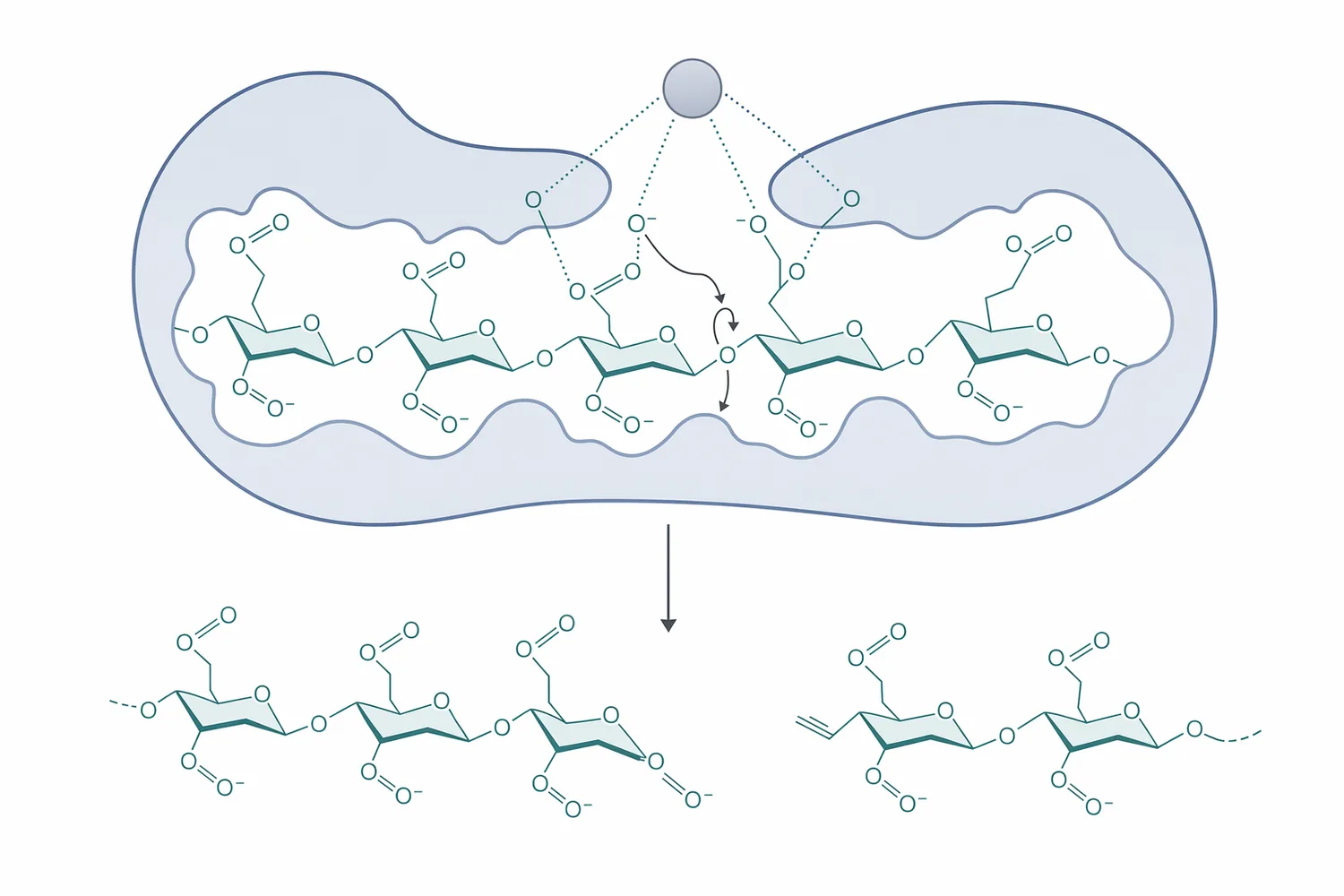
The effect of this reaction is mechanical as well as chemical. A long homogalacturonan chain can span cell-wall regions, bind cations, interact with other wall polymers and contribute to gel-like or gum-like behavior. After pectate lyase cuts the chain internally, the fragments are shorter, more mobile and less able to maintain a continuous network. In fiber processing, that means pectin-rich gums can be loosened from the fiber surface; in juice or plant extract processing, it can reduce pectin-driven viscosity or cloud-forming interactions when the substrate chemistry is appropriate. Studies on alkaline and thermostable pectate lyases emphasize this industrial value because the same chemistry can be useful under process conditions that would be too harsh for many non-industrial enzymes [3].
Calcium and other ions can influence the biochemistry of pectate lyase, although the details depend on the enzyme source. The reason is structural: pectate contains negatively charged carboxyl groups, and divalent cations can help organize substrate binding or stabilize reaction geometry in some lyase systems. This does not mean every pectate lyase behaves the same way, but it explains why the active-site environment, substrate charge and process water composition can change observed performance. Research on pectate lyase protein structure and engineering continues to focus on these binding-site details because small changes around loops, calcium-binding regions or catalytic residues can alter activity, stability and pH behavior [4].
The phrase “pectin lyase vs pectate lyase” is common because the names sound similar, but the enzymes are not identical. Both belong to the broader group of pectin-degrading enzymes, and both use lyase chemistry rather than hydrolysis. The practical distinction is substrate preference: pectin lyase generally acts on more highly methylesterified pectin, while pectate lyase acts mainly on pectate or low-methylesterified pectin. This distinction is important when interpreting research data or process outcomes because plant pectin can vary widely in degree of methylesterification, depending on source, ripeness, pretreatment and endogenous pectin methylesterase activity [1].
| Enzyme type | Main substrate tendency | Cleavage chemistry | Typical process relevance |
|---|---|---|---|
| Pectin lyase | More methylesterified pectin | β-elimination | Fruit and pectin systems where methylated pectin is abundant |
| Pectate lyase | Pectate and low-methylesterified pectin | β-elimination | Textile bioscouring, bast-fiber degumming, alkaline pectin removal, pectate-rich substrates |
| Polygalacturonase | De-esterified polygalacturonic acid | Hydrolysis | Acidic pectin breakdown, food and plant tissue softening systems |
| Pectin methylesterase | Methylesterified pectin | De-esterification, not chain cleavage | Converts pectin toward pectate-like regions that other enzymes may then cleave |
For a buyer using the product in a plant-material process, the main takeaway is straightforward: pectate lyase is most relevant when the limiting material is pectate-like pectin acting as a gum, binder or matrix component. If a substrate contains highly methylated pectin, other pectin-modifying enzymes may be involved upstream or alongside it in a broader process design. The distinction is not academic; it changes what the enzyme can attack and how quickly the pectin network loses its structure.
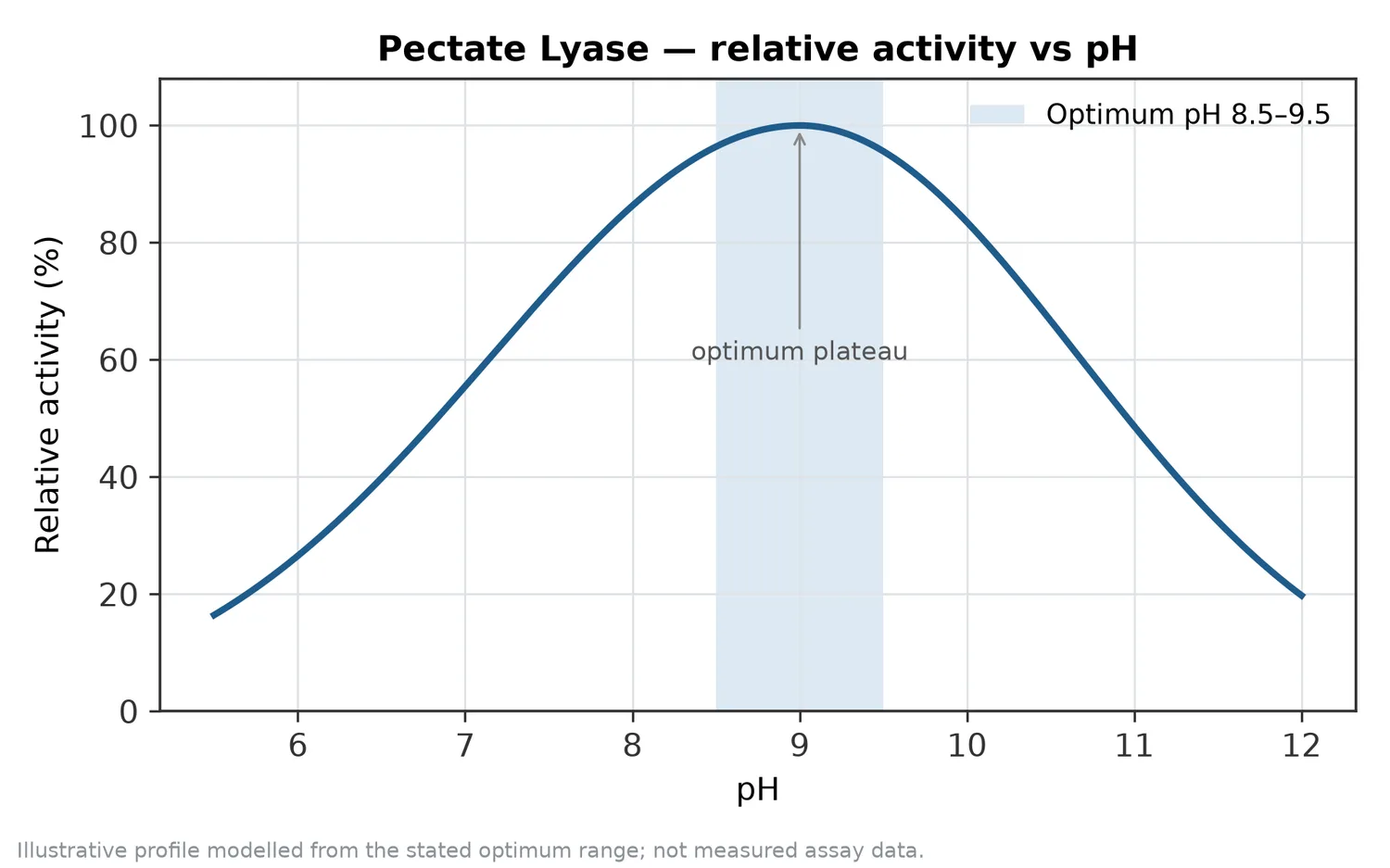
Pectate lyases are often discussed as alkaline enzymes because many bacterial pectate lyases show useful activity at neutral to alkaline pH, which fits textile, fiber and some industrial wet-processing conditions. However, pectate lyases are not all identical. Fungal, bacterial and engineered enzymes can differ in pH preference, temperature tolerance and stability window. For example, alkaline pectate lyases from Bacillus and Paenibacillus sources have been studied for industrial compatibility, while thermostable fungal pectate lyases have also been characterized for broader process relevance [5].
| Pectate lyase category | Conceptual operating profile | Where it tends to fit | Practical implication |
|---|---|---|---|
| Acid-tolerant or mildly acidic | More compatible with acidic fruit or plant extract systems | Juice, fruit pulp and selected food-related pectin modification | Useful when the process cannot be shifted alkaline |
| Neutral to mildly alkaline | Fits many aqueous plant-material treatments | Biomass, mixed plant extracts, moderate wet processing | Often useful where pectin removal is desired without strongly caustic conditions |
| Alkaline pectate lyase | Compatible with alkaline scouring, degumming and washing environments | Cotton bioscouring, ramie degumming, textile pretreatment | Especially relevant where pectin must be removed under alkaline process conditions |
| Thermostable or thermo-alkaline | Maintains function after heat exposure or at elevated process temperatures | Industrial fiber processing, faster wet treatment steps | Reduces loss of enzyme function in warmer treatments |
This table is deliberately conceptual rather than a product specification. The useful point is that pectate lyase biology has been developed across multiple process environments, with alkaline and thermostable forms receiving significant attention because textiles and plant-fiber treatments commonly combine warm water, alkalinity, agitation and extended contact times. Recent work screening alkaliphilic Bacillus pectate lyases under simulated industrial environments shows why pH-dependent stability, not just instantaneous activity, is important for real processing outcomes [6].
Cotton and other natural fibers contain non-cellulosic impurities, including pectic substances, waxes, proteins and mineral components. Conventional alkaline scouring is effective but chemically demanding. Pectate lyase supports bioscouring by attacking the pectin fraction that helps bind impurities to the fiber surface. When that pectin is cleaved, the surface becomes easier to wet and wash, and the fiber can be prepared for downstream dyeing or finishing with a more targeted enzymatic contribution. Research on alkaline pectate lyase production and its application in cotton fabric bioscouring directly connects the enzyme to this textile pretreatment role [7].
At the substrate level, the enzyme does not “bleach” cotton or dissolve cellulose. Instead, it weakens pectin-rich junctions in the outer fiber layers. This matters because cellulose is the valuable structural fiber; the goal of bioscouring is to remove or loosen surface impurities while preserving the fiber as much as the process allows. Pectate lyase is therefore attractive in textile pretreatment because it targets a non-cellulosic binder rather than the cellulose backbone. Studies on alkaline pectate lyases repeatedly frame them as industrial enzymes for scouring and plant-fiber preparation, not as general-purpose cellulases [8].
The process benefit is most visible when pectin is a major contributor to poor wetting or uneven treatment. Once pectin chains are cut, water and washing chemistry can penetrate more uniformly, and surface deposits may detach more readily under agitation. This is the same practical logic behind using pectate lyase in bioscouring: the enzyme makes a specific structural change to the pectin fraction, and the mechanical washing step then removes loosened material. Enzyme-assisted bioscouring research has therefore focused not only on enzyme production, but also on performance in actual fabric treatment, because visible and measurable fabric changes are what determine industrial relevance [7].
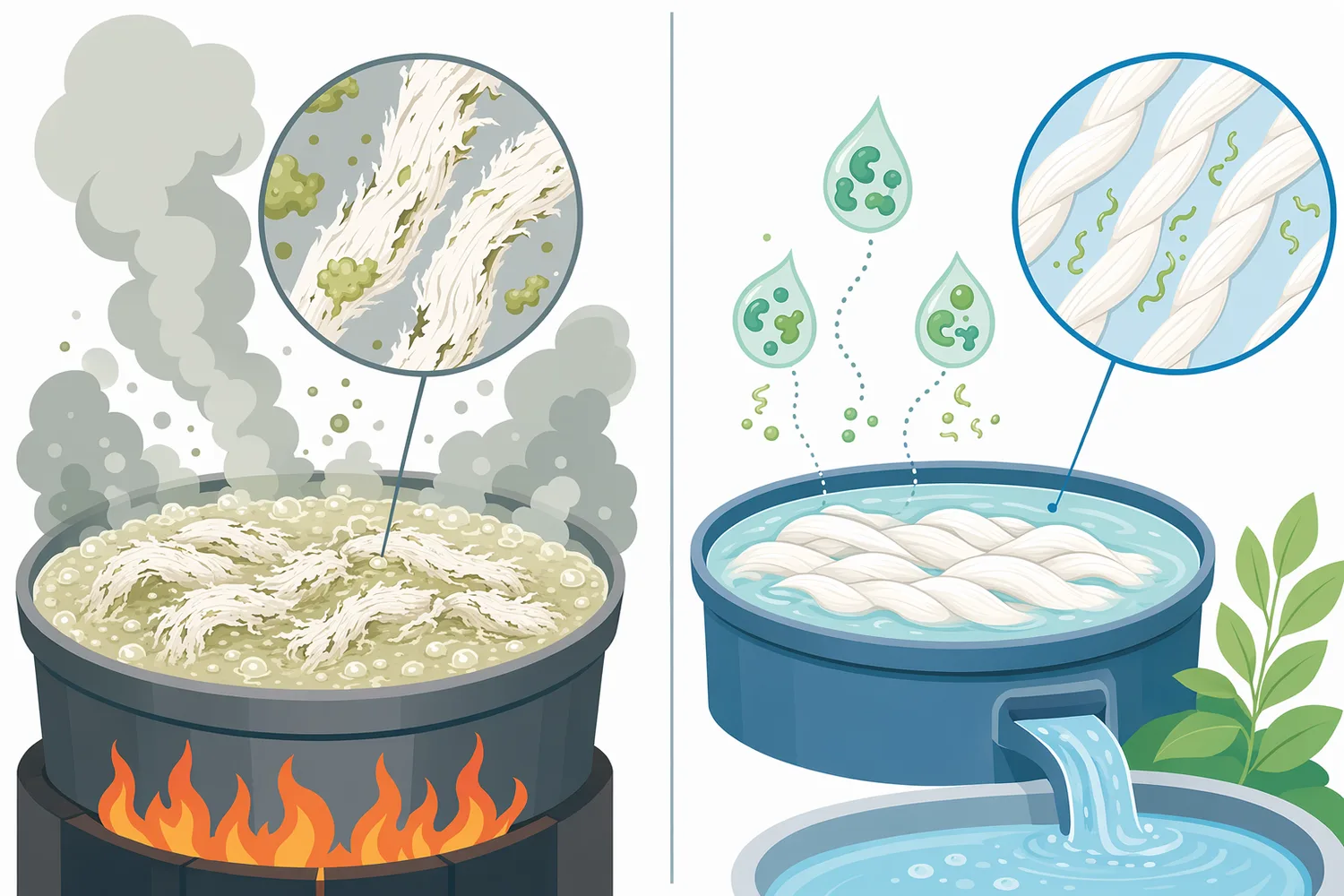
Ramie is a strong bast fiber, but raw ramie contains gum-like materials that must be removed before the fiber can be used effectively in textiles. These gums include pectin, hemicellulose and other non-cellulosic components that hold fiber bundles together. Pectate lyase is particularly relevant because pectin is one of the main cementing substances in the middle lamella and gum layer. By cleaving pectate-like regions, the enzyme helps loosen the gum network and improves fiber separation. Multiple studies have therefore explored pectate lyase for ramie degumming and related bast-fiber applications [9].
The mechanism in ramie degumming is concrete: pectin chains that bridge between fiber cells are cut into shorter fragments, reducing the cohesive strength of the gum. Once the pectin network is weakened, washing, agitation and compatible auxiliary chemistry can remove loosened material more effectively. The value is not only gum reduction; it is controlled gum reduction without relying entirely on aggressive chemical treatment. Studies on engineered or thermostability-improved pectate lyases for ramie degumming have focused on improving enzyme behavior under practical treatment conditions because ramie processing often involves warm, alkaline or otherwise demanding aqueous systems [10].
More recent work continues to refine pectate lyase for ramie by modifying enzyme properties and applying novel pectate lyases in preliminary degumming trials. This line of research is significant because it links molecular changes in the enzyme to a visible plant-fiber outcome: easier gum removal and improved processing of the bast fiber. A 2025 study on a pectate lyase from Paenibacillus tarimensis specifically connects characterization, modification and preliminary ramie degumming application, showing that this remains an active area of industrial enzyme development [11].
Pectate lyase is also relevant to fruit and juice systems, but the substrate context is different from textiles. Fruit pectin may be partly methylesterified, modified during ripening or changed by endogenous enzymes. Where pectate-like regions are present, pectate lyase can cut the pectin backbone and change viscosity, particle interactions or tissue texture. Low-temperature-active pectate lyase research for orange juice clarification is especially interesting because juice processing may benefit from pectin modification without high heat exposure that can affect flavor or freshness attributes [12].
In juice clarification, pectin can stabilize suspended particles and contribute to haze or cloud behavior. Breaking pectin into shorter fragments can reduce the network strength that traps fine particles or increases viscosity. However, pectate lyase should not be treated as a universal juice enzyme for every fruit system. Its effectiveness depends on the pectin’s methylesterification state and the broader enzyme environment. This is why the phrase “pectin lyase vs pectate lyase” matters in fruit processing: methylated pectin and pectate-rich pectin do not present the same substrate to the enzyme.
Fruit biology also confirms the power of pectate lyase chemistry. In living plant tissue, pectin remodeling is one of the events that changes firmness during ripening and softening. While industrial use is different from gene expression in fruit, the biological evidence helps explain why pectin-cleaving enzymes produce noticeable physical outcomes: when the wall pectin network is weakened, the material softens or separates more easily. Fungal pectate lyases from Aspergillus species have been characterized in this broader context of plant polysaccharide degradation and industrial application [2].
In lignocellulosic biomass, cellulose and hemicellulose often receive most attention, but pectin can still act as a barrier in certain plant materials. It can occupy middle lamellae, bind water, interact with other wall polymers and physically restrict access to cellulose-rich regions. Pectate lyase can support biomass processing by loosening this pectin fraction, making the cell-wall matrix more open to other enzymes. It should be viewed as a supporting enzyme in such systems, not as a replacement for cellulases, xylanases or other primary carbohydrate-degrading enzymes.
The practical mechanism is improved access. A cellulase cannot efficiently hydrolyze cellulose if the cellulose surface is covered or physically constrained by pectin-rich matrix components. By cutting pectate chains, pectate lyase reduces the integrity of that matrix and can help expose additional surface area. This is especially relevant in multi-enzyme treatments where each enzyme removes a different wall component. Reviews of pectate lyase uses include biomass and plant-material processing among the industrially relevant areas because pectin modification can improve the performance of broader enzyme systems [1].
In such applications, pectate lyase is most useful when the raw material actually contains meaningful pectic substances. Citrus residues, beet pulp, some agricultural residues, fruit-processing streams and certain green biomass fractions may contain more pectin than highly lignified feedstocks. The enzyme’s role is therefore substrate-specific: it modifies pectin barriers where they exist, but it does not solve cellulose crystallinity, lignin recalcitrance or hemicellulose complexity by itself.
The pectate lyase protein structure is central to how the enzyme works. Many pectate lyases have elongated binding surfaces suited to gripping a polymer chain rather than a small molecule. The active site must position multiple galacturonic acid residues, accommodate charged carboxyl groups and hold the scissile bond in the correct geometry for β-elimination. Structural modeling and functional evaluation of pectate lyase proteins, including plant-derived examples, highlight the importance of substrate-binding residues and fold architecture in determining enzyme behavior [13].
Engineering studies show that changes outside the catalytic residue itself can still matter. Loop regions near the active-site groove can alter substrate access, product release, pH response and temperature stability. A 2023 loop-replacement study on a Bacillus pectate lyase specifically targeted optimum pH and catalytic performance, illustrating how protein regions that shape the binding cleft can change industrially relevant behavior [14]. This matters because process environments rarely match the mild, controlled conditions under which enzymes first evolve.
Thermostability engineering is another major theme. Warm process water can speed mass transfer and cleaning but can also unfold enzymes. Structure-based engineering of alkaline pectate lyase from Paenibacillus has therefore been used to improve thermostability, with the goal of maintaining functional protein structure longer under heat stress [4]. At the molecular level, improved thermostability can come from better packing, stronger salt bridges, reduced flexible unfolding regions or stabilizing interactions around the β-helix fold. The customer-facing implication is simple: pectate lyase is not a single fixed molecule; it is an enzyme class with variants studied for different industrial environments.
Immobilization is another route to improving practical enzyme behavior, although it is more relevant to engineered process systems than to every use case. Hybrid nanoflower immobilization of pectate lyase has been studied to improve catalytic performance and reuse potential, demonstrating that researchers continue to explore ways to stabilize enzyme function beyond changing the amino-acid sequence itself [15]. This reinforces the broader point that pectate lyase performance depends on both the protein and its process environment.
Alkaline pectate lyases are prominent because textile scouring, degumming and plant-fiber preparation often occur at alkaline pH. Under these conditions, pectin can become more accessible, waxes and impurities are more readily loosened, and conventional processing chemistry already operates in a pH range where alkaline enzymes may be compatible. Bacillus-derived pectate lyases have been repeatedly studied for this reason, including alkali-stable enzymes from Bacillus subtilis and pH- and temperature-stable enzymes from Bacillus amyloliquefaciens [8].
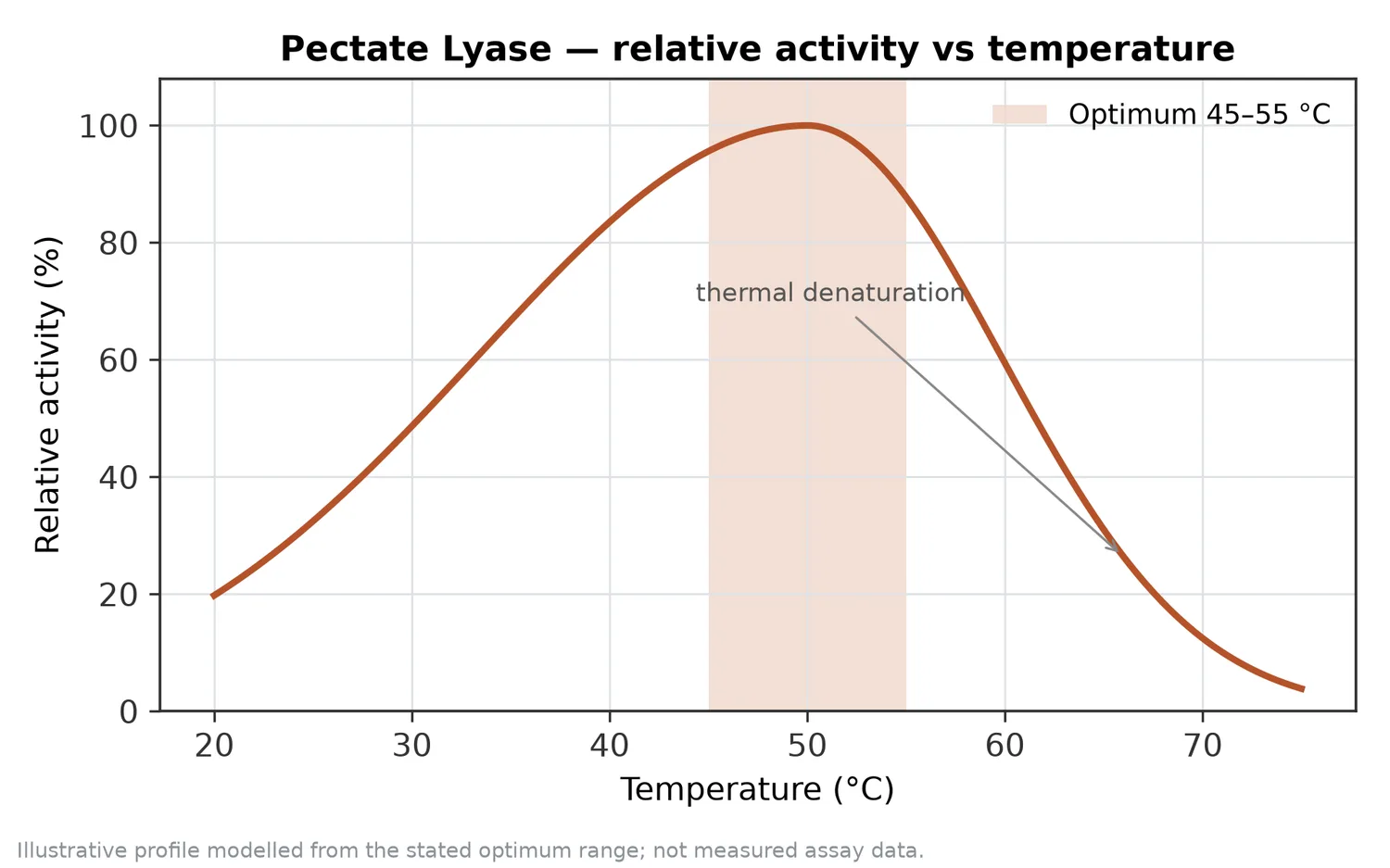
Thermostable pectate lyases are valuable because industrial wet processing is rarely static or gentle. Temperature can rise during washing, scouring, extraction, mixing or pretreatment, and an enzyme that rapidly loses structure will contribute less over the full contact period. Research on thermostable pectate lyases from fungal sources, including Aspergillus luchuensis var. saitoi, shows that stability is not limited to bacterial alkaline enzymes; different microbial sources can contribute different operating advantages [5].
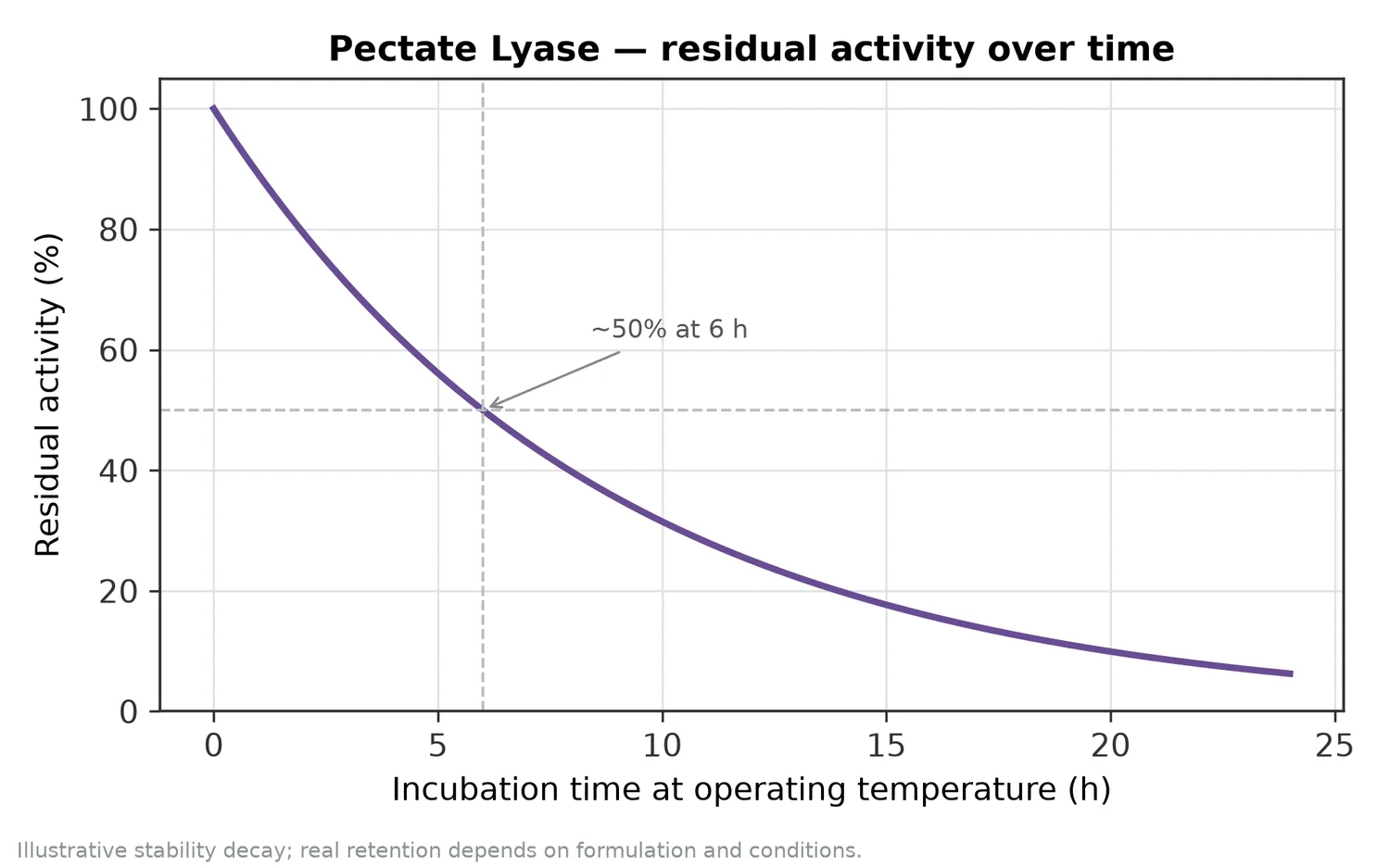
The biochemistry of pectate lyase is therefore closely linked to process fit. An enzyme that cleaves the correct substrate but unfolds too quickly, loses activity at the working pH or cannot tolerate the process matrix will not deliver the same practical outcome. This is why industrial pectate lyase literature often reports enzyme stability, pH behavior and temperature behavior alongside application tests such as bioscouring or degumming. The goal is not merely to prove that the enzyme can cut polygalacturonic acid; it is to show that it can keep doing so under conditions resembling actual plant-material treatment [6].
The first benefit of pectate lyase is targeted pectin modification. Because the enzyme acts on pectate-like regions rather than randomly degrading cellulose, it can reduce the binding effect of pectin while leaving the primary structural fiber more intact than a non-selective chemical attack would. In cotton bioscouring and ramie degumming, this selectivity is central to the value proposition: remove or loosen the pectin-rich impurity fraction without making cellulose degradation the objective [7].
The second benefit is improved separation. In bast fibers, pectin-rich gums physically hold fiber bundles together; in fruit or biomass slurries, pectin can bind particles and increase viscosity; in plant-wall matrices, pectin can block access to other polymers. Cutting the pectin chain reduces its molecular length and network-building ability, so the substrate can separate, wash, drain or react more easily. This is the concrete change behind many pectate lyase uses.
The third benefit is compatibility with enzyme-assisted lower-impact processing. Chemical scouring and degumming can be effective, but enzyme-assisted steps allow part of the work to be done through a specific biochemical reaction. Studies on ramie degumming and thermostability improvement have pursued pectate lyase because it can support pectin removal in processes seeking to reduce harsh treatment intensity while still achieving fiber preparation goals [9].
The fourth benefit is process flexibility across multiple plant-derived industries. The same enzyme class appears in research on cotton bioscouring, ramie degumming, orange juice clarification, pectin-rich biomass and microbial enzyme engineering. That does not mean one pectate lyase product is automatically ideal for every process, but it shows why the enzyme is widely searched and studied. Searches such as “pectate lyase detergent,” “pectate lyase Sigma” or “biochemistry of pectate lyase” often reflect different user contexts—industrial cleaning and textile use, research-catalog comparison and mechanistic study—but the underlying enzyme function remains pectate cleavage.
The term “pectate lyase detergent” is usually connected to the enzyme’s ability to remove plant-derived stains or pectin-rich soils. Fruit, vegetable and plant-processing residues can contain pectin that helps bind colored particles and solids to fabric or equipment surfaces. A pectate lyase can cut that pectin network, making the residue easier to detach during washing. Alkaliphilic Bacillus pectate lyases have been screened for reactivity and pH-dependent stability in simulated industrial environments, supporting the relevance of alkaline performance in detergent-adjacent and cleaning-related settings [6].
The mechanism is the same as in textile processing: the enzyme does not act as a surfactant and does not oxidize stains. It reduces the integrity of pectin-containing soil. Once the pectin matrix is weakened, surfactants, water movement and mechanical action can remove the loosened material more effectively. This is why pectate lyase is best understood as a targeted additive in plant-soil removal systems rather than a universal cleaner.
Pectate lyase is a protein enzyme, and enzyme powders should be handled with care to avoid unnecessary dust exposure. Searches for “pectate lyase allergy” generally reflect a reasonable concern: enzymes, like other proteinaceous materials, can be irritating or sensitizing for some people if inhaled or mishandled. The practical approach is to follow the Safety Data Sheet supplied with the order and apply normal workplace controls for enzyme-containing powders.
This handling point does not change the enzyme’s industrial usefulness; it simply reflects responsible use. Buyers purchasing from Enzymes.bio receive the product documentation with the order so internal teams can incorporate it into their existing handling procedures. The article you are reading is educational and application-focused, while the supplied documents support safe receipt and use of the material.
Enzymes.bio supplies Pectate Lyase directly online by the 1 kg unit. The purchase flow is simple: place the product in the online cart, pay online and the order is processed for shipment. A Certificate of Analysis and Safety Data Sheet are supplied with the order.
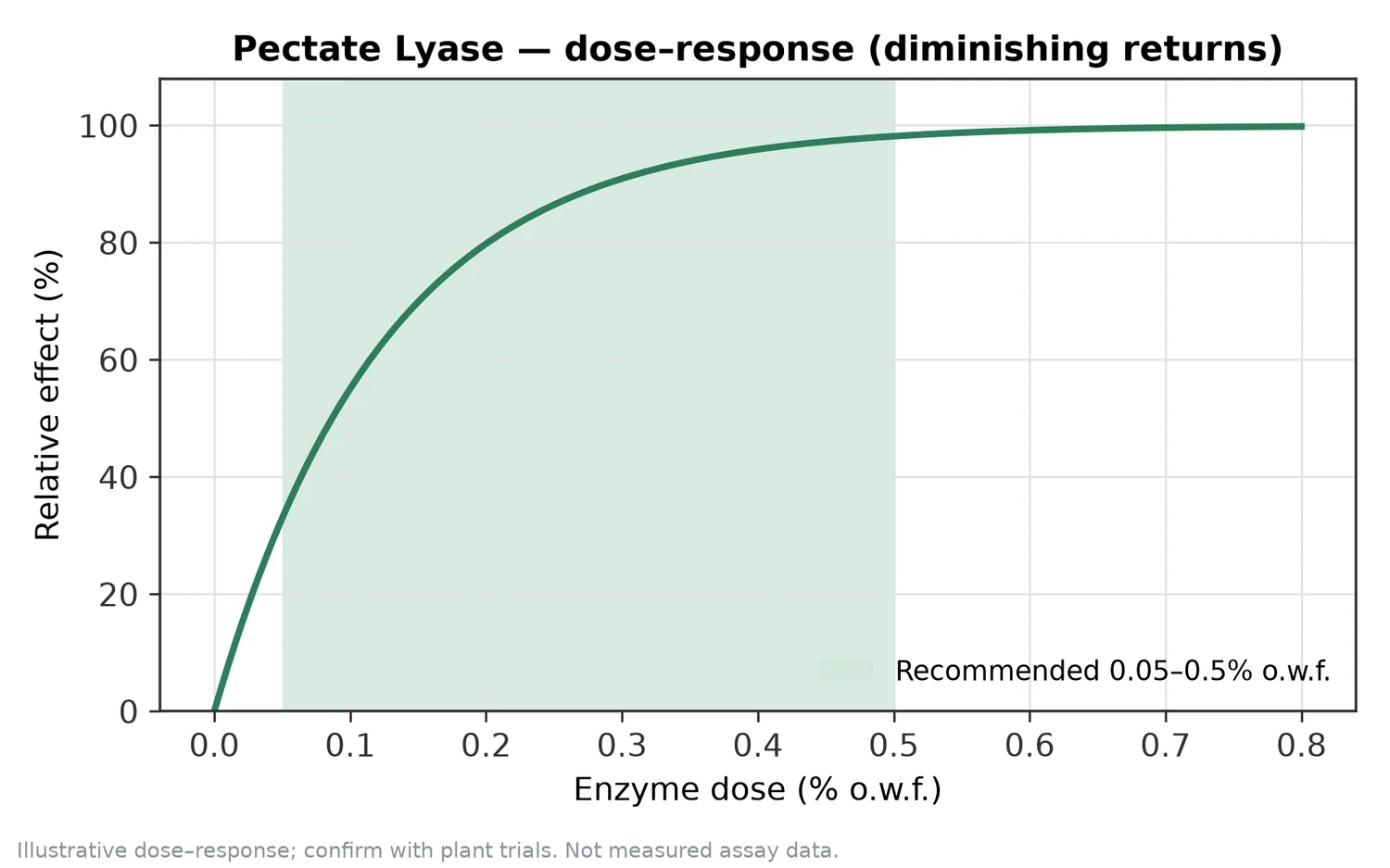
This format is suited to businesses that already know they need pectate lyase for enzyme-assisted processing, formulation work, textile or fiber trials, plant-material treatment or internal development. The scientific literature supports the enzyme’s core function—β-eliminative cleavage of pectate-like pectin—and demonstrates its relevance across bioscouring, ramie degumming, alkaline pectin removal, biomass accessibility and selected fruit-processing contexts [1].
Pectate lyase is best viewed as a precise pectin-modifying enzyme. Its value comes from what it changes in the substrate: long, structure-building pectate chains become shorter fragments; pectin-rich gums lose cohesion; plant surfaces become easier to wash; fiber bundles become easier to separate; and pectin barriers become less restrictive to downstream processing. For buyers working with pectin-rich plant materials, that targeted biochemical action is the reason pectate lyase remains an important industrial enzyme.
Sold by the 1 kg unit, in stock and ready to ship. Order directly on our store — pay online and we process your order. A Certificate of Analysis and Safety Data Sheet are included with every order.
Buy Pectate Lyase →Numbered in order of first citation. Open-access sources, each verified reachable at publication; citation numbers in the text link here.