
Pectinase helps turn many cloudy fruit juices into clearer cocktail and beverage ingredients by breaking down pectin, the plant cell-wall polysaccharide that traps pulp, stabilizes haze, raises viscosity, and slows filtration. When pectin is cut into smaller fragments, fine particles settle or filter more easily, so the juice can become brighter, smoother, and more consistent after an appropriate separation step. Enzymes.bio supplies Pectinase Enzyme directly online by the 1 kg unit; each order is processed and shipped after online purchase and is accompanied by a Certificate of Analysis and Safety Data Sheet.
Freshly pressed fruit juice looks cloudy because it is not just liquid. It contains microscopic plant particles, cell-wall fragments, soluble polysaccharides, proteins, phenolics, oils in some fruits, and suspended pulp. In pectin-rich juices, pectin is one of the main structural reasons that this cloud stays dispersed instead of settling quickly. Pectinases are widely described in the literature as industrial enzymes for fruit juice extraction and clarification because they degrade pectic substances that otherwise maintain turbidity and viscosity in juice systems [1].
For cocktail programs, clear fruit juice has practical value beyond appearance. A clarified apple, citrus, grape, berry, passion fruit, guava, or tropical fruit component can carry recognizable fruit flavor while reducing sediment in bottled serves, improving visual brilliance in stirred drinks, and avoiding the dense opaque look that pulp brings to highballs, sours, spritzes, and non-alcoholic cocktails. The same mechanism used in industrial fruit processing—enzymatic degradation of pectin before separation—can support clearer beverage bases when the haze is pectin-driven [2].
The phrase “turn any fruit juice into a crystal-clear cocktail” is best understood as an application goal, not a promise that every fruit behaves identically. Pectinase is most effective where pectin is a major cause of cloudiness, thickness, pulp suspension, or poor filterability. Some juices also contain starch, protein-polyphenol haze, oils, or very fine insoluble solids; in those cases, pectinase can still improve clarifiability, but the final visual result depends on the fruit matrix and the settling, straining, centrifugation, or filtration used after enzyme treatment [3].
Pectin is a complex, acidic polysaccharide found in plant cell walls and middle lamellae—the adhesive region between plant cells. In intact fruit tissue, it helps hold cells together and contributes to firmness, texture, and gel-like structure. When fruit is crushed, blended, or pressed, that structural pectin moves into the juice and pulp phase, where it can behave like a natural stabilizer. Instead of letting fine particles compact and separate, pectin increases the liquid’s body and helps keep solids suspended [1].
Chemically, much of pectin is built around chains of galacturonic acid units, often with methyl ester groups and side-chain regions depending on the fruit and ripeness. This matters because different pectinase activities attack different parts of that structure. Some enzymes cut the backbone into shorter pieces; others remove ester groups that change solubility and charge; others cleave pectic chains by elimination rather than simple hydrolysis. The shared practical outcome is that the large pectin molecules lose their ability to form a continuous haze-stabilizing network [4].
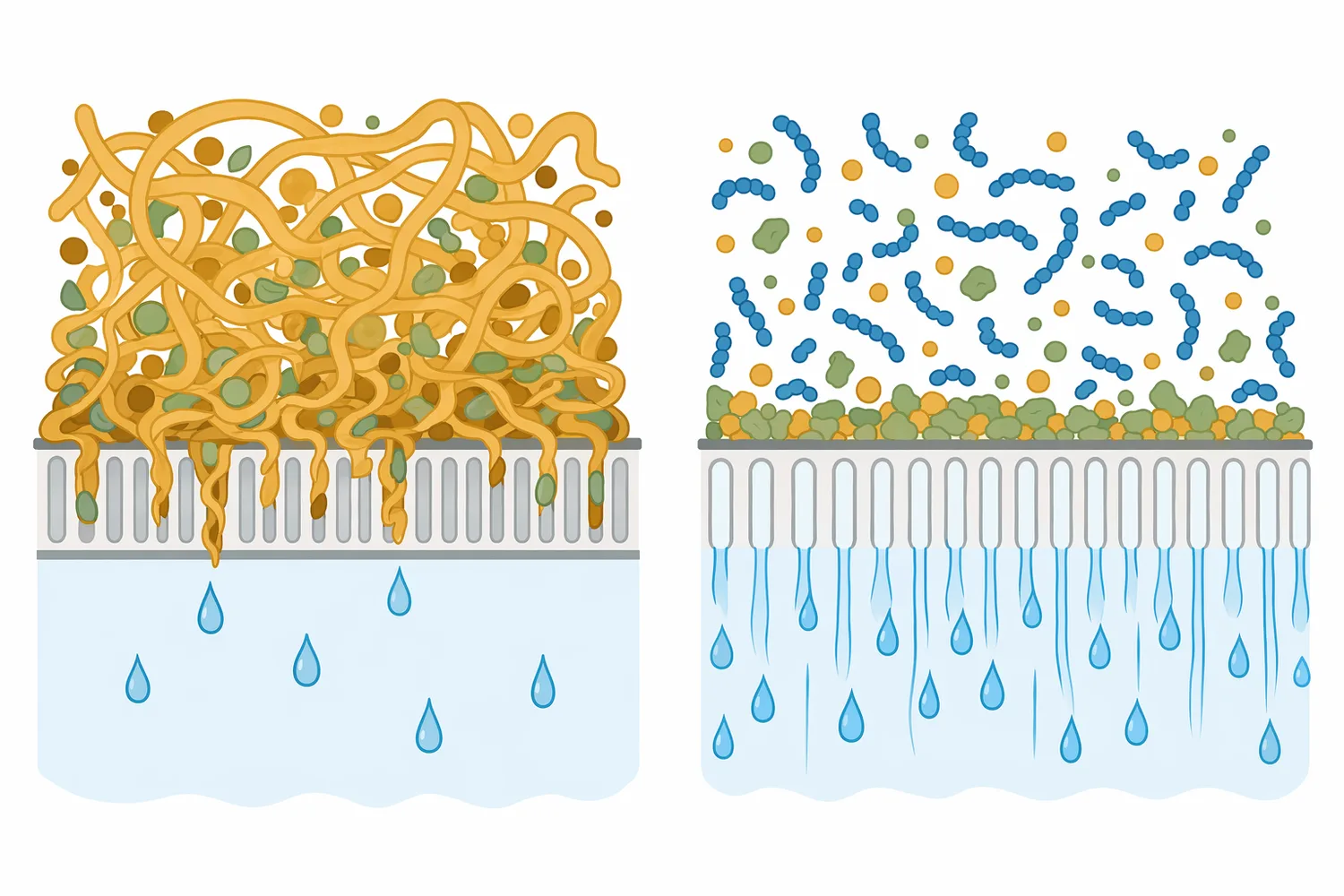
In a juice tank, shaker-batch, or preparation vessel, that molecular change shows up as a physical change. The liquid can become less viscous, pulp particles no longer remain supported in the same way, and filtration media face less slimy pectin load. A filter that would otherwise blind quickly can pass liquid more readily once the long pectin chains have been shortened and the suspended cloud has been destabilized. Reviews of pectinase applications consistently connect this depolymerization of pectin with juice clarification, viscosity reduction, and improved fruit processing performance [2].
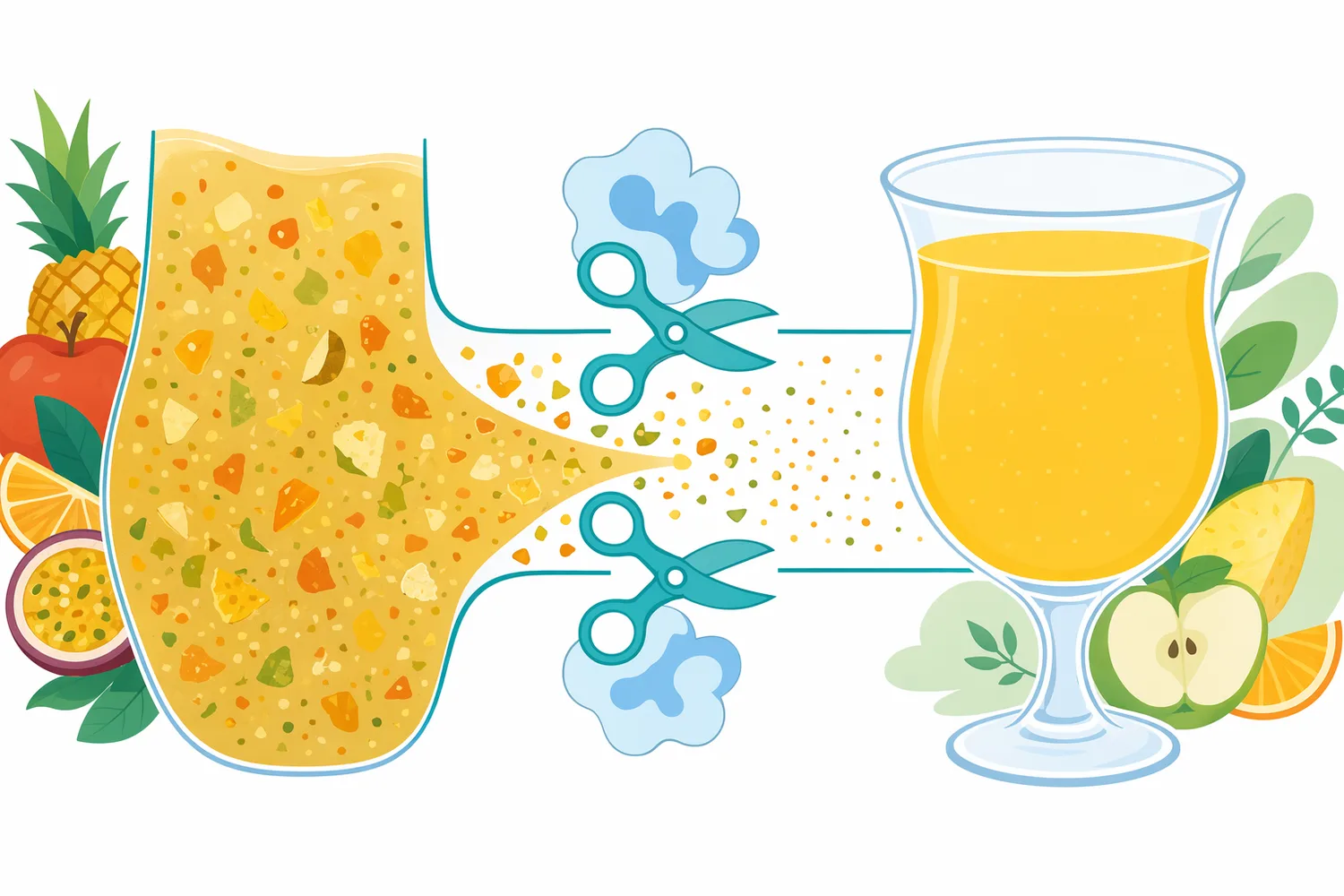
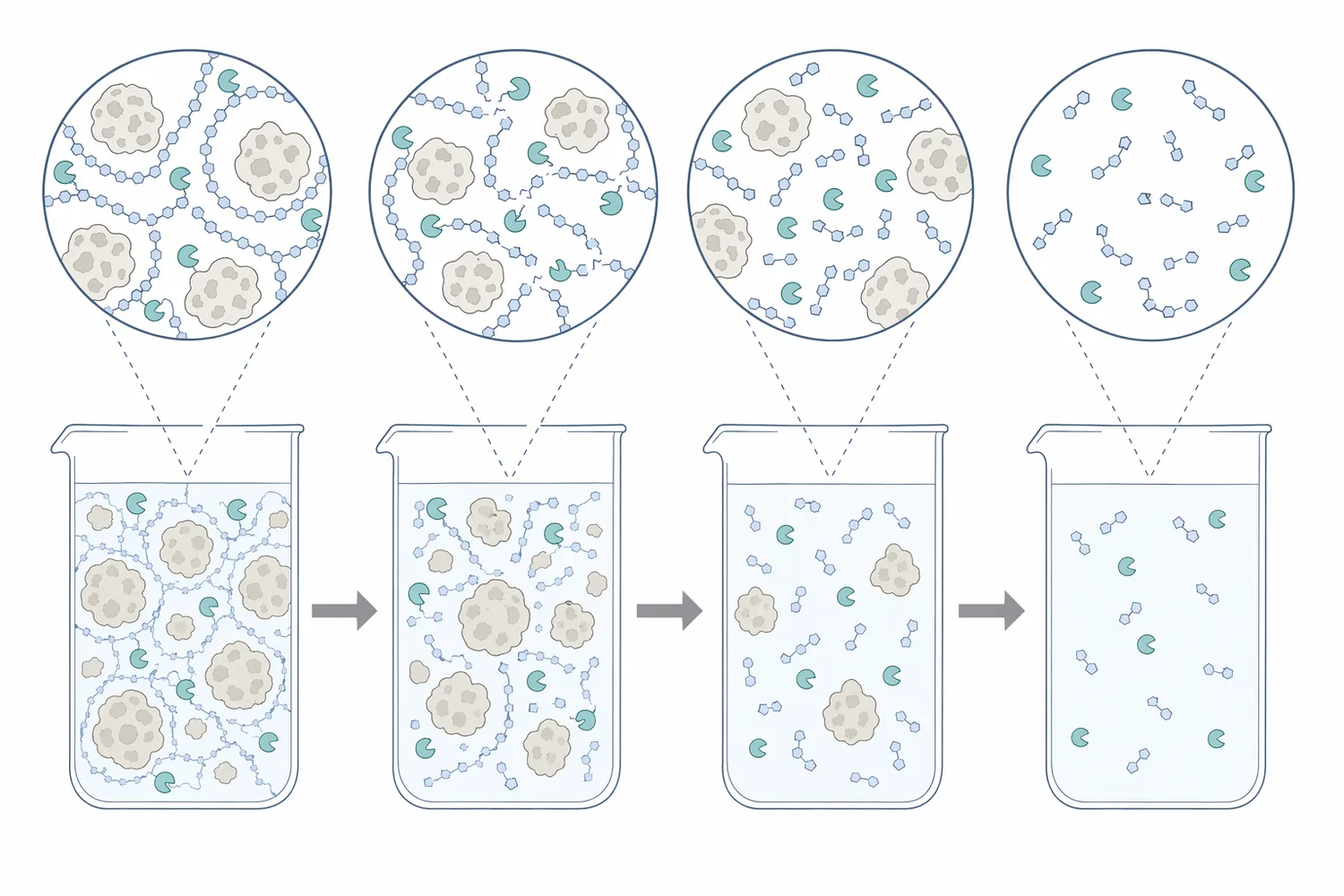
Pectinase does not “bleach” juice or simply remove color. It acts on a specific structural component: pectin. In cloudy fruit juice, pectin molecules form a hydrated network around fine cell debris. That network increases viscosity and slows particle collision, aggregation, and settling. Once pectinase cuts the pectin into smaller fragments, the network loses strength. The particles that were held apart can come together, settle more easily, or be retained more cleanly by filtration [1].
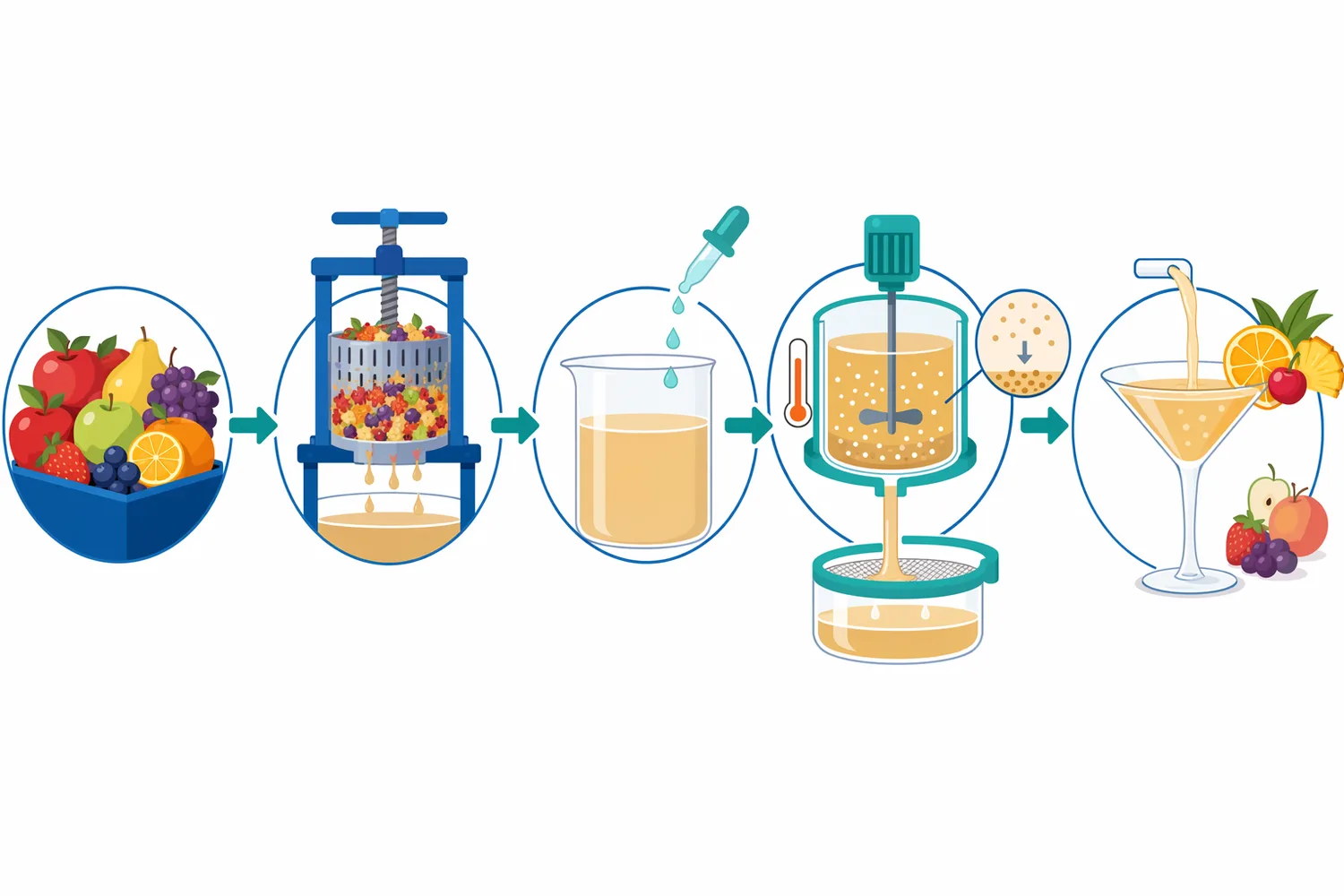
The mechanism can be understood in five practical stages. First, fruit is crushed, pressed, or blended, releasing soluble pectin and fine plant particles. Second, pectin hydrates and thickens the juice phase, creating a stable cloud. Third, pectinase diffuses through the liquid and binds pectic substrates. Fourth, the enzyme cleaves pectin chains or modifies pectic groups, reducing molecular size and changing how the fragments interact with water and suspended particles. Fifth, a separation step removes the destabilized solids, giving a clearer liquid if pectin was a main driver of haze [4].
This is why enzyme treatment and physical separation are usually partners. Pectinase prepares the juice for clarification by weakening the pectin-based structure; settling, racking, straining, centrifugation, or filtration removes the material that caused the visible haze. Without separation, the enzyme may reduce viscosity and destabilize the cloud, but the juice can still contain fine solids. With separation, the same enzymatic breakdown can translate into a visibly brighter cocktail ingredient or clear juice base [3].
Pectinase is not a single molecular action. It is a practical name for enzymes that degrade pectic substances. Many commercial pectinase preparations are built around complementary activities because fruit pectin is structurally mixed: it may be methylated, partially de-esterified, highly branched, or associated with other cell-wall polymers. Understanding the conceptual roles helps explain why pectinase can improve both juice release and clarification [2].
| Pectinase activity type | Main action on pectic material | Practical effect in juice or fruit mash |
|---|---|---|
| Polygalacturonase-type activity | Cuts the galacturonic acid backbone of pectin into shorter chains | Reduces pectin molecular size, lowers viscosity, weakens haze-stabilizing structure |
| Pectin lyase-type activity | Cleaves pectin chains through a non-hydrolytic elimination mechanism, often relevant to methylated pectin | Helps break down soluble pectin that maintains cloud and body in fruit juice |
| Pectate lyase-type activity | Acts on de-esterified pectate structures | Supports breakdown of pectic material in fruit tissues and some process conditions |
| Pectin esterase-type activity | Removes methyl ester groups from pectin | Changes pectin charge and structure, making it more accessible to other pectin-degrading activities |
| Mixed pectinase systems | Combine complementary pectin-degrading actions | Improve overall breakdown of diverse fruit pectins and support clarification, extraction, and filterability |
The table is conceptual rather than a product specification. In beverage use, the visible result comes from how these actions reduce the size, hydration behavior, and particle-stabilizing power of pectin in a specific juice. Pectinase literature repeatedly treats these enzyme groups as central to fruit juice clarification, pulp treatment, and pectin-rich agro-industrial processing [1].
Pectinase is most valuable in juices where pectin and cell-wall solids are substantial. Apple, citrus, grape, berries, guava, papaya, mango-like tropical matrices, passion fruit, soursop, cherimoya, and similar fruits can carry enough pectic material to make clarification difficult. Studies and reviews describe pectinase use across fruit-processing applications, including juice extraction, clarification, and treatment of pectin-rich fruit residues [3].
Citrus juices are a common example because they contain pulp, membrane fragments, peel-derived pectic substances, and suspended cloud materials. Pectinase can reduce the pectin contribution to thickness and haze, making the juice easier to separate into a brighter liquid phase. Research on microbial pectinases frequently links these enzymes with industrial fruit processing, including citrus-related substrates and beverage clarification applications [1].
Apple juice is another classic pectinase application. Apples contain pectin in the middle lamella and cell walls, and pressing releases pectin into the juice. When pectinase weakens this structure, juice can separate more readily from pomace and become easier to clarify. Recent work on immobilized multi-enzyme systems for apple juice focused specifically on quality and yield, reflecting the continued importance of enzymatic treatment in apple juice processing [5].
Tropical fruit juices often present a more difficult clarification challenge because they can be thick, pulpy, and rich in mixed cell-wall material. Pectinase helps with the pectic fraction, but fruits such as guava, papaya, soursop, and cherimoya may also contain cellulose, hemicellulose, starch-like components, and fine insoluble pulp. Research into pectinase production from soursop and cherimoya pulp highlights the high pectin relevance of these fruit matrices and the interest in using fruit processing streams for pectinase-related biotechnology [6].
A typical pectinase-assisted clarification workflow begins with fruit juice, puree, or mash. The enzyme is mixed evenly into the fruit phase and allowed to act before final clarification. During this holding period, pectinase breaks down soluble and particle-associated pectin. The physical signs can include reduced thickness, faster settling of pulp, a more defined sediment layer, and easier passage through filtration media. The underlying reason is not magic clarification; it is the loss of pectin’s ability to bind water and stabilize fine solids [4].
For cocktail use, the objective is usually sensory and visual balance. A clarified juice should still taste like the fruit, but with reduced cloud, less pulp, and less gritty or fibrous texture. Pectinase can help preserve a fruit-forward profile because it targets polysaccharide structure rather than relying only on aggressive heat treatment or heavy dilution. The literature on fungal enzymatic cocktails describes pectinases and related enzymes as useful processing tools because they act selectively on plant cell-wall polymers under food-processing conditions [7].
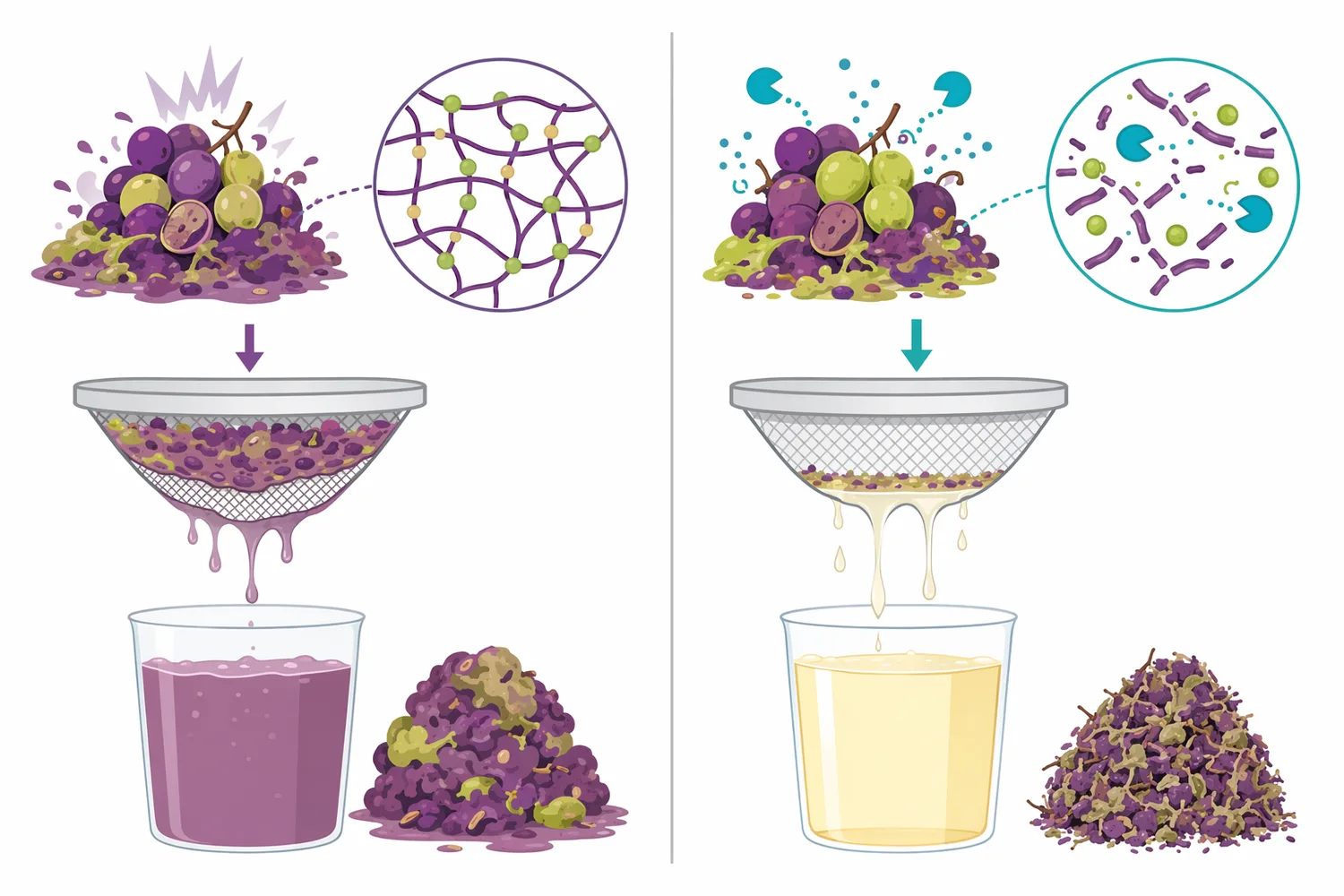
After pectinase treatment, the separation step determines the final brilliance. Coarse straining may remove large pulp but leave fine haze. Finer filtration can give a much clearer result if the pectin network has been sufficiently degraded. Settling and racking may work well for some juices but less well for highly colloidal fruit systems. The enzyme changes the juice’s clarifiability; the chosen separation method converts that improved clarifiability into a visible clear liquid [2].
Viscosity is one of the most practical bottlenecks in fruit clarification. Thick juice moves slowly, traps air, clogs filter surfaces, and carries fine solids through or into filtration media. Pectin contributes strongly to this viscosity because long hydrated chains occupy volume and restrict flow. When pectinase shortens those chains, the liquid can flow more easily, and suspended solids are less protected by the gel-like matrix [1].
This matters in both small-batch beverage preparation and larger juice processing. A pulpy fruit juice that is difficult to strain can become easier to handle after pectin breakdown. In fruit mash processing, degrading the pectin-rich middle lamella can also help release liquid trapped inside the tissue network. Pectinase studies and reviews repeatedly identify improved extraction, clarification, and process efficiency as reasons these enzymes are important in fruit and beverage applications [3].
Yield improvement is especially tied to tissue disassembly. In intact fruit, pectin helps bind cells together; in mash, it can hold juice within a soft, gelled pulp. Pectinase weakens that intercellular adhesive structure, allowing more liquid to separate from the solids under pressing, draining, or filtration. This is why pectinase is relevant not only for making a juice look clearer, but also for recovering more usable liquid from pectin-rich fruit material [4].
Most fruit juices are naturally acidic, and many pectinases used in fruit applications are suited to acidic or mildly acidic beverage environments. This fit is one reason pectinases have become established in juice processing: the enzyme can act in the same general pH environment where fruit flavor and microbial control are typically managed. Microbial pectinase literature describes broad industrial use, with food and fruit processing among the major application areas [1].
Temperature also affects the outcome because enzymes are proteins with folded active sites. Warmer conditions generally increase molecular movement and can speed substrate-enzyme contact up to the point where the enzyme remains structurally stable. Excessive heat can unfold the enzyme, changing the active site so it can no longer bind and cleave pectin effectively. For practical beverage work, pectinase treatment is therefore usually considered a controlled enzymatic step rather than a boiling step [2].
Fruit variety, ripeness, and preparation method also matter. Riper fruit can have pectin that is already partly degraded by natural ripening enzymes, while underripe fruit may contain firmer, more structured pectin. Blending can create very fine particles that are harder to remove than press juice solids. Peel contact can add pectic material, bitterness, oils, and other haze contributors. Pectinase addresses the pectin fraction, but the total clarification result reflects the complete fruit matrix [3].
Physical separation can clarify some juices without enzymes, but pectin-rich juices often resist because the haze is chemically stabilized. A filter can remove particles only if the particles can reach and be retained by the filter surface without instantly forming a slimy pectin layer. Pectinase changes the feed liquid before filtration, reducing the pectin load and helping the separation step work more efficiently [4].
| Approach | What changes in the juice | Strengths | Limitations |
|---|---|---|---|
| Settling or racking alone | Relies on gravity to separate solids | Simple and gentle | Slow or incomplete when pectin stabilizes fine cloud |
| Straining or filtration alone | Physically removes suspended particles | Direct route to clearer liquid | Can clog quickly in high-pectin, high-pulp juices |
| Heat treatment alone | Can soften tissue and affect microbes | Useful in some beverage processes | Does not selectively depolymerize pectin and may change fresh flavor |
| Pectinase plus separation | Breaks pectin structure, then removes destabilized solids | Targets a major cause of viscosity and haze; improves clarifiability | Final clarity still depends on fruit matrix and separation method |
This comparison explains why pectinase is often used as a preparation step rather than a stand-alone visual finishing tool. The enzyme reduces the molecular cause of stubborn cloud, while filtration or settling removes the physical particles. Reviews of pectinase applications emphasize this combined value in fruit juice clarification, extraction, and processing efficiency [1].
Commercial pectinases are commonly produced from microorganisms because microbial enzyme systems can be cultivated and processed for industrial application. Fungal and bacterial sources are both described in the literature, with organisms such as Aspergillus, Bacillus, yeasts, and other microbes appearing in studies on pectinase production and characterization. Reviews identify microbial pectinase as an important enzyme category for food, beverage, textile, feed, and waste-valorization applications [2].
Agro-industrial residues are frequently studied as substrates for pectinase production because fruit peels, pulps, and other plant wastes can contain pectin-rich materials that support microbial enzyme production. Research has examined orange peels, maize cobs, soursop and cherimoya pulp, and other agro-waste streams as part of pectinase biotechnology. This is relevant to the broader sustainability story of pectinases, although the buyer’s practical focus remains the enzyme’s performance in fruit clarification [8].
The production research also explains why pectinase is available as a practical enzyme ingredient rather than only as a laboratory concept. Studies on fungal strains, bacterial isolates, and process optimization show continued development of pectinase for industrial uses, including food processing and juice applications. Enzymes.bio supplies Pectinase Enzyme as an online product for professional users who want to purchase the 1 kg unit directly and use it within their own beverage or food-processing workflow [4].
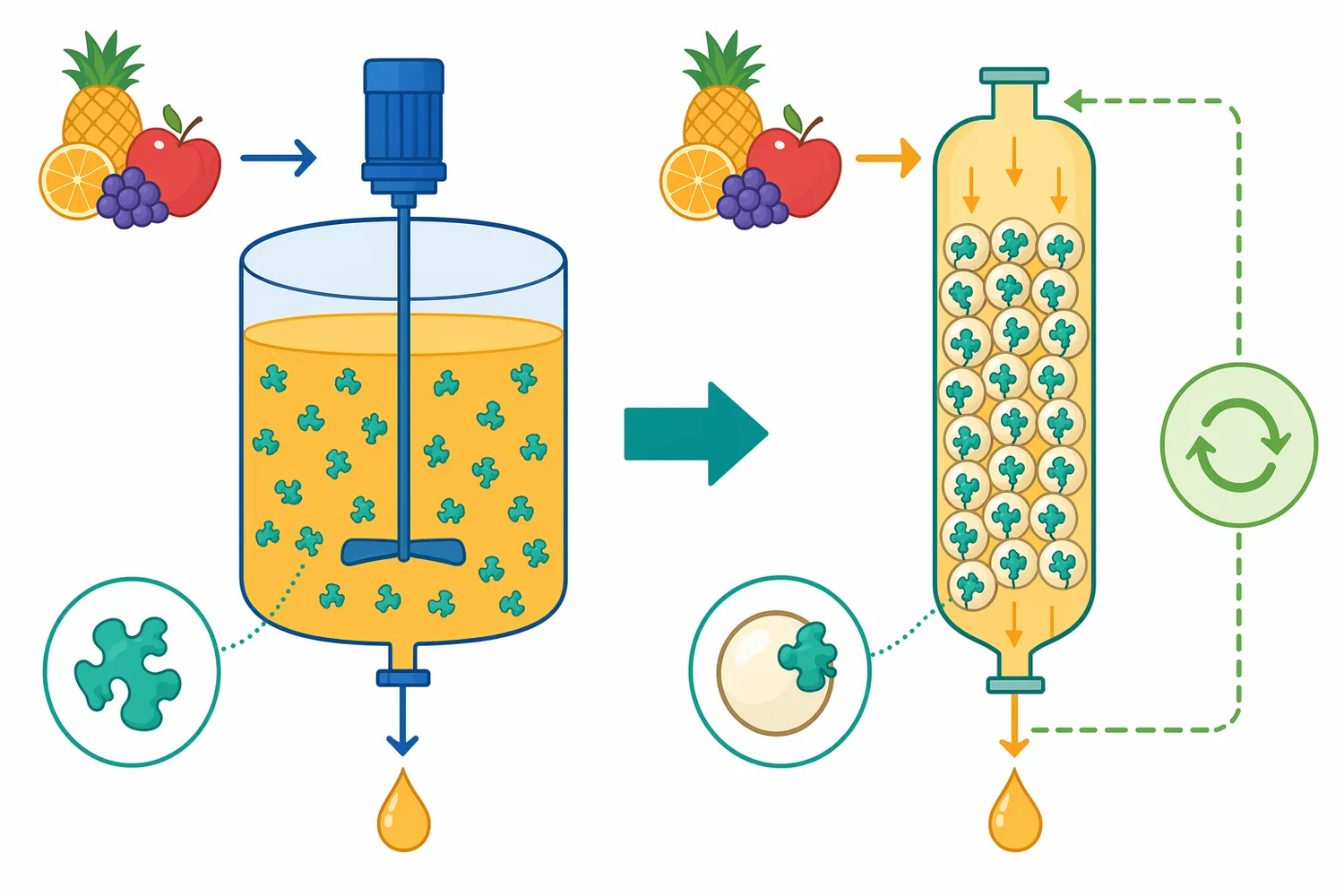
Most beverage creators think of enzyme clarification as a batch step: add enzyme to juice or mash, allow it to work, then separate the clarified liquid. Scientific literature also explores immobilized pectinase, where the enzyme is attached to a support so juice can pass through or contact the enzyme in a more reusable format. Immobilized systems are studied because they may improve handling, stability, and repeated-use process designs in controlled processing environments [5].
For cocktail and beverage ingredient preparation, the free-enzyme batch concept is usually easier to understand: the enzyme disperses through the fruit liquid and acts directly on pectin throughout the matrix. Immobilized systems are more process-engineering oriented and depend on reactor design, support material, liquid flow, and cleaning strategy. Their importance in the literature is that they confirm pectinase’s practical relevance to juice clarification beyond single bench-scale experiments [2].
The key takeaway for a buyer is not that every operation needs a complex immobilized reactor. It is that pectinase has been studied across both simple and engineered clarification formats because pectin breakdown is a robust mechanism in fruit processing. Whether the final beverage is a clarified cocktail component, a clear juice base, or an apple juice product, the value comes from reducing the pectin structure that makes juice cloudy, thick, and hard to separate [1].
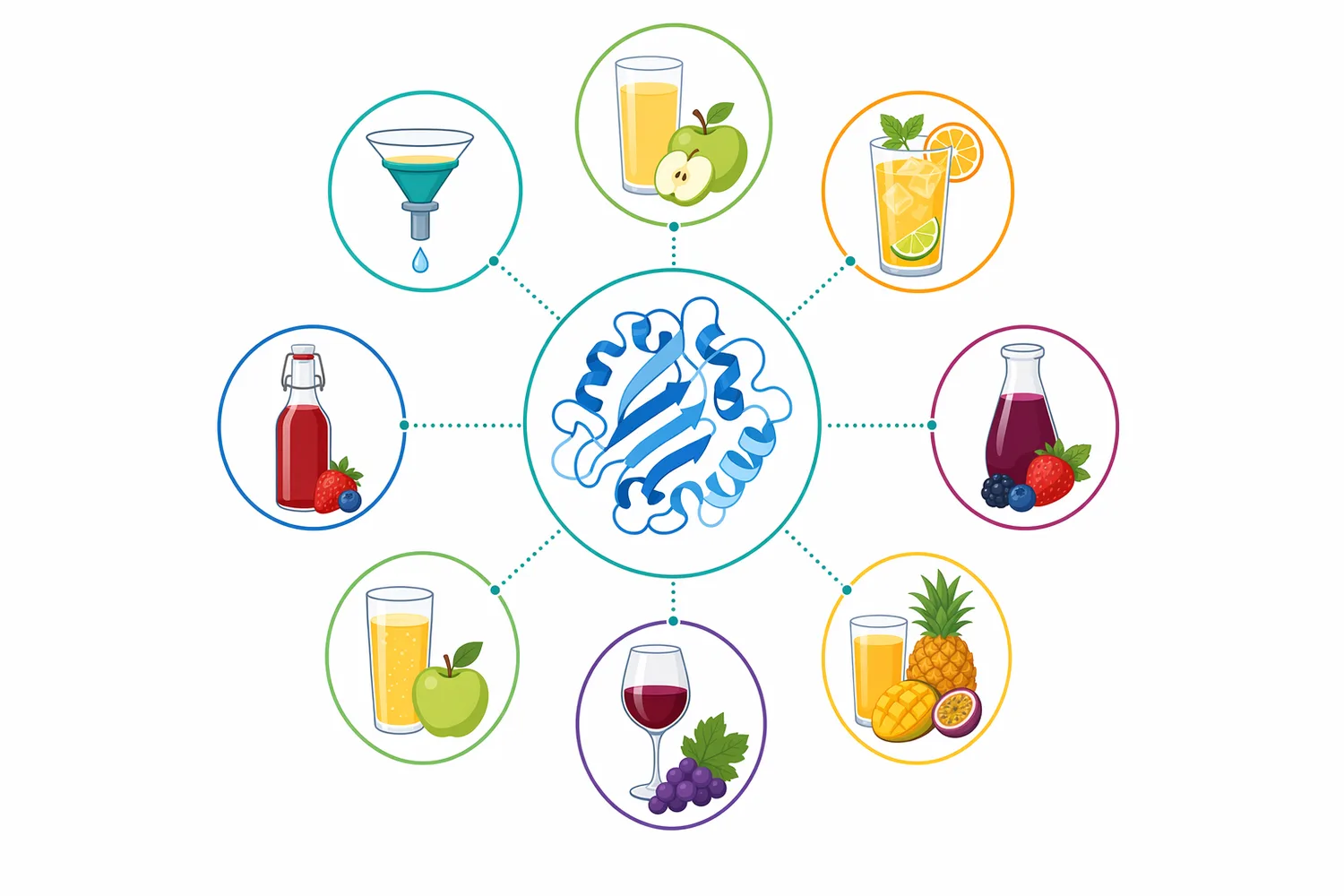
In cocktail development, pectinase enables clearer citrus blends, apple components, tropical juice bases, and fruit-forward non-alcoholic drinks. The result can be especially useful where a drink should look bright but still taste fresh and expressive. Clarified juice also behaves differently in the glass: it can reduce sediment rings, lower pulp separation, and create a cleaner visual line in carbonated or stirred formats. These benefits follow from pectinase’s established role in reducing pectin-driven haze and viscosity [3].
In ready-to-drink beverages, clear juice bases can support visual consistency from bottle to bottle. Cloud instability can be a quality issue because suspended material may settle unevenly over time. Pectinase treatment before final separation can help reduce the fraction of haze that depends on pectin, making the liquid easier to polish into a stable-looking beverage. The broader pectinase literature identifies clarification and improved juice processing as core food-industry applications [4].
In fruit processing, pectinase can support juice recovery from mash or pulp. This is relevant when fruit solids retain liquid and reduce usable yield. By weakening pectin-rich cell-wall and middle-lamella structures, the enzyme helps free juice from the fruit matrix. Agro-waste and pectinase-production research also underscores how closely pectinase biotechnology is linked to fruit tissues, peels, and pulps rich in pectic substances [9].
In fermented fruit beverages such as cider, wine, and fruit wines, pectinase can support clarification and juice release before or during processing, depending on the workflow. Pectin haze is a known concern in fruit-derived liquids, and pectinolytic treatment is one way to reduce the pectin contribution before final clarification. Reviews of microbial pectinases include beverage and fermentation-related uses among established industrial applications [1].
A good clarified fruit ingredient should not taste stripped or empty. Pectinase helps because its main target is structural carbohydrate, not the full flavor profile of the fruit. By reducing the pectin network, it can improve clarity while allowing acids, sugars, aroma compounds, and many color compounds to remain in solution. The final sensory character will still depend on the fruit, oxidation control, heat exposure, filtration intensity, and recipe design [7].
There can be texture changes because pectin contributes body. A juice treated with pectinase may feel lighter, less pulpy, and less syrup-like. For cocktails, this can be desirable: a clarified passion fruit or apple component can integrate more cleanly with spirits, carbonation, tea, botanicals, or non-alcoholic bases. For beverages that rely on nectar-like thickness, however, full pectin breakdown may not be the sensory goal [2].
Color outcomes vary by fruit. Pectinase does not inherently make juice colorless; it makes the liquid phase clearer by reducing haze and suspended solids. A clarified strawberry, grape, or apple juice may still carry color, but with more transparency and less opacity. If color-bearing particles are removed during filtration, the shade may also change. This distinction is important: pectinase improves optical clarity by changing colloidal structure, not by acting as a decolorizing agent [3].
Pectinase performs best when pectin is a meaningful cause of the problem. In apple, citrus, grape, berry, and many tropical fruits, this is often the case. In very low-pectin juices or beverages where haze is driven mainly by proteins, starches, oil droplets, or tannin interactions, pectinase may improve part of the system but not solve the entire clarity challenge. Fruit blends are especially variable because each ingredient contributes different suspended and dissolved materials [1].
The word “crystal-clear” also depends on the separation step. Enzyme treatment can make a juice dramatically easier to clarify, but the visible endpoint depends on how thoroughly destabilized solids are removed. A coarse sieve, a fine filter, gravity settling, and centrifugation can all produce different results from the same pectinase-treated juice. The enzyme reduces the molecular barrier; the physical process determines how far the liquid is polished [4].
Pectinase is also not a substitute for beverage hygiene, recipe stability, or appropriate handling. It is a processing aid for pectin-rich materials, not a preservative and not a universal stabilizer. If a clarified juice will be used in bottled cocktails, RTD beverages, or prepared drink programs, the broader process still needs to control spoilage risk, oxidation, ingredient compatibility, and final packaging requirements. Pectinase contributes specifically by making pectin-containing juice easier to extract, settle, and filter [2].
Enzymes.bio supplies Pectinase Enzyme directly online by the 1 kg unit for professional users preparing clarified fruit juice ingredients, clear beverage bases, cocktail components, and other pectin-containing food or beverage applications. The product can be purchased through the online store; after payment, the order is processed and shipped. A Certificate of Analysis and Safety Data Sheet accompany the order.
Enzymes.bio is a supplier, not a manufacturer or testing laboratory. The role of the product is straightforward: provide a pectinase enzyme ingredient that buyers can integrate into their own established beverage or food-processing workflow. For users working with pectin-rich juices, the scientific basis is strong: pectinase breaks down the pectin structures responsible for much of the viscosity, pulp suspension, haze stability, and filtration difficulty in fruit systems [1].
For cocktail creators and beverage developers, that makes pectinase a practical route to clearer fruit flavor. It can help transform thick, pulpy, cloudy juice into a liquid that is easier to strain, filter, and present in a bright glass or clear bottle. Results vary by fruit and process, but when pectin is the main obstacle, pectinase directly addresses the chemistry behind the cloud.
Sold by the 1 kg unit, in stock and ready to ship. Order directly on our store — pay online and we process your order. A Certificate of Analysis and Safety Data Sheet are included with every order.
Buy Pectinase Enzyme To Turn Any Fruit Juice Into A Crystal-Clear Cocktail →Numbered in order of first citation. Open-access sources, each verified reachable at publication; citation numbers in the text link here.