
High-temperature powder alpha-amylase is a bread improver enzyme used to partially hydrolyze flour starch into dextrins and smaller carbohydrates during dough processing and early baking. In bread systems, that controlled starch breakdown can support yeast fermentation, crust browning, loaf expansion, crumb softness, and slower starch-related firming during storage when the formula is balanced. Enzymes.bio supplies Powder Alpha-Amylase High Temperature Enzyme Alpha Amylase for Bread Improver online by the 1 kg unit, with payment completed online and the order processed for shipment; a Certificate of Analysis and Safety Data Sheet are provided with the order .
Powder alpha-amylase is an amylolytic enzyme ingredient for formulas where starch functionality affects bread volume, crumb texture, crust color, and freshness. In wheat bread, soft rolls, buns, Arabic-style flatbreads, rice-based breads, and gluten-free systems, the enzyme’s role is not to “add softness” directly, but to change the starch fraction in a controlled way so that dough fermentation, oven expansion, and post-bake firming behave more favourably [1].
The main substrate is starch from flour. Wheat flour is mostly starch, with a smaller but critical fraction of damaged starch produced during milling; this damaged fraction hydrates more readily than intact granules and is more accessible to amylase in dough. When water is added and dough mixing disperses the enzyme, alpha-amylase cleaves internal α-1,4 glycosidic bonds in amylose and amylopectin chains, producing shorter dextrins and malto-oligosaccharides rather than simply converting all starch to glucose in one step [2].
In bread improver use, “high-temperature” matters because baking is a moving temperature process, not a static fermentation. As dough warms in the oven, yeast gas production, gas expansion, starch gelatinization, gluten/protein setting, and enzyme inactivation overlap. A more heat-tolerant alpha-amylase can remain active further into the heating stage than a heat-labile amylase, which can increase its effect on starch breakdown during the period when oven spring and crumb setting are still developing; thermostability is a recognized target in alpha-amylase research because temperature tolerance changes how long the enzyme can function under process heat [3].
This does not make high-temperature alpha-amylase automatically “stronger” in every bread. The same heat tolerance that can help maintain enzymatic action during early baking can also produce excessive dextrin formation if the overall improver system or bake process is not balanced. Studies of bread improver systems repeatedly show that enzyme effects are formulation-dependent, with bread quality and shelf-life outcomes influenced by interactions among amylases, oxidizing systems, hydrocolloids, emulsifiers, flour quality, fermentation, and packaging [4].
Alpha-amylase acts on starch chains like a set of internal molecular scissors. Instead of trimming starch only from the ends, it cuts within the polymer chain, reducing the average chain length and creating a mixture of soluble fragments. These fragments change the dough system in several concrete ways: they increase the pool of fermentable and browning-relevant carbohydrates, lower the effective molecular size of part of the starch phase, alter paste viscosity during heating, and interfere with starch chain reassociation after baking [5].
During fermentation, yeast cannot directly consume intact starch granules. It relies on simple sugars already present in flour and sugars released during dough maturation. Alpha-amylase helps by converting accessible starch into shorter molecules that can be further acted on by endogenous or added enzymes, increasing the carbohydrate supply available to yeast over time. This is one reason alpha-amylase is used in bread improvers for formulas where fermentation support and volume consistency are important [6].
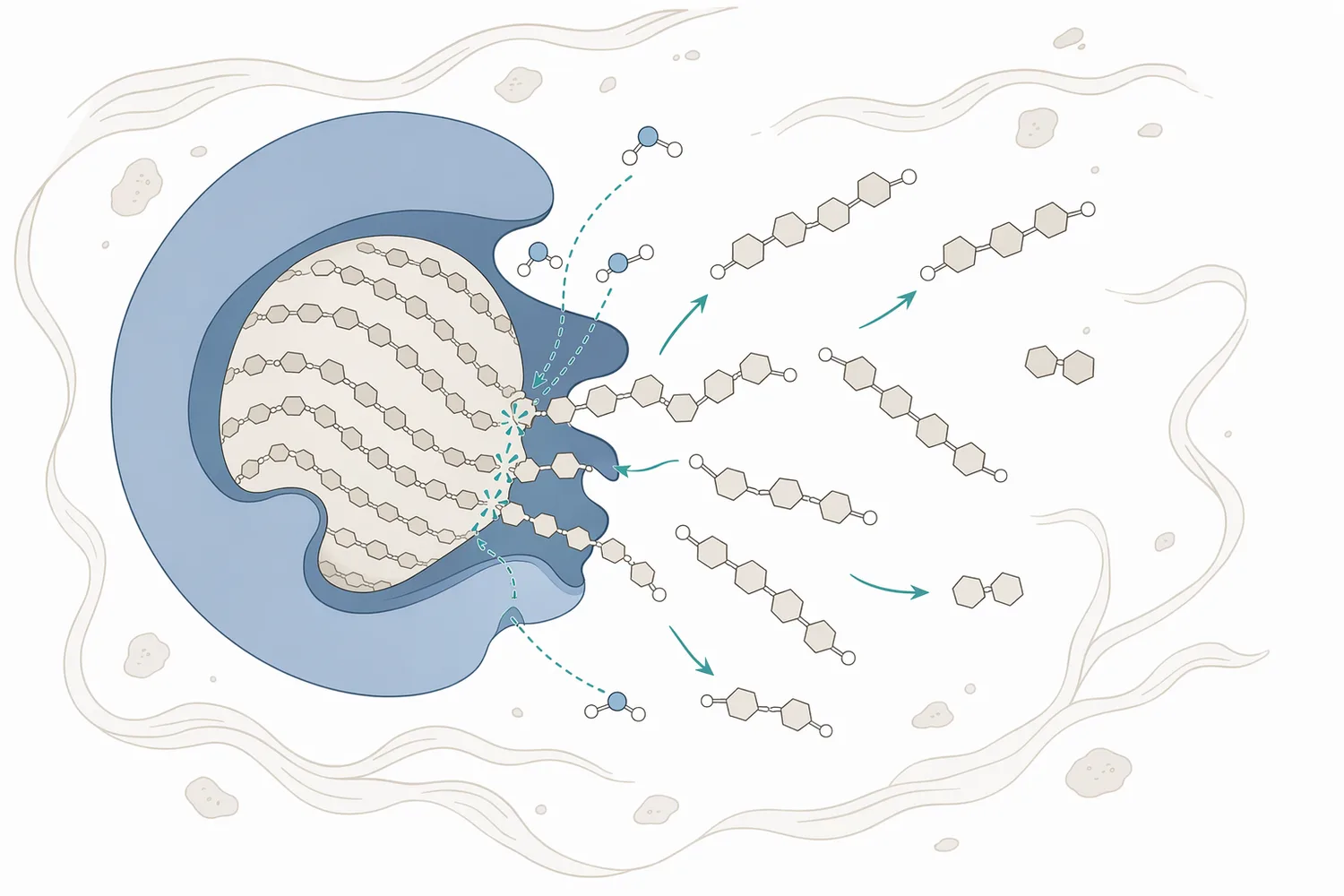
During baking, the mechanism shifts from fermentation support to thermal starch transformation. As dough temperature rises, starch granules swell and gelatinize, water is redistributed, gas cells expand, and the crumb structure begins to set. Dextrins generated by alpha-amylase can reduce the tendency of the starch phase to thicken too quickly, which may help the dough remain extensible during the early stage of oven spring before the crumb becomes fixed [7].
After baking, bread staling is strongly associated with starch retrogradation, especially the gradual reassociation and crystallization of amylopectin chains. Alpha-amylase-generated dextrins interfere with that reassociation because shorter chains and modified starch fragments do not rebuild the same firm network as native starch polymers. This is why amylase-containing improver systems are often studied for shelf-life and crumb-firming effects, including in pan breads and enzyme combinations that include maltogenic alpha-amylase [8].
Crust color is also linked to the same starch hydrolysis pathway. Smaller carbohydrates produced from starch contribute to the pool of reducing sugars that can participate in Maillard browning with amino compounds during baking. In formulas with limited added sugar or flours with low native amylase activity, controlled amylase supplementation can therefore support more even baked color and flavour development, provided the bake profile allows browning reactions to proceed [9].
Different amylase types can produce different baking effects because they differ in heat stability, reaction products, and the point in the process where they remain active. A high-temperature alpha-amylase is best understood as the option used when continued action under heating is valuable, while maltogenic amylase systems are often discussed for softness and shelf-life, and native cereal amylase varies with grain condition such as sprouting [10].
| Amylase category in bread systems | Main practical behaviour | Typical contribution to bread quality | Main caution |
|---|---|---|---|
| High-temperature alpha-amylase | Continues starch hydrolysis further into the heating phase before inactivation | Supports oven-stage starch modification, loaf expansion potential, crumb softness, and browning | Excessive activity can increase stickiness or create an overly soft/gummy crumb |
| Heat-labile fungal/cereal-type amylase | Acts mainly during mixing, fermentation, and early heating | Supports sugar release for yeast and crust color with earlier inactivation | May provide less oven-stage effect where extended heat action is desired |
| Maltogenic alpha-amylase | Produces maltose-rich fragments and is widely studied for anti-staling | Helps slow crumb firming and improve sensory shelf-life in pan bread systems | Must be balanced with texture goals and formula type |
| Native flour amylase | Naturally present but variable with wheat condition and sprouting | Can help fermentation when balanced | Too much native activity, such as in sprouted grain, can reduce flour quality and handling tolerance |
The table is intentionally conceptual rather than a product specification. The key point for bread improver use is that “amylase” is not a single uniform functionality: enzyme origin, heat tolerance, and reaction pattern determine whether the main observed effect is fermentation support, oven spring, crust color, anti-staling, or—if excessive—dough weakening and gumminess [1].
Flour is biologically and mechanically variable. Wheat variety, growing conditions, sprouting, storage, and milling all influence starch damage, endogenous enzyme activity, and water absorption. Research on sprouted wheat shows how sprouting conditions change alpha-amylase activity and flour functional properties, with consequences for bread shelf-life and quality, illustrating why bakeries often need more predictable amylolytic performance than flour alone can provide [10].
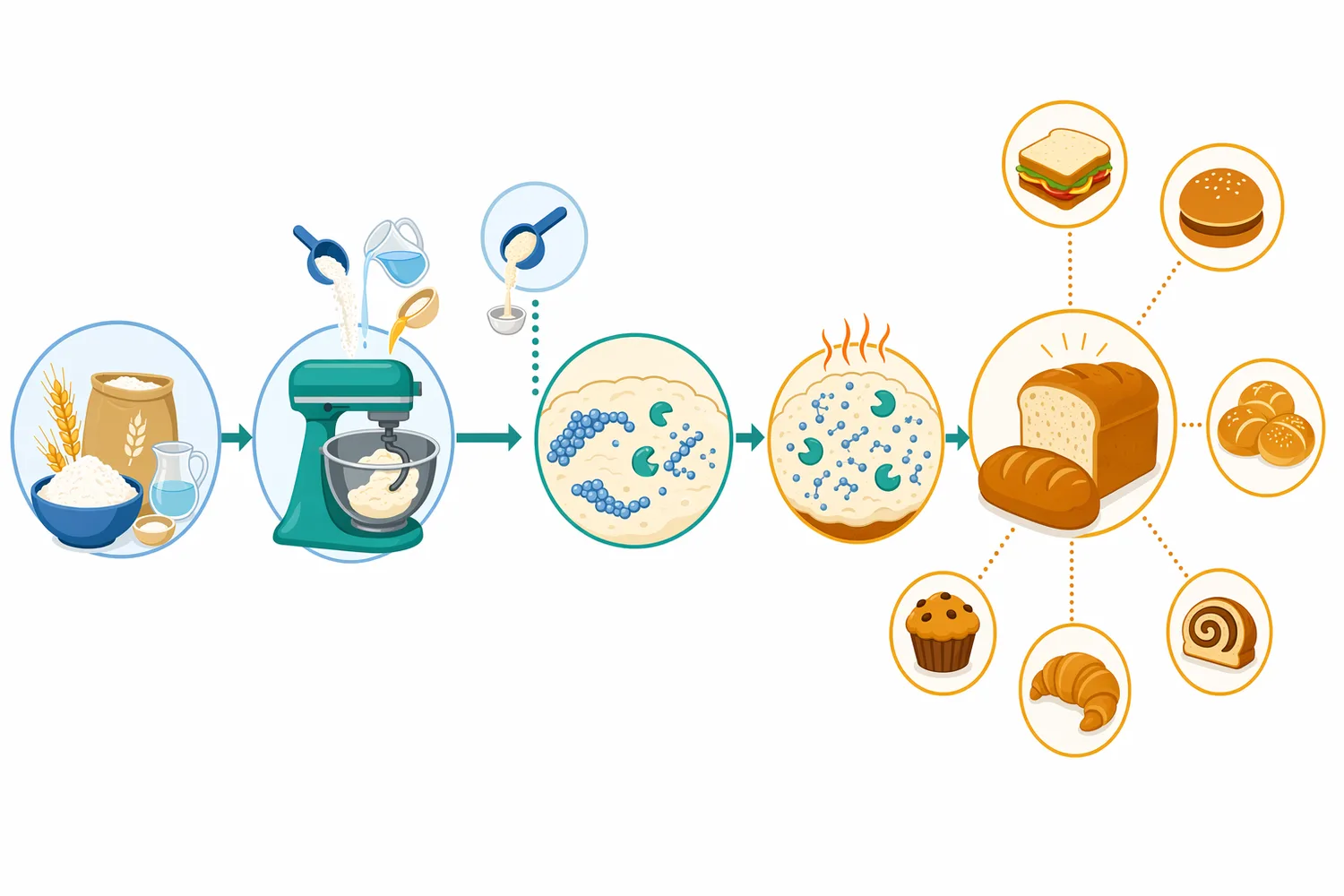
In practice, low or inconsistent amylase activity can show up as slower fermentation, pale crust, reduced loaf volume, or a crumb that firms quickly. Supplemented alpha-amylase helps standardize one part of that system by increasing controlled conversion of accessible starch. It does not correct weak gluten, poor mixing, incorrect proofing, or inadequate baking, but it directly addresses the starch-to-dextrin pathway that influences gas production, browning, and texture [6].
Bread volume depends on both gas production and gas retention. Yeast must generate carbon dioxide, the gluten or hydrocolloid matrix must retain it, and the crumb must set at the right point during baking. Alpha-amylase supports this chain by increasing starch-derived carbohydrate availability during fermentation and by modifying starch viscosity during heating, which can help the expanding dough avoid setting too early [9].
Studies on enzyme combinations in bread show that amylase is often most effective as part of a system rather than in isolation. For example, work on dough rheology, bread quality, and shelf-life found that enzyme combinations can improve dough and bread properties, because different enzymes affect different structural fractions: amylases target starch, while xylanases, oxidases, lipases, and other enzymes can influence arabinoxylans, gluten strengthening, emulsification, or dough handling [1].
Fresh crumb softness is influenced by water distribution, starch gelatinization, protein network formation, and the size and uniformity of gas cells. As bread cools and ages, starch molecules reassociate, moisture migrates, and the crumb becomes firmer. Alpha-amylase helps by creating shorter starch fragments that disrupt the formation of a firm, continuous retrograded starch network [8].
Maltogenic alpha-amylase has been directly studied in pan bread shelf-life and sensory evaluation alongside other enzymes such as transglutaminase and bacterial xylanase. That work is relevant because it shows the broader bakery principle: targeted enzyme systems can measurably affect how bread feels and is perceived during storage, not only how it performs on the day of baking [8].
Pale crust can result when available reducing sugars are limited or when bake conditions do not support browning. Alpha-amylase contributes by releasing smaller starch-derived carbohydrates that can feed browning chemistry during baking. This is especially relevant in lean doughs, short-fermentation systems, and flour lots with lower natural amylase activity [9].
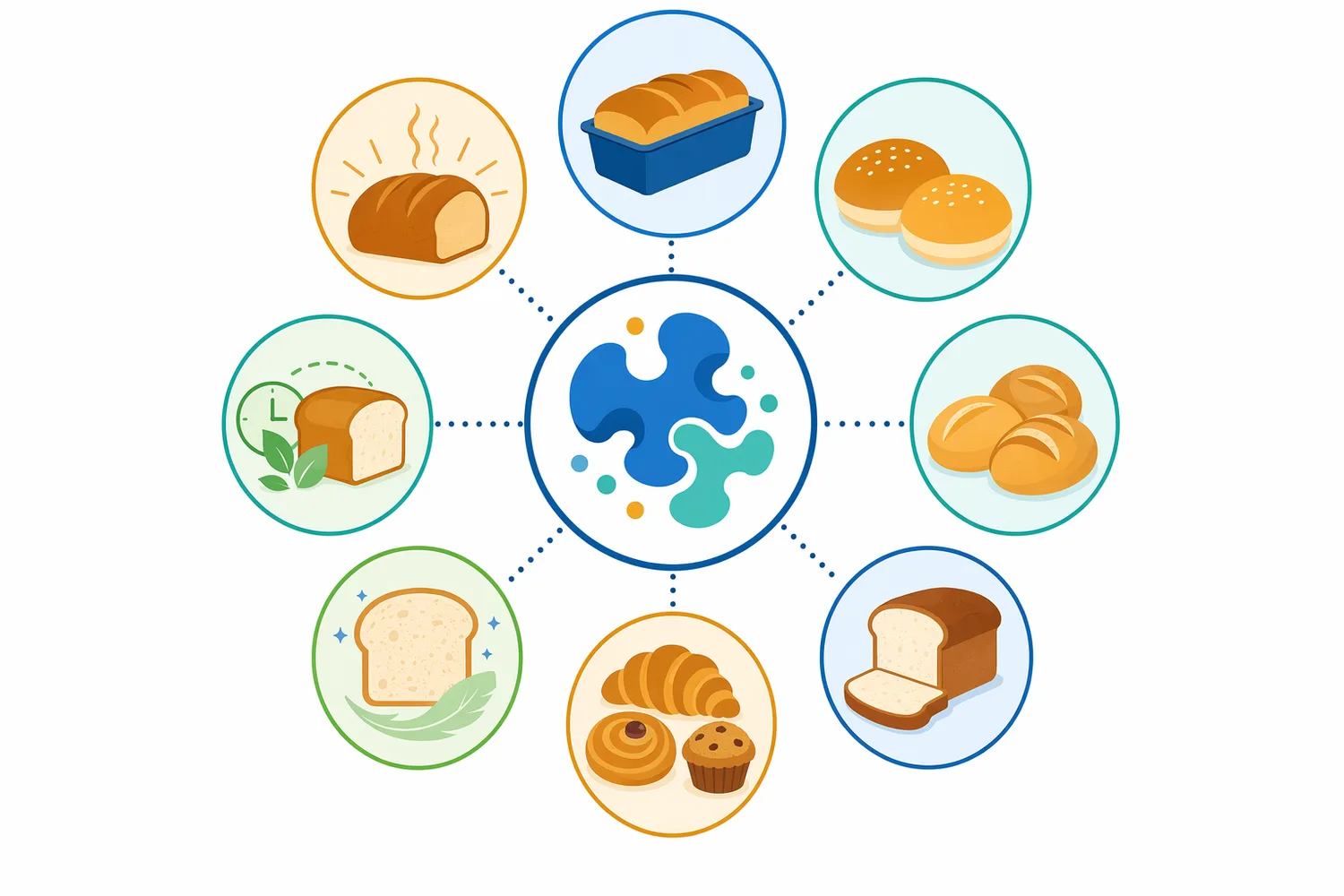
The browning effect should be understood as a linked outcome, not a cosmetic additive effect. Alpha-amylase does not “color” the bread; it changes the carbohydrate profile so that the existing thermal reactions of baking have more suitable reactants. If oven temperature, bake time, surface moisture, or formula balance are unsuitable, the same enzyme cannot fully compensate [4].
Bread enzyme research supports the practical use of alpha-amylase because multiple studies connect amylase-containing systems with changes in dough properties, loaf quality, and shelf-life. Caballero and co-workers studied enzyme combinations for dough rheology, bread quality, and bread shelf-life, showing that enzyme blends can improve performance where the formulation targets several dough components at once [1].
A study on glucose oxidase in the presence of ascorbic acid and alpha-amylase reported synergistic effects on dough properties, baking quality, and shelf-life of bread. This is important mechanistically because glucose oxidase and ascorbic acid influence dough oxidation and network strength, while alpha-amylase modifies starch availability; the combined effect reflects how bread improvers often work through multiple, complementary pathways [9].
Recent work on a newly reported Bacillus amylase evaluated production, characterization, and application together with fungal lipase in bread making. The relevance for bread improver use is that microbial alpha-amylase can be characterized as a food-process biocatalyst and then applied in a bread system, where its starch-hydrolyzing action interacts with lipid-modifying enzymes to influence final bread quality [6].
Research on wheat bread treated with purified thermostable cellulase and alpha-amylase is especially relevant to the “high-temperature” concept. Thermostable enzymes are studied because they can remain functional under heating conditions that would inactivate less stable proteins, and in bread this can shift enzyme action toward the stage where starch gelatinization and crumb setting occur [7].
Alpha-amylase has also been studied outside conventional wheat systems. Work on rice flour doughs and bread examined how alpha-amylase affected rheological and microstructural properties of different rice flour doughs, which is useful for gluten-free and non-wheat product development because starch structure becomes even more central when gluten is absent or reduced [11].
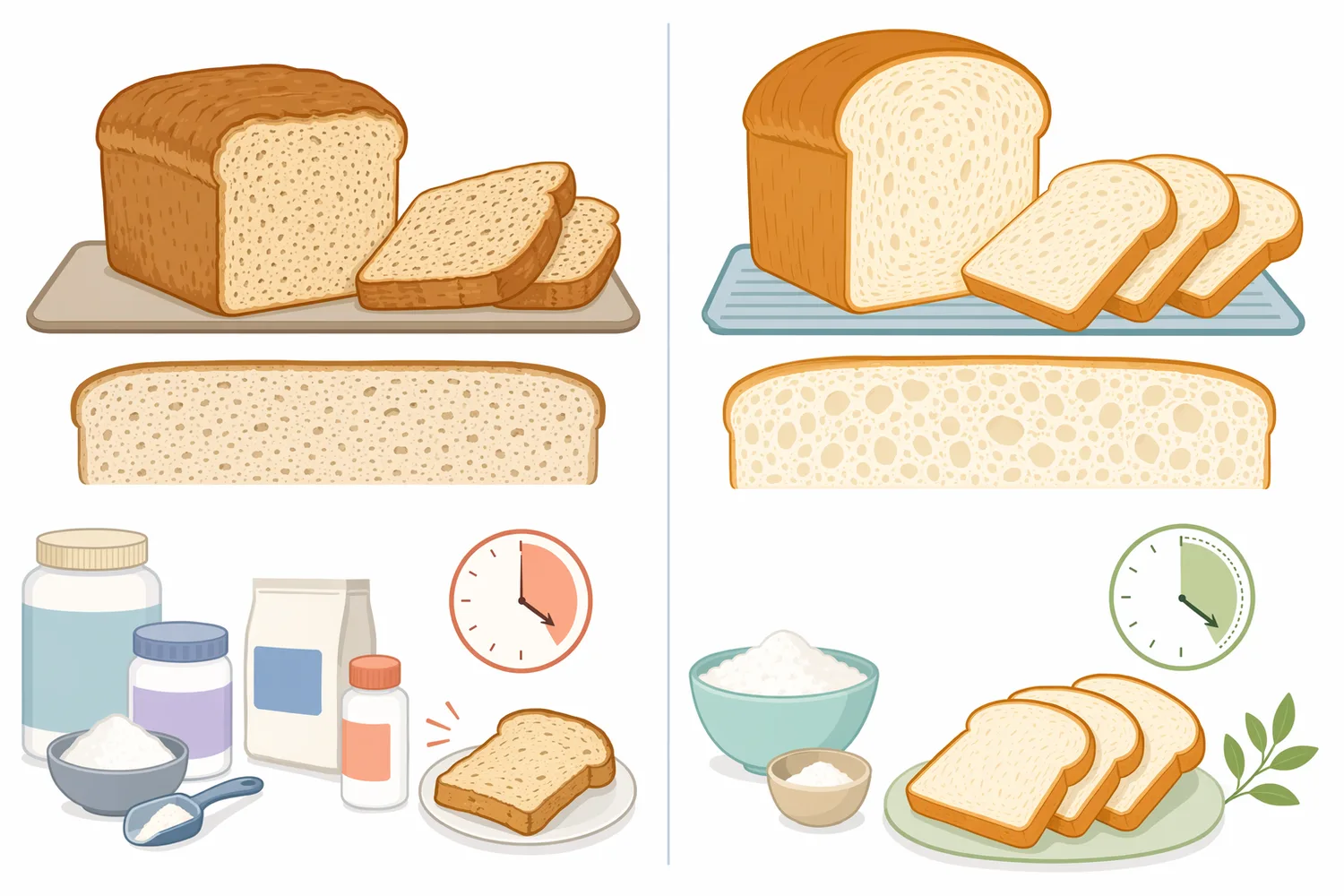
Arabic bread research also supports the broader role of bread improvers in maintaining quality and shelf-life stability. Flatbreads have a high surface-area-to-volume ratio and often stale quickly, so starch modification, moisture management, and packaging all become important; bread improvers can help, but the effect depends on the complete formulation and storage system [4].
A high-temperature alpha-amylase can remain active longer as dough heats, and this changes where in the process the enzyme has its strongest impact. In mixing and fermentation, all active amylases can act on hydrated, damaged starch. In the oven, however, heat-labile enzymes progressively lose function while heat-tolerant enzymes may continue hydrolyzing starch as granules swell and become more accessible [3].
This later action can be useful because starch accessibility increases during heating. Before gelatinization, much of the starch is still packed in granules, with damaged starch and granule surfaces being most available. As heat and water disrupt granule structure, more chains become accessible, so an enzyme that survives longer can generate dextrins during a particularly influential window for crumb viscosity and setting [2].
The practical benefit is often described as improved oven spring and softer crumb, but the underlying change is more specific: the enzyme lowers the effective molecular size of part of the starch phase and reduces the rate at which that phase thickens and later retrogrades. In a well-balanced bread, that can mean a loaf that expands more fully before set, slices more tenderly, and firms more slowly during storage [7].
The caution is equally concrete. If too much starch is hydrolyzed, the dough can become sticky, gas-cell walls can lose integrity, and the baked crumb can become gummy or collapse-prone. This is why high-temperature alpha-amylase is most useful when treated as a precision functional ingredient within a bread improver, rather than as a generic additive to increase softness at any cost [1].
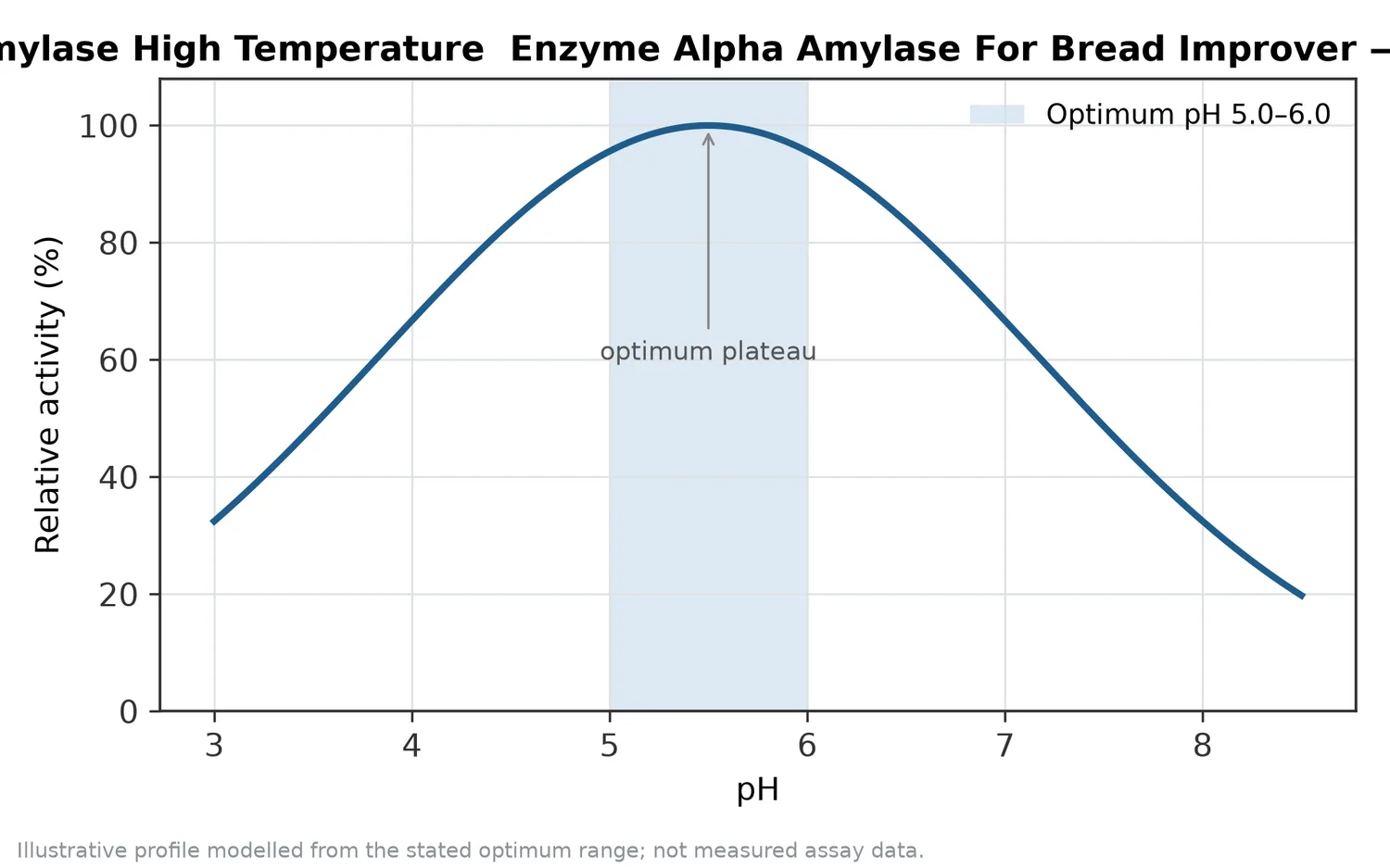
Pan bread is one of the clearest applications for alpha-amylase because consumers expect high loaf volume, fine crumb, softness, and freshness over several days. Amylase helps by supporting fermentation sugars, improving browning, and slowing starch-driven firming after baking. In pan bread studies, enzyme systems including maltogenic alpha-amylase have been evaluated specifically for shelf-life and sensory quality, showing the importance of amylolytic enzymes in soft bread formats [8].
High-temperature alpha-amylase may be especially useful where oven-stage starch modification is desired. In a pan loaf, the center crumb heats more slowly than the crust, giving the enzyme a period in which moisture and temperature can support continued starch hydrolysis before full inactivation. The effect is most beneficial when the crumb structure remains strong enough to hold expanding gas while the starch phase is being modified [7].
Buns and rolls often combine soft crumb, rich formulas, and short production schedules. Alpha-amylase can help maintain fermentation support and crumb tenderness, while other improver components may address gluten strength, emulsification, and dough tolerance. The enzyme’s contribution remains starch-specific: it increases smaller carbohydrate fragments and modifies the gelatinizing starch fraction during baking [9].
In sweet or enriched doughs, the system is more complex because sugar, fat, and emulsifiers already influence water availability, gelatinization, yeast activity, and crumb softness. Alpha-amylase can still provide value, but its observed effect depends on how much starch is accessible and how the enriched formula delays or modifies heat transfer and crumb setting [4].
Flatbreads stale rapidly because moisture loss and starch firming occur quickly in thin products. Research on Arabic bread improvers shows that quality and shelf-life stability can be improved by suitable improver systems, with enzyme action forming one part of a wider approach that also includes formula design and storage conditions [4].
For flatbreads, the desired effect is often flexibility rather than high loaf volume. Alpha-amylase can contribute by reducing starch-related firming, helping the bread remain pliable for longer. Because the product is thin and heats quickly, the time available for high-temperature enzyme action may differ from pan bread, so the functional outcome is shaped by product geometry as much as by enzyme type [4].
In gluten-free breads, starch functionality is even more visible because there is no wheat gluten network to dominate gas retention and crumb structure. Alpha-amylase studies in rice flour doughs and breads show that enzymatic starch modification can alter rheology and microstructure, both of which are central to volume, crumb uniformity, and eating quality in gluten-free systems [11].
The mechanism is still starch hydrolysis, but the processing significance changes. In wheat bread, alpha-amylase works alongside gluten development; in rice or gluten-free bread, it works in a matrix often supported by starch gelatinization, hydrocolloids, proteins, and emulsifiers. Controlled dextrin formation can help texture, but excessive hydrolysis can weaken the gel-like crumb structure these products depend on [11].
Powder alpha-amylase is commonly used as one functional component in bread improver premixes. In that role, it targets starch while other ingredients may influence protein network strength, dough extensibility, gas retention, emulsification, or water binding. Enzyme-combination research supports this approach because bread quality is multi-factorial and single-enzyme effects can be amplified, moderated, or redirected by companion ingredients [1].
This is also why high-temperature alpha-amylase should be understood by function rather than by a single promised outcome. Its contribution is controlled starch hydrolysis under bakery processing conditions. The final bread result depends on how that hydrolysis interacts with flour, water, yeast, mixing, fermentation, proofing, baking, cooling, slicing, and packaging [12].
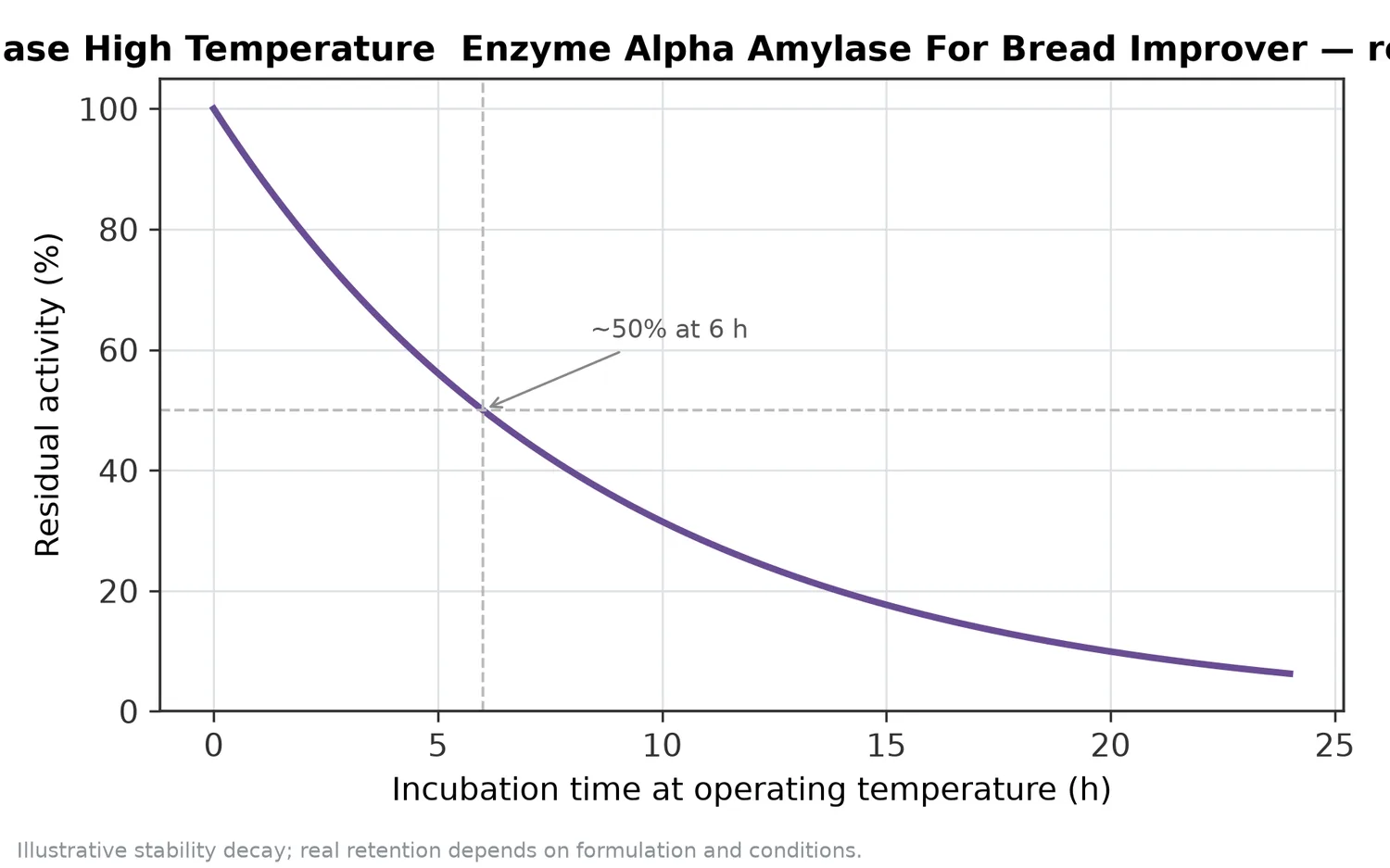
Alpha-amylase begins working only after it has access to water and substrate. In a dry premix, it is dispersed but largely inactive; in dough, hydration allows enzyme movement and contact with damaged starch and soluble starch fragments. Mixing improves distribution, while fermentation time gives the enzyme an opportunity to release carbohydrate fragments before baking [2].
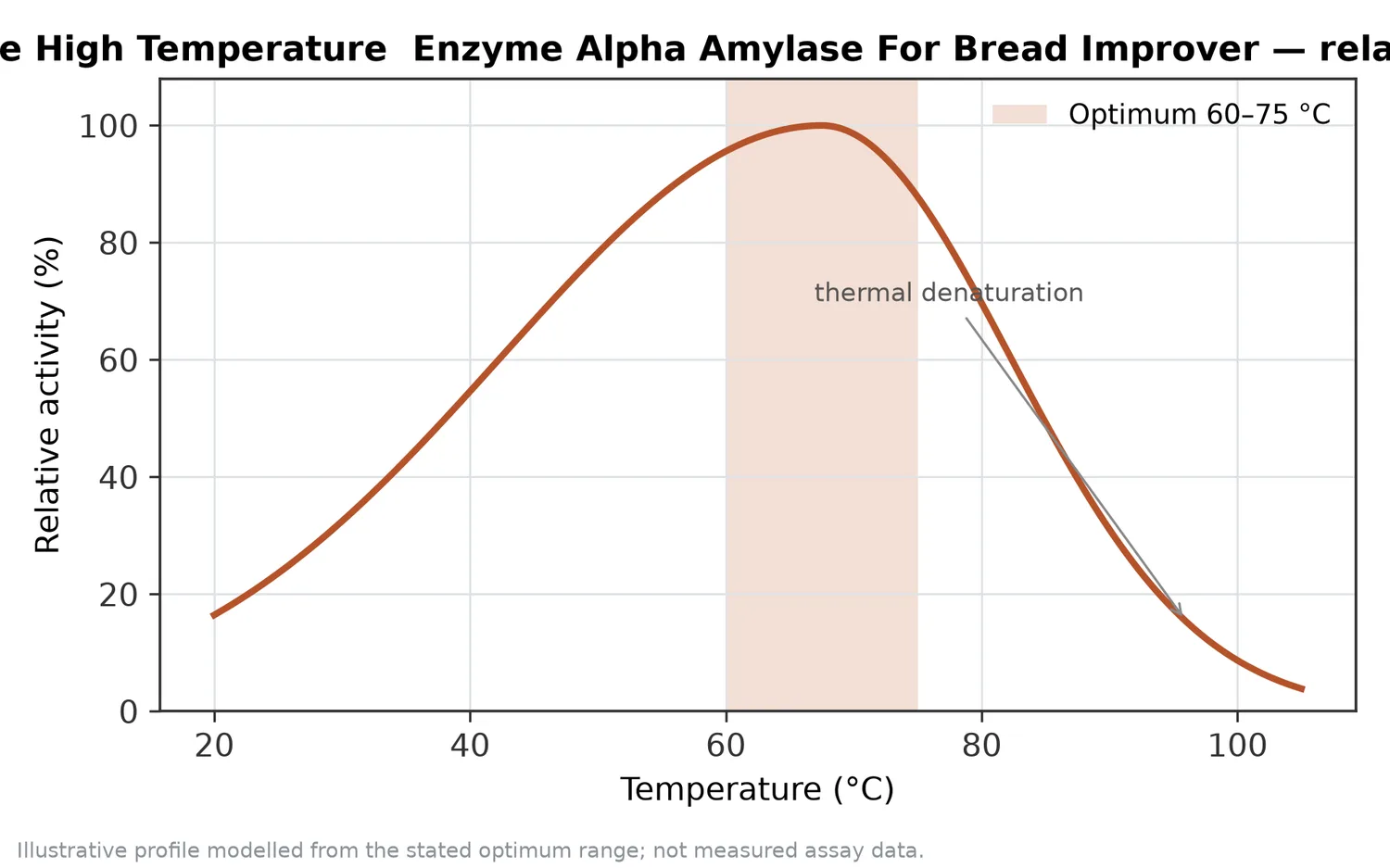
As the dough enters the oven, heat accelerates biochemical and physical changes. Enzyme activity generally rises with temperature until thermal denaturation begins, while starch granules simultaneously swell and become more reactive. A high-temperature alpha-amylase is designed for greater persistence in this transition zone, making it relevant where continued action during early baking is useful [3].
Once the crumb is baked and cooled, the enzyme’s practical legacy is the altered starch population it leaves behind. Shorter dextrins, modified amylopectin fragments, and changed carbohydrate availability affect crumb firmness, moisture perception, and staling behaviour. This post-bake effect explains why amylases are often evaluated not only by loaf volume on bake day but also by sensory shelf-life and firmness changes during storage [8].
Packaging and storage still matter. Bread shelf-life is not controlled by enzyme action alone; moisture migration, microbial spoilage, crust softening, and packaging atmosphere also influence quality. Research on packaging types and bread shelf-life reinforces that product freshness is a combined outcome of formulation and storage environment, so alpha-amylase should be seen as one important tool within a broader quality system [12].
The benefits of alpha-amylase are strongest when the target defect is starch-related: insufficient fermentation sugars, pale crust, limited oven spring associated with early starch setting, firm crumb, or rapid starch-driven staling. It is less relevant to defects caused primarily by weak protein quality, under-mixing, over-proofing, yeast imbalance, poor moulding, or inadequate bake conditions [1].
The main risk is over-hydrolysis. Too much conversion of starch into soluble dextrins can increase dough stickiness and weaken the structure that holds gas. In the baked product, this may appear as a tacky crumb, excessive softness without resilience, slicing problems, or a gummy mouthfeel. High-temperature alpha-amylase deserves particular respect because its extended heat tolerance can continue modifying starch when the dough is already transitioning into crumb [7].
Flour context also matters. Sprouted wheat, for example, may already carry elevated native alpha-amylase activity, which can change flour functionality and bread performance. In that situation, additional amylase may not have the same effect as it would in low-amylase flour; this is why alpha-amylase should be understood as a balancing ingredient rather than a universal flour corrector [10].
Scientific literature also shows that enzyme effects are not isolated. In systems combining alpha-amylase with glucose oxidase, ascorbic acid, lipase, xylanase, transglutaminase, cellulase, or sourdough fermentation, the final bread properties emerge from interactions among starch hydrolysis, protein network changes, acidification, water binding, and gas-cell stability. That interaction is exactly why bread improvers can be powerful, but also why a single ingredient should not be expected to solve every processing issue [9].
Enzymes.bio supplies Powder Alpha-Amylase High Temperature Enzyme Alpha Amylase for Bread Improver as a 1 kg online-purchase product. The buyer places the order and pays online; the order is then processed and shipped, with a Certificate of Analysis and Safety Data Sheet included with the order .
This product is positioned for buyers who need a practical powdered alpha-amylase ingredient for bread improver applications and want to understand its scientific role before purchase. The key value is controlled starch hydrolysis: changing flour starch into dextrins and smaller carbohydrates that influence fermentation support, browning chemistry, oven-stage starch behaviour, crumb softness, and starch-related firming during storage [6].
High-temperature powder alpha-amylase for bread improver use works by hydrolyzing accessible starch into shorter carbohydrate fragments. Those fragments feed downstream bakery effects: more available carbohydrates for yeast and browning, modified viscosity during oven heating, improved potential for loaf expansion, and reduced starch reassociation during storage. The “high-temperature” feature is valuable because it can extend enzyme action into the baking phase, where starch gelatinization and crumb setting are actively taking place [3].
The evidence base supports alpha-amylase as a functional bread improver component, especially when used as part of balanced enzyme systems. Studies on bread rheology, baking quality, shelf-life, thermostable enzyme use, pan bread sensory shelf-life, rice flour bread, sprouted wheat, and Arabic bread improvers all point to the same practical conclusion: amylase performance depends on the flour, formula, process, and storage environment, but controlled starch hydrolysis is a proven route to improving important bread quality attributes [1].
For bread and soft bakery applications, Powder Alpha-Amylase High Temperature Enzyme should therefore be viewed as a targeted starch-modifying ingredient. Used appropriately within a bread improver system, it can help support volume, crust color, crumb softness, and freshness retention; used without balance, it can push the dough or crumb toward stickiness and gumminess. That balance is the central technical principle behind successful alpha-amylase use in bread.
Sold by the 1 kg unit, in stock and ready to ship. Order directly on our store — pay online and we process your order. A Certificate of Analysis and Safety Data Sheet are included with every order.
Buy Powder Alpha-Amylase High Temperature Enzyme Alpha Amylase For Bread Improver →Numbered in order of first citation. Open-access sources, each verified reachable at publication; citation numbers in the text link here.