
Squid Skin Peeling Enzyme is a protease-based processing aid used to loosen the protein-rich skin layer of squid so it can be removed with less scraping, tearing, and repeated handling. It works by hydrolyzing peptide bonds in the connective proteins and surface matrix that help hold the pigmented skin to the mantle, making subsequent rinsing, tumbling, brushing, or light mechanical peeling more effective. Enzymes.bio supplies this product directly online in 1 kg units; the buyer pays online, the order is processed and shipped, and a Certificate of Analysis and Safety Data Sheet are included with the order .
Squid skin removal is a small step in the overall cleaning line, but it has an outsized effect on appearance, yield, labor, and downstream product uniformity. The outer skin is thin, elastic, pigmented, and closely associated with the mantle surface; when it is pulled or abraded too aggressively, edible tissue can be lost or the mantle can become roughened. Enzyme-assisted peeling is designed to make this step gentler by weakening the biological adhesion before mechanical force is applied, rather than relying on force alone.
The underlying technology is based on protease action. Proteases are enzymes that catalyze the breakdown of proteins by cleaving peptide bonds, and industrial reviews describe alkaline and other microbial proteases as widely used biocatalysts in food, detergent, leather, waste-treatment, and protein-modification applications [1]. In squid processing, the desired result is not full hydrolysis of the edible mantle; it is controlled surface modification at the skin interface so that the outer layer detaches more readily during normal cleaning.
Seafood-processing research also supports the broader use of enzymes for upgrading, modifying, and recovering value from marine raw materials. Reviews on enzymes from seafood processing waste and seafood enzymes in food processing describe proteases, lipases, chitinases, and other enzymes as practical tools for processing marine proteins and by-products [2]. That context matters because squid skin is not an inert film—it is a biological tissue with protein, connective material, pigments, and water-binding components that can be changed by enzyme treatment.
For the buyer, the practical point is simple: a squid skin peeling enzyme is not a substitute for good chilling, cleaning, line hygiene, and controlled handling. It is a processing aid that can make the peeling step easier and more consistent when integrated into an aqueous treatment step followed by rinsing or light mechanical removal.
Squid skin adheres because the surface layers are held together by proteins and connective structures. At the microscopic level, the skin and adjacent tissue are not separated by a clean “zipper”; instead, there is a hydrated protein matrix, including collagenous and muscle-associated material, that helps maintain attachment. Protease treatment reduces the integrity of that matrix by cutting long protein chains into shorter fragments.
A useful way to understand the action is to think of the skin–mantle interface as a network. Before treatment, proteins span and reinforce the surface layer, helping the pigmented skin resist peeling. During enzymatic treatment, proteases attack accessible peptide bonds in the exposed or hydrated proteins. As these bonds are cleaved, parts of the network lose strength, water penetrates more easily, and the skin layer becomes less resistant to removal.
This is the same broad biochemical principle behind many enzymatic protein-modification processes in seafood. Proteins and co-products from seafood discards are commonly studied for recovery and functional modification because marine tissues contain recoverable proteins that can be solubilized, hydrolyzed, or transformed into peptide-rich ingredients [3]. In peeling, however, the target is intentionally limited: the processor wants enough hydrolysis to loosen the surface, not enough to soften or digest the mantle.
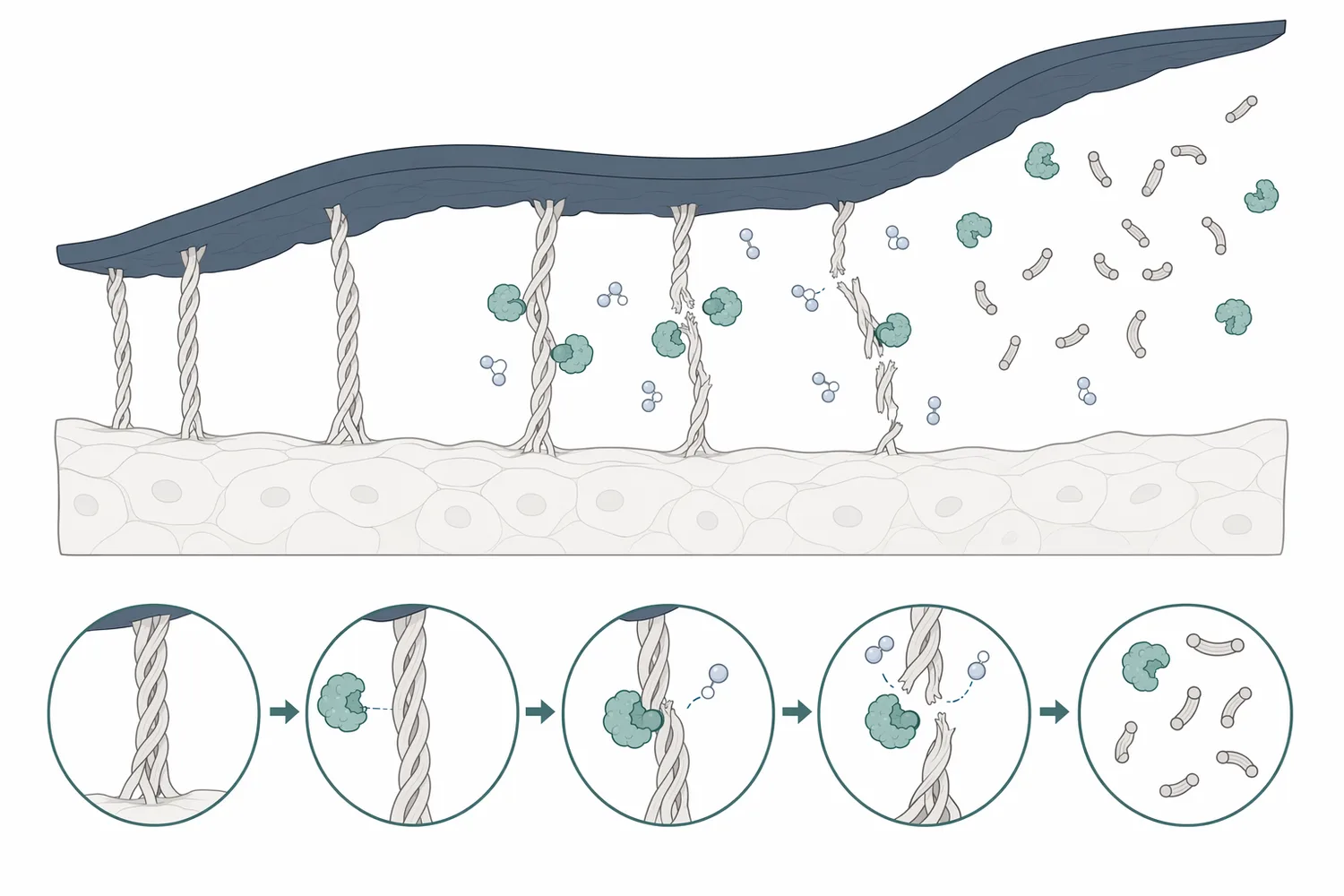
The enzyme’s effect is therefore both chemical and physical. Chemically, peptide bonds are hydrolyzed. Physically, adhesion drops, the surface layer becomes easier to lift or wash away, and the same brushing or tumbling action can remove more skin with less force. The visible outcome is a cleaner mantle surface, fewer stubborn pigmented patches, and less need for repeated manual intervention.
Seafood by-products are rich in proteins, structural biopolymers, pigments, lipids, minerals, and other recoverable compounds. Reviews of seafood by-product valorisation highlight that fish and shellfish processing streams are increasingly treated as sources of proteins, peptides, collagen, gelatin, chitin, and bioactive ingredients rather than as simple waste [4]. Squid skin belongs in that broader category of protein-containing marine by-products.
Squid processing also generates other enzyme-responsive materials. Recent work on squid pen waste, for example, describes combined fermentation and enzymatic post-treatment to produce β-chitin and bioactive peptides, showing that squid processing residues can be modified by biological and enzymatic routes [5]. While squid pen is not the same tissue as squid skin, the study supports the general processing reality that squid-derived materials can be transformed under controlled biocatalytic conditions.
The suitability of squid skin for enzyme-assisted loosening comes from its composition and structure. The skin is hydrated, thin, and proteinaceous; it contains structural material that responds to proteolysis. When the skin is exposed to a diluted enzyme solution under controlled conditions, the most accessible surface and interfacial proteins are attacked first. This is why enzyme-assisted peeling can be effective without needing harsh mechanical abrasion as the primary tool.
Importantly, enzyme treatment is not intended to remove everything instantly. The process works best conceptually when it weakens attachment enough that the next physical step—rinsing, agitation, brushing, or tumbling—finishes the separation. That combined approach is common in food processing: enzymatic action changes the substrate, and mechanical action completes the unit operation.
Not all proteases behave identically. Proteases differ in catalytic mechanism, preferred processing environment, substrate accessibility, and stability. Industrial literature often discusses alkaline proteases from Bacillus species because they are robust and widely used in large-scale applications, while other proteases are used where milder or different processing environments are desired [1].
The table below is conceptual. It does not define a product specification or a purchasing checklist; it simply explains why protease chemistry matters in an enzyme-assisted peeling process.
| Protease category | Conceptual processing environment | Typical action on protein substrates | Relevance to squid skin peeling |
|---|---|---|---|
| Acid protease | Performs best under acidic conditions | Cleaves accessible proteins where acidic treatment is compatible with the substrate | Can be useful in processes where acidic conditions are already part of the workflow, but seafood texture and flavor must remain protected |
| Neutral protease | Performs best around mild, near-neutral conditions | Moderates protein breakdown under relatively gentle aqueous conditions | Often conceptually attractive where the goal is surface loosening without aggressive tissue softening |
| Alkaline protease | Performs best under alkaline conditions | Often shows strong protein-hydrolyzing capacity and broad industrial utility | Can loosen protein-rich matrices effectively, but process control is important to avoid over-softening |
The key point is that squid skin peeling is not about using the strongest possible proteolysis. It is about controlled exposure. A highly active protease environment left too long can continue hydrolyzing accessible mantle proteins after the skin has loosened, which may soften the surface. A well-managed enzyme step aims for the narrow window where the skin detaches more easily while the edible tissue retains its expected bite and appearance.
Serine proteases are one important class within the wider protease family. Mechanistic reviews describe serine proteases as enzymes that use a catalytic serine residue to attack peptide bonds, forming and resolving a transient acyl-enzyme intermediate during protein hydrolysis [6]. In practical food-processing language, that means the enzyme repeatedly binds accessible protein regions, cuts peptide bonds, releases shorter fragments, and then acts again on another accessible site.
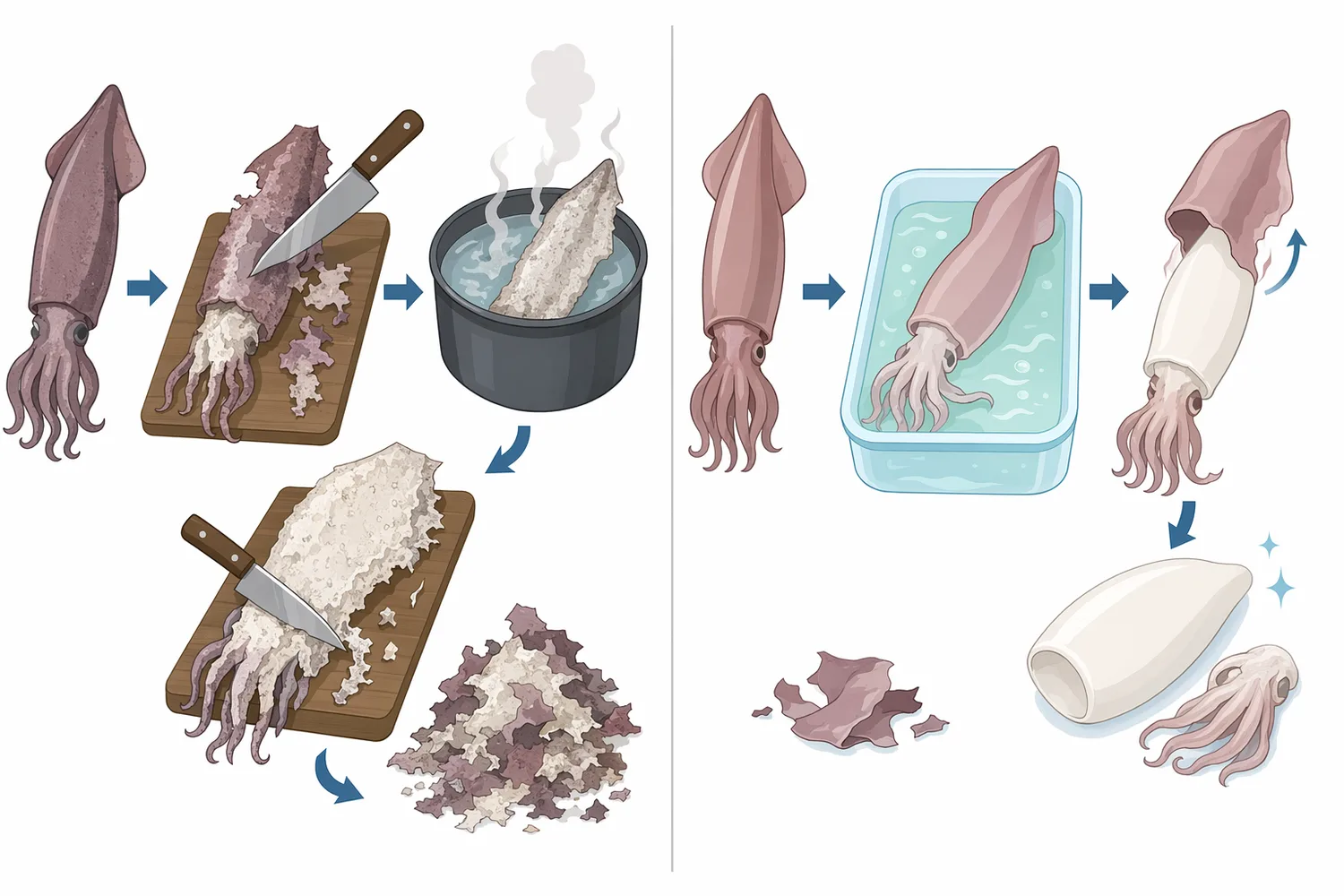
In a squid-cleaning workflow, the enzyme is usually best understood as an aqueous pre-treatment or in-process treatment before final skin removal. The squid surface must be wetted and brought into contact with the enzyme solution so that the enzyme can reach the skin and the proteinaceous interface. This may occur in a soak, dip, gentle agitation tank, circulating water step, or another controlled contact stage depending on the equipment already used in the facility.
After contact, the loosened skin is removed physically. The physical step may be rinsing, tumbling, brushing, or manual finishing, but the force required should be lower because the protein matrix has already been weakened. This sequence—biochemical loosening followed by mechanical separation—is the practical heart of enzyme-assisted peeling.
Water movement matters because enzymes act only where they can contact the substrate. Folds, trapped air, overlapping mantles, and heavy loading can reduce uniform exposure. Gentle agitation helps renew the solution at the surface and moves soluble protein fragments away from the interface, improving contact between enzyme and remaining substrate. The process should avoid excessive physical abuse, because the purpose of enzymatic treatment is to reduce mechanical damage rather than add another harsh step.
Temperature, time, and pH influence enzyme behavior, but they also influence seafood quality. Warmer conditions generally make many enzymes react faster, yet squid is a delicate raw material and excessive thermal exposure can affect texture, appearance, and food-safety controls. Likewise, longer contact can improve loosening, but unnecessary exposure can create surface softness. In practice, the enzyme stage is managed as part of the plant’s normal controlled processing system rather than as an open-ended soak.
For squid tubes, clean peeling supports a uniform white mantle surface and reduces visible pigment residues. This is especially important when tubes are sold whole, stuffed, or sliced into rings after cleaning. A smoother mantle surface also improves downstream handling because there are fewer partially attached skin fragments that can interfere with cutting, packing, or appearance after thawing.
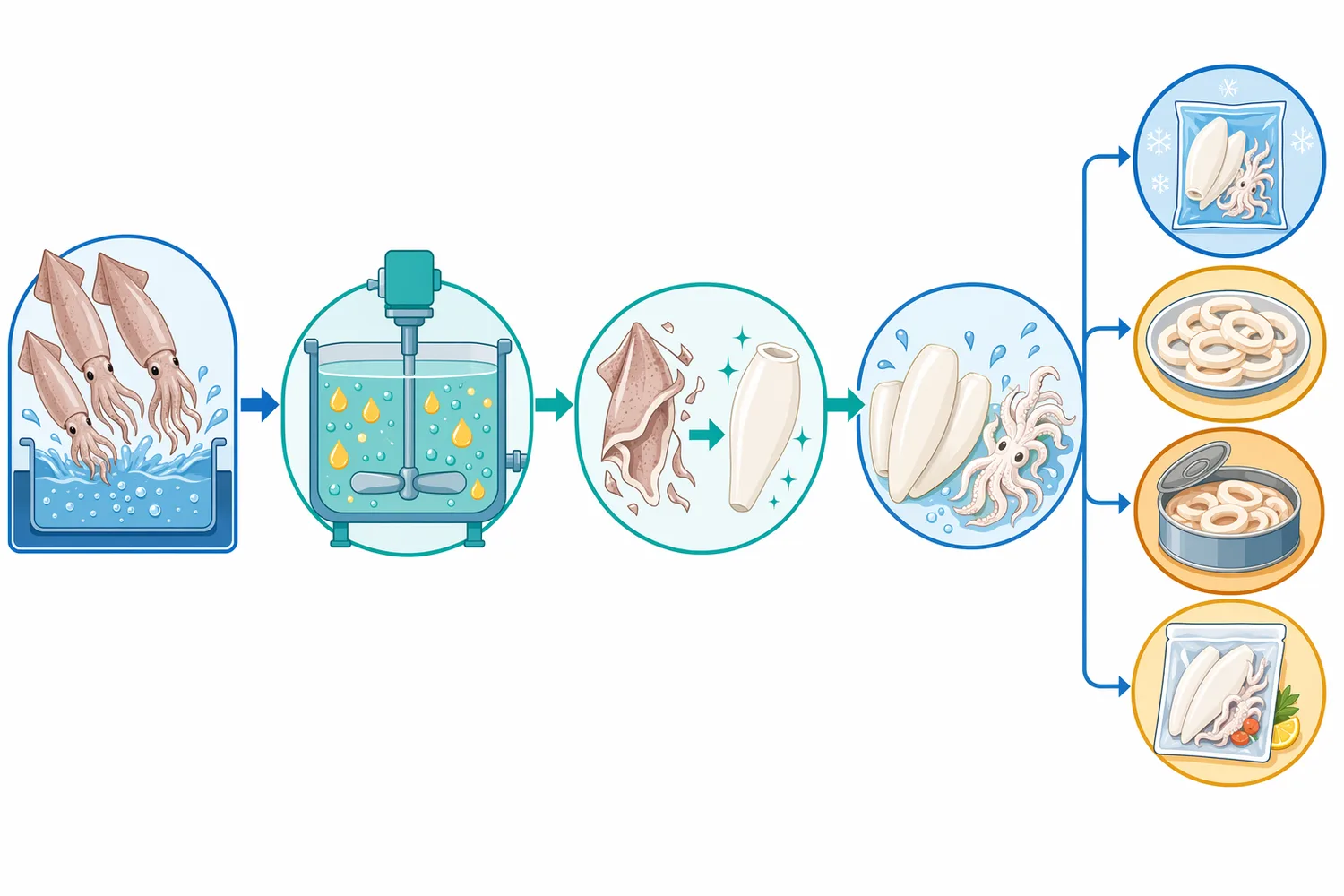
For rings and strips, skin removal affects consistency. Pigmented patches may be more visible on cut surfaces and can make finished packs look uneven. Enzyme-assisted loosening helps the skin release before cutting or before final trimming, depending on the line configuration. The result can be more standardized appearance across a batch, particularly when raw squid varies in size or condition.
For frozen squid, peeling quality before freezing matters because defects become locked into the product. Skin residues that look minor during wet processing may become more noticeable after freezing, glazing, thawing, and cooking. Conversely, over-handling before freezing can damage the surface and increase drip or textural variability. A controlled enzyme step can help reduce the amount of mechanical action needed before the product enters the freezing stage.
The same logic applies to foodservice squid. Kitchens value consistent preparation because labor at the point of use is expensive and unpredictable. Cleaned squid that requires less trimming or re-cleaning is easier to portion and cook. Enzyme-assisted peeling supports that outcome by addressing the skin-removal challenge earlier in the processing chain.
The most immediate benefit of enzyme-assisted peeling is reduced dependence on scraping, pulling, and abrasive action. When the skin is tightly attached, workers or machines may remove it by applying more force. That force does not distinguish perfectly between unwanted skin and valuable mantle tissue. If the attachment is weakened first, the same removal step can be gentler.
Yield protection is one of the practical reasons processors consider enzymatic surface treatment. If less edible mantle is torn away with the skin, more usable product remains. The improvement is process-dependent, because yield is influenced by raw material freshness, squid size, previous freezing, equipment design, operator handling, and the final product format. Still, the mechanism is clear: lower adhesion means less force is needed, and lower force can reduce unwanted tissue loss.
Seafood-processing reviews emphasize that enzymes are valuable partly because they can perform targeted transformations under relatively mild conditions compared with harsher physical or chemical methods [7]. In squid peeling, “mild” does not mean uncontrolled; it means the treatment is designed to act on specific protein structures while preserving the edible product.
There is also a consistency benefit. Manual peeling quality can vary from worker to worker and from batch to batch. Enzymatic loosening can make the starting condition more uniform before the manual or mechanical removal step begins. That uniformity may reduce the number of stubborn pieces requiring rework and can improve line flow.
A major advantage of enzyme technology is specificity. Proteases act on proteins; they do not function like a general corrosive chemical. That distinction matters in seafood, where processors want to modify the unwanted skin attachment without damaging flavor, color, or texture more than necessary.
Adjacent industries demonstrate the same principle. In leather and hide processing, protease treatment has been studied as a way to reduce reliance on harsher chemicals while improving processing outcomes, and recent work on sustainable leather tanning reports enhanced properties and pollution reduction through crude protease enzyme treatment [8]. Squid is a food material rather than a hide, so the process goals and hygiene requirements are different, but the enzyme logic is comparable: controlled protein modification can reduce the need for more aggressive treatments.
Research on enzymatic dehairing of animal skin also illustrates how enzymes can loosen biological surface structures by acting on proteinaceous attachment zones [9]. Again, squid skin peeling is not animal dehairing, but both processes depend on weakening a surface structure that is biologically attached to underlying tissue.
Abrasive or force-heavy peeling can be effective, but it may create product damage and inconsistent appearance. Enzyme-assisted peeling shifts part of the work from mechanical force to biochemical loosening. That can be especially valuable when the final product is sold on visual quality, such as cleaned tubes, rings, and retail-ready frozen packs.
Even when the main goal is clean peeling, squid skin remains a protein-rich processing stream. Better separation can make skin residues easier to collect and manage, and the broader seafood industry is increasingly interested in by-products as sources of proteins, peptides, collagen-derived materials, and other ingredients [4].
Comprehensive reviews on seafood processing by-products describe fermentation and enzyme-based approaches for recovering nutrients and improving utilization, reflecting a wider shift from disposal toward valorisation [10]. For squid processors, that does not mean a peeling line automatically becomes a peptide-production line. It means that clean, predictable separation of by-products can support better waste handling and may fit into future by-product strategies.
Protease production and application have also been studied using seafood processing by-products themselves. For example, research on Paenibacillus proteases produced from seafood by-products reports their application in biopeptide preparation [11]. This reinforces the circular-economy role of enzymes in seafood: marine by-products can be substrates for enzyme production, enzyme treatment, or ingredient recovery, depending on the process.
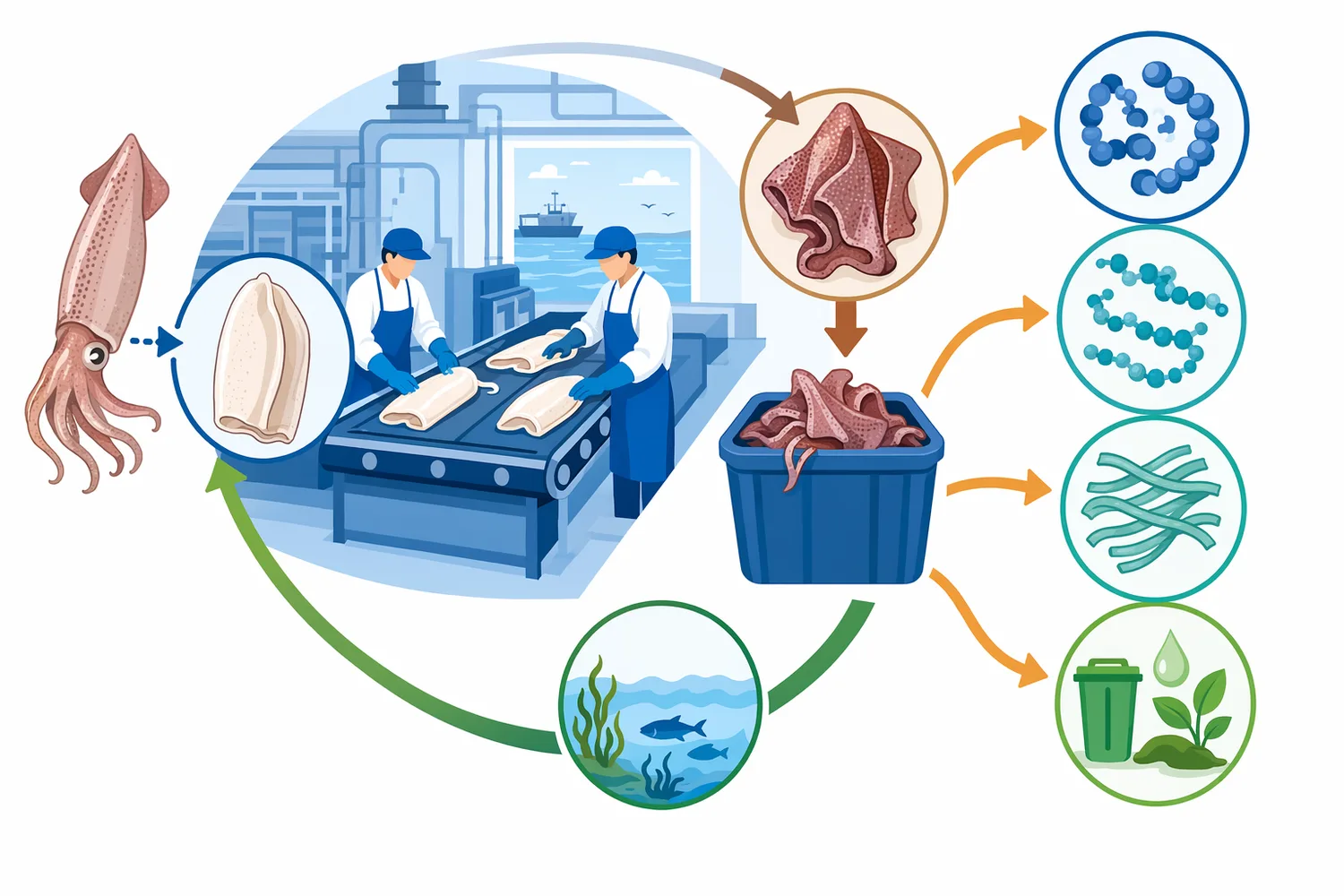
In practical squid peeling, the immediate value remains operational: easier removal, cleaner surfaces, and potentially less rework. The by-product angle is secondary but important for processors who are thinking about water use, waste streams, and future recovery opportunities.
The strongest evidence for squid skin peeling enzyme use is mechanistic and application-adjacent. Proteases are well-established protein-hydrolyzing enzymes; seafood-processing literature supports enzyme use in marine raw materials; and squid-derived by-products are demonstrably responsive to biological and enzymatic transformation [2]. Together, those points provide a sound scientific basis for using protease-based treatment to loosen squid skin.
The public literature is much stronger on seafood enzyme applications, protein hydrolysis, collagen and peptide recovery, and by-product valorisation than on standardized commercial squid peeling performance metrics. That distinction is important. Enzyme-assisted peeling is scientifically grounded, but its exact effect in a production environment depends on the raw squid and the line conditions.
Raw material variability is often the main reason results differ. Species, size, season, freshness, time after catch, freezing history, thawing quality, and physical damage all influence how tightly the skin adheres and how the mantle responds. A batch of fresh, properly chilled squid may behave differently from squid that has been frozen and thawed, or from squid with surface dehydration or bruising.
Process variability also matters. Contact uniformity, water movement, temperature control, residence time, and the mechanical removal step all affect the visible result. If the enzyme cannot reach the skin interface, it cannot loosen it efficiently. If contact continues after the skin has already loosened, unnecessary surface softening may occur. Good results come from treating the enzyme step as a controlled part of the line rather than as an uncontrolled additive.
Enzymes used in processing should be handled with the same care applied to other concentrated processing aids. Powders and aerosols should not be inhaled, and workers should avoid unnecessary eye or skin exposure. The Safety Data Sheet supplied with the order provides handling and safety information for the delivered product, while the Certificate of Analysis supports lot traceability for the purchased material .
Because squid is a food product, enzyme-assisted peeling should be incorporated into the processor’s existing food-safety, cleaning, and regulatory systems. The enzyme treatment does not replace hygienic raw-material handling, temperature control, potable water management, allergen controls where applicable, or finished-product checks. It is one tool within a broader seafood-processing workflow.

It is also important to avoid over-processing. The same proteolytic chemistry that loosens skin can continue acting on accessible proteins if exposure is excessive. Controlled use protects the main quality attributes processors care about: firm texture, clean appearance, low tissue loss, and predictable downstream handling.
Enzymes.bio supplies Squid Skin Peeling Enzyme as a direct online purchase in 1 kg units. After online payment, the order is processed and shipped, with the Certificate of Analysis and Safety Data Sheet included with the order .
The core value of Squid Skin Peeling Enzyme is operational. It helps convert a difficult, variable, force-dependent step into a more controlled loosening-and-removal step. That can reduce repeated handling, support cleaner surface appearance, and make mechanical or manual peeling more effective.
The mechanism is concrete: the enzyme hydrolyzes proteins in the skin and attachment matrix, reducing the strength of the surface network. Once that network is weakened, water movement and light mechanical action can remove skin that would otherwise require stronger scraping or pulling. The benefit comes from combining enzymatic specificity with ordinary physical separation.
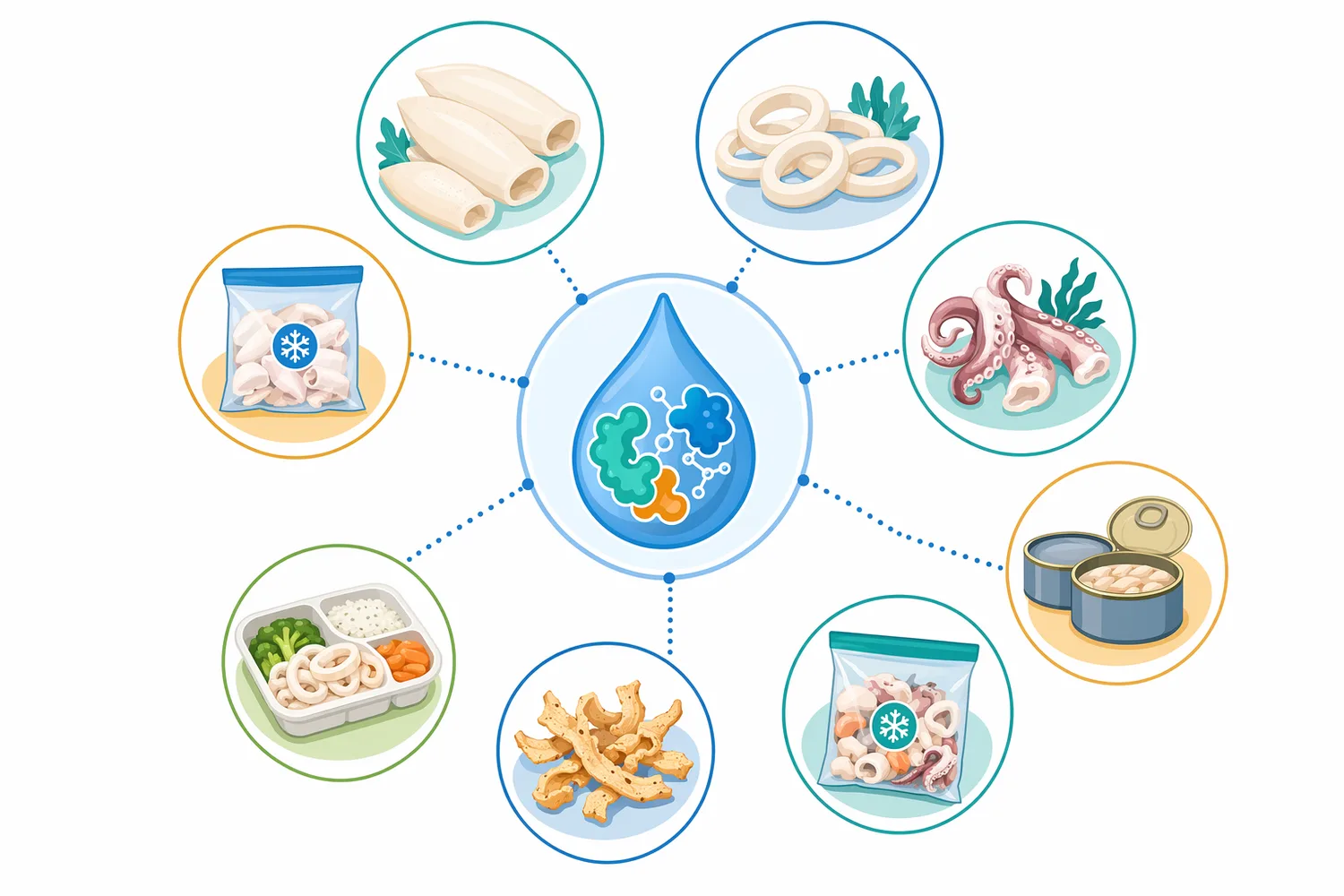
This makes the product especially relevant for cleaned squid tubes, rings, strips, frozen squid, and ready-to-cook formats where surface appearance and texture are commercially important. It can also support more predictable by-product separation, which aligns with the wider seafood-processing trend toward better utilization of protein-rich marine residues.
Squid Skin Peeling Enzyme should be viewed as a scientifically supported processing aid, not a universal guarantee of identical results across every squid species and line. When used within a controlled workflow, it offers a practical way to make squid skin removal easier, gentler, and more consistent.
Sold by the 1 kg unit, in stock and ready to ship. Order directly on our store — pay online and we process your order. A Certificate of Analysis and Safety Data Sheet are included with every order.
Buy Squid Skin Peeling Enzyme For Efficient Squid Processing →Numbered in order of first citation. Open-access sources, each verified reachable at publication; citation numbers in the text link here.