
Powder rennet for cheese is a dry milk-clotting enzyme preparation used to convert prepared milk into a curd by destabilizing casein micelles. In cheesemaking, rennet action enables the key transition from liquid milk to a gel that can be cut, drained, salted, pressed, stretched, or ripened depending on the cheese style. Enzymes.bio supplies powder rennet directly online by the 1 kg unit, with payment completed online and the order processed and shipped with a Certificate of Analysis and Safety Data Sheet.
Rennet is one of the defining enzyme systems in traditional and modern cheesemaking. Its role is not simply to make milk “thicker”; it initiates a specific proteolytic change in the milk protein system so that suspended casein particles lose stability, aggregate, and form a three-dimensional gel. Recent work on enzymatic coagulation models describes the process in terms of proteolysis and gelation dynamics, reflecting the two linked events cheesemakers observe in practice: enzyme cleavage first, curd structure second [1].
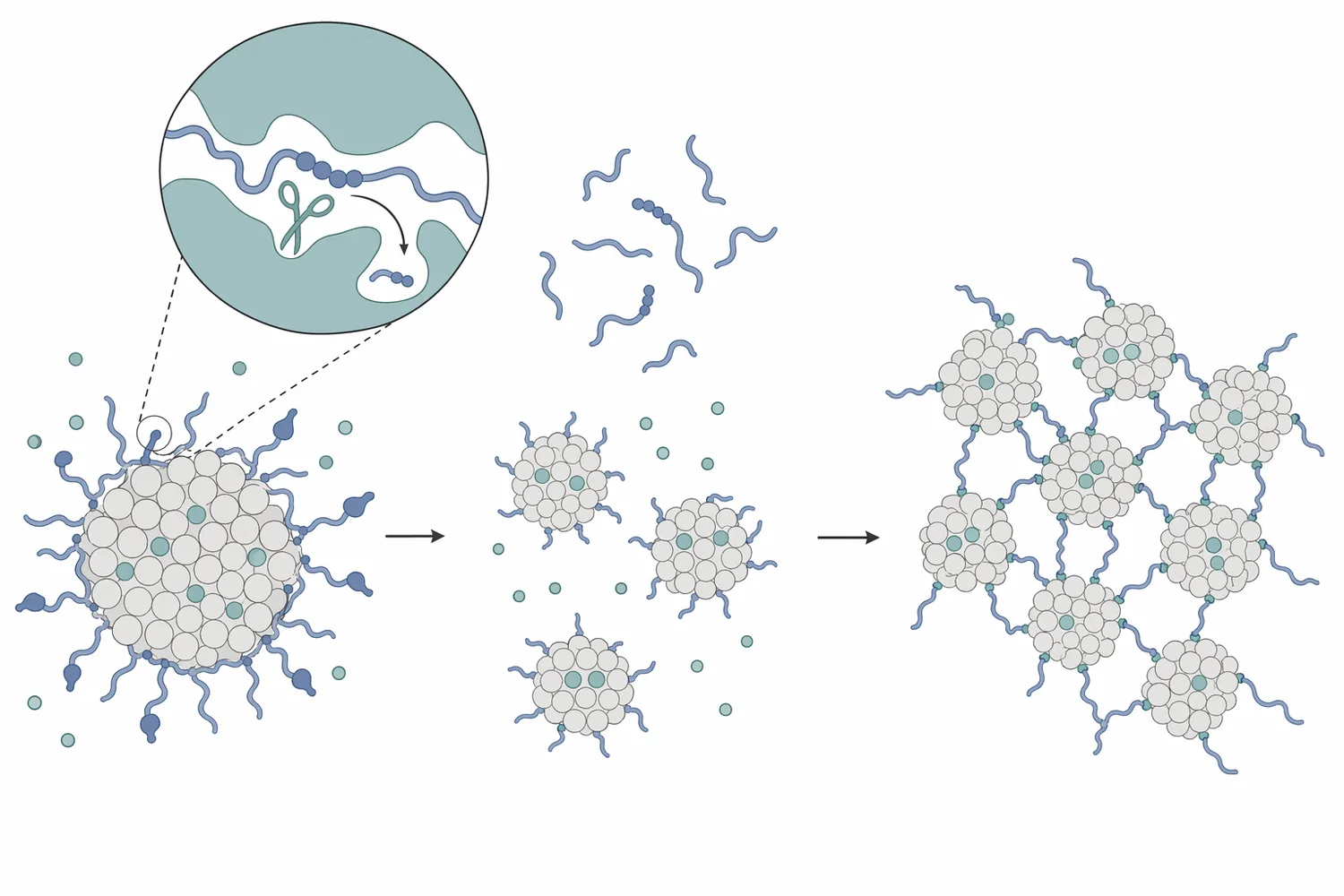
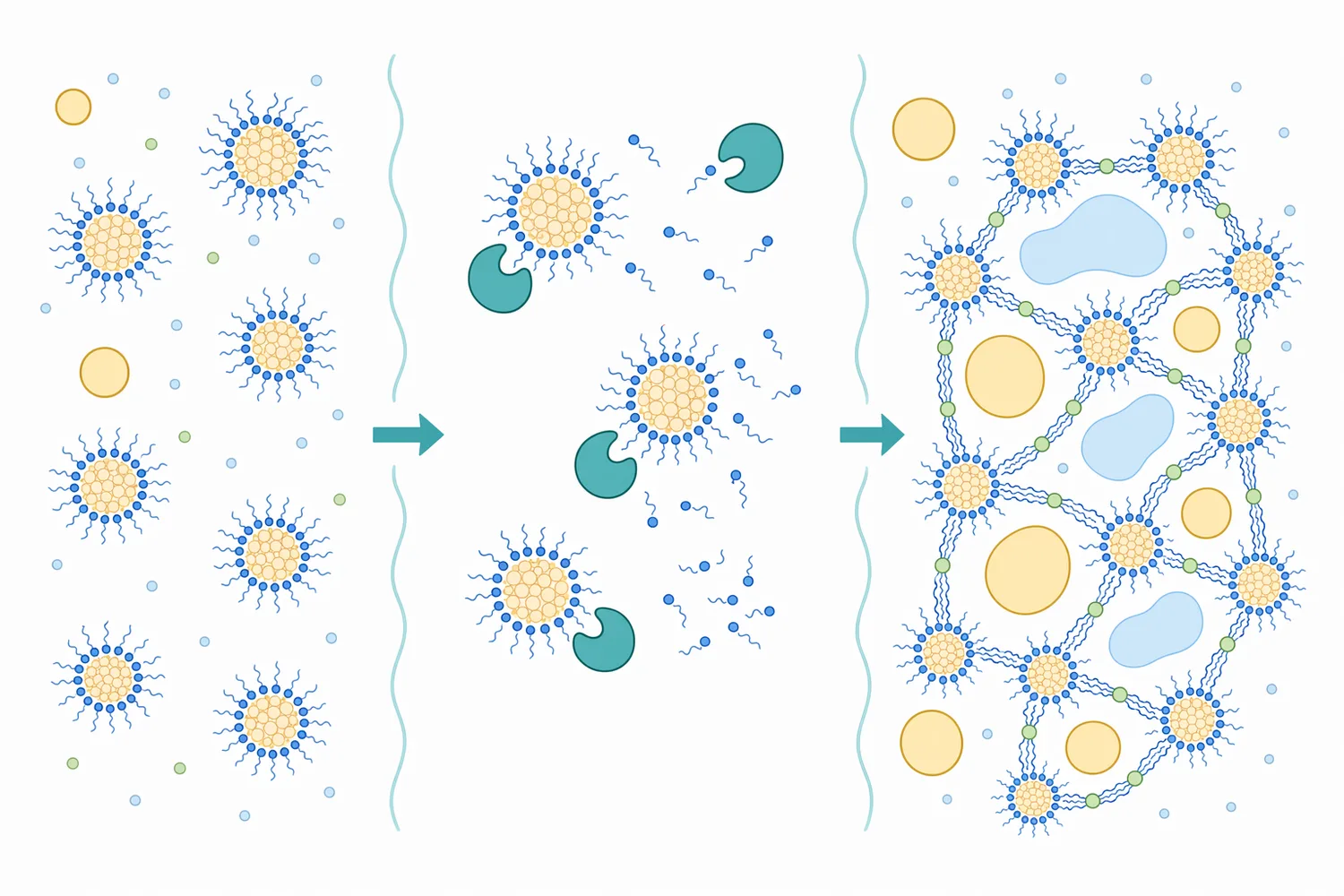
Milk is naturally stable because its major proteins, the caseins, are arranged in micelles. These micelles carry surface features that help keep them dispersed in the watery phase of milk. Rennet enzymes act on this colloidal system so that the micelles no longer repel one another effectively; once the protective surface is disrupted, calcium-mediated interactions and protein-protein contacts allow the micelles to join into a gel network. That network traps fat globules, water, minerals, starter culture cells, and soluble components until later cutting and handling release whey.
Powder rennet is a dry format of this milk-clotting enzyme function. It is used where a rennet-coagulated curd is required, including many hard, semi-hard, semi-soft, fresh, brined, and stretched-curd cheeses. Research comparing enzymatic milk coagulation methods continues to treat rennet-driven gel formation as a central operation in cheese processing, with the effects visible through rheology, light backscattering, and microscopy as milk changes from a liquid dispersion into a structured curd [2].
The practical change begins at the surface of the casein micelle. In rennet coagulation, the enzyme attacks the casein system in a way that reduces micelle stability. The most familiar model is chymosin action on κ-casein, the casein fraction that helps maintain the micelle’s outer stabilizing layer. When that stabilizing layer is cleaved, the micelles become more likely to collide, stick, and form a continuous protein network.
This mechanism explains why rennet coagulation is different from simple acid thickening. Acid coagulation mainly reduces charge and changes mineral balance as pH falls, whereas rennet coagulation starts with enzymatic cleavage and then proceeds into aggregation and gel strengthening. Studies on enzymatic coagulation equations and models separate the process into kinetic stages because cleavage, aggregation, and gel development do not happen as a single instant event; they unfold over time as protein particles change their interaction behavior [3].
As the gel firms, the milk becomes a curd that can be cut. Cutting increases surface area and allows whey to escape. Smaller curd pieces usually drain more rapidly than larger pieces because whey has shorter paths to leave the gel, while cooking and stirring further influence contraction of the protein network. Rennet therefore does not only “set” the milk; it creates the physical structure that makes later moisture control possible.
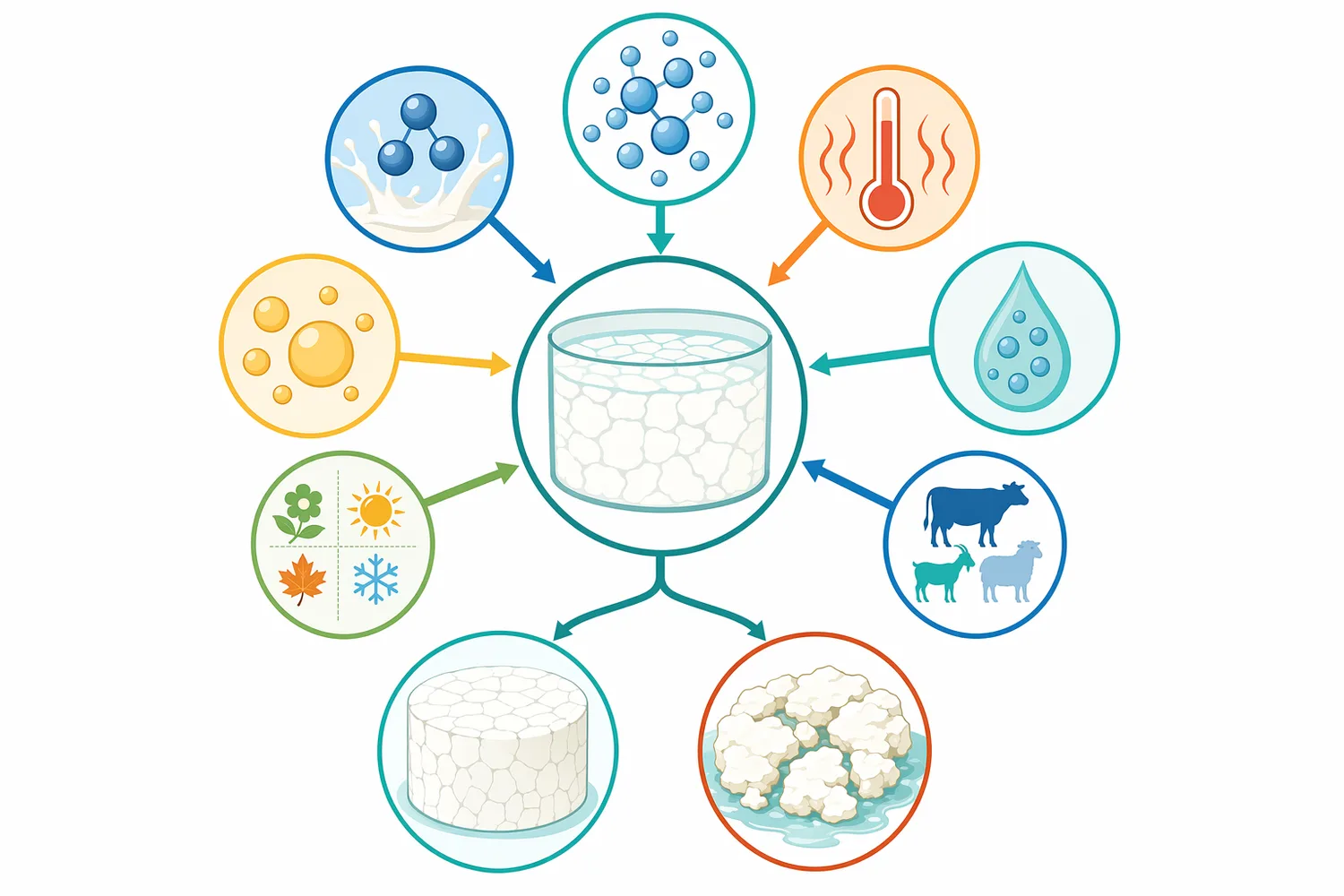
Rennet acts on protein, but the coagulation result depends on the milk environment. Protein concentration, casein composition, calcium balance, heat history, seasonal milk variation, fat distribution, and acidity all affect how quickly the gel forms and how firm it becomes. A study evaluating enzymatic coagulation of Holstein cow milk across three periods of the year highlights that milk coagulation properties are not fixed; they vary with the milk supply itself [4].
Heat treatment is especially important because it can alter the behavior of whey proteins and casein micelles. When milk or milk protein concentrates are heated, whey proteins may denature and associate with casein surfaces, which can change how rennet reaches its target sites and how micelles aggregate after cleavage. Research on milk protein concentrates found that heat treatment affects enzymatic coagulation properties, supporting what processors often see: the same enzyme can behave differently when the protein ingredient has a different thermal history [5].
Recombined and high-heat-treated milk systems can be more challenging because their protein structures and mineral equilibria may differ from fresh cheesemaking milk. Work on ultra-high-temperature-treated milk and recombined milk from whole milk powder specifically addresses modification of enzymatic coagulation for those systems, showing that rennet performance has to be understood in the context of the substrate being coagulated [6].
The immediate commercial value of rennet is that it creates a curd capable of separating from whey. The curd is the concentrated protein-fat network that becomes cheese; the whey is the expelled liquid phase containing water, lactose, soluble minerals, whey proteins, and other dissolved components. In rennet cheese manufacture, the balance between retained moisture and expelled whey strongly shapes yield, texture, body, and further processing behavior.
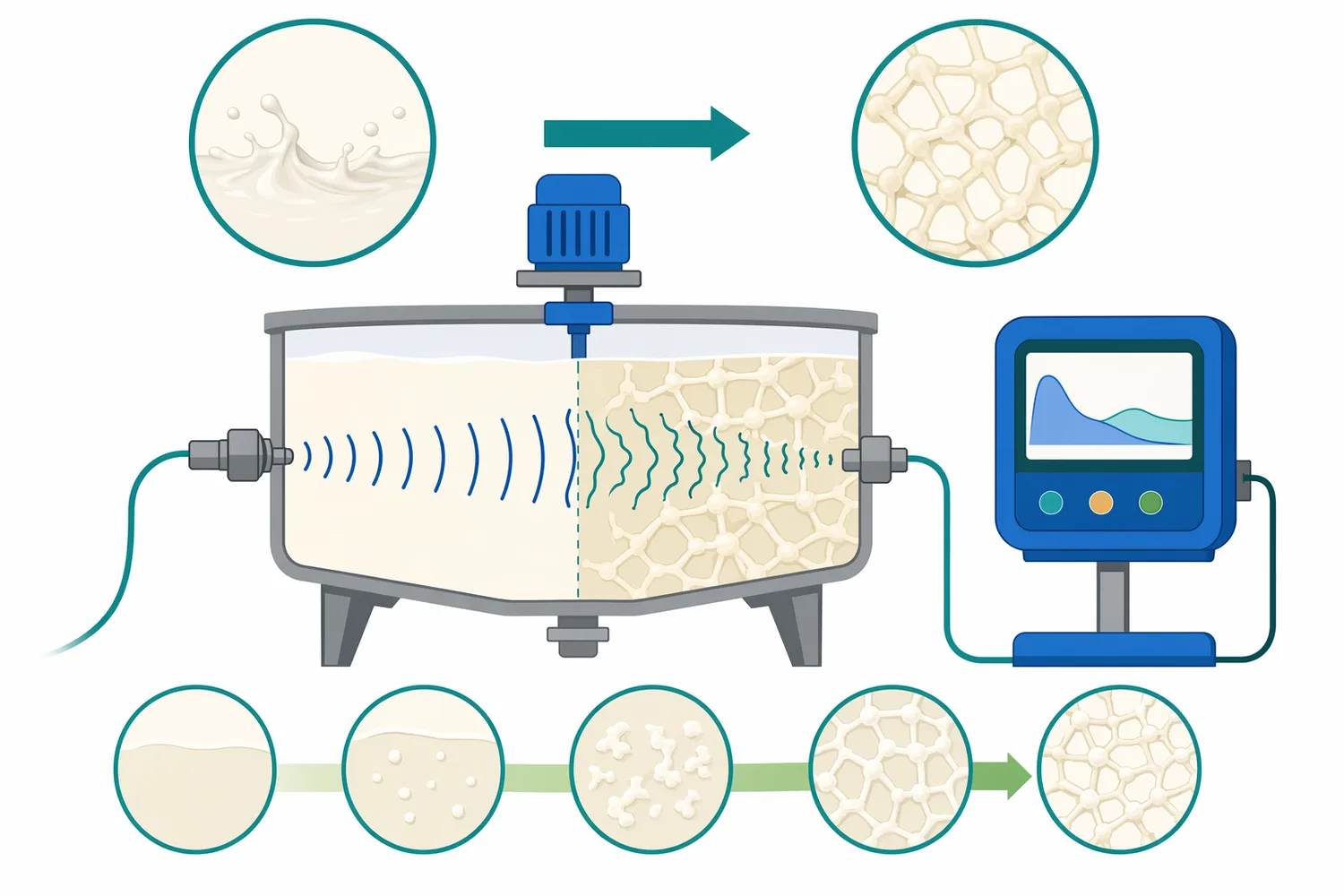
The gel network formed by rennet is initially delicate. As it matures, micelle aggregation increases and the structure becomes strong enough to cut. Once cut, the curd begins syneresis: the protein matrix contracts and whey moves out. The quality of the initial gel matters because weak or uneven coagulation can produce fines, poor curd handling, and inconsistent moisture. Research using ultrasonic velocity and backscattered acoustic waves has investigated ways to monitor enzymatic coagulation as the milk structure develops, reinforcing that gel formation is a measurable physical transition rather than a visual guess alone [7].
Ultrasonic attenuation has also been studied as a technique to follow enzymatic milk coagulation. These measurement approaches are useful scientifically because they detect structural changes inside the milk as the enzymatic reaction progresses and the gel network develops [8]. For a buyer using powder rennet in cheese production, the practical takeaway is straightforward: rennet performance is expressed not only in clotting time but also in the firmness, uniformity, and drainability of the curd that follows.
A powder format offers a practical way to handle rennet as a dry enzyme preparation. In use, the enzyme must be distributed evenly through the prepared milk so that coagulation occurs uniformly throughout the vat or batch. Uneven dispersion can lead to localized early gelation, weak zones, or inconsistent curd cutting behavior because different parts of the milk receive different enzyme exposure.
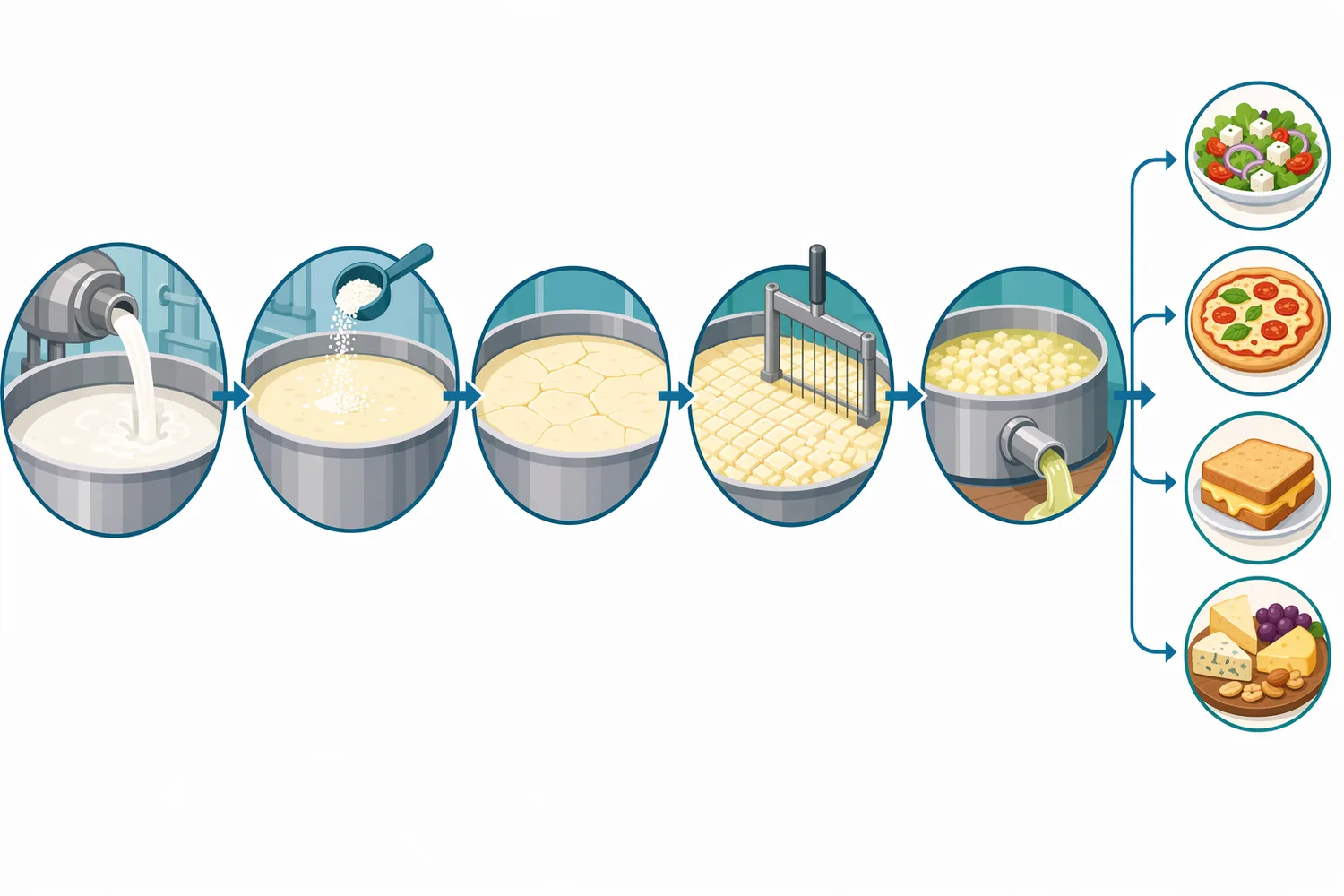
In a typical cheese process, milk is first prepared according to the cheese style. This may include standardization, heat treatment, cooling to the cheesemaking range, starter culture addition where needed, and controlled acid development. Rennet is then added at the coagulation stage, mixed gently, and allowed to work without excessive disturbance while the gel forms. Studies that compare rheological, optical, and microscopic methods show that enzyme concentration and protein concentration both influence coagulation behavior, which reflects the interaction between the enzyme dose present in the system and the amount of coagulable protein available [2].
After setting, the curd is cut, cooked or stirred where appropriate, drained, salted, pressed, molded, stretched, or ripened according to the product. Rennet’s main job occurs early, but its effects continue downstream because the initial gel structure influences moisture retention, curd particle strength, and the rate at which whey is released. In ripened cheeses, residual proteolytic activity and the wider enzyme-culture system also influence texture and flavor development over time.
Different rennet sources can clot milk through broadly similar functional steps, but they are not identical in specificity or secondary proteolysis. Traditional animal rennet is associated with chymosin-rich milk clotting. Microbial rennets, recombinant chymosin, insect-derived enzymes, plant extracts, and other protease preparations have also been studied for cheese applications. A 2024 paper on the sustainability and safety implications of different rennet types reflects the continuing interest in comparing enzyme sources beyond traditional animal rennet [9].
The main technical difference is the balance between milk-clotting activity and broader proteolytic activity. A highly specific milk-clotting enzyme creates the curd with limited breakdown of other casein regions at the coagulation stage. A less specific protease may still clot milk but can hydrolyze additional protein bonds, affecting curd firmness, bitterness risk, texture breakdown, and flavor formation during ripening. This is why alternative rennets can be valuable but may produce cheeses with different sensory and physical profiles.
| Rennet category | Main functional concept | Typical cheese impact to understand | Evidence context |
|---|---|---|---|
| Animal chymosin-rich rennet | Targeted milk-clotting protease traditionally associated with rennet cheese manufacture | Strong casein coagulation with a long history in rennet cheeses | Used as a reference point in many rennet comparisons and cheese studies [9] |
| Microbial rennet | Milk-clotting proteases from microbial sources | Can support non-animal rennet positioning; proteolytic profile may differ by source | Goat milk cheese development using microbial rennet from Kluyveromyces lactis has been studied [10] |
| Plant-derived rennet | Plant protease extracts capable of clotting milk | May suit specialty, regional, vegetarian, or flavor-forward cheeses; can differ in bitterness and texture behavior | Caciofiore cheese research has examined Cynara cardunculus rennet and Onopordum tauricum extracts [11] |
| Insect-derived or novel enzyme sources | Alternative milk-clotting proteases evaluated for functionality and flavor effects | May influence ripening chemistry and volatile flavor formation depending on enzyme action | Tenebrio molitor rennet has been studied in Cheddar flavor formation during ripening [12] |
This comparison is conceptual rather than a purchasing specification. The important point is that “rennet” describes a functional milk-clotting role, while enzyme source and specificity influence how the cheese behaves after coagulation.
Hard and semi-hard cheeses rely on a curd that can withstand cutting, cooking, stirring, drainage, salting, pressing, and ripening. Rennet provides the initial protein network that makes that sequence possible. A firmer, more cohesive curd helps retain fat and reduce curd fines, while controlled whey expulsion supports the moisture level needed for aging.
During ripening, the early rennet-set matrix becomes the substrate for ongoing biochemical change. Proteins are gradually broken into peptides and amino acids by residual coagulant, starter enzymes, non-starter microorganisms, and native milk enzymes. The resulting changes soften texture, reduce rubberiness, and contribute flavor precursors. Research on Tenebrio molitor rennet in Cheddar examined how a rennet source can affect flavor formation during ripening, illustrating the connection between coagulant choice and later cheese chemistry [12].
Fresh and soft cheeses often need a curd that is tender, moist, and cleanly drainable. Rennet may be used together with lactic acid bacteria so that enzymatic coagulation and acid development shape the final texture. In these cheeses, too much firmness can create a dense body, while too weak a set can lead to fragile curd and excessive losses during draining.
A study on soft cheese made from cow’s milk with added rennet and lactic acid bacteria yogurt evaluated yield, flavor, taste, and overall texture, reflecting the practical reality that rennet is part of a broader formulation system rather than an isolated input [13]. The enzyme forms the curd skeleton; acidification, fat level, salt, and drainage determine how that skeleton becomes a finished soft cheese.
Brined cheeses require curd structure that can tolerate handling, salting, and storage in brine. Rennet coagulation supports the protein matrix that absorbs salt and holds shape. Regional cheeses may also use traditional or plant-derived rennet sources for distinctive identity and sensory character.
Caciofiore cheese research has compared curdling with commercial Cynara cardunculus rennet and crude extracts from spontaneous and cultivated Onopordum tauricum, then assessed chemical, microbiological, textural, and sensory characteristics [11]. This type of evidence is important because it shows that rennet source can shape not only clotting but also the finished cheese profile.
Milk from different species does not coagulate exactly like cow milk. Goat milk, camel milk, and other milks differ in casein fractions, micelle structure, mineral balance, and fat globule characteristics. These differences can change curd firmness, gelation speed, and whey separation.
Goat milk cheese standardisation using microbial rennet from Kluyveromyces lactis has been studied, showing continued development of rennet systems for non-cow milk cheeses [10]. Camel milk is especially known for coagulation challenges, and research has explored enzymatic extracts from the kaolin layer of chicken gizzard to improve camel milk coagulation [14]. These examples underline the same mechanism: rennet must interact with the specific protein system present in the milk, and that substrate differs by species.
Rennet forms a protein network, but fat is physically trapped within that network and affects texture, opacity, lubrication, and sensory perception. If the fat phase changes, the rennet gel may also behave differently because the inclusions within the protein matrix differ in size, interface, and interaction with casein.
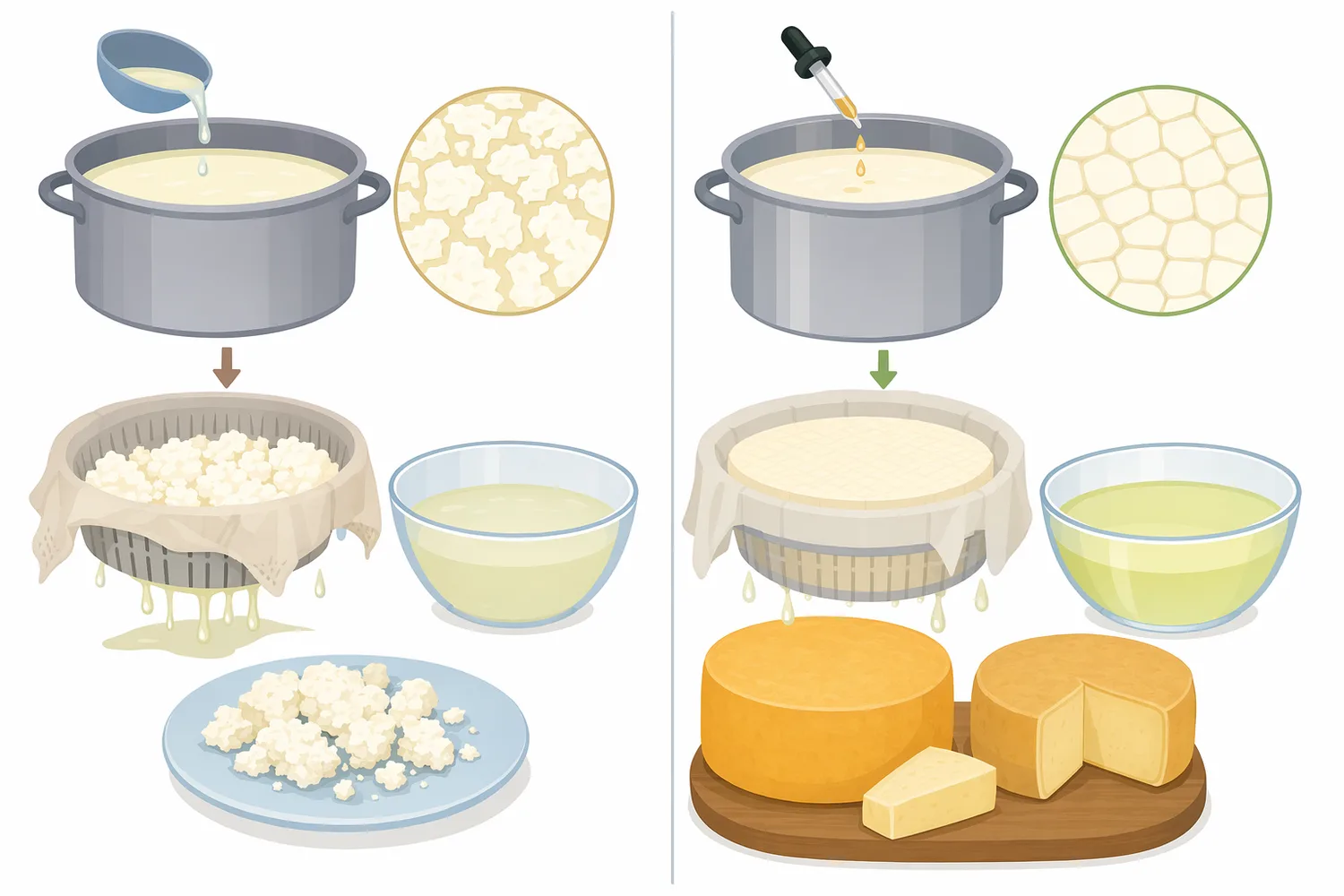
Research on fresh soft rennet cheese examined replacement of milk fat globules with emulsified canola oil droplets and evaluated composition, structure, texture, sensory properties, and lipid oxidation [15]. This is relevant for product development because it shows that rennet coagulation does not happen in a protein-only system; fat structure and emulsion behavior can affect the cheese matrix formed around the curd.
Alternative rennets are important where cheese products require non-animal enzyme systems, regional botanical identity, or distinctive ripening behavior. Plant-derived coagulants are especially associated with certain Mediterranean and traditional cheeses, where they may contribute characteristic texture and flavor. However, many plant proteases are broader in action than chymosin, so they can produce more extensive casein breakdown if not matched carefully to the cheese style.
Soft white cheese research using a milk-clotting enzyme from sycamore fig fruit studied its role as a partial rennet substitute and assessed physicochemical, textural, and sensory properties [16]. The “partial substitute” framing is technically meaningful: alternative coagulants may be used to complement rather than fully replace conventional rennet when the goal is to adjust texture, sensory profile, or labeling direction while maintaining an acceptable curd.
Plant and microbial rennets can also interact differently with ripening cultures. Lactic acid bacteria influence pH, metabolize lactose, generate flavor compounds, and release enzymes that continue protein and fat transformations. In goat cheese, lactic acid bacteria coculture has been studied for its impact on quality characteristics during ripening, showing how culture systems and the rennet-set matrix develop together over time [17].
The same rennet preparation can perform differently under different milk and process conditions. This is not because the enzyme “changes,” but because the substrate and environment change. Rennet needs access to susceptible casein sites, and the destabilized micelles need favorable conditions to aggregate into a gel. If milk has been strongly heated, diluted, concentrated, recombined, or altered in mineral balance, the coagulation pathway can shift.
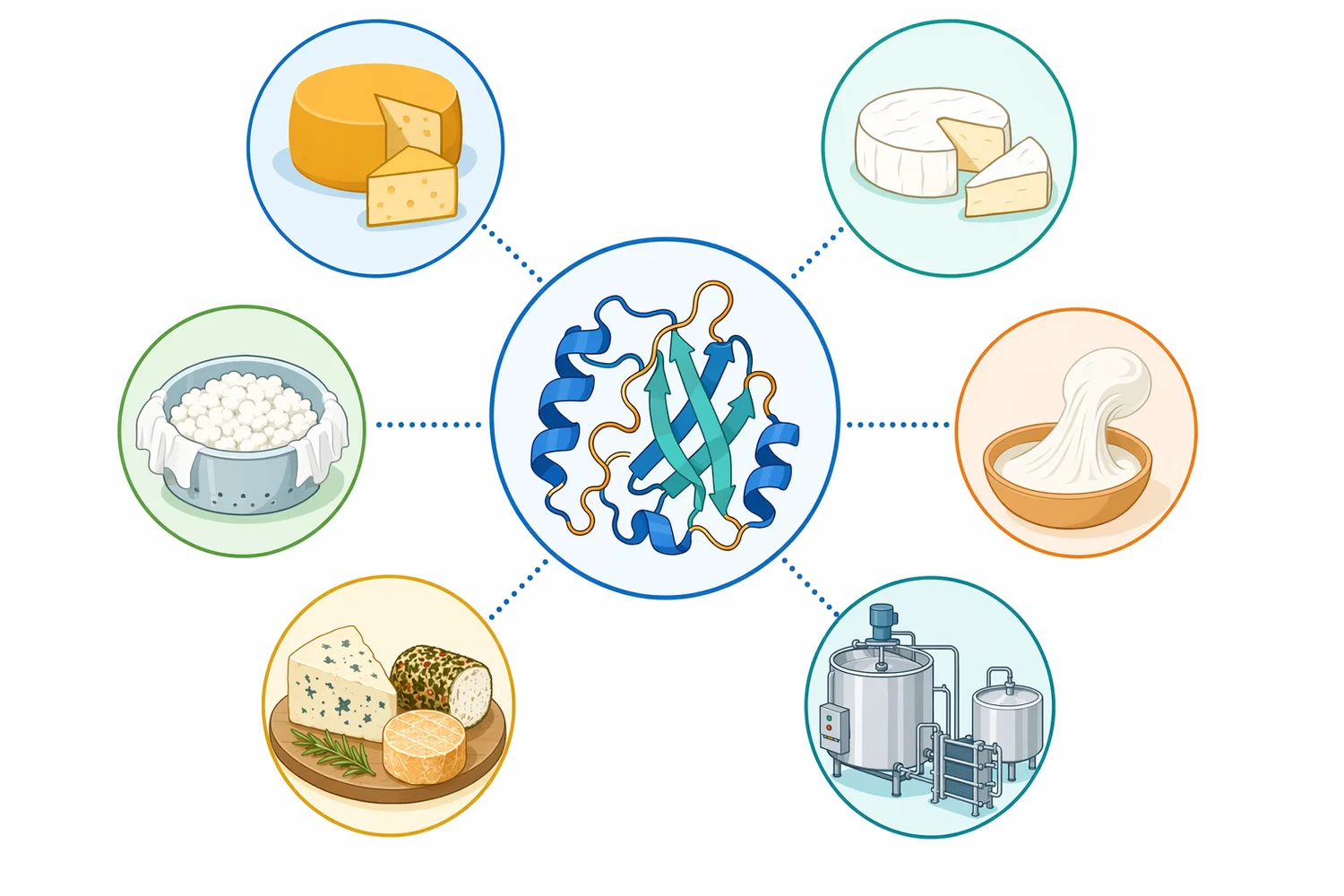
Milk protein concentration affects the density of the eventual network. Higher casein availability can support a stronger gel, while low protein or altered casein composition can reduce firmness. The 2017 comparative study using rheology, near-infrared light backscattering, and confocal microscopy examined the impact of different enzyme and protein concentrations on enzymatic milk coagulation, reinforcing the connection between protein substrate level and gel development [2].
Temperature and acidity also matter because they influence enzyme kinetics, casein micelle stability, and calcium behavior. In practical terms, warmer cheesemaking conditions generally allow enzyme reactions and micelle aggregation to proceed more readily than cold conditions, while acidification changes micelle charge and mineral solubility. These effects are part of why cheesemaking is a controlled process rather than a simple ingredient addition.
Rennet’s first visible effect is clotting, but its downstream influence extends into texture and flavor. The curd network formed at coagulation becomes the architecture of the cheese. Its porosity, mineralization, moisture, fat retention, and protein connectivity affect whether the finished cheese is elastic, brittle, creamy, sliceable, spreadable, or crumbly.
Proteolysis during ripening changes that architecture. Casein breakdown loosens the network, releases peptides, and creates amino acid precursors for flavor reactions. If proteolysis is balanced, the cheese develops desirable softness and complexity. If it is excessive or poorly matched to the cheese style, texture can weaken or bitterness may appear. The Cheddar study using gas chromatography-ion mobility spectrometry to evaluate Tenebrio molitor rennet focused specifically on flavor formation during ripening, showing that rennet source can influence volatile flavor development as cheese matures [12].
Flavor is not created by rennet alone. Lipases, lactic acid bacteria, non-starter microbes, salt, oxygen exposure, and ripening conditions all contribute. Reviews of microbial lipases in cheese production emphasize their role in quality, texture, and flavor, which helps place rennet in the wider enzyme ecology of cheese rather than treating it as the only biochemical driver [18].
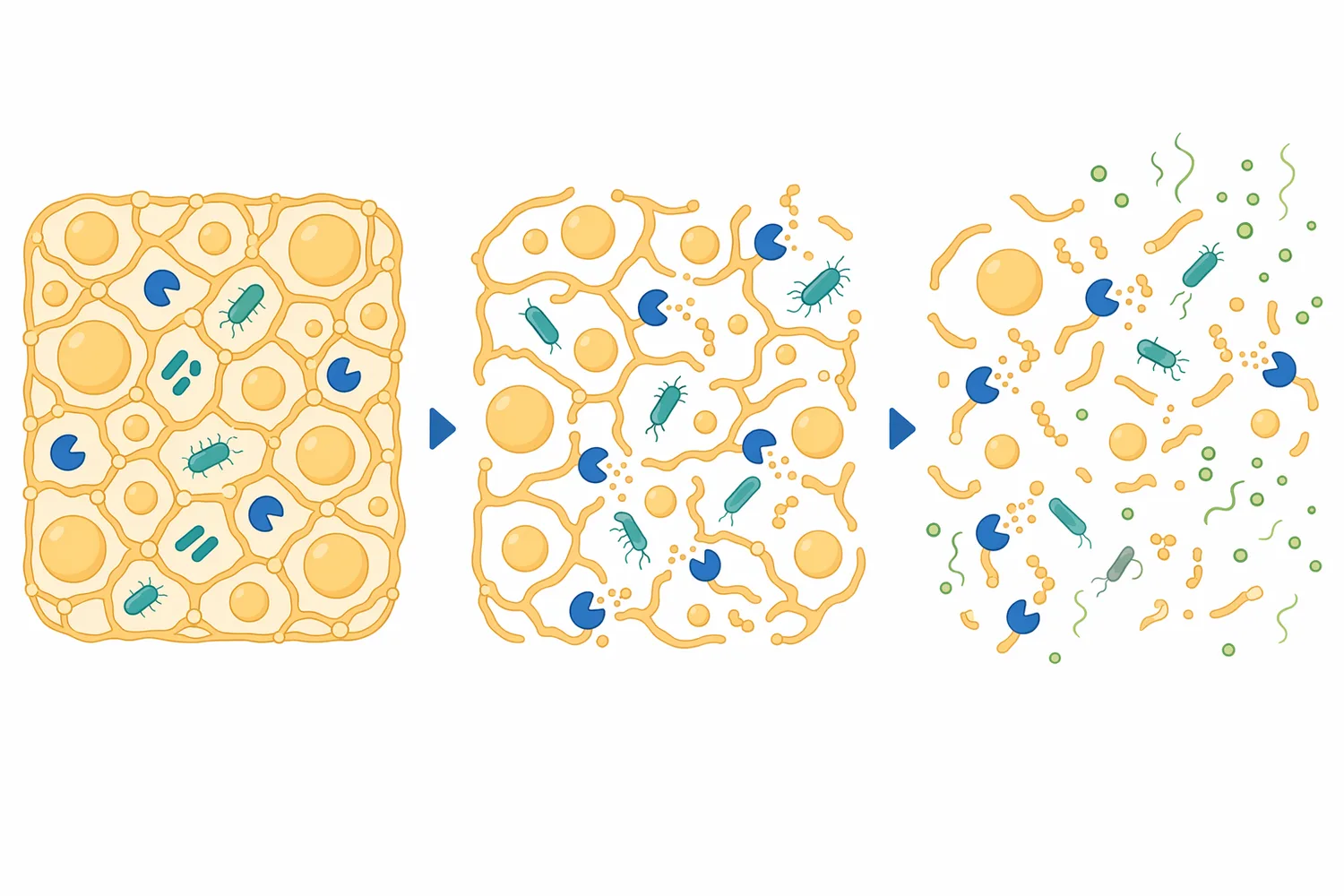
Industrial cheesemaking depends on recognizing the correct point for cutting the curd. If the curd is cut too early, it may shatter and release excessive fines. If cut too late, it may retain moisture differently and become harder to control. Traditional cheesemaking uses experience and physical checks, while scientific studies use instruments to understand the same transition in more detail.
Backscattered acoustic wave measurements have been used to monitor enzymatic coagulation by following changes in ultrasonic velocity as milk structure evolves [7]. Compression-wave ultrasonic attenuation has also been studied for monitoring coagulation, because wave behavior changes as liquid milk becomes a gelled protein network [8]. These tools are research and process-understanding methods; they illustrate that rennet coagulation is a physical transformation with measurable stages.
For a buyer using powder rennet, the practical implication is that consistency comes from the combination of enzyme distribution, milk composition, and process control. The enzyme initiates coagulation, but the final curd reflects the whole system. That is why the same powder rennet can support many cheese styles while still requiring the user’s own established cheesemaking procedure.
Enzymes.bio supplies powder rennet for cheese directly online by the 1 kg unit. The buying process is simple: the product is purchased online, payment is completed online, and the order is processed and shipped. A Certificate of Analysis and Safety Data Sheet come with the order.
This supply model is suited to buyers who want access to a practical enzyme format without a prolonged quotation process. Enzymes.bio acts as a product supplier, making the enzyme available through direct online ordering. The role of the buyer is to integrate the powder rennet into their own established cheese process, using their normal production controls and documentation practices.
Rennet is essential for many cheeses, but it does not guarantee finished cheese quality by itself. Good cheese depends on milk quality, sanitation, heat treatment, culture performance, acidity development, mineral balance, curd cutting, moisture control, salting, pressing, packaging, and ripening. Studies on seasonal milk variation, heat-treated protein concentrates, and recombined or UHT-treated milk all show that the substrate strongly affects enzymatic coagulation outcomes [4].
Rennet also does not replace starter cultures where they are needed. Cultures acidify the milk, affect safety hurdles, contribute enzymes, and drive flavor development. In ripened cheeses, culture selection and microbial ecology interact with the rennet-set curd over time. Research on lactic acid bacteria coculture in goat cheese demonstrates how ripening quality characteristics depend on microbial systems as well as the coagulated matrix [17].
Alternative rennets should be understood as functional enzyme options, not automatic equivalents. Plant, microbial, insect-derived, and animal-derived coagulants can all clot milk, but their proteolytic patterns may differ. That difference can be useful when it creates a desired regional, sensory, or dietary profile, but it also means the finished cheese may not be identical across rennet types.
Powder rennet for cheese is a core enzyme ingredient for rennet-coagulated cheese production. Its value comes from a concrete biochemical action: it modifies the casein micelle system so milk changes from a stable liquid into a curd-forming gel. That gel can then be cut and processed to control whey release, moisture, texture, and downstream cheese development.
The scientific literature supports rennet coagulation as a structured sequence of proteolysis and gelation, affected by milk composition, heat treatment, protein level, rennet type, and the broader cheese process [1]. For buyers looking for a practical online source, Enzymes.bio supplies powder rennet directly by the 1 kg unit, with online payment, order processing, shipment, and accompanying Certificate of Analysis and Safety Data Sheet.
Sold by the 1 kg unit, in stock and ready to ship. Order directly on our store — pay online and we process your order. A Certificate of Analysis and Safety Data Sheet are included with every order.
Buy Suppliers Price Powder Rennet For Cheese →Numbered in order of first citation. Open-access sources, each verified reachable at publication; citation numbers in the text link here.