
Transglucosidase is a carbohydrate-active enzyme used to rearrange glucose units in starch-derived substrates such as maltose, dextrins, and hydrolyzed starch streams. Its practical value is that it can support transglucosylation: transferring glucose residues to form new glycosidic linkages, especially structures associated with isomalto-oligosaccharides and modified starch functionality. In food, ingredient, and bioprocess development, this makes transglucosidase useful when the goal is not simply to break starch down, but to reshape the carbohydrate profile into a more functional mixture.
Enzymes.bio supplies transglucosidase directly online by the 1 kg unit. Buyers complete the purchase online, and the order is processed and shipped with a Certificate of Analysis and Safety Data Sheet included.
Transglucosidase is often discussed as an α-glucosidase-type enzyme because it acts on α-linked glucose carbohydrates. In practical terms, the transglucosidase function is different from a straightforward starch-liquefying enzyme: instead of only reducing chain length, it can transfer glucose residues from one carbohydrate molecule to another, creating a new distribution of oligosaccharides in the reaction mixture. Studies on starch modification and isomalto-oligosaccharide production describe transglucosidase as a tool for changing both molecular structure and functional properties of starch-derived systems [1].
The most important distinction is between hydrolysis and transglucosylation. Hydrolysis uses water to cleave a glycosidic bond, increasing smaller sugars such as glucose or maltose. Transglucosylation uses a carbohydrate acceptor instead of water, so the glucose unit is reattached to another sugar molecule; this can increase α-1,6-linked structures that are characteristic of isomalto-type oligosaccharides [2].
That dual behavior explains why transglucosidase appears in several application areas: isomalto-oligosaccharide generation, starch granule modification, paste stability improvement, and experimental nutritional systems studying post-meal glucose response. The enzyme works on the same broad family of starch-derived substrates, but the outcome depends on the substrate mixture and process environment: maltose-rich systems, dextrin-rich systems, and native or partially modified starch systems do not all respond identically [3].
Starch is built mainly from glucose units joined through α-1,4 linkages, with α-1,6 branch points in amylopectin. When starch is treated with amylolytic enzymes or heat-and-enzyme processing, it can be converted into shorter chains such as dextrins, maltose, maltotriose, and related oligosaccharides. Transglucosidase then acts on these smaller α-linked glucose donors and transfers glucosyl units to acceptor sugars, changing the distribution of linkages in the mixture [2].
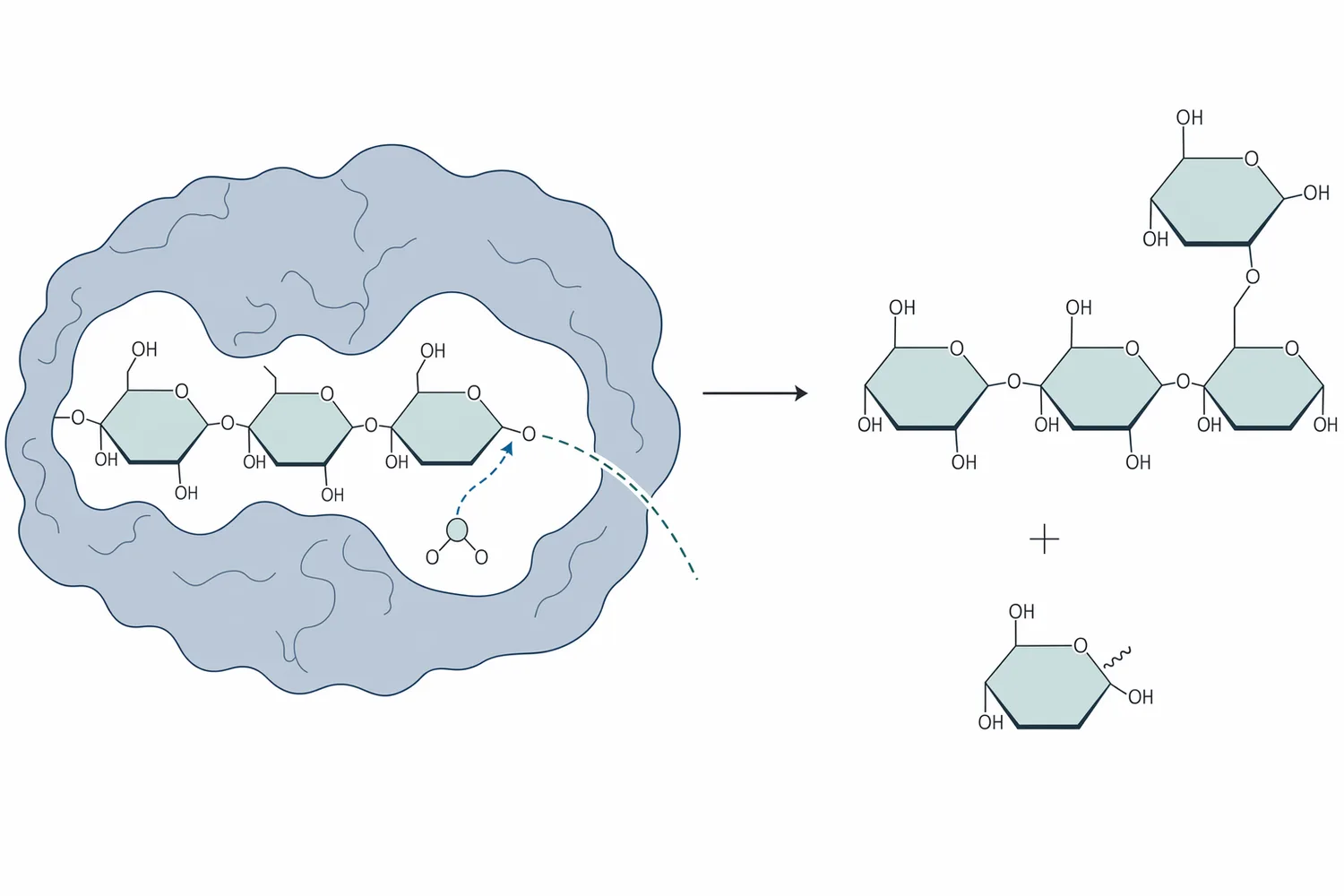
Mechanistically, the enzyme first recognizes an α-glucosidic donor substrate. The donor bond is cleaved at the active site, creating an enzyme-bound glucosyl intermediate. If water is the acceptor, the result is hydrolysis and free glucose release. If another sugar molecule is the acceptor, the glucosyl unit is transferred onto that sugar, generating a new glycosidic linkage. This is why the same transglucosidase enzyme can appear to “break down” carbohydrate in one system while “building” oligosaccharides in another.
For ingredient developers, the meaningful change is not just a laboratory reaction scheme; it is a shift in the carbohydrate population. A maltose-heavy syrup can become a mixture containing more branched or rearranged oligosaccharides. A starch paste can show altered molecular density, swelling behavior, and retrogradation tendency. A dextrin-containing dietary system can present a different set of digestible and less readily digestible carbohydrate structures to downstream digestion.
The term amylo-1,4-1,6 transglucosidase sometimes appears in searches alongside transglucosidase, as does the unpunctuated form amylo 1 4 1 6 transglucosidase. In technical use, these terms can refer to related but distinct carbohydrate-active enzymes involved in moving glucosyl units between α-1,4 and α-1,6 positions; they should not automatically be treated as identical to every commercial transglucosidase enzyme. The useful common idea is glucosyl transfer: the enzyme changes where glucose units are linked, which changes the structure and behavior of the carbohydrate material.
Transglucosidase is best understood in context. Many starch processes use multiple enzymes because each enzyme changes a different structural feature of starch or starch hydrolysates. The table below gives a conceptual comparison without turning the enzyme into a one-size-fits-all substitute for other carbohydrate enzymes.
| Enzyme type | Main action on starch-derived carbohydrates | Typical structural result | Practical implication |
|---|---|---|---|
| α-Amylase | Cleaves internal α-1,4 bonds in starch chains | Rapid reduction of long starch chains into dextrins | Liquefaction, viscosity reduction, preparation of shorter substrates |
| Glucoamylase / amyloglucosidase | Releases glucose from non-reducing ends | More glucose, fewer longer oligosaccharides | Saccharification when high glucose formation is desired |
| Branching enzyme | Introduces α-1,6 branch points within glucan chains | More highly branched starch-like molecules | Modified digestibility, solubility, and paste behavior |
| Maltogenic amylase | Acts on starch and maltooligosaccharides to produce maltose-rich products | Shorter chains and altered retrogradation behavior | Texture and shelf-life effects in starch-containing foods |
| Transglucosidase | Transfers glucosyl units from donors to acceptor sugars | More rearranged oligosaccharides, often including α-1,6-linked structures | Isomalto-oligosaccharide formation and carbohydrate profile adjustment |
The value of transglucosidase is therefore not simply “more starch breakdown.” In research on potato starch granules, transglucosidase has been studied alongside branching enzyme because both can alter glucan architecture, but they do so through different catalytic routes; the combined effect can change starch granule structure more than a single enzyme treatment alone [1].
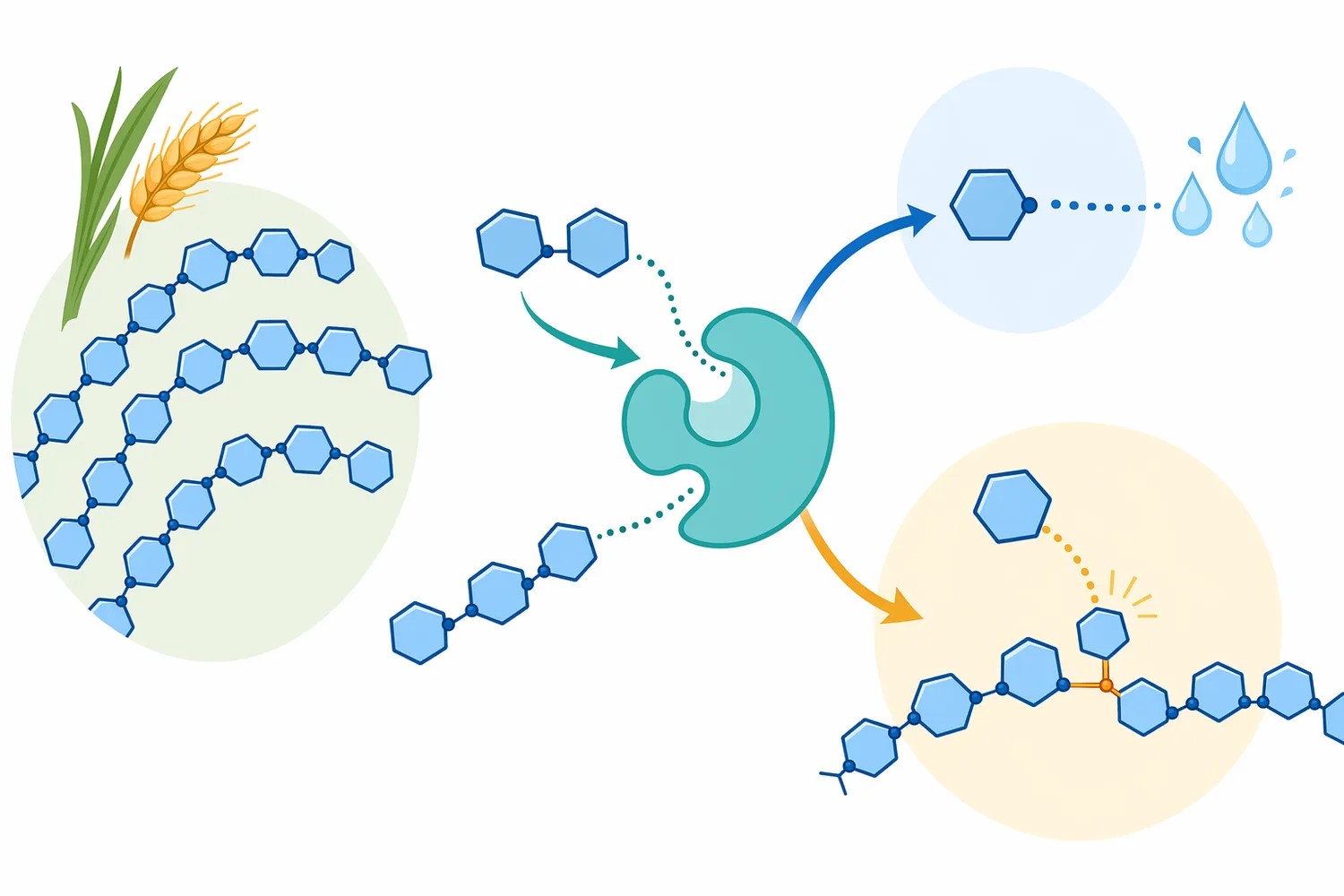
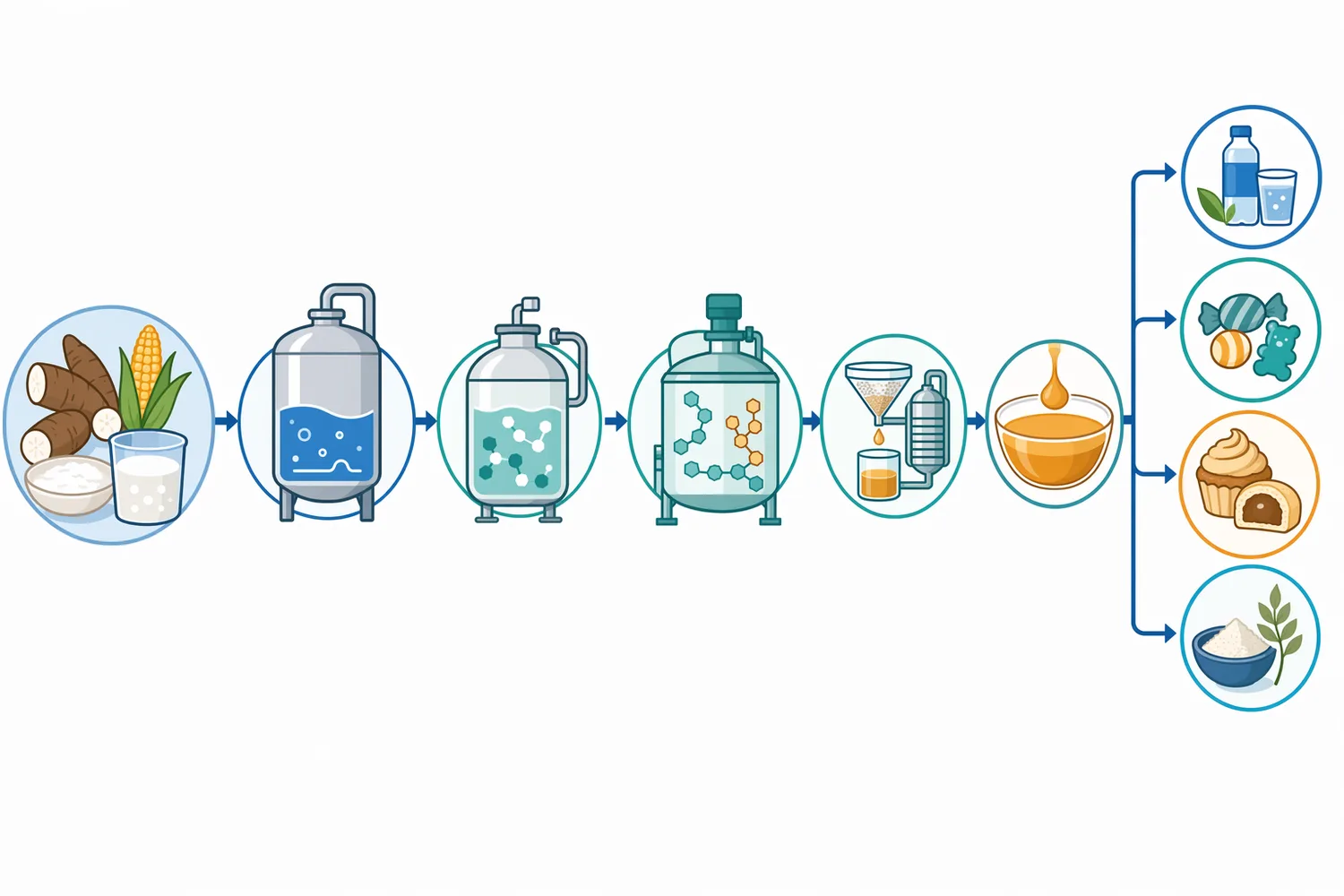
One of the clearest applications for transglucosidase is production of isomalto-oligosaccharides, often abbreviated as IMO. These are glucose-based oligosaccharides containing α-1,6 linkages such as isomaltose-type structures. The practical route is to start from starch or starch-containing residues, generate suitable maltose or dextrin substrates, and then use transglucosidase to transfer glucosyl units into α-1,6-linked products [2].
A recent study on immobilized α-transglucosidase used silica-coated magnetic nanoparticles and applied the enzyme system to produce isomalto-oligosaccharides from potato peel, a starch-containing by-product stream. The study is valuable because it illustrates two points relevant to industrial thinking: first, transglucosidase can upgrade starch-rich residual material into more structured oligosaccharide mixtures; second, enzyme immobilization was investigated as a way to make the catalyst easier to recover and reuse in that experimental system [2].
The substrate matters. Potato peel is not the same as refined maltose syrup, and native starch is not the same as a controlled dextrin stream. Enzyme access, starch gelatinization history, prior amylase treatment, soluble solids, and the ratio of donor to acceptor sugars all influence what the enzyme can actually contact. Transglucosidase cannot rearrange glucose units that are physically inaccessible; it works most effectively when suitable soluble or enzyme-accessible α-glucoside substrates are present.
For buyers using transglucosidase in product or process development, the main takeaway is that the enzyme is a carbohydrate-structure modifier. It is most relevant where the carbohydrate stream already contains, or can be converted into, the smaller glucose-based donors and acceptors needed for glucosyl transfer.
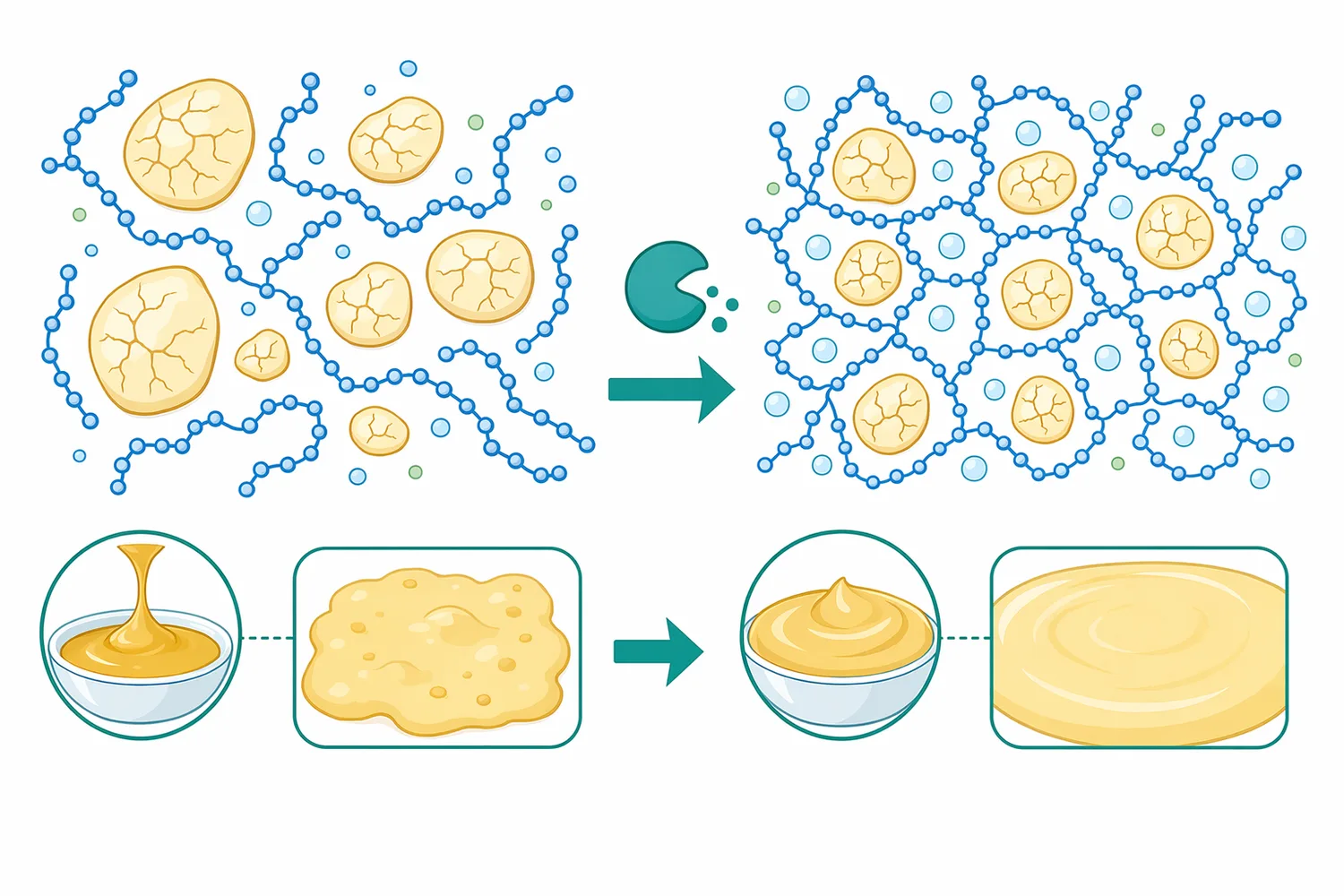
Transglucosidase is not limited to syrup chemistry. Several studies examine how it changes starch structure and functionality when used with starch granules or starch pastes. In potato starch granules, transglucosidase combined with branching enzyme produced synergistic effects, indicating that enzymatic modification can alter the physical and molecular organization of starch rather than merely producing soluble sugars [1].
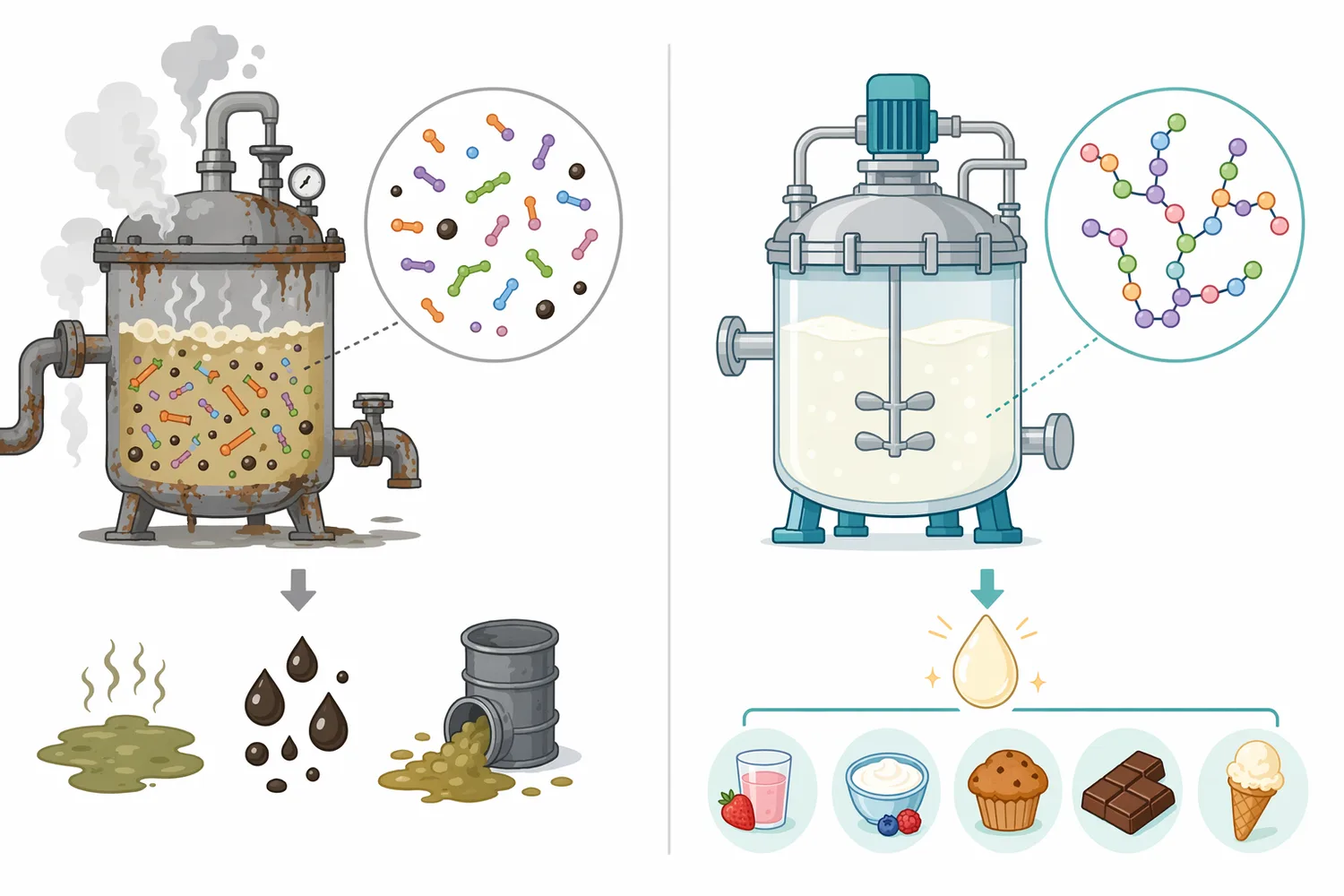
At the substrate level, this means enzyme treatment can change how starch chains pack, hydrate, swell, and reassociate after heating and cooling. Starch functionality in foods is controlled by more than dextrose equivalent or sugar composition; molecular branching, chain length distribution, and local density influence viscosity, gel firmness, paste clarity, freeze-thaw stability, and retrogradation. Transglucosidase can contribute to those properties because it changes linkage patterns and oligosaccharide architecture.
Kudzu starch research provides another example. A study using α-amylase and transglucosidase examined structural and functional modification of kudzu starch, demonstrating that sequential or combined enzymatic treatment can alter starch properties in a way that is tied to molecular transformation rather than simple dilution or cooking effects [3].
Cassava starch work also connects transglucosidase to paste stability. In a 2024 study, maltogenic amylase and transglucosidase were used to improve paste stabilities of cassava starch through changes described in terms of molecular density. That phrase is important: the enzyme treatment affects how carbohydrate chains occupy space and interact in the paste, which can reduce undesirable instability during storage or processing [4].
For food systems, these structural effects can be as important as sugar generation. A starch ingredient that resists excessive retrogradation, maintains paste stability, or develops a different viscosity profile may perform better in sauces, fillings, bakery systems, dairy-style preparations, and carbohydrate-based functional ingredients. Transglucosidase is relevant where the process goal is controlled modification of starch behavior rather than full conversion to glucose.
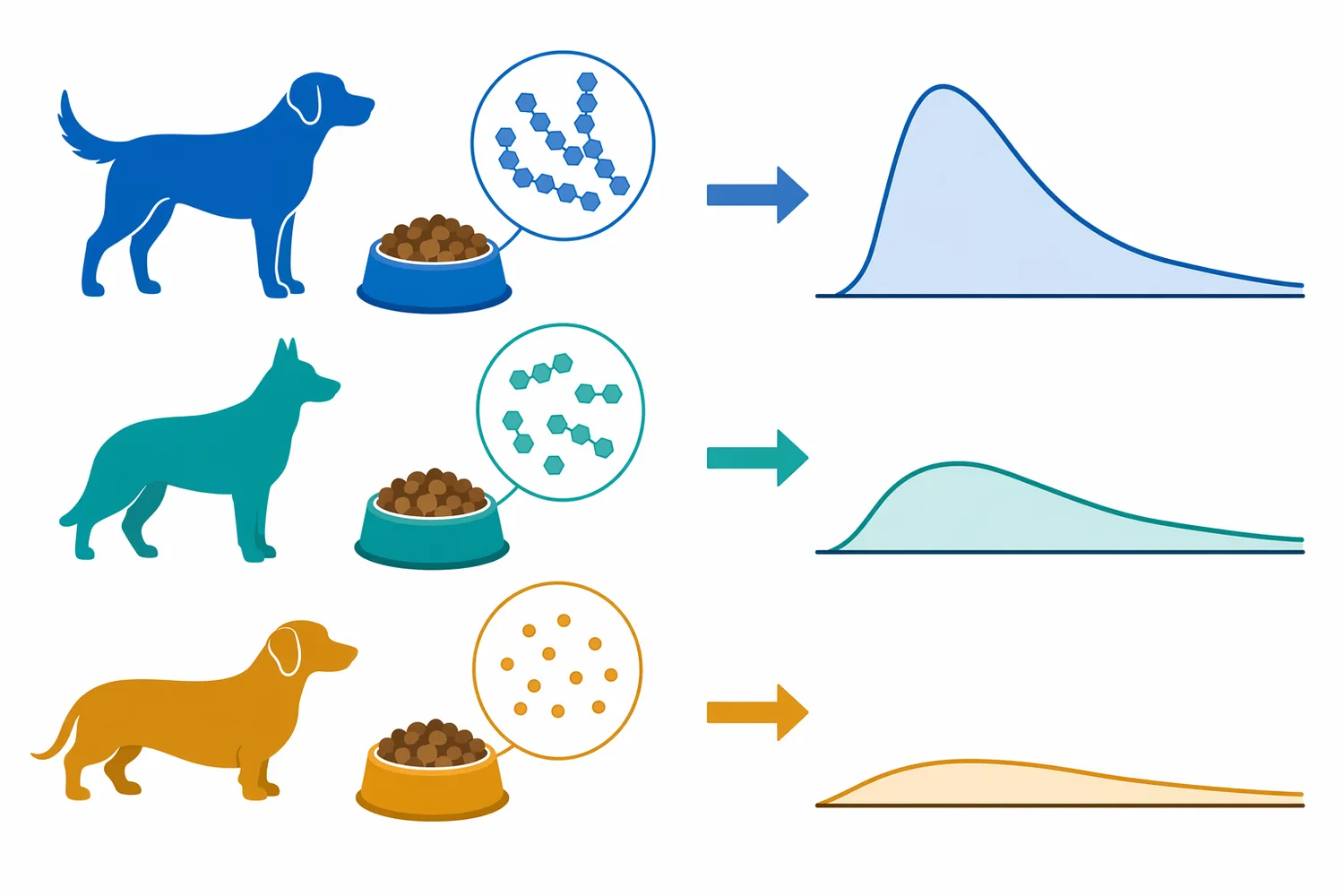
The supplied evidence includes a peer-reviewed animal study evaluating transglucosidase with maltose or dextrin in healthy and streptozotocin-induced diabetic dogs. The study used five healthy dogs and five diabetic dogs and tested the enzyme with carbohydrate substrates in the context of diet, making it relevant to research into how transglucosidase-modified carbohydrates may influence postprandial glucose patterns [5].
In healthy dogs, the study reported no detrimental effect from transglucosidase with dextrin or maltose under the tested conditions. The transglucosidase-plus-dextrin condition produced a flatter serum glucose pattern and reduced mean postprandial insulin and glucose concentrations compared with the control diet alone. This suggests that substrate pairing is not a minor detail: dextrin provided a different response pattern than maltose in that experimental design [5].
In the diabetic dog model, transglucosidase with maltose reduced mean postprandial glucose concentration by 13.8%, while transglucosidase with dextrin reduced it by 23.9%, compared with the control condition in the study. Transglucosidase with dextrin also produced a 13% lower mean postprandial glucose concentration than transglucosidase with maltose, again pointing to dextrin as the more effective substrate under those specific conditions [5].
The mechanism proposed by this type of work is consistent with the enzyme’s carbohydrate chemistry. If transglucosidase converts part of a digestible maltose or dextrin pool into oligosaccharide structures with different linkages, the timing and extent of digestion can shift. The result may be a flatter glucose appearance curve after feeding, not because the enzyme is a drug, but because the carbohydrate mixture presented to digestion has been structurally changed.
This evidence should be interpreted carefully. It supports transglucosidase as a research-relevant enzyme for studying carbohydrate structure and post-meal glucose response in an animal model. It does not establish that a transglucosidase supplement treats, prevents, or manages diabetes in humans. Searches for “transglucosidase supplement” or “transglucosidase deficiency” often mix enzyme-processing topics with medical or nutritional topics, but those are separate evidence categories and should not be collapsed into a single claim.
In food and ingredient development, transglucosidase is most useful where the desired outcome is a changed carbohydrate profile. A starch hydrolysate may contain too much maltose or glucose for a target application; transglucosidase can help redirect part of that substrate pool into oligosaccharides with different linkages and physical behavior. That shift can influence sweetness, fermentability, osmotic behavior, water binding, viscosity contribution, and nutritional positioning.
For functional carbohydrate ingredients, isomalto-oligosaccharide generation is a central application area. The enzyme’s ability to create α-1,6-linked glucosyl products makes it relevant to the production of IMO-type mixtures from starch-derived substrates, including by-product streams such as potato peel after suitable processing [2].
For starch-rich food matrices, the role is more structural. Transglucosidase can be used in research and development to alter paste behavior, stability, and molecular organization. The cassava starch work with maltogenic amylase and transglucosidase is a good example because it links enzyme treatment to improved paste stability through changes in molecular density, not just a change in simple sugar level [4].
For modified starch granules, the combination of transglucosidase with branching enzyme demonstrates that linkage rearrangement can interact with branching architecture. In potato starch, the reported synergistic effects show why transglucosidase may be considered alongside other carbohydrate-active enzymes when the target is a structural modification rather than a single end product sugar [1].
Transglucosidase belongs to a wider family of glucosyl-transfer concepts used in carbohydrate chemistry. Sucrose phosphorylase, for example, has been reviewed as a powerful transglucosylation catalyst for synthesizing α-D-glucosides used as fine chemicals, showing that glucosyl transfer is a broader industrial strategy rather than a niche reaction [6].
The shared principle is selective transfer of a glucose unit from a donor to an acceptor. What differs is the donor substrate, enzyme class, linkage selectivity, and desired product. In transglucosidase applications for starch-derived streams, the focus is typically maltose, dextrins, and glucan fragments; in other transglucosylation systems, the goal may be specialty glucosides rather than food carbohydrate mixtures.
That distinction is useful when reading broad web material. Searches such as “transglucosidase Wikipedia” may introduce general enzyme nomenclature, while brand-oriented searches such as “transglucosidase DuPont” may lead to commercial context. For practical use, the important question is the biochemical role: whether the enzyme system transfers glucosyl units in a way that produces the carbohydrate structures required for the intended formulation or process.
The strongest evidence for transglucosidase is mechanistic and compositional. Multiple studies show that it can participate in starch modification, oligosaccharide production, and carbohydrate profile changes. Potato starch, kudzu starch, cassava starch, and potato peel studies all support the same general conclusion: when appropriate starch-derived substrates are accessible, transglucosidase can change molecular architecture and measurable functionality [1].
The animal evidence on postprandial glucose is more application-specific. The dog study is controlled and numerically useful, especially because it compares maltose and dextrin and reports different glucose responses. However, it remains an animal model with a specific diet, specific substrates, and a specific metabolic context. It should inform product-development thinking, not be converted into a broad human health claim [5].
The evidence is more limited for finished consumer benefits. A finished food, beverage, powder, or supplement would contain many interacting variables: total carbohydrate load, fiber, protein, fat, processing history, dose, serving pattern, and regulatory category. Transglucosidase can help create or study a modified carbohydrate system, but the finished product’s claims require evidence for that finished product in its intended market.
A useful way to think about transglucosidase is as a sugar-structure management enzyme. If the process objective is only to liquefy starch quickly, α-amylase is usually the central enzyme. If the objective is maximum glucose release, glucoamylase becomes more central. If the objective is to create a more complex oligosaccharide mixture from maltose or dextrins, transglucosidase becomes highly relevant.

In an actual carbohydrate system, the enzyme’s observed effect depends on what molecules are present and accessible. Maltose provides a direct α-glucoside donor and acceptor pool. Dextrins provide longer glucose chains and may support a broader distribution of transfer products. Starch granules require structural accessibility; ungelatinized or tightly packed regions may limit how much enzyme can act, while prior hydrolysis can expose more suitable substrates.
The practical output should be evaluated as a carbohydrate profile and functional property change, not simply as “enzyme added.” In IMO-oriented systems, the desired result is a shift toward α-1,6-linked oligosaccharides. In starch paste systems, the desired result may be improved stability, altered viscosity behavior, or reduced instability during cooling and storage. In nutritional research systems, the desired result may be a changed postprandial response pattern, but that must be demonstrated in the specific model or product context.
Enzymes.bio supplies transglucosidase as an online enzyme product sold directly by the 1 kg unit. Buyers can place the order online; after payment, the order is processed and shipped. A Certificate of Analysis and Safety Data Sheet are included with the order.
Enzymes.bio is a supplier, not a manufacturer or testing laboratory. This document is intended to help buyers understand the enzyme’s function, the mechanism behind its use, and the evidence supporting its application in starch-derived oligosaccharide production and carbohydrate profile modification.
Sold by the 1 kg unit, in stock and ready to ship. Order directly on our store — pay online and we process your order. A Certificate of Analysis and Safety Data Sheet are included with every order.
Buy Transglucosidase →Numbered in order of first citation. Open-access sources, each verified reachable at publication; citation numbers in the text link here.