
Wool Protease – Anti-Felting & Anti-Pilling Enzyme For Wool Finishing is a protease-based textile enzyme used to modify the outer keratin surface of wool fibers. In controlled wool finishing, protease action can reduce scale-driven fiber interlocking, helping improve shrink resistance, anti-pilling performance, surface smoothness, handle, and dyeing behavior while avoiding the harsher profile of conventional chemical-only approaches.
Enzymes.bio supplies Wool Protease directly online by the 1 kg unit. Buyers can place and pay for the order online; the order is then processed and shipped, with a Certificate of Analysis and Safety Data Sheet included with the order.
Wool is a protein fiber built mainly from keratin, a sulfur-containing structural protein that gives wool its warmth, elasticity, resilience, moisture buffering, and characteristic handle. The same keratin structure that makes wool durable also makes it difficult to finish: the fiber surface is covered with overlapping cuticle scales, and those scales create frictional behavior that can lead to felting shrinkage during washing and abrasion-related defects during wear. Modern reviews of wool applications continue to emphasize wool’s broad textile value while also noting the importance of surface treatments for extending performance in demanding end uses [1].
Wool Protease is a protein-hydrolyzing enzyme preparation intended for wool finishing applications where controlled modification of the outer fiber surface is useful. Proteases catalyze the cleavage of peptide bonds in proteins; on wool, the relevant substrate is keratin-rich surface material rather than cellulose, starch, wax, or synthetic polymer. The finishing goal is therefore not to “coat” the fabric or chemically mask the surface, but to make a limited, targeted change to the wool’s own protein surface so that protruding scale edges and vulnerable surface fibrils behave differently under washing, rubbing, dyeing, and wearing conditions.
In anti-felting and anti-pilling finishing, this limited surface hydrolysis matters because wool problems often begin at the cuticle. When wool fibers are wet and mechanically agitated, the scale edges can act like microscopic directional hooks. Fibers move more easily in one direction than the other, migrate through the fabric structure, and progressively lock into a denser felted mass. Research on wool shrink-resist treatments has repeatedly focused on changing this scale layer—by chemical, physical, enzymatic, or combined methods—because the surface controls how fibers slide, catch, and consolidate under laundering stress [2].
Felting shrinkage is one of the main reasons wool garments can lose size, shape, and appearance after wet processing or domestic washing. It is not simple thermal shrinkage; it is a mechanical consolidation process caused by the interaction of moisture, heat, agitation, fiber elasticity, and directional friction from cuticle scales. Once fibers migrate and become locked together, the fabric becomes denser, thicker, and smaller, which is why shrink-resist finishing is so important for washable wool articles.
Conventional shrink-resist routes have often relied on strong oxidative surface modification and polymer finishing. These methods can be effective, but the wool industry has continued to study alternatives because more sustainable textile finishing is a major policy and market direction, especially where processes can reduce chemical intensity or improve wastewater profiles [3]. Protease-based finishing fits this direction because enzymes act catalytically and selectively on protein substrates, allowing the surface to be modified under comparatively mild processing conditions when the bath is properly controlled.
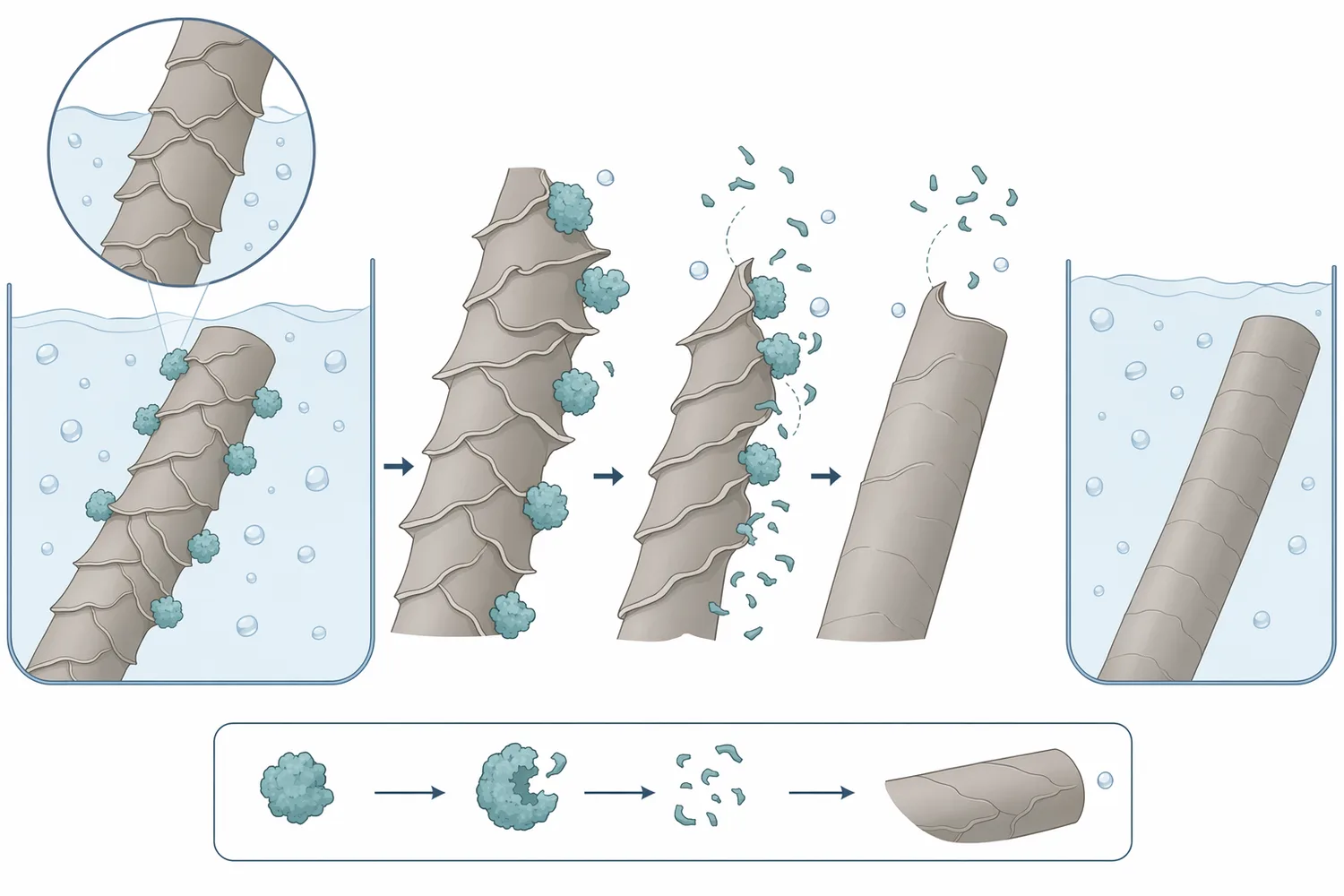
A recent study on liquid ammonia and protease surface modification illustrates the practical logic: liquid ammonia can alter or open the wool surface, while protease can then act on exposed protein regions to improve shrink resistance. The important point is that the enzyme is being used as a surface-modifying tool rather than a bulk fiber-dissolving chemical. The most valuable outcome is a fiber surface that is less prone to directional interlocking, while the interior cortex remains sufficiently intact to preserve strength, resilience, and handle [2].
Pilling is another surface-driven defect. Pills form when loose fiber ends or surface fuzz protrude from the fabric, entangle under rubbing, and remain attached as small balls on the surface. Wool knitwear and soft wool fabrics are particularly vulnerable because the structures that give comfort and bulk can also allow fibers to work out of the yarn surface during wear. Anti-fuzzing and pilling treatments for wool knitted fabrics have therefore been a specific research topic, with surface treatment used to reduce the formation and retention of pills [4].
Protease can support anti-pilling performance in two related ways. First, controlled hydrolysis can reduce the strength or persistence of fine protruding surface fibrils, so they are more easily removed during finishing rather than remaining as pill anchors. Second, smoothing or slightly eroding cuticle edges can reduce the mechanical catching that helps fibers entangle. The enzyme does not make wool “synthetic” or eliminate natural wool character; it changes the topmost protein surface enough that abrasion and laundering generate fewer persistent surface defects.
The mechanism is similar to textile biopolishing, but the substrate is different. On cotton, cellulase acts on cellulose microfibrils; on wool, protease acts on keratinaceous surface material. That distinction is important because wool is itself a protein fiber, so excessive treatment can move beyond useful surface polishing and become damaging bulk hydrolysis. Anti-pilling protease finishing is therefore best understood as a balance: enough action to reduce fuzz and scale-related anchoring, not so much action that yarn strength, fabric weight, or handle are compromised.
The cuticle layer also affects handle, absorbency, and dyeing. Wool’s scale surface and lipid-rich outer components can slow wetting and create a barrier to uniform diffusion of dye molecules into the fiber. When the surface is lightly modified, water access and dye penetration can improve, which can support more uniform coloration and a softer perceived touch. Broader wool treatment research, including enzymatic approaches, has examined improvements in fabric properties such as wetting behavior and handle because the wool surface strongly influences how the fabric feels and processes [5].
Protease pretreatment can also influence low-temperature or lower-impact dyeing concepts. If the surface barrier is reduced, dye molecules may diffuse more readily into the fiber, which can help the dyer achieve shade development with less aggressive temperature or time conditions in suitable systems. Recent work on full-enzymatic cascade finishing for woolen textiles specifically connects anti-felting, dyeing, and additional functional finishing in a combined enzymatic workflow, showing that surface biochemistry can support more than one finishing objective when the sequence is designed carefully [6].
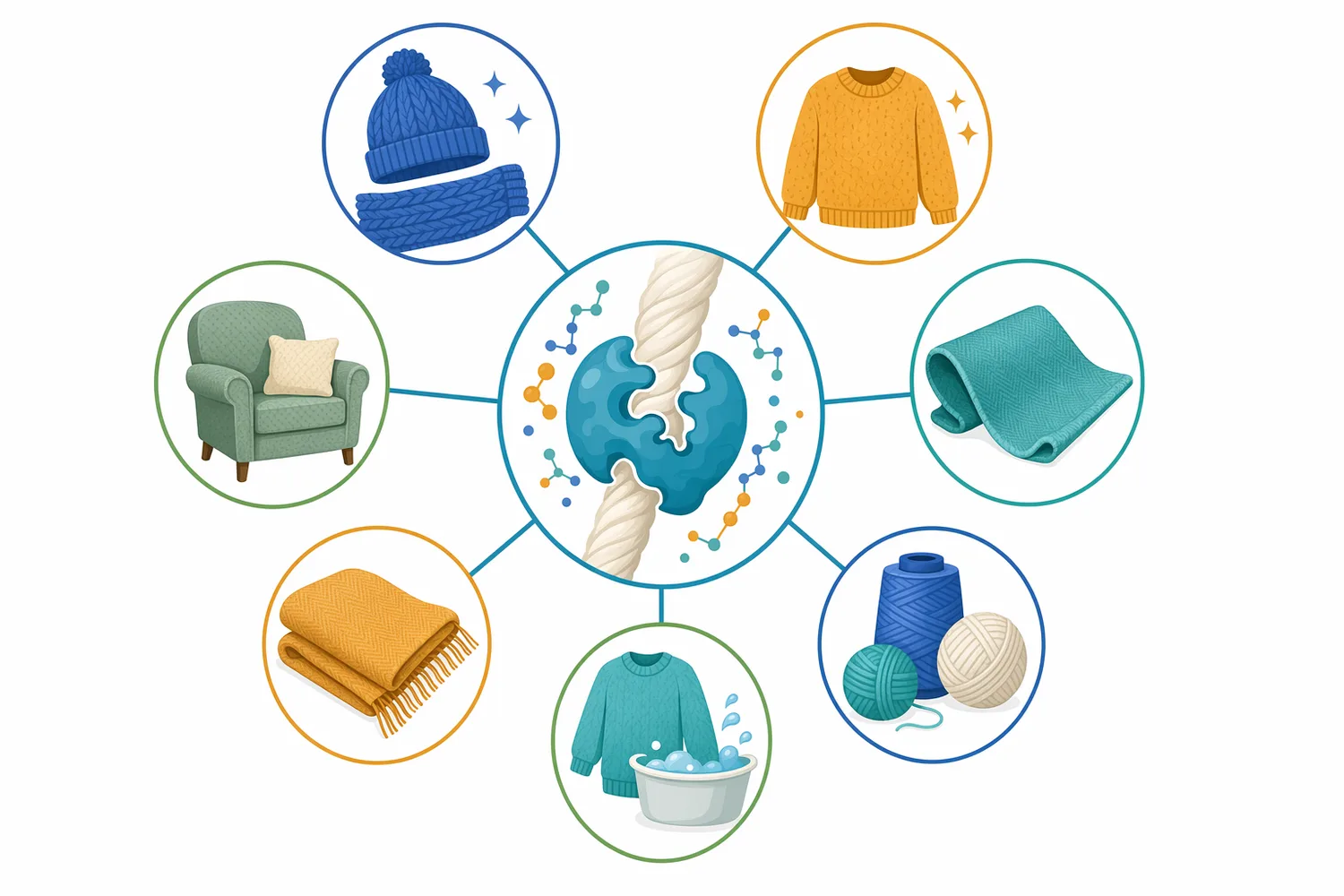
The key reaction is peptide-bond hydrolysis. Wool keratin is made of amino acid chains folded and crosslinked into a tough protein structure. Protease attacks accessible peptide bonds in surface proteins, creating shorter peptide fragments that can be loosened, washed away, or reorganized at the fiber surface. Because the enzyme is a catalyst, it is not consumed in a one-to-one stoichiometric reaction like a conventional chemical reagent; its effect depends on how much accessible substrate is present and how long the enzyme remains active in contact with the wool.
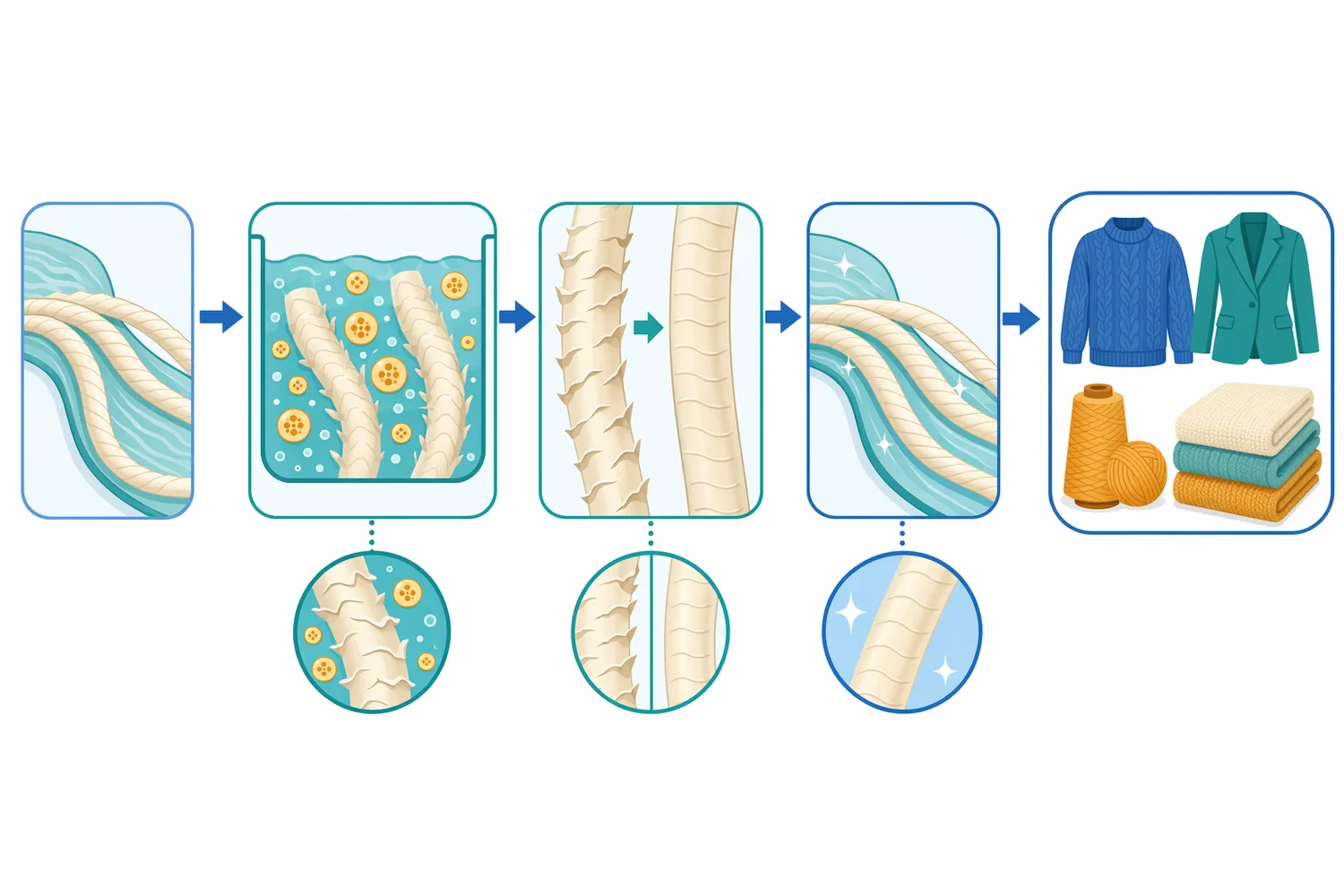
On an untreated wool fiber, the cuticle scales overlap like roof tiles. Their exposed edges create the roughness and directional friction associated with felting. A controlled protease treatment can blunt these edges, partially remove damaged scale fragments, and reduce weak protruding fibrils. What changes physically is the surface profile: less raised scale edge, less loose protein debris, and often a cleaner, smoother surface morphology. Research into engineered Protease K for wool scale-layer degradation is especially relevant because it focuses directly on improving enzyme action against the wool scale layer, the part of the fiber most responsible for shrinkage behavior [7].
This action is useful precisely because it is selective at the process level, not because wool is easy to digest. Keratin is naturally resistant: disulfide bonds, hydrophobic regions, and compact protein packing all limit enzyme access. That resistance helps prevent instantaneous fiber destruction, but it also means enzyme finishing must be assisted by good wetting, appropriate bath conditions, and sometimes compatible pretreatments. The process objective is controlled surface accessibility, not total keratin breakdown.
Felting depends heavily on differential friction. When a wet wool fiber is pushed back and forth, the scale geometry makes movement easier from root to tip than in the reverse direction. Over many agitation cycles, fibers ratchet through the yarn and fabric, becoming more entangled and compacted. By reducing the sharpness, height, or continuity of cuticle scale edges, protease treatment reduces this directional ratchet effect.
A practical way to visualize this is to compare untreated wool with a rough fish-scale surface and treated wool with slightly softened scale edges. The treated fiber can still be wool, still have cuticle structure, and still retain natural handle, but neighboring fibers have fewer mechanical points where they catch irreversibly. Studies combining mild reduction and protease treatment for dyed woolen textiles use this same principle: reducing or disrupting the scale layer can make protease action more effective for anti-felting finishing [8].
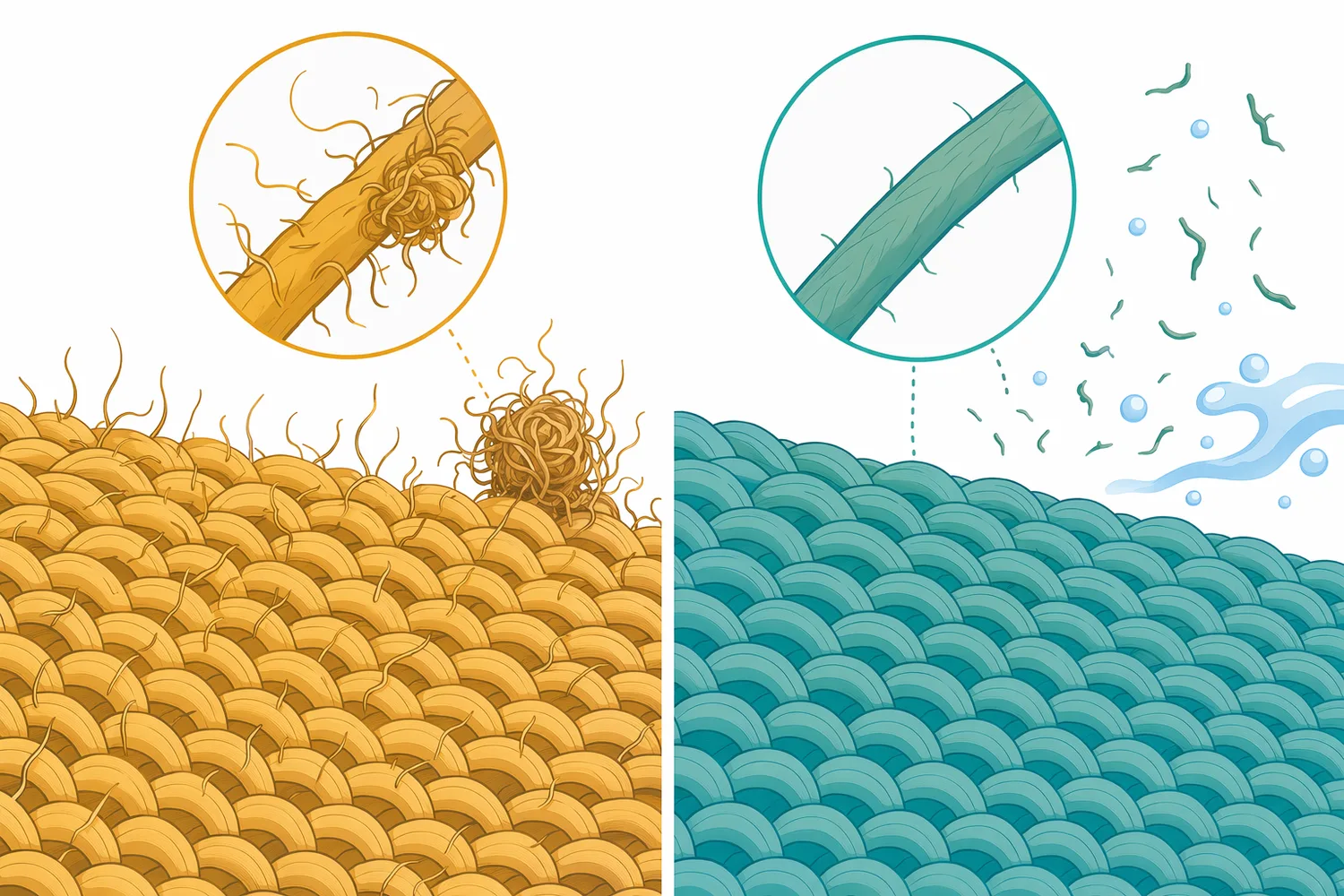
Pilling is driven by protruding fibers and fibrils. During wear, repeated rubbing pulls small fiber ends out of the yarn. If those ends are strong enough to remain attached but flexible enough to entangle, pills form and persist. Controlled protease finishing can weaken the most exposed proteinaceous fuzz at the surface so that finishing, washing, or early wear removes it before it develops into stable pills. At the same time, smoother scale edges reduce entanglement between protruding fibers.
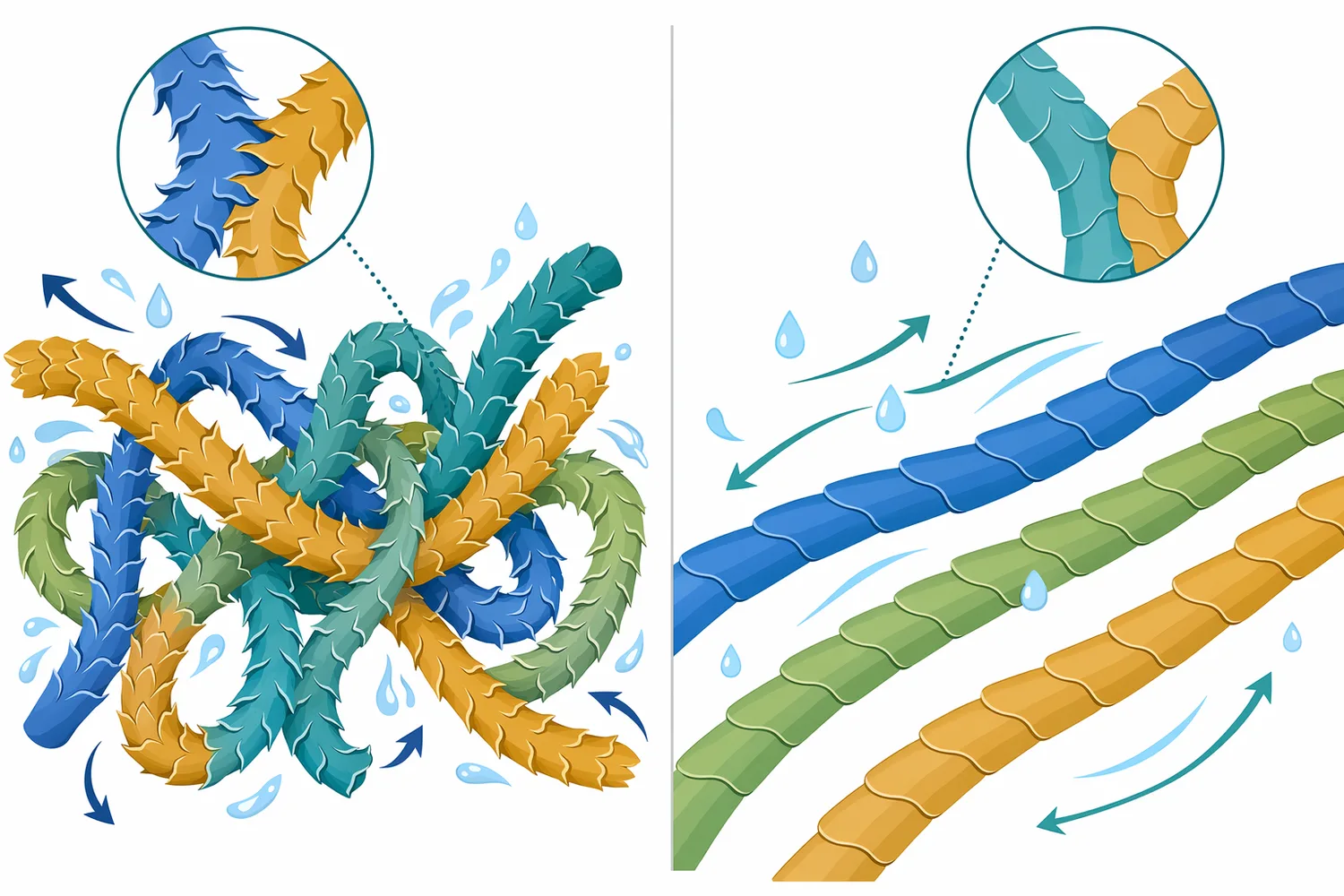
This does not mean protease should be used aggressively to “burn off” wool surface material. Wool differs from many cellulose fabrics because its useful mechanical properties depend on protein integrity throughout the fiber. If the enzyme penetrates beyond the outer scale and begins degrading the cell membrane complex or cortex, the result can be tensile strength loss, excessive weight loss, or a limp handle. The best anti-pilling effect is therefore a surface-limited effect.
Different proteases behave differently because their catalytic sites, molecular size, charge, and preferred bath conditions affect which peptide bonds they can reach and how quickly they hydrolyze them. In wool finishing research, protease types include alkaline proteases, neutral proteases, keratinolytic proteases, plant proteases, and engineered or modified proteases. The common thread is not the name of the enzyme class alone, but the ability to act on wool’s keratin-rich surface under textile-compatible conditions.
| Protease category | Conceptual operating character | What it can contribute on wool | Main caution in wool finishing |
|---|---|---|---|
| Acid protease | Generally associated with acidic bath conditions | May be relevant where the wool process is already acidic or close to dyeing conditions | Wool response, enzyme stability, and finishing result still depend on the full bath system |
| Neutral protease | Often used where milder pH conditions are preferred | Can support surface modification while fitting less aggressive process concepts | May require sufficient surface accessibility to produce strong anti-felting results |
| Alkaline protease | Common in many textile enzyme applications and often active in alkaline systems | Can give strong protein hydrolysis and scale modification where wool tolerates the process | Excess action can increase weight loss or strength loss if the treatment is not limited |
| Keratinolytic protease | Designed or selected for keratin-rich substrates | Particularly relevant for wool scale-layer modification and anti-felting research | Must be controlled because keratin is the structural material of the whole fiber |
| Modified or engineered protease | Altered to improve targeting, access, or substrate interaction | May improve scale-layer action or reduce unwanted penetration in research systems | Performance depends on the specific modification and process context |
Alkaline and keratinolytic proteases are often highlighted because wool keratin is resistant and requires enzymes capable of acting on tough protein surfaces. However, stronger hydrolysis is not automatically better. For wool finishing, the preferred result is not maximum protein digestion; it is sufficient surface change with acceptable retention of fiber performance. This is why research increasingly examines enzyme design, combined pretreatments, and process sequencing rather than simply increasing protease severity [7].
Neutral or milder protease systems can be attractive where the finishing concept is connected to dyeing, handle improvement, or lower-impact processing. The trade-off is that milder systems may need better surface preparation or longer contact to achieve the same visible scale modification. Recent cascade-finishing work is important in this respect because it frames enzymatic wool processing as a sequence of compatible biological steps rather than a single isolated reaction [6].
The strongest scientific support for wool protease is in anti-felting and shrink-resist finishing. Studies repeatedly target the cuticle scale layer because that is the structure responsible for directional friction. In work on liquid ammonia and protease treatment, the combination was used specifically for surface modification and shrink resistance, showing that protease can be part of a system designed to alter wool scale behavior without relying only on traditional oxidative chemistry [2].
Research on mild reduction plus protease treatment for dyed woolen textiles is also directly relevant. Dyed wool is more challenging than raw fiber because color, handle, and prior processing history must be preserved while shrink resistance is improved. The collaborative action described in that work reflects a practical finishing principle: a mild reducing step can disrupt disulfide-rich scale structures, making them more accessible, and protease can then hydrolyze exposed protein regions to reduce felting tendency [8].
The engineering of Protease K for efficient wool scale-layer degradation further strengthens the mechanistic evidence. Instead of treating protease as a generic additive, that study focuses on changing the enzyme’s substrate pocket to improve degradation of the wool scale layer. This supports the view that anti-felting performance depends on molecular recognition and access at the fiber surface, not merely on adding any protease to a bath [7].
Anti-pilling performance is less often isolated from other finishing outcomes, but the mechanism is consistent with the evidence on wool surface modification. Pilling begins with surface fuzz, fiber protrusion, and entanglement. Treatments that smooth the surface, reduce scale catching, or weaken loose fibrils can reduce the tendency for pills to form and remain attached.
Research specifically addressing anti-fuzzing and pilling treatment of wool plain knitted fabric shows that wool pilling is a recognized technical target in its own right, not just a cosmetic afterthought [4]. Protease is relevant because it can act at the same physical location where pilling begins: the outermost fiber and yarn surface. When incorporated into a finishing sequence, protease can help reduce the rough, catch-prone protein features that hold pills to the fabric surface.
There are also hybrid approaches to anti-pilling and antibacterial wool fabrics, showing that the industry often treats pilling as part of a broader surface-function package rather than an isolated defect [9]. Protease can fit into that broader finishing logic where the process objective is a cleaner wool surface, improved wearing appearance, and better comfort without unnecessarily heavy resin deposition.
Wool’s cuticle is naturally resistant to enzyme attack. The outer surface includes hydrophobic components and crosslinked keratin structures that limit wetting and enzyme penetration. Because of this, many successful research systems use protease together with another mild treatment that opens, reduces, swells, or otherwise prepares the scale layer. The purpose of the pretreatment is to make the right part of the wool accessible, not to damage the whole fiber.
Mild reduction is one example. Disulfide bonds are central to wool keratin strength, but the cuticle scale layer can be selectively weakened when reducing chemistry is carefully controlled. Once the scale layer is more accessible, protease can hydrolyze exposed peptide regions more evenly. The 2025 study on dyed woolen textiles using mild reduction and protease treatment is a clear example of this collaborative approach for anti-felting finishing [8].
Liquid ammonia plus protease offers another concept. Liquid ammonia can change wool surface and internal accessibility through swelling and structural modification, and protease can then act on the altered surface. The reported focus on surface modification and shrink resistance highlights why combined systems are studied: enzyme action is more useful when it reaches the surface structures responsible for felting, but less useful—and potentially harmful—if it attacks the fiber interior indiscriminately [2].
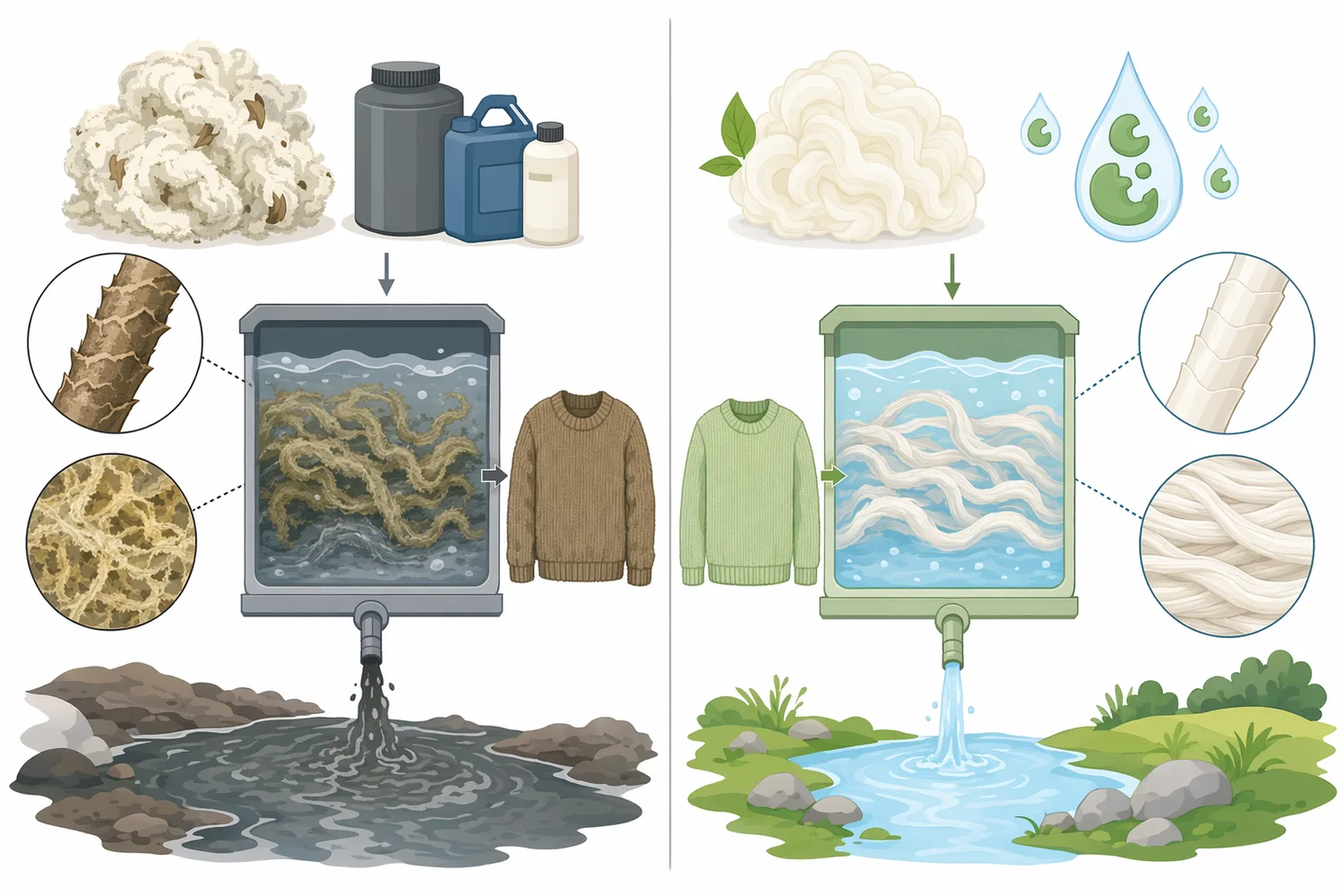
Enzymatic cascade processing is a broader version of the same principle. In a full-enzymatic three-in-one wool finishing concept, anti-felting, low-temperature dyeing, and antibacterial processing are integrated into one enzyme-centered workflow. This reflects a wider shift in textile finishing toward sequences that use biological specificity to reduce process intensity while still delivering multiple fabric functions [6].
A smoother, more accessible wool surface can improve more than shrink resistance. Dyeing depends on wetting, diffusion, and interaction between dye molecules and wool’s amino acid sites. If the cuticle barrier is reduced, dye can penetrate more readily and more evenly. This is why protease pretreatment is often discussed alongside lower-temperature dyeing or improved dyeing efficiency rather than only anti-felting.
Handle can also improve because the tactile response of wool is strongly affected by scale roughness and surface debris. A controlled protease finish can reduce harshness by removing or smoothing the most exposed proteinaceous irregularities. For the wearer, that may translate into a softer, less prickly perception, especially in finer fabrics and knitwear. Enzymatic treatment of wool fabrics with other enzyme classes, such as lipase, has also been studied for improving wool fabric properties, reinforcing the broader point that targeted enzyme treatment can change surface-related performance [5].
Wool’s value in apparel depends on comfort as much as durability. Warmth, breathability, resilience, and moisture management come from the natural fiber structure, so any finishing process must preserve the core wool character. Protease is valuable when it improves the surface problems—felting, fuzzing, pilling, wetting barriers—without stripping away the properties that make wool desirable in the first place.
Textile finishing is under pressure to reduce harsh chemicals, energy demand, and wastewater burden. Wool processing is part of that broader movement, with research exploring lower-impact dyeing, alternative solvent systems, enzymatic routes, and resource-efficient surface modification. Waterless or reduced-water wool processing using supercritical carbon dioxide has been reviewed as one example of the industry’s search for more sustainable processing routes, even though such systems come with their own technical challenges [10].
Protease finishing belongs to this sustainability conversation because enzymes can work under milder conditions and with substrate specificity. Instead of applying a broad chemical attack to the whole fiber surface, the process uses a catalyst that recognizes protein bonds. That does not make the process impact-free, and it does not remove the need for controlled washing and finishing, but it can reduce reliance on more aggressive treatment concepts where the application has been properly developed.
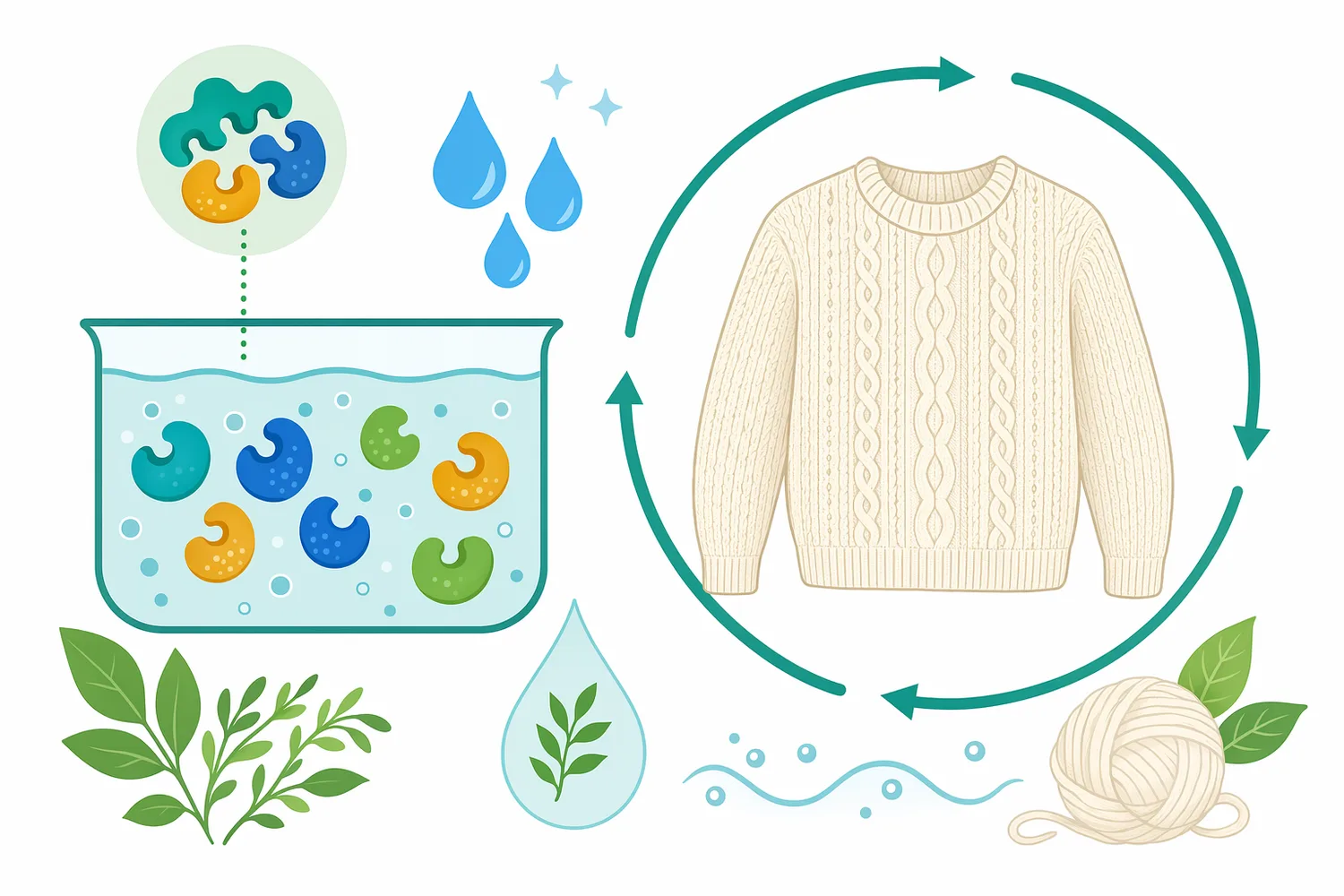
Sustainability also includes extending product life. Wool that resists felting and pilling is more likely to retain its dimensions, appearance, and comfort through repeated use. Improved durability reduces premature disposal and supports higher-value wool articles. Research into valorizing wool waste and expanding wool’s textile potential further underscores the importance of finishing methods that preserve or upgrade wool performance rather than treating wool as a difficult legacy fiber [11].
In a wool finishing workflow, protease is generally used after the fabric or fiber has been properly wetted and cleaned enough for the enzyme to contact the surface. Depending on the processing route, it may be used before dyeing, after dyeing, after a mild surface pretreatment, or as part of a combined finishing sequence. The exact placement depends on the fabric form, color stage, and finishing objective, but the functional role remains the same: controlled keratin surface modification.
For anti-felting, the enzyme treatment is directed at the cuticle scale layer. For anti-pilling, it is directed at loose surface fibrils and protruding protein structures. For dyeing support, it is directed at reducing surface barriers that slow wetting and diffusion. These are related but not identical outcomes, which is why process severity must be balanced against the desired final fabric performance.
Wool blends need particular care because non-wool fibers do not respond to protease in the same way. A wool/nylon or wool/synthetic blend, for example, contains a protein fiber alongside a polymer fiber with different chemistry and mechanical behavior. Research on wool/nylon spun yarn structure and fabric performance highlights how construction and blend structure affect textile behavior, which means the observed finishing result is not determined by enzyme chemistry alone [12].
Wool Protease should be viewed as a finishing aid for controlled surface modification, not as a universal replacement for every shrink-resist or anti-pilling technology in every fabric. The literature supports protease-based wool finishing, but it also shows why control matters: wool itself is protein, so the same reaction that improves the surface can harm the fiber if it proceeds too far.
The main risk is excessive hydrolysis. If protease action remains near the scale surface, the result can be smoother fibers, reduced directional friction, lower fuzz retention, and better wetting. If the action penetrates too deeply or continues too long, the enzyme can weaken structural protein regions that contribute to tensile strength and resilience. This is why modern research often examines modified enzymes, pretreatments, and combined finishing sequences that improve surface targeting rather than simply increasing protease intensity [7].
It is also important to expect variation across wool types and fabric constructions. Fiber diameter, scale height, yarn twist, knit or weave density, dyeing history, and previous chemical treatment all affect how much surface is exposed and how easily the enzyme reaches it. A tightly spun worsted fabric, a lofty wool knit, dyed woolen cloth, and loose wool top will not respond identically, even if the same general enzyme chemistry is used.
Enzymes.bio supplies Wool Protease – Anti-Felting & Anti-Pilling Enzyme For Wool Finishing as a direct online purchase by the 1 kg unit. The buying process is simple: place the order online, complete payment, and the order is processed and shipped. A Certificate of Analysis and Safety Data Sheet are included with the order.
This product is intended for buyers who want an accessible wool-finishing protease option for controlled textile processing. The scientific basis is strongest where the goal is surface modification of wool’s keratin scale layer for anti-felting, anti-pilling, smoother handle, and improved wet-processing behavior. Recent wool-finishing research continues to support enzyme-based and combined enzyme approaches as part of cleaner, more targeted textile finishing strategies [6].
Wool Protease works because wool is a keratin protein fiber with a scale-covered surface. Controlled protease treatment hydrolyzes accessible peptide bonds at the outer fiber surface, helping blunt scale edges, remove weak surface fibrils, reduce directional friction, and improve the way wool behaves during laundering, rubbing, dyeing, and finishing. The result can be better anti-felting and anti-pilling performance, along with improvements in softness, wetting, surface smoothness, and dyeing support.
The key is controlled surface action. Protease is most valuable when it modifies the cuticle layer enough to reduce felting and pilling while preserving the internal wool structure that provides strength, elasticity, warmth, and comfort. Research on protease surface modification, mild reduction plus protease, engineered proteases, and full-enzymatic wool finishing all points to the same practical conclusion: enzyme-based wool finishing is a credible, sustainable direction when the process is managed to protect the fiber while improving its surface performance [2].
Sold by the 1 kg unit, in stock and ready to ship. Order directly on our store — pay online and we process your order. A Certificate of Analysis and Safety Data Sheet are included with every order.
Buy Wool Protease – Anti-Felting & Anti-Pilling Enzyme For Wool Finishing →Numbered in order of first citation. Open-access sources, each verified reachable at publication; citation numbers in the text link here.