
Collagen protease is a biological enzyme preparation used to cut collagen-rich materials—such as fish skin, fish scales, cowhide, bovine hide trimmings, and leather by-products—into smaller collagen peptides or hydrolysates. In practical processing, the enzyme helps convert tough, fibrous, low-solubility collagen into more usable protein fractions for food, cosmetic, feed, biomaterial, and leather-related applications. Enzymes.bio supplies this collagen protease directly online by the 1 kg unit; the buyer pays online, the order is processed and shipped, and a Certificate of Analysis and Safety Data Sheet are provided with the order.
Collagen protease is used where the main process challenge is the structure of collagen itself. Fish skin, fish scales, cowhide, bovine hide splits, connective tissue, and some leather-processing by-products contain a high proportion of collagen or collagen-associated proteins. These materials are valuable, but native collagen is not easy to dissolve or convert because it is built as a strong structural protein rather than as a readily soluble food protein or formulation ingredient. Reviews of aquatic collagen describe fish and other marine by-products as increasingly important collagen resources, especially where processors want to turn side streams into higher-value materials instead of waste [1].
The enzyme’s role is to hydrolyze peptide bonds in collagen or collagen-derived materials. In other words, it cuts long protein chains into shorter peptide fragments. That change is important because peptide size affects solubility, viscosity, emulsifying behavior, bitterness, bioactivity testing results, digestibility, and how the material behaves in a finished formulation. Research on collagen hydrolysates extracted from leather by-products, for example, shows that hydrolysis changes functional properties such as emulsifying behavior, confirming that collagen is not just “broken down” but chemically transformed into a different functional ingredient system [2].
For fish skin and cowhide processing, the practical value is controlled biological conversion. Instead of relying only on harsh chemical hydrolysis or prolonged heat treatment, enzymatic hydrolysis can be used to generate soluble collagen peptides under aqueous conditions. In leather-related processing, proteolytic enzymes are also widely discussed as part of cleaner production strategies because they can help replace or reduce some aggressive chemical operations when used in an appropriate stage of the process [3].
Collagen is mechanically strong because its molecules are arranged in a triple-helical structure that assembles into fibrils and fibers. A simplified way to picture it is as three protein chains wound around each other, then bundled into larger rope-like structures. This is exactly why skin and hide are durable: collagen is designed to resist tearing, swelling, and ordinary biological attack. Aquatic collagen reviews emphasize that collagen performance depends on the relationship between source, extraction, structure, and function, which is why fish collagen processing is not simply a matter of dissolving protein in water [1].
This structural resistance creates a processing problem. Native collagen has limited solubility, and large collagen fibers are difficult to incorporate into beverages, powders, cosmetics, feed liquids, or uniform biomaterial systems. Hydrolysis changes that behavior by reducing the average molecular size of the protein. Fish-skin collagen hydrolysates are commonly described as peptide mixtures produced by enzymatic treatment of collagen or gelatin, and studies often report peptide fractions in lower molecular-weight ranges, including hydrolysates below about 20 kDa depending on the process [4].
Cowhide and bovine hide present the same basic challenge, but with additional complexity. Hide collagen may be raw, limed, acid-swollen, partially tanned, mechanically split, gelatinized, or present in a leather by-product stream. Each state affects how accessible the collagen chains are to enzymatic cutting. Work on collagen and hydrolysates from leather by-products confirms that the origin and processing history of the substrate influence the properties of the resulting hydrolysate, including its functional behavior in systems such as emulsions [2].
At the molecular level, collagen protease attacks peptide bonds in accessible regions of collagen or gelatinized collagen. The enzyme does not “melt” hide or fish skin in a nonspecific way. It recognizes susceptible protein-chain regions, binds to them, and catalyzes bond cleavage. Each cleavage shortens a protein chain, increases the number of chain ends, and can release peptides that were previously locked into an insoluble fibrillar network. Protease studies in leather and protein processing repeatedly show that enzymatic action is stage- and substrate-dependent rather than a universal dissolving reaction [5].
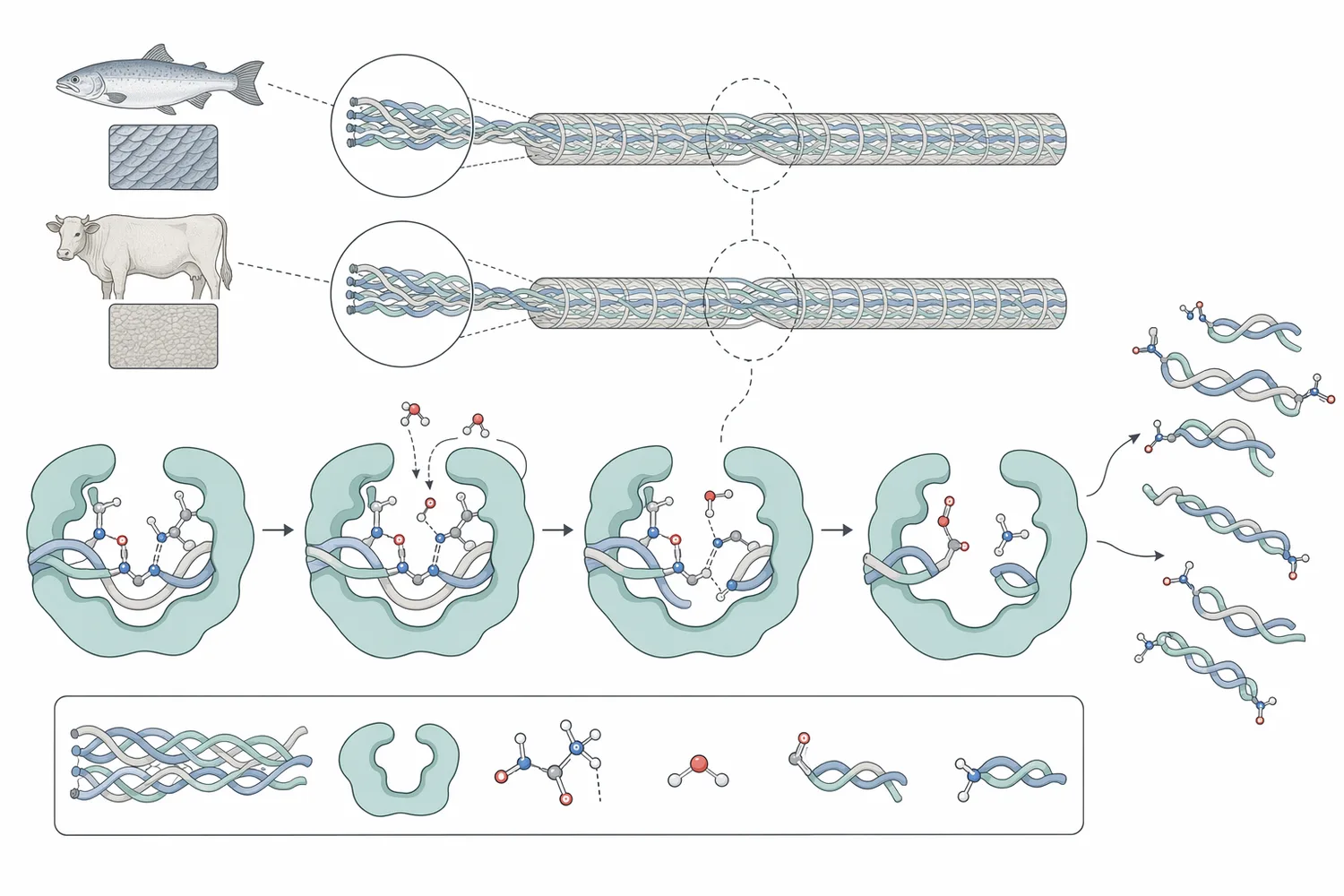
As hydrolysis proceeds, several practical changes can be observed in the material. Insoluble collagen becomes more dispersible; solution viscosity may fall as long chains are shortened; the liquid phase can gain soluble nitrogen and peptides; and the remaining solid residue may become softer or easier to separate. In peptide production, the same chemistry creates a distribution of peptide sizes rather than a single molecule. This is why collagen hydrolysate is best understood as a controlled peptide mixture, not as purified native collagen. Studies of enzymatic collagen hydrolysis using fungal collagenase systems show that reaction conditions and process intensification methods, such as ultrasound assistance, can influence the resulting peptide generation and functional testing outcomes [4].
The enzyme also changes surface properties. Large collagen molecules have limited mobility at oil-water or air-water interfaces, whereas shorter hydrolysate peptides may diffuse faster and expose hydrophobic and hydrophilic regions differently. This can improve, reduce, or otherwise alter emulsifying properties depending on how far hydrolysis proceeds. The 2025 study on collagen and hydrolysates from leather by-products specifically examined how protein hydrolysis affects emulsifying properties, illustrating that hydrolysis degree and protein structure are directly connected to ingredient functionality [2].
Fish skin is one of the most studied substrates for collagen protease applications because it is abundant, collagen-rich, and often underused. Fish-processing side streams can include skin, scales, bones, heads, frames, and connective tissue. Aquatic collagen research frames these materials as part of sustainable sourcing because they can reduce waste while producing collagen, gelatin, or collagen peptide ingredients with potential use in food, cosmetic, and biomedical-material development [1].
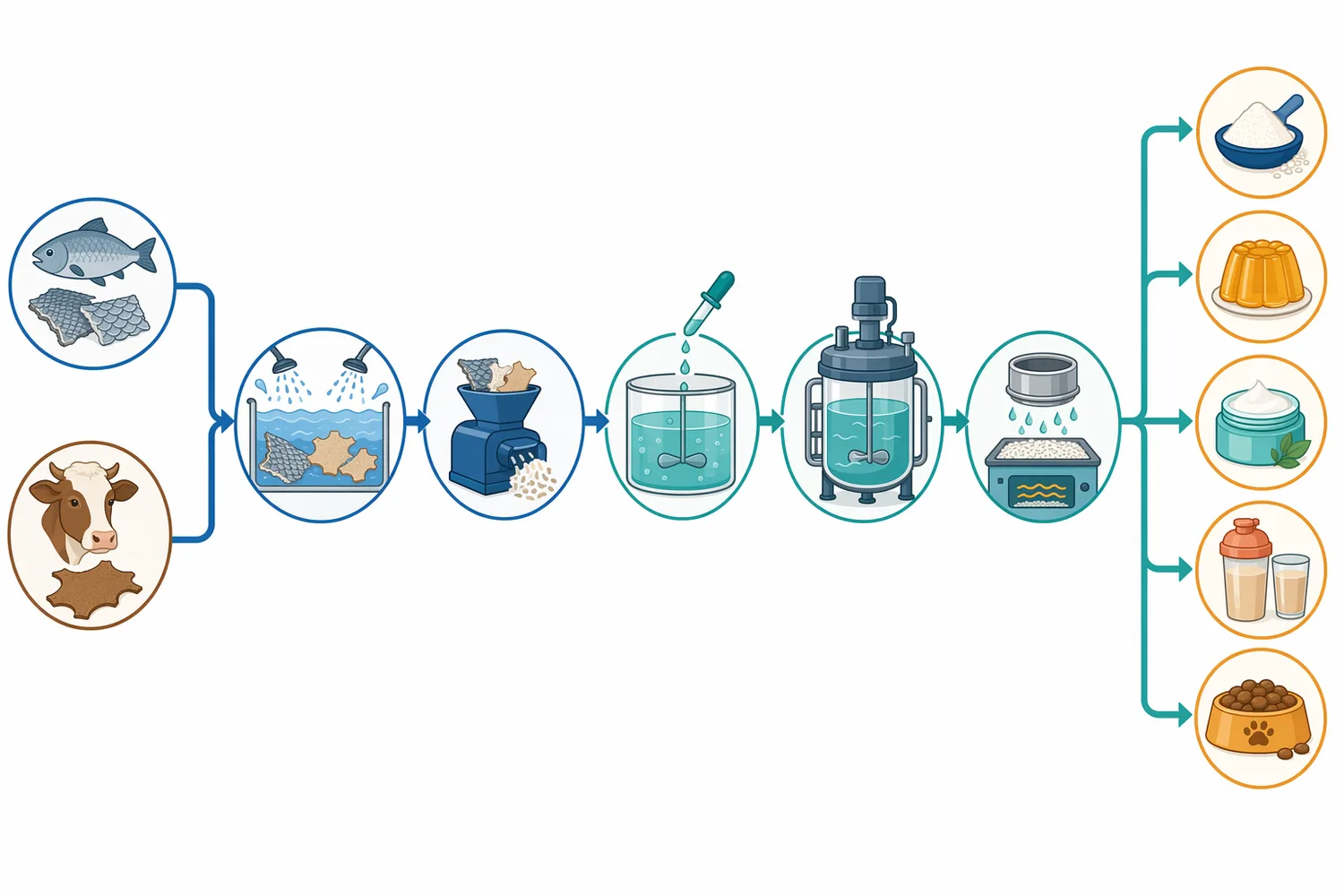
The typical sequence is preparation, collagen exposure, enzymatic hydrolysis, separation, and drying or formulation. Preparation may include washing, size reduction, removal of non-collagen proteins, defatting, demineralization for scales or bones, or conversion of collagen to gelatin-like material before enzymatic treatment. The reason these steps matter is physical access: the enzyme must reach peptide bonds. If collagen remains buried in dense, mineralized, fatty, or cross-linked tissue, hydrolysis is slower and less uniform. Research on aquatic collagen consistently links source handling and extraction design to the structure and function of the final collagen material [1].
Published fish-collagen hydrolysis work shows that enzyme choice and process design change peptide size and activity profiles. In one fish-scale and skin study, collagen and elastin accounted for about 76–86% of the protein mass, demonstrating why these by-products are attractive substrates for hydrolysis. The same work compared thermal, enzymatic, enzymatic-thermal, and electrochemical approaches and reported that enzymatic and enzymatic-thermal hydrolysis affected amino acid composition, molecular-weight distribution, and antioxidant activity.
Another study hydrolyzed codfish-skin collagen with alcalase for 120 minutes and evaluated resulting peptides for antioxidant and ACE-inhibition-related activity in the tested model. Those results are useful because they show a concrete outcome of enzymatic collagen hydrolysis: a tough fish-skin collagen source can be converted into a peptide mixture with measurable functional properties under defined study conditions. They should not be read as a guarantee that every collagen protease process produces the same activity, because peptide sequence and size distribution depend strongly on substrate and process design.
Enzyme combinations can also change peptide profiles. A fish-skin collagen study using alkaline protease, papain, and ginger protease reported that adding ginger protease increased degree of hydrolysis and shifted the fraction of peptides below 400 Da from 49.82% to 58.56%. That is a concrete example of how different protease specificities alter the final peptide pool: more cleavage sites become available, more small peptides are released, and the resulting hydrolysate has a different molecular-weight distribution.
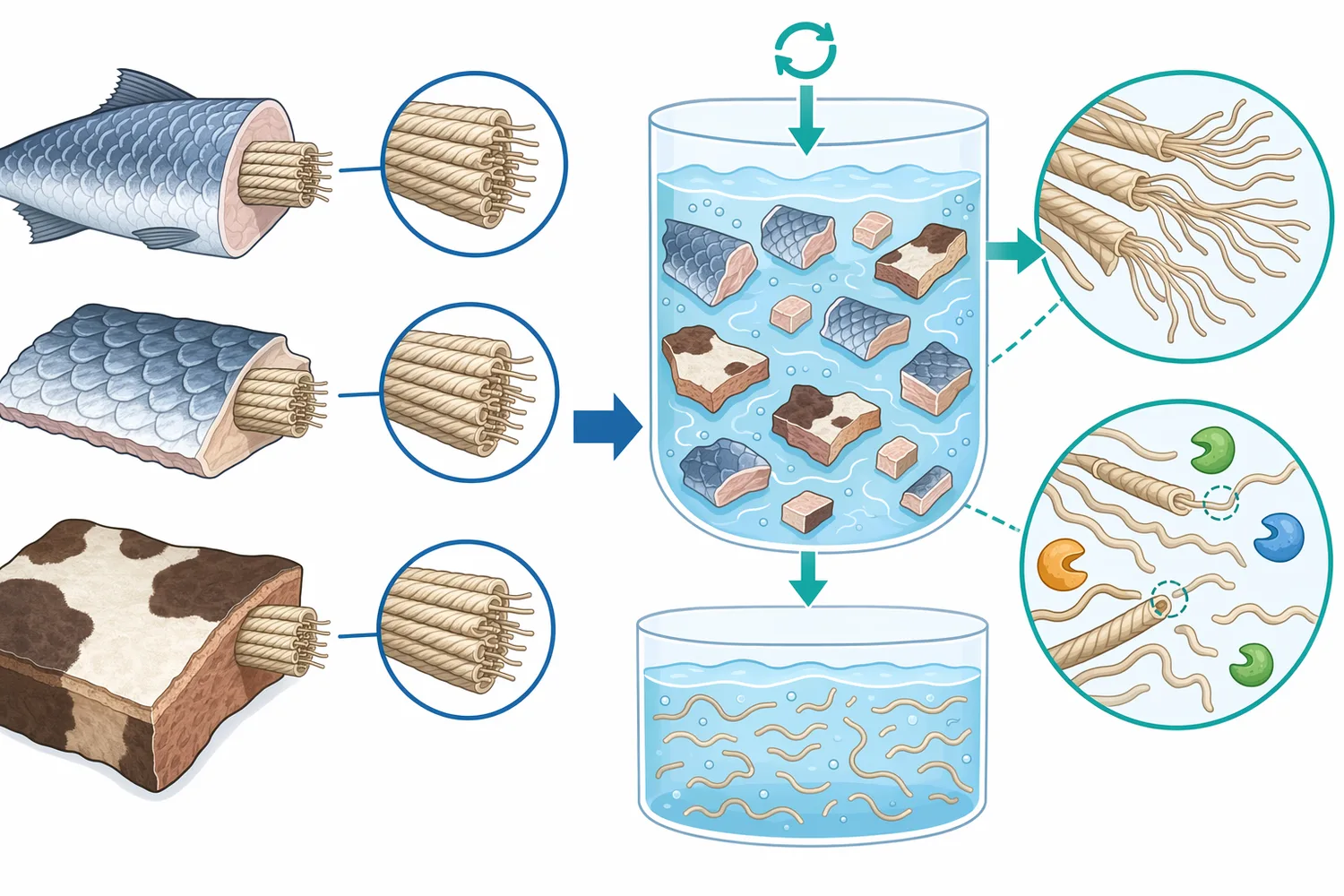
Cowhide is primarily a collagen substrate, but it behaves differently from fish skin because of its thickness, fiber density, cross-linking, and processing history. In raw or minimally processed hide, collagen fibers are strongly organized and physically protected. In limed, delimed, pickled, split, shaved, tanned, or partially degraded materials, the collagen network has already been chemically and mechanically altered. These changes affect how a protease reaches and cuts the substrate. Leather-processing reviews describe enzymes as useful across several stages, but they also make clear that enzyme application must be aligned with the desired transformation of the hide matrix [5].
For collagen hydrolysate production from cowhide or leather by-products, the goal is usually deeper conversion than in leather finishing. The process may aim to solubilize collagen, generate gelatin-like intermediates, or produce peptide-rich hydrolysates. Research on collagen and hydrolysates extracted from leather by-products demonstrates that enzymatic hydrolysis can change functional properties relevant to ingredient use, including emulsification. That is important because it supports the idea that hide by-products can be converted into functional protein materials rather than remaining low-value waste [2].
In leather manufacture itself, the objective is different. The collagen fiber network must remain strong enough to become leather. Protease use in leather processing therefore needs to be controlled so that non-collagenous proteins, interfibrillar materials, or unwanted residues can be modified without excessive damage to the collagen fiber structure. Reviews of sustainable leather processing identify enzymatic methods as part of cleaner production strategies, but not as a license for uncontrolled protein breakdown [3].
Recent work on a crude proteolytic enzyme from Bacillus halodurans BCRC 910501 illustrates the continuing interest in proteases for leather processing. Such studies are relevant because they show that microbial proteases can perform useful hide-processing functions under process-like conditions. The key distinction for buyers of a collagen protease product is whether the intended application is controlled hide modification, leather-processing support, or full collagen hydrolysis into soluble peptides [6].
Different proteases act best under different chemical conditions, and this affects how they interact with collagen-rich substrates. The table below gives a conceptual comparison. It is not a product specification and does not define a required operating recipe; it is a practical way to understand why enzyme behavior changes across fish skin, cowhide, gelatin, and leather by-product streams.
| Protease environment | Typical collagen-processing relevance | What changes in the substrate | Practical interpretation |
|---|---|---|---|
| Acidic protease conditions | Often associated with collagen extraction, acid-swollen materials, or processes where collagen fibers are opened before hydrolysis | Acid swelling can loosen fiber packing and expose more peptide bonds, especially when combined with mechanical preparation | Useful conceptually where collagen accessibility is the limiting factor rather than only enzyme strength |
| Neutral protease conditions | Can be relevant for milder hydrolysis where extreme pH is undesirable | Protein chains are cleaved without strongly alkaline swelling; hydrolysis may be gentler depending on substrate state | Often considered where the goal is controlled peptide release with less aggressive chemical change |
| Alkaline protease conditions | Common in many industrial protein hydrolysis and leather-related enzyme studies | Alkalinity can help swell or open some protein matrices while protease cleavage reduces chain length | Can generate efficient hydrolysis, but excessive action may over-break proteins or weaken collagen structures if the final material must remain fibrous |
The reason this distinction matters is that collagen accessibility and enzyme specificity work together. A protease may be active, but if peptide bonds are buried inside tightly packed fibrils, hydrolysis remains limited. Conversely, a swollen or gelatinized substrate may hydrolyze quickly because many peptide bonds are exposed. Prolyl-specific peptidase research is also relevant to collagen-rich proteins because collagen contains repeating sequences rich in proline and hydroxyproline, and enzymes that recognize proline-adjacent regions can strongly influence peptide patterns in food protein hydrolysis [7].
Thermal treatment can denature collagen and convert it toward gelatin-like materials, making the protein more accessible to proteases. However, heat alone can produce broad molecular changes and may not deliver the same peptide distribution as enzymatic treatment. Enzyme-catalyzed hydrolysis is more selective because peptide bonds are cut according to enzyme specificity and substrate accessibility. Ultrasound-assisted enzymatic collagen hydrolysis research shows that combining physical processing with collagenase action can enhance hydrolysis outcomes, illustrating the difference between simply heating a substrate and actively catalyzing bond cleavage [4].
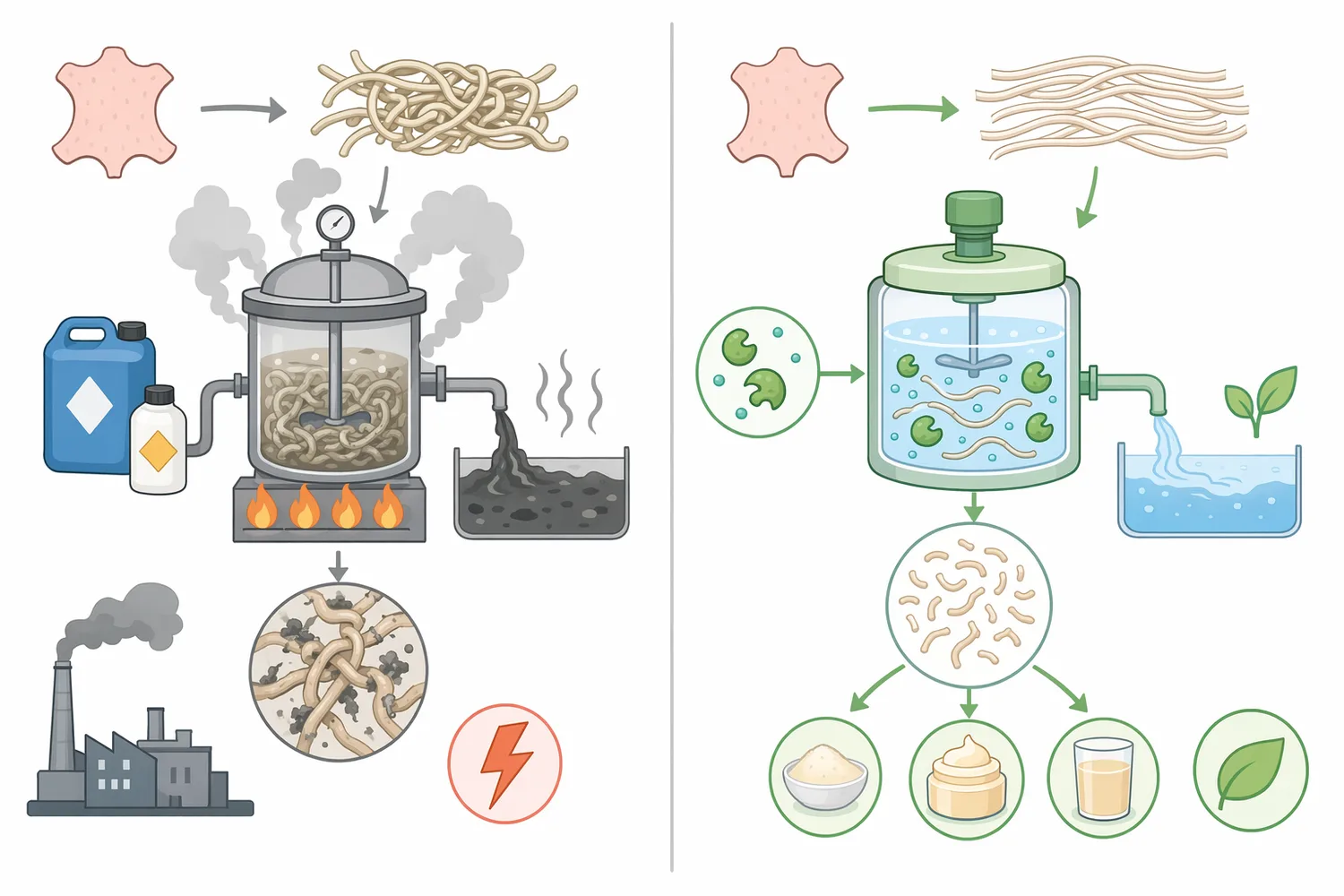
Chemical hydrolysis can be forceful, but that is both its strength and its limitation. Strong acid or alkali can break protein down extensively, yet may also alter amino acids, color, odor, salt load, or functional behavior. Enzymatic hydrolysis is valued because it can operate in water under milder conditions and can be stopped when the desired peptide profile is reached. Sustainable leather-processing reviews place enzymes within a broader shift toward cleaner production because they may reduce dependence on harsh chemical steps in selected operations [3].
For collagen peptides, “more hydrolysis” is not automatically better. A lightly hydrolyzed collagen may retain some film-forming, gelling, or emulsifying properties, while a deeply hydrolyzed material may become highly soluble but lose gel strength or develop taste issues in food systems. The study of collagen hydrolysates from leather by-products highlights this tradeoff by connecting hydrolysis with emulsifying behavior, showing that functional performance depends on how far the protein structure is modified [2].
The most immediate outcome of collagen protease treatment is improved solubility. Large, fibrous collagen becomes smaller peptide fragments that disperse more readily in water. This is especially important for fish-skin collagen peptide powders, liquid nutrition systems, cosmetics, feed liquids, and biomaterial precursor solutions. Aquatic collagen research repeatedly links hydrolysis and processing design to downstream function, because peptide size and structure influence how the material behaves in final applications [1].
Peptide size distribution is one of the most important technical outcomes. The fish-skin collagen study that shifted peptides below 400 Da from 49.82% to 58.56% demonstrates that enzyme systems can move the hydrolysate toward smaller fractions. Smaller peptides often dissolve more easily and may show different sensory, biological, or interfacial properties than larger collagen fragments. At the same time, very small peptides are not always preferred for every application, especially where texture, film formation, or viscosity contribution is useful.
Bioactivity studies are a major reason collagen hydrolysis receives attention, but they must be interpreted carefully. Published work reports antioxidant activity, ACE-inhibition-related activity, wound-healing-related responses, and other in vitro or model-system outcomes from collagen peptide mixtures. These findings show that enzymatic hydrolysis can generate peptides worth studying, not that every hydrolysate is automatically a therapeutic ingredient. The codfish-skin collagen study with 120 minutes of alcalase hydrolysis is best understood in that way: a defined research process produced peptides with measurable activity in the test systems used.
Collagen sources beyond fish and bovine hide also support the same principle. Jellyfish collagen, for example, is being discussed as a way to transform marine biomass challenges into collagen opportunities. Such work reinforces a broader trend: collagen-rich biological materials become more useful when their structure is converted into stable, soluble, application-specific collagen or peptide fractions [8].
Leather processing is one of the areas where protease value and risk must be understood together. Enzymes can support soaking, bating, fiber opening, removal of unwanted proteinaceous matter, and waste reduction. However, leather quality depends on preserving enough collagen fiber strength. If a protease over-hydrolyzes structural collagen during a stage intended only for cleaning or softening, the result can be loose grain, poor strength, or excessive weight loss. Enzyme applications in leather processing are therefore best viewed as controlled biological modifications rather than general-purpose digestion [5].
The leather industry is also under pressure to reduce environmental impact. Reviews of cleaner leather processing discuss enzyme-assisted operations alongside other approaches to reduce chemical load, improve waste management, and make processing more sustainable. In that context, collagen protease can support cleaner conversion when the target is a by-product stream or a controlled process step, but it does not replace the need for overall process control [3].
Protein hydrolysates can also re-enter leather systems. For example, keratin hydrolysate has been studied as a chrome exhaust aid and keratin filler in a cleaner technology approach for tannery solid waste management. Although keratin is different from collagen, that work supports a related industrial idea: proteinaceous wastes can be enzymatically or chemically converted into functional process aids, reducing disposal burden and creating value inside leather manufacturing routes [9].
Fish-skin collagen peptide production is the most direct application. The enzyme helps convert prepared fish skin or extracted fish collagen into soluble peptide mixtures for ingredient development. Depending on the final formulation, hydrolysates may be dried into powders, incorporated into liquids, blended with other proteins, or used as starting materials for further fractionation. Aquatic collagen research highlights the importance of linking source selection, process design, and final structure-function performance [1].
Fish-scale and mixed fish by-product valorization is another important use. Scales are more mineralized than skin, so preparation is especially important, but their high collagen content makes them attractive for peptide recovery. The reported 76–86% collagen and elastin contribution to protein mass in fish scales and skin demonstrates why these side streams are technically meaningful rather than marginal protein sources.
Cowhide and bovine-hide collagen hydrolysis can support recovery of protein from trimmings, splits, and other collagen-rich by-products. Enzymatic treatment can create soluble hydrolysates with altered emulsifying or formulation behavior. This is particularly relevant where a by-product has already passed through mechanical or chemical steps that make collagen more accessible than intact raw hide [2].
Cosmetic, nutraceutical, and biomaterial research also uses collagen peptides because hydrolysis changes size, solubility, and biological interaction. Aquatic collagen is studied for tissue repair and biomedical translation because source, extraction, and structure all affect function. The same principle applies to cosmetic and nutrition systems: a collagen peptide ingredient is defined not only by being “collagen-derived,” but by its peptide profile and processing history [1].
Animal feed and pet-food applications are another practical area. Collagen-rich materials can be difficult to digest or formulate when left intact, while hydrolysates can be easier to disperse and incorporate. Enzymatic hydrolysis of protein by-products is widely used as a way to improve utilization of secondary raw materials, although the final nutritional and sensory result depends on the substrate and hydrolysis extent [7].
Collagen protease is a powerful processing aid, but it is not a one-step solution for every collagen material. Native collagen is resistant because of its triple-helical and fibrillar structure. The more intact, cross-linked, fatty, mineralized, or physically dense the substrate is, the more important preparation becomes. This is why fish skin, gelatin, acid-swollen collagen, limed hide, and finished leather by-products can respond very differently to the same general type of enzyme treatment [1].
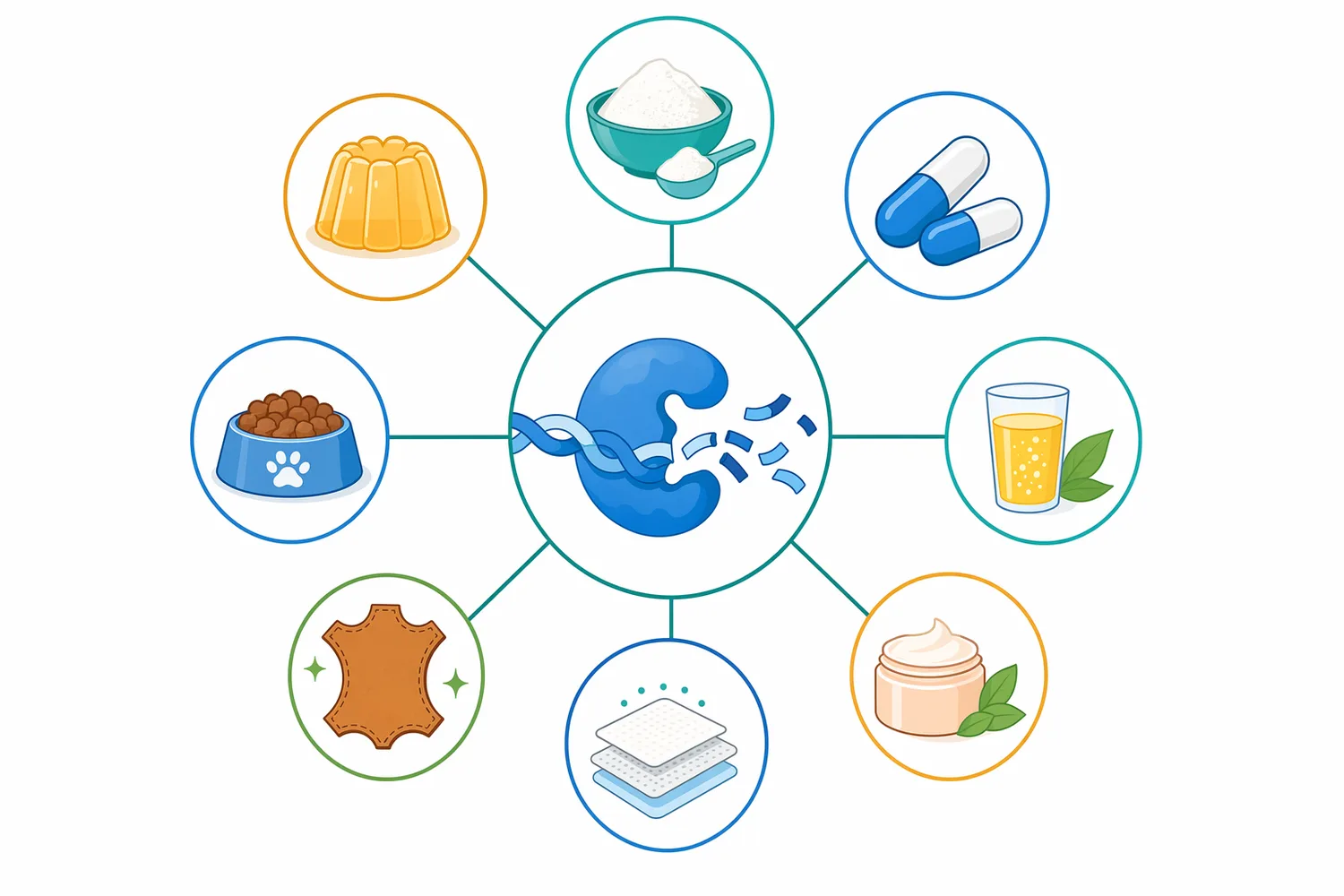
The endpoint also matters. Partial hydrolysis can improve solubility or modify texture while preserving some larger peptide functionality. Deeper hydrolysis can produce smaller peptides and lower viscosity, but may reduce film-forming or gel-forming behavior. In leather processing, too much collagen hydrolysis is usually undesirable if the hide is intended to become leather; in waste valorization or peptide production, deeper hydrolysis may be exactly the goal. Reviews of enzymes in leather processing emphasize that enzyme benefits depend on the operation and the degree of protein modification [5].
Bioactivity should be treated as application-specific evidence, not a universal claim. Studies showing antioxidant activity, ACE-inhibition-related activity, or other biological effects are valuable, but the results depend on the species, tissue, enzyme, reaction time, peptide size, purification, model system, and finished formulation. The 120-minute codfish-skin alcalase study and the fish-skin composite-enzyme study are useful examples because they report defined outcomes from defined processes rather than broad claims about all collagen hydrolysates.
Enzymes.bio supplies collagen protease as an online product for buyers who need a biological enzyme for collagen hydrolysis and collagen-rich material processing. The product is sold directly online by the 1 kg unit: the order is placed online, payment is completed online, and the order is processed and shipped. A Certificate of Analysis and Safety Data Sheet are included with the order.
This product is relevant where the intended process involves fish skin, fish scales, cowhide, bovine hide by-products, collagen-containing trimmings, gelatin-like intermediates, or leather-related protein streams. The strongest technical rationale is controlled protein conversion: protease action reduces collagen chain length, increases soluble peptide formation, and changes functional properties in ways that heat or harsh chemistry alone may not control as selectively [4].
Collagen protease helps convert tough collagen-rich substrates into smaller, more usable peptide fractions. In fish skin and aquatic by-products, evidence supports enzymatic hydrolysis as a practical route to collagen peptides with altered solubility, molecular-weight distribution, and functional testing outcomes. In cowhide and leather by-products, protease treatment can support hydrolysate production, process modification, and cleaner use of protein-rich side streams when collagen damage is controlled according to the intended application [3].
The value is not simply that the enzyme “breaks protein.” The value is that it provides a biological cutting mechanism for collagen: peptide bonds are cleaved, fibrillar material becomes more soluble or dispersible, peptide size distribution shifts, and the resulting hydrolysate behaves differently in formulation or processing. For buyers working with fish skin, cowhide, or collagen-rich by-products, collagen protease is a practical tool for turning resistant structural protein into process-ready collagen hydrolysate or peptide material.
Sold by the 1 kg unit, in stock and ready to ship. Order directly on our store — pay online and we process your order. A Certificate of Analysis and Safety Data Sheet are included with every order.
Buy Collagen Protease Fish Skin Cowhide Processing Biological Enzyme Collagen Hydrolysis →Numbered in order of first citation. Open-access sources, each verified reachable at publication; citation numbers in the text link here.