
Debranching Enzyme for Brewing Industry is used in brewing to hydrolyze the branch points in starch-derived dextrins, especially the α-1,6 linkages found in amylopectin. By opening those branched structures, it makes more carbohydrate available to amylases, which can support more complete starch conversion, improved wort fermentability, and better use of adjunct or gluten-free raw materials.
For brewers, the practical value is simple: debranching enzyme does not replace the normal mash enzyme system, but it removes a structural obstacle that standard starch-degrading enzymes often leave behind. Enzymes.bio supplies Debranching Enzyme for Brewing Industry as a B2B ingredient sold directly online by the 1 kg unit; the buyer pays online, the order is processed and shipped, and a Certificate of Analysis and Safety Data Sheet come with the order.
A debranching enzyme is a targeted starch-conversion aid. In brewing, the most relevant debranching activity is commonly associated with pullulanase, an enzyme class recognized for hydrolyzing α-1,6-glucosidic linkages in pullulan, amylopectin, starch-derived dextrins, and related oligosaccharides. Reviews of microbial starch-debranching enzymes describe pullulanases as important industrial enzymes because they act on the branch-point bonds that many other amylolytic enzymes do not efficiently remove [1].
That distinction matters because brewing starch is not one uniform molecule. Malted barley, adjunct grains, and many gluten-free raw materials contain starch as a mixture of amylose and amylopectin. Amylose is mostly linear, built mainly from α-1,4-linked glucose units, while amylopectin contains many α-1,4 chains connected through α-1,6 branch points. Research on cereal starch structure in wheat confirms that branching enzymes strongly influence amylose and amylopectin fine structure, showing why starch architecture has a direct effect on how easily enzymes can convert it during processing [2].
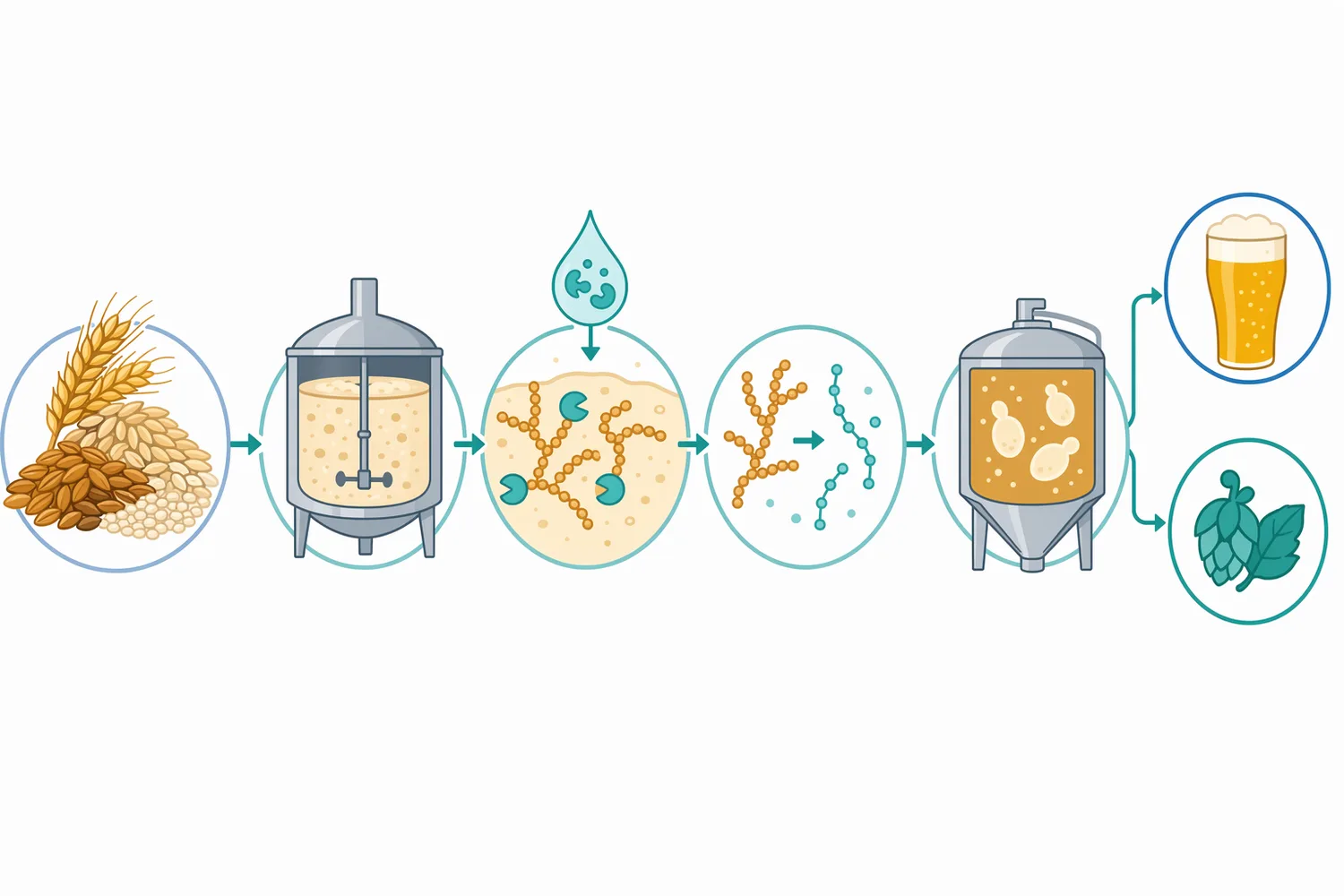
During mashing, α-amylase, β-amylase, and other carbohydrate-active enzymes attack accessible starch chains and dextrins. They reduce long polymers into smaller dextrins, maltose, glucose, and other sugars, but α-1,6 branch points can remain as limit structures. A debranching enzyme changes that substrate physically and chemically: it cuts the branch junction, releases side chains, increases the proportion of linear maltooligosaccharides, and gives amylases more workable chain ends and less-branched material to process.
The substrate-level effect can be pictured as a branched tree being converted into straight sticks. Amylopectin starts as a densely branched polymer: long α-1,4 glucan chains form the “branches,” while α-1,6 bonds form the “junctions.” Debranching enzyme hydrolyzes those α-1,6 junctions, so a branched dextrin becomes a set of shorter or less-branched chains that can be further hydrolyzed by the rest of the starch-conversion system. Studies of debranching enzymes in starch biology distinguish pullulanase and isoamylase as enzymes that act on amylopectin architecture, reinforcing that branch-point hydrolysis is a defined biochemical function rather than a generic “starch breakdown” claim [3].
This mechanism is especially useful because amylases do not all perform the same job. α-Amylase cuts internal α-1,4 bonds and rapidly reduces starch size, helping liquefy the mash. β-Amylase works from non-reducing ends to release maltose but slows or stops when it approaches a branch point. Glucoamylase can release glucose from chain ends and, depending on enzyme type and conditions, may act more broadly on dextrins. Debranching enzyme complements these activities by removing α-1,6 obstacles that otherwise interrupt linear hydrolysis. Microbial debranching enzyme research emphasizes that substrate specificity is shaped by enzyme binding regions, which helps explain why a pullulanase-type enzyme behaves differently from an α-amylase even though both act on starch-derived materials [4].
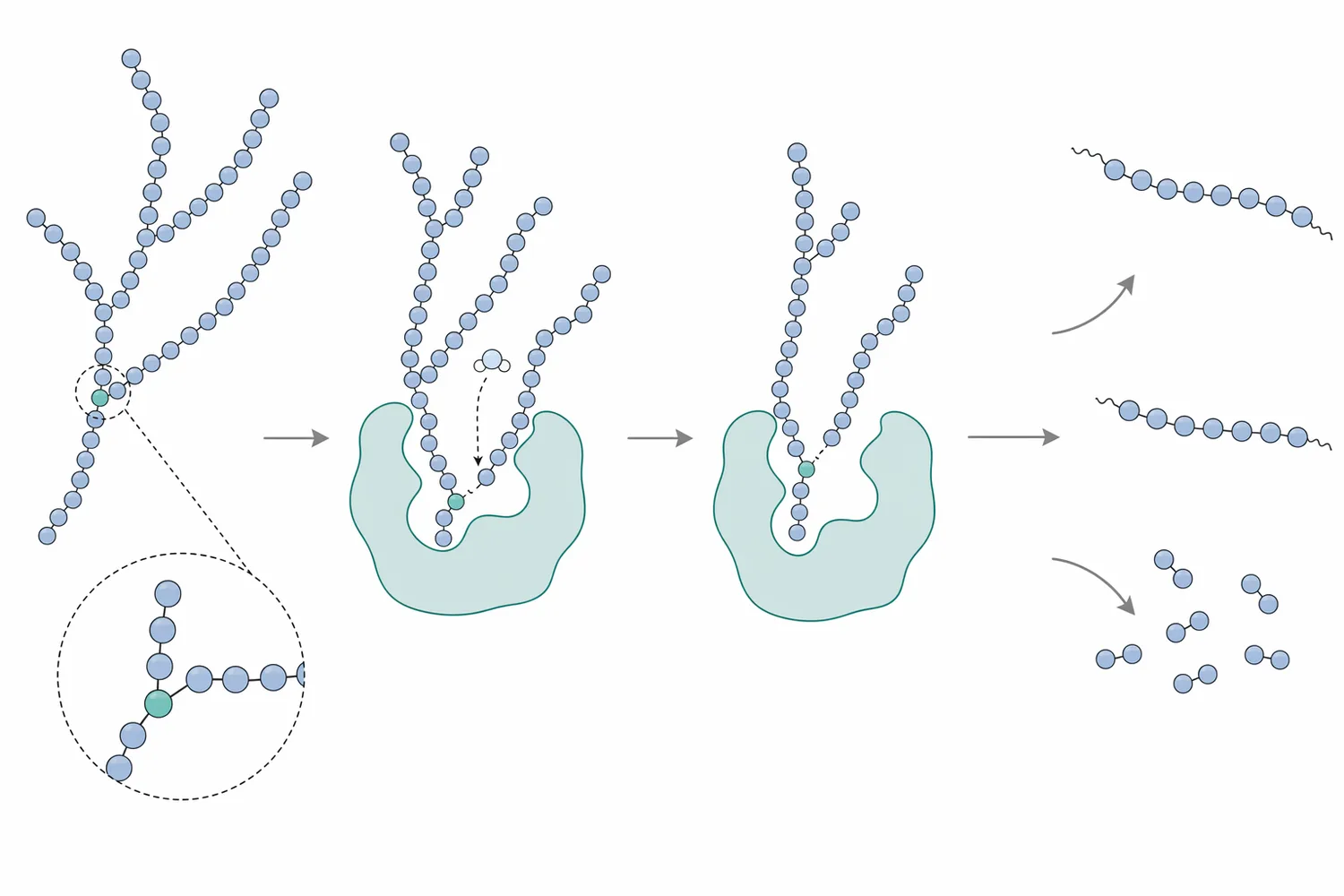
The practical result is a shift in wort carbohydrate profile. Instead of retaining a larger fraction of branched, yeast-unfermentable dextrins, the process can generate more linear dextrins and fermentable sugars when other amylolytic enzymes are active. The enzyme itself does not ferment sugar and does not create alcohol; it changes the starch-derived substrate so yeast and other enzymes can use it more effectively. This is why debranching enzyme is most powerful as part of a starch-conversion system rather than as a single-enzyme replacement for mashing.
A useful way to understand Debranching Enzyme for Brewing Industry is to compare it with other enzymes already familiar in brewing. Each enzyme type changes the substrate in a different way, and the final wort profile depends on how those actions overlap during mashing, wort treatment, or fermentation.
| Enzyme type | Main bond or substrate focus | What it changes in the mash or wort | Brewing relevance |
|---|---|---|---|
| α-Amylase | Internal α-1,4 bonds in starch and dextrins | Breaks long starch chains into shorter dextrins; reduces viscosity and supports liquefaction | Important for starch breakdown and extract development |
| β-Amylase | α-1,4 chain ends, especially non-reducing ends | Releases maltose but is limited by branch points and substrate accessibility | Important for fermentable sugar formation in malt-based mashes |
| Glucoamylase | Chain-end glucose release from dextrins | Produces glucose from starch-derived chains and can support high attenuation | Used where very complete carbohydrate conversion is desired |
| Debranching enzyme / pullulanase | α-1,6 branch points in amylopectin and branched dextrins | Opens branch junctions, producing less-branched chains that other enzymes can hydrolyze | Supports fermentability, adjunct conversion, and reduction of residual branched dextrins |
This comparison also clarifies what debranching enzyme does not do. It is not simply a “stronger amylase”; it performs a different reaction. Reviews of microbial starch-debranching enzymes describe pullulanase as a specialized tool for hydrolyzing α-1,6 linkages, which is why its role is complementary to liquefaction and saccharification enzymes rather than interchangeable with them [1].
Wort fermentability depends on which carbohydrates are present after mashing and whether the yeast can metabolize them. Yeast readily ferments glucose, maltose, and maltotriose to varying degrees depending on strain and process conditions. Larger dextrins, especially branched dextrins, are much less fermentable. If the mash leaves a high proportion of limit dextrins, the brewer may see lower apparent attenuation, higher residual carbohydrate, more body, and potentially a sweeter or fuller finish.
Malt itself contributes a complex enzyme system, but malt enzyme performance varies across raw material and process conditions. A study profiling enzymes related to malt fermentability, lautering, and beer filtration examined 94 commercially produced malt batches, highlighting that malt enzymology is not a fixed constant across supply and production conditions [5]. This helps explain why an added debranching enzyme can be useful in processes where the brewer wants more control over the branch-point portion of starch conversion.
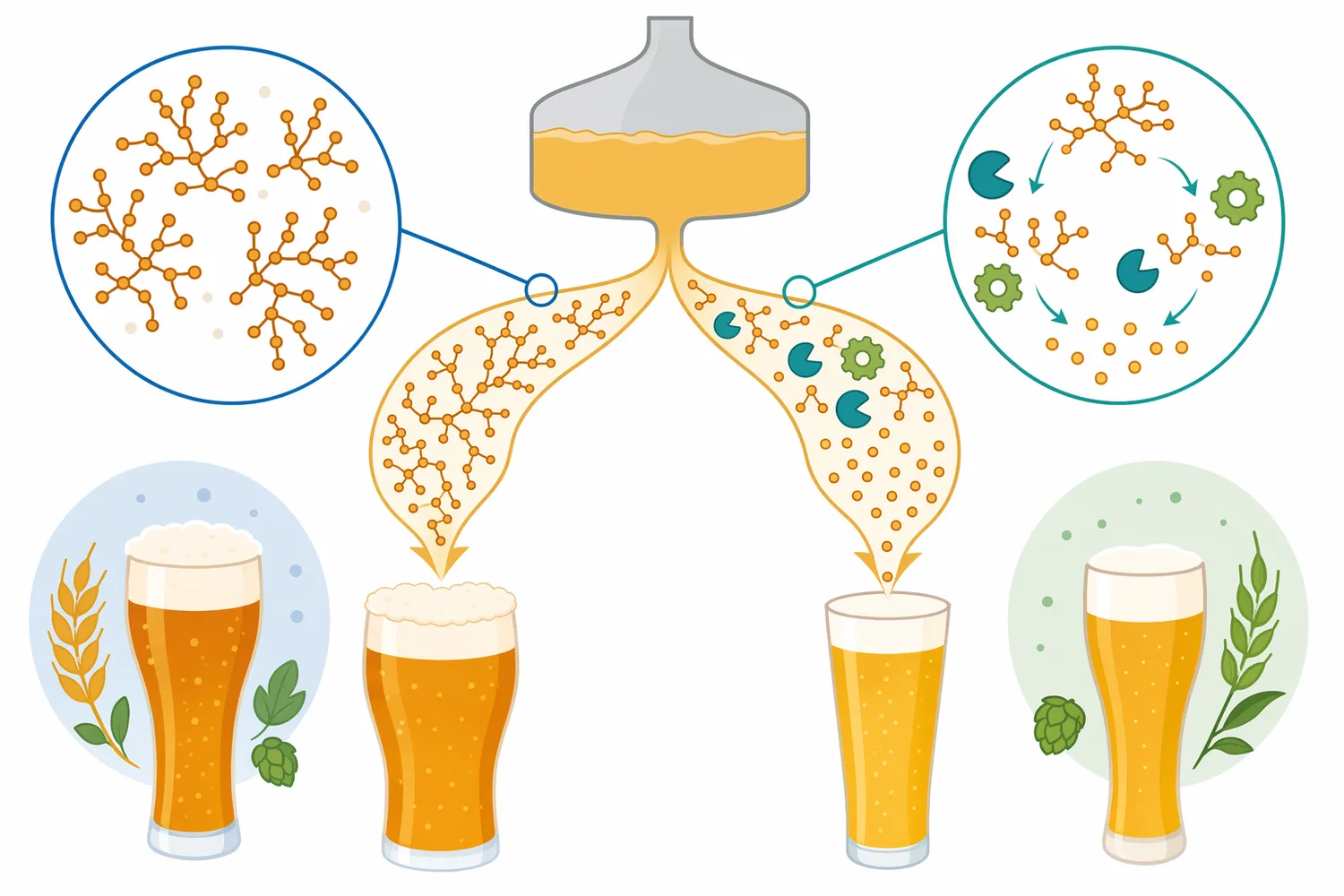
The effect is not only about final alcohol. Residual dextrin structure influences mouthfeel, perceived dryness, filtration behavior, and the balance between fermentable extract and non-fermentable extract. In some beers, dextrins are desirable because they support body. In other products—such as dry beer styles, high-attenuation bases, or low-residual-carbohydrate beverages—the same dextrins can be a limitation. Debranching enzyme gives the process another way to shift that balance by reducing the branched fraction that resists ordinary amylase action.
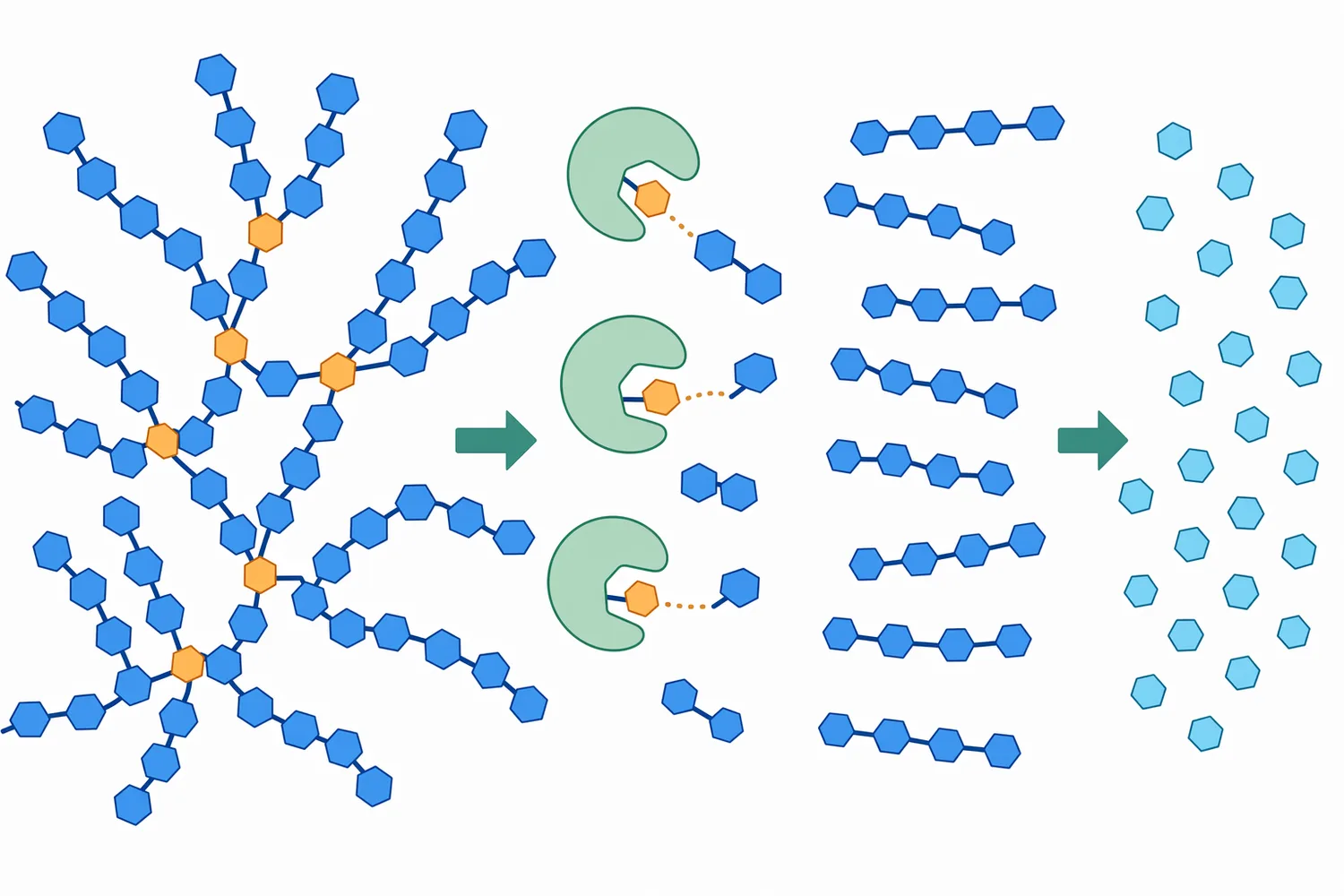
In mashing, debranching enzyme is used where starch has been gelatinized or otherwise made accessible enough for enzymatic attack. The enzyme acts on amylopectin-derived structures and dextrins as they become available, cutting branch points so α-amylase, β-amylase, malt enzymes, or added saccharification enzymes can continue conversion. Brewing enzyme reviews describe exogenous enzymes as established tools for extending or correcting the natural enzyme capacity of raw materials, particularly where cereal composition or process conditions differ from standard barley malt brewing [6].
In wort treatment, the enzyme’s role shifts from acting on raw starch granule conversion to acting on remaining soluble dextrins. This can be useful where the mash has already produced extract but leaves a carbohydrate profile that is less fermentable than intended. At this stage, debranching does not “remash” the grain; it modifies the soluble branched dextrin pool in the wort, making it more accessible to any compatible saccharifying activity present in the process.
During fermentation, debranching enzyme may be used in processes designed for continued dextrin conversion. This approach must be aligned with the intended beer profile because continued carbohydrate breakdown can change attenuation, sweetness, body, and alcohol balance. High-attenuation brewing is not only a biochemical question; it also changes sensory design. Reviews of craft beer production emphasize that beer quality is shaped by raw materials, process design, and sensory expectations together, so enzyme use should match the intended product rather than be treated as automatically beneficial [7].
High-gravity brewing increases the concentration of extract in the mash and wort. That can improve brewhouse productivity, but it also puts more pressure on starch conversion, wort viscosity management, yeast nutrition, oxygen management, and fermentation control. Reviews of high-gravity brewing describe it as a process with economic advantages but also technical challenges, including the need to manage wort composition and fermentation performance carefully [8].
Debranching enzyme is relevant in this context because concentrated mashes can leave less room for inefficient starch conversion. When branched dextrins remain after liquefaction and saccharification, they represent extract that contributes gravity but may not contribute fermentable sugar. By cutting α-1,6 branch points, a debranching enzyme can help shift part of that extract toward carbohydrates that are more available for subsequent enzymatic hydrolysis and yeast fermentation.
The benefit is not simply “more conversion” in a vague sense. The specific change is the reduction of branch-point constraints in amylopectin-derived dextrins. This can be important when high-gravity brewing aims for predictable attenuation after dilution, consistent alcohol output, and controlled residual body. However, because high-gravity systems are sensitive to yeast stress and wort composition, debranching enzyme should be understood as one component of the carbohydrate-management strategy rather than a complete solution for fermentation performance.
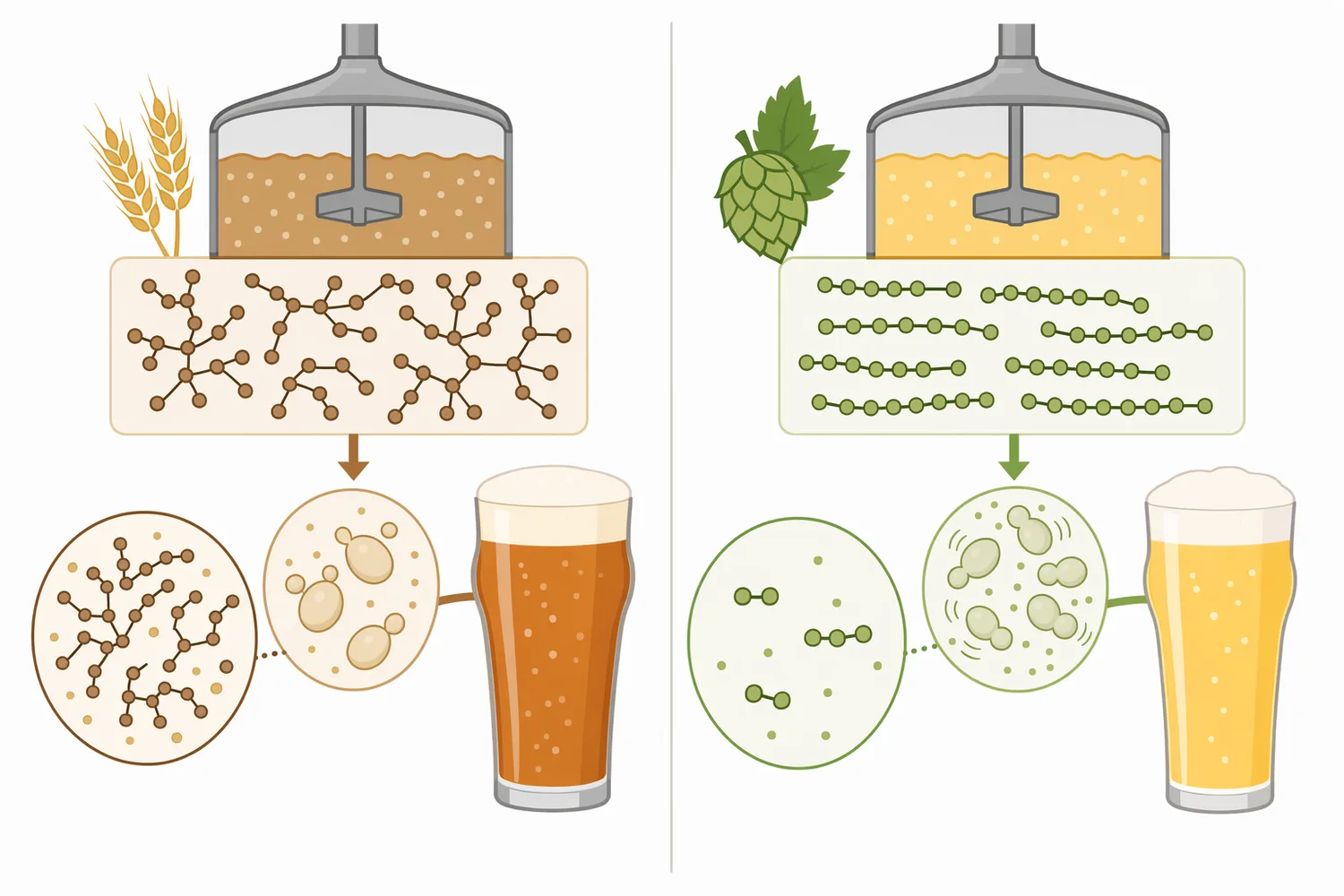
Adjunct brewing often introduces starch sources with different gelatinization behavior, amylose-to-amylopectin balance, protein composition, lipid content, and native enzyme activity compared with malted barley. Rice, corn, sorghum, millet, cassava, wheat, and other raw materials can all contribute useful extract, but they may require additional enzymatic help to achieve the intended sugar profile. A review of grain raw material processing in beer production emphasizes that secondary processing technologies and raw material treatment influence how grain components are converted for brewing use [9].
Debranching enzyme is useful because many adjunct starches contain substantial amylopectin, and amylopectin is the branched fraction most associated with α-1,6 linkages. When adjunct starch is gelatinized and partially liquefied, the process may still leave branched dextrins that ordinary amylases cannot fully convert. Pullulanase-type activity directly addresses that branched structure, turning “blocked” dextrins into less-branched chains that fit better into the rest of the enzyme system.
This is particularly important when adjuncts are used not only for cost or extract, but also for flavor, gluten-free positioning, local grain identity, or specialty beverage development. Research on alternative brewing materials such as wheat malt and legume-based wort shows that non-standard raw materials can influence physicochemical properties, wort composition, volatile compounds, and sensory outcomes [10]. Debranching enzyme does not make every adjunct behave like barley malt, but it can help manage one of the central differences: the accessibility and convertibility of branched starch.
Gluten-free brewing places even more attention on enzyme strategy because raw materials such as millet, sorghum, buckwheat, rice, maize, and pseudocereals often lack the balanced endogenous enzyme package of malted barley. Their starch gelatinization behavior and mash performance can differ substantially, which means fermentable sugar development may depend more heavily on process design and added enzymes. A review of exogenous enzymes for gluten-free beer production describes enzyme addition as an important industrial practice for addressing the limitations of gluten-free raw materials [6].
Millet research shows why this matters. A study on mashing protocol and fermentable sugar formation from millet specifically examined how mash conditions influence sugar development in gluten-free brewing, demonstrating that starch conversion in non-barley systems is highly process-dependent [11]. Debranching enzyme fits into this picture by targeting amylopectin branch points after starch has become accessible, helping reduce the dextrin structures that can otherwise hold back fermentability.
Gluten-free beer development is not only about conversion efficiency. Consumer expectations for gluten-free craft beer include sensory quality, body, flavor, and drinkability, and recent work on gluten-free craft beer highlights the importance of process choices in shaping final quality attributes [12]. For that reason, debranching enzyme should be used to support a defined beer profile. In a dry gluten-free beer, reducing branched dextrins may be desirable; in a fuller-bodied product, the brewer may want to preserve some dextrin contribution.
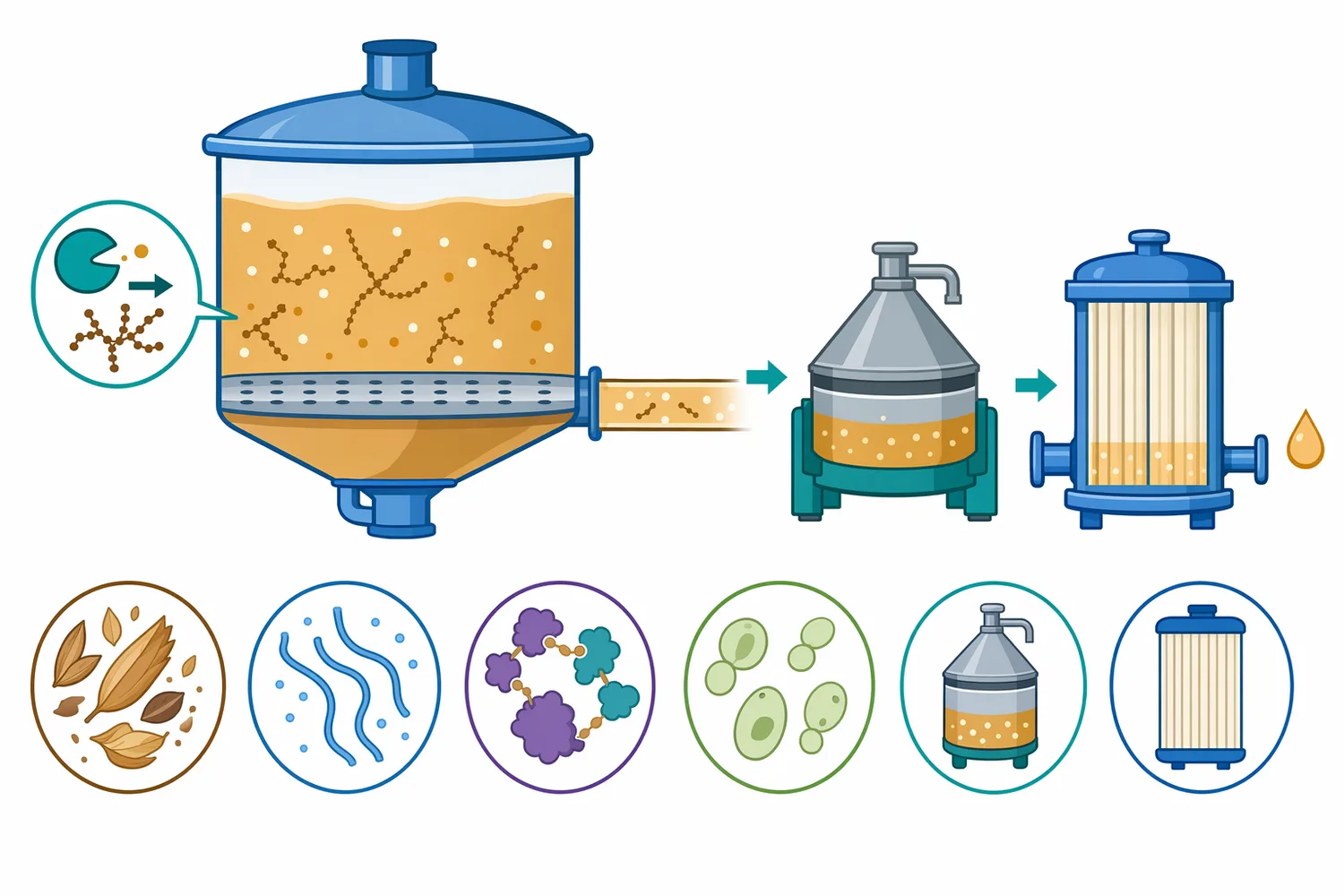
Debranching enzyme is primarily a starch-conversion tool, not a filtration enzyme. Still, carbohydrate structure can influence downstream handling because dextrins, β-glucans, arabinoxylans, proteins, and particulate material all contribute to wort and beer processing behavior. Malt enzyme profiling work links enzyme activity not only to fermentability but also to lautering and beer filtration performance, showing that extract conversion and processability are connected in practical brewing [5].
The direct debranching mechanism reduces α-1,6-linked dextrin branching, which can alter the size and structure distribution of soluble carbohydrates. In combination with other enzymes, that may support a wort profile that is easier to ferment and potentially less burdened by resistant dextrin fractions. However, lautering and filtration depend on many components beyond starch, including husk material, β-glucan, protein-polyphenol complexes, yeast, and clarification technology.
Modern beer clarification studies show that centrifugation and filtration technologies can affect beer quality, so enzyme effects should be viewed as upstream contributors rather than replacements for separation control [13]. Debranching enzyme can help create a more favorable carbohydrate profile, but it does not remove suspended solids, replace filtration, or correct all haze and processability issues.
Industrial enzyme use in brewing is often associated with more efficient use of raw materials, energy, or process time, depending on the application. A thermodynamic comparison of enzyme use in beer brewing examined resource use, reflecting the broader point that enzyme-assisted processing can change how breweries convert raw materials into saleable product [14]. Debranching enzyme supports this theme by helping convert the branched portion of starch-derived material that may otherwise remain less available.
The resource-efficiency logic is concrete. If a mash produces extract that remains as branched, yeast-unfermentable dextrin, that extract contributes to gravity and body but not to fermentable yield. If the intended product requires higher fermentability, debranching can help convert part of that structural carbohydrate into forms that the rest of the enzyme system can reduce further. In the right process context, that can improve the match between raw material input and desired wort composition.
Consistency is equally important. Raw material variation, especially in malt and adjunct systems, can produce shifts in fermentability. Malt enzyme profiling across 94 commercial batches illustrates that enzyme-related brewing performance can vary even within commercial malt supply [5]. Debranching enzyme provides a defined additional function—α-1,6 bond hydrolysis—that can help reduce reliance on the native debranching capacity of a particular grist.
The role of debranching enzymes is well established beyond beer. In plant starch biosynthesis, isoamylase and pullulanase are both involved in amylopectin structure, showing that branch trimming is central to how starch granules are formed and organized in nature [3]. That biological role helps explain why debranching enzymes are so relevant industrially: they act on one of the defining structural features of amylopectin.
Studies of starch-debranching enzyme properties also show that these enzymes differ in substrate preference, origin, and functional behavior. Earlier work on starch debranching enzymes discussed their properties and possible roles in amylopectin biosynthesis, while more recent microbial enzyme reviews describe developments and applications across food and industrial processing [15]. For brewing, the key takeaway is that “debranching enzyme” is not a vague processing additive; it refers to enzymes with a specific bond target and measurable effect on branched glucans.
Modern research continues to connect starch structure with functional performance. Mathematical models of amylose and amylopectin biosynthesis in rice, for example, describe interactions among enzymes that determine final starch architecture [16]. Brewing is not rice endosperm development, but the same structural principle applies: the arrangement of α-1,4 chains and α-1,6 branches determines how starch behaves when enzymes, heat, and water are applied.
The most common target is improved fermentability. By reducing branched dextrins, debranching enzyme can help the mash or wort generate more fermentable carbohydrate when compatible amylolytic enzymes are active. This can support drier beer profiles, more complete attenuation, and beverage bases where lower residual carbohydrate is desirable. Research on wort fermentation modeling for craft beer production reinforces that wort composition is central to predicting and managing fermentation behavior [17].
Another target is better use of adjunct extract. Adjuncts may contribute starch efficiently, but only if that starch becomes accessible and is converted into the intended carbohydrate profile. Debranching enzyme helps by addressing amylopectin branching after gelatinization and liquefaction, reducing the portion of dextrin structure that can remain resistant to ordinary amylase action. This is especially relevant when raw materials are chosen for cost, availability, gluten-free status, or product differentiation rather than because they naturally match barley malt performance.
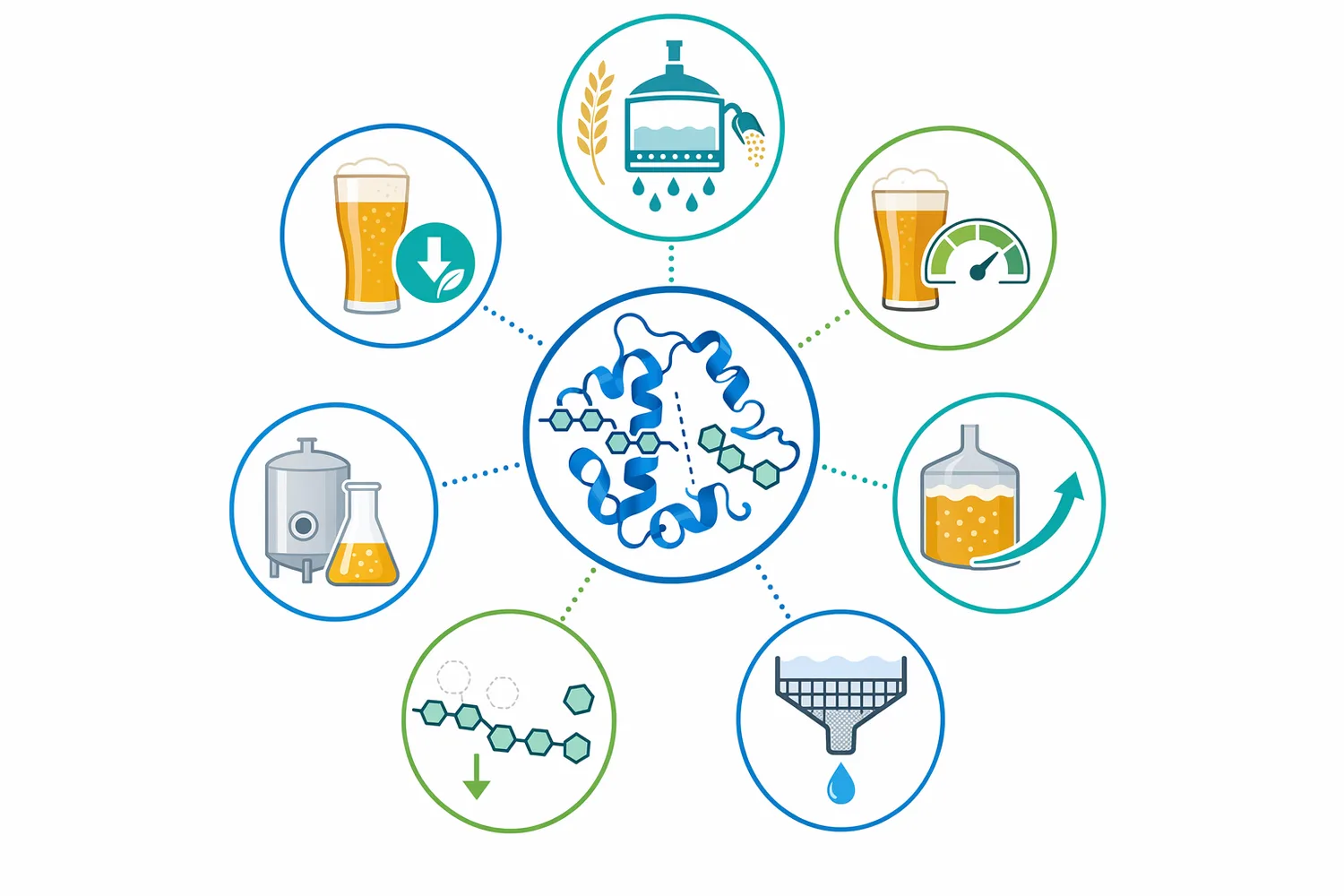
A third target is body control. Dextrins contribute fullness, so reducing dextrin branching may create a lighter, drier beer. That can be an advantage in some products and a disadvantage in others. The enzyme’s value is therefore not that it always makes beer “better,” but that it gives the brewer a specific way to influence the fermentable-to-nonfermentable carbohydrate balance. Craft beer research consistently frames quality as a combination of composition, process, and sensory expectation rather than a single analytical target [7].
Debranching enzyme does not replace gelatinization, liquefaction, saccharification, fermentation management, or sensory design. If starch is not accessible, an enzyme that targets branch points cannot fully compensate. If there is insufficient complementary amylase activity, released linear chains may not be converted as far as intended. If yeast health or fermentation conditions limit attenuation, changing dextrin structure alone may not deliver the expected final gravity.
It also does not guarantee a fixed attenuation, alcohol yield, or flavor outcome. Fermentability depends on grist composition, mash schedule, enzyme compatibility, wort composition, yeast strain, oxygenation, fermentation temperature, and time. Reviews of high-gravity brewing make clear that fermentation performance is a multi-variable system, especially when wort concentration is increased [8].
Finally, debranching may not be desirable in every beer. Some styles rely on residual dextrins for fullness and balance. In those products, excessive dextrin reduction can make the beer seem thin, overly dry, or out of style. The enzyme should therefore be viewed as a precision tool for processes that benefit from reduced branched dextrin content, not as a universal improvement for all brewing.
The most natural fit is in brewing processes where starch has already been made accessible and where the brewer wants a more fermentable carbohydrate profile. In a malt-based mash, it can complement the natural enzyme system. In adjunct brewing, it can help manage amylopectin-rich starch sources. In gluten-free brewing, it can support enzyme systems designed to compensate for raw materials with limited native brewing enzyme activity. Reviews of fungal-derived enzymes and brewing quality note the broad interest in enzyme tools that influence malting, mashing, and beer quality outcomes [18].
The enzyme’s role is easiest to understand by following the substrate. Starch granules are hydrated and gelatinized; long chains are liquefied into dextrins; branch points remain in some dextrins; debranching enzyme cuts α-1,6 linkages; the resulting less-branched chains become better substrates for saccharifying enzymes; yeast then ferments the sugars it can transport and metabolize. Each step changes the material in a specific way, and debranching is the step focused on branch-point removal.
Because brewing systems vary, results should be interpreted through the intended product. A process targeting a crisp, highly attenuated beer may value more extensive debranching. A process targeting body and fullness may use it more conservatively or not at all. The science supports the mechanism, but the best outcome is always the one that matches the beer’s design.
Enzymes.bio supplies Debranching Enzyme for Brewing Industry as a B2B ingredient available for direct online purchase by the 1 kg unit. The buyer places the order and pays online; the order is then processed and shipped. A Certificate of Analysis and Safety Data Sheet come with the order.
This product is intended for commercial brewing and beverage production contexts where a defined debranching function is useful in starch conversion. The article above is provided to explain the brewing science behind the enzyme’s role: hydrolysis of α-1,6 branch points, improved access to amylopectin-derived dextrins, and support for fermentability when used within a suitable starch-conversion process.
Debranching Enzyme for Brewing Industry is valuable because it targets a specific structural feature of starch that ordinary amylase action can leave behind: the α-1,6 branch points in amylopectin-derived dextrins. By hydrolyzing those branch junctions, it helps convert branched dextrins into less-branched chains that are easier for the broader enzyme system to process, supporting more complete starch conversion and potentially higher wort fermentability.
The strongest scientific basis is the well-defined action of pullulanase-type debranching enzymes on α-1,6 linkages, the known importance of amylopectin structure in starch behavior, and the demonstrated need for enzyme strategies in adjunct, gluten-free, and high-gravity brewing systems [1]. For brewers using malt, adjuncts, or alternative grains, debranching enzyme is best understood as a complementary tool: it does not do every job in starch conversion, but it performs one job that can be decisive when branched dextrins are limiting the desired wort profile.
Sold by the 1 kg unit, in stock and ready to ship. Order directly on our store — pay online and we process your order. A Certificate of Analysis and Safety Data Sheet are included with every order.
Buy Debranching Enzyme For Brewing Industry →Numbered in order of first citation. Open-access sources, each verified reachable at publication; citation numbers in the text link here.