
Fruit pectinase enzyme for orange juice production is an enzyme processing aid used to break down pectin, the citrus cell-wall polysaccharide that can hold water, suspend pulp particles, increase viscosity, and slow separation. In orange juice processing, pectinase supports easier juice release from pulp, more efficient clarification, and smoother filtration by converting structure-forming pectin into smaller fragments that no longer bind the juice matrix as strongly.
Enzymes.bio supplies Fruit Pectinase Enzyme for Orange Juice Production as a 1 kg product sold directly online. Buyers place the order and pay online; the order is then processed and shipped, with a Certificate of Analysis and Safety Data Sheet supplied with the order.
Orange juice is not just a liquid phase with flavor compounds and sugars. It is a complex citrus suspension containing soluble solids, acids, aroma compounds, pulp particles, cloud material, proteins, minerals, lipids, and pectic polysaccharides from peel, segment membranes, juice sacs, and pulp. Pectin is especially important because it behaves like a natural structural binder: in intact fruit tissue it helps hold plant cells together, while in extracted juice it can increase viscosity and stabilize fine particles in suspension.
That behavior can be helpful or problematic depending on the product target. In a cloudy orange juice, suspended cloud contributes to the expected appearance and mouthfeel. In a clarified juice, beverage base, or filtered citrus ingredient, the same pectin-driven suspension can create persistent haze, slow clarification, and reduce filtration performance. Research on citrus and related fruit juices continues to identify pectin as a key contributor to colloidal structure, cloud behavior, and instability when processing conditions change [1].
Pectinase is used because it changes the physical behavior of that pectin network. Instead of relying only on heat, centrifugation, settling, or filtration to overcome a pectin-stabilized juice matrix, the enzyme acts directly on the polysaccharide structure. The result is not “added clarity” in a cosmetic sense; it is a change in the way the juice solids, dissolved pectin, and liquid phase interact during processing.
Pectin is a family of acidic polysaccharides rich in galacturonic acid units. In fruit tissue, pectin forms part of the middle lamella and primary cell wall, where it helps cement cells together. When oranges are crushed, finished, pulped, or pressed, pectin can move from solid tissue into the juice phase, creating a hydrated network that traps liquid and keeps fine solids suspended.
Pectinase is a collective term for enzymes that degrade or modify pectic substances. In practical juice processing language, that means the enzyme cuts long pectin chains and weakens the gel-like network responsible for high viscosity and particle suspension. A pectinase characterized from Geotrichum candidum AA15 was specifically evaluated for orange juice clarification, illustrating the direct connection between pectin degradation and citrus juice processing performance [2].
Mechanistically, several changes occur as pectinase acts. Large pectin molecules lose chain length, so they bind less water and create less resistance to flow. The pectin coating around suspended particles is weakened, so particles are less effectively held apart and can settle, centrifuge, or filter more readily. Pulp tissue also softens because the pectin-rich “cement” between plant cells is disrupted, allowing more juice to be released from the solid matrix.
For a process engineer, the important point is that pectinase affects rheology and separation behavior. A thick, pectin-rich mash or juice does not behave like a simple liquid; it behaves like a hydrated colloidal system. By breaking down the polysaccharide framework, pectinase can lower the structural resistance that makes juice difficult to press, clarify, or filter.
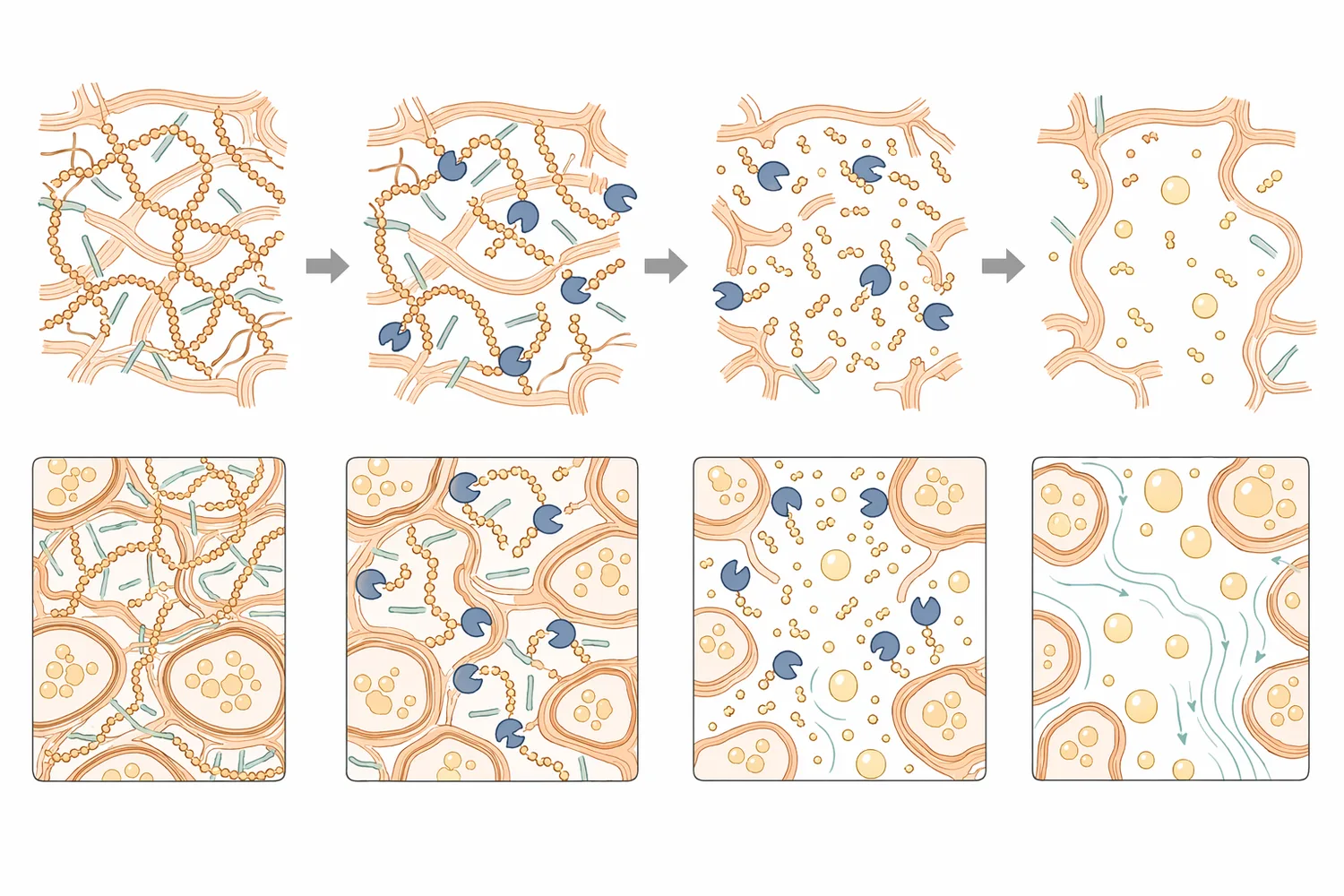
During extraction, some juice remains physically trapped inside pulp and disrupted fruit tissue. Pectin-rich cell-wall material holds water and soluble juice components in place, especially when the mash is viscous or contains fine suspended solids. Pectinase helps weaken this structure so more liquid can move out of the pulp phase during pressing, finishing, or separation.
This is why pectinase is widely discussed in fruit juice extraction and clarification literature rather than only as a clarification aid. A review of enzymatic treatment in tropical fruit juices describes pectinase and related enzymes as tools for improving juice yield, reducing viscosity, and changing physicochemical properties of juice systems where pectin and cell-wall material limit processing efficiency [3].
In orange processing, the practical result is easier liquid release from orange pulp and more manageable handling before downstream clarification or pasteurization. The enzyme does not create juice from nothing; it helps release juice that is already present but physically retained by the fruit tissue structure.
High viscosity affects more than mouthfeel. In processing, it can slow pumping, settling, centrifugation, filtration, and heat transfer. Pectin contributes strongly to viscosity because long hydrated chains occupy volume and interact with particles in the juice. When those chains are shortened, the liquid phase generally becomes less resistant to movement.
Pectinase-treated juice can therefore be easier to move through process equipment, especially where pulp content is high or where orange material has been mechanically disrupted. Enzymatic clarification studies in orange juice focus on these physicochemical changes because pectin breakdown alters measurable properties such as clarity, cloud behavior, and soluble/insoluble fractions during treatment [4].
The change is concrete: less intact pectin means fewer long-chain molecules spanning between particles and less water immobilized in the pectin network. That can translate into faster separation and a more predictable process stream.
For clarified orange juice, pectinase is one of the most relevant enzyme tools because pectin is a major stabilizer of haze. Fine particles remain suspended partly because pectin increases viscosity and partly because pectin can form protective colloidal layers around suspended material. Breaking the pectin reduces that stabilizing effect, making separation easier.
The orange juice clarification relevance is supported directly by work on pectinase from Geotrichum candidum AA15, where the enzyme was characterized and examined for potential orange juice clarification use [2]. Additional orange juice enzyme clarification research has examined how immobilization supports and crosslinking systems affect nutritional properties during enzymatic clarification, reinforcing that orange juice is a studied matrix for pectinase-assisted clarification [4].
For beverage manufacturers using orange juice as an ingredient, this can matter when a bright, low-haze citrus base is preferred. Clarified orange juice may be used where haze would interfere with product appearance, blending, carbonation, packaging presentation, or consumer expectations.
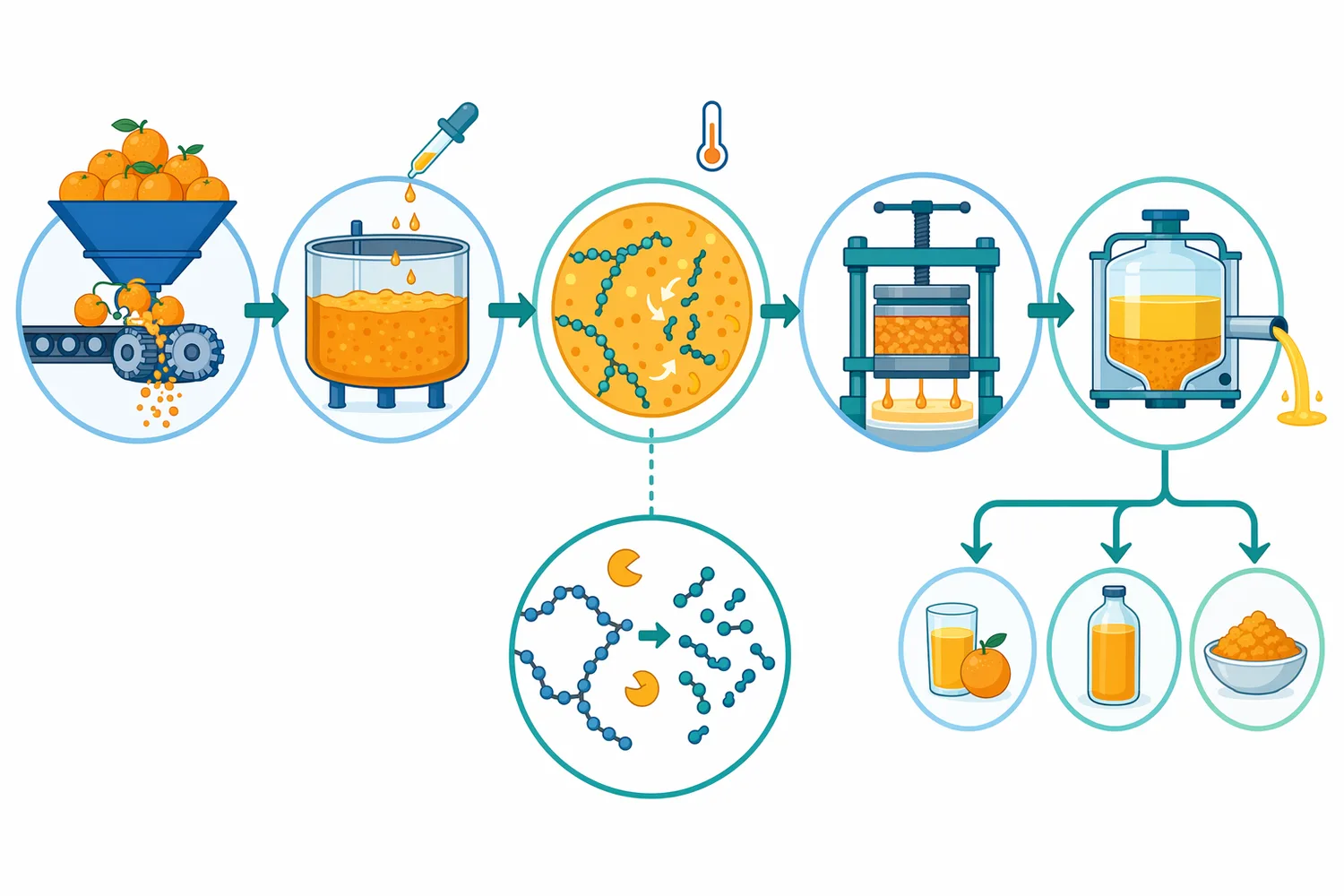
Pectin-rich juice can blind filters because fine particles and dissolved polymers form compressible layers on filter surfaces. Even when solids loading is not high, pectin can increase resistance to flow by creating a sticky, hydrated matrix that holds particles together. Pectinase reduces that matrix before filtration, so the filter sees a less cohesive and often more permeable suspension.
This is especially relevant when filtration follows settling, centrifugation, or enzyme treatment. Once pectin is degraded, suspended material can form larger, less stable aggregates or separate more readily from the liquid phase. Research on pectin-dominated colloidal instability in cloudy pomelo juice after enzymatic digestion shows how pectin digestion can alter morphology and rheological behavior in a citrus-related juice matrix [1].
The same principle applies to orange juice: pectinase changes what the separation equipment has to remove. Instead of fighting a stable colloidal network, downstream equipment handles a juice matrix in which the pectin support structure has been weakened.
Orange juice is sold in both cloudy and clarified formats, so pectinase use should be understood in relation to product style. In cloudy juice, the goal is not necessarily maximum clarification. Orange cloud can be a desired quality attribute, and excessive breakdown or separation may reduce the expected appearance. In clear citrus bases, by contrast, pectinase is often used specifically to destabilize haze and support particle removal.
This distinction matters because orange juice cloud stability is also affected by endogenous pectin methylesterase, usually abbreviated PME. PME is a natural orange enzyme that modifies pectin by removing methyl groups, which can promote interactions with calcium and contribute to cloud loss or sedimentation. Studies on orange juice preservation frequently focus on PME because controlling this native enzyme is central to maintaining cloud stability during storage [5].
Fruit pectinase used as a processing aid and native orange PME are therefore not the same processing issue. Added pectinase is used deliberately to degrade pectin for extraction or clarification. Native PME is often controlled or inactivated when the goal is stable cloudy orange juice. Understanding the difference helps prevent confusion between enzyme-assisted clarification and preservation of cloud.
| Processing target | Role of pectin | How pectinase fits | Related process concern |
|---|---|---|---|
| Juice extraction from pulp or mash | Pectin holds water in fruit tissue and increases mash structure | Breaks pectin-rich cell-wall material so liquid releases more easily | Treatment must match the desired pulp level and product style |
| Clarified orange juice | Pectin stabilizes haze and fine suspended solids | Weakens the colloidal network so solids separate more readily | Clarification intensity affects appearance and body |
| Cloudy orange juice | Pectin and cloud particles contribute to expected appearance | May be used carefully for viscosity or extraction, not necessarily full clarification | Native PME control is important for cloud stability |
| Filtration or centrifugation | Pectin raises viscosity and can create compressible solids layers | Reduces polymeric resistance and supports cleaner separation | Physical separation still determines final solids removal |
| Shelf-stable juice processing | Pectin chemistry changes during storage and treatment | Pectinase is mainly a processing tool, not a preservative | Heat, pressure, or other preservation steps may target microbes and PME |
Orange juice naturally contains pectin methylesterase, and this native enzyme receives significant attention because it can destabilize cloud. PME acts on pectin by de-esterifying it. That chemical change can make pectin more likely to interact with calcium and form larger insoluble structures, which may settle out and reduce cloud stability.
Many orange juice preservation technologies are evaluated partly by their ability to reduce PME activity while protecting sensory and nutritional quality. Ultra-high-pressure homogenization has been studied against conventional heat pasteurization for effects on PME activity and microbial characteristics in orange juice [6]. Thermosonication, microwave-assisted pasteurization, and high hydrostatic pressure combinations have also been examined with PME inactivation as a major quality target [7].
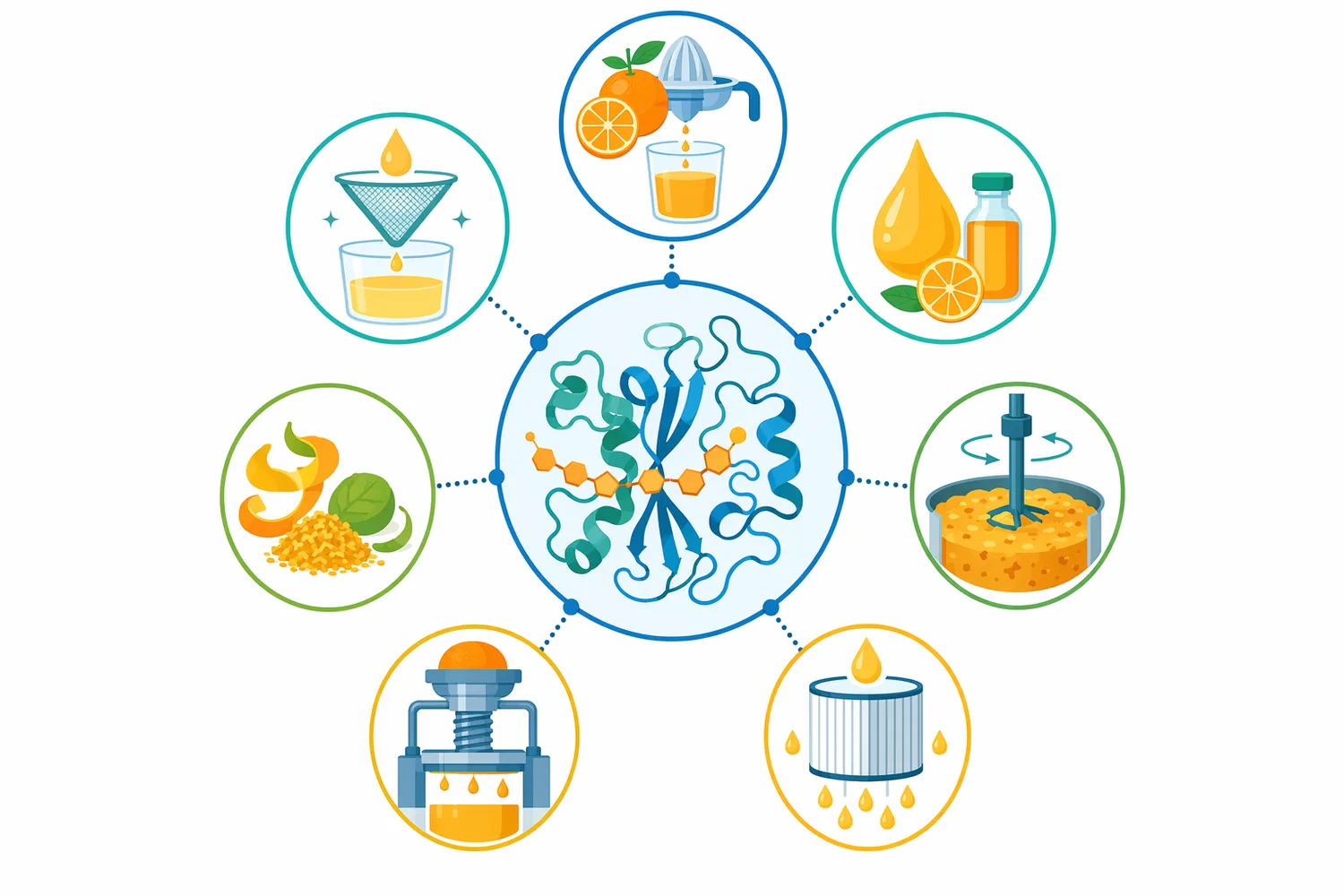
This is relevant to pectinase buyers because it shows how central pectin chemistry is in orange juice. Added fruit pectinase is used to deliberately change pectin for processing benefits. Native PME, in contrast, may need to be controlled in cloudy juice because uncontrolled pectin modification can damage cloud stability. Both issues involve pectin, but they serve different process objectives.
The most directly relevant evidence is research where pectinase is applied to orange juice clarification. The study on pectinase from Geotrichum candidum AA15 characterized the enzyme and evaluated its potential application in orange juice clarification, supporting the use of pectinolytic enzymes in citrus juice processing rather than only in general fruit systems [2].
A separate orange juice study evaluated how support matrices and crosslinking agents affected nutritional properties during enzyme clarification. While that work focused on immobilized enzyme systems and nutritional outcomes, it confirms that orange juice clarification with pectinase is an active research area and that treatment conditions can influence physicochemical and nutritional properties [4].
Evidence from other high-pectin fruit juices is also useful because the underlying processing problem is similar. In papaya juice processing, immobilized pectinase-alginate beads affected physicochemical properties, antioxidant activity, and reusability, showing how pectinase-driven clarification can change a dense fruit juice matrix [8]. Orange juice has its own acidity, aroma, pulp, and cloud profile, so results should not be transferred mechanically, but the same pectin-breakdown logic applies.
Broader reviews of enzymatic treatment in fruit juices report that pectinase use can affect yield, viscosity, clarity, turbidity, color, and functional properties. These reviews are valuable because they place orange juice within the larger category of fruit matrices where pectin and other cell-wall polysaccharides create extraction and clarification challenges [3].
Pectinase is not a preservation step by itself. It does not replace pasteurization, hygienic processing, or validated shelf-life control. Instead, it modifies pectin before or within a broader process sequence that may also include heat treatment, pressure treatment, pulsed electric fields, sonication, or homogenization.
Orange juice research has extensively examined nonthermal and mild preservation technologies because processors want microbial safety and enzyme control while retaining fresh-like quality. A review of pulsed electric field processing of orange juice discusses microbial, enzymatic, nutritional, sensory, and stability outcomes, showing how preservation decisions must balance several quality factors at once [9].
High-pressure processing has also been studied in food systems for economic and environmental sustainability, while orange juice-specific work has investigated pressure-based or combined treatments for native PME and quality preservation [10]. These technologies are not substitutes for pectinase when the target is pectin breakdown; rather, they address different parts of the process, such as microbial reduction, endogenous enzyme inactivation, or shelf-life extension.
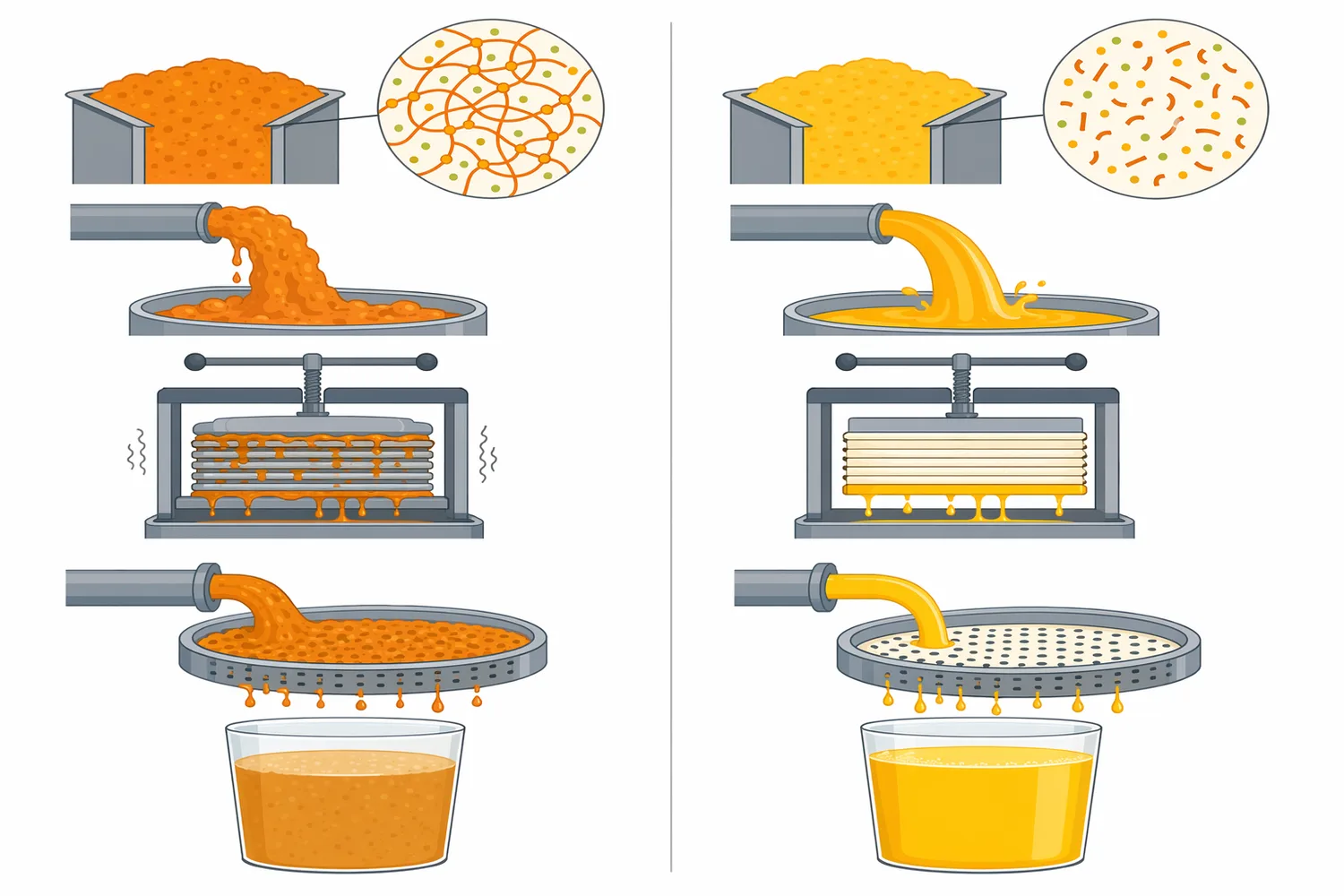
For practical orange juice production, pectinase treatment is often best understood as a front-end or mid-process aid for extraction, clarification, viscosity reduction, or filtration. Preservation technologies then address microbial stability and native enzyme activity according to the product format and shelf-life target.
Orange juice quality is strongly tied to aroma, freshness perception, acidity, sweetness, color, and cloud appearance. Pectinase acts mainly on polysaccharides, but changes in the juice matrix can influence how suspended materials, aroma compounds, and cloud fractions behave. This is why enzyme treatment should be viewed as part of the overall process design, not as an isolated ingredient addition.
Citrus off-flavor formation is influenced by processing and storage conditions, with reviews identifying multiple odorants and pathways involved in quality loss. Heat exposure, oxygen, storage time, and reactions involving juice components can all affect flavor stability [11]. Pectinase does not prevent these pathways on its own, but smoother extraction and clarification can help the process reach the intended separation target without unnecessary mechanical or thermal severity.
Research on shelf-stable orange juice also shows that soluble and insoluble compounds change during storage in relation to non-enzymatic browning. That reinforces the point that final orange juice quality depends on the combined effects of formulation, processing, storage, oxygen exposure, and matrix composition [12].
The practical expectation should be realistic: pectinase can help manage pectin-related processing behavior, but it is not a flavor corrector, antioxidant system, or preservation treatment. Its value lies in changing the structure of the juice matrix so the desired process outcome is easier to achieve.
Orange juice is naturally acidic, and fruit pectinases used in juice processing are generally selected because they function in acidic fruit systems. Temperature, contact time, pulp level, fruit maturity, and solids content all influence how quickly pectin is broken down and how strongly the treatment affects viscosity or clarification.
The research literature consistently shows that enzymatic fruit juice treatment is condition-dependent. Reviews of fruit juice enzyme optimization emphasize that treatment outcomes depend on variables such as enzyme type, juice matrix, process temperature, treatment time, and the target property being improved [3]. This is why pectinase effects are often studied in relation to turbidity, viscosity, yield, color, antioxidant properties, or clarity rather than described as a single universal result.
Orange juice adds further complexity because cloud stability may be desired in one product and reduced in another. A process aiming for clear orange juice may welcome strong pectin degradation and particle separation. A process aiming for stable cloudy juice may use enzyme treatment more cautiously or focus instead on controlling native PME through preservation steps.
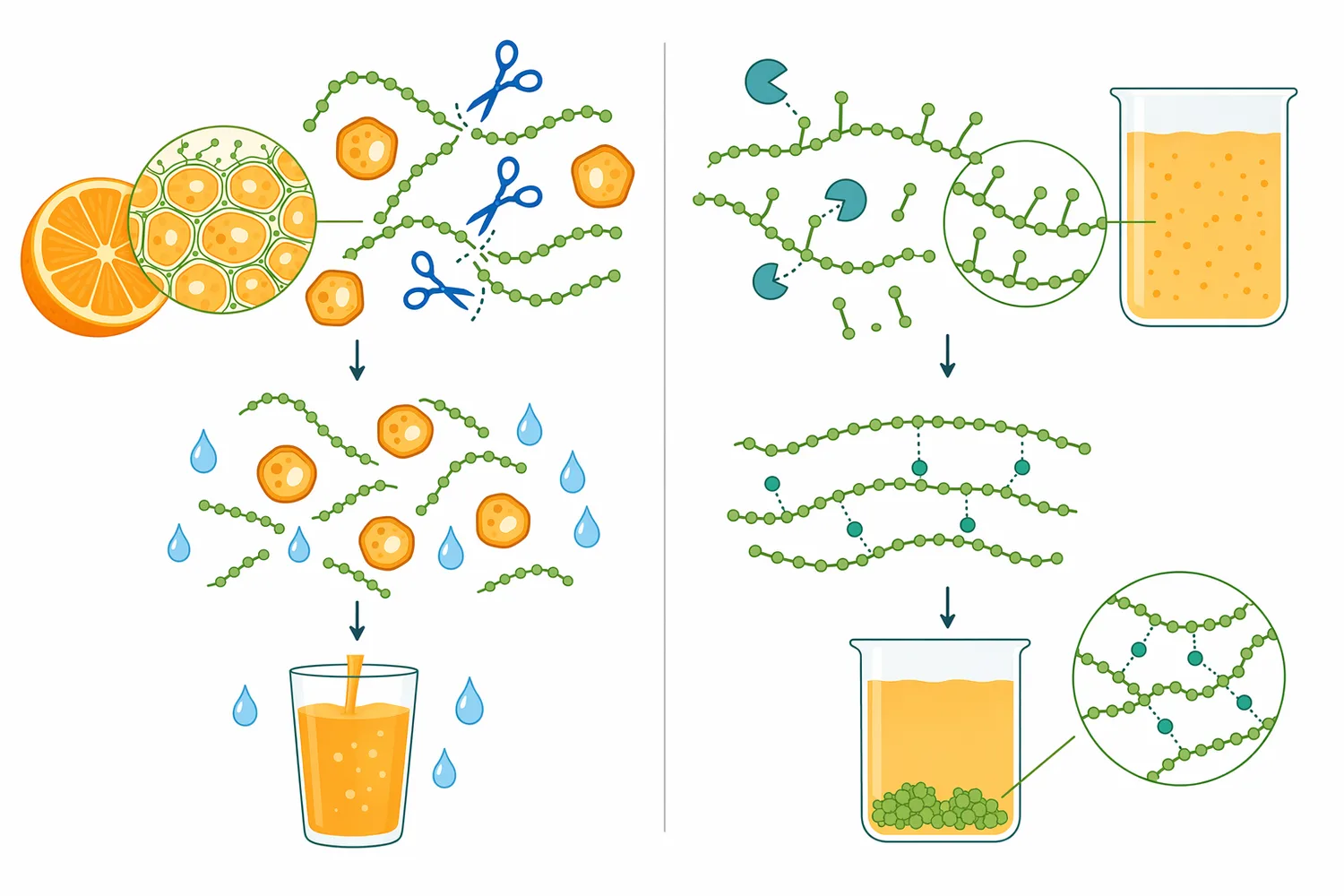
From a buyer’s perspective, the key takeaway is straightforward: fruit pectinase works on pectin, and pectin behavior changes with the juice matrix. The enzyme is most relevant where pectin is the reason the juice is too viscous, difficult to extract, slow to clarify, or hard to filter.
Pectinase is one tool within a wider orange juice processing toolkit. It is useful because it acts specifically on pectin structure. Other technologies may preserve quality, reduce microbial load, inactivate native enzymes, or physically separate particles, but they do not all solve the same problem.
| Tool or treatment | Primary action in orange juice | What changes physically | Where it differs from pectinase |
|---|---|---|---|
| Fruit pectinase | Degrades pectic substances in pulp or juice | Lowers pectin network strength; supports juice release, clarification, and filtration | Targets pectin structure directly |
| Centrifugation | Separates particles by density | Removes suspended solids and pulp fractions | Does not chemically break down pectin |
| Filtration | Removes particles by size and filter retention | Produces clearer liquid depending on filter and fouling behavior | Can be slowed by intact pectin unless the matrix is preconditioned |
| Heat pasteurization | Reduces microbes and inactivates enzymes depending on severity | Improves safety and stability but may affect sensory quality | Primarily a preservation step, not a pectin-degradation tool |
| High-pressure or pulsed electric field processing | Supports microbial and enzyme control with quality retention goals | Alters microbial and enzymatic stability depending on process | Used for preservation and quality management rather than direct clarification |
| Thermosonication or microwave-assisted processing | Combines energy input with heat or other effects | Can affect PME, microbes, and quality parameters | Focuses on stabilization; pectinase focuses on pectin breakdown |
This comparison is important because pectinase should not be expected to replace physical clarification or preservation. Instead, it often makes those downstream steps more effective by changing the juice matrix before separation or stabilization.
Orange juice is valued for vitamin C, phenolic compounds, carotenoids, acids, sugars, and sensory freshness. Enzyme treatment should preserve the intended nutritional and sensory profile while achieving the desired processing effect. Research into orange juice processing often tracks nutritional and functional properties because clarification, heat, pressure, homogenization, and storage can all influence measurable quality attributes.
The enzyme clarification study using support matrices and crosslinking agents specifically examined nutritional properties of orange juice during enzymatic clarification, showing that pectinase treatment is not only a clarity issue but also part of broader quality management [4]. Other orange juice processing research has investigated how high-pressure homogenization, thermal treatment, and matrix effects influence the bioaccessibility of phenolics in fruit juices, including orange juice [13].
The balanced view is that pectinase can support physical processing improvements, while the total nutritional outcome depends on the whole process. Enzyme treatment, clarification severity, oxygen exposure, pasteurization, packaging, and storage all contribute to the finished product profile.
Orange processing generates peel, pulp, and other pectin-rich by-products. These materials are important not only as waste streams but also as sources of pectin and bioactives. The broader citrus industry is increasingly interested in extracting value from orange peel waste for environmental and health-related applications [14].
This matters because pectinase technology is closely connected to the chemistry of citrus residues. The same pectic materials that create viscosity and clarification challenges in juice are also valuable polysaccharides in peel and pulp. Pectinase can therefore be understood as part of a larger citrus processing ecosystem: it helps manage pectin in juice production, while pectin-rich by-products are studied for sustainable recovery of bioactive compounds and functional ingredients.
For an orange juice operation, however, the immediate use case remains practical and process-focused. Fruit pectinase is applied where pectin interferes with extraction, flow, clarification, or filtration.
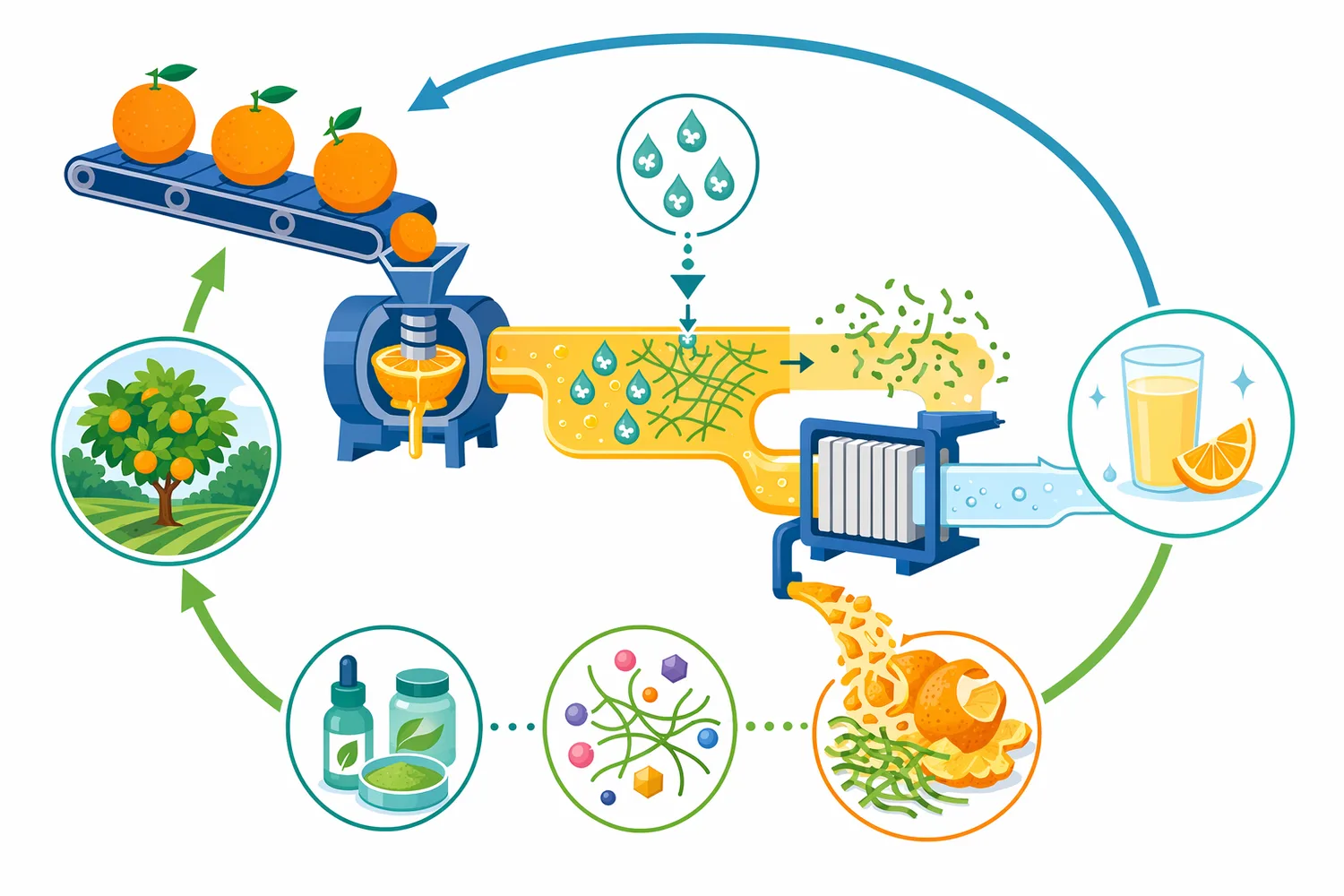
Fruit pectinase is highly relevant to orange juice production, but it is not a universal solution for every processing issue. If haze is driven mainly by proteins, oils, microbial growth, mineral precipitation, or other non-pectin causes, pectinase alone may not fully resolve it. If the product is intended to remain cloudy, excessive pectin breakdown may move the juice away from the desired appearance.
The enzyme also does not replace validated preservation. Native PME control, microbial stability, and shelf-life design remain separate process requirements. Studies on orange juice PME inactivation using microwave-assisted pasteurization, thermosonication, high hydrostatic pressure combinations, and other technologies show how much attention is still required to stabilize orange juice after extraction or clarification [15].
The best expectation is targeted and concrete: pectinase helps address pectin-driven resistance in orange pulp and juice. It can support better liquid release, lower viscosity, easier clarification, and improved filtration behavior when pectin is a limiting factor.
Enzymes.bio supplies Fruit Pectinase Enzyme for Orange Juice Production as a 1 kg online product for buyers who need an enzyme processing aid for orange juice or related fruit-processing applications. The product is purchased directly online: add the 1 kg unit, pay online, and the order is processed and shipped.
A Certificate of Analysis and Safety Data Sheet are supplied with the order. Enzymes.bio is a supplier, not a laboratory or manufacturer, and this article is intended as an educational technical guide to the enzyme class and its relevance in orange juice processing.
Fruit pectinase enzyme for orange juice production works by degrading pectin, the citrus cell-wall polysaccharide that contributes to pulp structure, viscosity, haze stability, and filtration resistance. By breaking the pectin network into smaller fragments, pectinase helps juice release more easily from pulp, supports clarification, and improves the behavior of orange juice during separation steps.
The strongest evidence for this application comes from orange juice clarification research, broader fruit juice enzyme treatment reviews, and citrus-related studies showing how pectin governs colloidal stability and processing behavior. Used with realistic expectations, pectinase is a practical tool for managing pectin-related challenges in orange juice production while leaving preservation, microbial control, and final product style to the wider process design.
Sold by the 1 kg unit, in stock and ready to ship. Order directly on our store — pay online and we process your order. A Certificate of Analysis and Safety Data Sheet are included with every order.
Buy Fruit Pectinase Enzyme For Orange Juice Production →Numbered in order of first citation. Open-access sources, each verified reachable at publication; citation numbers in the text link here.