
Glucoamylase Enzyme Aggressive Liquid Converts All Starch To Sugar In Wort And Mash is a liquid enzyme preparation supplied by Enzymes.bio for converting starch-derived dextrins into fermentable sugars, especially glucose, in wort, mash, brewing, distilling, and saccharification workflows. It is available to buy directly online in a 1 kg unit; the buyer pays online, the order is processed and shipped, and a Certificate of Analysis and Safety Data Sheet are supplied with the order .
For process use, the key value is straightforward: glucoamylase attacks starch fragments from their chain ends and releases glucose, while debranching support helps reduce the branch-point bottlenecks that can leave residual dextrins in amylopectin-rich grain substrates. The phrase “converts all starch to sugar” should be understood as the intended processing function under suitable mash or wort conditions, not as a guarantee that every substrate will fully convert regardless of preparation, time, temperature, pH, or starch accessibility.
Enzymes.bio supplies this product as a liquid glucoamylase enzyme preparation for applications where starch-rich material must be converted into fermentable sugars, including wort, mash, brewing, distilling, and broader starch-processing use cases . In practical terms, the enzyme is used after starch has been made accessible by milling, cooking, gelatinization, mashing, or liquefaction, because enzymes work on molecular surfaces and soluble starch fragments rather than magically penetrating every intact granule at the same rate.
The biochemical job of glucoamylase is different from simple starch thinning. α-Amylase rapidly cuts internal α-1,4 bonds in starch and reduces viscosity, creating shorter dextrins; glucoamylase then works mainly from non-reducing chain ends and releases glucose units, which yeast can ferment and starch processors can use as a glucose-rich saccharification product [1]. This “finishing” role is why glucoamylase is commonly associated with higher fermentability, lower residual dextrin, and more complete conversion of liquefied or mashed starch.
In grain-based wort and mash, the relevant substrate is not one uniform molecule. Starch is mainly a mixture of amylose, which is more linear, and amylopectin, which is highly branched; both are built from glucose, but their physical packing and branch structure affect how easily enzymes can hydrolyze them. Studies on grain and starch digestion systems show that grain type and starch structure influence enzyme activity and starch breakdown behaviour, which is why the same enzyme can perform differently across maize, barley, rice, sorghum, wheat, triticale, or tuber-derived starches [2].
In this product context, “aggressive” should be read as a practical description of strong saccharification intent: the enzyme is intended to push starch-derived carbohydrates toward fermentable sugar rather than leaving a dextrin-rich profile. The Enzymes.bio product page positions the liquid preparation for converting starch to sugar in wort and mash, with application relevance in brewing and distilling processes where fermentable extract is economically and operationally important .
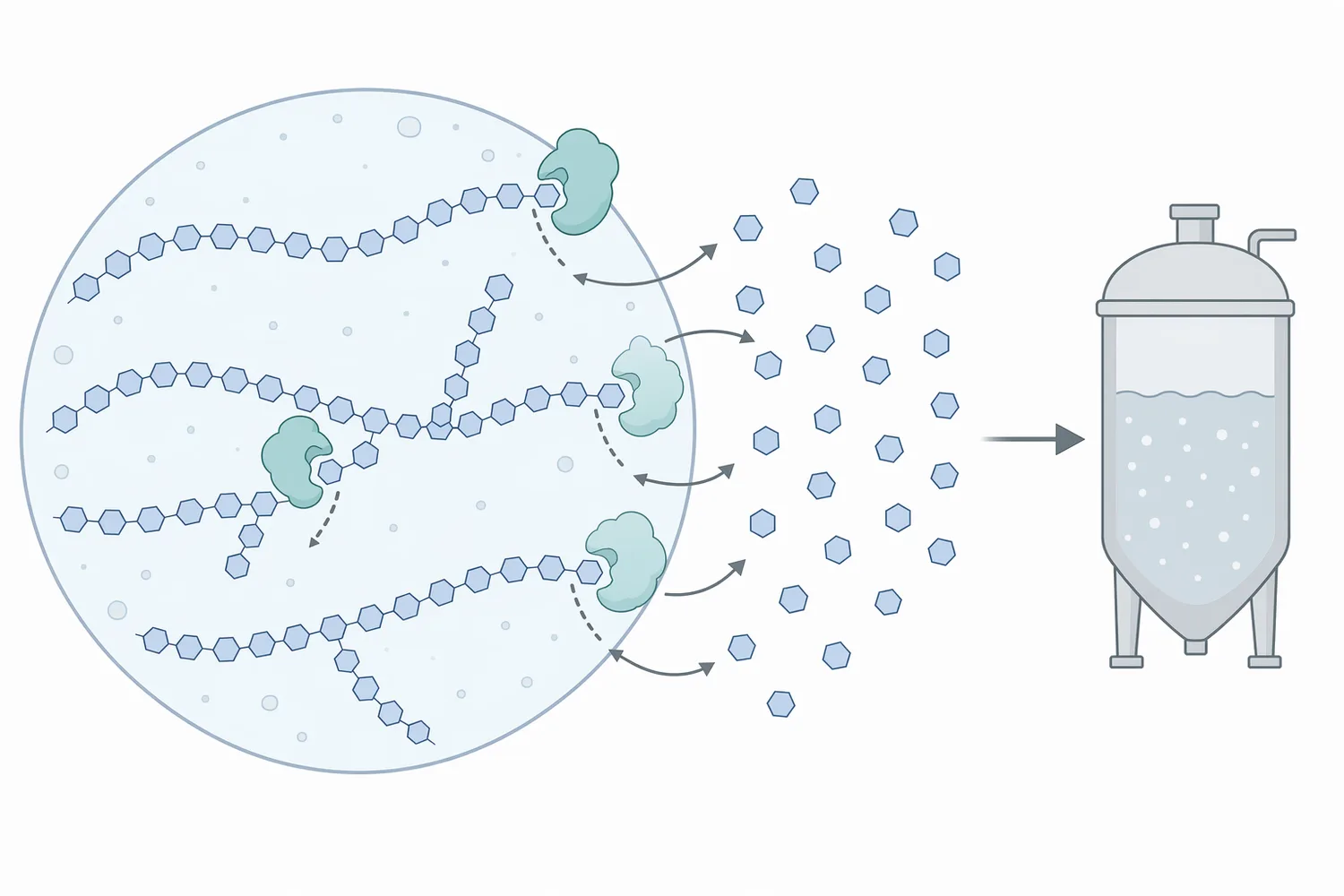
That does not mean glucoamylase acts independently of process reality. If starch remains ungelatinized, trapped inside coarse particles, complexed with lipids, or present as inaccessible granule regions, conversion can slow because the enzyme cannot efficiently contact the glycosidic bonds it is meant to hydrolyze. Research on raw-starch-degrading amylolytic enzymes confirms the broader point that substrate form, enzyme access, and thermal processing shape hydrolysis efficiency, particularly when processors are trying to act on starch without full conventional liquefaction [3].
For brewing and distilling, the most visible outcome is a change in carbohydrate profile. Dextrins and longer soluble starch fragments are reduced as glucose increases; this can raise fermentability, support drier final beer profiles, and provide more fermentable sugar for alcohol production in grain mash. Recent brewing-focused research on amylolytic biocatalysts for wort sugar enhancement supports the core industrial concept that targeted starch hydrolysis can be used to increase wort sugar availability [4].
Starch hydrolysis is a bond-cleavage process. Starch chains are made of glucose units joined mostly by α-1,4 glycosidic bonds, with amylopectin also containing α-1,6 branch points. Glucoamylase binds to a starch-derived chain end, positions the terminal glucose unit in its active site, and hydrolyzes the glycosidic bond so that one glucose molecule is released and the chain becomes one glucose unit shorter [1].
This end-wise action is important because it explains both the strength and the limitation of glucoamylase. Once dextrins have many accessible ends, glucoamylase can steadily release glucose from them; however, branch points and tightly packed or poorly hydrated starch regions can slow the rate at which new chain ends become available. Molecular studies of maltodextrin glucosidase systems show how glucosidase active sites recognize maltodextrin chains and position glycosidic bonds for hydrolysis, illustrating the substrate-recognition logic that also matters in starch-saccharifying enzymes [5].
In a mash or wort, the process can be understood as a staged physical and chemical transformation. First, milling increases surface area. Then heat and water swell or gelatinize starch granules, loosening the ordered structure. Native malt enzymes or added amylases cut long chains into dextrins. Glucoamylase then converts those dextrins toward glucose, producing a carbohydrate stream that yeast can ferment more completely than a dextrin-heavy wort or mash [1].
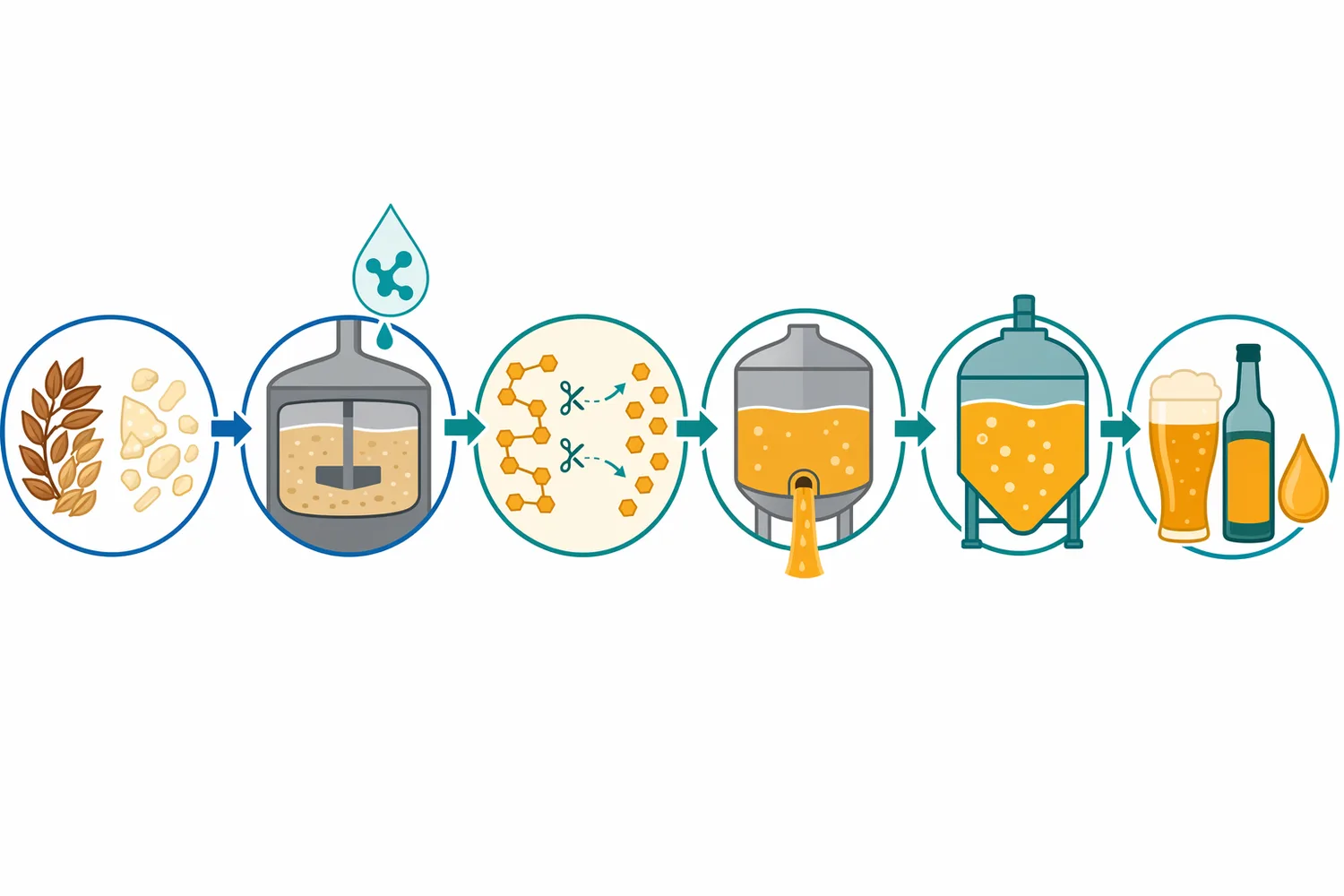
The Enzymes.bio product page describes the preparation as a glucoamylase-based liquid enzyme for starch-to-sugar conversion, and the product positioning includes the logic of improving saccharification in wort and mash systems where both linear and branched starch fragments may be present . The reason this matters is structural: amylopectin branch points create “limit dextrin” regions that are slower to convert if the process relies only on enzymes that prefer linear α-1,4 chain segments.
Pullulanase is a debranching enzyme: its useful role is to hydrolyze α-1,6 branch linkages, opening up amylopectin-derived structures into more linear chains. Once those branch points are reduced, glucoamylase has more accessible chain ends and fewer structural interruptions, so saccharification can move more cleanly toward glucose rather than leaving branched residual dextrins. This is a concrete molecular change: the substrate is not merely “softened”; its branch architecture is cut, exposing more hydrolysable α-glucan chain ends.
The combination is especially relevant in grain systems because amylopectin is a major component of cereal starch. A mash made from corn, barley, wheat, rice, sorghum, or other cereal material contains starch with botanical differences in granule size, crystalline order, lipid interaction, protein matrix, and amylose-to-amylopectin balance. Grain-composition studies show that different grains are associated with different starch-digestion enzyme activity patterns, reinforcing that starch source affects hydrolysis outcomes [2].
The enzymes used around wort, mash, and starch processing are often discussed together, but they do not do the same job. The following comparison is conceptual and application-focused; actual performance depends on process conditions and the specific enzyme preparation being used.
| Enzyme type | Main action on starch-derived material | What changes in the mash or wort | Practical role in saccharification |
|---|---|---|---|
| α-Amylase | Cuts internal α-1,4 bonds in long starch chains | Rapidly lowers viscosity and creates shorter dextrins | Liquefaction and dextrin formation |
| β-Amylase | Releases maltose from non-reducing ends of suitable chains | Increases maltose, especially in malt-based mashing | Fermentability development in traditional brewing mashes |
| Glucoamylase | Releases glucose from non-reducing ends of dextrins and starch fragments | Raises glucose and reduces residual dextrin potential | Final saccharification toward fermentable glucose |
| Pullulanase | Hydrolyzes α-1,6 branch points in amylopectin-derived dextrins | Debranches limit dextrins and exposes more linear chains | Supports more complete conversion when branched starch fragments are present |
This distinction matters because “more enzyme” is not the same as “the right conversion pathway.” α-Amylase can make a mash easier to pump by reducing viscosity but still leave many dextrins; glucoamylase can reduce those dextrins further into glucose; pullulanase can improve access to branch-limited regions that otherwise resist rapid conversion. Reviews of amylase applications describe the industrial importance of different amylolytic enzymes in converting starch into smaller sugars for food, fermentation, and starch-processing uses [1].
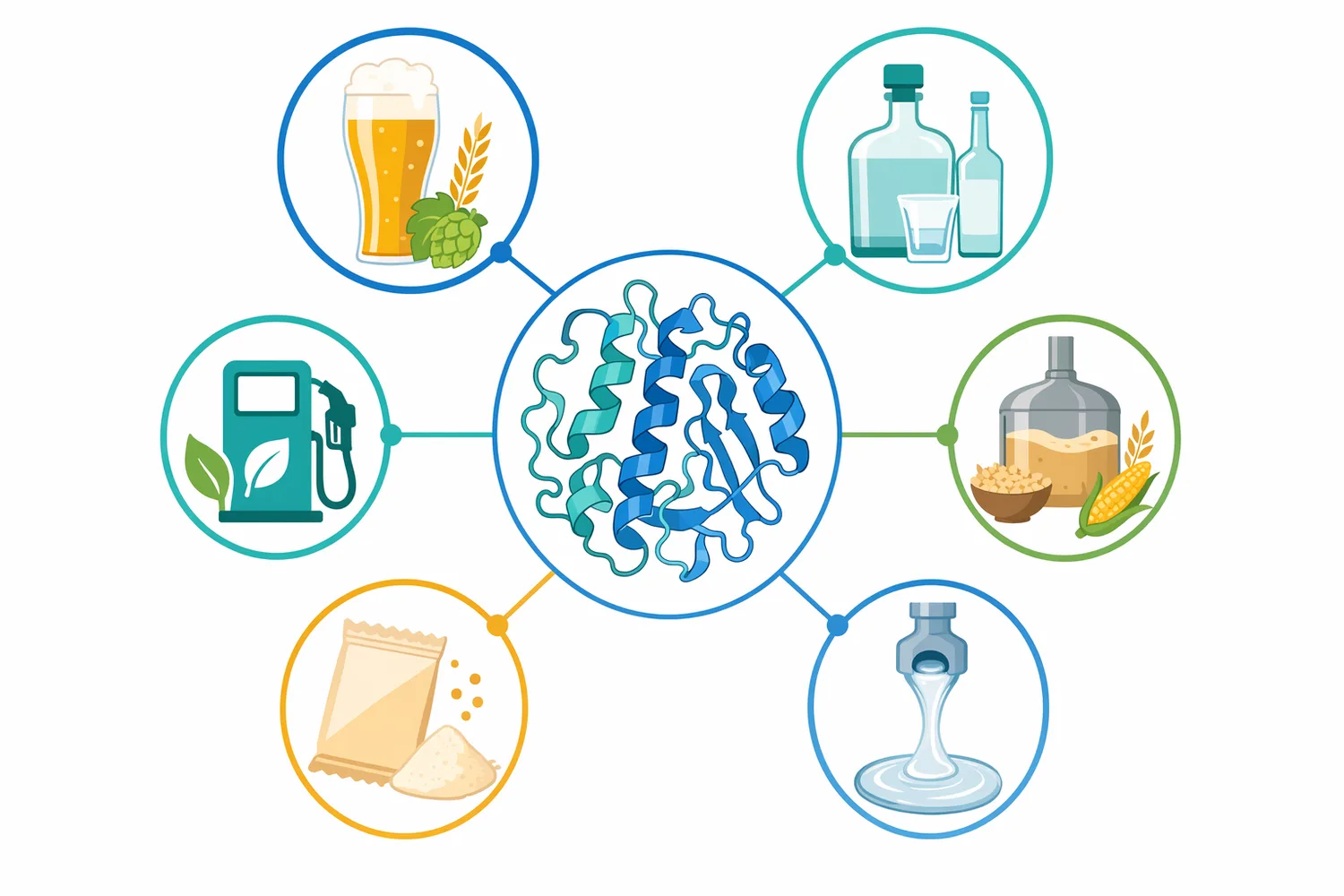
In brewing, glucoamylase is most relevant when the target is a highly fermentable wort. By converting dextrins into glucose, it can shift the wort carbohydrate profile away from residual body-building dextrins and toward yeast-fermentable sugar. That is useful for dry beer profiles, certain high-attenuation styles, low-carbohydrate process goals, or brewing situations where adjunct starch conversion needs additional enzymatic support .
The practical sensory consequence is important. Dextrins contribute body and fullness, while glucose is readily fermented by yeast; therefore, an aggressively saccharified wort can ferment drier and leave less residual sweetness or mouthfeel. This can be desirable in some beers and undesirable in others, so glucoamylase is best understood as a precision tool for a defined carbohydrate outcome rather than a universal upgrade for every recipe.
Brewing research also supports the wider concept that amylolytic biocatalysts can be used to enhance wort sugars. Work on a triticale-based amylolytic biocatalyst was specifically framed around starch hydrolysis with application in brewing wort sugar enhancement, showing that enzymatic manipulation of grain starch remains an active and relevant route for improving wort fermentable extract [4].
In distilling, the economic and process objective is often to convert as much accessible starch as possible into fermentable sugar, because yeast converts those sugars into ethanol. Glucoamylase supports this by hydrolyzing dextrins formed during cooking, liquefaction, and mashing into glucose. In a grain mash, this can help reduce residual starch-derived carbohydrate and improve the pool of fermentable substrate available to yeast .
The mechanism is directly aligned with distilling needs. A distiller does not need dextrin for body in the same way a brewer might; the priority is usually fermentable extract, manageable viscosity, reliable fermentation, and alcohol yield from raw material. Glucoamylase acts on the dextrin stream after starch has been opened up, releasing glucose that yeast can metabolize through glycolysis and alcoholic fermentation.
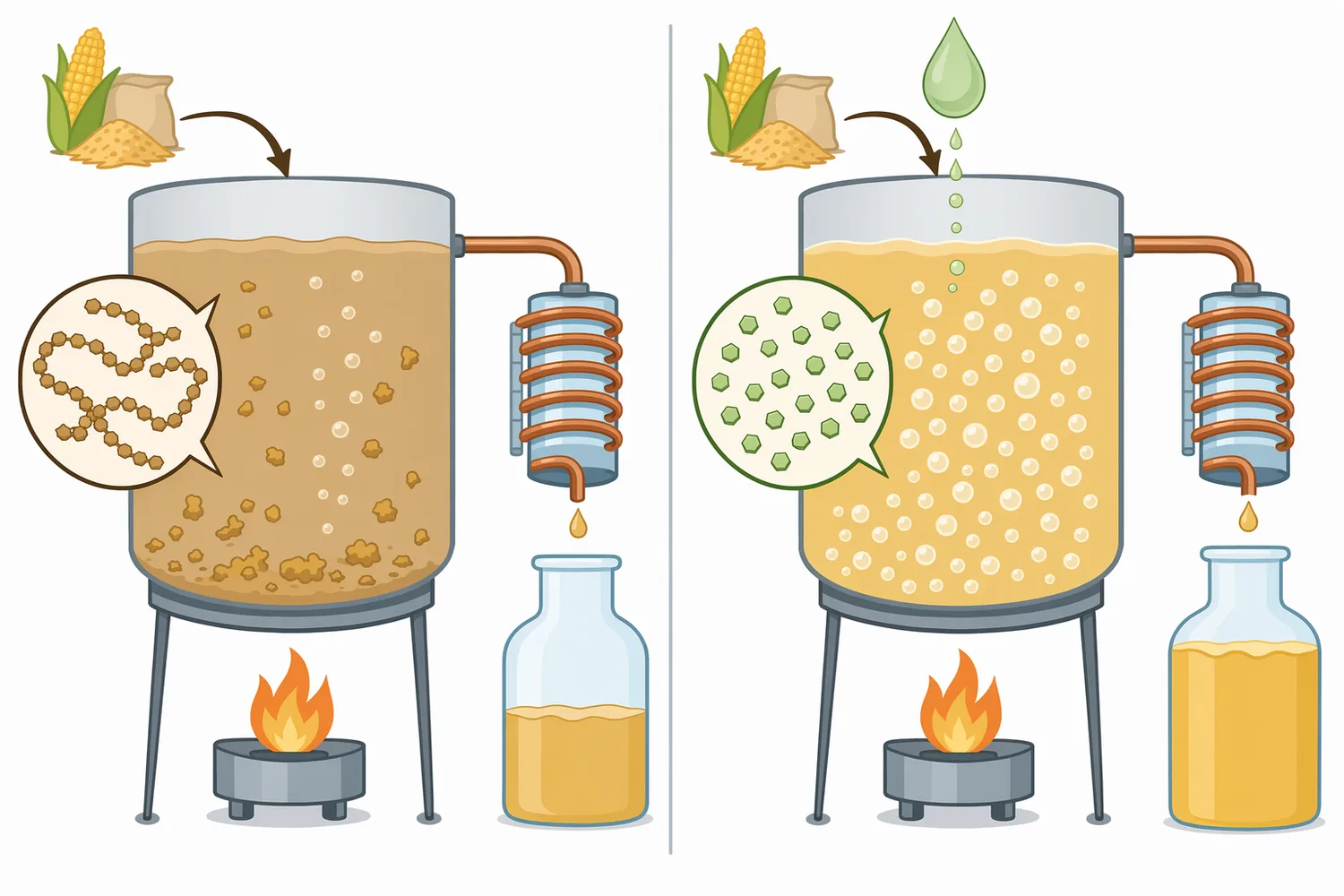
Raw material preparation remains decisive. Coarse grind, incomplete cooking, high solids, poor hydration, or matrix effects from grain proteins and lipids can limit enzyme access. Research on raw-starch-degrading enzymes highlights why thermal and structural accessibility matter: some enzyme systems can act on raw starch to an extent, but performance is still governed by the physical state of the starch and the enzyme’s ability to bind and hydrolyze it [3].
Outside beverage fermentation, glucoamylase is central to starch saccharification because glucose is the desired product in many starch-processing streams. Amylase literature describes broad industrial use of amylolytic enzymes for converting starch into sugars, including applications across food, fermentation, and starch-based processing sectors [1]. The same chemical transformation that benefits a mash—turning starch fragments into glucose—also underpins glucose-rich hydrolysate production.
The typical process logic is sequential. Starch is first dispersed and liquefied so the substrate becomes less viscous and more enzyme-accessible; then saccharifying enzymes convert the dextrin mixture into smaller sugars. Glucoamylase’s role is especially important at this second stage because it is associated with glucose release rather than only molecular-size reduction. Debranching support can further improve conversion where amylopectin-derived branch structures would otherwise persist.
For buyers using the Enzymes.bio liquid product in wort, mash, or related starch-conversion streams, the key expectation should be a shift in sugar composition rather than a visual transformation alone. A mash may look similar while its dissolved carbohydrate profile changes substantially: fewer long dextrins, more glucose, greater fermentable sugar availability, and lower residual starch-derived material when conditions support effective hydrolysis .
Glucoamylase performance depends on contact between enzyme and substrate. Gelatinized or liquefied starch is generally more accessible than intact starch granules because heat and hydration disrupt crystalline regions and allow enzymes to reach glycosidic bonds. This is why starch-conversion processes usually combine mechanical size reduction, water, heat, and enzyme action rather than relying on enzyme addition alone [3].
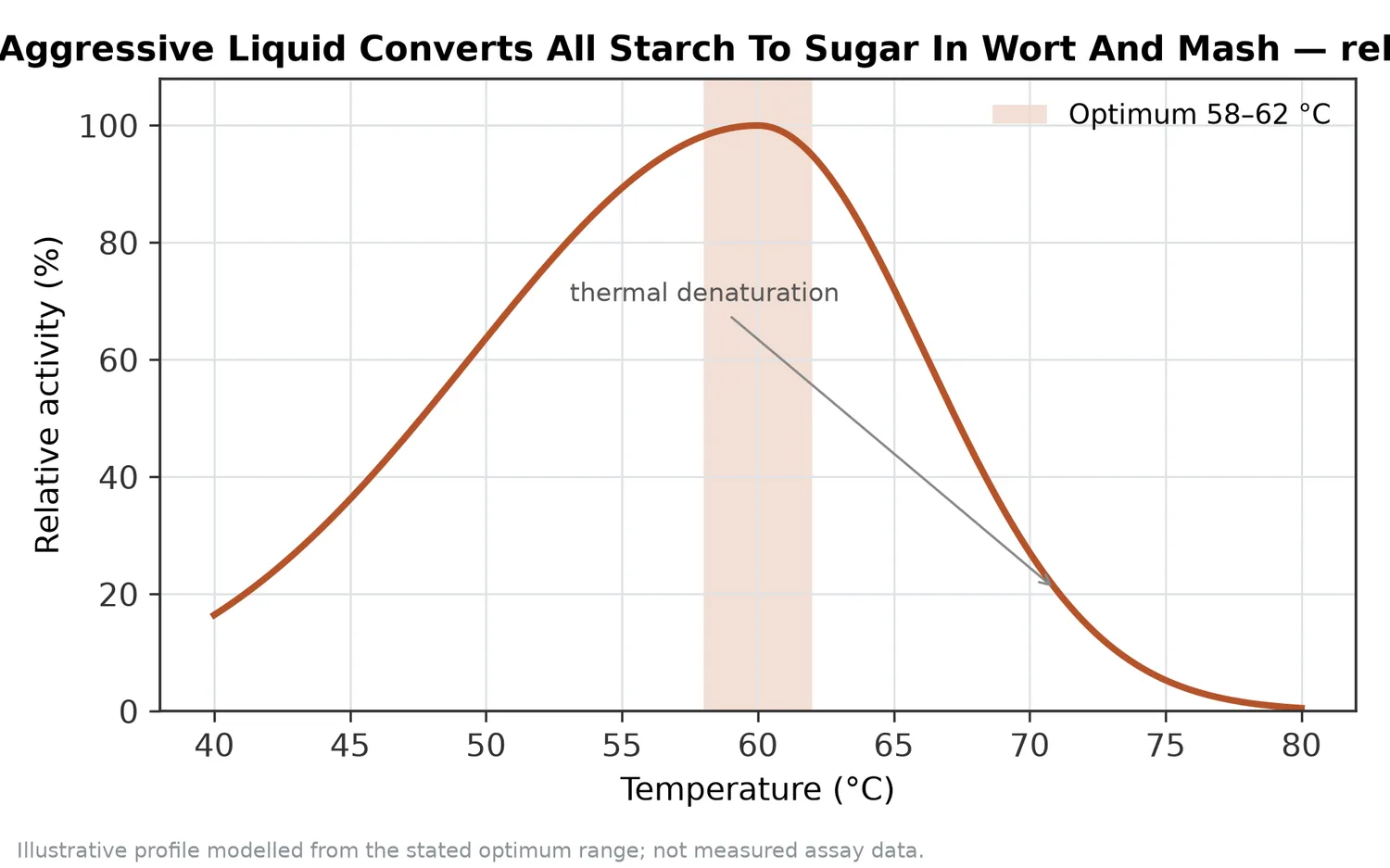
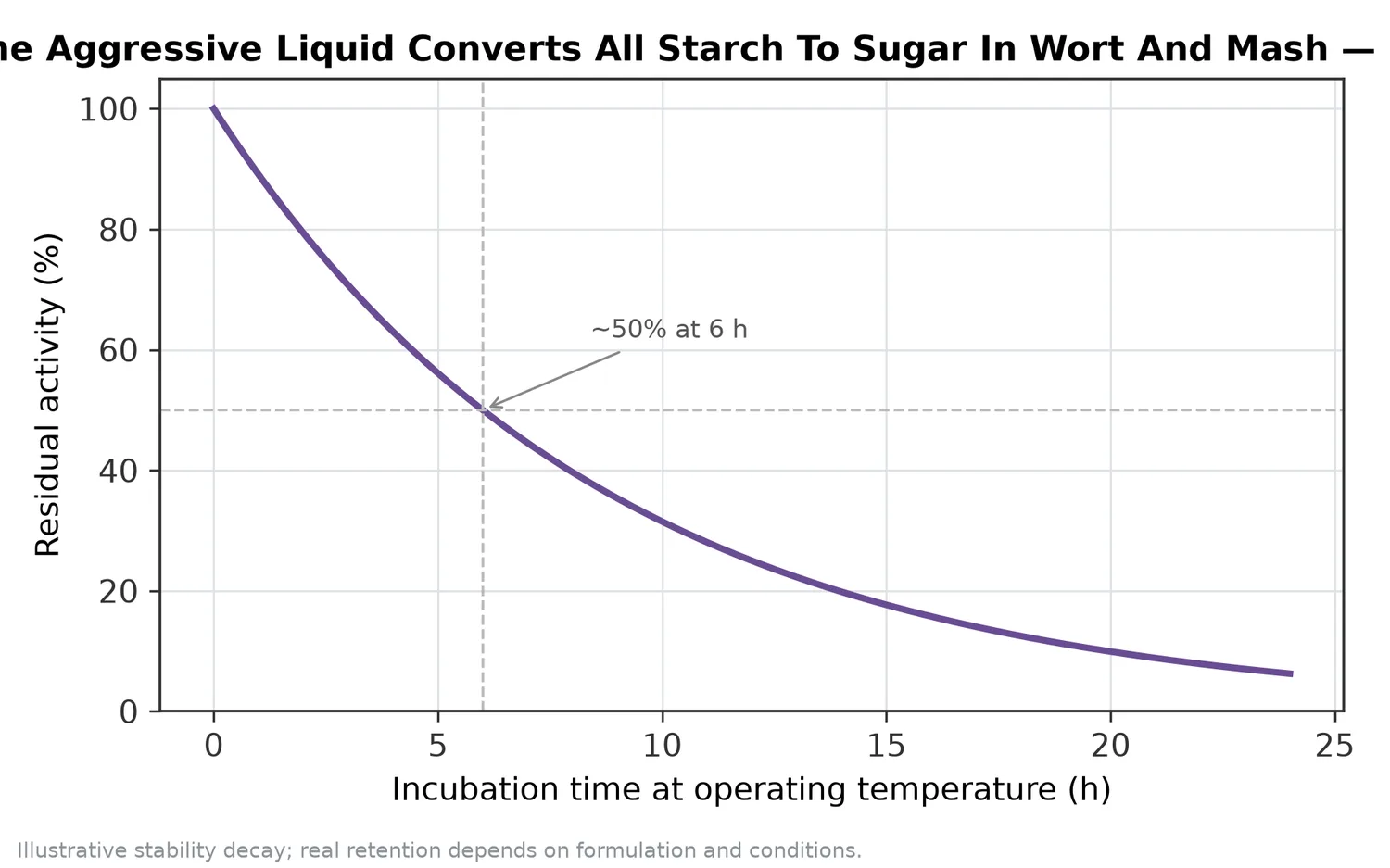
Temperature affects both reaction speed and enzyme stability. Warmer mash or saccharification conditions generally increase molecular motion and can accelerate hydrolysis up to the enzyme-compatible range, but excessive heat denatures proteins by disrupting the folded structure that forms the active site. Once denatured, the enzyme no longer holds the substrate in the correct orientation for bond cleavage, so conversion can fall sharply even if starch remains present.
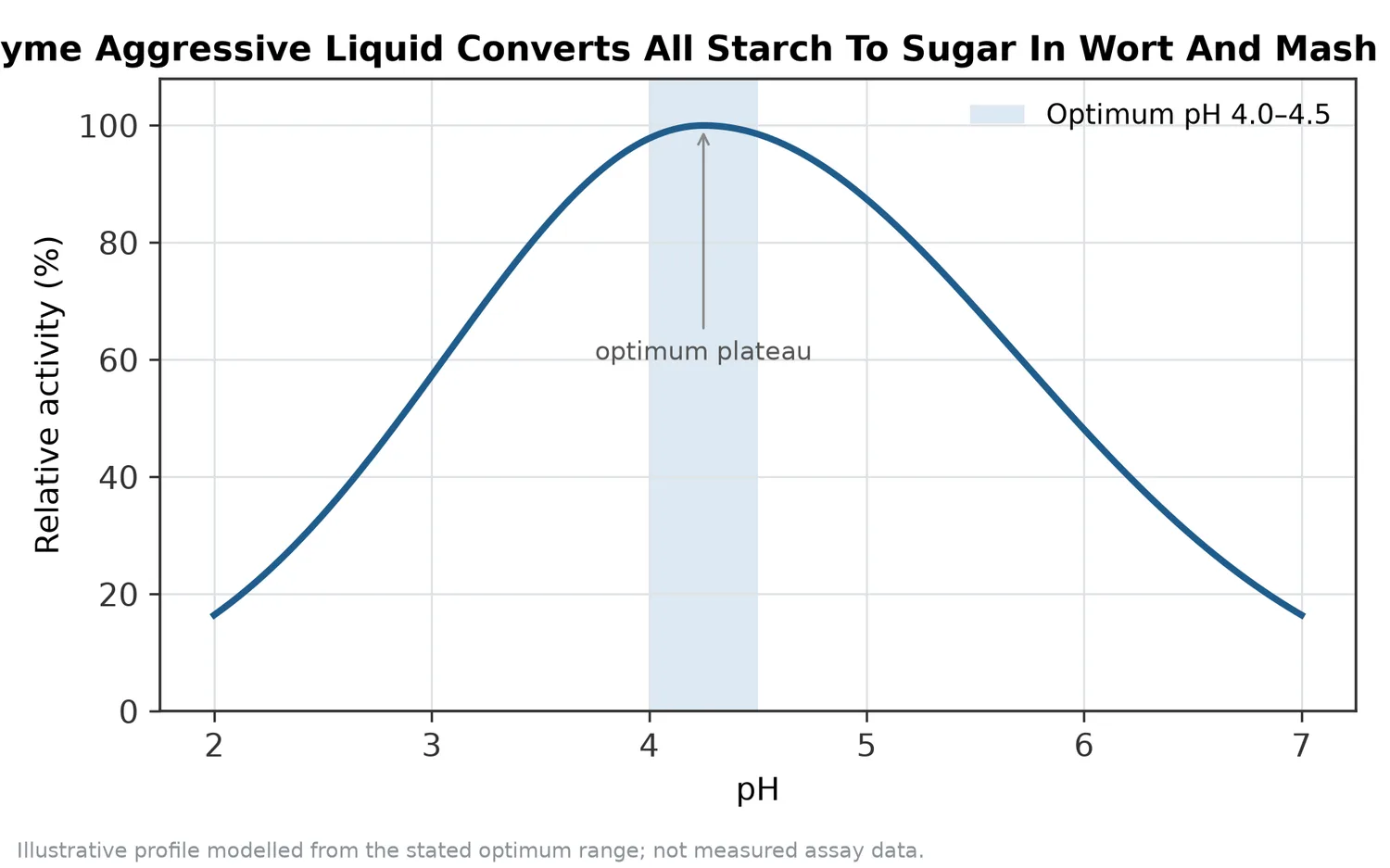
pH has a similarly concrete effect. Enzyme active sites depend on amino-acid side chains being in the right protonation state to donate, accept, or stabilize charges during hydrolysis. If the mash or wort pH is too far from the enzyme-compatible zone, the catalytic groups no longer behave optimally, substrate binding can weaken, and the rate of glucose release declines. Product handling should therefore respect the processing guidance associated with the online product information rather than treating glucoamylase as condition-independent .
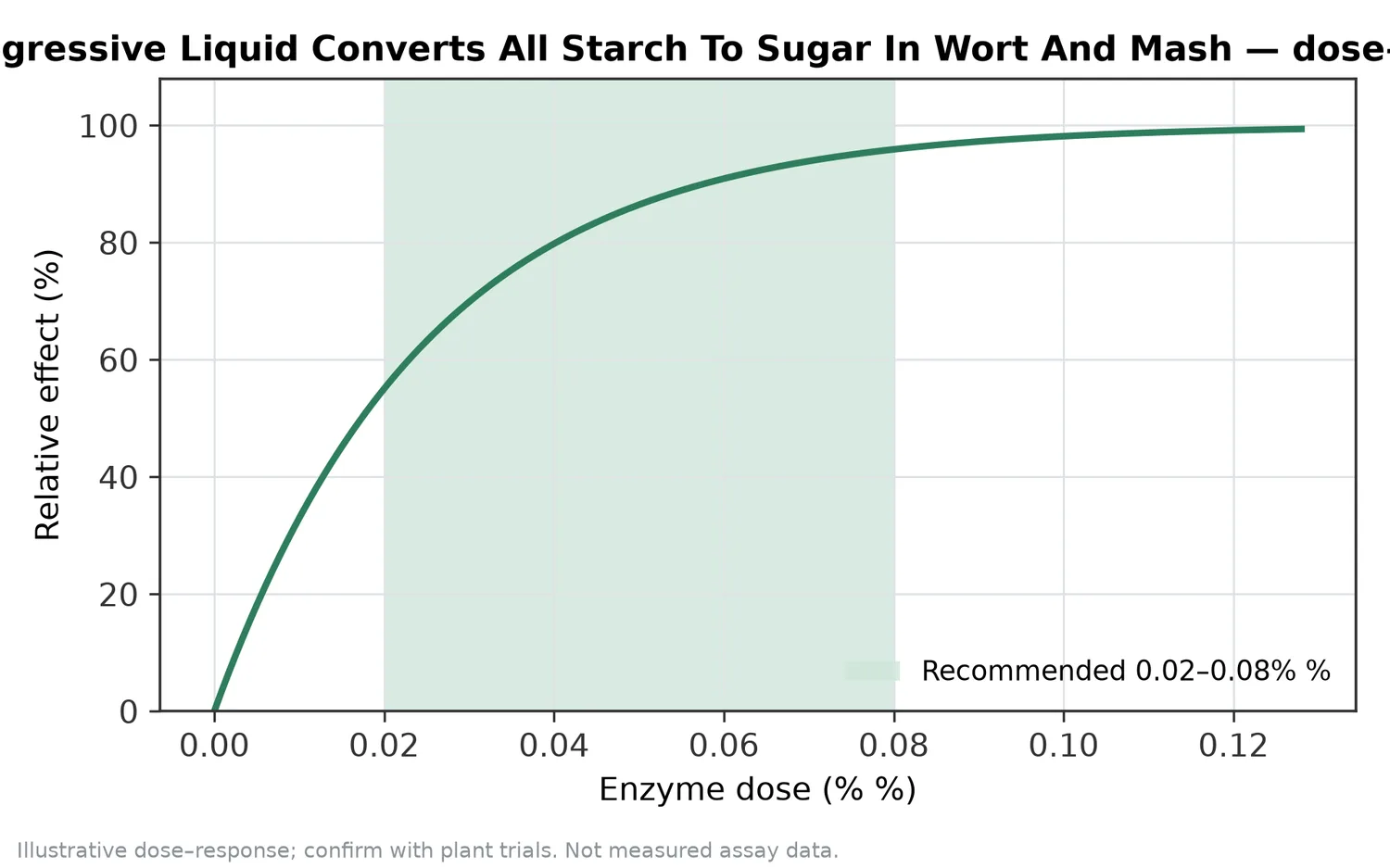
Time and solids loading also matter. Saccharification is progressive: the enzyme must encounter dextrin chains, bind, hydrolyze, release glucose, and repeat. At high solids, diffusion and mixing can become limiting; in short residence times, conversion may stop before the dextrin pool is fully reduced. The correct mental model is not an instant additive effect but a catalytic process that proceeds as long as the enzyme remains active and the substrate remains accessible.
A starch granule is not an open pile of loose glucose chains. It contains ordered and less ordered regions, with amylose and amylopectin arranged in semi-crystalline structures that resist enzymatic attack until water and heat disrupt them. Milling improves surface area, cooking improves hydration and swelling, and liquefaction breaks down viscosity; together, these steps increase the number of starch chains and dextrin ends that glucoamylase can reach.
Raw-starch-degrading enzyme research is useful because it demonstrates the challenge clearly. Enzymes can be selected or characterized for their ability to hydrolyze starch without complete gelatinization, but raw starch remains a more difficult substrate than soluble dextrins because the enzyme has to bind a solid or semi-ordered surface and work at limited access points [3]. In wort and mash, anything that increases access—adequate grind, hydration, temperature treatment, and mixing—usually supports more predictable saccharification.
Matrix components can also interfere indirectly. Grain proteins can physically surround starch, lipids can associate with amylose, and high-viscosity mashes can reduce mixing efficiency. These factors do not change what glucoamylase does at the molecular level; they change how often the enzyme can reach an appropriate bond in an accessible dextrin chain.
The scientific basis for this product category is strong: amylolytic enzymes are a major industrial enzyme group, and their central role is the hydrolysis of starch into smaller sugars for food, fermentation, and bioprocessing applications [1]. Glucoamylase is one of the key saccharifying enzymes in that group because its product is glucose, not merely shorter dextrin.
Brewing-specific evidence also supports the relevance of enzymatic starch hydrolysis to wort sugar enhancement. The development of a triticale-based amylolytic biocatalyst for brewing wort sugar enhancement shows that researchers continue to target grain starch conversion as a route to improving fermentable sugar profiles in wort [4]. While that study is not a product trial for the Enzymes.bio preparation, it supports the same underlying process goal: controlled enzymatic conversion of cereal starch into fermentable sugars.
Industrial enzyme literature further supports the broader commercial reliability of enzyme-based processing. Enzymes are used because they catalyze specific reactions under comparatively mild process conditions, allowing targeted modification of substrates such as starch, protein, cellulose, and other food or industrial polymers [6]. For glucoamylase in wort and mash, that specificity is the ability to convert starch-derived dextrins toward glucose rather than relying only on heat, acid, or endogenous malt enzymes.
Enzymes.bio supplies this glucoamylase product directly online in a 1 kg unit. The buying process is simple: add the product to the cart, pay online, and the order is processed and shipped; a Certificate of Analysis and Safety Data Sheet are supplied with the order . This model is suited to buyers who already know they need a liquid glucoamylase preparation for starch-to-sugar conversion in wort, mash, or related saccharification work.
The product should be understood as an enzyme ingredient for process use, not as a yeast, microbial starter, malt substitute, or finished beverage additive. It does not ferment sugar; yeast or another production organism does that. Its role is upstream or concurrent saccharification: converting starch-derived carbohydrates into glucose so that fermentation or downstream processing has a more fermentable sugar profile.
Because this is a liquid enzyme preparation, it is easier to disperse into a liquid mash or wort than a dry powder in many processing setups. Good mixing matters because enzymes act locally at the molecular scale; uniform distribution helps ensure that the enzyme contacts the dextrin-rich liquid phase rather than remaining concentrated in one part of the vessel.
The product name states the intended function clearly: aggressive conversion of starch to sugar in wort and mash. Scientifically, the pathway is sound—starch is hydrolyzed into dextrins, dextrins are hydrolyzed toward glucose, and branch-supporting activity can reduce structural barriers in amylopectin-derived material. The Enzymes.bio product page presents the preparation for exactly this starch-to-sugar use case .
However, “all starch” depends on accessibility. Starch trapped in poorly milled grain particles, ungelatinized regions, or enzyme-inhibiting matrix structures will not convert at the same rate as soluble dextrins. If the process leaves starch physically unavailable, glucoamylase cannot cleave bonds it cannot reach. This is why saccharification performance is always a combination of enzyme chemistry and process preparation.
A practical interpretation is: the product is designed to drive accessible starch-derived carbohydrates in wort and mash toward fermentable sugar, especially glucose, under enzyme-compatible conditions. That is a strong and useful claim without implying that enzyme addition overrides every physical, thermal, or compositional limitation of the substrate.
This liquid glucoamylase is most relevant where the desired process result is higher fermentable sugar availability, reduced residual dextrin potential, and stronger starch saccharification. In brewing, that points toward dry or highly attenuated profiles. In distilling, it supports fermentable extract release from grain mash. In starch-processing work, it supports glucose-rich hydrolysate formation from liquefied starch streams .
It is less appropriate where residual dextrin, body, sweetness, or carbohydrate structure is intentionally part of the finished product profile. Glucoamylase does not merely “improve” wort in a generic sense; it changes the carbohydrate balance toward glucose. That change can be valuable or undesirable depending on the product target.
For buyers ready to use a liquid glucoamylase preparation, Enzymes.bio offers the product as a direct online 1 kg purchase with order documentation supplied after purchase . The scientific rationale is well established: amylolytic enzymes hydrolyze starch into fermentable sugars, and glucoamylase is the saccharifying tool that pushes dextrin-rich wort and mash toward glucose-rich conversion [1].
Sold by the 1 kg unit, in stock and ready to ship. Order directly on our store — pay online and we process your order. A Certificate of Analysis and Safety Data Sheet are included with every order.
Buy Glucoamylase Enzyme Aggressive Liquid Converts All Starch To Sugar In Wort And Mash →Numbered in order of first citation. Open-access sources, each verified reachable at publication; citation numbers in the text link here.