
Glucoamylase enzyme is used in brewing to convert starch-derived dextrins and oligosaccharides into glucose, increasing wort fermentability so yeast can ferment more completely. In practical terms, it can help produce a lower final gravity, a drier finish, and higher attenuation when those outcomes are intended for the beer style or fermentation process.
For home brewers and brewery operators, the value of glucoamylase is targeted rather than universal: it is most useful for dry beer profiles, high-gravity fermentations, adjunct-heavy recipes, gluten-free or alternative-grain brewing, and processes where residual dextrin limits fermentation. Enzymes.bio supplies glucoamylase directly online by the 1 kg unit; the order is paid for online, processed, and shipped, with a Certificate of Analysis and Safety Data Sheet supplied with the order.
Glucoamylase, also called amyloglucosidase, is a starch-saccharifying enzyme. Its job is to hydrolyze starch-derived carbohydrate chains into glucose. In brewing, those chains originate from malted barley, adjunct grains, rice, corn, millet, sorghum, wheat, cassava, or other starch sources that have been gelatinized, mashed, liquefied, or otherwise made accessible to enzymes. Enzymes.bio positions glucoamylase for starch saccharification, brewing, ethanol production, and related carbohydrate-conversion applications .
The key brewing substrate is not raw starch alone, but the mixture of partially converted carbohydrates left after mashing: soluble starch fragments, maltodextrins, branched dextrins, and smaller oligosaccharides. Yeast readily ferments glucose, maltose, and often maltotriose depending on strain and conditions, but it does not efficiently consume most higher dextrins. Studies on beer carbohydrate analysis highlight why this distinction matters: beer fermentability depends on the profile of individual fermentable sugars, not simply on total extract or original gravity [1].
Mechanistically, glucoamylase works from the non-reducing ends of starch-derived chains, removing glucose units step by step. Alpha-amylase, by contrast, cuts internal bonds within starch chains and creates shorter fragments. This difference is central to brewing: alpha-amylase opens and liquefies the starch structure, while glucoamylase continues the conversion by turning the resulting dextrins and oligosaccharides into glucose. Research on glucoamylase preparations and stabilization focuses on preserving this catalytic ability because its practical value comes from sustained glucose release from starch-based substrates [2].
The brewing result is increased fermentability. When more dextrin becomes glucose, yeast has more simple sugar available. That can lower final gravity, reduce residual sweetness, increase apparent attenuation, and create a leaner, drier sensory profile. In yeast performance research, attenuation is treated as a core brewing outcome linked to how completely yeast converts wort carbohydrates into fermentation products [3].
Dextrins are not “bad” in beer. They contribute body, fullness, palate weight, foam-supporting structure in some contexts, and perceived malt roundness. Many beer styles rely on some residual dextrin for balance. A dry saison, Brut-style IPA, or certain high-strength ales may benefit from very low residual extract; a porter, stout, amber lager, bock, or malt-forward ale may taste thin if too much dextrin is removed.
This is why glucoamylase should be understood as a profile-shaping enzyme. It does not simply “improve” beer in every case; it changes the carbohydrate balance. Specialty malt research shows that grist composition strongly affects wort and beer characteristics, including extract composition, color, flavor, and body-related attributes [4]. If a recipe intentionally uses specialty malts for sweetness, fullness, or a rounded finish, aggressive dextrin conversion can move the beer away from its intended design.
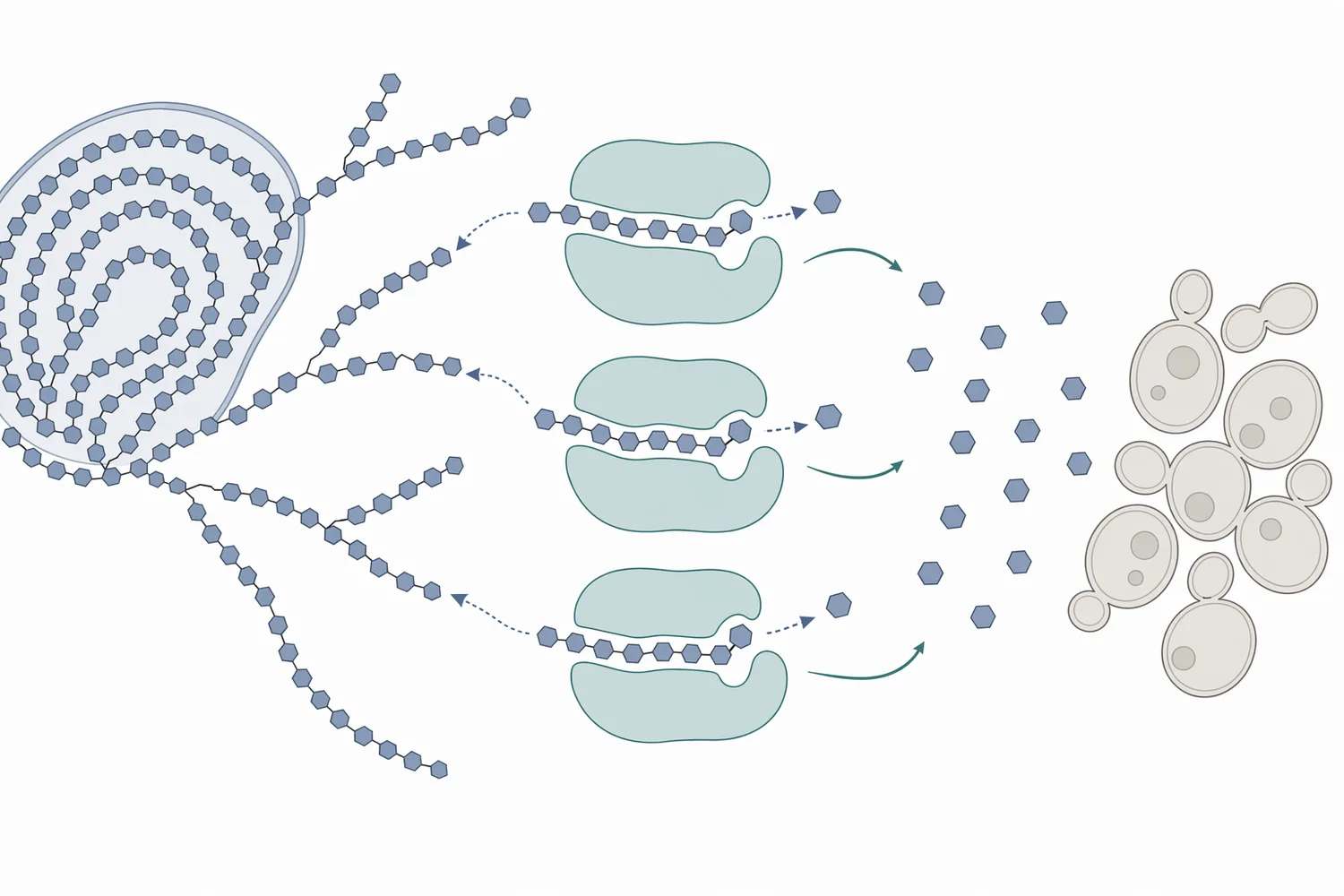
The most direct effect is on final gravity. If the wort contains dextrins that would normally remain unfermented, glucoamylase can convert part of that residual carbohydrate into glucose. Yeast then ferments the glucose into ethanol and carbon dioxide. The hydrometer or density meter sees less remaining extract, so final gravity drops. The palate sees the same change as less sweetness and less viscosity.
That mechanism also explains why glucoamylase can increase alcohol yield in high-gravity brewing. A concentrated wort often contains a larger pool of starch-derived material, including dextrin. If a portion of that pool is not fermentable, the beer may finish heavy or sweet. By increasing the glucose fraction, glucoamylase can help yeast convert more of the available carbohydrate into alcohol, provided yeast health and fermentation conditions are suitable. Research on lager yeast hybrids emphasizes that attenuation and fermentation performance depend strongly on yeast traits, so enzyme-driven sugar availability and yeast capability must work together [5].
Brewers often discuss “amylase” as if it were one enzyme, but brewing uses several enzyme functions. Each acts on a different substrate or solves a different process problem. Glucoamylase is specifically about pushing starch-derived carbohydrates toward glucose and fermentability.
| Enzyme type | Main substrate in brewing | How it acts | Main brewing effect | What it does not primarily solve |
|---|---|---|---|---|
| Alpha-amylase | Gelatinized starch and long starch chains | Cuts internal alpha-glucan bonds, rapidly shortening starch into dextrins | Liquefaction, mash conversion support, lower viscosity from starch breakdown | Does not fully convert all dextrins to glucose |
| Beta-amylase | Starch chain ends, mainly linear regions | Releases maltose from accessible chain ends | Supports maltose formation during mashing | Limited by branching and substrate accessibility |
| Glucoamylase | Dextrins, maltodextrins, oligosaccharides, soluble starch fragments | Releases glucose progressively from chain ends and can attack branch points more slowly | Higher fermentability, lower final gravity, drier finish | Does not replace mash design, yeast management, or filtration enzymes |
| Beta-glucanase | Beta-glucans from grain cell walls | Breaks down gummy cell-wall polysaccharides | Lower wort viscosity, improved runoff and filtration | Does not convert dextrins into glucose |
| Protease | Proteins and peptides | Hydrolyzes protein chains into smaller peptides/amino acids | Can affect FAN, haze potential, and protein structure depending on use | Does not directly increase fermentable carbohydrate |
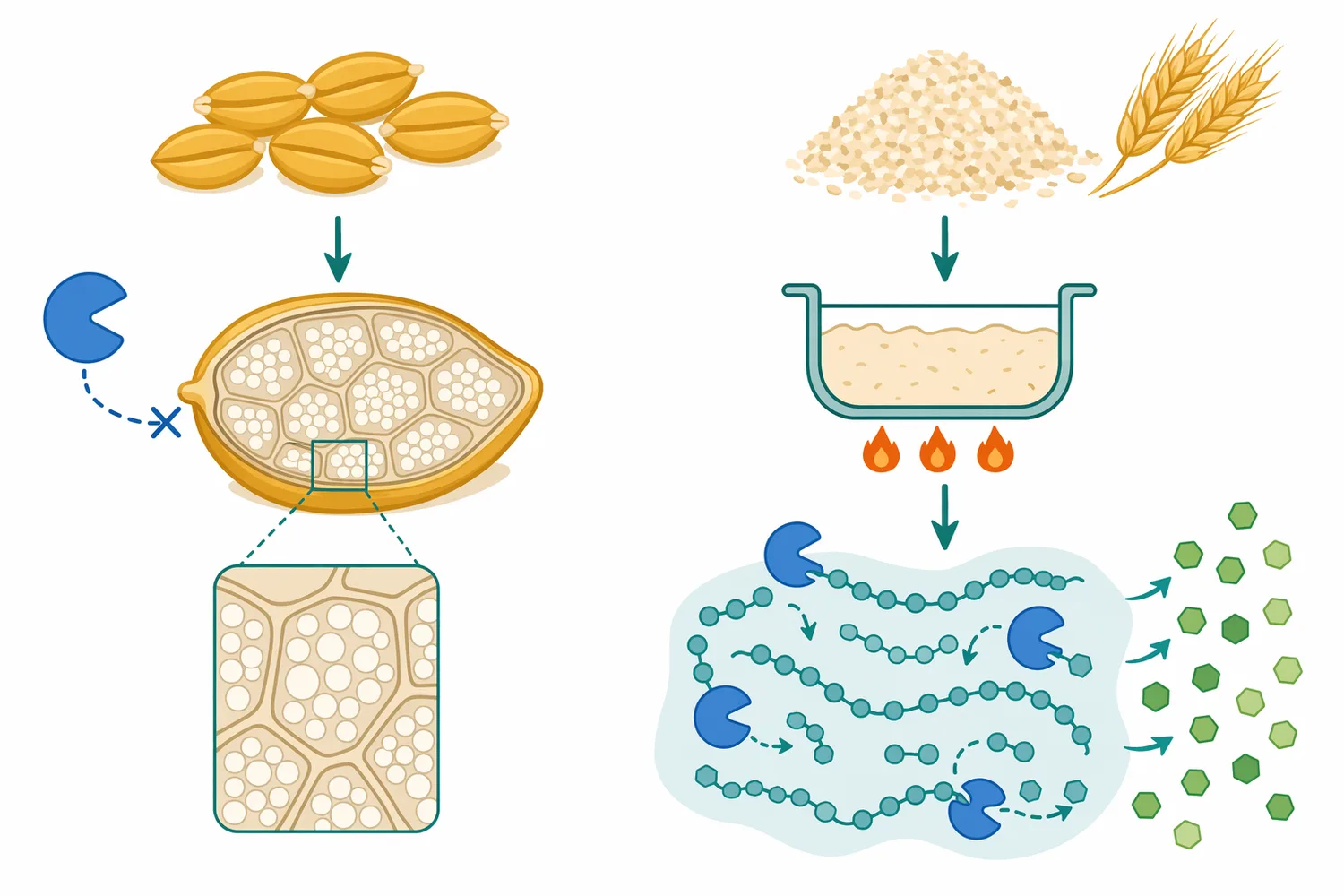
This comparison matters because glucoamylase is sometimes expected to fix every conversion problem. It is more precise to say that it extends saccharification toward glucose after starch has become accessible. Recent brewing research on starch conversion has focused on starch granule size and gelatinization characteristics, because enzymes cannot efficiently hydrolyze starch that remains physically inaccessible inside ungelatinized or resistant granule structures [6].
In practical brewing language: alpha-amylase breaks the long rope into shorter ropes; glucoamylase unthreads the ends into individual glucose units. If the rope is still locked inside an intact grain structure or ungelatinized starch granule, glucoamylase cannot perform at its best. Mash preparation, milling, gelatinization, adjunct cooking where appropriate, and wort composition still matter.
Glucoamylase can be used during mash conversion, wort handling, or fermentation, depending on the brewer’s goal. The earlier it is used, the more it influences the sugar profile before yeast activity begins. The later it is used, the more it can continue generating fermentable glucose while yeast is already active or after primary fermentation has slowed.
During mashing or saccharification, glucoamylase acts on dextrins as they are formed. This approach can create a highly fermentable wort before pitching yeast. It is especially relevant where adjuncts or alternative grains contribute starch but do not bring the same enzyme package as well-modified malted barley. Research on millet for gluten-free brewing shows that mashing protocol can significantly affect fermentable sugar formation, reinforcing that alternative grains require careful conversion rather than assuming barley-like performance [7].
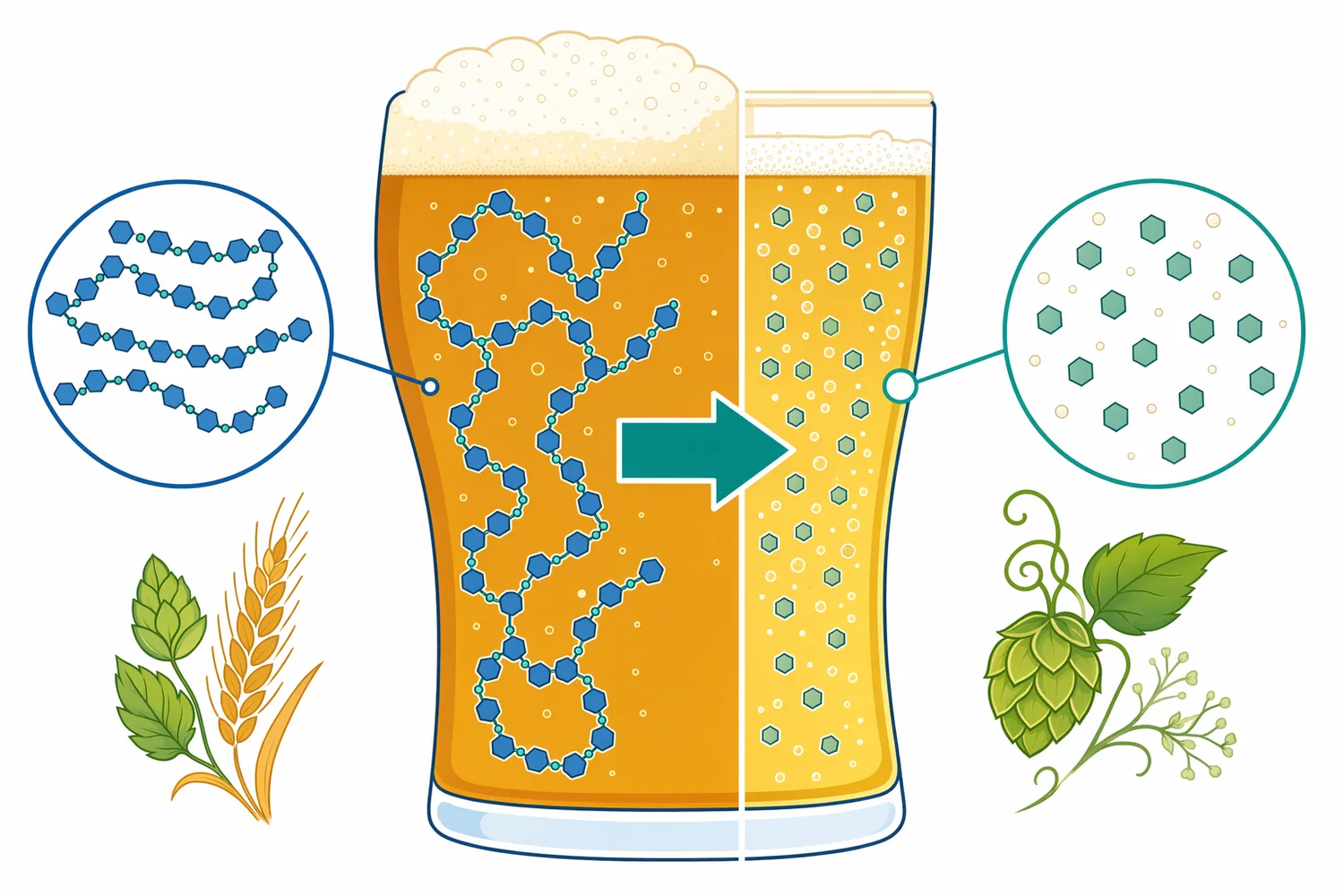
During fermentation, glucoamylase can continue releasing glucose from dextrins that survived the mash. Yeast can then consume the newly formed glucose, often reducing gravity further than the original wort fermentability would allow. This is the reason the enzyme is associated with very dry beers. However, it also means the enzyme can shift the beer beyond the intended endpoint if used in a recipe designed for body or residual sweetness.
The timing also affects sensory development. A wort made highly fermentable before pitching may ferment vigorously from the start, while a fermentation-stage addition may extend the period during which fermentable sugar is generated. Yeast strain remains important: non-Saccharomyces brewing research shows that different yeast species and strains vary substantially in fermentation behavior and beer impact [8]. Glucoamylase can increase glucose availability, but it does not make all yeast behave the same way.
For home brewing, glucoamylase is most commonly used when the desired beer is intentionally dry. Examples include Brut-inspired IPA, dry saison, certain Belgian-style strong ales, some high-attenuation pale ales, and experimental dry versions of strong beer. Home brewing guidance often presents glucoamylase as a way to produce drier, crisper beer by reducing final gravity through dextrin conversion [9].
The enzyme is also useful when a wort stalls at a gravity higher than desired because much of the remaining extract is dextrinous rather than fermentable. In that situation, glucoamylase can generate glucose from longer carbohydrates, giving yeast additional fermentable material. This is different from correcting yeast stress, oxygen limitation, underpitching, or temperature problems; the enzyme addresses carbohydrate availability, not every cause of poor fermentation.
Home brewers working with alternative grains may also benefit. Sorghum, millet, rice, and other gluten-free or adjunct grains can produce worts with carbohydrate profiles different from conventional all-malt barley wort. Research on sorghum in wort for non-alcoholic beer specifically addresses how grain sorghum affects carbohydrate composition, illustrating that non-barley substrates can materially change the sugar and dextrin balance brewers must manage [10].
At the same time, glucoamylase is not a default ingredient for every home brew. If the goal is a round amber ale, sweet stout, malty lager, or full-bodied porter, the enzyme may remove exactly the residual dextrin that the recipe needs. In home brewing, the best results usually come from treating glucoamylase as a deliberate design tool: use it when the beer should finish dry, not simply because more attenuation sounds beneficial.
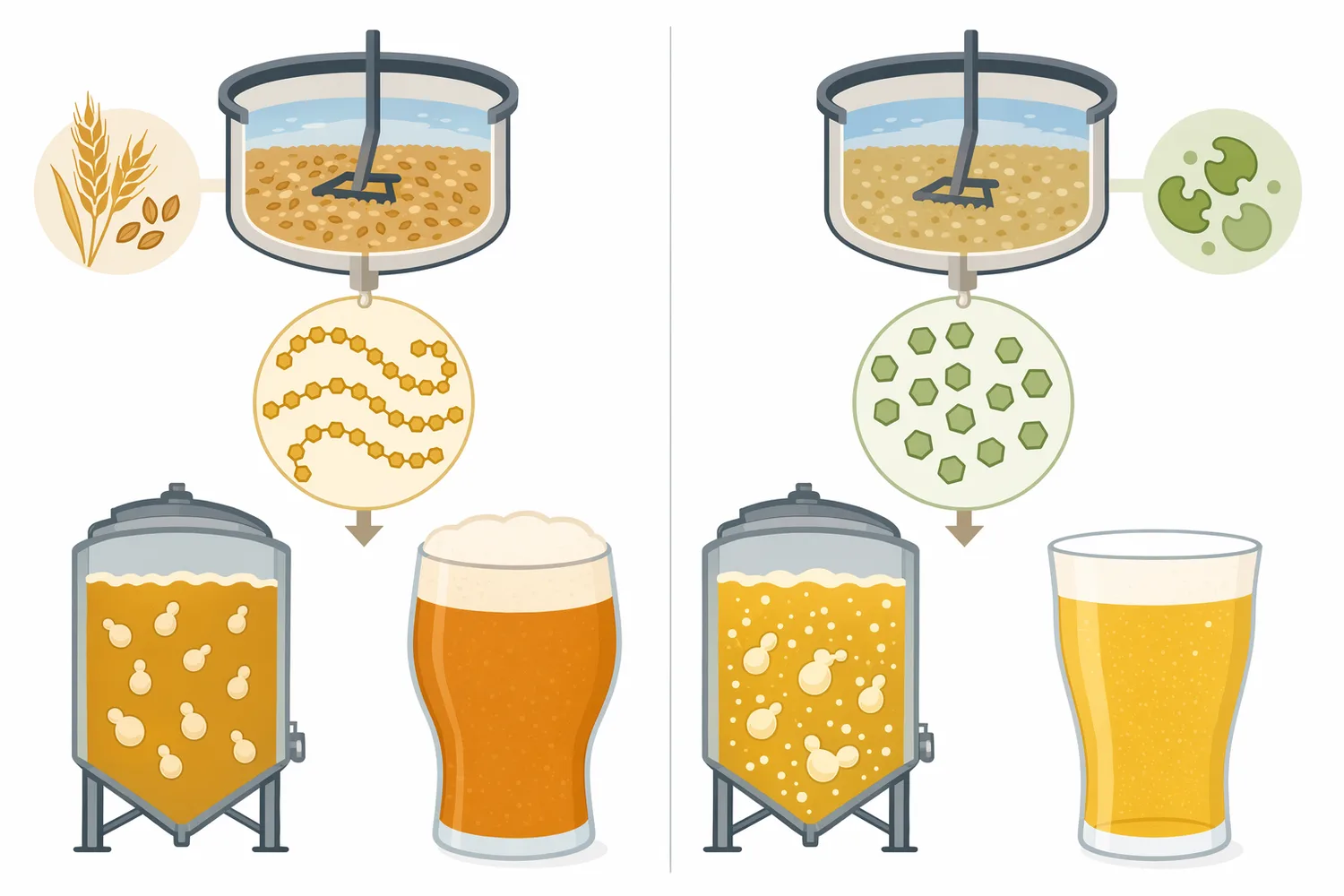
In commercial breweries, glucoamylase is used for the same core reason: converting dextrins and starch-derived oligosaccharides into glucose. The scale is different, but the chemistry is the same. The enzyme can help maintain fermentability targets when raw material variation, adjunct load, mash profile, or beer design requires more complete carbohydrate conversion.
High-gravity brewing is one of the clearest applications. Concentrated wort increases brewhouse efficiency and can support stronger beers, but it also places more demand on carbohydrate conversion and yeast performance. If a high-gravity wort contains too much unfermentable dextrin, the beer can finish heavy, sweet, and below the intended attenuation. Glucoamylase can increase the fermentable fraction by supplying yeast with additional glucose from residual dextrins.
Consistency is another reason breweries use enzymes. Malt lots differ. Specialty malt percentages vary by recipe. Adjunct quality can change. Process conditions such as milling, mash thickness, heating profile, and lauter performance all influence carbohydrate extraction and conversion. Brewing supply-chain reviews emphasize that brewing quality is shaped by inputs and processing decisions across the chain, not by a single isolated step [11].
Glucoamylase also supports product design. A brewery producing a very dry beer may not want to rely only on mash temperature, malt selection, and yeast strain to achieve a low final gravity. The enzyme provides a direct biochemical route to increase glucose formation from dextrins. Used in an appropriate recipe, that can make the difference between a beer that tastes crisp and one that remains sweet or heavy.
Adjunct brewing often increases the need for controlled starch conversion. Rice, corn, cassava, sorghum, millet, and other starch sources can contribute extract efficiently, but their starch structure, gelatinization behavior, and native enzyme contribution differ from malted barley. Glucoamylase becomes valuable after these starches have been opened up and partially hydrolyzed, because it can convert remaining dextrins into glucose.
Rice beer research illustrates how raw material processing affects brewing behavior. Drying techniques used on rice can change physicochemical properties and influence the rice beer brewing process, showing that starch ingredients are not interchangeable simply because they all contain carbohydrate [12]. When starch structure changes, enzyme access and sugar formation can change as well.
Millet and sorghum are especially relevant in gluten-free brewing. They can produce fermentable extract, but the mashing strategy may need to be adapted to achieve the desired sugar profile. The millet mashing study confirms that mashing protocol affects fermentable sugar formation in gluten-free brewing, which aligns with the practical observation that alternative grains often require more deliberate enzymatic support [7].
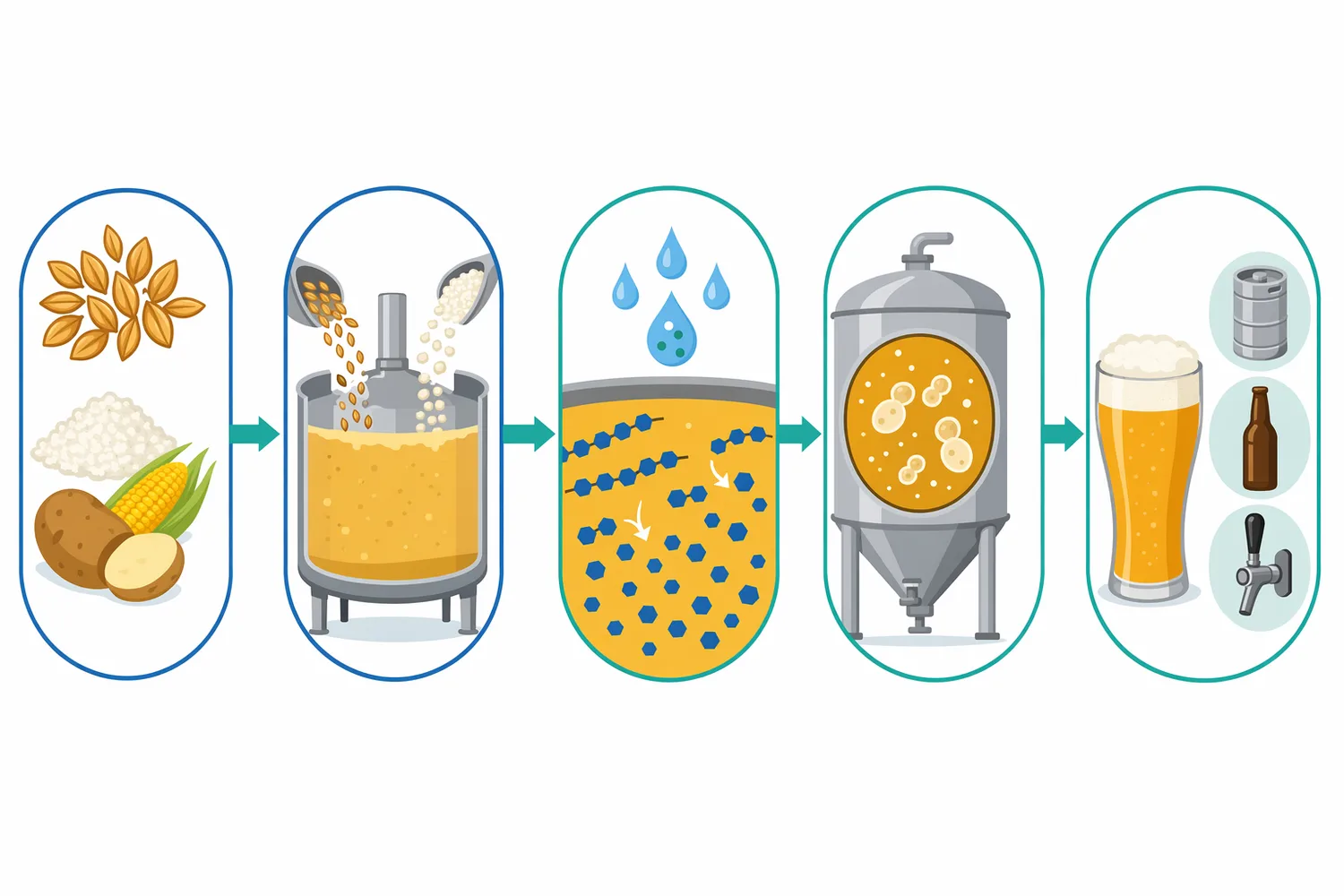
For brewers, the practical takeaway is straightforward: glucoamylase works best after the starch substrate has been made accessible. It is not a magic solvent for intact grain. It is a saccharification enzyme that performs when starch has been gelatinized, liquefied, mashed, or otherwise converted into soluble chains and dextrins that the enzyme can reach.
Once glucoamylase increases glucose availability, yeast metabolism changes because the fermentable sugar pool changes. Yeast can take up glucose readily and convert it into ethanol, carbon dioxide, biomass, and flavor-active metabolites. A wort with more glucose and fewer residual dextrins generally has the potential for higher attenuation than the same wort without that additional conversion.
Fermentation performance still depends on yeast condition. Research on brewing yeast cell age shows that yeast physiology can affect fermentation performance, attenuation, and flocculation [3]. That means glucoamylase can make more fermentable sugar available, but yeast must still be capable of completing fermentation cleanly.
Sugar composition also matters because yeast strains differ in how they consume glucose, maltose, and maltotriose. Some strains ferment maltotriose efficiently; others leave more behind. Glucoamylase can bypass part of that limitation by turning dextrin into glucose, but it does not eliminate the influence of strain genetics, vitality, nutrient status, or fermentation temperature. Research on lager yeast hybrids reinforces that brewing traits such as attenuation are inherited and strain-dependent [5].
In sensory terms, a more complete fermentation usually means less residual sweetness, lighter body, and a cleaner dry finish. It can also change perceived hop bitterness and alcohol balance. When sweetness drops, bitterness and carbonation may seem sharper. In strong beers, lower residual sugar can prevent syrupy heaviness, but it can also expose alcohol warmth if the recipe lacks balance.
Direct brewing use is supported by the broader science of starch hydrolysis and fermentation. Glucoamylase has been studied as a tool for increasing fermentable sugar generation from starch-rich substrates. In bread dough fermentation research, investigators examined the effects of alpha-amylase, alpha-glucosidase, and glucoamylase on yeast-mediated fermentation and bread sugar levels, which is highly relevant mechanistically because yeast response depends on the sugars enzymes make available [13].
The same principle applies in brewing: enzymes determine which carbohydrates are present, and yeast determines which of those carbohydrates become fermentation products. If glucoamylase increases glucose, yeast has a more immediately fermentable substrate. That is why the enzyme is used in brewing, distilling, ethanol production, and starch sugar processing.
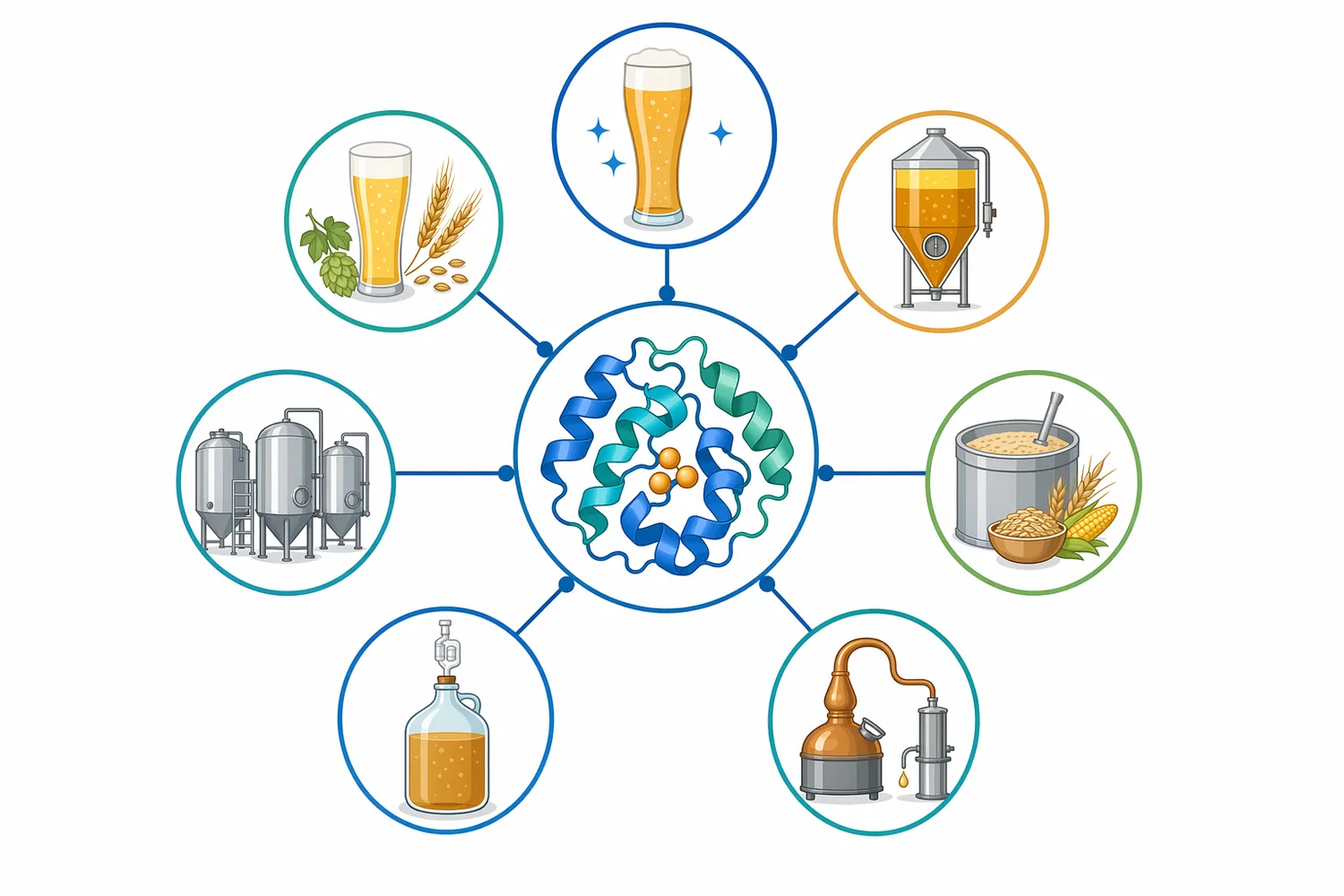
Starch structure research also supports the importance of accessibility. Brewing-focused work on starch granule volumes and gelatinization characteristics investigates how physical starch properties affect conversion during brewing [6]. This helps explain why glucoamylase performs differently across raw materials and mash designs: the enzyme acts on molecules it can contact, not on inaccessible starch trapped in ungelatinized granules or poorly processed adjunct particles.
Fermented cereal systems outside beer show similar dynamics. Research on Jiangxiangxing Baijiu examined molecular evolution of starch structure and sugar supply during initial fermentation stages, underlining that starch breakdown and sugar release are central to alcoholic fermentation in grain-based systems [14]. Beer, Baijiu, and ethanol fermentations differ in process and culture, but all depend on converting starch into sugars that microbes can use.
The most common sensory effect of glucoamylase is dryness. Lower residual extract reduces sweetness and palate weight. In hop-forward beers, this can make the finish seem sharper and more refreshing. In strong beers, it can help prevent a cloying finish. In saison-like profiles, it can support a lean, highly attenuated character.
However, dryness is not universally desirable. A beer with very low residual dextrin may feel thin if the recipe was designed around malt fullness. Specialty malts are often used specifically to build color, flavor intensity, sweetness, roast character, caramel notes, and body; changing fermentability can alter how those attributes are perceived [4].
Glucoamylase can also change balance by increasing alcohol formation from the same original carbohydrate load. More complete fermentation may raise alcohol relative to residual sweetness. This can be desirable in dry strong styles, but less desirable in beers where sweetness is expected to cushion bitterness, roast intensity, acidity, or alcohol warmth.
For that reason, the enzyme is best viewed as a precision tool. It is well suited to beers where the intended finish is crisp, dry, and highly attenuated. It is less suited to beers where dextrin body is part of the target profile. The question is not whether glucoamylase “works”; it does. The question is whether the beer should be driven toward a more glucose-rich, highly fermentable wort.
Glucoamylase use generally follows one of three patterns: mash-stage use, wort-stage use, or fermentation-stage use. Mash-stage use helps create a more fermentable wort before yeast is introduced. Wort-stage use can continue saccharification after lautering or during transfer steps if the process allows. Fermentation-stage use can reduce residual dextrin while yeast is active.
Each pattern has a different process effect. Early use shapes the initial wort sugar profile. Later use can extend fermentability during fermentation. For beers intended to finish extremely dry, fermentation-stage use is common because the enzyme continues converting dextrins as yeast consumes the glucose produced. For beers where only modest fermentability improvement is desired, earlier controlled use may be preferred.
The important operational point is to follow the product label and the brewer’s internal process controls. Enzyme performance depends on contact with the substrate, wort composition, process timing, and the intended beer profile. The enzyme should be handled as a functional processing ingredient, not as a flavoring or general-purpose brewing shortcut.
This is also where measurement matters in brewing practice. Brewers track gravity because it reflects the changing balance between fermentable material consumed and residual extract remaining. Modern beer sugar studies show that individual fermentable sugars can be quantified and differentiated, reinforcing that gravity changes are rooted in real carbohydrate composition rather than an abstract number [1].
Glucoamylase has three main limitations. First, it does not create fermentable sugar from material it cannot access. If starch is physically unavailable because it was not properly gelatinized, milled, cooked, or liquefied, saccharification will be incomplete. Brewing starch conversion research continues to examine gelatinization and granule characteristics for exactly this reason [6].
Second, it does not replace yeast management. More glucose is useful only if yeast can ferment it. Yeast age, strain, vitality, nutrient availability, and fermentation conditions all influence attenuation and performance. The enzyme can improve carbohydrate availability, but it cannot make unhealthy yeast behave like a robust fermentation culture [3].
Third, it can over-dry the beer if the recipe depends on dextrin. This is not a failure of the enzyme; it is the expected result of its mechanism. If the beer needs residual body, sweetness, or malt softness, glucoamylase may be unnecessary or counterproductive.
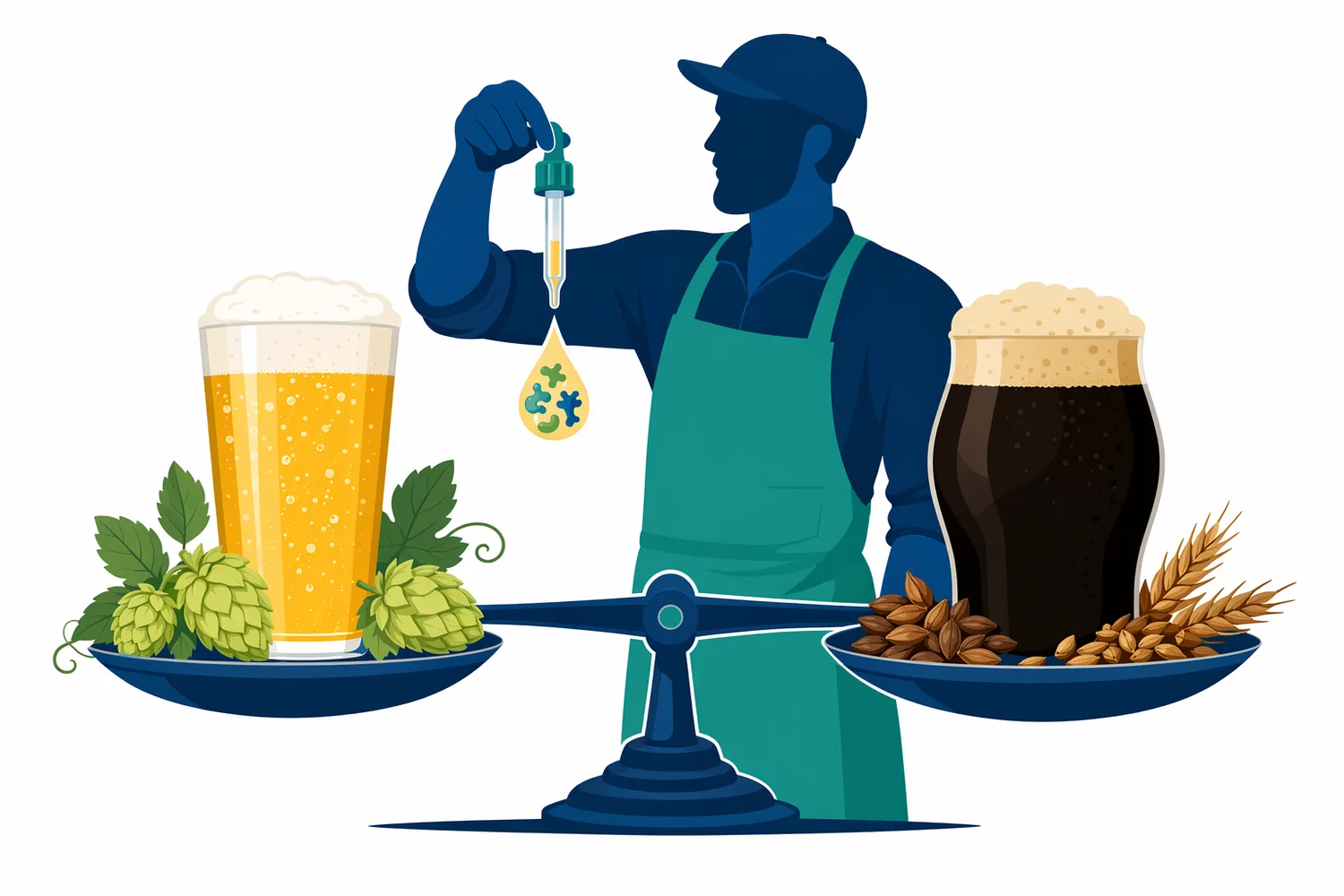
The responsible way to think about glucoamylase is therefore style-led and process-led. Use it when lower residual carbohydrate is desirable. Avoid treating it as a universal improvement for all wort. Its strength is precisely its specificity: it shifts starch-derived extract toward glucose and higher fermentability.
Enzymes.bio supplies glucoamylase for brewing and starch-saccharification applications through direct online purchase. The product is sold by the 1 kg unit; the buyer places the order online, pays online, and the order is processed and shipped. A Certificate of Analysis and Safety Data Sheet are supplied with the order.
This format is intended to keep purchasing straightforward for buyers who already know they need glucoamylase for brewing, fermentation, or starch conversion. The product should be used according to the label, the accompanying documentation, and the controls appropriate to the brewing environment. Enzymes.bio presents glucoamylase within its enzyme category for starch saccharification and related industrial and food-processing uses .
Glucoamylase is a proven starch-saccharifying enzyme for increasing wort fermentability. It works by converting starch-derived dextrins and oligosaccharides into glucose, which brewing yeast can ferment. The practical outcomes can include lower final gravity, higher attenuation, a drier finish, and better conversion of dextrin-rich or adjunct-derived extract.
Its best brewing applications are dry beer styles, high-gravity brewing, adjunct and alternative-grain recipes, gluten-free brewing, and processes where residual dextrin limits the desired fermentation endpoint. Its main limitation is equally clear: it can reduce body and sweetness in beers that need those qualities.
For buyers who need glucoamylase for home brewing or brewery use, Enzymes.bio offers direct online ordering by the 1 kg unit, with the order processed and shipped after online payment and documentation supplied with the order.
Sold by the 1 kg unit, in stock and ready to ship. Order directly on our store — pay online and we process your order. A Certificate of Analysis and Safety Data Sheet are included with every order.
Buy Glucoamylase Enzyme For Home Brewing And Commercial Breweries →Numbered in order of first citation. Open-access sources, each verified reachable at publication; citation numbers in the text link here.