
Glucose oxidase enzymes for bakery use are dough-strengthening baking enzymes used to improve dough tolerance, handling, gas retention, loaf volume consistency, and crumb structure. They work by converting glucose and oxygen into gluconic acid and hydrogen peroxide; in dough, the hydrogen peroxide promotes controlled oxidation and crosslinking within the gluten network, helping dough become stronger and more resilient during processing.
Enzymes.bio supplies Glucose Oxidase Enzymes for Bakery – Baking Dough Enzymes as an online-order product for bread and dough applications. The product is available for direct purchase by the 1 kg unit; after online payment, the order is processed and shipped, with a Certificate of Analysis and Safety Data Sheet included with the order .
Glucose oxidase is an oxidoreductase enzyme used in bakery systems primarily for dough strengthening. Unlike amylases, which act mainly on starch, or proteases, which relax gluten by breaking peptide bonds, glucose oxidase supports the formation of a more cohesive gluten network through oxidation chemistry inside the dough [1].
In breadmaking, dough must be elastic enough to trap gas, extensible enough to expand, and strong enough to survive mixing, dividing, moulding, proofing, and oven spring. Weak or highly variable flour can make this balance difficult: dough may become sticky, slack, easily torn, or unable to hold carbon dioxide evenly. Glucose oxidase is used because it modifies the dough structure itself, giving the gluten network more resistance to mechanical stress and helping the dough retain gas more consistently.
The basic reaction is simple:
glucose + oxygen → gluconic acid + hydrogen peroxide
The enzyme catalyzes the oxidation of glucose in the presence of oxygen. The key functional by-product in dough is hydrogen peroxide, a mild oxidizing agent that can convert reactive sulfhydryl groups in gluten proteins into disulfide linkages and can also contribute to other oxidative crosslinking reactions [1].
This is why glucose oxidase is commonly described as an enzyme-based alternative or complement to chemical oxidizing improvers. It does not “feed” yeast directly, does not soften crumb in the same way as anti-staling amylases, and does not act as a flavor ingredient. Its value is structural: it helps strengthen and organize the protein network that gives bread dough its gas-holding capacity and processing tolerance [2].
Wheat dough structure depends largely on gluten, a hydrated protein network formed from glutenin and gliadin fractions during mixing. Glutenins contribute elasticity and strength, while gliadins contribute flow and extensibility. Good bread dough requires both: too little strength gives collapse and poor gas retention, while too much tightening can reduce expansion and loaf volume [1].
Glucose oxidase affects this system indirectly. It does not cut gluten proteins or add new protein; instead, it generates hydrogen peroxide within the dough. Hydrogen peroxide can oxidize free sulfhydryl groups on gluten proteins, supporting the formation of disulfide bonds between protein chains. These bonds help link gluten proteins into larger, more connected structures, making the dough network more elastic, cohesive, and resistant to deformation [1].
This mechanism matters in practical baking because dough is repeatedly stressed. During mixing, the network is stretched and aerated. During dividing and moulding, it is compressed and reshaped. During proofing and baking, gas cells expand and push against gluten films. A stronger network can better preserve gas cell structure, reducing tearing, excessive spreading, and collapse.
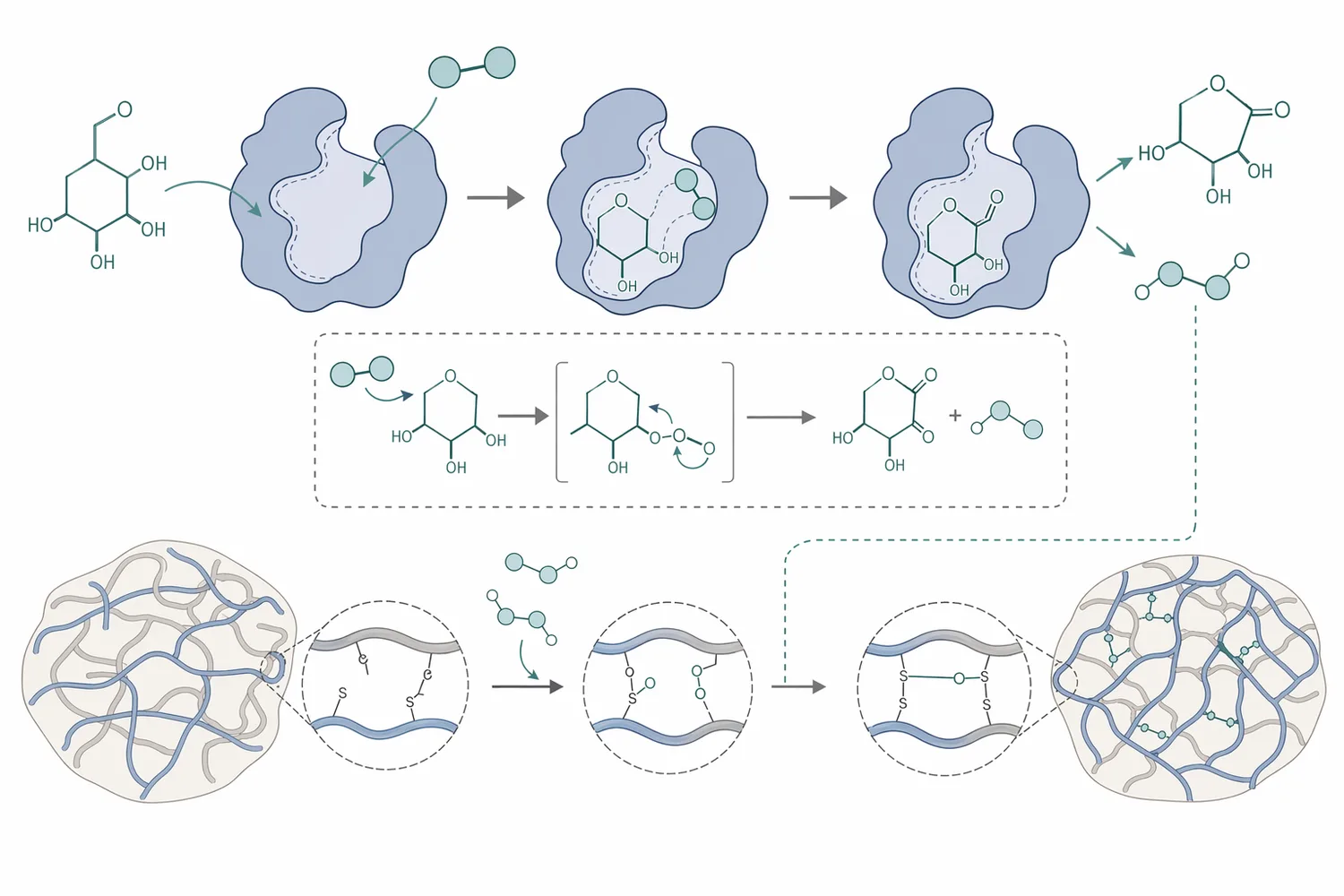
Research reviewed in the baking-enzyme literature also points to effects beyond simple disulfide bonding. Oxidative conditions generated by glucose oxidase may promote non-disulfide protein crosslinks and may influence flour polysaccharides such as pentosans, which can affect water distribution and dough rheology. In practical terms, the dough can become less sticky, more tolerant, and more stable because both the protein matrix and surrounding hydrated flour components behave differently after oxidation [1].
This is different from adding a fast chemical oxidant. Glucose oxidase requires glucose, oxygen, water, and time in the dough phase. Its effect develops as the enzyme reaction proceeds during mixing, resting, and fermentation, then the enzyme loses activity as baking temperatures rise and proteins denature [2].
Weak dough often shows up as slackness, spreading, low resistance during moulding, or poor recovery after mechanical handling. In commercial bread production, even a small change in flour strength or fermentation tolerance can create visible differences in loaf shape and crumb structure. Glucose oxidase helps address this by encouraging oxidative crosslinking in gluten, increasing dough strength and stability when the formulation and process are compatible.
This strengthening effect can be especially useful where dough must travel through dividers, rounders, moulders, sheeters, or other mechanical handling steps. A dough piece that retains its structure better through these steps is more likely to proof evenly and enter the oven with a consistent gas-cell network [2].
Stickiness can be caused by flour quality, high hydration, damaged starch, formulation changes, insufficient dough development, or excessive enzymatic breakdown from other components. Glucose oxidase does not remove water from the formula, but by reinforcing gluten and affecting hydrated flour components, it can improve dough handling and reduce the perception of tackiness in suitable systems.
The practical change is physical: a more connected gluten network holds water and gas cell walls more coherently. Instead of smearing, tearing, or clinging to equipment, the dough has better body and surface integrity. This can support smoother transfer through common bakery operations, especially where dough weakness and stickiness occur together [1].
Yeast produces carbon dioxide during fermentation, but bread volume depends on the dough’s ability to retain that gas. If gluten films around gas cells are too weak, bubbles coalesce, rupture, or escape. The result can be poor oven spring, coarse crumb, tunnels, collapsed shoulders, or inconsistent loaf height [2].
Glucose oxidase supports gas retention by strengthening the gluten films surrounding gas cells. Controlled oxidation increases the dough’s ability to stretch without rupturing, so gas expansion during proofing and early baking can be better supported. This is one reason glucose oxidase is associated with improved loaf volume and more uniform crumb structure in bakery applications.
Flour is a biological raw material. Protein quantity, protein quality, starch damage, enzyme background, and water absorption can vary between wheat lots and milling conditions. Even when flour specifications look similar, dough behavior may shift from one delivery to the next. Glucose oxidase can help moderate some of this variability by reinforcing gluten structure during dough development [1].
It should not be treated as a universal correction for unsuitable flour. If flour is extremely weak, poorly milled, contaminated, or mismatched to the product style, an enzyme alone cannot guarantee performance. However, in normal breadmaking systems, glucose oxidase can be a useful part of an improver approach aimed at more consistent dough strength and finished bread quality [2].
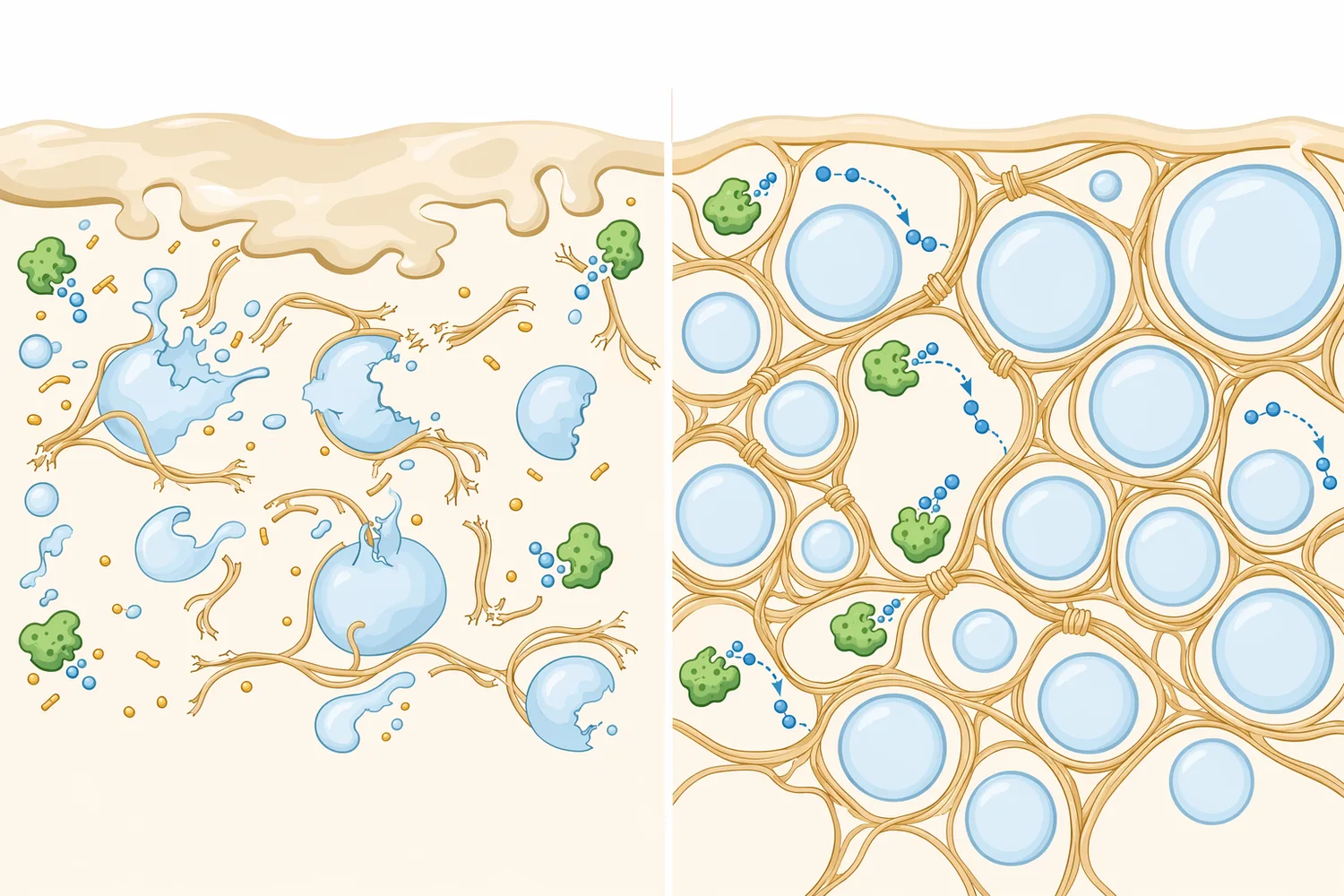
The scientific foundation for glucose oxidase in dough is well established: glucose oxidase catalyzes glucose oxidation in the presence of oxygen and generates hydrogen peroxide, which can act as an oxidizing agent in wheat dough systems. Reviews of bakery enzymes describe glucose oxidase as one of the enzymes used to improve dough properties through oxidative protein crosslinking [1].
The key evidence is not simply that the enzyme reacts with glucose. The important bakery result is that hydrogen peroxide changes gluten chemistry. Oxidation of sulfhydryl groups promotes disulfide bond formation, and protein crosslinking increases the size and connectivity of gluten polymers. Larger, more connected gluten structures increase dough resistance and elasticity, which can improve dough handling and breadmaking performance [1].
Bakery-industry guidance also describes glucose oxidase as useful for improving dough strength, elasticity, gas retention, and loaf characteristics. These effects are consistent with the mechanism: a stronger gluten network holds fermentation gas more effectively and maintains structure during proofing and oven spring.
At the same time, the literature is clear that the effect is dose-sensitive. Too little enzymatic oxidation may not produce a meaningful change, while too much oxidation can over-tighten the gluten network. Over-crosslinked dough may become less extensible, reducing expansion and potentially harming loaf volume or crumb quality [1].
That dose-sensitive behavior is important for understanding glucose oxidase responsibly. It is a functional dough-strengthening ingredient, not a “more is better” additive. Its performance depends on flour quality, hydration, mixing energy, fermentation time, oxygen availability, and the rest of the formulation [2].
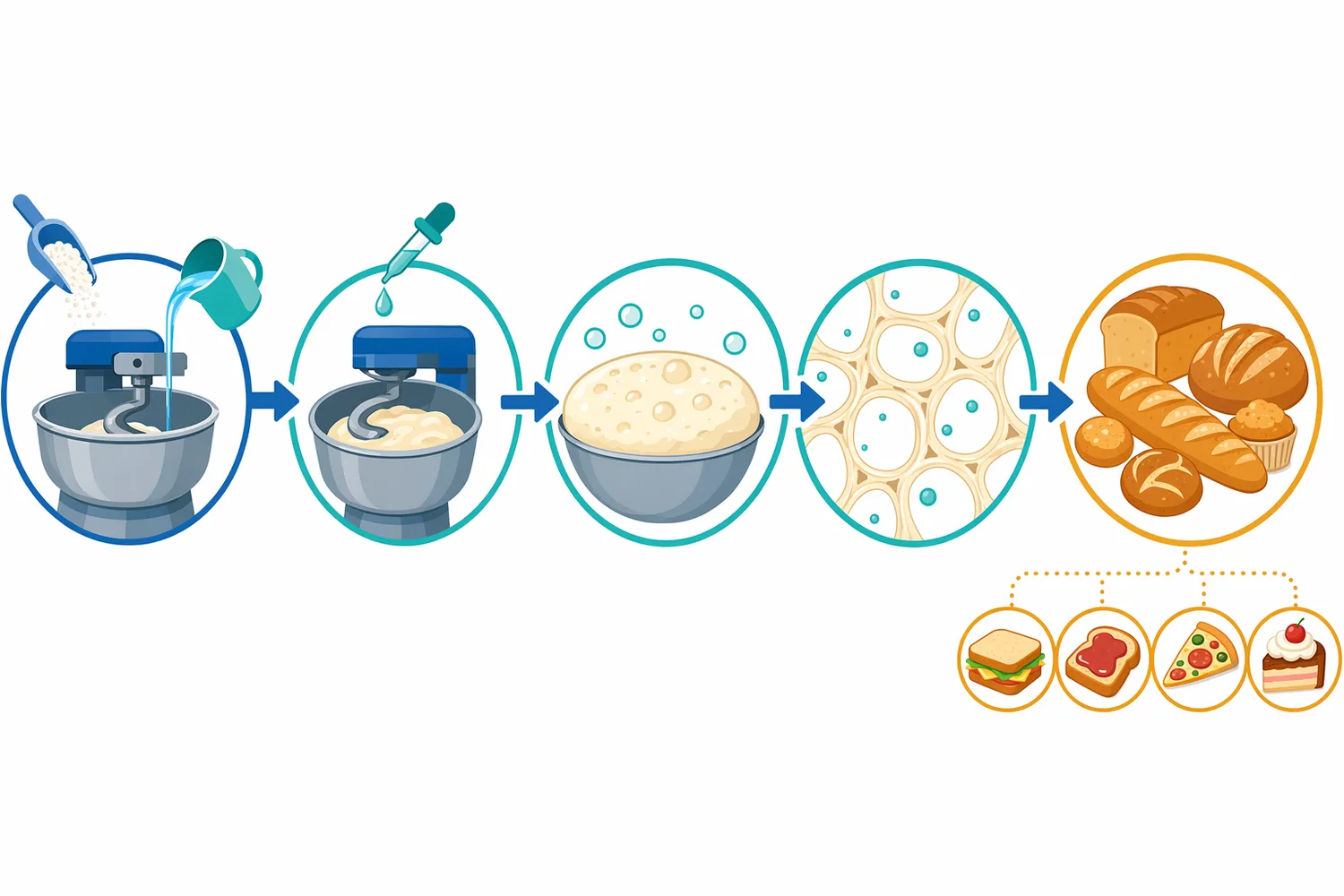
Glucose oxidase requires oxygen as a reactant. In bread dough, oxygen is incorporated mainly during mixing, when flour, water, yeast, and other ingredients are blended and air is dispersed into the dough. Mixing intensity, mixer type, batch size, and dough development all influence how much oxygen is available for the enzyme reaction [1].
This is one reason glucose oxidase is closely connected to the early dough-development stage. If the dough receives adequate mixing and aeration, the enzyme has the oxygen needed to generate hydrogen peroxide. If oxygen availability is limited, the same formula may show a reduced strengthening effect because the enzyme reaction is constrained by one of its required substrates.
Glucose oxidase also needs glucose. Bread dough can contain glucose from flour, added sweeteners, or sugars produced during dough development and fermentation by other enzymatic activity. The availability of glucose affects how much hydrogen peroxide the enzyme can generate within the time window before baking [1].
This does not mean glucose oxidase should be viewed as a sugar-management enzyme. Its purpose is not to increase sweetness or fermentation power. Rather, glucose is the chemical substrate that allows the enzyme to create the mild oxidative conditions responsible for dough strengthening.
Like other bakery enzymes, glucose oxidase acts in the hydrated dough phase. Flour particles must be wetted, substrates must be mobile enough to interact, and the enzyme needs time before heat inactivation. Mixing, floor time, intermediate proof, final proof, and early oven stages all contribute to the available reaction window [2].
Short-time processes may show a different response from long-fermentation processes because the enzyme has less or more time to generate oxidative effects. Similarly, doughs with very different hydration levels can respond differently because water distribution changes protein hydration, substrate mobility, and dough rheology [1].
Enzyme reaction rates generally increase as dough temperature rises, up to the point where the enzyme begins to lose activity. In breadmaking, glucose oxidase functions during mixing and fermentation, then is progressively inactivated as baking temperatures increase and the dough structure sets [2].
This matters because the enzyme’s role is to modify dough before and during the early stages of baking, not to remain functionally active in the finished bread. The final loaf reflects the structural changes created earlier in the process, after which heat denaturation and starch gelatinization fix the baked structure [1].
Glucose oxidase is best understood as one tool in the broader baking-enzyme toolbox. Different enzymes act on different substrates and therefore solve different formulation problems. The table below summarizes the conceptual differences without implying that one enzyme can replace another in every formula.
| Enzyme type | Main substrate in dough | Primary action | Typical bakery effect | How it differs from glucose oxidase |
|---|---|---|---|---|
| Glucose oxidase | Glucose and oxygen | Produces hydrogen peroxide, which promotes oxidative crosslinking | Strengthens gluten, improves tolerance, supports gas retention | Acts through oxidation and network reinforcement [1] |
| Amylase | Starch | Breaks starch into smaller carbohydrates | Supports fermentation, crust color, crumb softness, anti-staling effects depending on enzyme type | Acts on starch, not primarily on gluten structure [2] |
| Xylanase | Arabinoxylans / hemicellulose fractions | Modifies non-starch polysaccharides and water distribution | Can improve dough handling, volume, and crumb depending on flour system | Changes fiber-water interactions rather than oxidizing gluten [1] |
| Protease | Gluten proteins | Hydrolyzes peptide bonds | Relaxes dough, reduces mixing resistance, improves extensibility where dough is too tight | Weakens or softens protein structure rather than strengthening it [2] |
| Lipase | Lipids | Modifies lipid fractions and emulsifying behavior | Can improve gas cell stability, crumb softness, and loaf quality | Works through lipid modification, not glucose oxidation [1] |
| Transglutaminase | Proteins | Forms covalent crosslinks between protein residues | Can strengthen protein networks in selected systems | Crosslinks proteins by a different enzymatic mechanism [1] |
This comparison is useful because dough defects can look similar while having different causes. A sticky dough from weak gluten is not the same as a sticky dough from excess damaged starch or water imbalance. A low-volume loaf from poor gas retention is not the same as one caused by insufficient fermentation. Glucose oxidase is most relevant where the desired change is stronger, more stable dough structure [2].
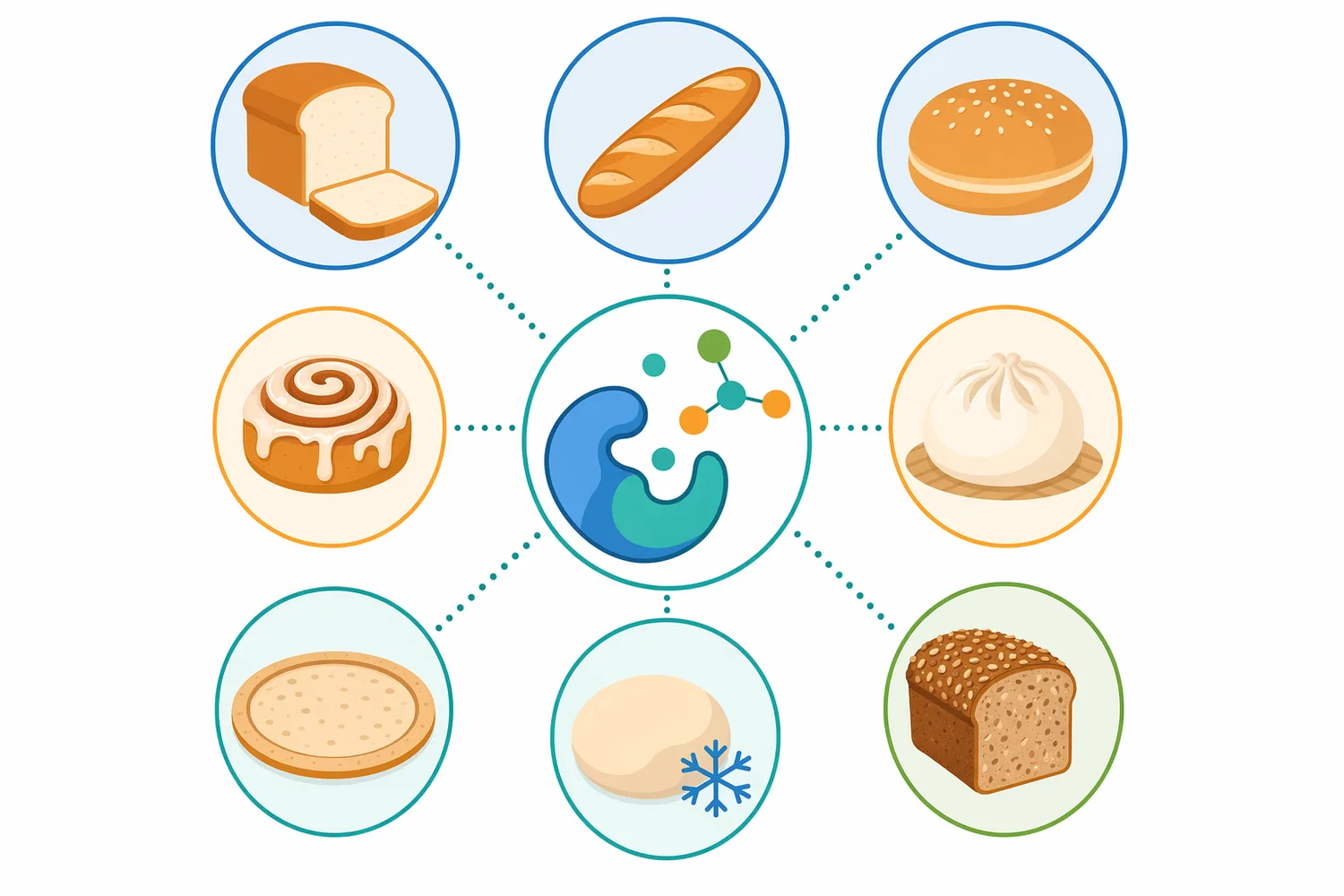
Pan bread depends on consistent dough strength, controlled proofing, uniform oven spring, fine crumb, and good sliceability. Glucose oxidase can support these targets by reinforcing the gluten network so expanding gas cells are better retained during proofing and baking.
In sandwich bread, the benefit is often seen as process consistency rather than a single isolated visual change. Stronger dough can support loaf symmetry, reduce collapse risk, and contribute to a more uniform crumb grain. Because pan bread is highly sensitive to dough development and proof height, controlled strengthening can be valuable when flour behavior varies within normal production limits [1].
Buns and rolls often pass through dividing, rounding, moulding, panning, and proofing steps where dough pieces must hold shape while remaining extensible enough to expand. Weak dough may flatten, tear, or develop irregular gas distribution, while overly tight dough may resist expansion and bake with poor volume [2].
Glucose oxidase can help mechanically handled doughs by increasing network cohesion. The practical result is better resistance to deformation and improved gas-cell stability during proofing. In suitable formulas, this can support more consistent piece shape, surface quality, and crumb structure.
Specialty breads and dough products vary widely. Some require strong gluten and high gas retention; others require tenderness, extensibility, or open crumb. Glucose oxidase is most relevant where the product goal includes stronger dough, improved processing tolerance, and more stable volume .
For products that depend on very open structure, long fermentation, or high extensibility, glucose oxidase must be balanced carefully with the rest of the formulation. The same strengthening mechanism that helps a pan bread hold gas may be less desirable if the target product needs a more relaxed dough system [1].
Glucose oxidase is also relevant in flour improvers and dry bakery blends where the goal is to build more predictable dough performance into the formulation. In this role, it contributes a strengthening function alongside other components that may affect fermentation, starch conversion, water distribution, emulsification, or crumb softness [2].
The important point is that glucose oxidase contributes a specific structural effect. It should not be treated as a complete improver by itself. Its strongest role is as the oxidative dough-strengthening component within a balanced bakery system [1].
Many bakeries use enzymes because they can deliver functional improvements at low inclusion levels and may support simpler label strategies, depending on local regulations and product claims. General bakery-enzyme guidance describes enzymes as tools for dough conditioning, fermentation support, processing efficiency, and finished product quality [2].
For glucose oxidase, the clean-label relevance comes from its ability to create oxidative strengthening inside the dough system. Instead of relying only on chemical oxidants, a formulation can use enzyme-driven hydrogen peroxide formation to promote gluten crosslinking during dough development [1].
This should be stated carefully. “Clean label” is not a single global regulatory category, and labeling expectations vary by country, customer, and product type. Glucose oxidase may support additive-reduction strategies, but it should not be presented as a universal labeling solution or a direct replacement in every formula [2].
When used appropriately in compatible bread and dough systems, glucose oxidase can support several practical outcomes:
These benefits all trace back to the same core chemistry: glucose oxidase produces hydrogen peroxide, and hydrogen peroxide promotes oxidative changes in gluten and related dough components. The enzyme does not create volume by itself; it helps the dough retain and organize the gas generated by yeast and expanded during baking [1].
The boundary is equally important. Excessive strengthening can make dough too tight, reduce extensibility, and harm bread quality. Glucose oxidase is most effective when the desired change is controlled reinforcement, not wholesale correction of every flour or process issue [1].
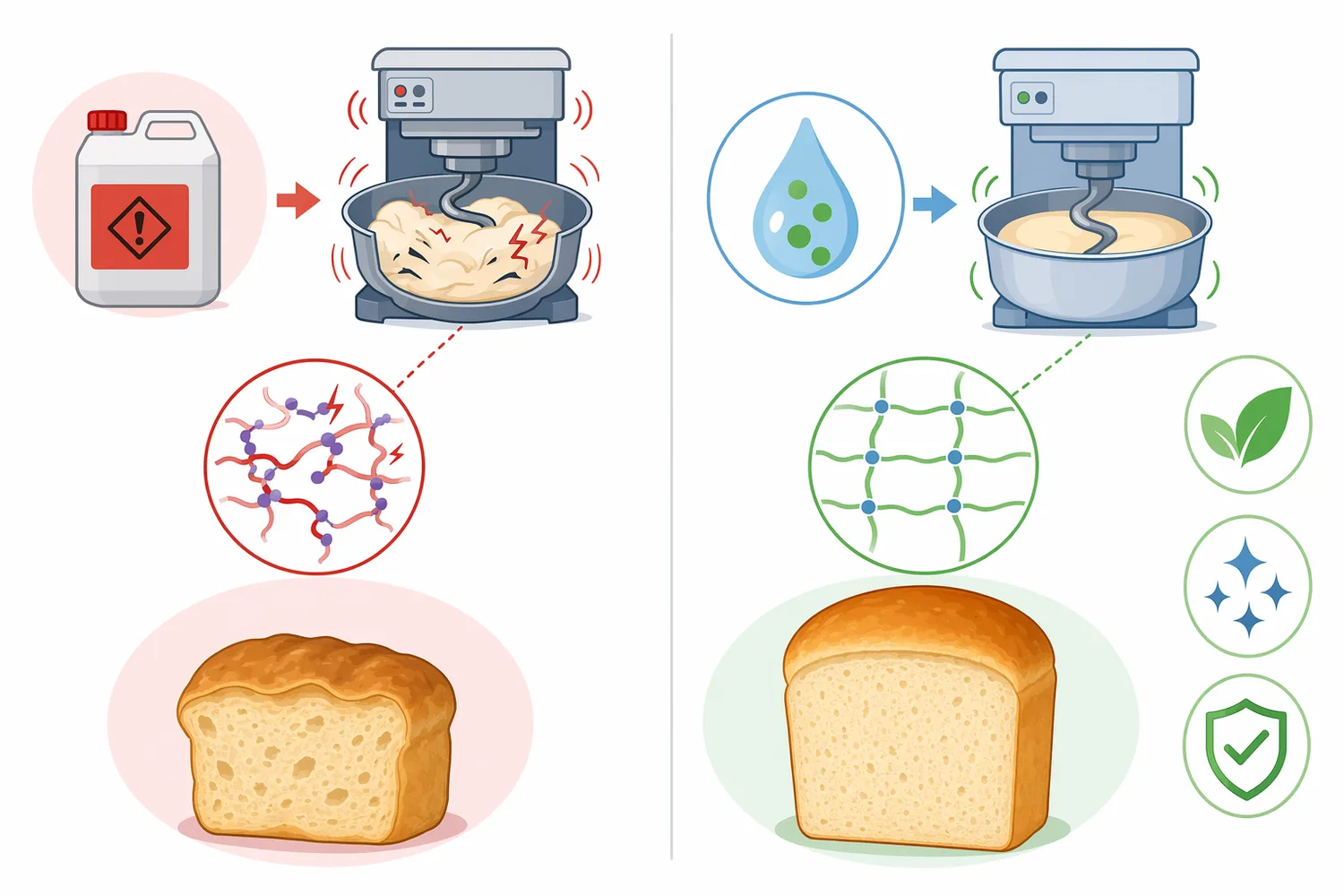
Glucose oxidase should be viewed as a targeted dough-strengthening enzyme. It is useful when the dough system would benefit from more resistance, better cohesion, and improved gas-holding capacity. It is not the right answer for every dough defect, and it should not be expected to compensate for poor flour suitability, incorrect hydration, weak fermentation control, or an unbalanced improver system [2].
For example, a dough that is too tight may need relaxation rather than more crosslinking. A loaf with poor fermentation may require attention to yeast activity, sugar availability, temperature, or process timing. A crumb-softness issue may involve starch retrogradation and anti-staling strategy rather than gluten oxidation. Glucose oxidase fits best where the underlying need is stronger dough structure [1].
This distinction helps buyers use the product with realistic expectations. The enzyme’s mechanism is specific, and the practical benefit comes from applying that mechanism to the right type of dough problem.
Enzymes.bio supplies Glucose Oxidase Enzymes for Bakery – Baking Dough Enzymes for bread and dough applications where controlled dough strengthening is desired. The product is positioned for bakery use, including dough systems where improved handling, stability, volume consistency, and crumb structure are relevant performance goals .
The product is sold directly online by the 1 kg unit. The buyer can add the product to the cart, pay online, and the order is then processed and shipped. A Certificate of Analysis and Safety Data Sheet are provided with the order for documentation and handling support .
Enzymes.bio is a supplier, so this article focuses on the science and practical application context rather than presenting laboratory testing services or custom technical development. The essential point for bakery buyers is straightforward: glucose oxidase is a well-established dough-strengthening enzyme whose function is based on enzymatic oxidation of glucose and controlled reinforcement of gluten structure [1].
Glucose oxidase is a specialized baking enzyme for dough strengthening. By converting glucose and oxygen into gluconic acid and hydrogen peroxide, it creates a mild oxidative effect within the dough; that hydrogen peroxide promotes gluten protein crosslinking, helping the dough become stronger, more cohesive, and better able to retain fermentation gas [1].
In bread, buns, rolls, and related dough systems, this mechanism can support better handling, improved tolerance through mechanical processing, more stable proofing, more consistent loaf volume, and a finer, more uniform crumb when the formula and process are compatible. The same mechanism also explains the limitation: too much strengthening can over-tighten the dough, so glucose oxidase should be understood as a controlled structural tool rather than a universal additive [1].
Enzymes.bio offers Glucose Oxidase Enzymes for Bakery – Baking Dough Enzymes for direct online purchase in 1 kg units, with order documentation included. For buyers looking for a baking dough enzyme focused on gluten reinforcement and bread process consistency, glucose oxidase is one of the most clearly understood enzyme options in modern bakery formulation .
Sold by the 1 kg unit, in stock and ready to ship. Order directly on our store — pay online and we process your order. A Certificate of Analysis and Safety Data Sheet are included with every order.
Buy Glucose Oxidase Enzymes For Bakery - Baking Dough Enzymes →Numbered in order of first citation. Open-access sources, each verified reachable at publication; citation numbers in the text link here.