
Hemicellulase Enzyme for Baking helps modify hemicellulose-rich non-starch polysaccharides in flour, especially arabinoxylan-type cell-wall materials that strongly influence water binding, dough viscosity, gas retention, and crumb structure. In practical bakery use, the enzyme can support more extensible dough, better expansion during proofing and oven spring, improved loaf volume, and a softer, more uniform crumb when it is used as part of a well-balanced flour and dough system. Enzymes.bio supplies Hemicellulase Enzyme for Baking as a food-grade powder sold directly online by the 1 kg unit, with online payment, order processing, shipment, and accompanying Certificate of Analysis and Safety Data Sheet.
Hemicellulase is a carbohydrate-active enzyme used in bakery formulations to act on hemicelluloses: the diverse, branched plant cell-wall polysaccharides found in cereal grains, bran, whole-grain fractions, and many flour blends. In wheat-based baking, the most relevant targets are commonly associated with arabinoxylans and related non-starch polysaccharides, which represent a small fraction of flour compared with starch but have a disproportionately large effect on dough water absorption, viscosity, elasticity, and gas-cell stability. Bakery enzyme reviews describe enzymes as functional processing aids that influence dough development, product quality, and shelf-life-related attributes across mixing, fermentation, baking, and storage stages [1].
The practical value of hemicellulase comes from controlled modification rather than complete breakdown. Flour is not simply starch and gluten: it also contains cell-wall fragments that behave like microscopic water-binding fibers. These components can trap water, increase dough resistance, interfere with gluten continuity, and make the dough feel tight or less extensible. Hemicellulase partially cuts long hemicellulose chains into shorter fragments, changing how they hydrate and interact with gluten, starch, and gas cells. That controlled change can make water more available to the dough matrix, reduce excessive resistance, and help expanding gas cells stretch the dough without tearing.
This is why hemicellulase is best understood as a dough-conditioning enzyme, not a direct substitute for gluten, amylase, oxidants, emulsifiers, or process control. It does not “create” gluten strength, and it does not produce yeast gas in the way fermentable sugars support fermentation. Instead, it changes the behavior of flour’s native hemicellulose fraction so the rest of the dough system can perform more predictably. Recent work on commercial bacterial and fungal xylanases in bread systems specifically connects enzyme action with dough rheology, loaf volume, and arabinoxylan structure, reinforcing that the non-starch polysaccharide fraction is a real control point in bread quality [2].
A bread dough can be thought of as a hydrated, gas-producing, viscoelastic network. Gluten proteins create the stretchable framework; starch granules provide bulk and gelatinize during baking; yeast or chemical leavening produces gas; and non-starch polysaccharides influence water movement, viscosity, and the way gas cells expand. Hemicellulase works at that last interface: it modifies the plant cell-wall polysaccharides that compete for water and affect dough flow.
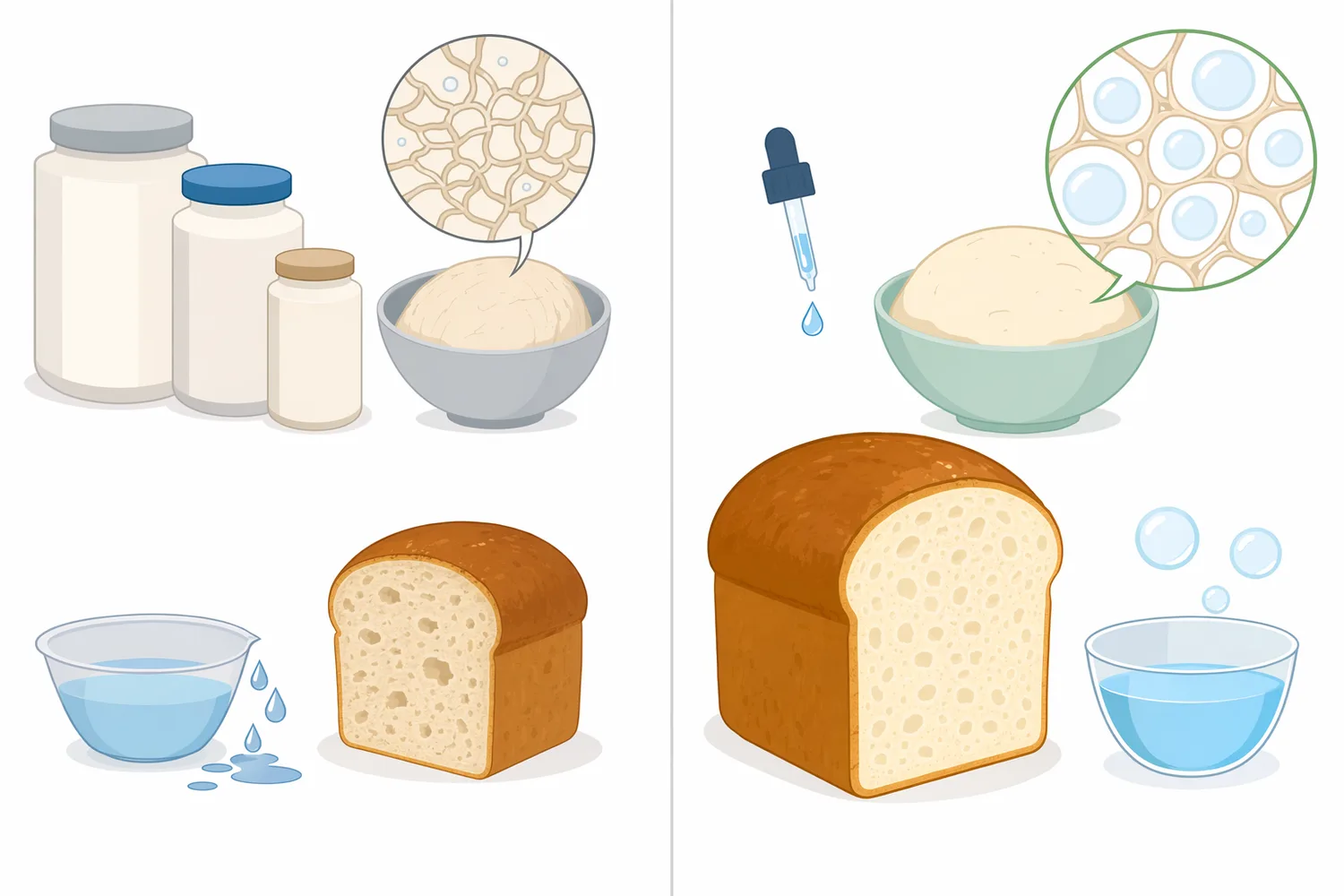
In a flour system with high water-binding hemicellulose fractions, part of the formula water is held tightly by arabinoxylan-rich material. This can make dough feel dry even when the total added water is adequate. When hemicellulase partially hydrolyzes those polysaccharides, the polymer chains become shorter and their ability to immobilize water changes. The dough may become more extensible, less resistant to deformation, and easier to develop during mixing. Studies on wheat dough rheology repeatedly treat xylanase or hemicellulase-type activity as relevant to measurable changes in dough behavior and bread quality, including work on xylanase produced on wheat bran and evaluated for dough rheology and bread performance [3].
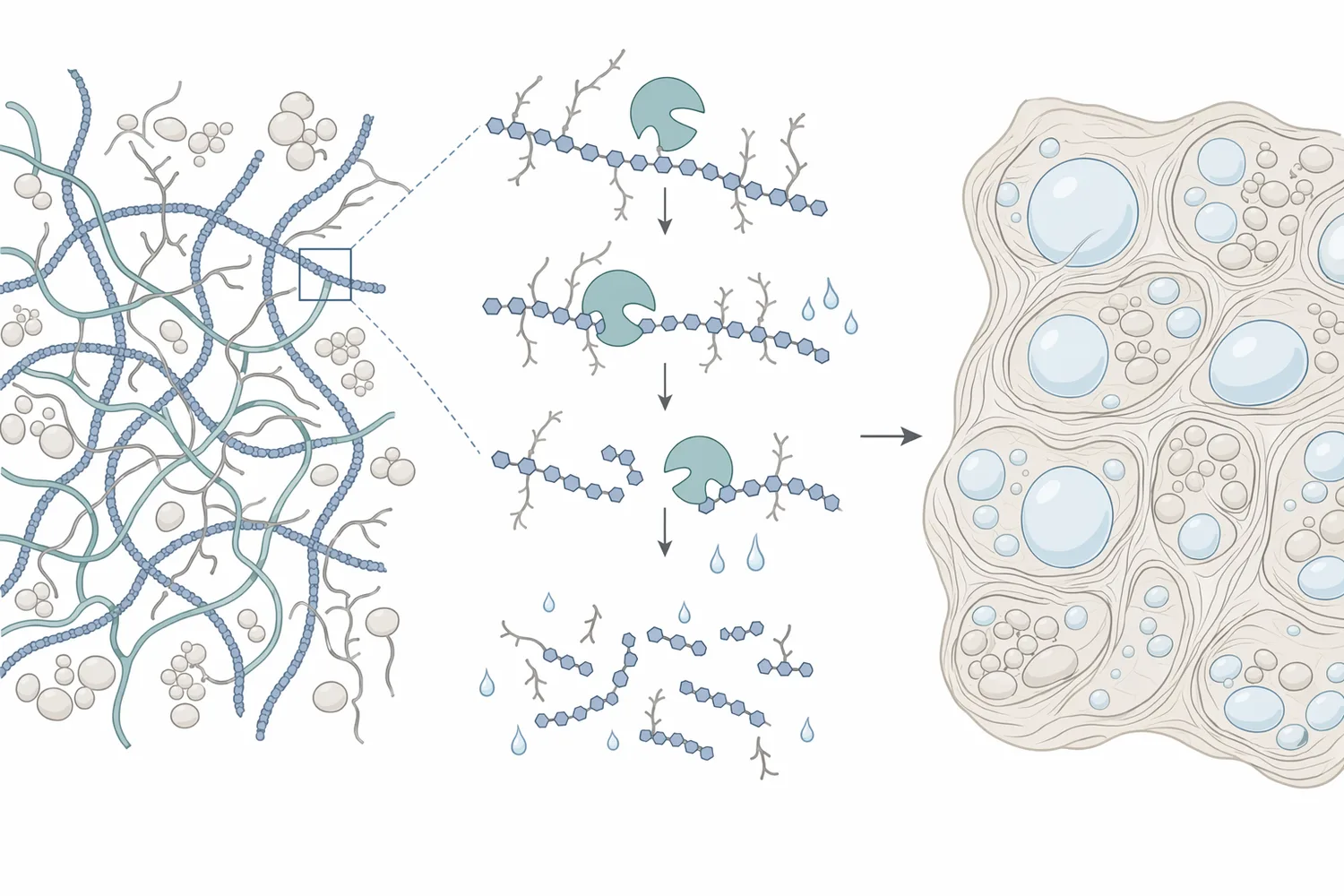
The enzyme’s action also affects gas-cell expansion. During fermentation and proofing, carbon dioxide needs to inflate thousands of small gas cells without causing the dough film around them to rupture. If the dough is too tight, it resists expansion and may produce low volume. If the dough is too weak or sticky, gas cells coalesce or collapse. Controlled hemicellulase action can help move the dough toward the middle of that range by reducing excessive viscosity and improving extensibility while preserving enough structure for gas retention.
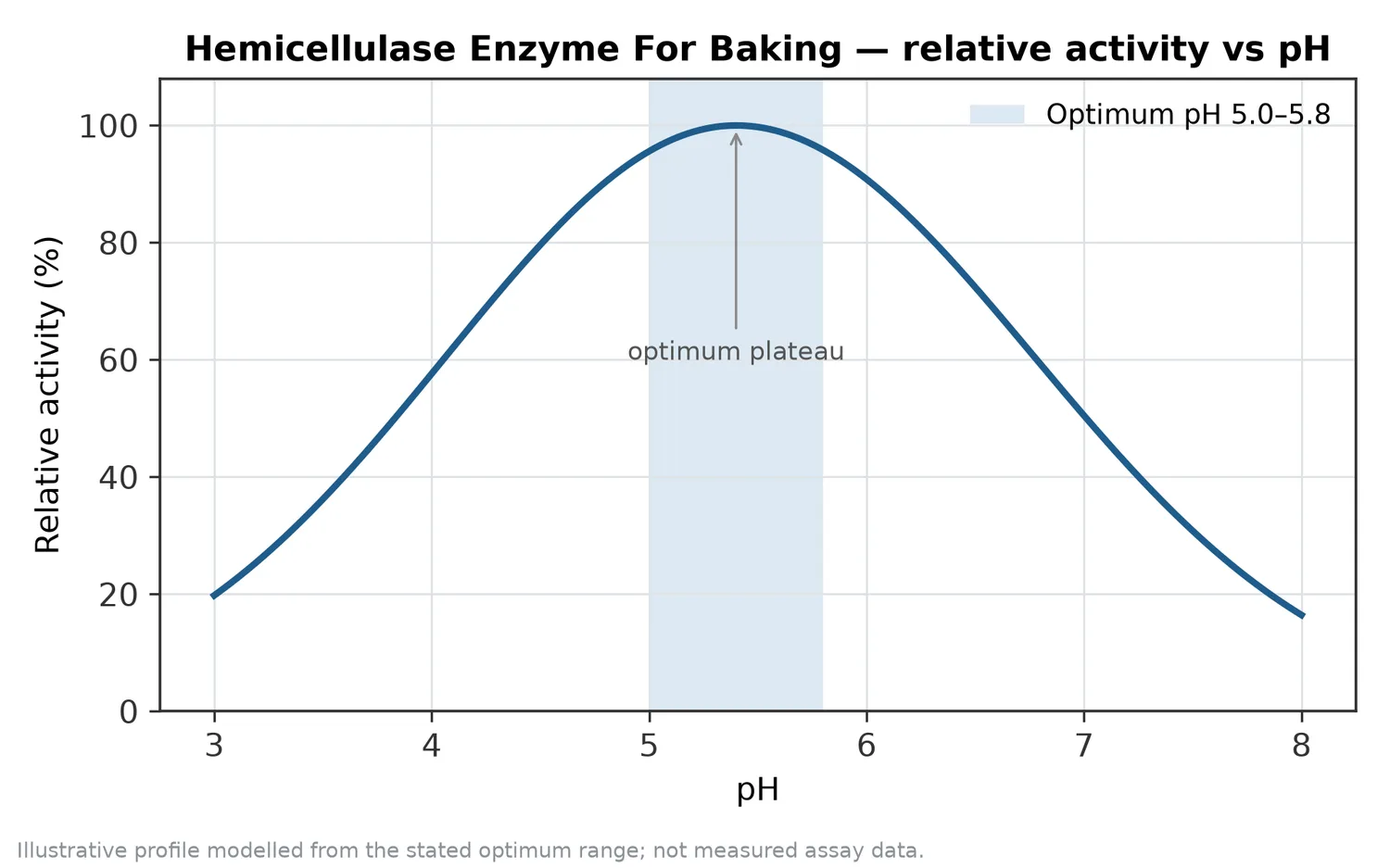
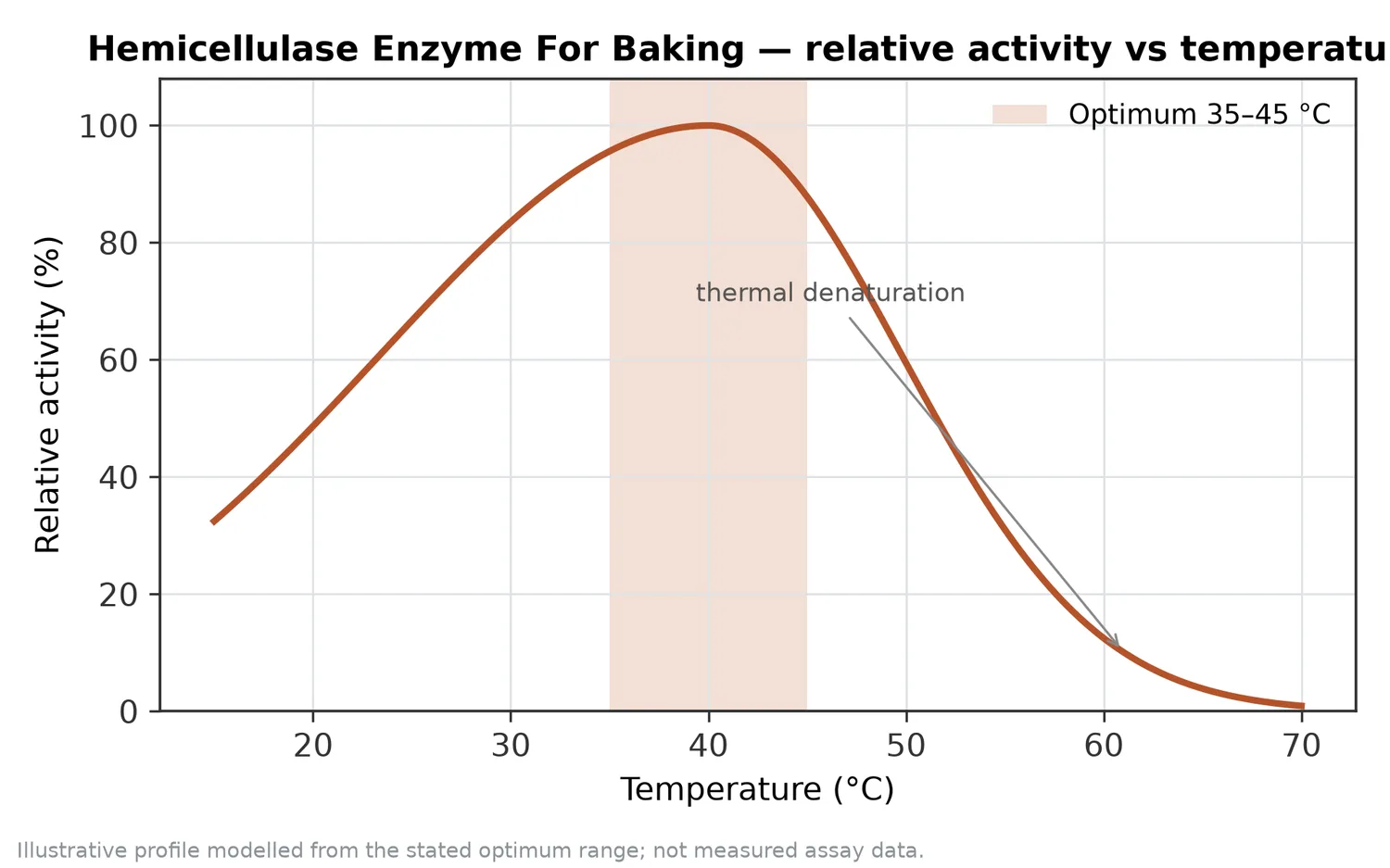
During early baking, this matters again. Oven spring depends on the dough expanding before starch gelatinization and protein setting lock the loaf structure in place. Hemicellulase activity is most relevant before heat inactivation becomes dominant: mixing, rest time, fermentation, proofing, and the early heating phase. Once baking progresses, enzymes as proteins lose catalytic activity as temperature rises, but the structural changes made earlier can remain expressed in loaf volume, crumb cell distribution, and bite.
The strongest reason hemicellulase can improve bread is that non-starch polysaccharides have high functional leverage in dough. They are present at much lower levels than starch, yet they influence the distribution of water between gluten, starch, and bran or cell-wall particles. When those polysaccharides hold water too strongly or increase dough viscosity too much, gluten development and gas expansion may be less efficient. When they are modified in a controlled way, the dough may become easier to mix, divide, sheet, mould, or pan.
This mechanism is particularly relevant in whole wheat, high-fiber, rye-containing, buckwheat-enriched, and composite flour systems. Whole-grain and bran-containing doughs contain more cell-wall material than refined wheat flour, and bran particles can physically interrupt gluten networks. Hemicellulase cannot remove that physical effect, but it can alter the water-binding and viscosity contribution of the cell-wall fraction. Research on bread dough supplemented with whole wheat flour and treated with enzymes reflects the continuing interest in enzyme use for improving bread-making quality when flour composition shifts away from standard refined wheat flour [4].
In composite systems, hemicellulase may help manage the additional fibers and non-starch polysaccharides introduced by alternative flours. Studies involving purple sweet potato powder or flour substitution have examined enzymatic treatment and hemicellulose-related variables in relation to bread-making quality, physical properties, texture, and structure, showing that enzyme effects become especially important when non-wheat ingredients alter dough hydration and structure [5]. These systems are more complex than standard wheat bread because the added plant powders bring pigments, fibers, starches, and cell-wall materials that change both dough mechanics and baked texture.
The same principle applies to cereal blends such as rye-containing doughs. Rye quality is strongly influenced by non-starch polysaccharides, including pentosan-type materials, which affect viscosity and crumb. Work predicting rye dough behavior and bread quality using response surface methodology illustrates that rye systems require attention to multiple interacting formulation and process variables rather than one isolated ingredient change [6].
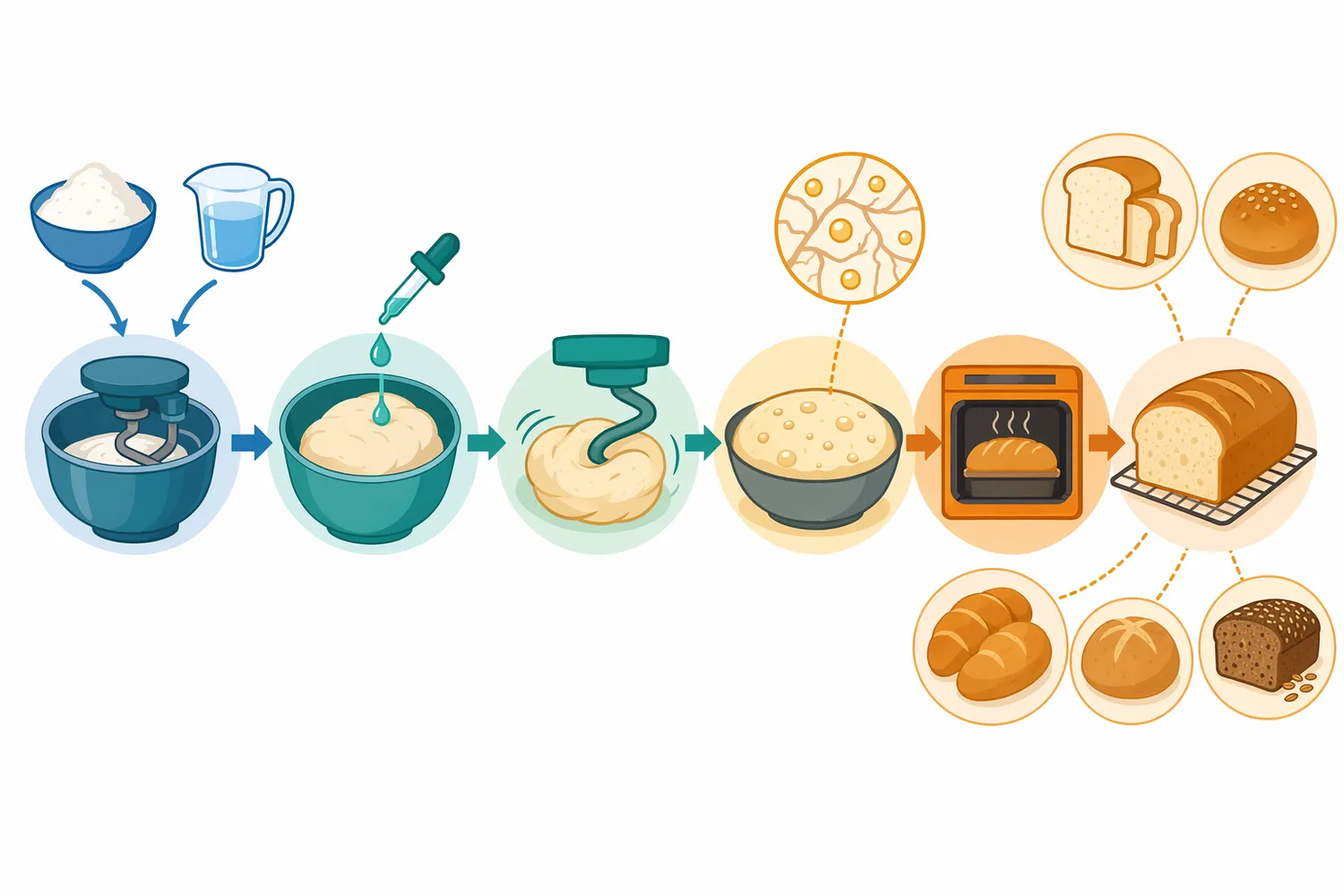
One of the most visible effects of hemicellulase is improved dough handling. When hemicellulose-rich fractions make dough overly resistant, partial hydrolysis can reduce tightness and allow the dough to stretch more smoothly. This can support dividing, rounding, sheeting, moulding, and panning because the dough is less likely to resist deformation or spring back excessively. In bakery research, dough rheology is a central measurement area because it connects ingredient changes with industrial processability, and hemicellulase/xylanase studies commonly evaluate exactly these dough-behavior effects [7].
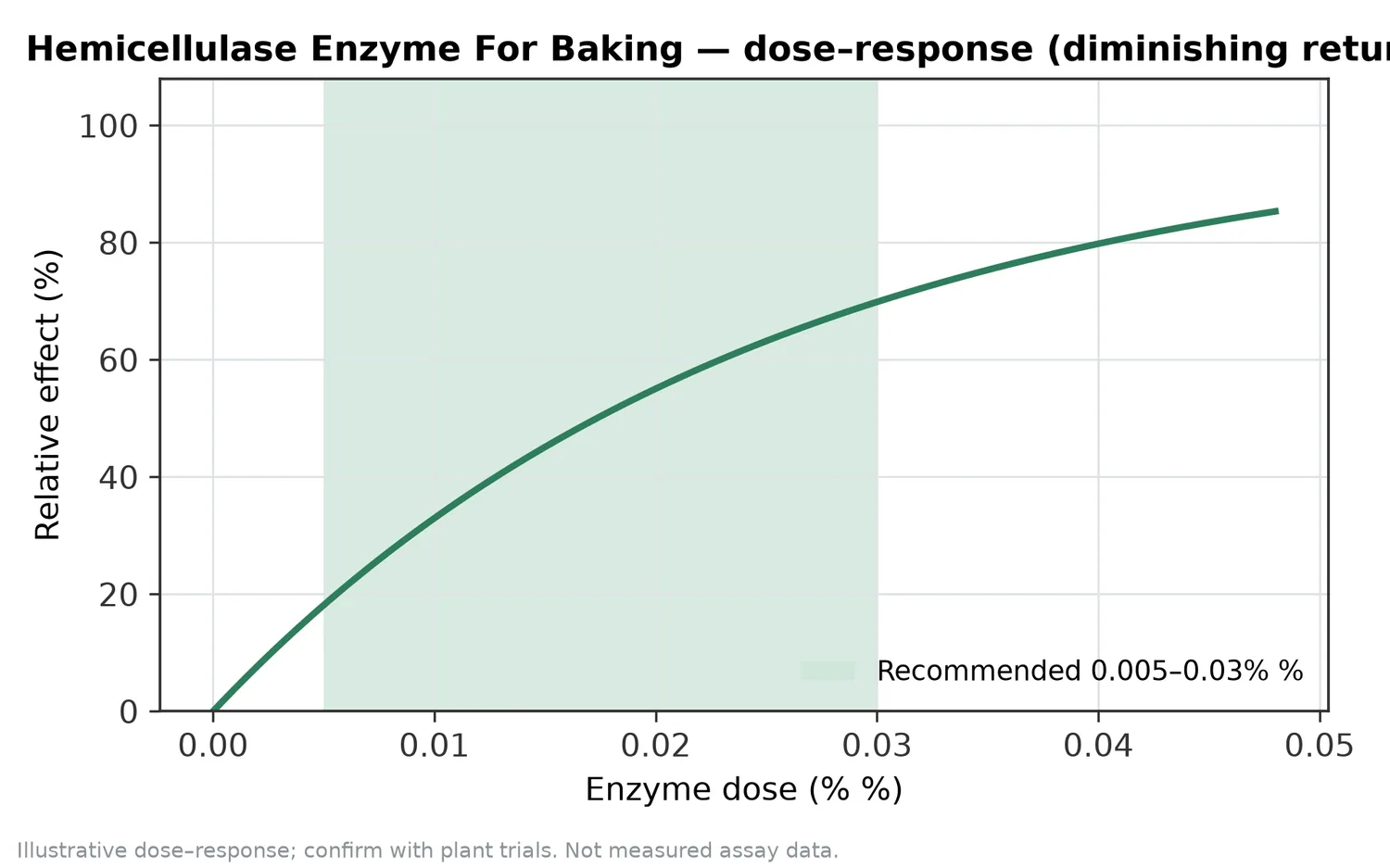
Improved handling is not the same as uncontrolled softening. The target is a dough that has enough extensibility to expand and enough elasticity to hold shape. Excessive enzymatic degradation can push dough toward stickiness or weakness, so the practical benefit comes from moderate, process-compatible modification of the hemicellulose fraction.
Loaf volume depends on gas production, gas retention, gluten development, dough extensibility, starch gelatinization, and oven spring. Hemicellulase supports volume indirectly by improving the dough’s ability to expand around gas cells. When the gluten-starch-water network is less constrained by highly water-binding cell-wall polymers, gas cells can enlarge more evenly during proofing and early baking.
Research on commercial xylanases has examined effects on dough rheology, loaf volume, and arabinoxylan structure, which is directly relevant because xylanase activity is one of the most important hemicellulase-type functions in cereal dough systems [2]. The key takeaway for bakery use is that the enzyme acts on the substrate responsible for part of the dough’s water-binding and viscosity behavior, and those changes can translate into measurable bread structure outcomes.
Crumb softness and uniformity are affected by gas-cell distribution, starch gelatinization, water mobility, and post-bake firming. Hemicellulase can contribute to a finer, more even crumb when it improves gas-cell expansion and reduces localized water imbalance. If dough expansion is more uniform, the baked loaf is less likely to show dense areas, tight crumb, or irregular cell structure.
Texture-focused research on bread supplemented with purple sweet potato powder and treated with enzymes highlights the connection between non-standard flour components, enzymatic treatment, and the final texture and structure of bread [8]. This is important because crumb quality is not determined only in the oven; it is built during mixing and fermentation as the dough structure forms and gas cells develop.
Flour varies naturally by wheat variety, crop year, growing conditions, milling stream, storage, and blending. Even when flour meets its usual specification, dough behavior can shift because small differences in protein quality, starch damage, endogenous enzyme activity, and non-starch polysaccharide composition influence water absorption and mixing response. Hemicellulase can help narrow some of that variation by targeting one part of the system that strongly affects dough feel: the hemicellulose-rich cell-wall fraction.
This is especially useful when formulas include whole grains, bran, seeds, legumes, sprouted ingredients, or other plant materials. For example, work on fortified cake with sprouted lentil evaluated active gluten and hemicellulase enzyme as quality-improving factors, showing that hemicellulase-type approaches are not limited to standard pan bread but are also explored in enriched bakery matrices [9].
Hemicellulase is often used alongside other bakery enzymes because each enzyme class acts on a different substrate. This matters: if the performance issue is starch-related, a hemicellulase alone will not behave like an amylase; if the issue is excessive gluten strength, it will not behave like a protease; if the issue is oxidative strengthening, it will not behave like glucose oxidase. Bakery enzyme reviews emphasize that enzyme combinations can affect dough development, bread quality, and shelf-life attributes because different substrates are modified at different stages of processing [1].
| Enzyme class | Main substrate in dough | What it changes physically | Typical bakery relevance |
|---|---|---|---|
| Hemicellulase / xylanase-type activity | Hemicellulose-rich non-starch polysaccharides, especially arabinoxylan-type materials | Water binding, dough viscosity, extensibility, gas-cell expansion | Dough handling, loaf volume, crumb uniformity, whole-grain and high-fiber systems |
| Amylase | Damaged or gelatinizing starch fractions | Starch breakdown products, fermentable sugars, crumb softness effects | Fermentation support, crust color, softness, anti-staling systems |
| Protease | Gluten proteins | Gluten resistance and dough relaxation | Dough softening where gluten is overly strong or machining requires more extensibility |
| Lipase | Flour and added lipids | Lipid interactions that can influence gas retention and crumb structure | Dough stability, volume, crumb softness depending on formulation |
| Glucose oxidase | Glucose and oxygen, with oxidative effects on dough components | Strengthening through oxidation-related network effects | Dough strengthening and improved tolerance in selected systems |
| Cellulase | Cellulose-rich plant cell-wall material | Fiber modification and water-binding changes | Some high-fiber or composite flour systems, usually as part of broader enzyme systems |
The value of hemicellulase is therefore specific: it focuses on the cell-wall polysaccharide fraction. In practice, that makes it a logical partner for amylase in bread systems because starch and hemicellulose both influence water and crumb, but through different mechanisms. Studies on combined α-amylase, xylanase, and cellulase produced by microbial systems have evaluated these enzymes together as bread improvers, reflecting the practical importance of multi-enzyme effects in dough and bread quality [10].
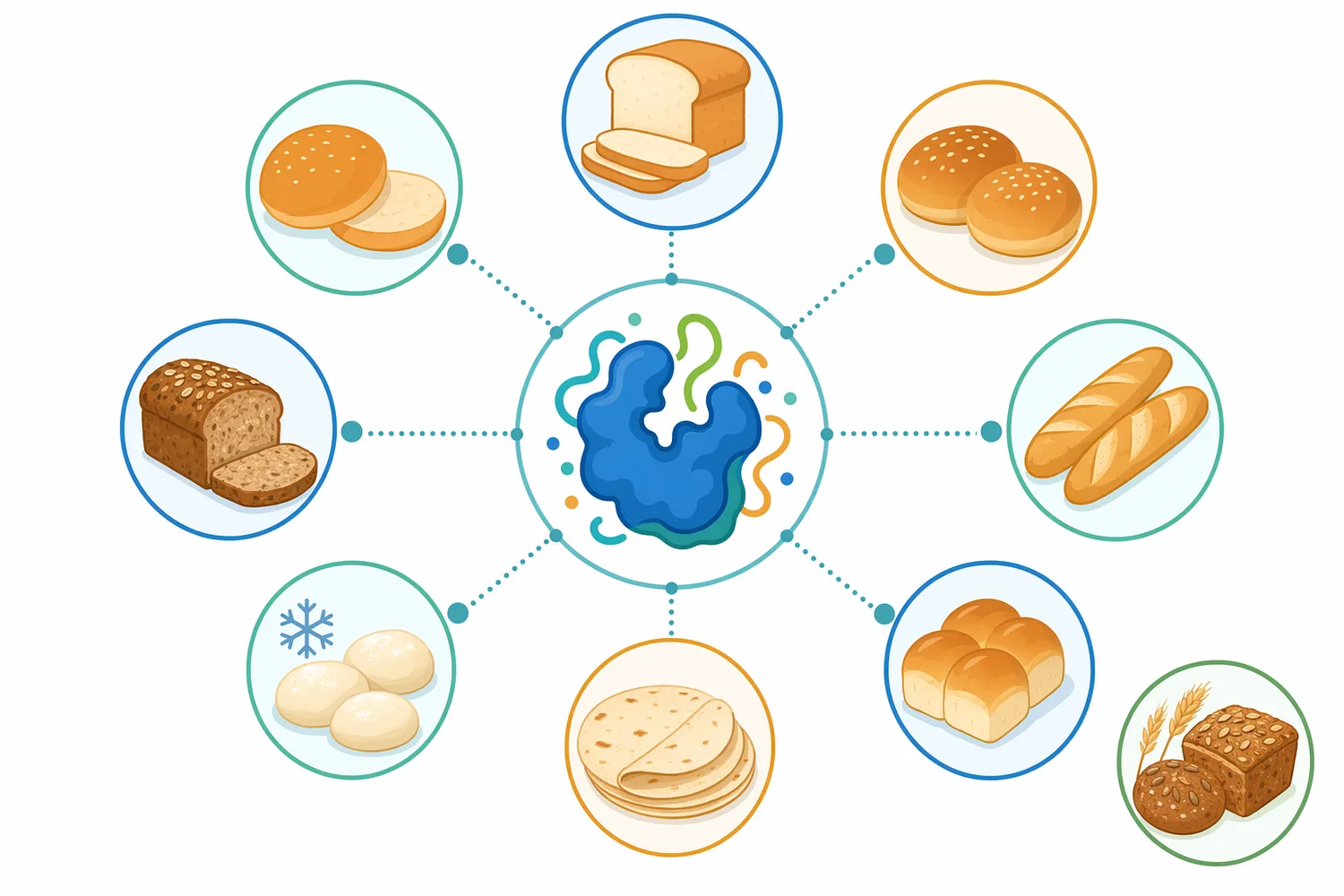
Pan bread depends heavily on predictable dough development, controlled proof height, oven spring, and a soft, uniform crumb. Hemicellulase can support these goals by helping the dough expand without excessive resistance. In refined wheat bread, the effect may be subtle but valuable when flour has tight handling characteristics or when the formula needs better volume and crumb uniformity. In higher-fiber pan breads, the effect may be more noticeable because there is more non-starch polysaccharide material for the enzyme to modify.
Pan bread also benefits from enzyme combinations. Research on sourdoughs, enzymes, and their combinations in gluten-based bread quality reflects how multiple biological tools can be combined to influence final bread attributes, rather than expecting one enzyme to control every quality parameter alone [11].
Buns and rolls require dough that divides cleanly, rounds smoothly, proofs evenly, and bakes into a soft bite. Hemicellulase may help when dough is too resistant, when proof expansion is limited, or when crumb density is higher than desired. Because many bun formulas include sugar, fat, milk solids, or other enriching ingredients, enzyme effects are formulation-dependent; the same enzyme action that improves lean bread may express differently in enriched dough.
The mechanism remains the same: partial hydrolysis of hemicellulose-type material changes water distribution and dough extensibility. The practical result can be smoother rounding and more uniform expansion, provided the dough retains enough strength to hold gas.
Whole wheat and multigrain systems are among the most relevant applications for hemicellulase because they contain more bran, aleurone, and cell-wall fragments than refined flour. These components bind water and can interrupt gluten networks, making loaves denser and crumb structure less uniform. Hemicellulase helps by modifying the polysaccharide portion of that challenge, although it cannot fully eliminate the physical disruption caused by coarse bran particles.
Studies on bread supplemented with whole wheat flour and treated with enzymes support the broader approach of using enzyme systems to improve bread-making qualities in whole-wheat-containing doughs [4]. In these formulas, hydration and mixing are especially important because the enzyme’s action changes how water moves between bran, gluten, starch, and soluble fiber fractions during dough development.
Rye and mixed-cereal breads are strongly affected by non-starch polysaccharides. Rye dough does not behave like wheat dough because gluten development is not the same, and viscosity from pentosan-rich fractions plays a major role in structure. Hemicellulase can help adjust dough consistency, but the margin between beneficial viscosity reduction and excessive weakening can be narrower than in some wheat systems.
For mixed-grain breads, the enzyme may help reduce density and improve dough expansion, especially when wheat flour still provides a gluten network. Work using response surface methodology to predict rye dough behavior and bread quality highlights that rye performance is controlled by interacting formulation and process factors, making controlled enzyme use part of a broader dough-system approach [6].
Buckwheat and other non-wheat flours can add nutritional, sensory, and marketing value, but they also change dough rheology. They dilute gluten, introduce different starches and fibers, and alter water absorption. Hemicellulase may be useful when the added flour contributes hemicellulose-type materials that increase viscosity or reduce extensibility.
Research on enzyme compositions in bread dough enriched with buckwheat flour directly addresses the rheological effects of enzymes in this type of composite system [12]. The practical point is that hemicellulase can be valuable in non-standard formulas, but the effect must be understood through the whole dough matrix: gluten dilution, fiber addition, starch behavior, fermentation, and baking profile all interact.
Plant powders such as purple sweet potato flour, sprouted lentil flour, and other alternative ingredients can increase fiber, pigments, bioactive compounds, and distinctive flavor, but they can also make dough denser or more difficult to structure. Hemicellulase may help by modifying some of the added plant cell-wall polysaccharides, improving water distribution and reducing excessive dough viscosity.
Studies on purple sweet potato powder substitution and enzymatic treatments have investigated bread-making quality, texture, structure, and physical properties, showing that enzyme treatment is a meaningful variable when alternative plant powders are incorporated into bread [13]. In fortified cakes with sprouted lentil, hemicellulase has also been studied together with active gluten to improve quality properties, which reflects the enzyme’s relevance beyond standard yeast bread [9].
Hemicellulase often performs best when it is part of a balanced enzyme strategy. This is not because hemicellulase is weak; it is because dough quality is controlled by multiple substrates. Starch, gluten, lipids, and non-starch polysaccharides all change during processing. A single enzyme modifies one part of that system, while combinations can address more than one limiting factor.
For example, hemicellulase can improve extensibility and water distribution, while amylase can influence fermentable sugar availability and crumb-softening pathways. Glucose oxidase can contribute strengthening effects, while lipase can influence lipid-mediated structure. Studies evaluating amyloglucosidase, glucose oxidase, and hemicellulase together on dough rheology and bread quality reflect this combined-enzyme approach in bakery research [7].
The same principle appears in studies of enzyme cocktails. A thermostable enzyme cocktail from Talaromyces emersonii has been characterized for applications in wheat dough rheology, illustrating the technical interest in enzyme mixtures that modify dough behavior through more than one biochemical route [14]. In practical baking, the benefit of hemicellulase is therefore often most visible when it complements, rather than replaces, other formulation tools.
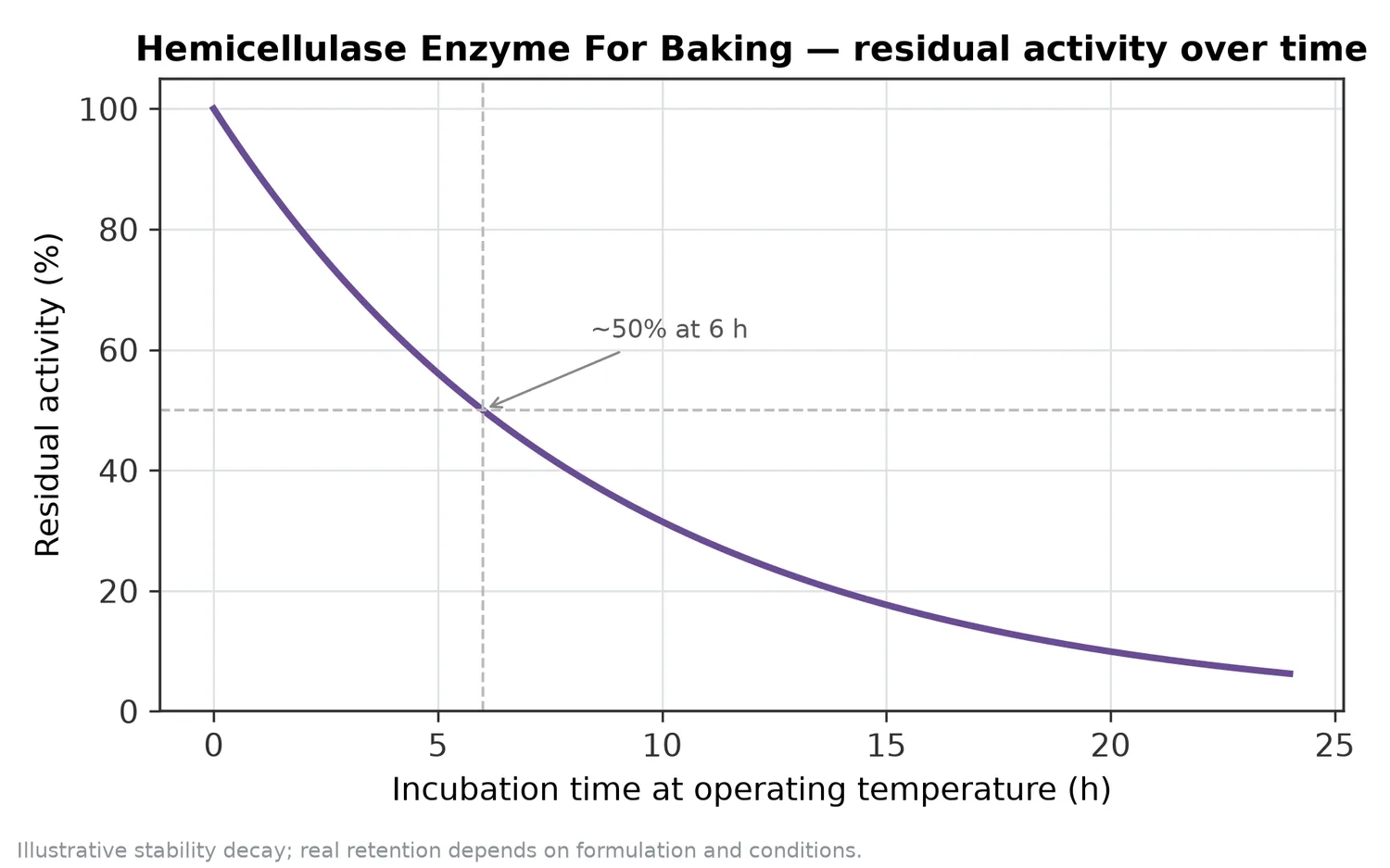
Hemicellulase is typically incorporated with flour or dry ingredients so it can disperse into the dough as water is added. Once hydrated, the enzyme begins acting on accessible hemicellulose-type substrates. Its useful activity window is the period when the dough contains enough water for enzyme mobility and before heat inactivation dominates: mixing, rest time, fermentation, proofing, and early baking.
During mixing, hemicellulase can begin changing water-binding behavior and dough resistance. During fermentation and proofing, continued action may improve gas-cell expansion and dough extensibility. During the early oven stage, the dough still expands before the structure sets; after that, rising heat progressively inactivates enzymes as proteins. This is why the benefit is seen in dough behavior and final bread structure, not because the enzyme remains indefinitely active in the finished loaf.
High-pressure and enzyme-combination research in bread making also shows that enzyme effects must be interpreted in the context of processing conditions. Work combining additional bakery enzymes with high-pressure treatment evaluated bread-making qualities under a process-interaction framework, reinforcing that enzymes operate within the physical environment created by mixing, fermentation, pressure, and heat [15].
Many bakeries use enzymes because they can improve process performance and finished-product quality while fitting enzyme-based formulation approaches. In many markets, enzymes are treated differently from conventional additives when they function as processing aids, although labeling and regulatory treatment depend on local rules and the specific product. The practical appeal is that small biochemical changes during dough processing can replace or reduce the need for some traditional chemical dough improvers.
The clean-label relevance should be kept realistic. Hemicellulase is not a universal label solution, and it does not remove the need for good flour, proper hydration, mixing control, fermentation management, and baking consistency. However, it is well aligned with the broader movement toward enzyme-based bakery quality improvement, as recent bakery enzyme literature discusses enzymes from dough development through shelf-life extension [1].
Hemicellulase for baking is a food-processing enzyme supplied as a powder. As with powdered enzymes generally, sensible handling practices are important because enzymes are proteins and fine powders can generate dust if handled roughly. Avoiding dust formation and following the Safety Data Sheet supplied with the order are practical steps for responsible workplace use.
Enzymes.bio supplies Hemicellulase Enzyme for Baking directly online by the 1 kg unit. The product can be purchased through the online product page, paid for online, and then processed for shipment; a Certificate of Analysis and Safety Data Sheet accompany the order .
Hemicellulase can help improve dough handling, extensibility, gas expansion, loaf volume, crumb uniformity, and consistency in suitable bakery systems. The most reliable results occur when the enzyme’s mechanism matches the formulation challenge: hemicellulose-rich flours, tight dough, high-fiber blends, whole-grain systems, or composite flours where water-binding cell-wall material affects processing.
It should not be expected to fix every flour defect or replace fundamental process control. If gluten quality is poor, fermentation is mismanaged, hydration is unsuitable, or baking conditions are inconsistent, hemicellulase can only address the hemicellulose-related portion of the problem. Bakery research consistently treats enzyme use as part of a complete dough system, with multiple enzymes and ingredients interacting to determine final bread quality [1].
For many bakery applications, that system-based view is exactly what makes hemicellulase useful. By acting on a small but influential flour fraction, it can change how dough feels, expands, and sets. In refined wheat bread, the benefit may appear as smoother handling and improved volume potential. In whole-grain or high-fiber bread, it may help counter density and water-binding challenges. In composite-flour systems, it can help manage the added complexity of plant powders and alternative grains.
Enzymes.bio supplies Hemicellulase Enzyme for Baking as a food-grade powder for bakery use. The product is sold directly online by the 1 kg unit: buyers place the order online, pay online, and the order is then processed and shipped. A Certificate of Analysis and Safety Data Sheet are included with the order.
For bakeries and food businesses using enzyme-based formulation strategies, hemicellulase is best viewed as a targeted tool for modifying flour cell-wall polysaccharides. Its practical value lies in controlled changes to water distribution, dough extensibility, gas-cell expansion, loaf volume, and crumb structure—especially in formulas where hemicellulose-rich material contributes to tight dough, dense crumb, or inconsistent processing.
Sold by the 1 kg unit, in stock and ready to ship. Order directly on our store — pay online and we process your order. A Certificate of Analysis and Safety Data Sheet are included with every order.
Buy Hemicellulase Enzyme For Baking →Numbered in order of first citation. Open-access sources, each verified reachable at publication; citation numbers in the text link here.