
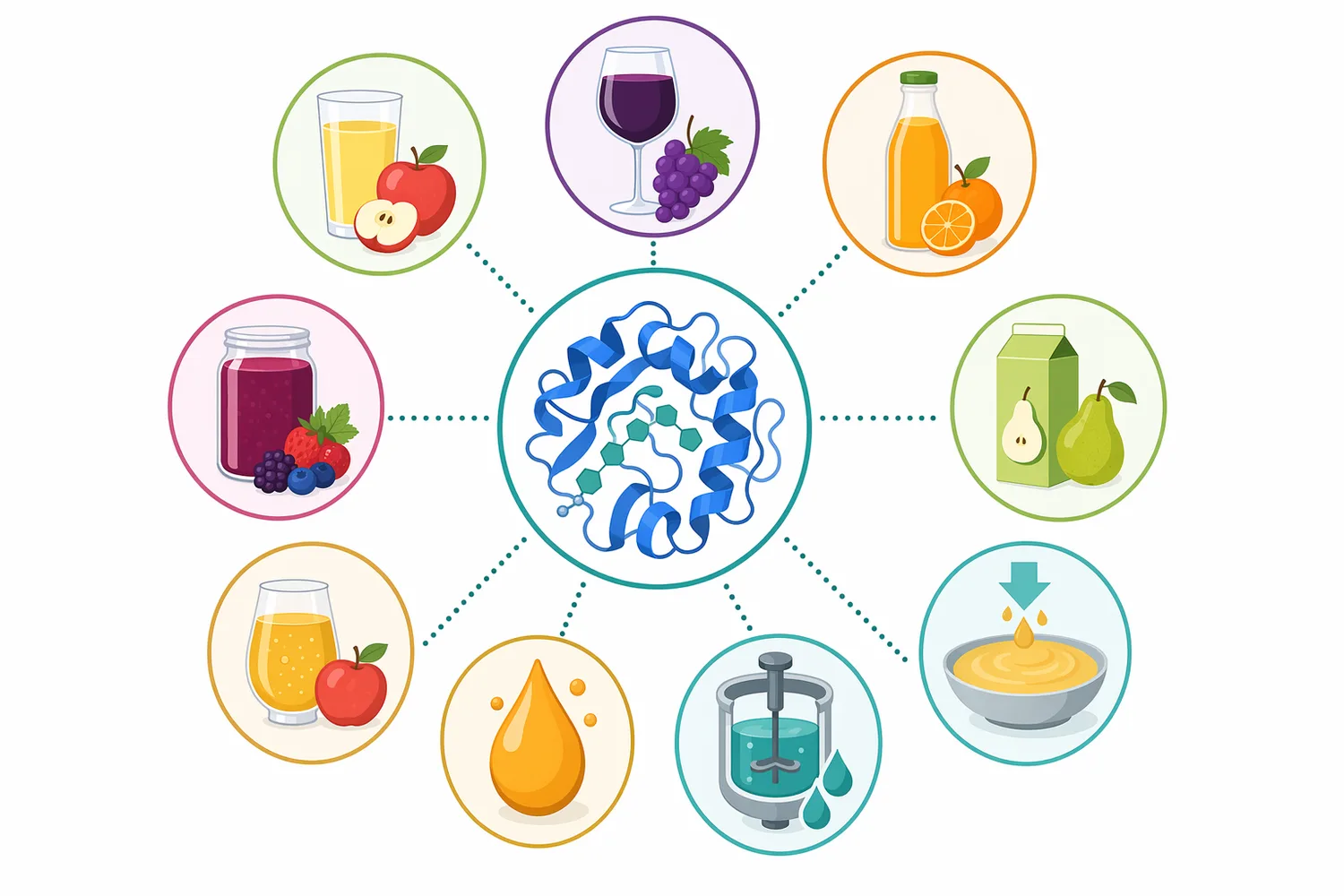
Pectinase enzyme for fruit juice clarification breaks down pectin, the fruit cell-wall polysaccharide that makes many juices thick, hazy, slow to press, and difficult to filter. By cutting the pectin network into smaller soluble fragments, pectinase helps release trapped juice, reduce viscosity, improve settling or filtration, and support the production of clearer fruit juice and juice bases. Pectinase is one of the established enzyme groups used in fruit juice processing, often alone or alongside other cell-wall enzymes when the fruit matrix requires it [1].
Enzymes.bio supplies Pectinase Enzyme for Fruit Juice Clarification as an online product sold directly by the 1 kg unit. Buyers place and pay for the order online; the order is then processed and shipped, with a Certificate of Analysis and Safety Data Sheet provided with the order .
Fruit tissue is not simply a collection of free liquid cells. The juice is held inside a plant structure made from cell walls and the middle lamella, where pectin acts as a hydrated “cement” between cells. When fruit is crushed, puréed, milled, or pressed, this pectin-rich matrix can remain partly intact, trapping liquid in pulp and stabilising fine particles in suspension. Reviews of fruit juice enzymatic processing consistently describe pectinase as a key enzyme for improving juice yield, clarification, and processing efficiency because it targets this structural pectin fraction [2].
In practical juice terms, pectin creates three linked problems. First, it increases viscosity: the juice or mash behaves less like a free-flowing liquid and more like a gelled colloidal system. Second, it stabilises haze: fine pulp particles, colloids, and pectin-protein or pectin-polyphenol associations remain dispersed rather than settling or filtering cleanly. Third, it reduces extractability: liquid remains bound within the fruit solids, so pressing or decanting leaves more juice behind in pomace or pulp [3].
The effect is especially visible in pectin-rich or pulp-heavy raw materials such as apple, guava, passion fruit, citrus, berry, and tropical fruit systems. The degree of the problem varies with fruit variety, ripeness, storage history, crushing intensity, temperature, and whether the target product is a clear juice, cloudy juice, nectar, purée, concentrate, or fermented beverage base. In apple juice, for example, recent reviews treat enzymatic clarification as one of the central routes for improving clarification and stabilisation because pectin and other colloids are major barriers to clear juice production [4].
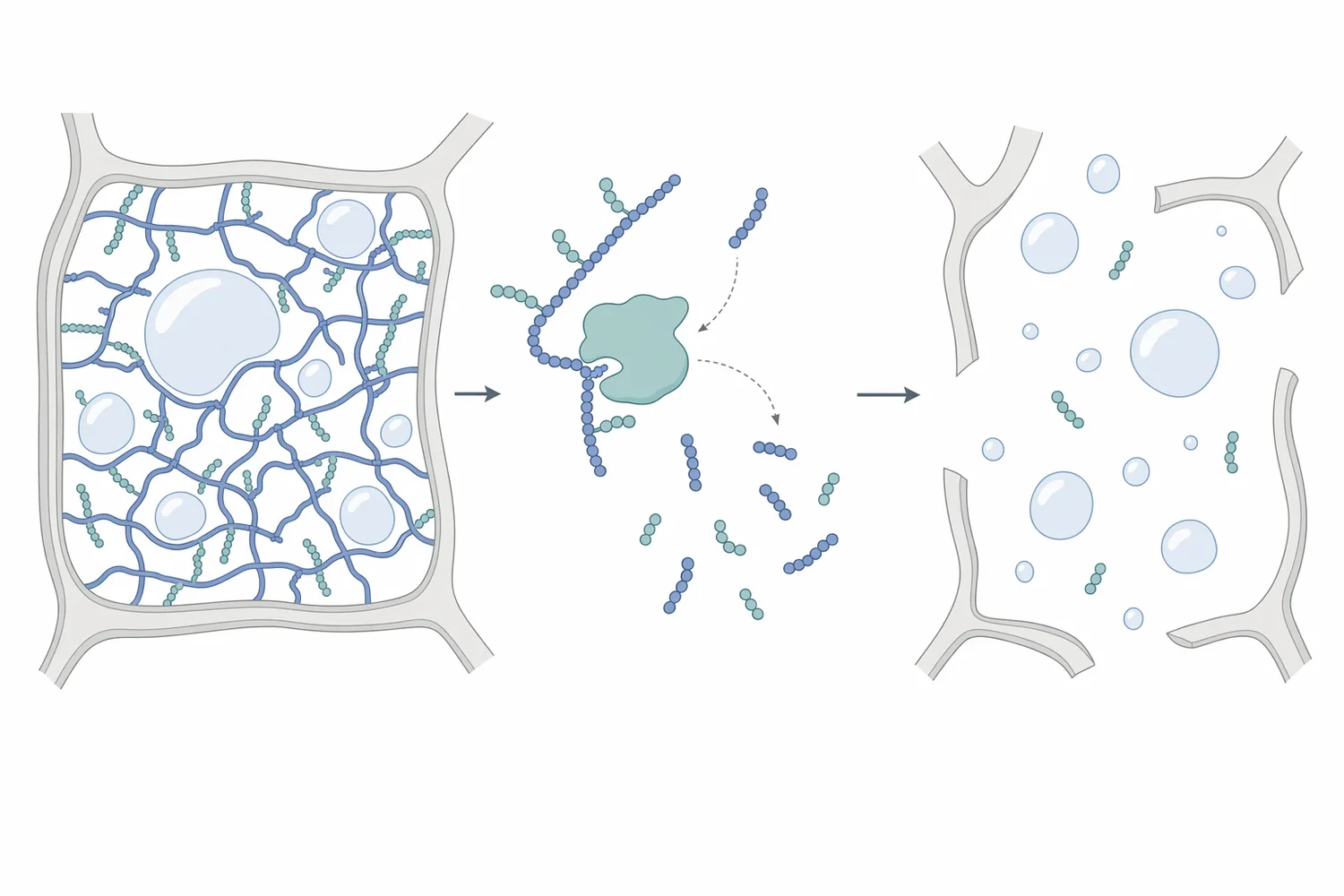
Pectinase is a functional name for a family of enzymes that degrade pectic substances. Pectin itself is rich in galacturonic acid units, with methyl-esterified and de-esterified regions that behave differently in fruit systems. In broad terms, pectinase weakens the pectin network by cutting the long polymer chains and, depending on the enzyme activities present, by modifying ester groups that influence how pectin gels, binds water, and interacts with calcium or other juice components [3].
The mechanism is physical as much as chemical. A long pectin molecule can bridge particles, hold water, and form a viscosity-building network. Once pectinase shortens that molecule, the network loses its ability to immobilise water and keep fine solids suspended. The juice becomes less resistant to flow, suspended solids can aggregate or separate more readily, and filtration media or membranes face a lower load of deformable pectin gels [1].
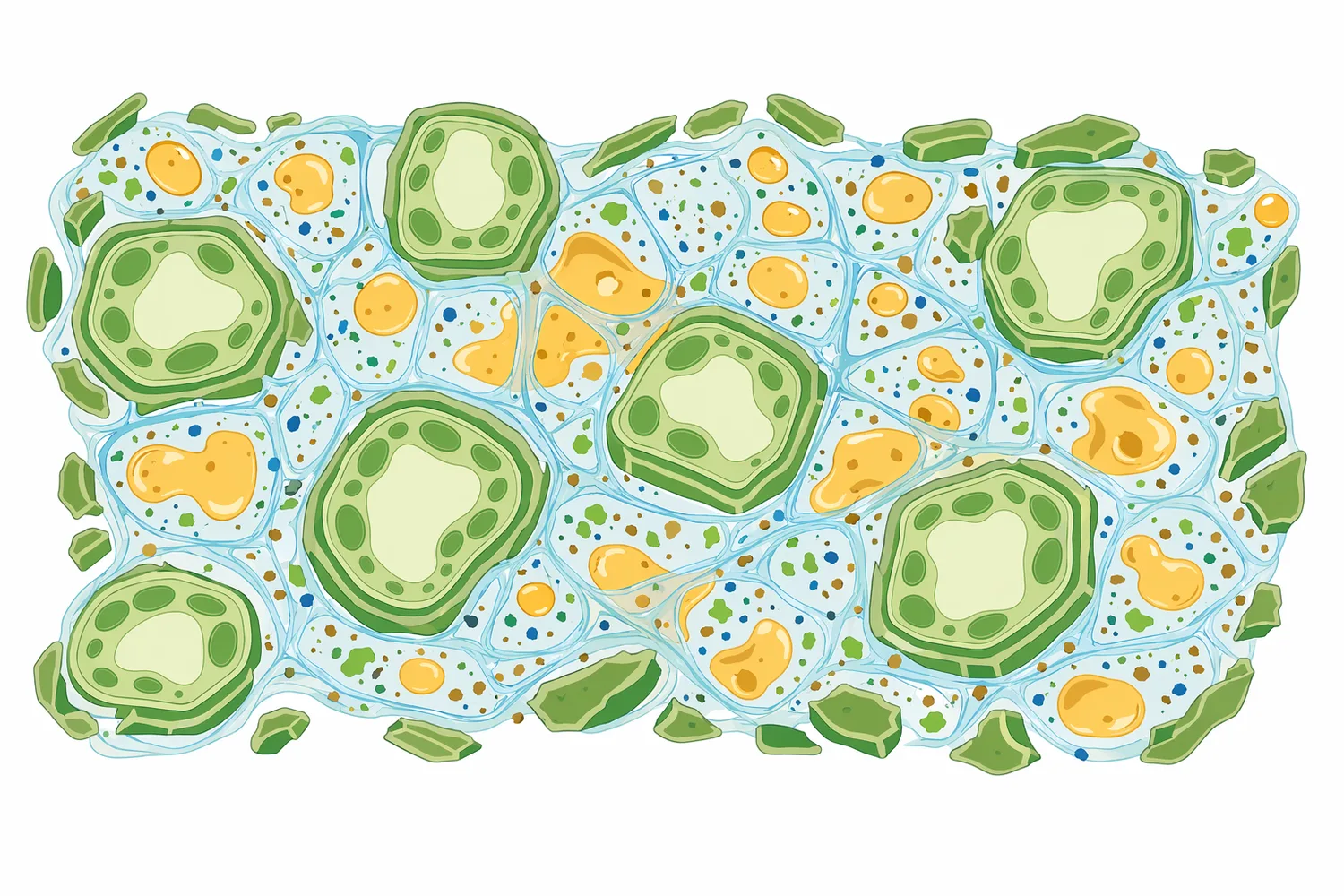
Different pectinase activities act at different points in the pectin structure. Polygalacturonase-type activity hydrolyses the glycosidic linkages in galacturonic acid chains; pectin lyase-type activity cleaves esterified pectin; pectate lyase-type activity acts on de-esterified pectate; and pectin methylesterase-type activity removes methyl groups, changing how pectin behaves and how other enzymes can attack it. A commercial pectinase preparation for fruit juice clarification may therefore produce a combined effect: chain scission, de-gelling, viscosity loss, improved particle separation, and easier downstream clarification [2].
This is why pectinase does not “bleach” juice or mask haze. It removes one of the structural causes of haze. If pectin is the material holding particles in suspension, depectinisation can make the juice visibly clearer after settling, centrifugation, filtration, or membrane processing. If the haze is caused mainly by starch, protein-polyphenol complexes, microbial instability, or heat damage, pectinase may still help with viscosity, but other process steps or enzyme types may be needed to address the non-pectin cause [1].
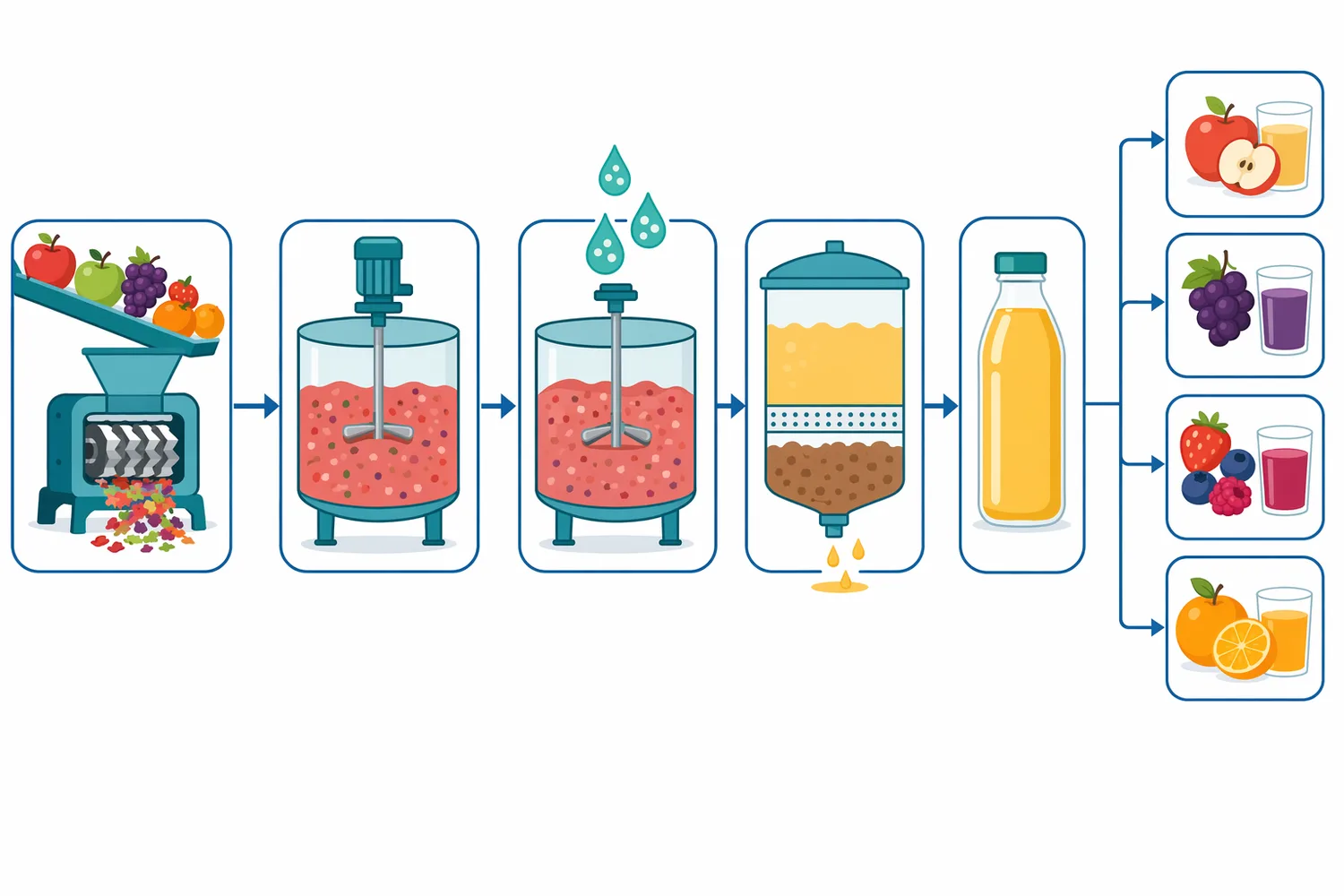
Pectinase can be used in two main process positions: mash treatment before pressing and juice treatment before clarification or filtration. In mash treatment, the enzyme contacts crushed fruit solids before the juice is separated. The goal is to weaken the pectin-rich cell-wall network so liquid moves out of the tissue more easily during pressing, draining, or decanting. In juice treatment, the enzyme acts after primary juice separation to reduce dissolved or colloidal pectin before clarification, filtration, ultrafiltration, concentration, or blending [2].
The best-known application is clear apple juice, but the same principle applies to many fruit matrices. Passion fruit processing studies have evaluated pectinase enzyme preparations for extraction and recovery because the pulp contains structural polysaccharides that limit free juice release [5]. Guava juice research has examined multi-enzyme treatment with pectinase, cellulase, and hemicellulase because guava pulp contains several cell-wall fractions that influence viscosity and turbidity, not pectin alone [6].
For citrus and orange juice, pectinase requires more deliberate use because product targets differ. A clear citrus base benefits from pectin degradation, while a cloudy or pulpy citrus drink may rely on controlled cloud and mouthfeel. Continuous clarification work with orange juice has examined immobilised pectinase reactor formats, showing that pectinase is relevant not only to simple batch treatment but also to engineered clarification systems for specific process designs [7].
Red dragon fruit juice research also illustrates the quality dimension. Pectinase treatment can affect clarification, viscosity, extractability, and quality attributes in coloured fruit juices, where processors want better separation without unnecessarily damaging colour or sensory value. Studies on red dragon fruit juice have specifically examined the effects of pectinase treatment on juice quality, reinforcing that clarification is not just a visual target but part of a broader quality-control problem [8].
Pectinase is often most effective when the processing problem is pectin-driven. It can also be part of a wider clarification strategy that includes settling, centrifugation, fining, membrane filtration, or nonthermal processing technologies. The important point is that these approaches do not all work by the same mechanism.
| Approach | Main action in the juice | What changes physically | Best fit in clarification workflows |
|---|---|---|---|
| Pectinase enzyme | Degrades pectin polymers in pulp or juice | Lower viscosity, weaker colloidal network, easier particle separation and filtration | Pectin-rich juices, mash treatment, depectinisation before filtration or concentration |
| Cellulase / hemicellulase | Degrades other plant cell-wall fibres | Better breakdown of fibrous pulp; improved liquid release in some fruit matrices | Fibre-rich pulps, guava-type or tropical fruit systems, enzyme blends where pectin is not the only barrier [6] |
| Amylase | Degrades starch | Reduces starch-related haze or processing instability | Starchy fruit materials or juices where starch contributes to cloudiness |
| Fining agents | Bind or aggregate selected haze-forming compounds | Larger flocs settle or filter more easily | Polishing step where haze is not solely due to pectin; natural fining agents are reviewed for fruit juice clarification [9] |
| Membrane clarification | Physically separates particles and macromolecules | Produces clarified permeate; can concentrate retained solids | Clear juices and concentrates, but performance can be limited by viscosity and fouling [10] |
| Ultrasound, pulsed electric field, pulsed light, cold plasma | Nonthermal physical treatment for quality, extraction, microbial or enzyme effects depending on process | Can alter cell permeability, quality attributes, or stability | Complementary technologies; not direct substitutes for pectin breakdown in all juices [11] |
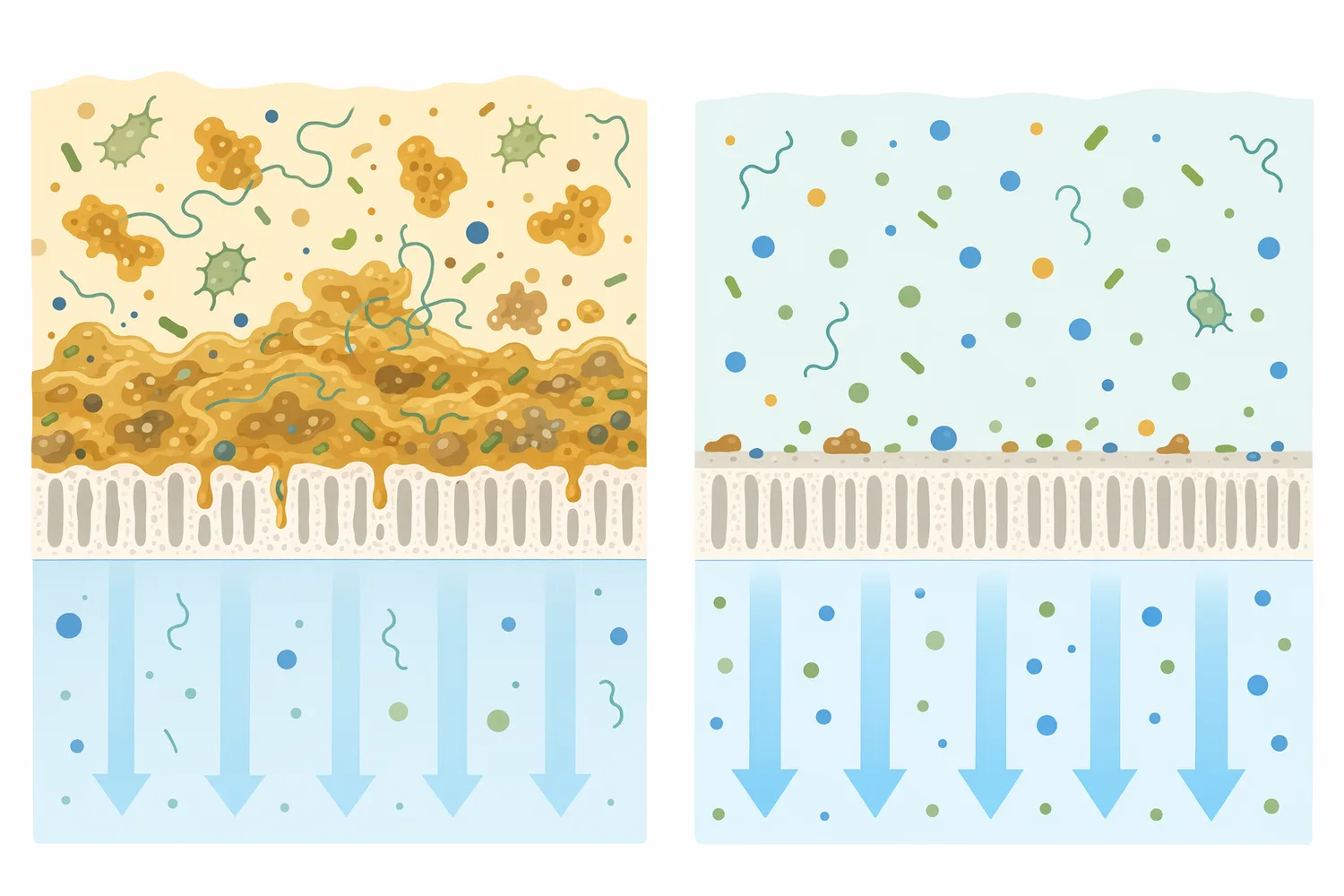
Membrane technology is a good example of why pectinase remains useful even in modern clarification systems. Microfiltration, ultrafiltration, and related membrane processes can produce clear juice and concentrates, but membranes are sensitive to fouling by suspended solids, colloids, and high-viscosity feed streams. Reviews of membrane technology in fruit juice clarification and concentration discuss membrane processes as valuable tools, while also recognising performance limitations that depend on the feed composition and fouling behaviour [10].
Similarly, emerging physical technologies such as ultrasound, pulsed electric fields, pulsed light, and cold plasma can support juice quality, safety, extraction, or stability, but they do not automatically replace enzymatic depectinisation. Ultrasound reviews describe effects on physicochemical properties of fruit and vegetable juices, while pulsed electric field reviews focus on changes in juice quality and structure under nonthermal conditions [11]. Where the specific barrier is pectin viscosity or pectin-stabilised haze, pectinase directly targets the polymer responsible.
The strongest evidence for pectinase in fruit juice clarification comes from a combination of review literature and applied fruit-specific studies. Sharma’s review on enzymatic extraction and clarification describes enzyme-assisted processing as a major route to improving juice yield and quality, with pectinase repeatedly identified as one of the core enzyme classes in fruit juice applications [1].
A review focused on pectinase properties and juice clarification explains that pectinase is used because pectic substances affect viscosity, turbidity, filtration, and clarification. It also discusses immobilisation approaches, including membranes as supports, which indicates that pectinase is relevant both as a conventional processing aid and as part of more engineered biocatalytic clarification systems [3].
Guava juice research is useful because guava is a naturally pulpy, viscous fruit matrix. The 2019 study on guava juice used a multi-enzyme approach involving pectinase, cellulase, and hemicellulase and focused on optimisation of processing parameters for clarification. That design reflects a real processing principle: when fruit pulp contains several structural polysaccharides, pectinase addresses the pectin fraction while companion enzymes can open fibre networks that also trap liquid and suspended solids [6].
Passion fruit is another relevant example. Research on pectinase enzyme preparations for passion fruit juice extraction and recovery examined the enzyme’s use in improving juice recovery from Passiflora edulis. In a fruit such as passion fruit, the edible pulp contains soluble and insoluble polysaccharides that can hold liquid and complicate separation, making pectinase treatment a logical route for improving extraction efficiency [5].
Orange juice has also been studied in continuous enzymatic clarification formats. A 2021 study compared fluidized-bed and packed-bed reactors for enzymatic clarification of orange juice, showing that pectinase can be incorporated into continuous reactor concepts rather than being limited to a one-off batch addition. For most buyers, the useful takeaway is not the reactor hardware itself, but the evidence that pectin breakdown is important enough in orange juice clarification to justify controlled continuous processing research [7].
Recent work on concurrently produced xylano-pectinolytic enzymes also supports the value of combined cell-wall degradation in extraction and clarification. Xylanase targets hemicellulosic xylans while pectinolytic activity targets pectin; together, these activities can reduce the structural integrity of fruit pulp more broadly than either activity alone. This is particularly relevant in fruit materials where pectin is important but not the only polymer restricting juice release or clarification [12].
The first measurable improvement is usually viscosity reduction. As long pectin chains are cleaved, the juice loses some of the water-binding and network-forming behaviour that makes it thick. This can make pumping easier, reduce resistance during pressing, and help filtration equipment operate with less physical burden from gel-like colloids [3].
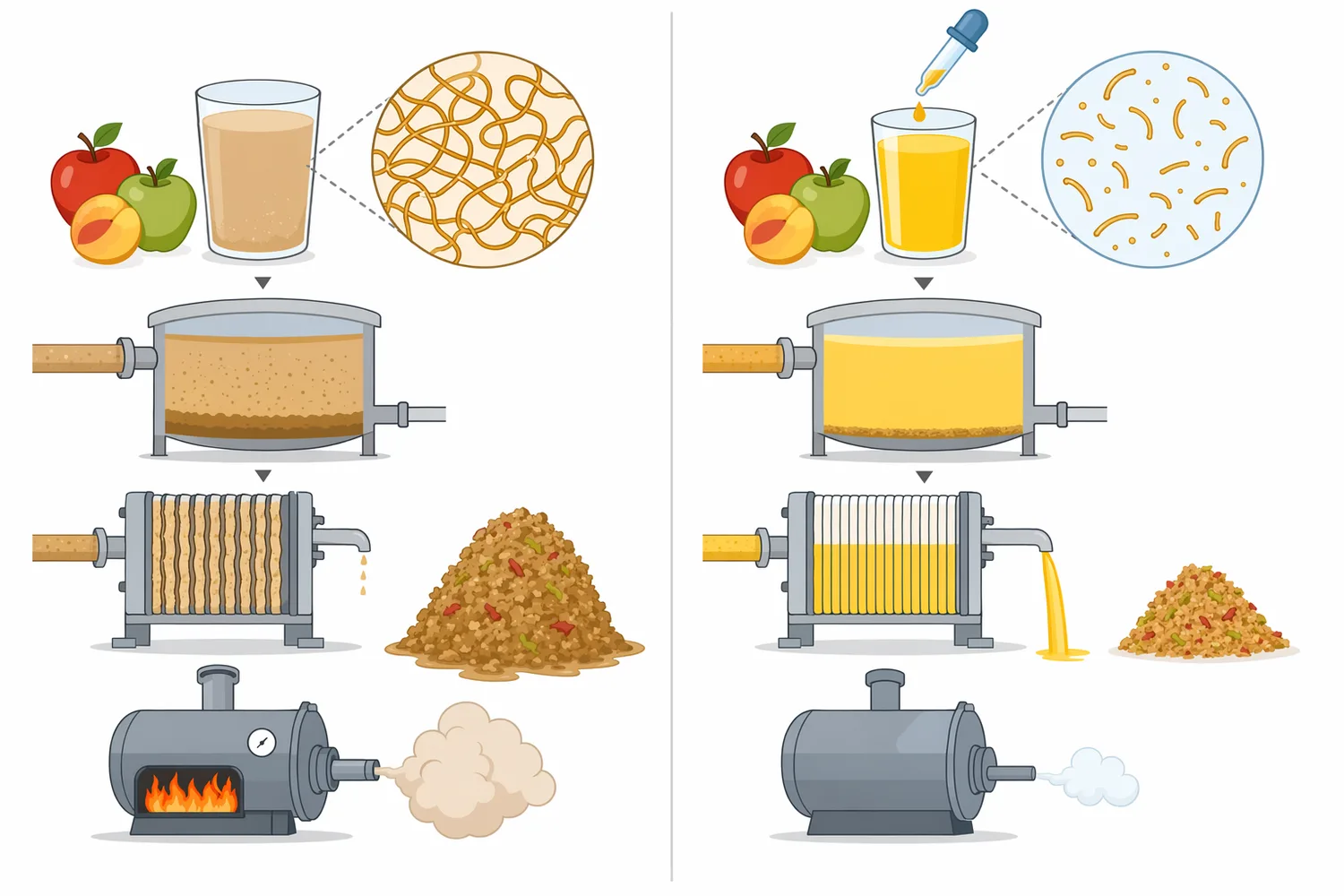
The second improvement is clarity or turbidity reduction. Pectin-stabilised particles remain suspended because the pectin network prevents them from colliding, aggregating, and settling. Once pectinase reduces the molecular size and bridging ability of pectin, particles can separate more readily through gravity settling, centrifugation, depth filtration, sheet filtration, or membrane clarification [1].
The third improvement is juice release. In mash treatment, pectinase weakens the middle lamella and surrounding wall material so cells separate more easily. Liquid that was mechanically trapped in pulp can move toward the press liquor, increasing practical extraction from the same fruit input. Reviews of enzyme-aided fruit juice treatment identify yield improvement as one of the major reasons enzymes are used in juice processing [2].
The fourth improvement is process consistency. Raw fruit is biologically variable: pectin content, degree of esterification, cell-wall integrity, and pulp particle size all change with cultivar, maturity, seasonal conditions, storage, and milling. Enzymatic treatment gives the process a controlled way to reduce one major source of variability before clarification or concentration [4].
Most fruit juices are naturally acidic, and pectinase used for juice processing is commonly discussed in that context. Acidic pectinases are especially relevant for fruit processing because they can function in the pH environment where apples, berries, citrus, grapes, and tropical fruit juices are normally processed. Reviews of pectinase applications describe fruit juice clarification as one of the principal industrial uses of pectinase because the enzyme’s substrate is abundant in fruit cell walls [3].
Temperature also matters because enzymes are proteins with a folded three-dimensional structure. At lower temperatures, molecular movement is slower and hydrolysis proceeds more slowly. At higher temperatures, the reaction may accelerate until the enzyme begins to lose structure and activity. Published juice studies often use controlled warm holding conditions to balance reaction speed with quality retention, but those study conditions should be understood as process examples rather than a universal specification for every fruit or every plant [2].
Contact time and mixing affect the result because the enzyme must physically reach the pectin. In a mash, pectinase has to diffuse through crushed pulp, skins, and suspended solids. In a pressed juice, the enzyme contacts soluble and colloidal pectin more directly, but the outcome still depends on dispersion, temperature, juice composition, and the separation step that follows. The visible clarification often occurs after pectin degradation has made the suspended material easier to remove, not at the instant the enzyme is added [1].
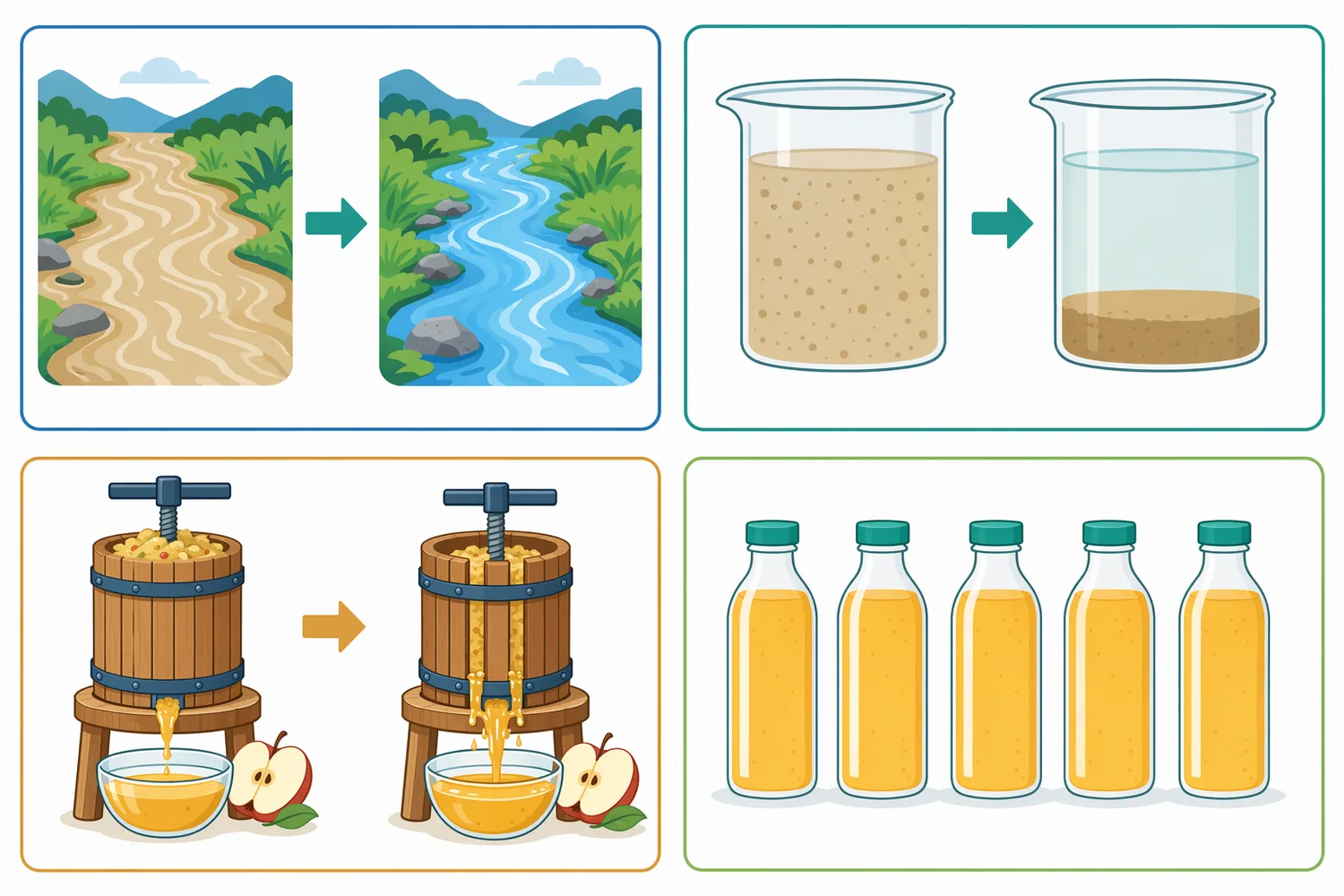
Apple juice remains one of the clearest examples of pectinase value. Apple tissue contains enough pectin to create haze and filtration difficulties, particularly when the target is a bright, clear juice or concentrate. A 2024 review of alternative processes for apple juice stabilisation and clarification places enzymatic and non-enzymatic clarification within the wider challenge of producing stable apple juice with desirable quality attributes [4].
Berry and red-coloured juices bring a different concern: clarity must be improved without unnecessarily sacrificing colour, aroma, or bioactive compounds. Pectinase can help because it targets pectin structure rather than acting as a broad adsorbent. In red dragon fruit juice, pectinase treatment has been studied specifically for its quality effects, making it relevant to processors handling visually sensitive fruit juices where colour and clarity both matter [8].
Tropical fruit juices such as guava and passion fruit often combine high pulp load, fibrous tissue, and pectin-rich soluble solids. That is why studies in these fruits frequently examine multi-enzyme treatment or extraction recovery rather than clarification alone. Pectinase reduces pectin viscosity, while cellulase or hemicellulase can help open additional wall components where the pulp structure is more complex [6].
Citrus juices require product-specific intent. In some citrus drinks, cloud is desirable and pectin contributes to body and mouthfeel; in other citrus-based products, such as clarified bases or concentrates, pectin is a processing obstacle. The orange juice continuous-bed reactor study is a useful reminder that pectinase can be applied to citrus clarification when the target is a clarified stream, but it should be aligned with the intended beverage style [7].
Fruit juices used in brewing or fermentation also benefit from understanding pectin. Fruit additions can affect haze, fermentability, filtration, and final beverage stability. A review and case study on brewing with fruit juices, using peaches as an example, highlights that fruit juice composition must be considered carefully in beverage production because fruit brings sugars, acids, pulp components, and haze-active materials into the process [13].
Pectinase is often used before filtration because it changes the feed into a more filterable liquid. A filter does not remove dissolved pectin efficiently if that pectin remains as a hydrated, viscosity-building polymer. By hydrolysing the polymer first, pectinase reduces the tendency of pectin to plug pores, form slimy filter cakes, or slow down flow through filtration media [3].
This is especially important for membrane clarification. Membranes can generate clear juice and help concentrate fruit streams, but fouling is a recurring limitation. Reviews of membrane-based processing strategies for fruit juice production discuss methods to improve membrane performance, and feed pretreatment is one of the practical routes for reducing fouling stress [14].
Immobilised enzyme research illustrates the same logic from another angle. Studies using immobilised xylanase or combined xylanase-pectinase nanobiocatalysts for juice clarification show that researchers are actively exploring ways to keep cell-wall enzymes in controlled systems while treating juice streams. These studies are not necessary for ordinary batch juice processing, but they confirm that pectin and related polysaccharides remain important engineering targets in clarification [15].
Natural fining agents occupy a different role. They can bind or flocculate selected haze-forming materials, but they do not hydrolyse pectin chains. Reviews of natural fining agents in fruit juice clarification show that fining can be valuable, yet enzyme treatment is mechanistically distinct because it changes the polymer structure before separation [9].
Pectinase is powerful when pectin is the problem, but juice haze can come from several sources. Starch can create haze in some fruit systems, especially after heating or concentration. Proteins and polyphenols can form complexes. Fine insoluble pulp can remain physically suspended. Microbial instability or residual native enzymes can also affect cloud, colour, flavour, or shelf life [2].
For that reason, pectinase should be understood as a pectin-targeted processing aid, not a universal clarification agent. In a juice where starch is the dominant haze source, amylase may be more directly relevant. In a fibre-heavy purée, cellulase or hemicellulase may be useful alongside pectinase. In a juice where the desired product is naturally cloudy, full depectinisation may not match the sensory target [1].
Pectinase also does not replace good separation design. After pectin is degraded, the resulting juice still needs an appropriate physical route for removing solids, whether by settling, decanting, centrifugation, filtration, membrane clarification, or another process. The enzyme changes the material so those steps can work more effectively; it does not eliminate the need for the steps themselves [10].
Enzymes.bio supplies Pectinase Enzyme for Fruit Juice Clarification for buyers who want a practical enzyme product for fruit juice clarification and viscosity reduction. The product is sold directly online by the 1 kg unit: add the item to the cart, pay online, and the order is processed and shipped. A Certificate of Analysis and Safety Data Sheet are provided with the order .
The scientific value behind the product is straightforward: pectinase targets pectin, one of the most important structural causes of viscosity, haze, poor juice release, and filtration difficulty in many fruit juice systems. In the juice plant, that translates into a more processable mash or juice stream, especially when pectin-rich fruit is being pressed, clarified, filtered, or prepared for concentration [3].
For buyers producing clear or semi-clear juices, clarified fruit bases, concentrates, fermented fruit beverages, or fruit preparations where pectin creates handling and clarity issues, pectinase is an established enzyme category with strong support in both review literature and applied fruit-specific studies. Its best use is as a targeted tool for pectin breakdown within a complete juice process, not as a generic additive for every haze or stability problem [2].
Sold by the 1 kg unit, in stock and ready to ship. Order directly on our store — pay online and we process your order. A Certificate of Analysis and Safety Data Sheet are included with every order.
Buy Pectinase Enzyme For Fruit Juice Clarification →Numbered in order of first citation. Open-access sources, each verified reachable at publication; citation numbers in the text link here.