
TL;DR
- Bromelain is a protease — it breaks down protein, not pectin. That single fact explains most of the confusion in pineapple and tropical-fruit processing.
- If your syrup is cloudy from pectin (the usual case in pineapple, guava, mango, and papaya bases), you need pectinase, not bromelain.
- Bromelain earns its place when the problem is protein haze, fibrous pulp that won’t settle, or you’re tenderising fruit-adjacent protein alongside the syrup step.
- Dose by activity, run a small trial ladder, and inactivate with heat before bottling or setting a gelatin-based product — bromelain left active will keep digesting protein after you’ve stopped watching it.
- Enzymes.bio supplies food-grade bromelain with COA and SDS for bulk buyers through our bromelain enzyme hub; specify your process conditions before ordering.
Why does pineapple make your mouth tingle — and does that help your syrup?
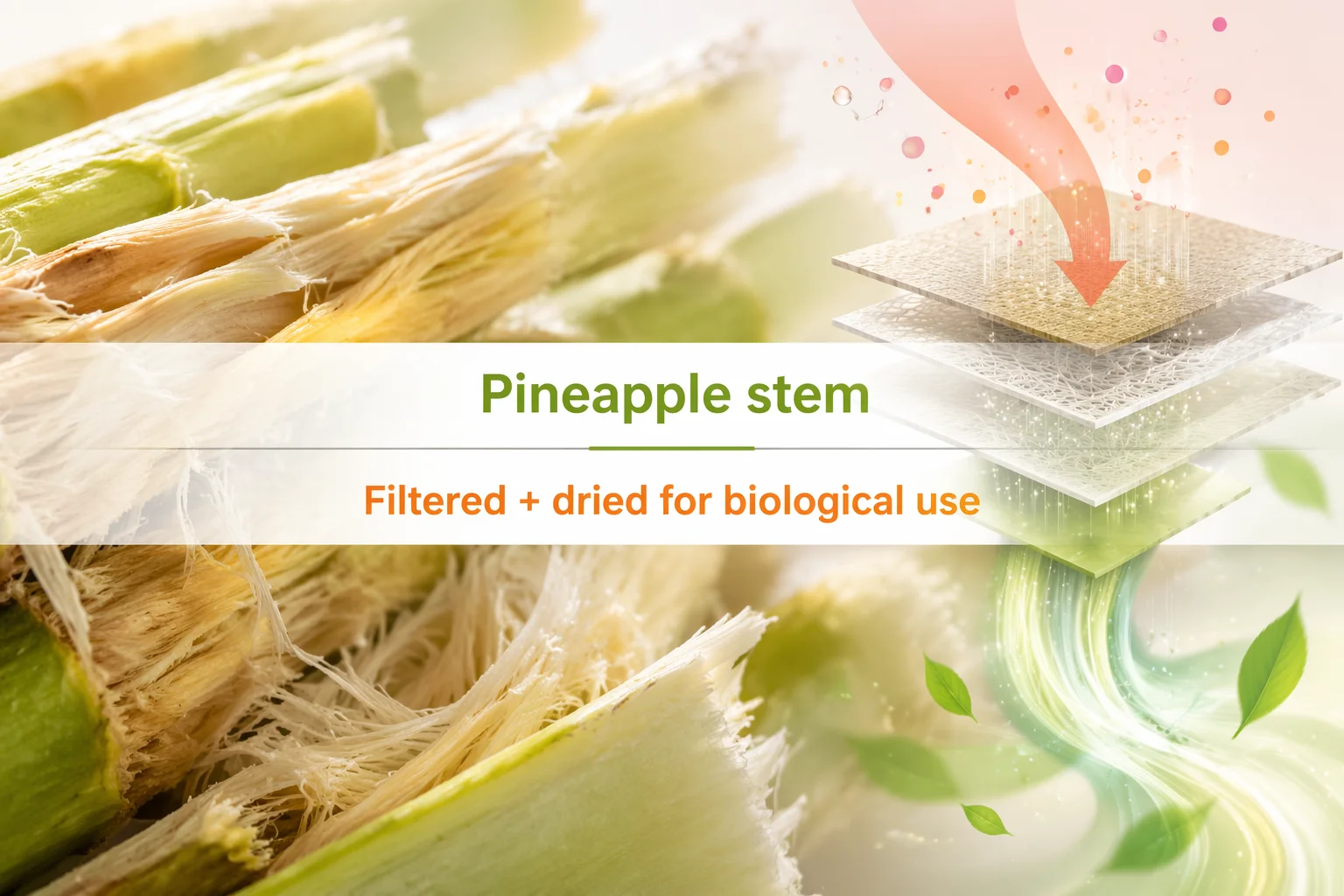
The tingling you feel eating fresh pineapple is bromelain, a protease, breaking down protein on the surface of your tongue and cheeks. It is a real, well-documented mechanism, not a health effect — bromelain doesn’t know the difference between food protein and the protein in your own tissue, so raw pineapple gently digests both until you swallow or the enzyme is diluted by saliva.
That mechanism is also exactly what a small beverage or dessert maker is trying to harness (or avoid) in processing. Bromelain hydrolyses protein wherever it finds it — in muscle fibre for tenderising, in a protein-based haze, or in the gelatin of a dessert you didn’t want digested. It does not act on pectin, the plant-cell-wall carbohydrate that is the main reason pineapple, guava, and mango syrups stay cloudy and thick. We’re stating this as basic enzyme biology, not a digestive-health or supplement claim — if you came here because of pineapple-and-gut-health content elsewhere, this article stays on the processing side of that question.
Bromelain vs pectinase: two different hazes, two different enzymes
The most common mistake a small producer makes is reaching for bromelain because it’s “the pineapple enzyme,” when the actual haze in the syrup is pectin, not protein. Pectin haze looks similar to protein haze to the eye — both make juice or syrup cloudy and slow to filter — but bromelain will not clear it, no matter how much you add or how long you hold it.
Use this to sort out which enzyme actually matches your problem, with working ranges from our own product specification data where we have them:
| Enzyme | What it actually solves | Working pH (our spec data) | Working temperature (our spec data) | Inactivation |
|---|---|---|---|---|
| Bromelain | Protein haze; tenderises fibrous pulp/connective tissue; not effective on pectin | Not listed on our current bromelain spec sheets — ask for a working range with your RFQ | Not listed on our current bromelain spec sheets — as with any protease, expect it to lose activity well before boiling | Sustained heat step; confirm residual activity by trial |
| Pectinase | Pectin/colloidal haze — the usual cause of cloudy, thick pineapple and tropical-fruit syrup | 3.5–5.5 (our juice-clarification pectinase products) | 40–55 °C typical (our juice-clarification pectinase products; some formulations run wider) | Short heat hold in the same range used to pasteurise the syrup |
| Papain | Protein haze and tenderising, alternative to bromelain with a different pH profile | 6.0–7.0 (our protein-hydrolysis papain product) | Not listed on our current papain spec sheet | Heat step; confirm by trial |
If you’re not sure which haze you have, a rough kitchen check is informative: pectin haze tends to thicken the liquid (higher viscosity, slower pour) as well as cloud it; a protein haze clouds without much viscosity change. For a production decision, don’t guess — a small bench trial with each enzyme on a split sample settles it in an afternoon. For the pectin side of this, our pectinase for juice clarification article covers the clarification workflow in more depth, and for a fuller protease comparison, see papain vs bromelain.
A safe small-batch method, if bromelain is genuinely your enzyme
If your syrup or dessert application really does need protein hydrolysis — a haze that’s protein, not pectin, or a tenderising step on fruit-adjacent tissue — treat bromelain the way any working protease should be treated: dose low, hold under control, and inactivate deliberately.
- Confirm the substrate first. Run the pectin/protein check above, or ask a lab to confirm, before you commit product to an enzyme trial.
- Start with a conservative dose ladder. Because our bromelain spec sheets don’t carry a universal recommended dose per litre — activity varies by grade (our bromelain powders range from roughly 50,000 U/g up to 1,200,000 U/g / 2,500 GDU) — request a starting-dose recommendation for your specific grade from our technical team, then test two or three doses below and around it on a split batch.
- Hold at a controlled, moderate temperature. Don’t assume boiling helps; a protease that’s already denaturing won’t clarify anything. Keep the batch at the same temperature for every trial arm so dose is the only variable.
- Time the contact period and check clarity at intervals, not just at the end — over-long contact is the most common way small-batch trials go wrong.
- Inactivate with your existing heat step. Most syrup and juice processes already include a pasteurisation-range heat hold; that same step should stop the enzyme. Verify by testing a sample after cooling — if it’s still hydrolysing protein (a gelatin set test is a simple way to check, below), the heat step wasn’t enough.
- Document the batch: enzyme lot, activity, dose, hold time, temperature, and the inactivation check. This is what lets you repeat a good batch and diagnose a bad one.
What goes wrong: over-treatment, gelatin, and bitterness
Three failure modes account for most of the complaints we hear about bromelain in fruit processing, and none of them require exotic causes.
- Bitterness from over-hydrolysis. Push a protease too far — too much enzyme, too long a hold, or too warm a temperature — and it can release bitter peptides. This is a known behaviour of proteolytic enzymes generally, not specific to a bad batch of bromelain; the fix is a shorter, lower-dose trial, not a different supplier.
- Gelatin that won’t set. This is the classic bromelain incompatibility: fresh or under-processed pineapple carries active bromelain that keeps digesting the gelatin’s protein, so the dessert never firms up. Canned pineapple works in gelatin desserts precisely because the canning heat has already inactivated the enzyme. If your process combines a bromelain-treated syrup with a gelatin-set product downstream, your heat-inactivation step is not optional.
- Wasted enzyme on the wrong haze. Adding bromelain to a pectin-cloudy syrup and getting no result is the single most common support question in this category. It isn’t a defective enzyme — it’s the wrong tool for that substrate. Re-check with the pectin/protein test above before assuming the enzyme failed.
Choosing the right pack size and getting a quote
Enzymes.bio supplies bromelain as a food-grade powder in bulk, with activity grades from roughly 50,000 U/g up to 1,200,000 U/g (2,500 GDU), so a small producer and a larger processor can both find a grade that matches their batch size rather than buying far more activity than they need. Our listed hub product is Bromelain Enzyme 200,000 U/g (400 GDU) — a mid-activity grade that’s a reasonable starting point for a trial before you scale to a higher- or lower-activity grade.
When you request a quote, include: your substrate (pineapple, guava, mango, mixed tropical), whether the haze is confirmed as protein or pectin (or unconfirmed and you’d like help characterising it), your batch size, target pH and temperature range, and whether the product downstream includes gelatin or another heat-sensitive step. That’s enough for our technical team to recommend a grade and a starting dose instead of just a price list. COA and SDS are supplied with every order, and a Food-Grade Declaration is available on request.
If pectin turns out to be your actual problem — which it is for most cloudy pineapple and tropical-fruit syrups — start with our fruit-processing enzymes hub for pectinase options instead, and keep bromelain in reserve for the protein side of your process.
Need this enzyme for your process?
Talk to our team about grade, activity, and volume, or browse the options.