
Bulk Papain Enzyme Supplier
How Papain Works
Broad-Spectrum Proteolysis
Papain cleaves peptide bonds adjacent to basic and hydrophobic amino acid residues with minimal selectivity — making it highly effective for complete protein hydrolysis across diverse substrates including meat, plant proteins, and collagen.
Wide Temperature Range
Active from 20°C to 70°C with optimum at 60–65°C, and retains significant activity in meat at cooking temperatures (50–70°C). Self-inactivates above 75°C — enabling controlled tenderization through cook temperature.
Natural & Non-GMO
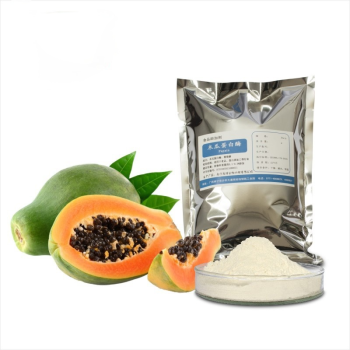
Papain is extracted directly from unripe papaya fruit by coagulation, drying, and purification of the natural latex. No genetic modification involved. Suitable for natural and clean-label food products.
Papain Applications by Industry
Meat Tenderization
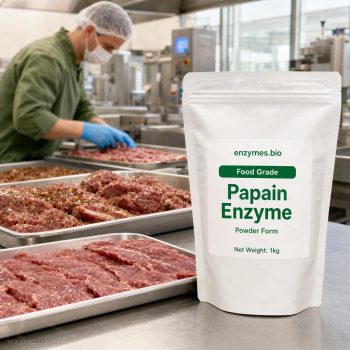
Injected or applied as marinade to beef, pork, poultry, and game. Degrades myofibrillar proteins and connective tissue during cooking, producing tender texture. Active until inactivation at 75°C+ for controlled results.
Protein Hydrolysates
Produces savory flavor extracts, yeast extract, plant protein hydrolysates, and collagen peptides. High-activity grades (1,000,000–2,000,000 U/g) enable cost-effective bulk hydrolysate production.
Brewing & Chill-Proofing
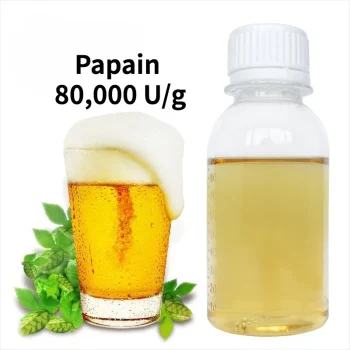
Liquid papain is applied during beer conditioning to hydrolyze haze-forming proteins, preventing chill-haze and improving beer clarity and filtration in lager and ale production.
Food Manufacturing
High-activity papain powder (400,000–2,000,000 U/g) is used in food processing, meat tenderization, and cosmetic formulations. Food-grade and industrial-grade available.
Feed & Specialty Processing
Improves protein digestibility in aquaculture and specialty animal feeds. Also used in collagen peptide production, wound debridement preparations, and specialty fermentation processes.
Papain Applications: Process Details, Application Rate & Parameters
Meat Tenderization
Meat Processing | Injection Brine & Marinade Systems
Function: Papain hydrolyzes myofibrillar proteins (actin, myosin) and connective tissue collagen, breaking rigid muscle-fiber cross-links. Warner-Bratzler shear-force values improve 30–60% at commercial application rates. Activity is mild during cold storage and spikes on cooking, providing even, cook-activated tenderizing.
Typical application rate: 10–100 ppm in injection brine (10–15% pump rate); 0.005–0.03% w/w dry rub; activity ≥500,000 USP units/g
Applications: Beef and pork primals (blade, round, chuck), injection tenderizing lines, marinade systems, automated brine injection.
Related guide: Meat Processing Enzymes — bromelain, protease & tenderizing enzyme guide →
Protein Hydrolysates
Food Ingredients | FPH & Savory Hydrolysate Production
Function: Broad-spectrum cysteine protease active at pH 5–8, up to 70°C. Rapidly cleaves peptide bonds generating oligopeptides and free amino acids. Degree of hydrolysis (DH) of 15–40% is achievable in 2–6 hours, producing savory flavor precursors, functional peptides, or functional food ingredients.
Typical application rate: 0.1–0.5% w/w enzyme:substrate; DH target 15–40%; 50–60°C, pH 6–7, 2–6 hour reaction
Applications: Meat protein hydrolysates, fish protein hydrolysates (FPH), soy hydrolysates, seasoning bases, infant formula protein.
Brewing & Chill-Proofing
Brewing | Haze-Active Protein Removal
Function: Chill haze forms when haze-active hordein-derived proteins bind polyphenols at low temperatures. Papain degrades these proteins during conditioning without affecting foam stability (beta-glucan and foam-positive proteins are largely unaffected at correct application rate).
Typical application rate: 1–5 g/hL beer; add to conditioning tank at 0–4°C; inactivated by pasteurization at 72°C
Applications: Lager and pilsner chill-proofing, bottle-conditioned ale shelf-life extension, keg beer clarity.
Related guide: Brewing Enzymes — amylase, glucoamylase & haze-control enzyme guide →
Food Manufacturing Applications
Food Processing Enzyme | GRAS-Recognized Plant Protease
Function: Papain is active across pH 5.0–8.0, making it suitable for diverse industrial hydrolysis applications. Standardized papain (6M–10M USP units/g) is used in food processing, protein hydrolysis, and commercial enzyme formulations.
Typical application rate: applied at 0.1–0.5% w/w in food processing; pH stability 4–8
Applications: Food processing enzymes, protein hydrolysis, cosmetic formulations, commercial enzyme blends.
Animal Feed & Pet Food
Feed Manufacturing | Protein Digestibility Improvement
Function: Papain pre-digests feed proteins, increasing amino acid bioavailability for monogastric animals (poultry, swine, pets) with low intrinsic protease output. Improved digestibility reduces feed conversion ratio (FCR) and supports growth performance.
Typical application rate: 100–500 U/g feed; 0.01–0.05% inclusion in pet food; heat-stable formulations available for pelleted feed
Applications: Poultry and swine performance feed, premium pet food, soft-moist pet treats, pre-digested protein concentrates.
Papain Products Available Now
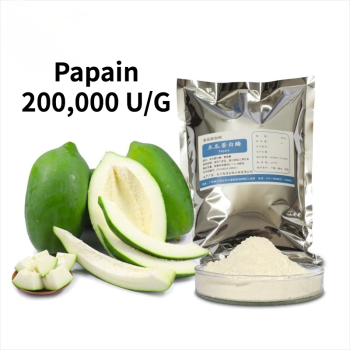
Top picks: Papain 1.5 Million U/g High Activity
-
-

-
-
-
-
-
-
-
-
Beer Brewing Enzymes
Papain 80,000 U/g Liquid Beer Clarification Additive Hydrolyzed Protein Biological Enzyme
US$77.99 Add to cart Buy Now -
-
-
-
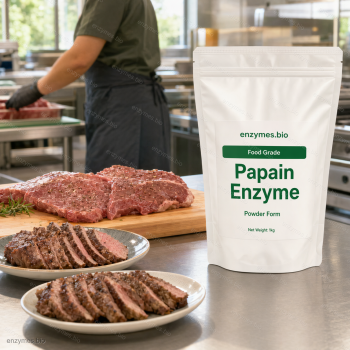
Why Source Papain from enzymes.bio?
Low MOQ from 1 kg
Flexible order quantities from R&D samples to full production runs. Scale up when ready.
Custom Preparations
Our technical team formulates custom enzyme preparations to match your exact specification.
Global Shipping
DHL, FedEx, and USPS fulfillment to 180+ countries with full tracking. Cold-chain shipping available.
Technical Support
Application guidance from our enzyme specialists on application rates, stability, and formulation.