
TL;DR
- Sugar yield is usually lost through a mismatch between the enzyme complex and the pretreated feedstock, or through dosing set on the wrong basis, rather than because “the enzyme is weak.”
- A saccharification cellulase needs three activities working together: endoglucanase, exoglucanase (cellobiohydrolase) and β-glucosidase. Without enough β-glucosidase, cellobiose accumulates and the conversion stalls.
- Our bioethanol-specific liquid cellulase (CFB3S) is dosed at 0.8–2.0% of cellulose. It is a starting range, not a fixed answer. The optimum depends on feedstock quality and process conditions.
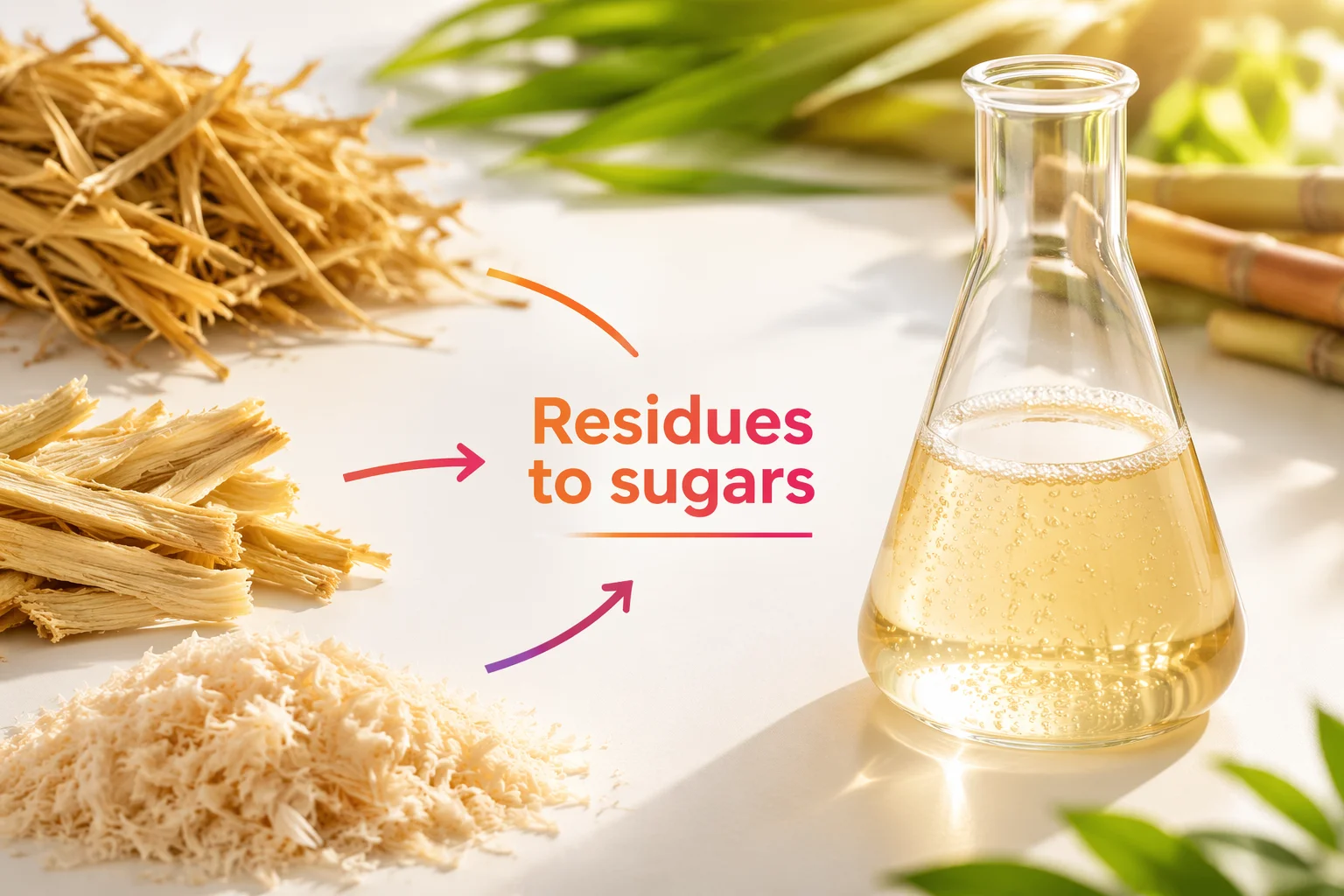
- Corn straw, corn cob, corn bran, wheat straw and bagasse are the feedstocks named in the product data.
- Xylanase activity is part of the same product. Hemicellulose that is not degraded can hold back access to cellulose.
- No per-product optimum pH or temperature is published in our data for CFB3S. Set those in your own trial, using the general cellulase ranges below only as a starting frame.
Why saccharification yield goes missing
A biorefinery does not usually fail at saccharification because cellulose is uncooperative in principle. It fails at the edges. A batch is dosed on the weight of whole biomass when the enzyme should be dosed against cellulose content. A feedstock changes between deliveries, and the enzyme rate stays where it was. A blend built for one substrate is used on another.
Each of these shows up as the same three symptoms: long hydrolysis times, a glucose curve that flattens early, and batch-to-batch scatter that is hard to trace. The fix is rarely “more enzyme.” It is a matching problem, and it is worth solving before a purchasing decision, because enzyme is a recurring cost.
Our CFB3S product data lists the benefits a well-matched cellulase is meant to deliver: shorter hydrolysis time, lower enzyme dosing, higher total solids loading, milder pretreatment, and better biomass-to-sugar conversion. These are the goals to measure in a trial, not results to assume. The product data does not publish yield percentages, so we do not quote any.
How the enzyme system converts biomass to sugar
Cellulose is a glucose polymer joined by β-1,4-glycosidic bonds. Cellulase is a system, not a single enzyme:
- Endoglucanase (EG) cuts cellulose chains at random internal positions, creating new chain ends.
- Cellobiohydrolase (CBH, exoglucanase) works from those ends and releases cellobiose, a glucose dimer.
- β-glucosidase (BG) splits cellobiose into glucose.
These activities work synergistically. If one is under-supplied, the others slow down: in general enzymology, cellobiose can build up and hold back the exoglucanase step when β-glucosidase is relatively short.
Real biomass adds a layer. Lignocellulose contains hemicellulose (largely xylan) around and between cellulose fibres, and intact hemicellulose can limit access to cellulose — general background on why a cellulase blend is often paired with xylanase. CFB3S carries xylanase activity (≥7,000 u/ml) alongside its cellulase components; our data gives no reason for that pairing and no feedstock-by-feedstock comparison, so no substrate-specific claim is made here — confirm your own feedstock’s response in trial.
The declared activities for CFB3S, as stated in our product data, are: CMC-based cellulase activity ≥4,500 u/ml, xylanase ≥7,000 u/ml, and β-glucosidase ≥3,000 u/ml. It is a liquid preparation.
Operating variables: dose, pH, temperature, contact time
| Variable | What our data says | What you must set yourself |
|---|---|---|
| Dose | CFB3S: 0.8–2.0% of cellulose | Where in that range, given your feedstock and pretreatment |
| pH | No optimum published for CFB3S | Determine in trial |
| Temperature | No optimum published for CFB3S | Determine in trial |
| Contact time | Not published for CFB3S | Determine in trial; the product’s stated aim is to shorten it |
| Storage | 25 °C, 6 months, activity stays ≥90%; increase dose after shelf life | Rotate stock; plan purchases to fit the shelf-life window |
Dose basis. The 0.8–2.0% figure is stated against cellulose, not against total dry biomass. Converting between the two requires a compositional analysis of your pretreated material. If your incoming cellulose fraction moves, the correct enzyme mass moves with it. This is a common source of the batch scatter described above.
pH and temperature. Our CFB3S listing does not give an optimum for either. For orientation only, our other Trichoderma reesei cellulase grades (powder at 11,000 u/g and a liquid at 200,000 u/g) state a working temperature of 40–80 °C and pH 4.5–6.0. These are different products with different activity declarations. Use that window as a starting frame for scouting runs, and do not treat it as a CFB3S specification.
Activity units. Unit definitions differ between our product listings, and some listings do not state a definition at all. Do not compare “u/g” or “u/ml” numbers across grades without checking how each was measured. Compare on the same substrate in your own assay.
After shelf life. The product data says to increase the application rate once the shelf life has passed. It gives no correction factor, so establish one by re-assaying an aged lot.
Limitations and trade-offs
- The enzyme cannot fix a poor pretreatment. The stated benefits include allowing milder pretreatment. Even so, the enzyme works on what pretreatment leaves it, and a very recalcitrant residue will need more enzyme or more time.
- Higher solids loading is a benefit and a risk. The product data lists increased total solids loading as a benefit. In practice, higher solids also raise viscosity and mixing demands, so test at your real loading rather than at bench dilution.
- Blend versatility is not universality. The listed feedstocks are corn straw, corn cob, corn bran, wheat straw and bagasse. Wood residues are not named in our data. If your feedstock is woody, treat it as untested and trial it first.
- Dose is a cost lever with a ceiling. Raising enzyme dose to rescue a weak batch is expensive and may plateau. If yield does not respond to dose in your trial, look at pretreatment and feedstock composition instead.
- Supplementary hemicellulase is possible but unvalidated for this use. We list separate hemicellulase products, for example a food-grade grade with an optimum pH of 3.5–5.0 and 40–55 °C. Those are documented for food, feed and processing uses, not for biomass saccharification, so any pairing with cellulase needs its own trial.
- Enzymes are proteins. Our product data notes that they may cause sensitisation in susceptible individuals, and that skin, eye and nasal contact should be avoided. Handle with appropriate protective equipment.
Designing a trial that gives a usable answer
A saccharification trial should be built to decide a purchase, not to produce an impressive single number.
- Characterise the substrate first. Record cellulose content on the pretreated material you will actually run. Dose is defined against cellulose, so without this the dose is meaningless.
- Run a dose ladder inside the published range. Use several points between 0.8% and 2.0% of cellulose, plus one point outside each end to see where the response flattens. Keep everything else fixed.
- Scout pH and temperature separately. Since no CFB3S optimum is published, vary one at a time around your plant’s real operating point. Start in the 4.5–6.0 pH band and 40–80 °C window used by our other cellulase grades, and let the data narrow it.
- Sample over time, not at one endpoint. Take glucose readings across the run. Time to a target conversion is what shows whether hydrolysis time really shrinks.
- Test at real solids loading. A trial at low solids will flatter the result.
- Repeat on more than one feedstock lot. This exposes the batch scatter that causes plant-scale surprises.
- Check ageing. If you plan to hold stock, run one aged lot against a fresh one, so you know how much to raise the dose after the 6-month shelf-life window.
- Carry the best conditions into fermentation. Confirm that the hydrolysate ferments as expected, since the goal is ethanol and not sugar alone.
Keep the enzyme lot number and declared activity in every trial record so results can be traced back later.
Product fit: sourcing cellulase
We are a trader and supplier of enzymes, not a manufacturer. For bioethanol saccharification, the documented match is Cellulase Enzyme For Bioethanol Production (CAS 9012-54-8, SKU ENZ023), the liquid CFB3S grade. In our data it is described as a preparation for converting pretreated lignocellulosic material into fermentable sugars, containing balanced endocellulase, exocellulase and β-glucosidase. It is supplied in 1 kg bags.
If you want to compare against other cellulase grades in our range, the documented options include:
- Acid Cellulase Enzyme Liquid For Fiber Hydrolysis (ENZ058): liquid, declared at 200,000 u/g, Trichoderma reesei, working at 40–80 °C and pH 4.5–6.0, with a general application rate of 0.1–3 kg per tonne of dry substrate. This listing is written for multiple industries, not specifically for bioethanol.
- Cellulase Enzyme Powder 11000u/g (ENZ001, CAS 9012-54-8): powder, Trichoderma reesei, same working ranges, listed for feed, distilling, textile, plant extract and food uses.
- Acid Cellulase Enzyme For Hydrolyzing Fiber (ENZ082): listed for biomass saccharification at low pH. Detailed specifications are not in the data we hold, so ask us for the current data sheet before planning around it.
For a plant sourcing decision, ask for the current specification sheet and a sample of the lot you would receive, and run the trial above before setting a purchase volume. Plan volumes around the 6-month shelf life of CFB3S at 25 °C. Browse the full range on the cellulase enzyme hub.
Need this enzyme for your process?
Talk to our team about grade, activity, and volume, or browse the options.