
TL;DR
- Enzyme storage and shelf life depend on protecting activity, not just keeping a material physically intact.
- The main risk factors are heat, moisture, repeated opening, contamination, and long exposure after dilution.
- Store enzyme powders sealed and dry, and store liquids according to the product label or COA guidance.
- Compare inventory by activity units and retest when storage history is uncertain.
- For food-processing applications, specify grade, activity, format, COA, and SDS before bulk purchase.
What does enzyme storage and shelf life mean in practice?
Enzyme storage and shelf life means maintaining enough declared activity for the enzyme to perform in your process at the intended dose. A package can look unchanged while its activity has declined, so the practical question is whether the material still meets the activity and quality expectations for use.
Activity is the critical specification. Enzymes are purchased and dosed by activity units, not by weight alone. A protease, amylase, lactase, catalase, or pectinase may use a different assay and unit system, so shelf-life decisions should be tied to the product’s declared activity and COA, not a generic “kg remaining” calculation.
Shelf life is conditional. It assumes the material has been stored under the supplier’s recommended conditions, in intact packaging, and protected from avoidable stress. If a container has been exposed to heat, humidity, or frequent opening, the labelled shelf life may no longer describe the true retained activity.
For buyers sourcing food enzymes, storage planning should be part of the specification stage, especially when the same enzyme will be stocked across multiple plants or used intermittently.
Which enzyme storage conditions matter most?
The most important enzyme storage conditions are temperature control, moisture control, sealed packaging, clean handling, and limited exposure time after opening. These factors affect enzyme stability more directly than warehouse location or container size by themselves.
| Storage factor | Why it matters | Practical control |
|---|---|---|
| Temperature | Heat can accelerate loss of activity | Follow label or COA guidance, avoid hot zones |
| Moisture | Water uptake can trigger clumping or activity loss in powders | Keep sealed, use dry tools, close immediately |
| Oxygen and headspace | Some enzymes or formulations are more sensitive after opening | Minimize repeated opening and reseal tightly |
| Contamination | Foreign material can affect quality or downstream processing | Use clean scoops, avoid shared utensils |
| Light | Some liquid or formulated enzymes may be light sensitive | Keep in original packaging where possible |
| Time after dilution | Diluted enzyme solutions are usually less stable than concentrates | Prepare only what the process needs |
Do not generalize across all enzymes. A powdered amylase, a liquid lactase, and a catalase preparation may have different stabilizers, carriers, moisture limits, and recommended storage ranges. Treat the product label, COA, and SDS as the controlling documents.
What enzyme storage temperature should you use?
Use the enzyme storage temperature specified on the product label, COA, or supplier documentation. If no single universal temperature is stated, avoid heat exposure, avoid freeze-thaw cycles unless the product is supplied for that use, and keep the material in a stable storage environment.
Temperature affects rate of activity loss. Higher storage temperatures generally increase the risk of activity decline over time. That does not mean every enzyme must be refrigerated, because formulation format, carrier, water content, and stabilizers all influence stability.
Avoid temperature cycling. Repeated movement between cold storage and warm production rooms can create condensation, especially on powders. Condensation is often more damaging than a short, controlled transfer, because it introduces localized moisture into the material.
Check receiving conditions. For bulk enzyme receiving, record damaged packaging, wet cartons, prolonged heat exposure, or other transit issues before accepting the lot into production inventory. If storage history is questionable, request technical review before adjusting dose.
How to store enzymes in a production or R&D facility
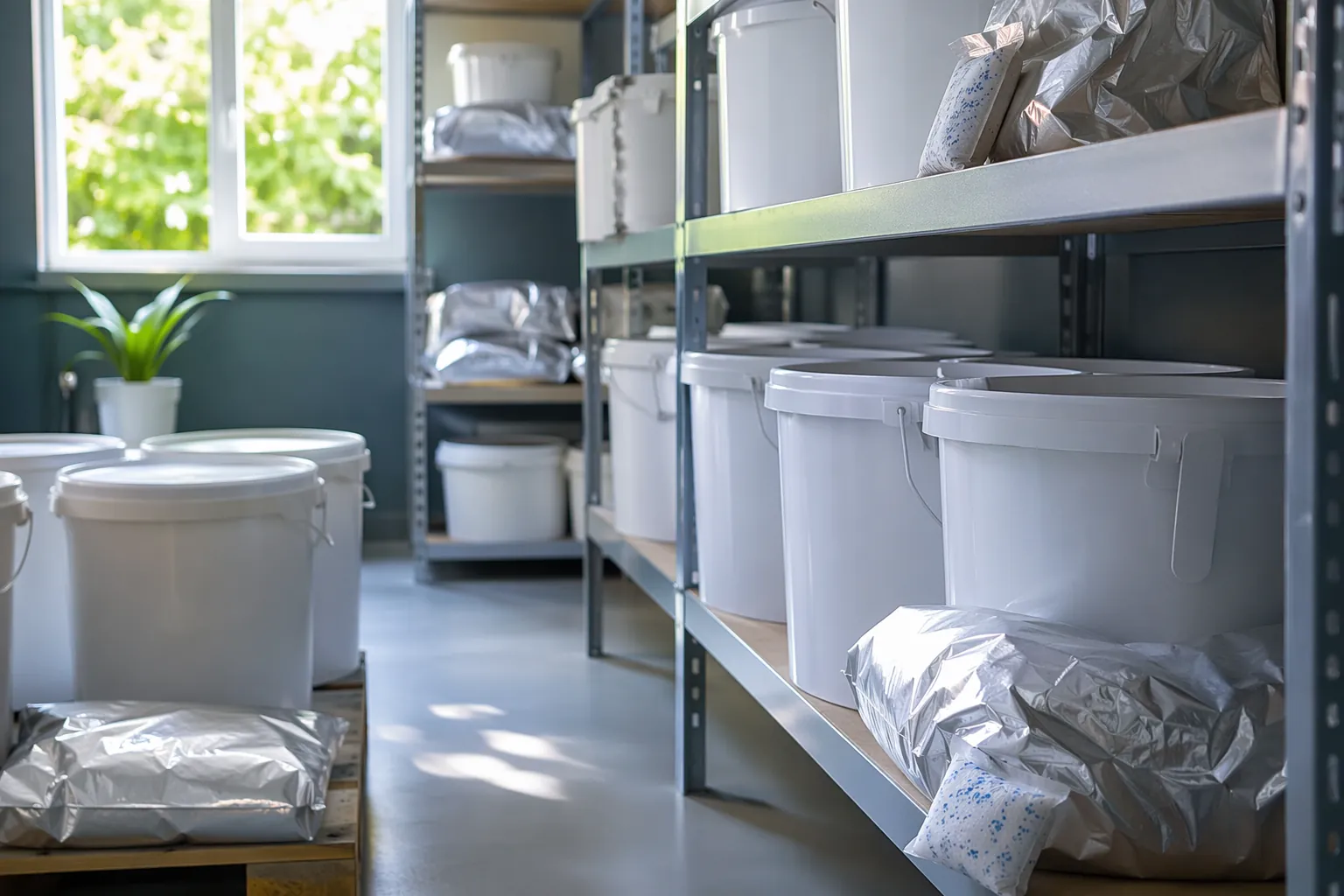
Store enzymes in their original closed packaging, under the recommended conditions, with controlled access and clear lot identification. The goal is to preserve activity while keeping traceability intact from receipt to use.
A practical facility workflow:
- Receive and inspect: Confirm product name, lot, packaging condition, COA availability, and SDS availability.
- Segregate by grade and use: Keep food-grade, feed-grade, and non-food materials clearly separated according to your internal quality system.
- Store by condition: Place each enzyme in the correct temperature and humidity-controlled area.
- Control opening: Open one container at a time where possible, and record first-opened dates.
- Use clean handling tools: Avoid wet scoops, shared utensils, or contact with process residues.
- Reseal immediately: Close bags, bottles, or liners as soon as weighing is complete.
- Rotate stock: Use lot control and first-expire or first-in procedures according to your internal policy.
Production teams should avoid “line-side storage” by default. Keeping enzymes next to steam lines, kettles, dryers, sunny windows, or washdown zones increases risk. If line-side staging is necessary, stage only the quantity required for the batch window.
How to store enzyme powder without losing activity
Store enzyme powder sealed, dry, and protected from humidity, condensation, and airborne contamination. Powder handling should focus on preventing moisture uptake and maintaining uniformity.
Moisture is the main powder risk. Many enzyme powders are formulated on carriers or granules that are designed for handling, but water pickup can still cause clumping, poor dosing flow, or activity decline. Even if a clumped powder can be broken apart, its activity may no longer be uniform.
Use dry equipment. Scoops, weighing boats, funnels, and transfer containers should be clean and dry before contact with enzyme powder. Do not return unused weighed material to the original container unless your quality procedure explicitly allows it.
Control dust and exposure. Powders should not be left open during batch setup. Open containers only long enough to weigh the required amount, then reseal. Where worker exposure controls are required, follow the SDS and local occupational procedures.
For formulators comparing enzyme types or formats, the enzyme catalogue can help narrow whether powder or liquid is more appropriate for the process and storage setup.
How should liquid enzymes be stored?
Liquid enzymes should be stored closed, clean, and at the temperature stated for that product. Liquids are often easier to dose into aqueous systems, but they can be more sensitive to contamination, dilution, and repeated temperature abuse.
Keep concentrates separate from working solutions. A supplied liquid enzyme concentrate is not the same as a diluted day tank solution. Once diluted, pH, water quality, microbial control, and process temperature can change stability significantly.
Avoid uncontrolled freeze-thaw. Some liquid enzymes may tolerate cold storage, while others can lose performance or show phase changes if frozen. Do not assume a liquid enzyme can be frozen unless the supplier documentation supports it.
Use clean transfer practices. Pumps, hoses, and dip tubes should be dedicated or cleaned according to site procedure. Cross-contact with acids, alkalis, oxidizers, detergents, or process residues can reduce enzyme activity before the enzyme ever reaches the substrate.
What affects enzyme shelf life after opening?
After opening, enzyme shelf life is affected by moisture exposure, air exchange, contamination risk, and the number of handling events. The original unopened shelf life should not be treated as automatically unchanged once a container is repeatedly opened.
First-opened date matters. Marking the date helps QA, production, and purchasing teams decide whether a retained lot needs review before use. This is especially useful for low-volume enzymes used in pilot trials, seasonal products, or intermittent campaigns.
Dose drift can hide storage loss. If operators gradually increase dose to maintain process performance, the root cause may be activity decline, substrate variation, process pH, temperature, or contact time. Do not assume the enzyme is “weak” without checking the full process and lot history.
Retesting may be needed. If a valuable lot has been stored longer than planned, exposed to an excursion, or opened many times, activity retesting is the cleanest way to decide whether to use, adjust, or discard it. The relevant assay must match the enzyme and activity unit used for the original specification.
How does enzyme stability storage differ by application?
Enzyme stability storage differs by application because process tolerance, dosing precision, and risk of underperformance vary. A small activity change may be acceptable in one process and unacceptable in another.
| Application area | Storage concern | Why it matters |
|---|---|---|
| Baking | Powder flow, blend uniformity, activity retention | Enzymes are often dosed at low inclusion levels |
| Brewing | Liquid handling, dilution stability, temperature exposure | Process timing and contact conditions are important |
| Dairy | Cold-chain compatibility, clean transfer | Enzymes may be used in controlled liquid systems |
| Fruit and vegetable processing | Seasonal storage, pectinase activity retention | Inventory may sit between campaigns |
| Starch and syrup | Bulk handling, heat exposure, lot consistency | Throughput depends on reliable conversion |
| Detergent and cleaning formulations | Compatibility with surfactants and builders | Blend stability depends on formulation matrix |
| Feed | Powder handling, storage humidity, pelleting exposure | Pre-process storage and downstream heat both matter |
Formulation compatibility is separate from warehouse storage. An enzyme can be stable in its supplied package but lose activity when blended into a high-moisture, high-pH, oxidizing, or reactive formulation. For blends, run stability checks in the actual matrix, not only in the original package.
What should procurement specify for enzyme storage and shelf life?
Procurement should specify enzyme name, grade, activity unit, format, storage condition, documentation, and expected usage rate. This prevents buying on price per kg while missing the true delivered activity and handling requirements.
Ask for the practical documents. Enzymes.bio supplies COA and SDS with enzyme orders, and a Food-Grade Declaration is available on explicit request. The COA supports lot-specific quality review, while the SDS supports safe handling and workplace procedures.
Align order size with consumption. Bulk ordering can lower unit cost, but overbuying can create shelf-life risk if usage is slow. A lower price per kg is not useful if retained activity declines before production can use the material.
Confirm shipping and receiving expectations. Orders ship within 1 to 3 business days via third-party logistics, with cheaper consolidated shipping available to selected countries. Receiving teams should move enzyme materials into the correct storage area promptly after delivery.
Storage checklist before you release an enzyme lot to production
Use this checklist when a lot has been in storage, opened, transferred, or returned from a production area. It gives QA and production a fast way to decide whether the material is ready for use or needs review.
- Product name and grade match the batch record
- Lot number matches the COA
- SDS is available to the handling team
- Packaging is intact, sealed, and dry
- Storage temperature history is acceptable
- No visible contamination, wetting, or abnormal clumping
- First-opened date is recorded, if applicable
- Activity unit and dosing basis are understood
- Material has not been mixed with another lot
- Any excursion has been reviewed before use
Do not blend questionable lots into good inventory. If a container has uncertain history, isolate it until QA or technical staff decide whether it can be used, retested, or rejected.
For new sourcing, review Enzymes.bio’s food-grade range and specify the enzyme, activity unit, format, and required documentation before requesting a quote. We can supply COA and SDS for bulk enzyme orders and help align storage expectations with the process conditions you plan to run.
Need this enzyme for your process?
Talk to our team about grade, activity, and volume, or browse the options.