
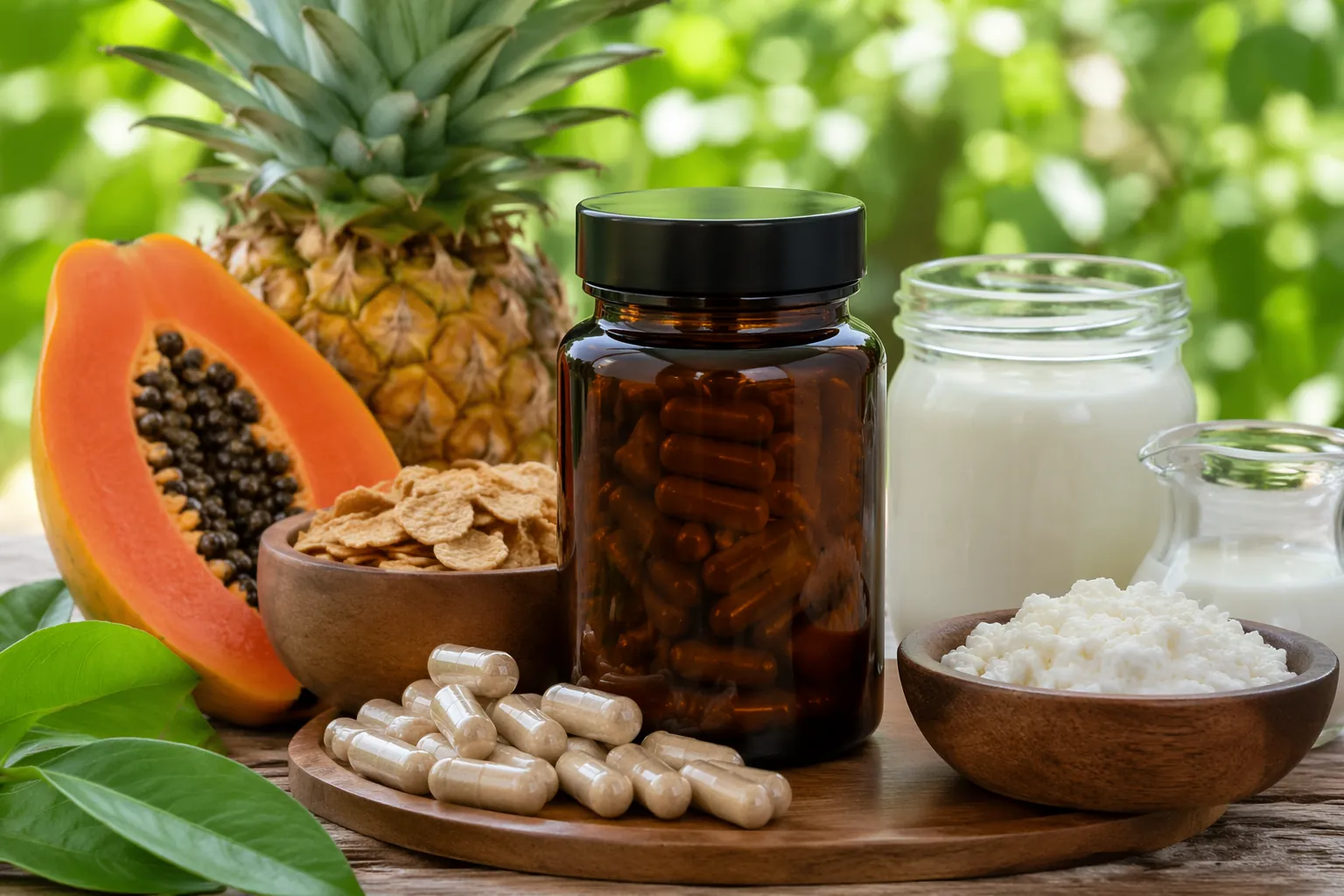
TL;DR
- Choose a digestive enzyme blend by substrate first: protein, starch, fat, lactose, fiber, or a defined matrix.
- Compare enzymes by declared activity units and assay method, not by price per kg or inclusion rate alone.
- A practical core often starts with protease, amylase, lipase, and lactase, then adds specialist enzymes only when the substrate case supports them.
- Screen pH, temperature, moisture, excipient compatibility, and finished-format stability before scaling.
- For sourcing, request COA and SDS, confirm grade, activity units, lead time, and whether the supplier can support bulk quantities.
How to choose a digestive enzyme blend is mainly a specification exercise: define the substrates your formulation is positioned around, assign the enzyme classes that act on those substrates, then qualify activity, grade, format, and documentation. Enzymes.bio supplies bulk nutraceutical enzymes for B2B formulators who need ingredient-level clarity, not consumer-facing claims.
What do digestive enzymes do in a blend?
Digestive enzymes in a blend catalyze hydrolysis of defined food substrates under specified conditions. In formulation work, that means proteases act on proteins, amylases act on starch, lipases act on triglycerides, lactase acts on lactose, and other enzymes are added only when their substrate is relevant.
Use the phrase carefully: “what do digestive enzymes do” is often searched by consumers, but a B2B specification should not be written as a health-benefit statement. The technically correct framing is substrate conversion, assayable activity, and performance under a chosen pH, temperature, and exposure time.
A digestive enzyme blend is therefore not one generic ingredient. It is a controlled mixture of enzyme activities, each with its own assay method, unit system, stability profile, and contribution to the finished formulation.
How to choose a digestive enzyme blend for target substrates?
Choose the blend by mapping each target substrate to the enzyme class that hydrolyzes it. This prevents overbuilding the formula with enzymes that look comprehensive on a label but add little technical value to the intended substrate profile.
| Target substrate | Typical enzyme class | Formulation question |
|---|---|---|
| Protein | Protease | Which pH range and activity assay match the product concept? |
| Starch | Amylase | Is the specification based on fungal, bacterial, or other amylase activity? |
| Fats and oils | Lipase | Is activity declared in a comparable lipase unit system? |
| Lactose | Lactase | Is lactose hydrolysis relevant to the matrix or claim architecture? |
| Plant fiber components | Cellulase, hemicellulase, xylanase | Is the formula designed around plant-cell-wall substrates? |
Start with the matrix: A dairy-positioned formula may justify lactase, while a grain-heavy matrix may justify amylase and selected carbohydrases. A broad “enzyme blend” without substrate logic is harder to test, harder to cost, and harder to defend in procurement review.
Avoid unit stacking: More ingredient names do not automatically mean a stronger formulation. A smaller blend with declared, relevant activities can be easier to qualify than a long list of low-activity components.
Which digestive enzyme ingredients belong in the core enzyme blend?
The core digestive enzyme ingredients are usually selected from protease, amylase, lipase, and lactase, then adjusted for the target substrate profile. Additional carbohydrases or specialty enzymes can be included when the product brief supports them.
| Ingredient type | Substrate role | Specification watchpoint |
|---|---|---|
| Protease | Protein hydrolysis | Activity unit, pH profile, source type, grade |
| Amylase | Starch hydrolysis | DU, SKB, or other declared method, depending on product |
| Lipase | Triglyceride hydrolysis | FIP or other declared activity, assay comparability |
| Lactase | Lactose hydrolysis | ALU or supplier-specific unit basis |
| Cellulase | Cellulose and fiber-associated substrates | U/g basis and assay condition clarity |
Protease: For protein-oriented concepts, protease is usually the major activity block. Specify whether the target profile needs acid, neutral, or alkaline performance, because “protease” alone is too broad for technical purchasing.
Amylase: Amylase selection depends on starch substrate, desired activity declaration, and stability in the finished format. Do not compare one amylase to another unless the assay and unit basis are understood.
Lipase: Lipase should be specified by its declared activity unit and expected compatibility with excipients. It is often used at much lower mass than bulk excipients, so weighing and blend uniformity matter.
Lactase: Lactase is relevant where lactose is part of the substrate logic. The buyer should confirm grade, unit basis, and whether the documentation supports the intended market.
Optional carbohydrases: Cellulase can be considered where plant-fiber substrates matter. If a defined cellulase activity is needed, review our cellulase powder listing and confirm whether that format fits your blend plan.
How should you specify an enzyme blend for protein digestion?
Specify an enzyme blend for protein digestion by defining the protease activity target, pH window, assay unit, and the role of any supporting enzymes. The phrase should be handled as a formulation requirement, not as a consumer performance claim.
Protease first: Protein hydrolysis is driven by protease activity, so the protease component should not be hidden inside a generic blend name. Ask for the declared activity unit, the assay condition, and whether the enzyme is acid, neutral, or alkaline in character.
Supporting enzymes: Amylase and lipase may be included in the same formula if the finished concept also addresses starch and fat substrates. They do not replace protease in a protein-focused blend.
Testing logic: Bench screening should compare prototype blends under the same pH, temperature, moisture, and exposure time. If the result is being compared across suppliers, normalize by activity unit wherever possible.
How do activity units and assays affect selection?
Activity units determine the real strength of the enzyme ingredient, so they are central to blend selection. Enzymes are specified by catalytic activity, not simply by weight, and unit systems differ by enzyme and assay.
Common unit labels include U/g, USP, DU, ALU, FIP, SKB, GDU, and other assay-specific systems. The same mass inclusion can produce very different activity if the source material, assay method, or concentration differs.
Procurement rule: Do not compare two enzyme blend quotes only by price per kg. Convert the quote to cost per declared activity, then check whether the activity unit is genuinely comparable.
Formulation rule: The declared activity on a COA is usually measured under a defined assay condition. Your finished product may have different pH, water activity, excipients, and storage exposure, so application testing is still required.
Blending rule: Low-dose, high-activity enzymes need careful premixing for uniformity. If the blend is going into capsules, sachets, tablets, or powders, confirm that the manufacturing process can distribute the enzyme activity consistently.
What pH, temperature, and format constraints should you screen?
Screen the conditions that the enzyme will actually experience: pH, temperature, water activity, excipients, compression, and storage. A blend that looks balanced on paper can underperform technically if one component is unstable in the finished format.
| Constraint | Why it matters | What to check |
|---|---|---|
| pH exposure | Enzymes have different activity profiles | Match enzyme class to intended pH window |
| Temperature | Heat can reduce activity | Review process and storage exposure |
| Moisture | Water activity affects stability and reaction potential | Control hygroscopic excipients and packaging |
| Compression | Tableting can stress enzymes | Compare powder blend versus compressed format |
| Excipients | Minerals, acids, flavors, and carriers may interact | Run compatibility screens |
| Shelf life | Activity can decline over time | Test retained activity in the finished product |
Powder blends: Powders are often easier to prototype because the enzyme is not exposed to compression. Moisture control still matters, especially for multi-enzyme systems.
Capsules: Capsules can simplify low-dose handling, but the fill blend must remain uniform. Particle size, flow, and segregation risk should be checked during pilot work.
Tablets: Tablets add compression stress and may require more stability work. If tableting is required, do not assume that activity in the raw material transfers unchanged into the finished tablet.
Digestive enzyme supplement guide for B2B formulators
A digestive enzyme supplement guide for formulators should focus on ingredient selection, activity declaration, grade, and documentation. It should not make consumer health claims or imply outcomes for the person using the finished product.
For a “protease amylase lipase supplement” style formula, treat the phrase as a shorthand for a multi-enzyme ingredient system. The technical specification still needs separate activity lines for protease, amylase, and lipase.
A clean specification might include:
- Product format, such as powder, capsule blend, or tablet premix.
- Target substrates, such as protein, starch, fat, lactose, or plant fiber.
- Enzyme classes and target activities.
- Activity unit and assay method for each component.
- Grade requirement, such as food grade or feed grade where applicable.
- Required documents, including COA and SDS.
- Packaging preference and bulk quantity target.
- Lead-time requirement and shipping country.
Regulatory discipline: Approval status, labeling, and permitted claims depend on the finished product, market, and local regulation. Confirm those requirements locally before finalizing the formula or commercial label.
How to choose a digestive enzyme blend supplier?
Choose a digestive enzyme blend supplier by checking whether they can document activity, grade, format, and lot-level quality. A supplier should be able to discuss enzyme units, not only ingredient names.
Ask these questions before requesting a quote:
- Which enzyme activities are included, and in what unit system?
- Is each enzyme supplied as food grade or another specified grade?
- Is the product a powder or liquid, and is it suitable for the intended manufacturing step?
- Will each order include a COA and SDS?
- Can a Food-Grade Declaration be provided on explicit request?
- What bulk MOQ applies to the selected item?
- What is the expected dispatch window?
- Which payment and shipping options are available?
Enzymes.bio supplies single enzymes and selected blends in bulk quantities. Orders ship within 1 to 3 business days via third-party logistics, and payment options include card, PayPal, and bank transfer. For category-level options, start with our enzyme sourcing hub.
Build and qualify the blend: a practical workflow
A practical workflow starts with the product brief, then moves through enzyme selection, bench testing, stability screening, documentation review, and procurement comparison. This keeps R&D and sourcing aligned.
Step 1, define the substrate map: List the substrates that justify enzyme inclusion. Remove enzymes that do not map to a real substrate or positioning requirement.
Step 2, assign activity targets: Set desired activity levels by enzyme class. Use the relevant unit for each enzyme rather than forcing all components into one generic measure.
Step 3, build prototypes: Prepare a small number of blends that vary one factor at a time. Keep carriers, excipients, pH, and moisture consistent so results can be interpreted.
Step 4, check compatibility: Screen the blend against flavors, minerals, acids, sweeteners, colors, anti-caking agents, and processing conditions. Multi-enzyme blends can fail because of the matrix, not the enzyme alone.
Step 5, compare suppliers: Evaluate quotes by activity, grade, document availability, lead time, and shipping practicality. A lower kg price may be less attractive if the activity basis or documentation is weak.
What documentation should procurement request?
Procurement should request a COA and SDS for the selected enzyme or blend, then verify that the activity units and grade match the purchase specification. Documentation is part of the buying decision, not an afterthought.
COA: The Certificate of Analysis should support the lot-level specification, including the declared activity where applicable. Make sure the activity unit on the COA matches the unit used in your formula and quote comparison.
SDS: The Safety Data Sheet supports handling, storage, and internal EHS review. Enzyme powders should be handled according to the supplier’s safety instructions and your site procedures.
Food-Grade Declaration: A Food-Grade Declaration can be requested explicitly where needed. Do not assume additional certificates unless they are provided for the specific item and lot.
Quote packet: For a complete sourcing review, include target enzyme activities, grade, product format, destination country, required quantity, and any document needs. This lets the supplier respond with relevant options rather than a generic catalog answer.
If you are specifying a digestive enzyme blend for a commercial formula, send the substrate map, target activities, format, and documentation needs to Enzymes.bio. Start from the health enzymes hub, or request guidance on the enzyme classes that fit your formulation brief.
Need this enzyme for your process?
Talk to our team about grade, activity, and volume, or browse the options.