
TL;DR
- Pectinase for fruit maceration breaks down pectin in fruit mash, helping processors release juice, reduce mash viscosity, and improve pressability.
- Fruit maceration is not the same as clarification: maceration acts before or during pressing, while clarification acts after juice extraction.
- **A good maceration enzyme choice depends on fruit type, pH, temperature, contact time, and whether you need pectinase alone or a blend with cellulase or hemicellulase.
- Dose by activity, not by weight: compare enzyme offers by declared activity units, application fit, COA, SDS, and grade.
- For sourcing: Enzymes.bio supplies food-grade fruit-processing enzyme options in bulk quantities, with documentation for technical review.
How does pectinase for fruit maceration work?
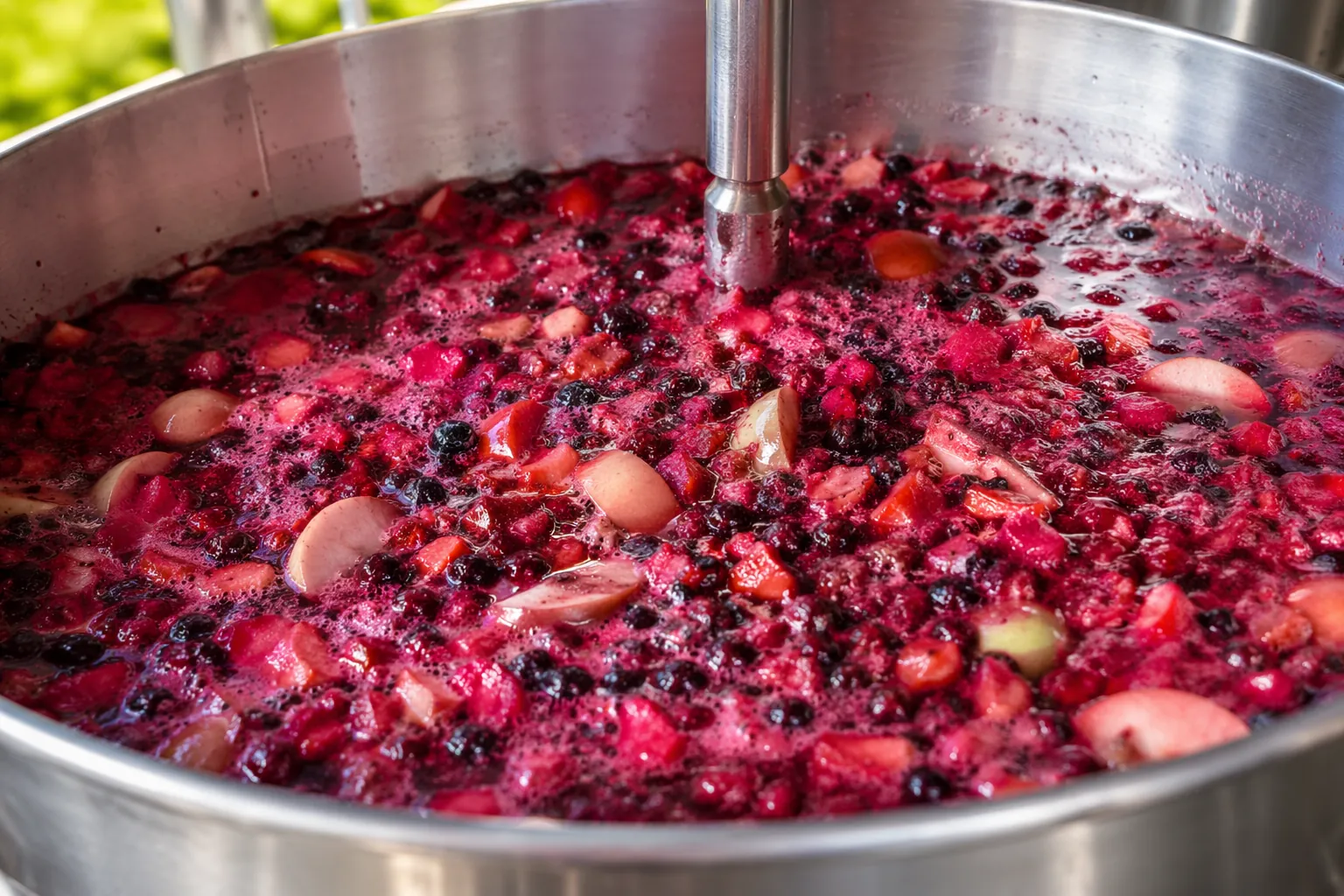
Pectinase for fruit maceration works by hydrolysing pectin in the middle lamella and cell wall network of fruit tissue. That weakens the gel-like structure that holds plant cells together, so the mash releases liquid more readily during holding, pumping, draining, and pressing.
In fruit processing, pectin is one of the main reasons a mash becomes viscous, sticky, or slow to dejuice. When pectinase reduces pectin chain length, the mash usually becomes easier to handle and the free-run fraction can increase before mechanical pressing. This is the maceration angle: tissue breakdown before separation.
Pectinase maceration is most relevant where the process goal is extraction, not only visual clarity. Apples, berries, stone fruit, tropical fruit, and grapes can all behave differently because their pectin content, cell-wall architecture, solids load, and endogenous enzyme activity are not the same.
For buyers, the practical question is not “is pectinase active?” It is whether the enzyme system is active under your mash pH, temperature, contact time, and solids conditions. Start with the application, then check specification and documentation.
What is fruit maceration in processing?
Fruit maceration is the controlled breakdown of fruit tissue before separation, pressing, pulping, or further extraction. It can be mechanical, enzymatic, thermal, or a combination, but in industrial fruit processing the enzyme step is often used to make the mash easier to dejuice or pulp.
Maceration is different from simple crushing. Crushing reduces particle size mechanically, while enzymatic maceration changes the pectin and cell-wall matrix that traps liquid and soluble solids. A crusher can open the fruit, but pectinase can reduce the binding and viscosity that still limit juice release.
Typical process objectives include:
| Objective | What the enzyme is expected to change | Process impact to check |
|---|---|---|
| Higher extractability | Pectin network in mash | Free-run yield, press yield |
| Lower viscosity | Soluble and suspended pectin | Pumpability, heat transfer |
| Better pressing | Cell adhesion and water binding | Press cycle time, cake dryness |
| More uniform puree | Cell-wall cohesion | Particle texture, screenability |
| Easier downstream clarification | Pectin load entering juice | Settling, filtration, turbidity |
Do not evaluate fruit maceration only by final juice clarity. A maceration step can improve extraction even if a separate clarification enzyme or fining operation is still needed later.
When should you use pectinase for fruit maceration?
Use pectinase for fruit maceration when pectin-driven viscosity, poor pressability, or low extract release is limiting your process. It is especially relevant when mechanical crushing alone leaves a wet press cake, slow drainage, or a mash that is difficult to pump.
Good candidates include processes where the fruit mash has a high suspended-solids load and enough residence time for enzyme contact. If the mash is heated immediately to an enzyme-inactivating temperature, or if the hold time is extremely short, the enzyme may not have time to deliver the intended effect.
Use pectinase before pressing when:
- The mash is viscous or gel-like after milling.
- Press cycles are long or inconsistent.
- Free-run juice is lower than expected.
- The press cake remains wet after normal pressure.
- Downstream clarification is burdened by high pectin load.
Use caution when:
- Texture retention is the primary quality target.
- Excessive tissue breakdown would create too much fine pulp.
- Your process uses very high temperature before enzyme contact.
- The fruit matrix has low pectin as the main bottleneck, but high cellulose or hemicellulose contribution.
For a broader sourcing view, review our fruit-processing enzymes hub before selecting a single enzyme or blend.
Is pectinase the right maceration enzyme?
Pectinase is the primary maceration enzyme when pectin is the main structural and viscosity barrier. In many fruit mashes, that makes it the first enzyme class to screen before adding cellulase, hemicellulase, or other supporting activities.
A maceration enzyme is not one fixed product type. It is an enzyme or enzyme system selected to open the fruit matrix for a defined extraction target. Pectinase, cellulase, hemicellulase, and sometimes amylase or protease-adjacent systems may be considered depending on the raw material and process, but pectinase is usually central for pectin-rich fruits.
| Enzyme class | Main substrate | Why it may be used in maceration |
|---|---|---|
| Pectinase | Pectin | Reduces pectin viscosity and cell adhesion |
| Cellulase | Cellulose | Supports cell-wall breakdown and extraction |
| Hemicellulase | Hemicellulose | Helps open non-pectin wall polysaccharides |
| Amylase | Starch | Useful only where starch contributes to viscosity |
| Protease | Protein | More relevant in select matrices, not a default fruit maceration choice |
Selection should be substrate-led. If your process issue is gel-like pectin viscosity, pectinase is logical. If the issue is fibre-bound extract, a blend including cellulase may be more appropriate.
Pectinase maceration process variables to control
Pectinase maceration performance depends mainly on pH, temperature, contact time, particle size, solids load, and mixing. These variables determine whether the enzyme can reach its substrate and remain active long enough to change the mash.
pH and temperature: Match the enzyme to the natural pH and thermal profile of the fruit mash. Do not assume one pectinase grade fits all fruit processes. Ask for the recommended working window and confirm it against your plant conditions.
Contact time: Maceration needs residence time. Short contact can still help if mixing and temperature are favourable, but the enzyme must be in contact with hydrated substrate. Lab trials should mirror real hold time as closely as possible.
Particle size: Finer milling increases exposed surface area but can also increase suspended solids and fines. Coarse milling may limit enzyme access. The right particle size is a balance between enzyme accessibility and downstream separation.
Solids load and mixing: High-solids mash can create local concentration gradients. Add the enzyme where dispersion is reliable, and avoid dead zones in tanks or lines.
Inactivation: If the process includes a pasteurisation or heat step, decide whether enzyme activity should continue until that point or be stopped earlier. Document where the enzyme enters and where activity is effectively terminated.
How does cellulase extraction fit with pectinase?
Cellulase extraction supports pectinase when cellulose-containing cell-wall material is also limiting release. It is not a replacement for pectinase in pectin-rich fruit, but it can be useful in blends where cell-wall fibre contributes to retained juice, pulp texture, or extract loss.
Cellulase acts on cellulose rather than pectin. In fruit maceration, that means it may help open plant cell-wall structure after pectinase has reduced the pectin network. The effect is matrix-specific, so it should be tested rather than assumed.
Consider cellulase when:
- Press cake remains fibrous and wet after pectinase screening.
- Puree yield is limited by cell-wall structure rather than only viscosity.
- Fruit skin, peel, or fibrous tissue is a major part of the feedstock.
- You want a broader extraction enzyme system for difficult raw material.
If your development work indicates a cellulase contribution, compare declared activity and grade for a suitable cellulase enzyme rather than adding enzyme by weight alone.
How is pectinase used in wine processing?
In wine processing, pectinase is used on grapes, must, or juice to support extraction, pressing, settling, and filtration depending on the process point. The same chemistry applies, pectin breakdown changes viscosity and cell-wall release, but the operating target differs by red, white, rosé, or fruit wine process.
The pectinase wine use case often sits between maceration and clarification. During grape maceration, pectinase may support juice release and skin tissue breakdown. After pressing, a pectinase step may help reduce pectin-related haze risk and improve settling or filterability.
Key wine-process questions include:
| Question | Why it matters |
|---|---|
| Is the enzyme added to crushed grapes, must, or pressed juice? | Defines whether the goal is maceration, extraction, or clarification |
| What is the contact time before pressing or racking? | Determines realistic enzyme action time |
| Is the temperature suitable for the enzyme grade? | Low-temperature operations may need compatible activity |
| Is the process pH within the enzyme’s working range? | Wine and fruit musts are typically acidic |
| Will fining, filtration, or heat follow? | Determines how much pectin reduction is needed before downstream steps |
For regulated beverage applications, confirm the enzyme grade, local approval status, and documentation requirements before use. Enzymes.bio can provide COA and SDS for supplied materials, and a Food-Grade Declaration is available on explicit request.
What is the difference between fruit maceration and fruit juice clarification?
Fruit maceration breaks down fruit tissue before or during extraction, while fruit juice clarification removes or reduces haze-forming material after juice has been released. Both may use pectinase, but the process objective and performance checks are different.
In fruit juice clarification, the key issue is often soluble pectin or colloidal material that slows settling, centrifugation, or filtration. The juice has already been extracted, so the enzyme is acting in a lower-solids liquid phase compared with mash maceration.
In fruit maceration, the enzyme works in a dense mash. Access, mixing, and cell-wall breakdown are bigger concerns. A successful maceration step may make clarification easier later, but it does not replace clarification process design.
| Process step | Typical substrate phase | Main target | Practical KPI |
|---|---|---|---|
| Maceration | Crushed fruit mash | Tissue breakdown, extraction | Press yield, viscosity, press time |
| Clarification | Extracted juice | Pectin haze, colloids | Turbidity, settling, filtration rate |
| Polishing | Clarified juice | Fine haze or residual solids | Filter load, final clarity |
If you need both extraction and clarification, avoid selecting an enzyme only from a clarification claim. Ask whether the product is intended for mash treatment, juice treatment, or both.
How should you specify and trial a fruit maceration enzyme?
Specify a fruit maceration enzyme by activity, grade, process conditions, and documentation rather than by price per kilogram. Enzymes are functional ingredients, so weight alone is a poor comparison unless activity, assay method, and use conditions are aligned.
A practical trial plan should include a control mash and at least one enzyme-treated mash under plant-relevant conditions. Keep milling, fruit batch, temperature, time, and mixing constant. Measure outcomes that match the commercial bottleneck, not just visual appearance.
Recommended specification checklist:
- Enzyme class: pectinase alone or pectinase-led blend.
- Intended process point: mash, must, puree, or juice.
- Grade: food grade or feed grade as appropriate.
- Activity declaration: unit system and assay basis.
- Physical form: powder or liquid, matched to dosing equipment.
- Process window: pH, temperature, residence time.
- Documentation: COA and SDS.
- Logistics: bulk MOQ, packaging format, and lead time.
Trial outputs to record:
| Output | Why it matters |
|---|---|
| Mash viscosity | Indicates pectin breakdown and pumpability |
| Free-run juice | Shows release before pressing |
| Press yield | Direct extraction metric |
| Press cake moisture | Indicates retained liquid |
| Turbidity after extraction | Helps plan clarification |
| Filtration behaviour | Shows downstream load |
Enzymes.bio supplies bulk food and feed enzyme options as powders and liquids, with orders typically shipping within 1 to 3 business days via third-party logistics. For process matching, use the maceration enzyme category route rather than relying on a generic pectinase name alone.
Buying checklist for pectinase for fruit maceration
A good pectinase sourcing decision connects enzyme activity to your fruit matrix and operating conditions. The supplier should be able to support activity-unit comparison, grade confirmation, and documentation without substituting vague claims for specifications.
Use this checklist before requesting a sample or quote:
- Define the fruit and process point: apple mash, berry pulp, grape must, tropical fruit puree, or another matrix.
- State the bottleneck: viscosity, low press yield, slow drainage, wet cake, or clarification load.
- Share process conditions: pH, temperature, contact time, solids level, and heating steps.
- Ask for the activity basis: compare products by declared enzyme activity and assay, not by kg price.
- Confirm documentation: COA and SDS should be available for technical and purchasing review.
- Check grade requirements: food grade or feed grade, with local regulatory review by the buyer.
- Run a controlled trial: use the same fruit batch and process settings for treated and untreated controls.
For formulation or plant trials, start from our fruit enzyme options and specify whether your priority is maceration, extraction, clarification, or a combined process. Enzymes.bio can help route the request toward pectinase-led systems and cellulase support where the substrate justifies it.
Need this enzyme for your process?
Talk to our team about grade, activity, and volume, or browse the options.