
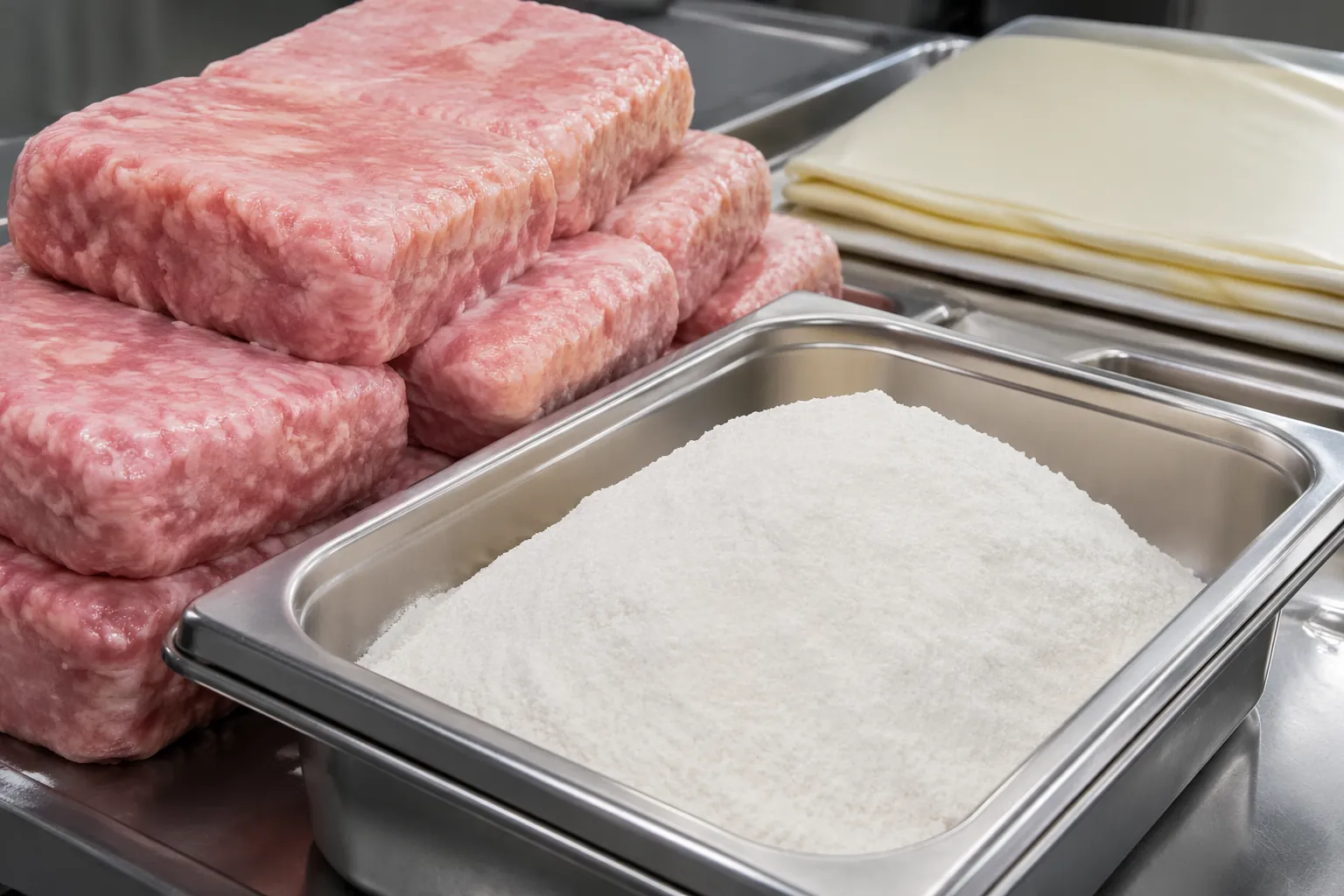
TL;DR
- Transglutaminase in meat and baking is used to cross-link proteins, improving binding in meat systems and modifying dough or protein networks in bakery formulations.
- “Meat glue enzyme” is the informal name for TG enzyme in meat, but buyers should specify it by activity, grade, carrier system, and application fit.
- Dose by activity, not weight. Compare COA activity units and run bench trials against your substrate, salt level, pH, temperature, and hold time.
- In baking, TG is formulation-dependent. Flour protein level, added gluten, dairy/egg proteins, hydration, mixing, and proofing all affect response.
- For procurement, request COA and SDS and confirm food-grade suitability, regulatory status in your market, pack size, MOQ, and shipping lead time.
Transglutaminase in meat and baking is best understood as a protein-network tool: it links suitable protein substrates in a controlled process, rather than acting as a general-purpose texture additive. For B2B buyers, the practical question is not only “does TG work?” but “which grade, activity, carrier, dose, and process window match my meat or bakery system?”
Enzymes.bio supplies TG enzyme for industrial and food-processing buyers through the TG enzyme category, with COA and SDS available for specification review.
What is the transglutaminase enzyme doing?
Transglutaminase enzyme catalyzes cross-linking reactions between protein-bound glutamine residues and primary amines, commonly lysine residues, forming covalent links within or between proteins. In processing language, it helps build or reinforce a protein network where suitable substrate proteins are present.
The enzyme is classified as protein-glutamine gamma-glutamyltransferase, EC 2.3.2.13, in enzyme nomenclature references such as EC 2.3.2.13. That reaction chemistry is why TG can change binding, firmness, elasticity, sliceability, and water distribution in protein-rich systems.
Key selection point: TG does not create structure from nothing. It needs accessible proteins, enough contact between surfaces or particles, and a process that gives the enzyme time to act before heat, low moisture, or other conditions reduce activity.
How is transglutaminase in meat and baking different by application?
Transglutaminase in meat and baking targets the same basic protein-cross-linking chemistry, but the process constraints are different. Meat applications usually focus on binding muscle pieces, comminuted meat, fish, or formed products, while baking applications focus on dough strength, protein network modification, and interactions with gluten or added proteins.
In meat, TG often works in relatively dense, protein-rich systems with direct particle-to-particle contact. The process may include tumbling, mixing, forming, holding, chilling, then cooking or freezing.
In baking, TG is introduced into a hydrated dough or batter system. Its effect depends strongly on protein type, gluten development, mixing energy, rest time, fermentation, proofing, and bake step.
| Factor | Meat systems | Baking systems |
|---|---|---|
| Main substrate | Muscle, myofibrillar proteins, fish proteins, added protein | Gluten, wheat proteins, dairy proteins, egg proteins, added protein |
| Main goal | Binding, restructuring, slice integrity, bite | Dough strength, elasticity, volume support, crumb structure |
| Process dependency | Mixing/tumbling, contact, hold time, temperature | Hydration, mixing, proofing, bake profile |
| Common risk | Uneven distribution, over-firm texture, visible seams | Excess dough tightening, reduced extensibility, formula-specific variability |
| Buying focus | Food grade, activity, carrier, meat-process compatibility | Activity, carrier, flour/protein system compatibility |
What are the main transglutaminase uses?
The main transglutaminase uses are protein binding, texture modification, restructuring, and protein-network reinforcement in food-processing systems. It is most often evaluated where a processor needs repeatable structure from meat, fish, dairy-protein, egg-protein, plant-protein, or cereal-protein substrates.
Common industrial uses include:
- Meat and poultry: binding pieces, improving formed-product integrity, supporting sliceability.
- Fish and seafood: restructuring fish portions, forming seafood analogues, improving cohesion in minced fish systems.
- Bakery: modifying gluten and added protein networks in doughs and batters.
- Dairy-protein systems: cross-linking casein or whey protein systems where formulation and regulations allow.
- Plant-protein systems: improving cohesion in protein matrices used in formed foods.
- Prepared foods: improving bite and shape retention in protein-rich processed products.
For purchasing teams, “transglutaminase uses” should always be translated into a process-specific trial brief. A TG enzyme that performs well in one protein matrix may require reformulation in another because substrate accessibility, salt, moisture, pH, and process timing all change enzyme response.
Why is it called transglutaminase meat glue?
Transglutaminase meat glue is an informal name for TG enzyme used to bind meat surfaces or particles, but the technical specification should still be “transglutaminase enzyme” with defined activity and grade. The nickname comes from the visible application: separate pieces can be bonded into a cohesive form when protein surfaces are in close contact and the enzyme has enough time to act.
For industrial buyers, the phrase “meat glue enzyme” is useful for search and internal shorthand, but it is not a specification. A procurement document should identify:
- enzyme name: transglutaminase enzyme or TG enzyme
- intended use: meat binding, restructuring, formed meat, fish, poultry, or another defined application
- grade: food grade where required
- activity unit and assay basis from the COA
- carrier or blend format, if relevant
- physical form, such as powder or liquid if available
- required documentation, normally COA and SDS
- local regulatory and labeling review requirements
Process reality: TG binding is not instant adhesive behavior. It depends on hydration, dispersion, protein contact, temperature, dwell time, and downstream heat treatment. Treat it as a controlled enzymatic processing step, not a surface glue.
How to use transglutaminase in meat systems?
To use transglutaminase in meat systems, disperse it uniformly, create close contact between protein surfaces, hold under validated process conditions, then apply the normal downstream cook, chill, freeze, or packaging step. The exact procedure should be confirmed by bench and pilot trials because meat type, particle size, salt, moisture, fat level, and process temperature all affect performance.
A typical development workflow looks like this:
- Define the product target. Binding strength, sliceability, bite, yield, seam visibility, and process tolerance should be measured separately.
- Select the TG format. Choose a food-grade transglutaminase enzyme suitable for meat processing and confirm documentation.
- Prepare a controlled control batch. Keep the base formula and process unchanged for comparison.
- Disperse evenly. Add TG in a way that avoids localized concentration, clumping, or dry pockets.
- Create surface contact. Use mixing, tumbling, forming, or pressing as appropriate for the product.
- Hold under controlled conditions. Validate time and temperature with your substrate and plant process.
- Stop or reduce activity through the normal process. Heat treatment or other downstream conditions may reduce enzyme activity, depending on the process.
- Evaluate texture and integrity. Measure not only binding, but bite, juiciness, appearance, and handling losses.
Dose control: do not copy a percentage from another product unless the activity unit, carrier, substrate, and process are the same. Dose should be calculated from the supplier’s activity specification and verified through trials.
If you need a sourcing starting point, review the TG enzyme category and request the COA/SDS for the grade under evaluation.
How does TG enzyme meat performance depend on process conditions?
TG enzyme meat performance depends on substrate accessibility, distribution, moisture, salt level, pH, temperature, and contact time. The enzyme must reach reactive protein sites, and the meat surfaces or particles must remain close enough for cross-links to improve structure.
Substrate: myofibrillar proteins are typically more relevant than fat or connective tissue for TG-driven binding. Leaner, protein-accessible systems often show clearer response than high-fat or poorly mixed systems.
Moisture and salt: hydration supports dispersion and protein mobility, while salt can change protein extraction and surface functionality. The effect is formula-specific, so evaluate TG under the same salt and water conditions planned for production.
Temperature and hold time: enzyme activity is condition-dependent. A colder process may require longer hold, while elevated temperatures can accelerate reaction until the enzyme is reduced or inactivated by heat or unsuitable conditions.
Distribution: uneven addition is one of the most common causes of inconsistent binding. For powders, pre-blending with a dry ingredient or using a controlled addition sequence may improve uniformity, but the carrier and formula must be compatible.
Mechanical action: tumbling, mixing, pressing, or forming helps create the contact needed for binding. Excessive shear, however, can damage structure or alter texture, so optimize mechanically and enzymatically together.
How is transglutaminase in baking used?
Transglutaminase in baking is used to modify protein networks in doughs, batters, and protein-enriched bakery systems. The practical effect may include changes in dough strength, elasticity, handling tolerance, crumb structure, or shape retention, depending on the flour and added proteins.
Bakery applications are more variable than many meat applications because flour protein quality changes by source, season, and specification. TG can interact with wheat gluten, added vital wheat gluten, dairy proteins, egg proteins, soy proteins, or other protein ingredients in the formula.
Use TG in baking as a formulation variable, not a universal improver. A small change in hydration, mixing energy, proofing time, or added protein can shift the result from useful strengthening to excessive tightening.
Common bakery evaluation points include:
- dough development time
- extensibility and elasticity balance
- machinability and sheeting tolerance
- gas retention during proofing
- loaf or product volume
- crumb resilience
- bite and chew
- storage texture over the intended shelf life
Because the enzyme acts on proteins rather than starch directly, TG is usually evaluated alongside the protein system. If your main challenge is starch conversion, sweetness, dextrin control, or anti-staling through starch modification, a different enzyme class may be the better starting point.
What transglutaminase applications should formulators screen first?
Formulators should screen transglutaminase applications where protein cross-linking is likely to solve a defined structure problem. The best candidates are systems with enough accessible protein, enough process time, and a measurable target such as binding strength, dough tolerance, or slice integrity.
| Application | Good trial objective | Watch-out |
|---|---|---|
| Restructured meat | Improve binding between meat pieces | Visible seams if contact is poor |
| Formed poultry | Improve handling and sliceability | Over-firm bite if overused |
| Minced fish | Improve cohesion | Texture can become rubbery |
| Protein-enriched bread | Improve dough strength | Reduced extensibility |
| Gluten-modified dough | Adjust elasticity | Formula-specific response |
| Plant-protein formed foods | Improve matrix cohesion | Protein source variability |
| Prepared protein foods | Improve shape retention | Distribution and labeling review |
Screening design: evaluate at least a control, a low trial dose, and a higher trial dose based on the supplier’s activity unit. Keep process variables fixed during the first screen, then optimize temperature, hold, and mixing separately.
Avoid evaluating TG only by finished appearance. Include instrumental or semi-quantitative tests where practical: shear, compression, slice loss, handling breakage, dough rheology, or controlled sensory panels focused on texture attributes.
How should buyers specify a meat glue enzyme?
Buyers should specify a meat glue enzyme by activity, grade, application, physical form, documentation, and regulatory review requirements. “Meat glue” alone is not enough for purchasing or QA because it does not define enzyme potency or suitability for a process.
Use this checklist in RFQs and supplier conversations:
| Specification item | What to ask |
|---|---|
| Enzyme name | Transglutaminase enzyme, TG enzyme |
| Application | Meat, fish, bakery, plant protein, or other |
| Grade | Food grade or other required grade |
| Activity | Activity unit and assay method on COA |
| Physical form | Powder or liquid, as available |
| Carrier system | Confirm compatibility with your formula |
| Documentation | COA and SDS, Food-Grade Declaration on explicit request |
| Order basis | Bulk or wholesale MOQ |
| Lead time | Standard dispatch timing and shipping option |
| Compliance | Confirm local approval and labeling obligations |
Activity comparison: do not compare TG offers only by price per kilogram. A lower-cost powder with lower activity, different carrier, or poorer dispersion may be more expensive in use than a higher-activity material. Compare cost per functional activity in your tested formula.
Enzymes.bio supplies bulk enzyme ingredients with COA and SDS, and wholesale orders typically ship within 1 to 3 business days via third-party logistics. For the current TG options, start from the transglutaminase category rather than assuming a one-size-fits-all grade.
Dosing and trial design for transglutaminase in meat and baking
Dosing for transglutaminase in meat and baking should be developed from the supplier’s activity unit and your substrate response, not from a generic weight percentage. The same weight addition can produce different results if enzyme activity, carrier content, protein quality, moisture, and process time differ.
A practical development plan:
- Request the COA and SDS. Confirm activity, grade, batch details, handling, and safety information.
- Define the substrate. Record protein source, protein level, moisture, salt, fat, pH, and other functional ingredients.
- Choose trial levels by activity. Convert supplier activity into a consistent internal dosing basis.
- Keep one variable at a time. First test enzyme dose, then hold time, temperature, mixing, and hydration.
- Run a no-enzyme control. Without a control, you cannot separate TG effect from process variation.
- Measure the right endpoint. Meat may require bind strength or slice loss, while baking may require rheology, volume, and crumb structure.
- Check scale-up behavior. Mixing efficiency, heat transfer, and dwell time often change between bench, pilot, and production.
Do not overdose to compensate for process uncertainty. Too much cross-linking can produce excessive firmness, poor extensibility, rubbery bite, or inconsistent texture. Optimize distribution and contact before increasing enzyme level.
Procurement notes: grade, documentation, and compliance
For commercial use, procurement should align TG enzyme specifications with QA, regulatory, and production requirements before scale-up. Confirm the grade and documentation before building a formulation around a specific enzyme lot.
Enzymes.bio provides COA and SDS for enzyme orders, with a Food-Grade Declaration available on explicit request. Do not assume additional certifications unless they are specifically confirmed for the product and batch.
Regulatory review: approval status, allowed use, labeling, and processing-aid treatment can vary by market and finished product category. Your regulatory team should verify local requirements before commercialization.
Ordering reality: wholesale and bulk MOQs apply. Orders ship within 1 to 3 business days, and cheaper consolidated shipping may be available to selected countries. Payment options include card, PayPal, and bank transfer.
Common mistakes to avoid
Specifying by nickname only: “transglutaminase meat glue” or “meat glue enzyme” is not a complete specification. Always include activity, grade, application, and documentation.
Comparing by kg price: enzymes are purchased for activity and function. Compare cost-in-use after confirming the activity unit and dose response.
Skipping dispersion work: poor distribution can cause weak zones, over-firm zones, or variable texture. Addition method matters.
Ignoring substrate differences: meat cut, fish species, flour protein, added gluten, and plant-protein source all change the result.
Using TG to solve the wrong problem: TG modifies protein networks. If the process issue is starch conversion, fiber breakdown, peroxide removal, or lactose hydrolysis, another enzyme class may be more appropriate.
Scaling too quickly: bench success does not guarantee production performance. Validate mixing, dwell time, temperature profile, and finished-product texture at pilot scale.
For transglutaminase in meat and baking projects, start with the application, substrate, and target texture, then select the TG grade and dose by activity. Review available options in the TG enzyme hub and request COA/SDS details for the material you want to trial.
Need this enzyme for your process?
Talk to our team about grade, activity, and volume, or browse the options.