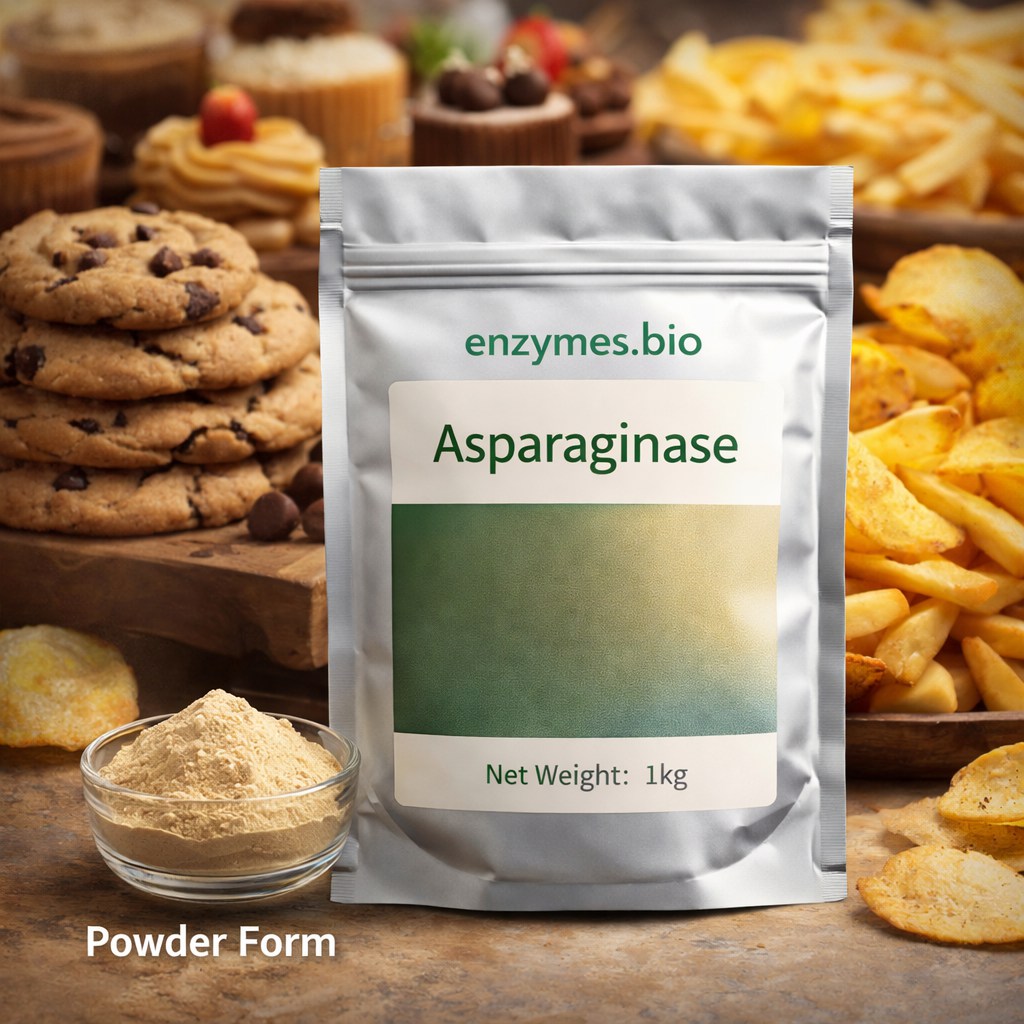
Food Grade Asparaginase
Product Name: Asparaginase
Grade: Food Grade
Enzyme Activity: 3000 U/g
Food Grade Asparaginase is an enzyme preparation developed for high-temperature processing of starch-rich foods. It is suitable for baking, frying, roasting, and other heat-intensive food manufacturing processes where control of asparagine levels is required.
During prolonged high-temperature processing of starch-rich raw materials, such as frying or baking, sugars can react with asparagine through the Maillard reaction. While this reaction contributes to desirable color
and flavor, it may also lead to the formation of undesired reaction products. Reducing the asparagine content before high-heat treatment is therefore an important step in many modern food formulations.
Mechanism of Action: Asparaginase converts asparagine into aspartic acid. Aspartic acid does not participate in the same reaction pathway during high-temperature processing. By reducing the precursor asparagine
content at the source, this enzyme helps lower formation risk while maintaining the product’s appearance, flavor, and overall sensory quality.
In starch-rich food raw materials, during prolonged high-temperature processing such as frying or baking, sugars react with asparagine through the Maillard reaction. This reaction gives starch-based foods their characteristic color and flavor, but at the same time it can also produce a potential harmful substance — acrylamide. Acrylamide is neurotoxic, transmissible, and potentially carcinogenic, so controlling the level of acrylamide in food is extremely important.
Asparaginase can reduce the content of asparagine in raw materials. Specifically, asparaginase converts the precursor substance that forms acrylamide — asparagine — into aspartic acid. Aspartic acid does not generate acrylamide during subsequent Maillard reactions. Therefore, the use of asparaginase can control the formation of acrylamide in foods at the source. In addition, while reducing acrylamide levels, asparaginase does not affect the product’s appearance, taste, or flavor.
Key Benefits
- Designed for starch-rich food systems under high-temperature processing
- Helps reduce asparagine content in food formulations
- Supports stable color, flavor, and texture
- Broad compatibility with common food processing conditions
- Food grade quality suitable for industrial applications
Recommended Dosage
20–500 g per metric ton of flour
Actual dosage may be adjusted according to formulation, process conditions, and target reduction performance.
Application Areas
Suitable for high-temperature production and processing of starch-rich foods, including but not limited to:
- Cookies, biscuits, and crackers
- Cakes and other baked goods
- Fried snacks such as chips and fries
- Other starch-based processed foods
- Related food applications involving high-heat steps
Product Information
- Ingredients: Asparaginase; carrier: wheat starch
- Working Conditions:
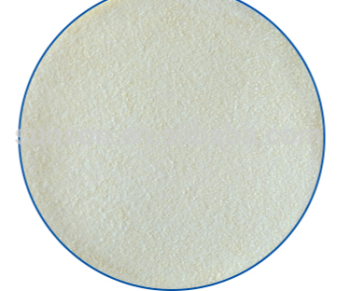
Temperature range 10°C–60°C; pH range 4.0–11.0 - Appearance: Light yellow to yellow-brown powder
- Shelf Life: 12 months
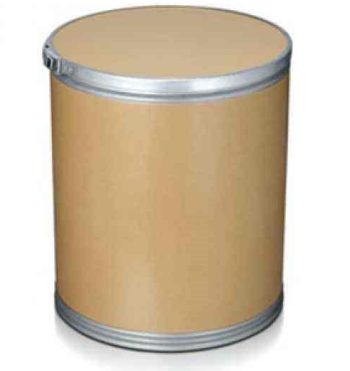
- Packaging: Supplied in 0.1 kg/bag, sealed food-grade aluminum foil bag. Please note that the product image is for illustration purposes. Actual packaging may differ.
Quality Specifications
| Item | Specification |
|---|---|
| Loss on Drying | ≤ 8.0% |
| Fineness (40-mesh pass rate) | ≥ 99% |
| Lead (Pb) | ≤ 5.0 mg/kg |
| Total Arsenic (as As) | ≤ 3.0 mg/kg |
| Total Plate Count | ≤ 50,000 CFU/g |
| Coliforms | ≤ 30 CFU/g |
| Escherichia coli | Not detected |
| Salmonella (25 g) | Not detected |
Usage Notes
- Add during mixing or an early processing stage to ensure sufficient reaction time before heating.
- Dosage optimization may be required depending on formulation and processing parameters.
- Store sealed in a cool, dry place and protect from moisture.